DOI: https://doi.org/10.31849/reila.16017 Vol. 5, No. 3, December 2023, pp. 313-335
313
Unlocking Melawi Malay Medicine Mantras: Sound Patterns and Ecological Symbolism of Oral Literature
Ikhza Mahendra Putra 1, Agus Syahrani 2 & Dedy Ari Asfar 1
1 Universitas Tanjungpura, Pontianak, Indonesia
2 Badan Riset dan Inovasi Nasional, Jakarta Pusat, Indonesia [email protected]
ARTICLE HISTORY
Received : 2023-09-05 Revised : 2023-12-20 Accepted : 2023-12-24
KEYWORDS
Ecocriticism
Ecological Symbolism Mantra
Oral Literature Sound Patterns Stylistics
ABSTRACT
The Melawi Malay community has a rich tradition of medicine using oral literature in the form of mantras, passed down through generations. These medicine mantras incorporate elements of beautiful sound and reflect the ecological, customary, and cultural values of the Malay people. This research aims to unveil the sound patterns and describe the symbolism of the triadic ecological elements, namely nature, nurture, and culture. To achieve this, purposive sampling was employed to select key informants, with Su Usnah, a traditional healer from Bina Karya, Melawi, being a crucial source. Through interviews and field notes, six relevant data sets were extracted from a pool of 15 available medicine mantras for analysis. Using a qualitative descriptive approach, this research utilized stylistic protocols to categorize the data according to existing sound patterns and employed ecocriticism guidelines to reveal the presence of ecological elements within the Melawi Malay medicine mantras. The primary findings of this research disclose the existence of four sound patterns in these mantras: assonance, alliteration, consonance, and rhyme.
The ecocritical perspective reveals that each mantra contains ecological elements, including nature, such as flora and natural elements; nurture, reflecting the relationship between nature and society, and human connections; and culture, as manifested in customary practices. This study deepens our understanding of the sound patterns and ecological elements present in these mantras, with the hope that further research, through exploration of mantras in the Melawi Regency, can contribute to the continuous conservation and promotion of oral literature. Enriching the global understanding of mantras from linguistic, literary, and ecological perspectives is vital in practising traditional medicine in Melawi and other regions in West Kalimantan.
1. Introduction
Oral literature has been a longstanding tradition, transmitted orally across successive generations, and has evolved into a valuable cultural legacy from Indonesia's history (Berkovich-Ohana et al., 2015;
(Lembah, 2017; Verlinda, 2020). The presence of oral literature encompasses the traditional life and culture of the Malay people, as Malay culture plays a significant role as one of the main foundations of Indonesian culture (Ramli, 2016). Traditional medicine practices in Malay still rely on oral traditions passed down through generations (Hidayatullah, 2020). One of the preserved traditions is the use of mantras (Susilastri, 2020). As part of ancient poetry, the Malay community believes that mantras are always associated with the supernatural world and possess magical
powers (Asfar, 2016b; Sutikno et al., 2020). Therefore, mantras are often used to restore balance by invoking the assistance of supernatural forces (Fadillah, 2021;
Hidayat, 2022).
The fundamental belief in the importance of balance and the role of magical assistance forms the basic principles that drive the community to preserve mantras in traditional healing practices (Heriyanto et al., 2020). The vision of harmony as a means to restore balance with the environment is realized through their faith in the spirits that serve as guiding forces within their traditional environment (Suharyadi, 2014;
Sutikno et al., 2019). Consequently, mantras are essential in determining the success or failure of a particular treatment (Czaja, 2020). Thus, it is suitable for the Malay people in Melawi to use mantra-based
314 healing. According to Yolanda (2022) in practice,
Medicine mantras, in the context of pronunciation and content, hold intriguing elements worthy of in-depth analysis, much like Mardiyanti et al. (2023) and Mu’jizah (2020)statement that Malay culture and literature contain fascinating elements that should be explored.
The Malay Melawi Traditional Medicine Mantras, which are the subject of this study, are recited by traditional healers with finesse, as these mantras play a crucial role in expressing tone, rhythm, atmosphere, emotions, and inner turmoil (Juni, 2019). This aesthetic beauty is inseparable from the patterns that create these beautiful sounds because mantra poets in the past often had a strong influence on their listeners, adding to the aesthetic appeal of the mantras themselves (Suwardi, 2018; Herawati, 2021) On the other hand, medicine mantras deliberately create cosmic symbols through each line of lyrics, each with meaning, purpose, and entities referring to objects and living creatures in the universe (Badrih, 2018; Bahardur, 2017). This happens naturally because humans have experiences related to the environment or a series of anthropological boundaries, such as the relationship between humans and the physical, natural, and ecological environment (Ernst Bloch; Kaswadi, 2015). These ecological symbols in Malay society are associated with the constant involvement of natural elements and their connection to existential issues, such as the existence of God, humans, and the universe, as seen in ecocriticism (Suwardi, 2018; James & Morel, 2018;
Rosa et al., 2017). Therefore, to comprehensively understand the beauty of sound and ecological aspects, careful exploration of dominant sound patterns and ecological symbolism that significantly influences the lyrics and content of Malay Melawi medicine mantras is required.
The richness of Malay medicine mantras in West Kalimantan, characterized by diverse oral literature and culture (Yuniar et al., 2021), underscores the need for an in-depth study of stylistics and ecocriticism in Malay medicine mantras in Melawi Regency. In the context of Malay Melawi culture, the importance of sound patterns and ecological symbolism cannot be denied, as they represent the unique Malay customs in the region. Firstly, despite significant research on Malay medicine mantras, most have focused on the structural and semiotic aspects (Kurmalasari & Candra, 2022). More comprehensive research is needed to analyze aspects beyond structure and semiotics in medicine mantras. Previous researchers have primarily focused on semiotic theory, exploring signifiers and the signified, as well as symbolic theory, which analyzes objects representing a symbol. Additionally, research on "mantra pakasih" and "papikat" has examined natural and stylistic elements, but it has been limited to the representation of animals, plants, and linguistic styles. Therefore, further complex and
comprehensive research focusing on dominant aspects is needed (Norvia, 2019).
Subsequent research on mantras, especially in the Kalimantan Barat region, can be seen in Sulissusiawan et al. (2022) who uncovered pronoun replacements for human names in "sinding badan" mantras. Asfar (2016a) examined Malay mantras from Ketapang through the lens of hot and cold knowledge divisions based on the Islamic strategies in Malay society.
Existing research has mainly focused on Malay- majority areas, where the mantras are representative of Malay culture and traditions. However, it is essential to note that Kalimantan Barat, especially in the hinterlands, boasts rich cultural diversity, including Malay oral literature and customs in Melawi Regency.
Even though its inhabitants may not be predominantly Malay, Malay oral literature in the region showcases a unique cultural heritage. Documenting this research is crucial to preserve the authenticity of this literature before it becomes intertwined with other ethnicities in the area and risks fading over time.
Overall, despite significant progress in the study of stylistics and natural elements (Norvia, 2019), research into Malay medicine mantras in the Kalimantan Barat region has some gaps that need to be addressed. This includes the need for more comprehensive ecocritical theory research and a dominant focus on stylistics to go beyond previous research limited to Malay-majority areas. This study's methodology combines interviews and recordings in a qualitative descriptive research design using stylistic and ecocritical theory protocols, offering a valuable model for investigating emerging sound patterns and ecological elements within the triad of natural elements (nature), social and cultural influences (nurture), and cultural context (culture). By exploring the complex relationship between linguistic elements and literary criticism, this research opens the path to a more comprehensive understanding of traditional medicine practices using mantras (Harimansyah, 2022; Suharti et al., 2023). Moreover, it is expected that this research will have global implications for a deeper insight into how the Malay community in Melawi Regency intuitively perceives the beauty of sound patterns in creating mantras and the presence of ecology as an integral part of their traditional medicine practices.
2. Literature Review
As a form of free expression, Mantras hold a unique influence on traditional Malay medical practices in Melawi. Abidin (2013) assert that mantras, unlike other poetic forms, are not bound by line count, rhyme, or stanza division rules, allowing for creative freedom in composition. Like pantun and syair, mantras carry deep symbolic meanings in Malay traditional healing practices. Kadarsih et al. (2018) and Fariani (2019) explain that mantras serve as healing tools and spiritual and cultural anchors for the Melawi Malay community.
Medical practices in Melawi view mantras as key
315 elements bridging the community's connection with
their cultural roots. In the community's belief system.
The disease is depicted as a result of the local community's belief in mystical disturbances (tekenak) or interactions with spirits. “Kempunan or kapuhunan”, which is the act of someone refusing food and drink when about to leave, is considered a sign of misfortune or illness. Traditional healers conduct ritualistic healing by reciting specific mantras to restore this spiritual equilibrium (Yock, 2022).
Mantras are not just ancestral legacies; they safeguard strong cultural and spiritual values for the Melawi Malay community (Fariani, 2019).
2.1 Stylistic Analysis in Malay Medicinal Mantras
Stylistic analysis of Malay medicinal mantras in Melawi sheds light on how language elements are crucial in conveying spiritual purposes. In examining the beauty of language in Malay medicinal mantras, stylistic analysis plays a significant role. Stylistics, as the study of the aesthetic use of language, enables an understanding of how various linguistic aspects, such as sound, lexicon, structure, and rhetorical devices, are employed to create aesthetic effects (Nurgiyantoro, 2014; Pradopo, 2021). Aminuddin (1995) describes the distinctive use of sound in literary works, including mantras, such as assonance, alliteration, consonance, and rhyme.
Assonance, the repetition of vowel sounds within a line, creates auditory beauty even with differing consonants (Maulinda, 2019). Alliteration, the combination of consonants at the beginning of lines, forms rhythm and strengthens poetic sound (Keraf, 2010). Consonance, the combination of consonants at the end of lines, is evident in sound patterns within the same line, adding linguistic richness (Hastianah, 2011).
As a crucial aspect of poetry and mantras, rhyme has various types reflecting sound beauty. In the context of Melawi Malay medicinal mantras, open rhyme with the pattern /abab/ creates harmony between the last syllables of the first and third lines and the second and fourth lines.
Additionally, an initial rhyme with a similar sound at the beginning of each line provides compactness, reinforcing the meaning of the mantra (Harun, 2012).
Rhyme in poetry can be categorized into three types based on word placement in lines. First is broken rhyme (abcd), without a regular line pattern. Second, chain rhyme (aaaa), with similar end sounds consecutively on each line. Third, couplet rhyme (aabb), where the end sounds of the first and second lines and the third and fourth lines are the same. This rhyme type offers variation and uniqueness in poetic structure.
This research employs a stylistic study to reveal sound patterns in Melawi Malay mantras. Similar to pantun or syair, mantras are dominated by rhyme and
stanza. The presented theories are relevant for exploring sound presentation in Melawi Malay medicinal mantras, providing new insights into the role of language elements in conveying spiritual purposes.
2.2 Ecological Symbolism in Mantras through Ecocritical Studies
Ecological symbolism in Melawi Malay mantras can be uncovered through ecocritical studies. Ecology in the literary context reflects the complex interaction between humans, culture, and the natural environment (Arisa et al., 2021). Ecocritical studies, as an approach to unveil wisdom in oral literature, consider local wisdom an integral part of ecosystem management (Azis, 2021; Endraswara, 2016). The nature-nurture- culture paradigm in ecocriticism emphasizes the close relationship between humans, oral literature, and the environment.
The verses of Melawi Malay mantras mirror symbols of the cosmos with a trichotomies ecological pattern involving nature, nurture, and culture. The Melawi community's environmental beliefs give rise to mantras reflecting the symbolism of nature.
Ecocriticism is crucial in unravelling the complexity of ecological symbols in mantras, revealing how human life, oral literature, and the environment are interconnected (Setiawan et al., 2018). The trichotomies model of nature-nurture-culture in literary ecocriticism illustrates three main factors: Nature encompasses representations of the relationship between humans and nature in literature, including the natural environment, animals, plants, and other natural elements. Nurture involves the impact of human activities on the environment, such as activities affecting natural elements. Culture includes influencing the community's views and responses to the environment.
By employing ecocritical theory in this research, we can explore three key ecocritical concepts, especially to interpret the verses of mantras that reflect reality and meet the criteria of ecocritical literature
(
Khomisah, 2020; Larasati & Manut, 2022). Exploring issues can be revealed through the Harsono (2008) ecocritical framework, dissecting Melawi Malay mantras comprehensively by considering emerging aspects. The representation of complexity uses theories that align with the research needs of Melawi Malay medicinal mantras.3. Method
This research was conducted with the characteristics of qualitative research. Qualitative research aims to explore qualitative phenomena, social issues, and humanity in a natural context through the meanings provided by humans (Asfar, 2017; Creswell, 2014; Kusumastuti, 2019; Syahrani et al., 2021). Based on this perspective, this qualitative research aims to describe the sound patterns and ecological elements
316 that shape the lyrics and content of Melawi Malay
medicine mantras from linguistic and literary perspectives. The data collection process involved purposive sampling, with one key informant named Su Usnah, a 69-year-old traditional healer who has inherited knowledge from their parents and plays a significant role in traditional medicine in Melawi. The selection of informants was done with strict criteria based on informant selection criteria (Heryana &
Unggul, 2018). The informant is a native of Bina Karya Village, Tanah Pinoh District, Melawi Regency, and a
native speaker of Melawi Malay with a deep understanding of the language and medical mantras in the region, residing at the research site, physically and mentally healthy, and capable of effective communication in Melawi Malay. Furthermore, the selection of informants was conducted carefully due to their expertise and ability to provide valuable insights into the issues discussed in this research.
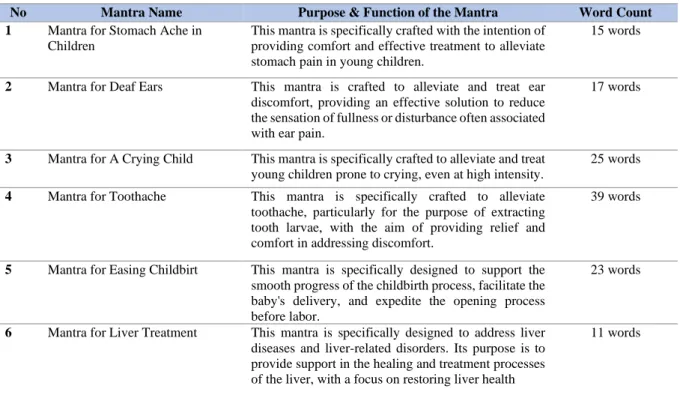
The mantras to be analyzed are six selected mantras, outlined below.
Table 3.1 Six sets of mantra data to be analyzed
No Mantra Name Purpose & Function of the Mantra Word Count
1 Mantra for Stomach Ache in Children
This mantra is specifically crafted with the intention of providing comfort and effective treatment to alleviate stomach pain in young children.
15 words
2 Mantra for Deaf Ears This mantra is crafted to alleviate and treat ear discomfort, providing an effective solution to reduce the sensation of fullness or disturbance often associated with ear pain.
17 words
3 Mantra for A Crying Child This mantra is specifically crafted to alleviate and treat young children prone to crying, even at high intensity.
25 words 4 Mantra for Toothache This mantra is specifically crafted to alleviate
toothache, particularly for the purpose of extracting tooth larvae, with the aim of providing relief and comfort in addressing discomfort.
39 words
5 Mantra for Easing Childbirt This mantra is specifically designed to support the smooth progress of the childbirth process, facilitate the baby's delivery, and expedite the opening process before labor.
23 words
6 Mantra for Liver Treatment This mantra is specifically designed to address liver diseases and liver-related disorders. Its purpose is to provide support in the healing and treatment processes of the liver, with a focus on restoring liver health
11 words
The use of data and the disclosure of informant identities in this research have been considered solid ethical principles. The informants involved in this research provided informed consent wholeheartedly, indicating their understanding of the risks, benefits, purposes, and procedures involved in the research. The informants gave their consent voluntarily and without any pressure. These ethical principles are essential to protect individual rights, privacy, and autonomy. Moreover, we have also considered the sensitivity of cultural information that may arise in this research. Therefore, throughout the process of data collection and usage, we have upheld ethical considerations, safeguarded confidentiality, and prioritized research integrity.
3.1 Data Collection
The primary data collection method in this research involved direct interviews and field notes. During the interviews, the informants were asked questions focused on the lyrics of Melawi Malay medicine mantras to uncover the linguistic and ecological
dimensions within the words, phrases, and sentences of the mantras. The informants were requested to share their knowledge and perspectives on how the words in the mantra lyrics depict the beauty and symbolism of ecology that reflects nature, understanding, and culture. To ensure the accuracy and reliability of the collected data, field notes were made by the researcher.
Field notes were done to prevent data inaccuracies in the research. Furthermore, a careful data triangulation process was conducted by comparing and cross- referencing the explanations from the informants with the field notes held by the researcher. Through this verification process, the data can accurately represent mantras that contain sound patterns and ecological element.
3.2 Data Analysis
The method used for analyzing qualitative research data is descriptive (Sulissusiawan et al., 2022). In the data analysis stage of this research, a descriptive qualitative design is used. This approach aims to facilitate a comprehensive exploration of the two
317 protocols that will be applied in the research, namely,
stylistics and literary ecocriticism reflected in the lyrics of Melawi Malay medicine mantras. The analysis is focused on two main aspects. First, the data is categorized based on sound pattern units such as assonance, alliteration, consonance, and rhyme present in the lyrics of Melawi Malay medicine mantras.
Second, the data is categorized based on the triad units of nature, nurture, and culture. In this case, the protocols of Stylistics (Aminuddin, 1995; Harun, 2012) and literary ecocriticism (Harsono, 2008) are used as a systematic framework for organizing the data.
Although these protocols are considered old theories, their advantage lies in supporting comprehensive exploration.
These protocols allow for in-depth analysis of linguistic elements, particularly sound patterns in the mantra lyrics, and relevant ecological elements in the research. The use of these protocols will help uncover the complexity of Melawi Malay medicine mantra lyrics comprehensively. In addition to these two protocols, content analysis is used to identify patterns in the data. This process involves examining the extent to which specific sound patterns and ecological terms are consistently present in the mantra lyrics. Content analysis is crucial in organizing and dissecting complex data to explain the relationship between linguistics and literature in medical mantras.
Throughout the data analysis stage, a rigorous validation process is applied. Key informants who actively contributed to the data were involved in the interpretation stage to ensure the accuracy and authenticity of the findings. This iterative approach enhances confidence in the research results.
4. Result
We present the results of our research that explore sound patterns and ecological symbolism in the lyrics of Malay Melawi medicine mantras. In our in-depth analysis, we employed two approaches. Firstly, we categorized the data based on sound patterns, including assonance, alliteration, consonance, and rhyme.
Secondly, we classified the data based on the symbolism of ecological elements related to nature, nurture, and culture. Our research revealed that sound patterns and ecological symbolism play a dominant role in Malay Melawi medicine mantras. These mantras, as a form of oral literature expressed orally, are used to convey messages, depict, and often have a strong emotional impact on their listeners. Emphasis is placed on our role as creators of relevant questions, active listeners, and data interpreters when interacting with informants during interviews. We utilize reflexivity as a critical element to help us reflect on the potential impact of bias and subjectivity in the research.
While awareness of potential bias is crucial to maintaining objectivity and data validity in research, it must be acknowledged that the influence of personal
views or bias may still occur in data interpretation.
Therefore, it is crucial for us to consistently and systematically strive to reduce the impact of potential bias and subjectivity by applying rigorous research methods and transparently documenting the decision- making process. With careful efforts, we can achieve a deeper and more accurate understanding of the research subject and make research findings more relevant and valuable to the academic community.
The sound patterns we discovered include patterns formed by consonant and vowel influences, as well as the end lines that shape the lyrics of these mantras. In Melawi Regency, the Malay community is closely tied to the environment, representing an intense human- environment interaction. The ecological elements we found include Nature, first in the categories of flora and fauna, encompassing stems, teakwood, tobacco, black taro, white nibung, shoots, and lice. Second, elements related to natural geography, such as soil, mountains, and bays. Third, some words refer to natural objects or living beings, including light, diamonds, and placentas.
Nurture is reflected through the influence of upbringing and education in understanding individual origins and values, which are highly apparent.
The influence of the divine also emerges with the statement, "The Most Merciful; tell to the Prophet".
Nurture, stories about parents' names reflect parts of education, individual and social identity. The connection with Nature is also emphasized in expressions like " Planting in the sigala guni; climb"
and "Kemiang dead of shoots" which indicate interaction with Nature. All these elements depict the influence of upbringing, religion, education, and the environment in shaping individuals. Culture the use of
"Name of God says Bismillah" reflects solid religious values in this culture. There are references to leadership and education in the phrase "Tobacco kings and teachers." Culture, ethical values and honesty are emphasized by saying, " Words are true; Lying words also happen". Stories about the origins and history of places play a significant role in preserving cultural identity. The use of the words "Allah" and
"Muhammad" reveals dimensions of belief and spirituality in Malay society. These are examples of how the culture and values of the Malay community are reflected in their everyday language expressions and stories.
Our findings underscore the rich ecological significance of Malay Melawi medicine mantras, referring to the triadic ecological triad. In this analysis, we reveal that mantras, as oral literature, can yield complex findings when viewed from linguistic and literary perspectives. The use of beautiful sounds in these mantras plays a crucial role in more profound understanding.
Within the framework of environmental literary criticism or ecocriticism, we assert that these mantra lyrics reflect ecological elements due to the
318 community's close connection to Nature, the formation
process, and the representation of customs and beliefs deeply embedded in it. In this context, we present our research findings.
4.1 Sound Patterns Melawi Malay Medicine Mantra
Table 4.1.1 Mantra for Stomach Ache in Children Translation (English) Original Lyrics
(Malay Language)
Phonetic Representation
Drift stems from upstream Perch on display on teak wood Tobacco kings and teachers Dead (aras) die
Anyut batang dari ulu Ingap pampang kayu jati Temakau raja guru Aras mati aras mati
aɲut bataŋ daɣi ulu iŋap pampaŋ kayu jati təmakaw ɣaja guɣu aɣas mati aɣas mati
This mantra conveys that the initial step in healing a stomach ache is identifying its root cause. Once the root cause is identified, the treatment of the stomach ache can be carried out more accurately, akin to laying a solid foundation, like teakwood. Tobacco is considered the most potent element that mediates the healing of ailments because it plays a significant role in countering the negative spiritual or energetic influences in diseases. This mantra emphasizes the importance of considering the spiritual and energetic aspects of healing a stomach ache to address or eliminate negative entities believed to be responsible for the ailment.
After understanding the semantic meaning of this mantra, we will address the first research question regarding the existence of sound patterns that form the beauty of sound in the Mantra for Stomach Ache in Children. These patterns include:
(a) Assonance involves the repetition of vowel sounds within the same sequence, as found in this mantra.
Repetition of vowel sounds among adjacent words occurs repeatedly. Its function is to create a melodic sound effect and reinforce the meaning within the mantra.
For instance:
(1) /iŋap pampaŋ kayu jati/
The repetition of the vowel /a/ in adjacent words dominates the entire sequence, creating a sense of long and deep sounds to convey solid and intense movements against sadness and despair.
(2) /aɲut bataŋ daɣi ulu/
Repeating the vowel /u/ in the words /aɲut/ and /ulu/ creates a musical effect in the mantra. The repeated /u/ sound provides a soothing, curved, and calming tone, which can evoke a peaceful and tranquil atmosphere.
(b) Alliteration involves the repetition of consonant sounds among words with the same arrangement, even if the vowel sounds are different. It creates a unique rhythm and reinforces the sound in this mantra.
For example:
/aɣas mati aɣas mati/
The repetition of the sound /m/ in the word /mati/.
This alliteration creates a distinctive rhythm and reinforces the sound in this mantra, a technique often used in poetry to create a specific rhythmic effect.
(c) Consonance, another literary technique, involves the repetition of consonant sounds between words in the mantra, similar to alliteration, but with the repeated sound occurring not at the beginning but in the middle or at the end of a word.
For example:
/aɣas mati aɣas mati/
/aɲut bataŋ daɣi ulu/
/iŋap pampaŋ kayu jati/
In the mantra Aras, consonance can be seen in the repeated consonant /s/ in the word /aɣas/ and the combination of two consonants in one sound, /ŋ/, in the words /bataŋ/, /iŋap/, and /pampaŋ/. The use of consonance creates a gentle, calm, and curving sound effect, providing the mantra with a deep and harmonious ambience.
(d) Rhyme, on the other hand, is the similarity of sounds (phonemes) at the end of each line, creating harmony in the poem. Good relationships are typically formed through vertical rhyme at the end of each line.
For instance:
/aɲut bataŋ daɣi ul(u)/
/iŋap pampaŋ kayu jat(i)/
/təmakaw ɣaja guɣ(u)/
/aɣas mati aɣas mat(i)/
This mantra uses an open rhyme pattern, marked by the alternating and repeated vowel sounds /u/- /i/-/u/-/i/ at the end of each sequence, forming an a-b-a-b rhyme pattern. Open rhyme creates a distinctive rhythmic effect and invites the listener
319 to engage in the flow of sound. It is a vital element
in bringing beauty and depth to this mantra.
In conclusion, through the analysis of sound patterns in the Mantra for Stomach Ache in Children, it can be inferred that the poet carefully uses these elements to create a profound ambience and impression in their work. The repetition of sounds, both vowel and
consonant and the rhyme patterns all work together to create a rhythmic and harmonious effect that reinforces the message of beauty in this mantra. In a scholarly interpretation, the regular repetition in open rhyme as a sound beauty can enhance the meditative and mnemonic effects in the healing process, adding value to the understanding of the use of this mantra in the context of healing.
Table 4.1.2 Mantra for Deaf Ears Translation (English) Original Lyrics
(Malay Language)
Phonetic Representation
Bismillah says Allah
The Most Merciful, said the Prophet Light radiates from bismika to the ear The word is true
The word lie happens too
Bismillah kata Allah Ya Rahim kata Nabi Bismika temus telinga Kata benar tejadi Kata bulak pun jadi
bismillah kata alɭah ya ɣahim kata nabi bismika təmus təliŋa kata bənaɣ təjadi kata bulaʔ pun jadi
The Mantra for Deaf Ears, which begins with
"Bismillah" (in the name of Allah) and contains words like "Allah," "Rahim," "Nabi," and "Bismika," holds a solid semantic meaning in the context of healing deaf ears. This mantra conveys hope and prayers to God, represented by the word "Allah," for healing and compassion, symbolized by "Rahim" (The Most Merciful) and "Nabi." The repetition of the word
"Bismika" (in Your name) emphasizes that this healing effort occurs with the permission and blessings of Allah. The words "terjadi" (occurs) and "terdengar"
(heard) reflect the expected miraculous healing process, whereby lost sounds, both right and wrong, will be heard again.
In the Mantra for Deaf Ears, there are elements of sound patterns, such as assonance, alliteration, and rhyme, as follows.
(a) Assonance, the repetition of specific vowel sounds like /a/, /i/, and /u/ in each word sequence, creates a profound impression. The overall use of these sound patterns in the mantra creates an atmosphere that promotes tranquility, hope, and a sense of spiritual strength in the context of deaf ears.
(1) /bismillah kata alɭah/
The repetition of the vowel sound /a/ in all word sequences in this verse creates a deep impression of the spirituality of faith.
(2) /ya ɣahim kata nabi/
/bismika təmus təliŋa/
The repetition of the vowel sound /i/ in the second sequence in the words /ɣahim/ and /nabi/. In the third sequence, the words /bismika/ and /təliŋa/.
The repetition of the /i/ sound in this mantra indicates a sound full of majesty and hope.
(3) /kata bulaʔ pun jadi/
There is also a repetition of the /u/ sound in the fifth sequence in the words /bulaʔ pun/. The
repetition of /u/ in this mantra gives a sense of firmness in ending the sentence.
(b) Alliteration, this mantra uses the repetition of the consonant /t/.
/kata bənaɣ təjadi/
/word/ and /təjadi/. The repetition of /t/ in this line provides expressive strength and a distinctive nuance in this mantra. Consonant repetition creates a peaceful and harmonious atmosphere, promoting a sense of calm and tranquility in the context of deaf ears. The alliteration of the /t/
sound creates a permeating and soothing rhythm in the mantra. The repetition of the /t/ consonant also imparts a strong sense of uniformity, helping to highlight the meaning of the words and creating a profound meditative effect in spiritual practice or prayer.
(c) Consonance, the mantra contains the repetition of consonants /t/, /l/, and /m/.
(1) /bismika təmus təliŋa/
In the second line, in the words /təmus/ and /təliŋa/. Consistent consonance /t/ can strengthen the sentence or phrase. The repetition of the /t/
sound provides clarity and strength to the evocative sound. There is also the /m/ consonance in /bismika/ and /təmus/. Regarding unity, the /l/
consonant has a soft sound nature, and the /m/
consonant has a resonant sound nature. When both of these consonants are repeated, they can create a soothing, embracing, and relaxing effect in writing or poetry. The soft /l/ sound and resonant /m/
sound create a peaceful and harmonious atmosphere.
(2) /bismillah kata alɭah/
Second is the /l/ consonance in the words /bismillah/ and /alɭah/.
320 (d) Rhyme pattern. Many words have different ending
characters, affecting the rhyme pattern. In this mantra, there is a broken rhyme pattern, which is in the form of a-b-c-b-b. There are words like /alɭah/, /nabi/, /təliŋa/, /təjadi/, and /jadi/ that have different and unaligned ending characters, resulting in a broken rhyme pattern. However, according to the informant, the use of this broken pattern in the mantra was intentionally chosen to achieve a stronger expressive effect and enhance the memorization ability of the mantra. The broken rhyme in this mantra has the potential to give uniqueness to the arrangement of mantra words and create a distinctive rhythm.
Analyzing the elements of sound patterns in the Mantra for Deaf Ears provides deep insights into how this mantra functions in the context of healing deaf ears. Repeating vowel and consonant sounds creates a rich sound, conveys a spiritual nuance, and strengthens the mantra's message. The broken rhyme pattern, although unconventional, was deliberately chosen to enhance the ability to remember the mantra. These findings relate sound elements to research questions about their impact on the spiritual experience and understanding of healing deaf ears
.
Table 4.1.3 Mantra for A Crying Child Translation (English) Original Lyrics
(Malay Language)
Phonetic Representation
You're diving deep bay You see your eyes are rotten You're peeking at your bad eyes I know where you came from Your father has many fleas, Mother you're a thief
Kau nyelam telok dalam Kau mantau mata kau buntau Kau nyengok mata kau burok Aku tau asal kau jadi Apak kau pengutu Inai kau pencuri
kaw ɲelam təloʔ dalam kaw mantaw mata kaw buntaw kaw ɲəŋoʔ mata kaw buɣoʔ aku tau asal kaw jadi apaʔ kaw pəŋutu inay kaw pəncuɣi
The Mantra for a crying child reflects an individual's inner journey, which refers to a profound exploration to understand and overcome emotional issues or distress. The rotten and bad eyes depict an awareness that internal problems or negative qualities have been acknowledged and there is no need to dwell in sorrow, as it would have adverse consequences.
Furthermore, the mantra reveals an awareness of the origin of the spirit, as in the phrases “dad you have a lot of lice and Mother you're a thief” reflecting a threat towards disruptive entities. These phrases convey negative statements to shame these entities and diminish their status compared to humans. The "Tawar Anak Nangis Mantra" also exhibits elements of sound patterns as follows.
(a) Assonance in this mantra is formed by repeating the vowel /a/ in each phrase.
(1) /kaw ɲelam təloʔ dalam/
The assonance of /e/ can be found in words like /ɲelam/ and /təloʔ/ in the first phrase.
(2) /kaw mantaw mata kaw buntaw/
Furthermore, there is the diphthong /au/ in words like /mantaw/, /kaw/, and /buntaw/ in the second phrase, creating a rhythmic impression and symbolizing continuous movement.
(3) /kaw ɲəŋoʔ mata kaw buɣoʔ/
Additionally, there is also assonance with the letter /o/ in words /ɲəŋoʔ/ and /buɣoʔ/, providing a sharp
appearance and a threatening tendency to the mantra.
(b) The presence of alliteration is reflected through the alliteration of the letter /m/ in words like
"mantau" and "mata," as well as the alliteration of the consonant /k/ in the phrase "kau" in the second and third phrases.
(1) /kaw mantaw mata kaw buntaw/
(2) /kaw ɲəŋoʔ mata kaw buɣoʔ/
The repetitive use of alliteration with the consonant /m/ can create an image of a peaceful and calm atmosphere. The /m/ sound signifies softness, beauty, and eternity. When words containing the /m/ sound are repeated, the impression of tranquility is strengthened, adding depth to the conveyed imagery. Moreover, alliteration with the repeated consonant /k/
produces a consistent and striking sound pattern.
The /k/ sound is aspirated, requiring intense air pressure when pronounced, thus giving the impression of a firm and clear sound with sharp and loud characteristics.
(c) Consonance is reflected in the first line with /l/ in the words /ɲelam təloʔ dalam/. Likewise, consonance /m/ is present in the words "nyelam"
and "dalam" in the first line, and consonance /k/
appears at the end of the phrases /ɲəŋoʔ/ and /buɣoʔ/.
321 /kaw ɲəŋoʔ mata kaw buɣoʔ/
The repetition of consonance /l/, /m/, and /k/ can add dimension to the writing or poetry, helping to create the desired atmosphere and enrich the reading or listening experience. The repetition of the /l/ sound can evoke a sense of softness, creating a calming atmosphere or describing an object or feeling. The consonant /m/ has resonant and vibrating sound properties. The repetition of the /k/ sound can create a dominant impression, describing objects or situations that emphasize specific words.
(d) Fourth, rhyme in this mantra is represented through the repetition of the phrase /kaw/ at the beginning of each phrase. This repetition creates a repeated initial rhyme pattern with the sound /kaw/. This repetitive initial rhyme pattern gives the mantra its uniqueness in terms of rhythm and the repetition of words, achieving a solid effect
and increasing clarity in pronunciation. Each phrase begins with the word /kaw/, emphasizing and emphasizing the word. This can help focus the listener's attention on the word /kaw/ and reinforce the message. The repetitive pattern of the initial rhyme also gives the mantra a distinctive rhythm and creative power. The listener can feel the rhythmic flow created by repeating the word /kaw/
at the beginning of each phrase. Furthermore, throughout the lines, broken rhymes can be identified through the pattern a-b-c-d-e-d formed from the words /dalam/, /buntaw/, /buɣoʔ/, /jadi/, /pəŋutu/ dan /pəncuɣi/. Mantras chanted with broken rhymes have irregular sound patterns that add an artistic touch to the mantra. This effect can be exciting and create a different impression when listened to. Broken rhymes can alter the flow of words' rhythm, introducing tension and rhythmic changes that provide uniqueness to the mantra.
Table 4.1.4 Mantra for Toothache Translation (English) Original Lyrics
(Malay Language)
Phonetic Representation
Latut kadi kuhul
I know you were originally Your father is called basyar Your mother is named Eve Affected by white nibung From the land of roka alam mujaid Go home to Jabal Kap
To Mount Reban Tanah Mujapait The origin of you so
Latut kadi kuhul Aku tau semula kau jadi Apak kau benama basyar Inai kau benama hawa Tekenak nibung putih Dari tanah roka alam mujaid Balit am engkau ke jabal kap Ke gunung reban tanah mujapait Asal mula kau jadi
latut kadi kuhul aku tau səmula kaw jadi apaʔ kaw bənama baʃaɣ inay kaw bənama hawa təkenaʔ nibuŋ putih daɣi tanah ɣoka alam mujait balit am əŋkaw kə jabal kap kə gunuŋ ɣəban tanah mujapait asal mula kaw jadi
The mantra for Toothache creates spiritual imagery and directs it to return to its origin, requesting the spirit to return to its source. Then, this mantra reveals an understanding of the origin of the spirit, referred to in the name of one's parents. There is also a reference to the white power or healing from nature, originating from the earth of the Mujait natural rock land. This mantra directs the spirit to return to its place of origin, namely 'to Jabal kap kə gunung reban tanah majapahit.' Thus, this mantra establishes a connection between the spirit and its origins, inviting the spirit to return to its source and thus assisting in healing toothache.
(a) The Mantra for Toothache follows a sound pattern, with the first being the assonance of vowel repetition /a/ in the words in each line of this mantra.
(1) /təkenaʔ nibuŋ putih/
The vowel /i/ is repeated in the words /nibuŋ/ and /putih/ in the fifth line.
(2) /kə gunuŋ ɣəban tanah mujapait/
There is also a repetition of the vowel /ə/ in the words /kə gunuŋ ɣəban/ in the eighth line.
In some mantras or prayers in the Malay language, the vowels /a/, /ə/, and /u/ are repeated as part of the rhythmic words. The repetition of the vowel /u/ does not have a specific image but instead serves as an expression and reverence for the language and tradition believed to have a specific vibration or frequency that can help open chakras or spiritual energy in the human body and heal diseases.
(b) Second, there is a pattern of sound alliteration in the form of the repetition of the consonant /k/, which provides a rhythmic effect and strengthens the power of the toothache mantra.
(1) /latut kadi kuhul/
The repetition of the consonant /k/ at the beginning of syllables occurs in several words, namely /kadi kuhul/.
(2) /apaʔ kaw bənama baʃaɣ/
322 The repetition of the consonants /k/ and /b/ can
create different effects on the reader, such as creating a recurring rhythm or emphasizing a concept or idea.
(c) Third, consonance. Consonance in this mantra is the consonance /n/ in the eighth sequence of words /ɣəban tanah/ in the following word.
/kə gunuŋ ɣəban tanah mujapait/
The /n/ consonant is a nasal consonant, which means this sound can flow smoothly and continuously. The repetition of the /n/ sound can create a flowing effect and symbolize continuity.
This can be used to express ongoing ideas or describe continuous movement, as in the mantra directing the direction /kə gunuŋ ɣəban tanah mujapait/.
(d) Fourth, rhyme. The reflection of the a-b-c-d-e-f-g- e-c rhyme in the last line of the mantra /kuhul/, /jadi/, /baʃaɣ/, /hawa/, /putih/, /mujait/, /kap/, /mujapait/, /jadi/. The following rhyme shows that the benefits of the interrupted rhyme in this mantra take advantage of the phonetic effect that aids in memory. Interrupted rhyme creates a consistent yet interrupted pattern, thus helping the listener strengthen their memory of the mantra.
Furthermore, interrupted rhyme in this nine-line mantra may also reflect respect for the tradition and the continuity of oral culture. Mantras are often passed down orally from generation to generation, and interrupted rhyme may also be part of this tradition
Table 4.1.5 Mantra for Facilitating Childbirth Translation (English) Original Lyrics
(Malay Language)
Phonetic Representation
Black (Birah) black taro Planting in the sigala guni climb Out of diamonds with the placenta The door opener
It wasn't me who opened Allah Muhammad opens
Birah itam keladi itam Tanam dimunguk sigala guni Keluar intan ngan temuni Sang rangkai lawang tebuka’
Bukan aku muka’
Allah Muhammad yang muka’
biɣah itam kəladi itam tanam dimuŋuʔ sigala guni kəluaɣ intan ŋan təmuni saŋ ɣaŋkay lawaŋ təbukaʔ bukan aku mukaʔ
alɭah muhammat yaŋ mukaʔ
Mantra for facilitating childbirth is a mantra used to facilitate the smooth progress of childbirth without obstacles and to make it more accessible from the onset of contractions. In this mantra, each line and word plays a crucial role in creating an environment that supports the smooth process of childbirth. The mantra weaves a narrative of the stages and challenges that occur during childbirth while also depicting the hope for the growth and birth of the baby as a precious gem.
It then creates a vision of wide-open doors, symbolizing the belief that the childbirth process will proceed smoothly. However, the mantra also emphasizes that true strength in giving birth comes from God, affirming a reliance on God and the belief that through Him, childbirth will go well. Overall, this mantra creates a spiritual atmosphere that provides support and comfort to the laboring mother, viewing the process as a sacred journey driven by faith and belief in the power of God and the Prophet Muhammad.
(a) Mantras for a smooth childbirth also have a sound pattern aspect. Firstly, the presence of assonance or the repetition of vowel sounds in the same word order is marked by,
(1) /biɣah itam kəladi itam/
(2) /tanam dimuŋuʔ sigala guni/
(3) /kəluaɣ intan ŋan təmuni/
The repetition of the vowel sound /a/ in the words /biɣah/, /itam/, and /kəladi/ in the first sequence, in the second sequence in the words /tanam/ and
/sigala/, and in the third sequence through the words /kəluaɣ/, /intan/, /ŋan/. In the fourth, fifth, and sixth sequences, this is found in all the words in that order. In addition, the repetition of the vowel sound /i/ is found in all the words in the first sequence. In the words /dimuŋu, sigala/, and /guni/
in the second sequence. Then, in the third sequence, in the words /intan/ and /təmuni/. The Mantra for facilitating childbirth also shows the repetition of the vowel sound /u/ in the second line with the words /dimuŋuʔ/ and /guni/. In the third line, in addition to the repetition of /u/, there is also the repetition of the vowel sound /ə/ in the words /təbuka/ and /təmuni/. Furthermore, in the fifth line, there is no repetition in the arrangement. The repetition of vowel sounds in this mantra includes the repetition of /a/, /i/, /u/, and /ə/. This complex sound repetition creates an atmosphere of seeking assistance from the Almighty.
(b) There is also consonance /m/ in the word /itam/ in the first line /biɣah itam kəladi itam/, and there is also consonance /n/ in the fourth line /intan ŋan təmuni/. The combination of double consonance /ng/ is also found in the fourth line of the word /saŋ ɣaŋkay lawaŋ təbukaʔ/. The repetition of consonants /m/, /n/, and /ŋ/. Consonance /m/ has a resonating and vibrating sound, while consonants /n/ and /ŋ/ have softer sounds. When these three consonants are repeated, they can create a strong resonating and vibrating effect. This can attract
323 attention, add intensity to a sentence or phrase, or
depict a pulsating sound.
(c) There is also a broken rhyme a-b-b-c-c-c- with the rhyme a, -ni in words/guni/ and /təmuni/ rhyming with b, and /təbukaʔ/ and /mukaʔ/ in the last three lines rhyming with c. In this mantra, a broken rhyme at the end of each line is not too chaotic but
still structured yet accessible. The existence of a broken rhyme in this mantra is like signaling that everything abstract can manifest in multi-level beauty, as reflected through the rhyme pattern (a) ending in one, (b) ending in two, and (c) ending in /...ukaʔ/ three times.
Table 4.1.6 Mantra for Liver Treatment Translation (English) Original Lyrics
(Malay Language)
Phonetic Representation
Tekurak tekuri
Kemiang dead of shoots Kurak died of standing pierced by the tip of the index finger
Tekurak tekuri Kemiang mati pucok Kurak mati bediri Kenak rejang ujung tunyok
təkuraʔ təkuɣi kəmiaŋ mati pucoʔ kuɣaʔ mati bədiɣi kenaʔ ɣejaŋ ujuŋ tuɲoʔ
The Mantra for liver treatment addresses liver diseases and liver-related disorders. In this mantra, each phrase carries symbolic significance related to liver healing. The liver, a crucial organ responsible for detoxification and various metabolic functions, is the focal point. The mantra conveys the notion that when the vitality or energy of the liver is depleted or disturbed, it can lead to health complications. Specific phrases imply that a diseased or weakened liver can impede overall well-being and necessitate restoration to a healthy state. The phrase "terkena rejangan ujung telunjuk" underscores the necessity for targeted healing or treatment, with the index finger indicating the area of concern for liver treatment.
(a) The source of power in this mantra is also evident in the sound patterns. Firstly, there is assonance with the vowels /u/, /e/, and /i/.
(1) /təkuraʔ təkuɣi/
(2) /kenaʔ ɣejaŋ ujuŋ tuɲoʔ/
The repetition of the vowel sound /u/ occurs in the initial sequence: /təkuraʔ təkuɣi/. Whereas the vowel /e/ appears in the first and fourth sequences within the words /təkuraʔ təkuɣi/, /kenaʔ/, and /ɣejaŋ/
(3) /kuɣaʔ mati bədiɣi/
The repetition of the vowel /i/ is observed in the third sequence, specifically in the words /mati/ and /bədiɣi/
(b) Secondly, the recurrence of the /t/ consonant in the first line /təkuraʔ təkuɣi/ employs alliteration with the repeated /t/ consonant, which helps depict the strength of the object, action, or situation in the text. The sharp and firm /t/ sound can provide a robust impression and reinforce the meaning of abstract terms in liver treatment.
(c) Thirdly, consonance in this mantra only encompasses the /ŋ/ consonant in the words /rejaŋ/
and /tuɲoʔ/, whereas the /ɣ/ and /ʔ/ consonance is present in the words /təkuraʔ təkuɣi/. The presence of the /ŋ/, /ɣ/, and /ʔ/ consonants produces strong and sharp sounds. These consonants add energy
and strength to the mantra, intensify a sentence or phrase, create a solid auditory experience, and emphasize words containing these sounds. This effect can evoke powerful emotions or underscore courage and strength.
(d) The rhyme scheme in this mantra follows an intriguing a-b-a-b pattern, where phonetic similarity occurs in some of the final syllables of the words. For instance, the sound /ɣi/ is present in the words /təkuɣi/ and /bədiɣi/, and the sound /oʔ/
is evident in the words /pucok/ and /tuɲoʔ/. This rhyme pattern can be considered a "slant rhyme,"
which adds a distinctive quality to the mantra. By blending similar sounds, this mantra creates a unique rhythmic effect, engaging the listener in an intriguing auditory journey. The similarity in sounds imparts an expressive vigor to the mantra, offering a profound impact and a distinctive aesthetic.
4.2 Symbolization of ecological elements in Melawi Malay Medicine Mantra
Ecocriticism has emerged as a critical approach that examines the relationship between humans and their environment, focusing on how humans influence their surroundings and how the environment, in turn, affects humans. Ecocriticism operates on the fundamental principle that every object can be understood through ecological networks, and an ecotopic approach can serve as a tool for critically assessing such objects.
In considering ecology, Harsono (2008) asserts that the representation of ecological elements is evident through the trichotomous triad of nature-nurture- culture, forming the foundational paradigm in ecocriticism. This theory is pertinent and prevalent in this research as it provides a robust framework for comprehending the complex relationship between humans and the environment. Through the nature- nurture-culture triad, the theory offers a way to understand the interactions occurring within an
324 ecosystem. Nature represents natural elements and the
physical environment, nurture refers to human influences on the environment, while culture encompasses human values, norms, and practices that impact their relationship with nature. Thus, this triad aids in identifying and analyzing crucial aspects of ecocriticism. The paradigm underscores the importance of examining the research object within the dynamic relationship context of nature, nurture, and culture. By utilizing the trichotomous triad, research can gain a deeper understanding of the complexity of human interactions with their environment. Employing the ecocritical paradigm becomes more comprehensive. Therefore, the study's findings for each mantra are presented in the following results.
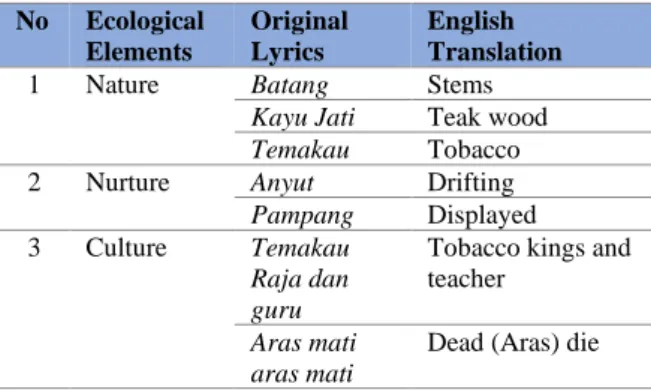
Table 4.2.1 Ecological Elements of Stomach Ache in Children No Ecological
Elements
Original Lyrics
English Translation
1 Nature Batang Stems
Kayu Jati Teak wood Temakau Tobacco
2 Nurture Anyut Drifting
Pampang Displayed 3 Culture Temakau
Raja dan guru
Tobacco kings and teacher
Aras mati aras mati
Dead (Aras) die
Ecocritically, the text of the Mantra for Stomach Ache in Children contains ecological symbolization that is analyzed based on the trichotomous trade as follows, first, in the aspect of nature. In the context of this mantra, Stems and teak wood can be considered an element of nature because it is closely related to the heart and has characteristics associated with existence and growth in a natural environment. Stems and teak wood come from teak trees that grow in nature. Teak trees are living organisms that depend on the natural environment to grow and develop. Teak wood is easy to find because teak trees grow in forest areas often used as living places (Irsyad, 2013). In this context, teak trunks and wood represent the natural products of teak trees that fulfil their roles and functions in the ecosystem. In addition, teak stems and wood are products of natural processes in the natural environment. Stem growth occurs naturally through photosynthesis and the accumulation of natural substances from the surrounding environment, such as water, sunlight, and nutrients from the soil. Thus, teak stems and wood result from biological processes that occur in the natural environment. The connection of teak trunks and wood to the ecosystem is also why they can be categorized as elements of nature. Teak trees shelter various animal and plant species and contribute to natural nutrient cycling and carbon sequestration.
Teak wood can also be a habitat for organisms that live in it, such as insects or small animals. In this sense, teak trunks and wood are closely related to the ecosystem and affect various aspects of natural life. Finally, using
teak logs and wood is linked to sustainability and nature protection issues. The wise and responsible use of teak wood can support the principles of nature conservation and sustainable management of natural resources. Thus, teak trunks and wood are essential in maintaining ecosystem sustainability and preserving nature.
Another element of Flora is tobacco, a significant plant in the lives of Malay people. Sarah (2022) states that tobacco is one of the plants with wide-shaped leaves. The leaves are finely blended and then dried, which are used for cigarettes and cigars. Tobacco is used in certain traditional ceremonies. The Malay community considers tobacco as a symbol of strength and endurance. Tobacco is quite existent in the Malay Mantra. In the Sambas Gilik Malay Pekasih Mantra, for example, tobacco has the function of captivating women's hearts using tobacco media (Mariyadi et al., 2017). In Malay medical spells, tobacco is often a magical ingredient for luck and healing. In the image of nature in the Melawi Malay community, tobacco is called “temakau lipat”, Which is one of the representations of ecological elements. Tobacco is a plant grown for its leaves, which are then dried and processed into tobacco products such as cigarettes, cigars, sliced tobacco, and others. The Malay community in medicine uses dried tobacco leaves.
Mantra areas utilize the medium of dried tobacco leaves as a condition and intermediary in reciting the mantra. Tobacco is rolled up as big as a marble, and then the mantra is repeated and blown three times.
Tobacco is placed in the centre of a small child affected by aras disease. The placement of tobacco in the centre is also a form of representation of the belief that the centre is the middle and central part so that the balance of the body and the healing of the disease is believed to start from the balance of the centre as a vital part.
The second is nurture: “drifting of stems from upstream” refers to a natural phenomenon where stems or plant parts are drifted or carried away from upstream rivers. It reflects the influence and role in movement and transformation. “Displayed on teak wood” depicts human power and care for the object or thing on display. Using teak wood as a place shows the values of beauty, carpenter skills, and human efforts in maintaining natural beauty.
Thirdly, culture: "The kings of tobacco and the teachers" reflect the influence of culture in this mantra.
The tobacco kings refer to influential figures in the tobacco industry, many of whom play important roles in culture, economics, or politics. The last line, “dead aras die”, can be interpreted as acknowledging death as an inevitable part of life. It reflects the cycle of life and the permanence of nature as well as the mindset of the Malay people, who consider in their culture that death is a certainty.
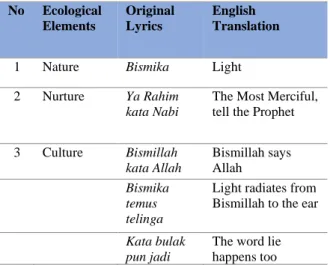
325 Table 4.2.2 Ecological Elements of Mantra for Deaf
Ears No Ecological
Elements
Original Lyrics
English Translation
1 Nature Bismika Light
2 Nurture Ya Rahim kata Nabi
The Most Merciful, tell the Prophet 3 Culture Bismillah
kata Allah
Bismillah says Allah Bismika
temus telinga
Light radiates from Bismillah to the ear Kata bulak
pun jadi
The word lie happens too
Firstly, in nature. The aspect of nature is represented through the phrase "light," an elemental force. "Light" is a natural phenomenon generated by energy sources such as the sun or objects emitting electromagnetic radiation. Light plays a crucial role in ecosystems and life on Earth. Plants utilize sunlight in photosynthesis to generate the energy necessary for growth and development. Light also influences weather patterns, natural cycles, and animal navigation. Thus, light is a natural element integral to our environment and profoundly influences life on Earth.
Secondly, in nurture. In this context, invoking God as "The Most Merciful" reflects humanity's connection to a larger entity and the need for guidance, advice, and social care. Addressing God as "The Most Merciful"
indicates the human desire to feel connected to an entity with a loving and caring nature. In social contexts, humans often seek support, direction, and understanding from others or entities with greater authority or wisdom. In this case, God is invoked as a source of knowledge and care that fulfils human social needs. It also underscores the significance of social development in shaping human beliefs and behaviour.
Humans tend to derive influence and nurture from their social environment, including family, community, and religion. The ideas and values transmitted through this social nurturing are essential in shaping people's worldviews, ethics, and behaviour. The line suggests that humans seek social guidance and nurturing from entities perceived to have greater wisdom and influence, such as God. It also depicts humanity's relationship with the spiritual dimension and the need for social guidance.
Thirdly, in culture, the "Name of God" refers to God's presence in the universe and man's relationship with nature. This phrase indicates an acknowledgement of God's presence and humanity's connection to the greater forces of nature. The terms "Light radiates from Bismillah to the ear" and the statements "Words are true" and "Lying words also happen" reflect cultural
and linguistic influences in the mantra. Furthermore, representations of "Allah" can often be found in sacred texts such as the Qur'an in Islam or other religions' holy writings. These texts describe God's attributes, characteristics, and teachings that form the basis of religious beliefs and practices, providing evidence of a strong culture of divinity.
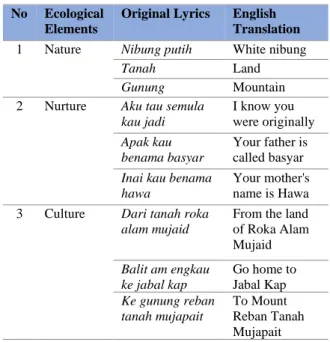
Table 4.2.3 Ecological Elements of Mantra for A Crying Child
No Ecological Elements
Original Lyrics English Translation
1 Nature Telok Bay
Pengutu Fleas
2 Nurture Kau nyengok mata kau burok
You're peeking at your bad eyes 3 Culture Aku tau asal kau
jadi
I know where you come from Mum
Apak kau pengutu Your father has many fleas Inai kau pencuri You’re a thief The context of the first ecological element, nature, can be observed in the terms "bay" These phrases depict natural images such as a bay or river mouth, and the bay is part of a coastal ecosystem crucial for the survival of various species. These elements illustrate the vital relationship between humans and nature, emphasizing the importance of the environment in creating a balanced and sustainable life to achieve overall well-being. The term “Fleas” means a harmful parasite can cause discomfort to humans. In this case, lice are portrayed as parasites that attach to the body and pose health risks. Since lice can attach to the body and jeopardize health, a medicine man can remove such lice from a person's body, thus restoring their health. In this sense, lice can be symbolically used to represent the healing power of medicine and its ability to eliminate diseases or health problems.
Secondly, nurture. The phrase “you're peeking at your bad eyes” indicates social influence and nurture in the mantra. This expression may refer to the role of people around an individual in shaping their perception and self-view. A negative self-perception can arise through interactions and influences received from the social environment.
Thirdly, in terms of culture, the phrases "I know where you come from" and "Your father has many fleas, Mum, you are a thief" reflect cultural influences in the mantra. These expressions involve family relationships and social constructs associated with individual identity. Knowing one's origins and applying negative attributes to family members (such as a father having many lice and a mother being a thief) may reflect the role of culture in shaping social perceptions and judgments.