
Space does not allow me to thank everyone who has helped, but I want to express my gratitude to as many as I can. Many thanks to Laurie Jones, Jeremiah Rhodes, Jonathan Rhodes, June Rhodes, Kerry Rhodes and Kris Rhodes. Thanks also to Pastor Billy Edwards, the elders and the rest of Brazos Meadows Baptist Church for allowing me to pursue this degree.
Adam, thank you for always saving me and always being available to talk about ideas, strategies and next steps. Kris, my love, I know you are so tired of carrying books from one end of the house to the other and me being busy all the time. Kris, Jonathan and Jeremiah, thanks for making me laugh; you are the ones who keep me going.
INTRODUCTION
He concludes that "the differences between the elders of the Old and New Testaments are too considerable to permit the conclusion that the elders of the church were a natural development of the elders of Israel." Merkle, "The Biblical Role of Elders," in Baptist Foundations: Church Government for an Anti-Institutional Age, ed. Finn, "The Rule of Elders: The Presbyterian Angle on Church Leadership," in Merkle and Schreiner, Shepherding God's Flock, 198.
24 James Allen Fain III, “A Descriptive Analysis of the Relationship Between Paradigms and Duties of Pastoral Ministry” (PhD Dissertation, The Southern Baptist Theological Seminary, Louisville. 36 James Leo Garrett, Jr., “The Congregationally-Led Church: Congregational Polity,” in Brand and Norman, Perspectives on Church Government, 124. See also Alastair Campbell, “The Elders of the Jerusalem Church,” The Journal of Theological Studies 44, no.
Elder" appears twice in the letters of John, where John refers to himself as "the elder" (2 John 1:1 and 3 John 1:1). 41 The Greek does not include "church affairs" after "directly", but the word indicates leading. He defines episcopacy as "the institution by which bishops (or episkopois) govern the visible church."76 Adherents of the episcopal system believe that there are three levels of ordination or separation, of governing the church.
Finn, "The Rule of Elders: The Presbyterian Angle on Church Leadership," in Shepherding God's Flock: Biblical Leadership in the New Testament and Beyond, ed. Reymond, “The Presbytery-Led Church: Presbyterian Church Government,” in Brand and Norman, Perspectives on Church Government, 82. He defines congregational government simply by saying, “The congregational form of government means that the ultimate authority to govern the church lies in.
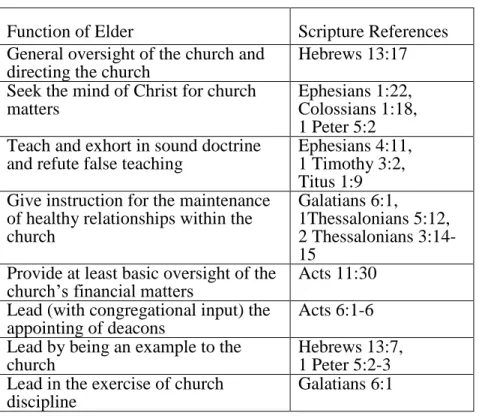
Armstrong Sr., "The Major Functions of New Testament Elders," MST thesis, Dallas Theological Seminary, 1995. The purpose of the research was to identify the specific roles of lay elders in contemporary Southern Baptist churches.2 The first part of the study involved obtaining quantitative data from a large sample of current elders. 14 James Allen Fain III, "A descriptive analysis of the relationship between paradigms and tasks of pastoral ministry" (PhD diss., The Southern Baptist Theological Seminary.
Delimitations
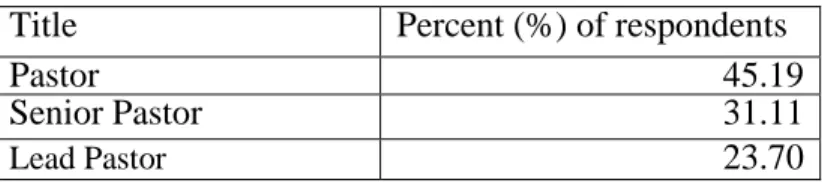
The purpose of this study was to identify the specific roles of lay elders in contemporary Southern Baptist churches. The qualitative portion involved personal interviews with senior pastors and lay elders of eligible churches. A thorough internet search yielded electronic contact data for 3,272 of those churches.1 The team then used these contacts to send 2,881 invitations (see appendix 1) and ask the pastor at each church to take the survey.2 The invitations included a World Wide Web link that gave the church access to the survey.
However, Question 1 asked the person if they were willing to participate, and 97 of the 352 declined. 130 participants responded negatively and the study asked them to stop at that point, leaving 125 qualifying responses.4. The 125 people who were still eligible moved to question 11, which asked if the person was willing to participate in follow-up interviews.
If the respondent answered affirmatively, he was referred to question 12, which asked for his contact details. The researchers sent as many as possible in one day and then had to wait a day or two before sending more. 3 Using Survey Monkey, anyone with internet access could easily complete the survey.
It also allowed the use of skip logic and made it easy for researchers to send reminder emails and monitor daily response rates. It is not clear whether these 15 were lay elders conducting the investigation on behalf of the church or whether they were senior clergy who volunteered. Of the 125 respondents who passed the demographic part, the researchers had to leave one out because he actually checked that he did not want to participate, even though he completed and returned the instrument.5.
Next, the researchers contacted these 124 pastors using the email addresses they provided on the survey and asked them to invite their lay elders to complete the instrument.
Delimitations
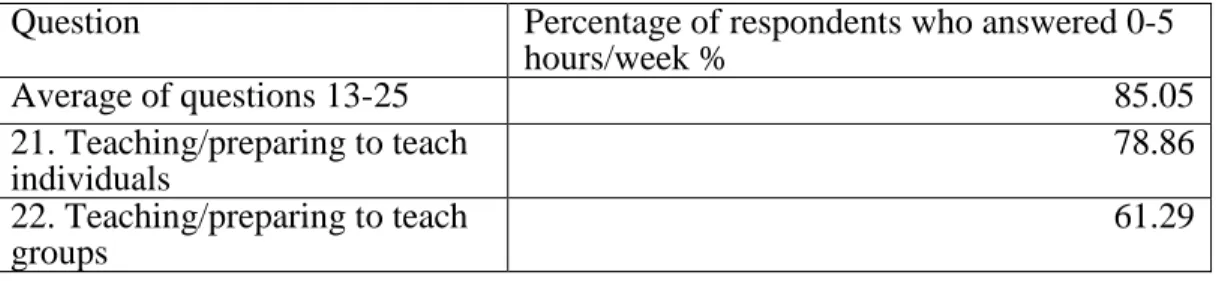
As part of the interview protocol, the investigator asked the pastor to ask one of his unpaid elders to complete an interview as well.9. For eleven of the thirteen tasks, over 75 percent of pastors reported that lay elders spent less than five hours per week on that task. Only five of the jobs were rated in the six to ten hours per week category by 15 percent (or more) of respondents.
The rest of the interview included a section on parent roles, one on parent selection, and one on transitioning to a multiple parent leadership model. In each of the six churches, unpaid elders fill vital teaching ministries such as teaching on Sunday. Note: These items are ordered according to the order of the process rather than frequency or responses.
Four of the six pastors interviewed and one of the unpaid elders were at their church during the transition to multiple elder leadership and the interview asked them to describe how that change was navigated. Analysis of the results of the quantitative survey and qualitative interviews provide answers for the study's sample. Paid and unpaid elders do many of the same tasks, but unpaid elders cannot spend nearly as much time on them.
Of the churches surveyed, 74.14 percent had policies that governed the decision-making process of elders. The fact that the survey was online meant that members of the sample population did not have to incur any paperwork or postage to complete and return the survey. Compounding this challenge was the fact that many of the pastors whose answers seemed most interesting declined to be interviewed.
The study's findings present verifiable data, as opposed to conjecture or anecdotal evidence, about the work done by lay elders in Southern Baptist churches.
CONCLUSIONS
The remainder of this chapter presents implications of the results along with suggestions for further research. The purpose of the current research was not to discover the percentage of Baptist churches with multiple parent leadership. However, of the 233 unique churches that responded to the demographic portion of our survey (percent) said they have a plurality of elders.
Overseeing an area of ministry fits well under Paul's formulation that elders "manage the affairs of the church." Finally, in each of the six churches, the unpaid elders preach in the Sunday service at least two or three times a year. In three of the churches, the unpaid elders also preach in various contexts outside their home denomination.
All eight men interviewed were adamant that they and most of their churches viewed paid and unpaid elders as shepherds. If the congregation has the ability to appoint and remove elders, this keeps authority in the hands of the body. In addition, everything had to be voted on by the final authority.
First, the current study needs to be replicated with different populations to get an accurate picture of the evangelical landscape regarding lay eldership. According to survey item 26, 16.36 percent of council elders in this sample are involved in church governance, but it is not clear what this means. Therefore, churches considering adopting this practice may not have the correct ideas about the role of lay elders.
Irska, The Ministry of the Elder: Developing Effective Elders to Serving the Local Church (Montclair, NJ: Impact Publishing House, 2004), Greg R.
SURVEY INVITATION
SURVEY INSTRUMENT
Are you willing to participate in a follow-up interview about the role of unpaid elders in your church. Our survey indicated that lay elders in your church spend ______ hours per week teaching congregations one-on-one. Our survey indicated that lay elders in your church spend ______ hours per week teaching congregations in a group setting.
Elders and Deacons in History.” In Baptist Foundations: Church Government for an Anti-Institutional Age, edited by Mark Dever and Jonathan Leeman, 229-42. A Descriptive Analysis of the Relationship Between Paradigms and Duties of Pastoral Ministry." Doctoral Dissertation, The Southern Baptist Theological Seminary, 2010. The Rule of Elders: A Presbyterian View of Church Leadership." In Shepherding God's Flock: Biblical Leadership in the New Testament and Beyond, edited by Benjamin L.
A Church Governed by a Congregation: Congregational Polity.” In Perspectives on Church Government: Five Views of Church Polity, edited by Chad Owen Brand and R. Did the Church Borrow Its Leadership Structure from the Old Testament or the Synagogue?” In Shepherding God's Flock: Biblical Leadership in the New Testament and Beyond, edited by Benjamin L. Some Historical Roots of Congregationalism.” In Baptist Foundations: Church Government for an Anti-Institutional Age, edited by Mark Dever and Jonathan Leeman, 229-42.
The Biblical Role of Elders.” In Baptist Foundations: Church Government for an Anti-Institutional Age, edited by Mark Dever and Jonathan Leeman, 271-89. The Basics of Shared Leadership.” In Shared Leadership: Reframing the Hows and Whys of Leadership, edited by Craig L. The Biblical and Theological Case for Congregationalism.” In Baptist Foundations: Church Government for an Anti-Institutional Age, edited by Mark Dever and Jonathan Leeman, 47-78.
The bishop-led church: the episcopal or Anglican polity is confirmed, weighed and defended.” In Perspectives on Church Government: 5 Views, edited by Chad Owen Brand and R.