Urban Planning
Theory since 1945
Urban Planning Theory Since 1945
Nigel Taylor
SAGE Publications
London. Thousand Oaks. New Delhi
To my father, with admiration and love, and all those others who endured or died in the Second World War hoping for a better future
Nigel Taylor © 1998 First published 1998
All rights reserved. No part of this publication may be reproduced, stored in a retrieval system, transmitted or utilized in any form or by any means, electronic, mechanical,
photocopying, recording or otherwise, without permission in writing from the Publishers.
SAGE Publications Ltd 6 Bonhill Street London EC2A 4PU
SAGE Publications Inc 2455 Teller Road
Thousand Oaks, California 91320 SAGE Publications India Pvt Ltd 32, M-Block Market
Greater Kailash - I New Delhi 110 048
British Library Cataloguing in Publication data A catalogue record for this book is
available from the British Library ISBN 0 7619 6094 5
ISBN 0 7619 6093 7 (pbk)
Library of Congress catalog card number record available Typeset by Dorwyn Ltd, Rowlands Castle, Hants Printed in Great Britain by Athenaeum Press, Gateshead
Acknowledgements Introduction
Contents
Part I Early post-war planning theory
1 Town planning as physical planning and design 2 The values of post-war planning theory
3 Early critiques of post-war planning theory
Part II Planning theory in the 1960s
4 The systems and rational process views of planning 5 Planning as a political process
Part III Planning theory from the 1970s to the 1990s 6 Theory about the effects of planning
7 Rational planning and implementation 8 Planning theory after the New Right
Part IV Conclusion
9 Paradigm shifts, modernism and postmodernism Bibliography and references
Index
IV V
3 20 3 8
5 9 75
95 1 1 1 130
157 1 70 1 8 1
Acknowledgements
Hugh Barton, Martin Chick, Ron Griffiths and Tony Scrase were kind enough to read earlier drafts of selected chapters of this book. I am very grateful to them for their comments, especially as, for the most part, I came to agree with their critical comments and modified the text accordingly. However, I of course am responsible for what I have written.
I also thank my wife, Diana, and my children Georgia and Lawrence, for all their support and love. Without them I don't know if I would have bothered with this. But having decided to bother, I often stayed on in my office at work to do the task, and so was often a late-home husband and father. Never once was there any complaint or resentment. On the contrary, always a welcome.
The loss was as much my own; I'd have much rather been home. But for some reason some of us are compelled to do these things, and I hope that the product will be worth it, for my students if not for my family.
Introduction
This book describes the history of town planning theory since the end of the Second World War ( 1 945). Over this fifty-year period ideas about town plan
ning have changed significantly. Yet students of town planning lack a book which describes, in an accessible way, the recent development of ideas which have informed their discipline. This book aims to fulfil that purpose.
As part of their town planning studies, students usually take some course in 'planning theory'. But as I know from my own experience of teaching this subject, students find the subject difficult. Part of this difficulty may be due to the intrinsic nature of the subject-matter, which deals with ideas and argu
ments rather than the accumulation and transmission of facts about planning.
But the difficulties which students experience are not eased by the literature of planning theory. Much of the original literature in the subject is unnecessarily complicated and obscure, and so pretty impenetrable to the average student.
Enthusiasm kindled in the opening week of a course on the subject can soon be drowned by the first reading of some 'classic text' in planning theory! There are some useful 'readers' in planning theory, such as Andreas Faludi's reader published in 1 973 (Faludi, 1 973a), and the more recent reader put together by Scott Campbell and Susan Fainstein ( 1 996) . 1 However, what is still lacking is a book which 'tells the story' of how town planning theory has changed since the end of the Second World War. Again, I have tried in this book to meet that lack. In so doing I have tried to tell the (his)story in a clear and accessible way, without sacrificing analytical rigour. For in my view, a book on the history of ideas should not only describe the ideas under consideration but also draw the reader into assessing them. Whether or not I have succeeded in these aims I leave for others to judge.
Before I begin I should say something about what I take 'town planning theory' to be (this itself has been a matter of debate amongst planning theorists since 1 945). On this, it is worth saying to begin with that, if the practice of town planning is, literally, actually doing it, then everything that town plan
ning students do at college is 'theory' about town planning of one kind or another, even when, for example, they are learning about the law that governs town planning. What is distinctive about the subject of 'planning theory' is that it aims to provide some overall or general understanding of the nature of
VI URBAN PLANNING THEORY SINCE 1 945
town planning. Because of this, the sorts of questions planning theorists ask (or should ask) about town planning are fundamental questions about town plan
ning. Questions such as: What sort of an activity is town planning? What should town planning be aiming to do? What are the effects of actual town planning practice? Because these are basic questions about town planning, they are also 'simple' questions; they are the sorts of questions a child might ask about town planning. But, as anyone who has had children will know, the 'simple' (i.e. fundamental) questions are generally the most difficult to answer, because they probe to the very basis of our thought.2 This, then, is another reason why many students may find the subject of 'planning theory' difficult and why also, in spite of my best efforts to make this book straightforward and accessible, some parts of it may still make difficult reading.
A brief note, too, about the term 'town' planning. I use this term for simplicity's sake and also because it is probably the most widely used term the world over to describe the activity I am concerned with. But in using 'town planning' I take it to refer also to what some people (especially in the USA) call 'urban' or 'city' planning. All the terms 'town', 'urban' and 'city' make it clear that the focus of this discipline is the (planning of) the built environment.
However, the way we fashion the urban (built) environment also affects the rural and natural environment, and so we should perhaps rename our activity 'environmental' planning (some texts on 'town' planning do carry this title) . What I describe here a s 'town' planning also encompasses what i n Britain has been traditionally, and charmingly, called 'town and country' planning.
The story I have told is from a British perspective. But since the Second World War, the kind of town planning that has been practised and debated in Britain has been similar in many respects to town planning in other advanced capitalist democracies. So even though what I describe here is the development of town planning thought in Britain, much of this thought came from other places, especially the USA. I therefore hope that readers in other countries will find this account of interest and relevance to them.
So much for the terms of this text. More important than all this is the following fact: in the twentieth century, most people in Europe and North America, and now increasingly in other parts of the world too, have come to live in cities. This 'move to the city' has been associated with a great sense of loss for something which the countryside, or 'wild nature', provided, and in Britain this has generated a 'rural nostalgia' and a tradition of 'anti-urban' literature (see, e.g. Williams, 1 973). This has played a significant part in twentieth-century town planning thought. I don't think we should belittle these sentiments, for it may be that, in the prescence of 'wild nature', many people experience something sublime and transcendent which is generally not available in cities. On the other hand, cities can be wonderful places, as is indicated by the numbers of people who flock to see cities like Florence and Venice, Paris and Rome, London and New York. But these, perhaps, are the exceptions. If there is another source of the anti-urbanism which has been so prevalent, it is that many cities are inhospitable, ugly places. But cities are human-made things, and the fact that some cities are congenial and uplifting
INTRODUCTION VB
shows that the miserable urban environments which most people are con
demned to live in don't have to be like that.
It is this which makes town planning important. Indeed, it is an extraordin
ary fact that, in our contemporary urban culture, the activity of town planning is not more widely discussed and written about, and so, apparently, not per
ceived as being very significant in relation to the quality of our lives. The point has been well made by the novelist Margaret Drabble ( 1 991, p. 32):
I was recently talking with friends about which of the arts has the most powerful and direct effect upon the emotions. The rival claims of music and poetry found the most powerful advocates, until one unexpectedly nominated architecture. A surprised and respectful silence fell. Architec
ture? Did she really mean architecture? Did buildings make her want to weep or sing with joy? We questioned her and, yes, she did mean buildings I have thought back to this discussion many times, and now consider this friend's point is less eccentric than at first appeared. Some of the greatest and grandest emotional and aesthetic experiences come from architecture.
Who can forget a first vision of Venice, of Rome, of Istanbul, of Mar
rakesh, of Carthage, of Tangiers, of Paris, of Rio de Janeiro, of Moscow, of Sydney, of Cape Town?
There are some points I would want to add to alter, slightly, what Margaret Drabble says here. First, although cities can be experienced as large works of art, so that questions of aesthetics should be central to their planning, cities are not just works of art; whether or not we experience them as pleasant or repugnant depends on more than this. Good town planning therefore depends on more than good urban design. Secondly, and most important, Margaret Drabble speaks of architecture and of buildings. But although individual build
ings, and thus architecture, are important to the quality of towns, it is the whole ensemble of buildings and spaces in a town - including its parks and gardens - which governs how we experience it (notice how in the above quotation Drabble slides from talking about individual buildings to cities as a whole) . In other words (and in so far as it is an 'art'), it is really the art of town planning which emerges from Drabble's reflections as arguably the most sig
nificant art. But with these qualifications added, what Drabble says here is very important, for it draws attention to the extraordinary fact that town planning (and architecture) is not generally perceived as very significant in our society (notice, again, her initial surprise at her friend's 'eccentric' suggestion). And this even though most of us live in cities, and even though most of these cities are unpleasant to be in, and even though it is possible for humans to create wonderful cities for people to inhabit.
If town planning is as important as I contend, then clearly so too is the general theory which underpins it. Moreover, from the above discussion it would appear that a central part of that general theory should be concerned with three questions: First, what are the components of good-quality urban environments? Secondly, under what conditions are these qualities most likely
V III URBAN PLANNING THEORY SINCE 1 945
to be realised? And third, to the extent that public sector town planning is one of these conditions, what part can town planning play in bringing about better cities (and a better environment more generally) for people to live in? I shall return to these questions in concluding this book. However, for much of the time since the Second World War planning theorists have been more preoc
cupied with other questions, and particularly with the basic conceptual ques
tion of how we should conceive of (and so define) the discipline of town planning. There have been good reasons for this, the chief amongst them being that theorists of town planning since 1 945 have held different, and in some ways opposing, conceptions of town planning, and thus different and opposing views about the theory which is most relevant to inform it. But this is to anticipate the story which I should now begin.
NOTES
1. Other readers in planning theory include: Burchell and Sternlieb ( 1 978), Healey, McDougall and Thomas ( 1 982a), Paris ( 1 982), Mandelbaum, Mazza and Burchell ( 1 996).
2. If this account of 'planning theory' is correct, then the 'discipline' of planning theory is rather like philosophy, for philosophy asks basic, fundamental questions about the world and our place in it. Perhaps, then, the 'planning theorist' should be someone with a philosophical predisposition, and not only in the sense of asking fundamental questions about planning but also in the sense of employing the analytical rigour that is typical of the best philosophy in examining those questions.
PART I
EARLY POST-WAR PLANNING THEORY
1
Town planning as physical planning and design
INTRODUCTION
In this and the following chapter we shall be examining the view, or theory, of town and country planning which prevailed in Britain for about twenty years following the Second World War. There are two aspects of post-war planning theory which I shall distinguish and examine separately in this and the next chapter.
First, in this chapter, I examine the prevailing conception of the nature of town (and country) planning as a discipline; that is, the view which most town planners held in the post-war years about the kind of activity they were engaged in - how planning theorists at this time would have defined town planning. A useful way of approaching this is to imagine a leading town planner of the post-war years being asked by an intelligent layperson: 'what is town and country planning?' Although as we shall see, the concept or defini
tion of town planning which prevailed at this time could be summarised in one or two sentences, we get a richer picture if we fill out this definition somewhat, and that, too, I shall do in this chapter.
Second, in the next chapter, I examine the main views held during the post
war period of what the purposes or aims of town planning should be. This necessarily involves an inquiry into the values which underpinned town plan
ning at this time, and so in describing this second aspect of post-war planning theory we examine the normative theory of planning which predominated in those years.
First, the prevailing view held in the post-war years of the nature of town planning. The concept of town planning which predominated was similar to that which was held during the war and pre-war years and, indeed, long before that. During and after the Second World War there was in Britain (as in other western democracies) an added political ingredient to town planning because of the widespread discussion about establishing a new system of planning for the country as a whole. This was connected with a view that emerged follow
ing the war and the interwar economic depression that the state should play a much more active, interventionist role in society. The post-war Labour Gov
ernment represented this emergent position of 'social democracy' (as it came to be called), and between 1 945 and 1951 this government established a new
4 URBAN PLANNING THEORY SINCE 1 945
political agenda based on an expansion of the state's responsibilities: a 'wel
fare' state providing universal education, health care and social security, etc., and in the state's more active role in managing the economy ( including, in some cases, the nationalisation of major industries and services). The expan
sion of the state's role in town planning, as represented by various pieces of planning legislation (of which the centrepiece was the Town and Country Planning Act 1 947), was thus part and parcel of this new post-war politics.
But if people had been asked at this time what sort of an activity town and country planning was, then, I suggest, their answers would have reflected a concept of town planning that had not changed significantly for some hun
dreds of years, since at least the time of the Renaissance and subsequent European Enlightenment. It was generally assumed that town planning was essentially an exercise in the physical planning and design of human settle
ments. As such, it was seen as a natural extension of architecture and (to a lesser extent) civil engineering, and hence as an activity most appropriately carried out by architects (and civil engineers) . It is therefore this 'physicalist', design-based view of town and country planning which I describe in this chapter.
Before doing so, there are two preliminary points to note here which antici
pate material presented later in the book. First, whilst conceptions about the nature of planning during the post-war years exhibited continuity with earlier periods of history, views about the purposes or aims planning should pursue were more particular to that time and had their roots in more recent history (see Chapter 2).
Secondly, though the view about the nature of town and country planning stretched back into history, it was a view that came to be questioned and to some extent abandoned during the 1 960s because many of the outcomes (or apparent outcomes) of post-war planning practice were criticised in the late 1 950s and 1 960s. The conception of town planning described here is one which persisted for about twenty years following the Second World War. After that, new ideas and perspectives emerged, and it is the task of the rest of this book to describe these.
My account of the 'physicalist' conception of planning is drawn chiefly from books and other written sources published in and around the period of the Second World War, and especially from 'textbooks' which sought to explain, in a general sense, what town and country planning was about. After all, our understanding of the view of planning that was taken during this or any other period must rest to a large extent on what relevant people said about it, and this translates, for the most part, into what people wrote about planning.
Examples of such texts include Patrick Abercrombie's Town and Country Planning (first published in 1 933), Thomas Sharp'S Town Planning ( 1 940), Lewis Keeble's Principles and Practice of Town and Country Planning ( 1 952), and Frederick Gibberd's Town Design ( 1 953). Keeble's was a standard and highly recommended textbook for students and practitioners of planning from the time of its publication through to the mid-1 960s, and thus it expresses in a particularly vivid way the view of town and country planning which prevailed
TOWN PLANNING AS PHYSICAL PLANNING AND DESIGN 5
during this period. As was written on the sleeve of the fourth edition of Keeble's book published in 1 969:
'Principles and practice' has always been much more than a student's textbook. In this edition it emerges fully as probably the clearest and most explicit, certainly the fullest and most comprehensive, work yet published upon the vital subject of physical planning . . . Today there are few plan
ning offices and almost certainly no schools of planning in the English speaking world where it is not in use.
The blurbs on book jackets, of course, always makes grand claims like this.
Nevertheless, I do not think this particular claim is either untrue or unreason
ably immodest. Throughout the 1 950s and into the mid-1 960s, Keeble's book was recommended to all students of planning (and often as the main course text). It was also used as a standard work of reference, even as a planning 'manual', in many planning offices, so that amongst planners themselves it was probably the best known and most widely used book on town planning.
THE COMPONENTS OF THE POST-WAR CONCEPTION OF PLANNING
The description of town and country planning in the post-war period (and long before that was conceived) as essentially an exercise in physical planning and design, but this abbreviation needs to be more fully explained. We can dis
tinguish three related components to this:
1 ) Town planning as physical planning.
2) Design as central to town planning.
3 ) The assumption that town planning necessarily involved the production of 'master' plans or 'blueprint' plans showing the same degree of precision in the spatial configuration of land uses and urban form as the 'end-state' blueprint plans produced by architects or engineers when designing build
ings and other human-made structures.
Town planning as physical planning
After the Second World War, there was much talk of 'planning' in a general sense - that is, state intervention in, and playing a more active role in, the managing and planning of social and economic affairs generally as part of the changed political climate. As town and country planning was only one form of planning activity, the question naturally arises as to what made town and country planning different from other forms of planning. The prevailing view was that, with the possible exception of regional planning controls over indus
try,l town and country planning was concerned with the 'physical' environ
ment and was thus most appropriately described as physical planning, as opposed to 'social' and 'economic' planning. As Keeble ( 1 952, p. 1 , emphasis added) put it on the first page of his book:
6 URBAN PLANNING THEORY SINCE 1945
Town and Country Planning might be described as the art and science of ordering the use of land and the character and siting of buildings and communicative routes . . . Planning, in the sense with which we are con
cerned with it, deals primarily with land, and is not economic, social or political planning, though it may greatly assist in the realisation of the aims of these other kinds of planning.
There are three points about this statement worthy of comment. The first concerns the conceptual problem of distinguishing between 'physical' and 'so
cial' (as well as 'economic') planning. The second concerns the alleged relation between physical and other forms of planning. And the third concerns the suggestion that town and country planning is not 'political'.
The conceptual problem arises because it is difficult to make much sense of the idea that town and country planning is not concerned with 'social' and 'economic' matters. One could suggest that town and country planning is concerned with the 'physical environment' - and so with buildings, roads, land, etc. (i.e. with physical objects), and that this is distinct from planning (for example) health care or education. The former could be described as 'physical' and the latter as 'social' planning. This is, however, a rather contrived distinction. If one were to ask what physical planning is for, or why one might wish to plan a part of the physical environment, then it is difficult to think of a reason for this planning which is not 'social': for people generally wish to control the form of their environment to maintain or enhance their well-being or welfare. The nineteenth-century town planning movement in Britain was very much concerned with the physical plan
ning of cities for reasons of public health, and policy for health is generally regarded as 'social'. Furthermore, town and country planning is a form of social action just as much as planning the provision of health care or education. So there is some incoherence in this distinction between planning which is said to be only, or even primarily, 'physical', and planning which is, by contrast, 'social'.2 However, as is evident from Keeble's way of defining planning, town and country planning was typically thought of at this time as being about the physical environ
ment, and hence as only physical planning.3
This is not merely a pedantic point. For if we allow that there is some distinction between 'physical' and 'social' planning, the question of whether town planning should be defined as 'physical' (and not 'social'), or alter
natively as 'physical and social', is a question of what the proper scope, and hence the purposes, of town planning should be; it is a question of whether town planning should be conceived as an activity which is 'only about' the physical environment and physical development or as a wider activity encom
passing 'social' and 'economic' matters as well. Donald Foley drew attention to these alternative conceptions of town planning in a well-known paper about the ideology of British post-war planning (Foley, 1 960). Here he made clear that there is considerable tension, and ideological debate between, a 'physical
ist' view and a wider 'social' concept of town planning.
Secondly, Keeble suggests that town planning, though it is not social and economic (or even political) planning, 'may greatly assist in the realisation of
TOWN PLANNING AS PHYSICAL PLANNING AND DESIGN 7 the aims of these other kinds of planning'. If we allow that there is some distinction between physical, social and economic ends, then implicit in this statement is an assumption that social and economic ends could be advanced by physical means - that is, by the location, siting, disposition and physical layout of buildings and roads, etc. At one level there is nothing exceptional about this, for clearly the physical form and layout of a town can affect social and economic life (e.g. new roads can attract commercial development to an area; and a toddlers' play area can attract young children and so bring children in a neighbourhood into contact with each other) . Keeble's statement, however, is worth attending to because the idea that the physical form of the environment could affect social and economic life was quite central to plan
ning thought at the time. This sometimes took the stronger thesis that the physical form and layout of buildings and spaces could determine the quality of social or economic life, and this thesis was appropriately termed physical, architectural or environmental determinism (see Broady, 1 968, Chap. I). The post-war 'Mark l' new towns, for example, were designed from a common assumption that, by laying out residential areas in physically distinct neigh
bourhoods, with 'their own' local shops, recreational open spaces, primary schools, etc., there was a greater likelihood that a 'social' neighbourhood (i.e a 'community') would develop. As it turned out, this was sociologically naive (as we shall see in Chapter 3 ) . Nevertheless, this assumption was built into early post-war planning thought, and Keeble's statement hints at this.
The third point concerns Keeble's assertion that town and country planning is not 'political' planning. Again, much hangs on how we interpret this. If he meant that town and country planning is not concerned with planning the political system, then we could concur with this. But if he meant that planning does not involve or assume a commitment to a political position, then this is questionable.
The very introduction of land-use planning entails an acceptance of some form of state intervention in the property market, which in turn entails a particular political ideology (such as social democracy). Indeed, the introduction of pub
licly accountable town planning presupposes, even if it does not itself directly 'plan', a certain kind of political system, so that from this point of view town planning is a form of 'political planning'. Decisions about how land should be used and developed necessarily involve making choices which affect the interests of different groups in different ways, and so these choices are also 'political' in this sense. Whatever Keeble himself may have meant, his statement is worth attending to because it was also part of the prevailing conception of town and country planning that planning was primarily a 'technical' activity, and so an activity that was not in itself political, or which at least did not carry with it any specific political values or commitments. Indeed, its designation as 'physical' (not 'social' or 'economic' ) was precisely one of the reasons why people at this time thought of town planning as technical and apolitical.
Assuming that town and country planning was conceived of as physical planning, the question naturally arises as to what technical skills were thought relevant, which brings us to the second component of the post-war conception of planning.
8 URBAN PLANNING THEORY SINCE 1 945
Town planning as urban design
Because town planning was viewed as an exercise in planning the physical location, form and layout of land uses and buildings, it was also regarded as an exercise in physical or urban design (the term 'civic' design was also much used). Town planning was regarded as an 'extension' of architectural design (or to a lesser extent civil engineering) in the literal sense of being concerned with the design of whole groups of buildings and spaces - with 'townscape' rather than the design of individual buildings and their immediate sites, and also in the sense that architecture too was seen to be an exercise in the physical design of built forms. It followed that the professionals generally considered as most qualified to undertake such work were architects, together with the two other main built environment professions, civil engineering and surveying. It is not surprising, therefore, that these other built environment practitioners res
isted the establishment of town planning as a separate profession in Britain on the grounds that town planning was a natural extension of their work and hence part and parcel of their brief (see Cherry, 1974, Chaps. 6 and 7). Hence, although the British Town Planning Institute had been established in 1 9 1 3 and had petitioned for a Royal Charter in 1 948, it was not until 1971 that the institute succeeded in obtaining the grant of a Royal Charter to become fully recognised as a distinct profession.4
Most practising town planners in the immediate post-war period, therefore, were architect-planners.5 Three of the most famous planners in post-war Bri
tain - Patrick Abercrombie, Frederick Gibberd and Thomas Sharp - were all architects. This situation was reflected in other European countries: in The Netherlands, for example, from the end of the First World War to the mid-1930s, the early modernist architect H.P. Berlage was responsible for Amsterdam's southern extension plan, and in the post-war years the famous modern architect Le Cor busier was commissioned by various cities to prepare town planning schemes.
It is thus not surprising that most of the town planning treatises written at the time put great emphasis upon urban design. Books written specifically about urban design, such as Frederick Gibberd's Town Design (published in 1 953), were regarded as standard texts on town planning. And in Europe generally, most of the influential twentieth-century tracts on town planning, such as those by Tony Garnier ( 1 9 1 7) and Le Corbusier ( 1 924; 1933), likewise saw the task of planning cities as an exercise in large-scale urban design.
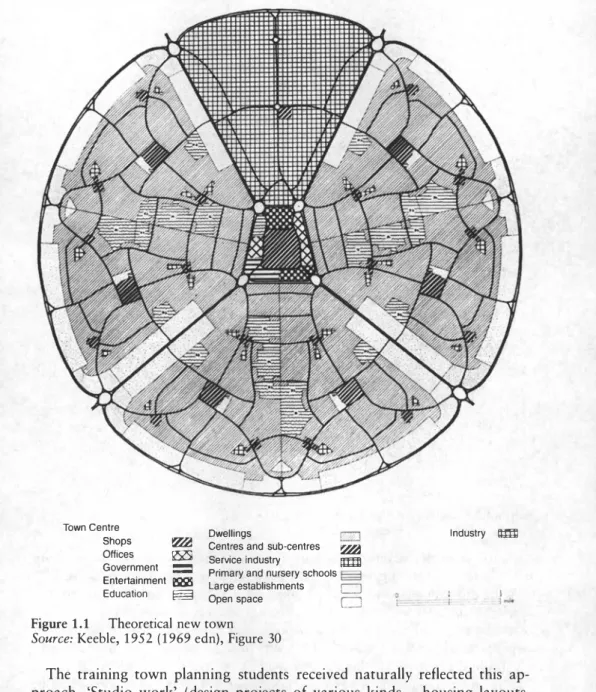
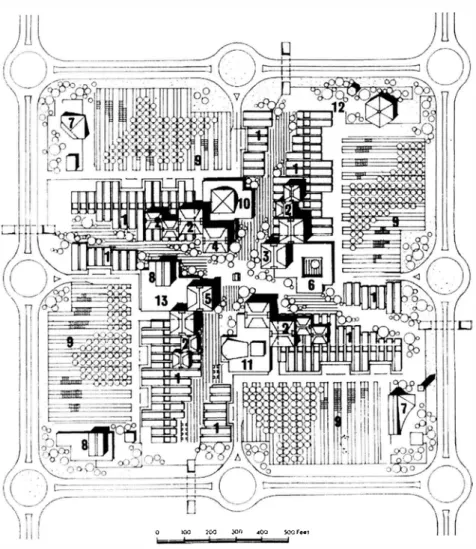
This emphasis on town planning as urban design is very evident in Lewis Keeble's Principles and Practice of Town and Country Planning, as Figures 1 . 1- 1 .5 show. 'Theoretical' master plans for new towns (Figure 1 . 1 ) are worked up by the author into a detailed design (Figure 1 .2). Then, homing in on particular areas within an imaginary town, there are examples of represent
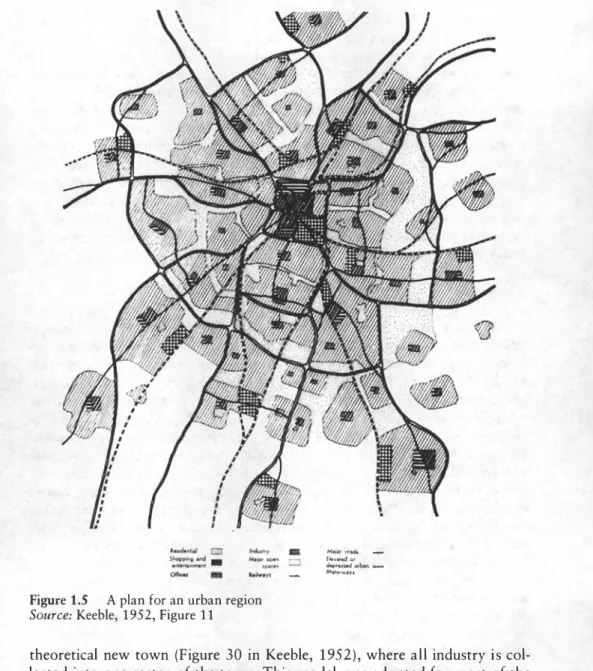
ative designs for a town centre (Figure 1 .3, also reproduced on the cover of the 1 969 edition), and for residential neighbourhoods (Figure 1 .4). Even a plan for an imaginary urban region is shown as if it were an exercise in large-scale design ( Figure 1.5).
TOWN PLANNING AS PHYSICAL PLANNING AND DESIGN
Town Centre
Shops �
Offices �
Government =:::::I
Entertainment R5Z5l5
Education §
Dwellings GJ
Centres and sub-centres �
Service industry W
Primary and nursery schools El
Large establishments 0
Open space 0
Figure 1.1 Theoretical new town
Source: Keeble, 1 952 ( 1 969 edn), Figure 30
9
Industry 11m
The training town planning students received naturally reflected this ap
proach. 'Studio work' (design projects of various kinds - housing layouts, designs for shopping centres, town centre plans, master plans for imaginary new towns, etc.) was at the heart of planning education, and all students were equipped with the same kind of drawing materials as architectural students (drawing boards, T-squares, set-squares and scales, cartographic pens and pencils, Letraset for printing, etc.). There were differences. Whereas architec
ture students were engaged more directly on the detailed design work for individual buildings, town planning students were concerned with the design of whole groups of buildings and urban spaces - in other words, with design
1 0 URBAN PLANNING THEORY SINCE 1 945
Figure 1.2 Detailed design for theoretical new town
Source: Keeble, 1 952, Figure 3 1 ( 1 969 edn)
'layouts'. But town planning was still viewed and taught as a natural extension of architectural training, involving the same kinds of spatial design skills.
With this emphasis on town planning as design was an emphasis on the aesthetic character and qualities of existing areas of townscape for which plans might be prepared, together with an emphasis on making plans which (it was hoped) would enhance the aesthetic quality of environments. Raymond Unwin - a leading exponent of this concern with aesthetics - stressed the need for beauty in urban life: 'Not even the poor can live by bread alone' (cited in Creese, 1967, p. 71). Unwin spoke of town planning unreservedly as an 'art' which would provide 'the opportunity of a beautiful environment out of which a good human life would grow' (Unwin, 1930, cited in Creese, 1967, p. 165;
note again the physical determinism of this). The aesthetics of urban form and design dominated the standard post-war texts on town planning. Thomas Sharp's (1940) Town Planning, for example, was greatly preoccupied with the aesthetic qualities of suburban as compared with terraced housing development.
TOWN PLANNING AS PHYSICAL PLANNING AND DESIGN
o 100 100 )On 400 SOO Foe_t
b�' ! , , ;
Figure 1.3 A design for the centre of a theoretical new town
Source: Keeble, 1 952, Figure 78
1 1
The centrality of aesthetics is also echoed in many of the town planning reports produced at the time, and the planning reports for cities produced by Thomas Sharp provide a vivid illustration of this. Sharp's ( 1 946) plan for the blitzed city of Exeter begins with an analysis of the aesthetic character of the city centre and his proposals are largely governed by aesthetics. For example, his block design for the pedestrianised shopping street Princesshay was located and aligned on aesthetic grounds to provide a perspective view of the cath
edral, rather than from an analysis of the locational requirements of retail businesses or of people's shopping behaviour.
Admittedly, land and buildings were used and thus how the parts of a town 'functioned' were also considered as part of the process of urban design. This was, after all, the age of modernist 'functional' architecture. Just as architects saw architectural design as the art of designing forms to accommodate (even
1 2 URBAN PLANNING THEORY SINCE 1 945
Figure 1.4 Design of neighbourhoods in a theoretical new town
Source: Keeble, 1 952, Figures 93 and 94, 1 969 edn.
to 'follow') functions, so urban designers (most of whom were architects any
way) saw their job as one of designing functionally efficient towns. In spite of this, however, a kind of aesthetic formalism dominated ideas of the well de
signed town so that urban functions were visualised and accommodated for in terms of some prior aesthetic conception of the ideal urban form rather than the other way round (this was also true of much modern architecture, notwith
standing the rhetoric of functionalism). For example, in deciding where indus
try should be located, a prime consideration was to site it away from residential areas. It was thought (no doubt correctly in many cases) that it was unpleasant to live next to factories, but this notion tended to prevail to the locational requirements of the industries themselves which, in any case, were hardly taken into account by planners, bound as they were to a design concep
tion of planning. This approach is all too evident in Keeble's plan for a
TOWN PLANNING AS PHYSICAL PLANNING AND DESIGN
Figure 1.5 A plan for an urban region
Source: Keeble, 1 952, Figure 1 1
�'Otl:b _
f:. ... ld.dOf
�.wdlJ<bM_
Motor •• )'.
1 3
theoretical new town (Figure 30 in Keeble, 1 952), where all industry is col
lected into one sector of the town. This model was adopted for most of the 'Mark l' new towns built in Britain after the war (though typically with two industrial zones rather than j ust one) and, from a traffic point of view, this proved to be anything but functionally efficient: each morning and evening peak traffic tidal flows emerge from one or two sectors of the town.6
In the residential planning of new towns, plans were laid down on the basis of a neat pattern of physically distinct neighbourhoods, all of which were roughly the same size, with same-sized local shopping centres, primary schools and the allocation of green open space. As such writers as Christopher Alex
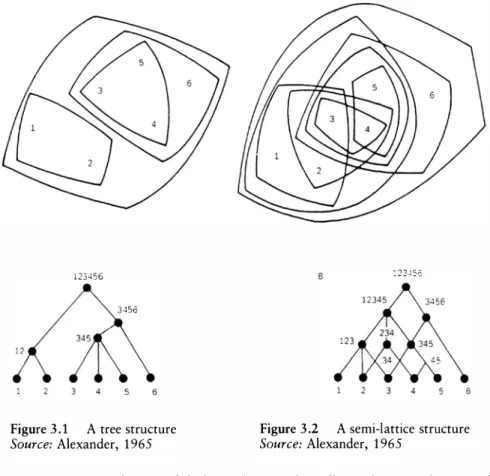
ander ( 1 965) and Maurice Brown ( 1 966) were later to point out, this 'tidy
14 URBAN PLANNING THEORY SINCE 1 945
design' conception of urban form showed no real understanding of how dif
ferent residential areas actually functioned or, in what Alexander called 'natu
ral' cities, of how different areas tended to develop differing patterns and concentrations of urban functions. The very notion that 'neighbourhoods' existed or functioned as distinct entities was itself a design idea which had not been subjected to critical examination and, when it was (e.g.: by Ruth Glass, 1 948, in a study of Middlesbrough), it was found to be 'suspect'. During this postwar period there was hardly any systematic research into how cities and regions or specific activities functioned. As Eric Reade ( 1 987) has shown, town planning practice was not grounded in empirical research and theory. Plans and planning decisions were made largely on the basis of intuition or, rather, on the basis of simplistic aesthetic conceptions of urban form and layout which embodied physical determinist assumptions about how best to accommodate the diverse economic and social life of cities.
Town plans as detailed blueprints or 'master' plans
Given that town planning was viewed as essentially an exercise in physical design, along the lines of the architectural model of design, it seemed self
evident to town planners at this time that their prime task was the production of plans -town plans, regional plans, plans for village extensions and so on. It also seemed self-evident that these plans should be as detailed as far as possible to guide future development and should define, as precisely as feasible, sites for particular uses. In other words, a plan should in principle show the extent and form of that town at some specified date in the future when, all being well, the plan would be realised or 'completed' (little thought was given at this time, however, to the problem of implementing such plans). Plans were seen as 'blueprints' for the future form of towns - as statements of 'end-states' that would one day be reached. This was directly analogous to the work of archi
tects or civil engineers, where an architect's or engineer's design would also lead ultimately to the making of a detailed plan or blueprint for a building or some other structure. Just as a building can, in principle, be constructed from an architect's final drawings, so too could a town be developed by reference to its master plan, at least in terms of the 'outlines' of development.? This is hardly surprising, given that most of the town planners were architects by training. As Peter Hall (in Hall et aI., 1 973, Vol. 2, p. 3 8 ) was later to write:
' . . . the planning profession in Britain from the outset had a heavy design bias:
an obsession with plan design, in the form of a physical blueprint.'
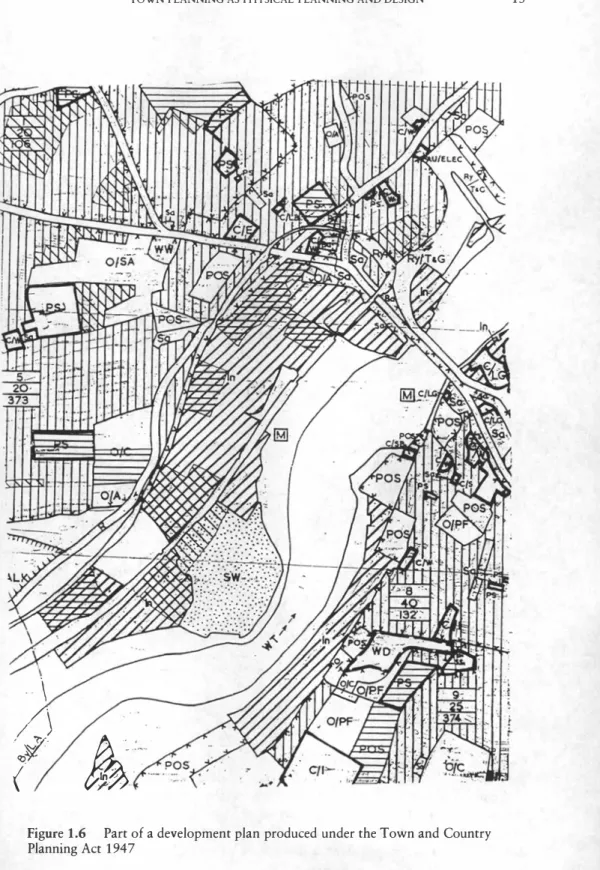
The 'blueprint' character of town plans is well illustrated by the plans for new towns which were produced in the 1 940s and 1 950s. Indeed, the end state character of these plans was evident in that it was generally assumed that a time would come when the new town's development, based on its plan, would be completed. The first generation of development plans local authorities were required to produce under the Town and Country Planning Act 1 947 also adopted this approach. Detailed zoning plans specified how particular sites were to be used and developed, including the detailed alignments of any road
\
\
/
/ ) -' ?I""
N,'(
� -TOWN PLANNING AS PHYSICAL PLANNING AND DESIGN
A,"
- ... ...
"Ii,"; ,
Y":
Figure 1.6 Part of a development plan produced under the Town and Country Planning Act 1 947
1 5
1 6 URBAN PLANNING THEORY SINCE 1 945
fig. 24 (i)
Fif. 24 [iii) ...
FiO, 24 (iv) ...
Figure 1.7 Planning theories according to Keeble
Source: Keeble, 1 952 ( 1 969 edn), Figure 24, 1 969 edn.
fi._ 24 (ii)
widening (see Figure 1 .6 ) . These were accompanied by 'programming' plans that showed the stages at which the envisaged development of different parts of the plans would be carried out to 'complete' the plans.
Town planning theories at this time were often similarly preoccupied with visionary plans or designs that showed how the ideal town or city should be spatially organised. Soria y Mata's nineteenth-century plans for linear cities, Le
TOWN PLANNING AS PHYSICAL PLANNING AND DESIGN 1 7 Corbusier's plans for the 'contemporary city' (and later the 'radiant city') i n the 1 920s and 1 930s, and Frank Lloyd Wright's plans for 'Broadacre City' in the 1 930s were exemplars of this approach, as had been Ebenezer Howard's 'Garden City' (with some important qualifications about Howard's land policy pro
posals). In other words, because town planning was viewed at this time as an exercise in planning and designing the physical form of towns, it was natural that theories of planning were expressed as master plans for urban form. The point is well illustrated by Figure 1 .7, from Keeble's standard text (Keeble, 1 952). The figure shows five different suggestions for how the form of towns might be planned. Each is essentially a master plan, or a blueprint, and it is significant that Keeble labelled this figure 'Planning theories'. For the idea that town planning was essentially about physical design, and hence involved producing blueprint plans for future urban form, was precisely the conception, or theory, of town planning which prevailed at the time when Keeble wrote his book.
CONCLUSION
In this chapter I have described the main features of the conception of town and country planning which held sway during the years following the Second World War in Britain. In fact, this conception - which viewed town planning primarily as an exercise in the physical planning and design of land use and built form - long pre-dated the Second World War, even the twentieth century.
Thus for as far back as the European Renaissance, town planning - in so far as it had been conceived as a separate enterprise at all - had been seen as a natural extension of architecture onto the larger stage of urban streets and piazzas. But really, until the late nineteenth century, town planning had not been dis
tinguished from architecture, and precisely because it was seen as architectural design on a larger canvas.
The view of pre-war planning described in this chapter was not peculiar to Britain. Since the town planning movement in this period was very much an international movement, the idea that town planning was 'like' architecture, but on a larger scale, was also the norm in other European countries and in North America. The European concept of town planning, which has design at its heart, has proved more durable than that in Britain, as has the idea that the product of town planning should be detailed land-use zoning or 'master' plans.
In France the local 'POS' plans ( 'plans d'occupation des sols') are still essen
tially detailed 'blueprint' plans, as are the local 'binding' plans (the 'bestem
mingsplans') in The Netherlands. Furthermore, in Britain, the idea that urban design is central to (even if no longer definitive of) town planning experienced something of a resurgence in the late 1 980s (see Chapter 8 ) . The concept of town planning as physical design has not, therefore, been entirely discredited or superseded.
However, one thing which has changed since the early post-war years has been the kind of visionary Utopianism that characterised the expression and promulgation of many town planning ideas throughout the first half of the twentieth century (Fishman, 1 977). Implicit in these imaginary master plans -
1 8 URBAN PLANNING THEORY SINCE 1945
whether they were the grandiose plans of Le Cor busier for the 'radiant city', or the more prosaic plans we find in Keeble's textbook - was not just an approach to town planning as an exercise in physical planning and urban design but also a normative concept of the ideal urban environment. In other words, the tracts and textbooks published at the time not only advanced an extended definition of planning but they also embodied certain values about the kinds of environ
ment which, it was believed, should be realised through town planning. It is to the normative ideals of post-war planning theory that the next chapter turns.
NOTES
1. Before, during and after the Second World War, town and country planning was seen by some to include regional planning as well as the more specific task of planning towns. So even at this early date there was a concern with strategic as well as local land-use and development planning. This wider perspective can be traced back to Geddes's writings (e.g. Geddes, 1915). It was exemplified by the report of the Barlow Commission ( 1 940) which was concerned centrally with the regional pattern of economic activity and employment, as well as the physical extent and pattern of urban development. The Barlow report was the basis for the first of the major post
war planning Acts, the Distribution of Industry Act 1 945, which initiated controls over the regional location of industry. Strategic-level planning was, then, seen to be an aspect of 'town and country planning'. However, this level of planning was clearly distinguished from the localised form of town and country planning established by the Town and Country Planning Act 1 947. Thus post-war regional planning controls over industry were administered by the Board of Trade, not the ministry responsible for town and country planning.
2. The same problem arises with the distinction between 'physical' and 'economic' planning, and indeed between 'social' and 'economic' planning.
3. The distinction persists to this day in the difference often made in official circles between so-called 'planning' or 'land-use' matters, and 'social' or 'economic' matters.
4. The Town Planning Institute's petition for a Royal Charter in 1 948 was met with counterpetitions from the Royal Institute of British Architects (RIBA), the Royal Institute of Chartered Surveyors (RICS) and the Institute of Civil Engineers (ICE).
Each opposed the TPI's petition on the grounds that town planning was not separate from their own areas of work. As the ICE petition put it: 'Town planning is not a separate professional activity. It requires the bringing together of the art of the architect with the skill of the civil engineer and the knowledge of the surveyor, as well as a knowledge of public administration, a judgement of economic trends and popu
lation distributions and other matters of a social character' (cited in Cherry, 1 974, p. 1 67) . Note, too, how this statement emphasises physical design skills, and how the skills of incorporating 'social and economic' issues into town planning are very much tacked on.
5. To be precise, over the period of 1 946-56, 45% of the Associate Members of the Town Planning Institute were architects, as compared with 22% 'direct entry' plan
ners, 14% engineers, 9% surveyors, and 9% holding other first-degree qualifications, such as geography (figures from Cherry, 1 974, p. 210).
6. This was one of the things which distinguished the post-war 'Mark l ' new towns from later new towns, such as 1 960s Milton Keynes, throughout the town to spread journey-to-work traffic more evenly over the road network.
TOWN PLANNING AS PHYSICAL PLANNING AND DESIGN 1 9
7 . Decisions about the detailed architectural form and style o f new development were of course beyond the scope of a land-use zoning plan alone. This is why the first generation of these plans produced following the Town and Country Planning Act 1 947 were very poor instruments for achieving good-quality design, even though good design was a central concern of town planning.
2
The values of post-war planning theory
THE NORMATIVE CONTEXT: A CULTURE OF SOCIAL REFORM AND CONSERVATIVE SENTIMENTS
Town planning as an exercise in physical planning and design represented a particu
lar theory of what kind of an activity town planning is - in other words, a 'formal' or 'definitional' theory of planning. However, British post-war planning was also driven by a distinct set of values which, when generalised, amounted to a normative theory of what constituted the ideal physical environment which it should be the task of town planning to try to bring about. The internationalism of town planning as physical planning and design was emphasised in Chapter 1 . However, the values which drove British post-war planning were more particular to that country, to its time and place. They reflected the responses of social reformers and middle-class intellectuals to the dreary industrial cities which had grown up in the Victorian age, and were a curious mixture of radicalism and conservativism.
The grim living conditions endured by working-class people in British nineteenth-century industrial cities had generated a movement for radical social reform, and this dovetailed with the rise of socialism. Thus Robert Owen - the creator of the famous model settlement of New Lanark - was both a pioneer of the model village movement, which aimed to improve the living and working condi
tions of working-class people, and an early socialist. The model village and socialist movements were characterised by a radical Utopianism which sought a completely new kind of urban settlement to accommodate a new kind of society. Ebenezer Howard's ideas for the creation of completely new 'garden cities', in which land would be collectively owned, came to represent at the end of the century the distillation and most complete expression of this radical Utopian socialism.
British Utopian socialism, on the other hand, was also characterised by a romantic vision of a pastoral, preindustrial past, and this nostalgia for the past had affinities with conservative sentiments. This is evident in the socialist writings of William Morris, whose ideas about art and craftsmanship and whose vision of a future urban Utopia described in News from Nowhere looked back longingly, and romantically, to medieval England (Morris, 1 890).
This backward-looking romanticism is also evident in Howard's Garden Cities of Tomorrow (Howard, 1 898). Howard combined radical socialist proposals
THE VALUES OF POST-WAR PLANNING THEORY 21
for the collective ownership of land in his garden cities with very traditional and, in this respect conservative, notions of urban size and form. The designs of Howard's 'garden cities', with their curvaceous tree-lined avenues of neo
gothic cottages, represented an expression in town planning of that more general neo-gothic romanticism that infected the whole of Victorian Britain.
The garden city planning movement - which was to have such a profound influence on British town planning in the twentieth century - thus illustrates perfectly this mixture of radical and conservative values.
The heir to this tradition of radical reform combined with conservative senti
ments was the consensus politics that succeeded the Second World War - the so
called 'social democratic' consensus which was to endure for thirty years until the mid-1970s. At one level, the post-war Labour Government represented a radical politics expressed through increasing the role of the state in society in both the 'social' sphere (the so-called 'welfare state') and also in the sphere of managing the economy (including nationalisation). The town and country planning legisla
tion introduced by this government - the New Towns Act 1 946, the Town and Country Planning Act 1 947 and the National Parks and Access to the Coun
tryside Act 1 949 - was consonant with this broader programme of increased state intervention.
Radical though this programme was at the time, in the pure sense of the term this programme was not 'socialist'. In its acceptance of a 'mixed' economy, in which an enlarged public sector co-existed with free market capitalism - in which, in effect, the state 'managed' capitalism but where private enterprise remained the central driving force in the economy (including land develop
ment) - the post-war government's stance is more correctly characterised as 'social democratic' rather than 'socialist'. This social democratic style of poli
tics also commanded the support of the conservatives as well as 'radicals' following the experience of economic depression and unemployment in the 1 930s and the acceptance of a Keynsian economic strategy to address these problems, and following also the necessity and apparent success of a state run economy during the war itself. There was also the need for reconstruction following the war. So had a Conservative government been elected in 1 945, it is likely that it would have introduced a planning system similar to that introduced by Labour (on this, see Cullingworth, 1 975, Vol. 1; Ward, 1 994, Chap. 4).1
The consensus politics of post-war Britain was, therefore, characterised by both radical and conservative ideas to construct a 'middle-way' between the extremes of liberalism (with its support of private enterprise and the free market) and socialism (with its advocacy of greater public ownership and control) . This 'middle way' was perfectly illustrated by the post-war British planning system brought into being by the Town and Country Planning Act 1 947. To create a 'positive' system of planning in which the state could prop
erly plan urban land use and development, some socialists argued, the state would have to secure control over the land market by, for example, nationalis
ing land. Indeed, the wartime Uthwatt Committee, which had been established to examine the issue of compensation and betterment in relation to land-use
22 URBAN PLANNING THEORY SINCE 1945
planning, came close to recommending this (Uthwatt Committee, 1 942).2 However, leading Labour politicians recognised that land nationalisation would be politically unpopular, and so, in the 1 947 Act, they drew back from nationalising land (or the land development industry), and instead nationalised the right to develop land. This was a clear piece of 'mixed economy' legislation with, on the one hand, the retention of a market system based on private ownership rights in land and property and, on the other, the regulation of this market by the state's control of development rights.3
One other factor should be mentioned in the normative context of British post-war planning, which tilted the balance between radicalism and conserva
tism in favour of radicalism, and this was the widespread acceptance by the architectural establishment of the 'modern' style in architecture and urban design. This certainly did mark a break with the past. In the interwar years, modern architectural styles had been widely adopted in Europe (e.g. for social housing in Germany and The Netherlands) but at this time British architecture and urban design were still dominated by traditional 'revivalist' styles, such as the 'Tudorbethan' semi-detached housing which characterised inter-war sub
urban development (see Punter, 1986; 1 9 8 7; Ward, 1 994, Chap. 3 ). However, all this changed following the Second World War, when modern architecture was suddenly embraced enthusiastically by architects and planning commit
tees. This change can be seen in many of the planning reports produced im
mediately after the war, such as Thomas Sharp's report on the blitzed city of Exeter (Sharp, 1 946). During the war, Exeter lost some of its most lovely pieces of architecture and urban design, such as the fine Georgian Bedford Circus and part of Southernhay West. In his report, Sharp raised the question as to whether these architectural gems should be rebuilt, but he resisted this, arguing instead that the blitzed areas of the city should be rebuilt in the style of the modern age (ibid. pp. 8 7-88, 1 09). Sharp's view was typical of the time and reflected the optimism of post-war Britain. Following the deprivations of two world wars and the interwar depression, there was an upsurge of energy and confidence in the capacity to build a better future without the need to rely on the past. Support for more active state intervention and 'planning' generally was part of this post-war optimism; the belief that, having achieved a victory in the war, die state and proper planning could 'win victory in peace' as well. But part of this optimism was also the willingness to embrace the new architecture.
The 'normative background' of post-war Britain was, then, a mixture of both radical and more traditional, conservative values, and both these elements informed the aims of British town planning in the post-war years.
THE NORMATIVE THEORY UNDERLYING BRITISH POST-WAR PLANNING
A normative theory of town planning can comprise two things: a theory of how town planning should be approached, and a theory of the kinds of urban environ
ments town planning should seek to create. It is normative theory of the latter kind with which this chapter is most concerned, although something about the
TIlE VALUES OF POST-WAR PLANNING TIlEORY 23
general approach to creating better cities which was assumed by British post-war planning will also be touched upon. In explaining the normative theory of British post-war planning, the values which informed it will also be described. By 'values' here, are simply meant those things which are deeply cherished (which are, literally, highly 'valued') and which have a bearing on how we judge the quality of urban environments. The deep values we hold often take the form of taken-for-granted assumptions and norms and, because of this, our values are often not explicitly articulated or analysed. This is certainly true of the values that underpinned British post-war planning. However, these values become apparent when we examine the kind of urban environments that were judged by planners at the time to be of high quality or 'ideal'.
Four broad planning principles of the time may help to describe this. The first concerns the general approach to creating better cities that was adopted by British post-war planning, as opposed to the kind of urban environment that was thought to be ideal. This approach can be described as 'Utopian com
prehensiveness'. As noted in the introduction to this chapter, the town plan
ning movement in the nineteenth century was strongly influenced by Utopian schemes for new settlements. This Utopianism persisted into the twentieth century, where two visions of the ideal urban future were especially influential - Howard's scheme for garden cities and Le Corbusier's 'radiant city' (see Fishman, 1 977).4 A feature of these Utopian schemes was that they envisaged the future ideal city as a whole. In other words, the Utopianism of post-war planning thought went hand in hand with a 'comprehensive' approach to planning cities.
The second and third normative principles of post-war planning concern, more specifically, the view taken of the ideal urban world town planning should try to bring about. The first of these concerns the general aesthetic values which informed British post-war planning (and, as we noted in Chapter 1 , aesthetic considerations were central to the whole conception of town plan
ning at this time). These aesthetic values can be described under the heading anti-urban aestheticism. The third principle concerns the view most town plan
ning theorists took of the ideal urban structure, namely, a highly ordered view of urban structure.
The fourth concerns a general assumption that all these principles were self
evident and thus 'commonsense' principles in themselves, commanding a con
sensus amongst all sections of the population. In short, there was an assumed consensus over the aims of planning.
Utopian comprehensiveness
Utopian schemes for ideal settlements had a long tradition stretching from Thomas More's Utopia in the sixteenth century (More, 1 5 1 6 ) to William Morris's News from Nowhere in the nineteenth (Morris, 1 890). More derived the word 'Utopia' from the Latin word for 'nowhere', and Utopian thought has ever since been characterised by turning attention away from the world as it actually is to construct an imaginary ideal world which it would be desirable to
24 URBAN PLANNING THEORY SINCE 1945
bring into being. Town planning continued to be influenced by this kind of Utopianism well into the twentieth century, and two schemes in particular had an especially powerful influence on British town planning in the 1 950s and 1 960s: Ebenezer Howard's proposals for garden cities and Le Corbusier's imaginary sketch of the 'radiant city'.
Implicit in both these proposals was the Utopian suggestion that town plan
ning should turn its back on existing cities and create an entirely new kind of urban settlement, although clearly there was debate as to whether this should be Howard's garden city or Cor busier's 'radiant city'. Howard's ideas, in size and urban form, underlay Abercrombie's 1 944 plan for Greater London, with his proposal for a ring of relatively 'self-contained' and 'socially balanced' new towns circling London's green belt. More generally, the aesthetic of the 'garden suburb' (which also owed much to Howard via Raymond Unwin's Hampstead Garden Suburb) was the model for much post-war suburban housing, just as it had been in the interwar years. By contrast, in the post-war slum clearance and comprehensive redevelopment schemes of many inner-city areas, it was Le Corbusier's vision of the modern city of tower blocks which arose from the rubble in the late 1 950s and 1 960s. However, just as Howard's original ideas were corrupted, so were Le Corbusier's. Only in the London County Council's Alton Estate bordering Richmond Park was Le Cor busier's dream of the 'city in the park' realised. Elsewhere, high-rise council blocks were set coldly on a stage of grey concrete. Such has been the fate of so many twentieth-century Utopias. The fact remains, however, that these visionary urban Utopias sup
plied the inspiration for much post-war planning, not only in Britain but also in much of Europe and in North America.
As noted above, Abercrombie's plan proposed new towns around London, whilst in inner-city areas modernist high-rise estates were erected in areas subject to comprehensive redevelopment. This highlights a related normative assumption of much British post-war planning, which was that town planning should plan towns (or large parts of towns) as a whole, or comprehensively.
This comprehensiveness was part of the Utopian tradition: Howard's and Le Corbusier's schemes were for whole cities and sets of cities. And this 'gran
diose' approach to town planning comes through in Lewis Keeble's ( 1 952) influential textbook, Principles and Practice of Town and Country Planning, in which many of Keeble's hypothetical plans are plans for whole towns or regIOns.
Three further aspects of the post-war 'Utopian comprehensive' approach to planning are worth commenting on here. First, with the exception of Howard's garden city, which was very English and traditional in its urban form, the urban Utopias were typical expressions of modernist 'functional' design and aesthetics (e.g. Antonio Sant'Elia's La Citta Nuova, Tony Garnier's La Cite Industrielle and Le Corbusier's Ville Radieuse -see Figures 2.1 and 2.2). Thus the city of the future was ordered into great blocks or zones of single land uses, with fast motorways like great arteries connecting up the different districts. In appearance, the form of the modern city was one of plain, geometrical, 'func
tional' buildings standing at regular intervals in a sea of 'free-flowing' space.