AIP Conference Proceedings 2583, 040004 (2023); https://doi.org/10.1063/5.0118813 2583, 040004
© 2023 Author(s).
Utilization of coconut water for in vitro
shoots multiplication of Pogostemon cablin Benth. ‘Sidikalang’ and essential oil profile
Cite as: AIP Conference Proceedings 2583, 040004 (2023); https://doi.org/10.1063/5.0118813 Published Online: 13 January 2023
Natasha Florenika, Go Gaby Eliazar, Wina Dian Savitri, et al.
ARTICLES YOU MAY BE INTERESTED IN
Response of 16 rice varieties (Oryza sativa L.) to high temperature at vegetative stage AIP Conference Proceedings 2583, 020041 (2023); https://doi.org/10.1063/5.0116158
The effectiveness application of urea fertilizer coated with compost of empty oil palm bunch in tablet formula on growth, yield, and N content of celery
AIP Conference Proceedings 2583, 020036 (2023); https://doi.org/10.1063/5.0116209
Utilization of Coconut Water for In Vitro Shoots
Multiplication of Pogostemon cablin Benth. ‘Sidikalang’ and Essential Oil Profile
Natasha Florenika
1,b), Go Gaby Eliazar
1,c), Wina Dian Savitri
1,d), Didik Pudji Restanto
2,e), Popy Hartatie Hardjo
1,a)1Faculty of Biotechnology, University of Surabaya, Raya Kalirungkut, 60293 - Indonesia
2Faculty of Agriculture, University of Jember, Kalimantan Tegalboto, 68121 - Indonesia
Corresponding author: a)[email protected]
Abstract. Pogostemon cablin Benth. cv. Sidikalang (Acehnese patchouli) is one of the essential oil-producing plants which has therapeutic properties and fixative materials for perfume, so the demand for patchouli oil is relatively high. However, this advantage of patchouli is in contrast with the low quality of patchouli oil and its fluctuating prices in the international market. Therefore, patchouli's plant tissue culture technique is developed to obtain oil with a similar and a better quality one, which is characterized by the high level of patchouli alcohol in patchouli oil. This study aims to determine the effect of coconut water and BAP (6-Benzyl Amino Purine) of in vitro shoots multiplication of Pogostemon cablin Benth.
‘Sidikalang’ and to compare the in vitro essential oil profile to the native plant. Hence, in vitro shoots multiplication of patchouli in this study was done by using solid and liquid MS (Murashige-Skoog) medium with the treatment of 10%
coconut water, 15% coconut water, 10% coconut water + 0.5 mg/L BAP, 15% coconut water + 0.5 mg/L BAP, and 0.5 mg/L BAP. Patchouli leaves hydrodistillation was done for six-weeks-old shoots derived from liquid MS medium with the giving of 0.5 mg/L BAP, which had the best growth index (24.94 ± 3.38). Morphologically, the growth of patchouli in the solid medium was not as good as in the liquid medium because more rosette shoots were found. The analysis results of UV-Vis spectrophotometry and gas chromatography showed that in vitro essential oil profile were the same as the native plant (ex vitro) and its commercial patchouli oil.
INTRODUCTION
Nowadays, the highest consumption level of essential oil is patchouli oil from Aceh patchouli (Pogostemon cablin Benth. ‘Sidikalang’) leaves. Patchouli oil has an important role in the cosmetics and perfume industry because it has fixative properties (scent binders) hence it is used as the main raw material for these products [1,2]. The increasing consumption of essential oils as industrial raw materials has resulted in more patchouli oil production from patchouli plants by developing or producing better quality patchouli oil. Therefore, the need for patchouli oil in the world market will grow in cosmetic and perfume products. Moreover, the excellent quality of patchouli oil depends on the extraction method the properties of patchouli oil so that the resulting patchouli oil is of good quality. The extraction method in this case, is using plant tissue culture techniques in order to obtain uniformed patchouli leaves for commercial purposes [3,4].
In vitro shoots multiplication of Aceh patchouli using tissue culture method is initiated with cytokinin as a growth regulator, by adding various concentrations of coconut water as an alternative cytokinin to synthetic cytokinins such as BAP in solid and liquid Murashige & Skoog (MS) medium to get the best growth index. Coconut water can replace
The 5th International Conference on Agriculture and Life Science 2021 (ICALS 2021) AIP Conf. Proc. 2583, 040004-1–040004-8; https://doi.org/10.1063/5.0118813
Published by AIP Publishing. 978-0-7354-4216-0/$30.00
040004-1
synthetic cytokinin because coconut water contains natural growth regulators, which are included in the cytokinin group and are organic compounds. In addition, coconut water contains glucose, fructose, and sucrose, so it is often used in tissue culture engineering applications [5]. Similarly, Surachman [6] reported that patchouli shoot multiplication in MS medium + 10% coconut water was the best because it produced the highest and highest shoots and the highest number of leaves. In contrast, MS + BAP 0.5 mg/L, the growth of the culture was more towards the formation of shoots with a small number of leaves but many, and green. According to Swamy [7], BAP concentration of 0.5 mg/L also produced the best yield because it showed the highest average number, length, and fresh weight of shoots. Based on these studies, not only coconut water and BAP were compared, but also the consistency of the medium. There was a solid and a liquid medium. The consistency of the medium affected the growth of shoots. Vyas et al. [8] stated the growth of shoots was better in liquid medium than in solid medium. Shoots multiplication in liquid medium reached a much higher rate (about 4.75 to 7-fold) than the control one.
The study was continued by looking at the profile of essential oils from the medium with the best shoot multiplication to determine the components contained in the oil. The best quality of patchouli oil based on Indonesian national standards is with a minimum PA content of 31% [9]. PA can bind and prevent aroma evaporation because it is fixative to retain the aroma longer. In order to get good quality patchouli oil, extraction methods are also needed in accordance with the nature of patchouli oil. Ermaya et al. [10], suggested that patchouli oil extracted from Aceh patchouli leaves is composed of several main constituents, but patchouli alcohol (PA) (42,75%) is the highest. The techniques used to qualitative and quantitative analysis were Ultraviolet-Visible Spectrophotometry and Gas Chromatography.
MATERIALS AND METHODS In Vitro Shoots Multiplication
In vitro patchouli shoot explants that have been cultured in MS0 medium, without plant growth regulator (PGR), were then planted in various of treatment medium, both solid and liquid medium, with 10% coconut water, 15%
coconut water, coconut water 10% + BAP 0.5 mg/L, coconut water 15% + BAP 0.5 mg/L, and BAP 0.5 mg/L. In each treatment medium, three replications were carried out with each culture bottle containing two explants, and each explant contained three nodes.
Growth Curve
The shoot growth curve was obtained from the fresh weight of the late shoots divided by the fresh weight of the initial shoots. The initial fresh weight data was obtained by weighting the shoots just before being cultured on the treatment medium.
In contrast, the final fresh weight data was obtained by weighing the shoots every week for seven weeks to obtain growth index data for each week. The determination of the value of the growth index can be made with the following formula:
𝐺𝑟𝑜𝑤𝑡ℎ 𝐼𝑛𝑑𝑒𝑥 = 𝑠ℎ𝑜𝑜𝑡 𝑓𝑟𝑒𝑠ℎ 𝑤𝑒𝑖𝑔ℎ𝑡1 (𝑚𝑔) 𝑠ℎ𝑜𝑜𝑡 𝑓𝑟𝑒𝑠ℎ 𝑤𝑖𝑔ℎ𝑡0 (𝑚𝑔)
Hydrodistillation of Leaves of Patchouli
Patchouli leaf explants from the original plant (ex vitro) and in vitro shoots were first dried by aerating. After that, the dried leaves and shoots were made into powder. Then, the step was followed by the water distillation method.
After that, the distillate (oil and water) obtained was added with anhydrous Na2SO4 to absorb the water that was still present in the essential oil [11–13]. The yield of patchouli oil can be calculated by the following formula [14]:
𝑌𝑖𝑒𝑙𝑑 = 𝑒𝑥𝑡𝑟𝑎𝑐𝑡 𝑤𝑒𝑖𝑔ℎ𝑡
𝑠𝑎𝑚𝑝𝑙𝑒 𝑑𝑟𝑦 𝑤𝑒𝑖𝑔ℎ𝑡 × 100%
Ultraviolet-Visible Spectrophotometry
Each patchouli oil sample from commercial patchouli oil, plant origin, and in vitro culture of 10 L was dissolved in 3 mL of n-hexane and put into a different quartz cuvette. Then a qualitative analysis was carried out with a UV-Vis spectrophotometer for the three samples to obtain the maximum wavelength possessed by each oil sample.
040004-2
Gas Chromatography Analysis
A total of 1 µl of essential oil was analyzed using a Gas Chromatography (GC) tool to determine the chemical components that made up essential oils in the database program on the GC device. The results of the analysis with GC would obtain chromatograms derived from the results of GC analysis [15]
Data Statistics Analysis
Data analysis with the Two-Way Anova Test and Duncan's Multiple Range Test was carried out on growth index data at six weeks of explants at the stationary point on the growth curve. The various analyzes were carried out with IBM SPSS Statistics 20 Software with α = 0.05.
RESULTS
Shoot Multiplication and Growth Index
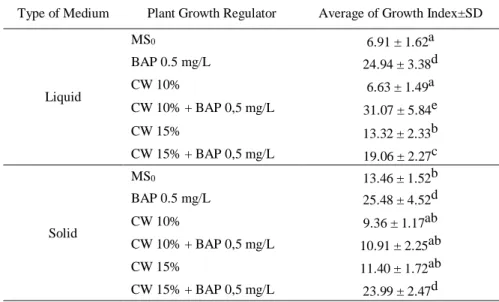
Table 1 showed the best results on MS medium supplemented with coconut water 10% + BAP 0.5 mg/L because it had the highest average growth index value (31.07 ± 5.84) and was significantly different compared to other treatments which was indicated by a different notation. Unfortunately, the growth of shoots at sixth week on liquid MS medium supplemented with coconut water 10% + BAP 0.5 mg/L increased to many shoots, rosettes, and calli.
Therefore, based on the type of medium, treatment using 0.5 mg/L BAP on liquid medium was the best because morphologically the shoots were normal and not rosettes-shaped.
TABLE 1. The Average of Growth Index of Interaction between Type of Medium and Plant Growth Regulator of Patchouli Shoots in 6 Weeks
Type of Medium Plant Growth Regulator Average of Growth Index±SD
Liquid
MS0 6.91 ± 1.62a
BAP 0.5 mg/L 24.94 ± 3.38d
CW 10% 6.63 ± 1.49a
CW 10% + BAP 0,5 mg/L 31.07 ± 5.84e
CW 15% 13.32 ± 2.33b
CW 15% + BAP 0,5 mg/L 19.06 ± 2.27c
Solid
MS0 13.46 ± 1.52b
BAP 0.5 mg/L 25.48 ± 4.52d
CW 10% 9.36 ± 1.17ab
CW 10% + BAP 0,5 mg/L 10.91 ± 2.25ab
CW 15% 11.40 ± 1.72ab
CW 15% + BAP 0,5 mg/L 23.99 ± 2.47d
CW: coconut water
Different letter notations indicate that the data is significantly different at p<0.05 based on Duncan's Multiple Range Test (DMRT)
Based on Table 2, regardless of the type of medium used, the data obtained shows different results from Table 1, where the BAP 0.5 mg/L treatment gave the best results (25.21 ± 3.58) and was significantly different from other treatments indicated by different notations. On the other hand, Table 3 proves that the type of medium used has no difference.
040004-3
TABLE 2. The Average of Growth Index from Type of Plant Growth Regulator of Patchouli Shoots in 6 weeks
Plant Growth Regulator Average of Growth Index±SD
MS0 10.18 ± 3.85ab
BAP 0,5 mg/L 25.21 ± 3.58d
CW 10% 7.99 ± 1.91a
CW 10% + BAP 0,5 mg/L 20.99 ± 11.,73c
CW 15% 12.36 ± 2.11b
CW 15% + BAP 0,5 mg/L 21.52 ± 3.43c
CW: coconut water
Different letter notations indicate that the data is significantly different at p<0.05 based on Duncan's Multiple Range Test (DMRT
TABLE 3. The Average of Growth Index from Type of Medium of Patchouli Shoots in 6 weeks
Type of Medium Average of Growth Index±SD
Solid 16.99 ± 9.66
Liquid 15.76 ± 6.99
Hydrodistillation of Leaves of Patchouli
Distillate from hydrodistillation obtained patchouli oil from plant origin (ex vitro) as much as 0.4 mL and in vitro 0.2 mL from 10 grams of dry weight of simplicia plant leaves ex vitro and shoots in vitro, respectively. Hence, the ex vitro patchouli oil yield was 4% (v/dw) and the yield of patchouli oil in vitro was 2% (v/dw).
Ultraviolet-Visible Spectrophotometry Analysis
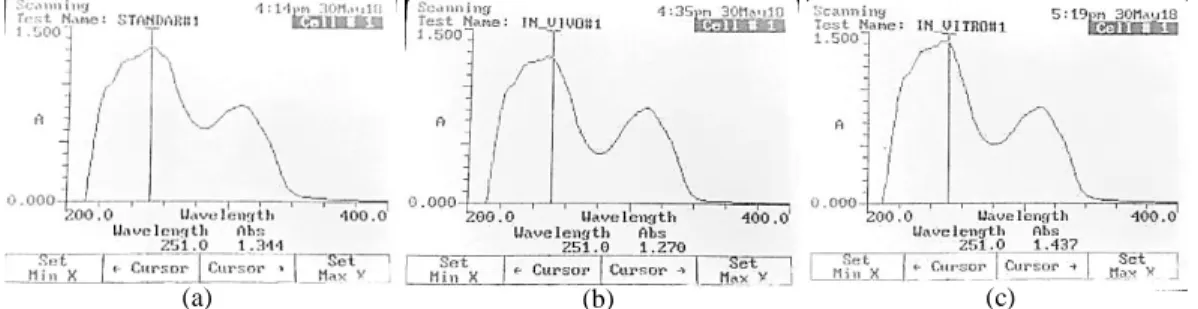
Scanning results of commercial patchouli oil samples, plant origins (ex vitro), and in vitro cultures yielded qualitatively the same spectrum profile. The similar spectral profiles shows that the chemical compounds contained in the ex vitro and in vitro oil samples are not different from commercial patchouli oil, with the maximum wavelength (λmax) of the three samples being 251 nm.
FIGURE 1. Spectrum of Patchouli Oil Samples (a) Commercial; (b) Ex Vitro; (c) In Vitro at λ= 200-400 nm with n-Hexane Eluent using UV-Vis Spectrophotometry
Gas Chromatography Analysis
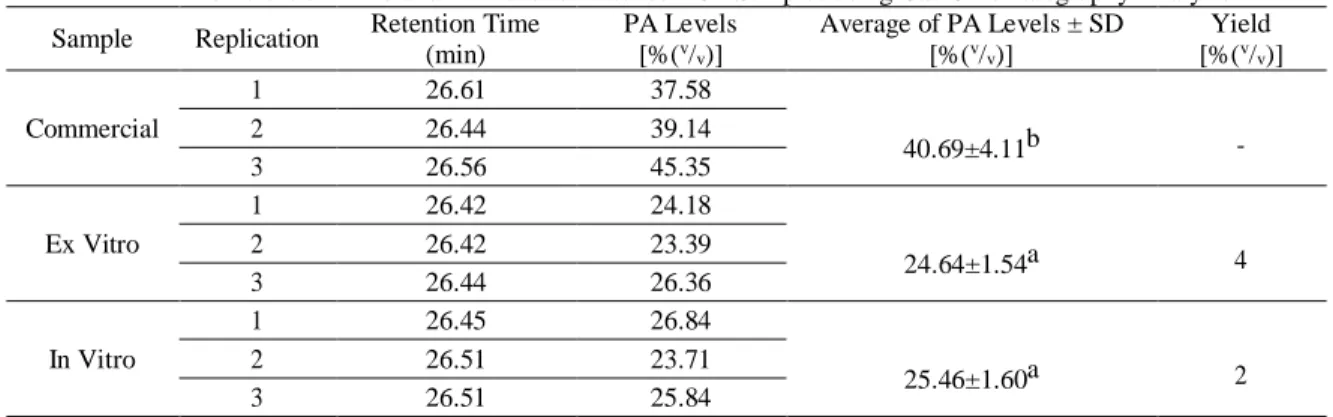
Based on the results of patchouli oil profile with GC (Figure 2), it was found that in the content of patchouli oil from commercial patchouli oil, ex vitro, and in vitro plants there are several constituents including patchouli alcohol (PA) which is the main constituent of patchouli oil. PA was found at a retention time of around 26.5 minutes and produced the highest peak compared to other compounds in all samples. PA levels of commercial patchouli oil ranged between 37.58 – 45.35% (v/v), PA levels of ex vitro patchouli oil were between 23.39 – 26.36% (v/v), and PA levels of in vitro patchouli oil were between 23.71 – 26.84% (v/v).
(a) (b) (c)
040004-4
FIGURE 2. Chromatogram of Patchouli Oil Samples (a) Commercial; (b) Ex Vitro; (c) In Vitro using Gas Chromatography with HP-INNOWax Coloumn
TABLE 4. Retention Time and PA Level of Patchouli Oil Samples using Gas Chromatography Analysis Sample Replication Retention Time
(min)
PA Levels [%(v/v)]
Average of PA Levels ± SD [%(v/v)]
Yield [%(v/v)]
Commercial
1 26.61 37.58
40.69±4.11b -
2 26.44 39.14
3 26.56 45.35
Ex Vitro
1 26.42 24.18
24.64±1.54a 4
2 26.42 23.39
3 26.44 26.36
In Vitro
1 26.45 26.84
25.46±1.60a 2
2 26.51 23.71
3 26.51 25.84
Different letter notations indicate that the data is significantly different at p<0.05 based on Duncan's Multiple Range Test (DMRT)
min
0 5 10 15 20 25 30
Norm.
0 2500 5000 7500 10000 12500 15000 17500 20000 22500
FID1 A, (NIL-BIO\INVITR-3.D)
2.972 14.945 16.325 17.555 21.799 22.827 25.523 26.514 - Patchouli Alcohol
min
0 5 10 15 20 25 30
Norm.
0 2500 5000 7500 10000 12500 15000 17500 20000 22500
FID1 A, (NIL-BIO\VV-R2.D)
2.937 12.896 15.033 16.354 17.662 25.493 26.423 - Patchouli Alcohol
min
0 5 10 15 20 25 30
Norm.
0 2500 5000 7500 10000 12500 15000 17500 20000 22500
FID1 A, (NIL-BIO\S3-NIL.D)
5.382 12.177 12.826 15.126 15.321 16.402 16.638 17.774 18.584 21.737 22.773 24.679 24.881 25.515 26.559 - Patchouli Alcohol
a
b
c
040004-5
DISCUSSION
Shoots Multiplication and Growth Index
Based on the results of this study, liquid MS medium was the best for patchouli shoot multiplication, and its growth index was also good (Table 1). This was supported by data from Table 3 which shows that there was no difference between solid and liquid MS medium types. Commercially, liquid MS medium was chosen because the required operational costs would be less than solid MS medium because it did not require a gelling agent (agar or phytagel). The use of the gelling agent in a solid medium requires about 80% of the cost of the medium, and eliminating the gelling agent from the medium can reduces the cost by up to 5.2 –fold of the total cost [16]. Moreover, De Klerk & Brugge [17] proved that growth of Dahlia hybrida shoots in vitro in liquid MS medium was four times faster than in solid MS medium. Similarly, Pati et al. [16] reported that shoot growth, poliferation, diameter, number of leaves and shoots, fresh and dry weight of Catharanthus roseus (L.) G. Don in liquid MS medium supplemented with 5 µM of BA was better than in solid medium. In contrast, Pancaningtyas [18] also proved that using liquid MS medium supplemented with 0.025 mg/L of adenine hormone can produced somatic embryo of Theobroma cacao higher (74%) than in solid medium (43%). Hence, liquid medium can be selected to produce better cultures and faster multiplication rates, as well as higher commercial profit.
Based on Table 1, there was no difference in growth index between treatments only with coconut water and without PGR. This was probably due to the insufficient cytokinin content of coconut water to increase shoot growth.
Coconut water also contains cytokinins for shoot growth which is lower than BAP, hence BAP is a better ZPT than coconut water [19]. In contrast with Surachman [6] research that used coconut water singly with concentrations of 5%, 10%, 15%, 20%, and 25% stated that coconut water 10% was the best concentration for patchouli shoot multiplication when viewed from the percentage of shoots that grew, number of shoots, shoot height, and number of leaves
Hydrodistillation of Leaves of Patchouli
The hydrodistillation of patchouli leaves ex vitro produced higher patchouli oil [4% (v/dw)] than patchouli leaves in vitro [2% (v/dw)]. The results obtained for ex vitro patchouli oil were following the literature and research conducted by Schaduw et al. [20] who also obtained patchouli oil 3.93% (v/dw). Meanwhile, the level of in vitro patchouli oil ought can reach about 2.5 – 5% (v/dw), which means that patchouli oil in vitro in this study has not reached that number. This result could be due to the small leaf size of the in vitro shoots, so the number of glandular trichomes on the leaf surface was estimated to be small, hence oil productivity was also low [21]. The use of in vitro shoots on the leaves and stems was also influential, because the stems had fewer glandular trichomes than the leaves. In addition, in vitro shoot culture was not in contact with other subjected to external pressure, so it was suspected that the shoots did not produce large amounts of glandular trichomes on the leaf surface. If glandular trichomes are produced in small quantities, the essential oil produced is also small, because glandular trichomes are the site of biosynthesis and accumulation of patchouli essential oil. Moreover, on the leaves surface there is not only glandular trichomes, but also non-glandular trichomes that do not produce essential oils. Therefore, high value of growth index does not necessarily guarantee the number of glandular trichomes present [22].
Ultraviolet-Visible Spectrophotometry Analysis
The patchouli oil profile can be seen from the wavelength spectrum produced by the three samples (commercial, ex vitro, and in vitro). The results obtained were that the three types of samples had the same spectrum profile with the same maximum wavelength (λmax), which was 251 nm, so it could be confirmed that the three patchouli oil samples contain similar chemical constituents (Figure 1). Moreover, the maximum wavelength scanning results were not in accordance with the theory, where the max of patchouli alcohol was in the range of 254 – 366 nm. This could be due to differences in the sample preparation carried out, and also diluted samples would show better spectral results [23].
040004-6
Gas Chromatography Analysis
Based on the Table 4, PA levels of ex vitro oil were significantly different from commercial patchouli oil, as well as in vitro oil to commercial patchouli oil. Ex vitro patchouli oil was obtained from small and early leaves were assumed to be still in the lag or log growth stage, so that the synthesis of secondary metabolites had not yet reached the optimum point or stationary point [24]. PA levels from in vitro patchouli oils were relatively higher than ex vitro although they were not significantly different. The reason was because in the in vitro culture system, the nutritional requirements were already available so that the environmental conditions were more controlled [25]. Ermaya et al.
[10], explained that the highest PA levels were found in the leaves compared to the roots and stems of patchouli. In this study, in vitro shoots were used, not only from the leaves, but also from the stems. Therefore, the PA levels of in vitro patchouli oil obtained were slightly higher than ex vitro and were still below commercial patchouli oil. Bunrathep et al. [15], also stated an increase in secondary metabolites of PA (alcohol sesquiterpenes) can be done by giving a precursor such as cis-farnesol.
The GC profiles for all samples were the same (Figure 2), with the retention time for the PA around 26.5 minutes.
Meanwhile, the research conducted by Hu et al. [26], shows that the retention time of PA was 29.21 minutes, while the research conducted by Paul et al. [27], shows a retention time of 23.46 minutes. PA has a high boiling point, which is 150 – 160oC at a pressure of 8 mmHg. The higher the boiling point of the compound, the longer the retention time.
Therefore, the retention time of PA is longer than other compounds in patchouli oil [28].
In this study, patchouli oil of in vitro culture was derived from several patchouli shoots consisting of stem nodes and leaves, while the ex vitro patchouli only used the leaves. Hence, this research can only confirm the presence or absence of PA contained and its levels in these samples. Further research is needed to compare ex vitro and in vitro patchouli only in the leaves.
CONCLUSION
The addition of natural plant growth regulator such as coconut water was not good enough for in vitro shoot multiplication and growth. The most suitable medium for in vitro shoot explant multiplication was liquid MS medium supplemented with BAP 0.5 mg/L. The essential oil profiles were qualitatively and quantitatively the same for in vitro and ex vitro essential oils.
ACKNOWLEDGEMENT
This research was funded by Hibah Penelitan Dasar Unggulan Perguruan Tinggi (PDUPT) The Ministry of Education, Culture, Research and Technology (Kemdikbudristek) 2021 with contract number 013/SP-Lit/LPPM- 01/RistekBRIN/Multi/FTB/lII/2021 ; 013/SP-Lit/AMD/LPPM-01/Dikbudristek/Multi/FTB/VII/ 2021 (on behalf of Dr. Ir. Popy Hartatie Hardjo, M.Si.).
REFERENCES
[1] H. S. Kusuma, and M. Mahfud . J Appl Res Med Aromat Plants. 46–54, 4 (2017).
[2] T. A. van Beek, and D Joulain. Flavour Fragr J. 6–51, 33(1) (2018).
[3] Y. Nuryani, Budidaya Tanaman Nilam. Balai Penelitian Tanam Rempah dan Aromatik, 2006.
[4] H. Jin, Z. C. Deng, and H. He. Plant Omics. 322–327, 7(5) (2014).
[5] K. N . Nova, and S. F. Syahid.. J Penelit Tanam Ind. 125, 18(3) (2020).
[6] D. Surachman. Bul Tek Pertan. 31–33, 16(1) (2011).
[7] M. K. Swamy, and U. R. Sinniah. Ind Crops Prod. 161–176, 87, (2016).
[8] S. Vyas, M. S. Rao, R. K. Suthar, and S. D. Purohit. Med Aromat Plant Sci Biotechnol. 96–100, 2(2) (2008).
[9] T. Rihayat, A. Putra, and E. Elwina. J Sains dan Teknol Reaksi. 1(1) (2016).
[10] D. Ermaya, S. P. Sari, A. Patria, F. Hidayat, and F. Razi. IOP Conf Ser Earth Environ Sci. 365(1) (2019).
[11] H. S. Kusuma, and M. Mahfud. RSC Adv. 1336–1347, 7(3) (2017).
[12] N. Harimurti, T. H. Soerawidjaja, D. Sumangat, and Risfaheri. J Pascapanen. 1–10, 9(1) (2012).
[13] N. Kongkathip, S. A. Pornpat, B. Kongkathip, Y. Pankaew, M. Tanasotnbat, and P. Udomkusonsri. Kasetsart J - Nat Sci. 519–525, 43(3) (2009).
040004-7
[14] M. E. Syahputra, D. Parasandi, and M. Mahfud. J Tek ITS. 602–604, 6(2) (2017).
[15] S. Bunrathep, G. B. Lockwood, T. Songsak, and N. Ruangrungsi. ScienceAsia. 293–296, 32(3) (2006).
[16] P. K. Pati, J. Kaur, and P. Singh. Plant Cell Tissue Organ Cult. 299–307, 105(3) (2011).
[17] G. J. De Klerk, and J. Ter Brugge. 542–547, 127(4) (2011).
[18] S. Pancaningtyas S. Pelita Perkeb. 10–19, 29(1) (2013).
[19] S. A. Saefas, S. Rosniawaty, and Y. Maxiselly. J Kultivasi. 368–372, 16(2) (2017).
[20] J. Schaduw, J. Pojoh, and T. Djabar. J Ilm Farm Poltekkes Manado. 96568, 3(2) (2012).
[21] M. Mucciarelli, S. Scannerini, C. Bertea, and M. Maffei. New Phytol. 579–591, 158(3) (2003).
[22] A. Rusydil, N. Talip, J. Latip, R. A. Rahman, and I. Sharif. Aust J Crop Sci. 744–749, 7(6) (2013).
[23] T. E. Purbaningtias, A. C. Aprilia, and L. Fauzi’ah. AIP Conf Proc. 1–6, 1911 (2017).
[24] M. J. Muthaiya, P. Nagella, M. Thiruvengadam, and A. A. Mandal. J Crop Sci Biotechnol. 143–149, 16(2) (2013).
[25] A. Ramakrishna, and G. A. Ravishankar. Plant Signal Behav. 1720–1731, 6(11) (2011).
[26] L. F. Hu, S. P. Li, H. Cao, J. J. Liu, J. L. Gao, F. Q. Yang, et al. J Pharm Biomed Analysis. 200–206, 42(2) (2006).
[27] A. Paul, G. Thapa, A. Basu, P. Mazumdar, M. C. Kalita, and L. Sahoo. Ind Crops Prod. 366–374, 32(3) (2010).
[28] T. M. Asnawi, P. N. Alam, H. Husin, and M. Zaki. IOP Conf Ser Mater Sci Eng. 345(1) (2018).
040004-8
Volume 2583: THE 5th INTERNATIONAL CONFERENCE ON
AGRICULTURE AND LIFE SCIENCE 2021 (ICALS 2021)
Accelerating Transformation in Industrial Agriculture Through Sciences Implementation
By Peng Zhang and Tri Agus Siswoyo Number of Volumes: 2
Publication date: August 2023 ISBN: 9780735442160
Volume 2583 is the proceedings of THE 5th INTERNATIONAL CONFERENCE ON AGRICULTURE AND LIFE SCIENCE 2021 (ICALS 2021) (3–4 November 2021, Jember, Indonesia)
Book type
Softcover Book, $315.00
Add to cart
Return to: AIP Conference Proceedings Return to: AIP Publishing Books Contact Us
Help Login Cart
Volume 2583: THE 5th INTERNATIONAL CONFERENCE ON AGRICULTURE AND LIFE SCIENCE 2021 (ICALS 2021)
Title information
About Us Contact Us Privacy Policy Terms & Conditions Copyright 2017 AIP Publishing LLC. All rights reserved.
Powered by Sheridan Press
Summary of this volume: The 5th International Conference on Agriculture and Life Sciences (ICALS 2021) was organized to continue the success story of the three previous conferences. The focus of discussion in this conference was Accelerating Transformation in Industrial Agriculture Through Sciences Implementation. ICALS 2021 was remotely attended by 1,262 academicians, researchers, students, farmers, private businesses, and government-workers. The topics of discussion were (1) agronomy and plant protection, (2) food science and smart education for plant based-diet, (3) biotechnology and biomolecule, (4) agriculture engineering and technology, (5) smart business for agriculture and healthy food, and (6) smart social and political in industrial agriculture.
These proceedings will be of interest to: graduate or doctorate researchers.
For further information about this volume: Please view the table of contents available on AIP Publishing's Scitation platform: Volume 2583 table of contents.
Number of Volumes: 2 Pages: 1,024
Language: English
Publisher: AIP Publishing Details
RESEARCH ARTICLE | JANUARY 13 2023
Committees: The 5th International Conference on Agriculture and Life Science 2021 (ICALS 2021)
AIP Conference Proceedings 2583, 010002 (2023) https://doi.org/10.1063/12.0014292
Topics
Governing committees,Conference
This content is only available via PDF.
Article PDF first page preview
You do not currently have access to this content.
Sign in
Don't already have an account? Register
Preface: The 5th International Conference on Agriculture and Life Science 2021 (ICALS 2021)
AIP Conference Proceedings 2583, 010001 (2023) doi:https://doi.org/10.1063 /12.0013388
Committees: The 5th International Conference on Agriculture and Life Science 2021 (ICALS 2021)
AIP Conference Proceedings 2583, 010002 (2023) doi:https://doi.org/10.1063 /12.0014292
Effect of application of chicken manure and Pseudomonas fluorescens bacteria on growth and yield of shallot (Allium ascalonicum L.)
Sri Hartatik; Diyah Ayuk Saputri
AIP Conference Proceedings 2583, 020001 (2023) doi:https://doi.org/10.1063/5.0117533
The effect of mutagen ethyl methane sulfonate and potassium treatment on organic substances of tomato
Slameto; Sigit Soeparjono; Raden Soedrajad; Ketut Anom Wijaya; Oria Alit Farisi; Distiana Wulanjari
AIP Conference Proceedings 2583, 020002 (2023) doi:https://doi.org/10.1063/5.0119379
Application of vermicompost fertilizer and mycorrhizal fungi on growth of Biduri (Calotropis gigantea)
Samanhudi; Ahmad Yunus; Muji Rahayu; Mochammad Danny Sukardan;
Agung Hasudungan
AIP Conference Proceedings 2583, 020003 (2023) doi:https://doi.org/10.1063/5.0116574
Efforts to reduce soil compaction in pineapple plantations using plants rotation with banana Cavendish in Central Lampung, Indonesia
Winih Sekaringtyas Ramadhani; Soemarno; Ali Rahmat; Priyo Cahyono;
Fitri Wijayanti
AIP Conference Proceedings 2583, 020004 (2023) doi:https://doi.org/10.1063/5.0117532
High yield potential of fifteen soybean accessions with different planting methods
Runik Dyah Purwaningrahayu
AIP Conference Proceedings 2583, 020005 (2023) doi:https://doi.org/10.1063/5.0116199
Sago (Metroxylon sago, Rottb) genetic resources in Jayapura Regency: A case study in Waibu district PRELIMINARY
View article PDF
View article PDF
AGRONOMY AND PLANT PROTECTION
View article PDF Abstract
View article PDF Abstract
View article PDF Abstract
View article PDF Abstract
View article PDF Abstract
y p g y y
Alberth Soplanit; Merlin K. Rumbarar; Niki E. Lewaherilla
AIP Conference Proceedings 2583, 020006 (2023) doi:https://doi.org/10.1063/5.0116358
The effect of growing media composition and coconut water concentration on the yield and quality of red chili (Capsicum annuum L.)
Sigit Soeparjono
AIP Conference Proceedings 2583, 020007 (2023) doi:https://doi.org/10.1063/5.0119376
Isolation and characterization of rhizobacteria, Bacillus spp.
for controlling bacterial leaf blight and increasing shallot yield
Yulmira Yanti; Hasmiandy Hamid; Nurbailis
AIP Conference Proceedings 2583, 020008 (2023) doi:https://doi.org/10.1063/5.0116763
Increasing yield of waxy maize following paddy rice through mycorrhiza-biofertilization and additive intercropping with several rows of peanut
Nihla Farida; Wayan Wangiyana
AIP Conference Proceedings 2583, 020009 (2023) doi:https://doi.org/10.1063/5.0116678
Intercropping red rice genotypes with mungbean and application of mycorrhiza-biofertilizer to increase rice yield with reduced inorganic fertilizer doses
Wayan Wangiyana; I. G. P. M. Aryana; N. W. D. Dulur
AIP Conference Proceedings 2583, 020010 (2023) doi:https://doi.org/10.1063/5.0116676
Non-preference for oviposition and damage intensity on soybean genotypes by Bemisia tabaci
Marida Santi Yudha Ika Bayu; Apri Sulistyo; Yusmani
AIP Conference Proceedings 2583, 020011 (2023) doi:https://doi.org/10.1063/5.0119453
Evaluation of maize-soybean intercropping on specific dry land in Gunungkidul – Yogyakarta
Kristamtini; Setyorini Widyayanti; Endang Wisnu Wiranti
AIP Conference Proceedings 2583, 020012 (2023) doi:https://doi.org/10.1063/5.0116328
The effect of root growth regulator and environmental sanitation of salacca edulis seedling on Sleman
Reki Hendrata; Damasus Riyanto
AIP Conference Proceedings 2583, 020013 (2023) doi:https://doi.org/10.1063/5.0123970 View article PDF
Abstract
View article PDF Abstract
View article PDF Abstract
View article PDF Abstract
View article PDF Abstract
View article PDF Abstract
View article PDF Abstract
View article PDF Abstract
The effectiveness of giving organic matter to the productivity of tomato plants
Soetriono; Oria Alit Farisi; Basuki; Sigit Prastowo; Uyun Erma Malika;
Diah Ayu
AIP Conference Proceedings 2583, 020014 (2023) doi:https://doi.org/10.1063/5.0119712
Growth and quality of seed bulb of four garlic varieties on different NPK level at Alahan Panjang, Indonesia
Nilla Kristina; Yusniwati; Warnita; Elara Resigia
AIP Conference Proceedings 2583, 020015 (2023) doi:https://doi.org/10.1063/5.0116061
Length of the wet seasons and its effect on food crop productivity (rice, corn, and soybean)
Razhika Faradila; Cahyoadi Bowo
AIP Conference Proceedings 2583, 020016 (2023) doi:https://doi.org/10.1063/5.0115799
An analysis on the relationship and genetic diversity of Indonesian cassava accessions (Manihot esculenta)
Sholeh Avivi; Fajar Firmansyah; Bella Rhea Lavifa Sanjaya; Didik Pudji Restanto
AIP Conference Proceedings 2583, 020017 (2023) doi:https://doi.org/10.1063/5.0117487
Influence of foliar spraying of Moringa oleifera extract as biostimulant on growth of Singgalang cabbage (Brassica oleraceae var. capitata L.)
Zozy Aneloi Noli; Sintia Rahmadani; Putri Aliyyanti
AIP Conference Proceedings 2583, 020018 (2023) doi:https://doi.org/10.1063/5.0117059
Application of biopesticides to Nilaparvata lugens Stal. and Triporyza incertulas L. in Jember, East Java, Indonesia
Wagiyana
AIP Conference Proceedings 2583, 020019 (2023) doi:https://doi.org/10.1063/5.0116697
Pollinating insects in honey pumpkin (Cucurbita moschata Dusch) and sweet corn (Zea mays L. saccharata Sturt) agroecosystems
Wilyus; Hamdan Maruli Siregar; Mikha Rosio Hutagaol
AIP Conference Proceedings 2583, 020020 (2023) doi:https://doi.org/10.1063/5.0116313
Insecticidal activity of Syzygium aromaticum leaves and Allium sativum bulbs extracts against subterranean termites Macrotermes gilvus Hagen (Blattodea: termitidae)
Junianto S. Batubara; Idham Sakti Harahap; Dadang
AIP Conference Proceedings 2583, 020021 (2023) doi:https://doi.org/10.1063/5.0116179 View article PDF
Abstract
View article PDF Abstract
View article PDF Abstract
View article PDF Abstract
View article PDF Abstract
View article PDF Abstract
View article PDF Abstract
View article PDF Abstract
Intensity of purple spot disease due to attack Alternaria porri (Ellis) Cif. in 5 varieties of garlic (Allium sativum L.)
Yenny Muliani; Eti Heni Krestini; Junengsih; Mia Nurul Milani
AIP Conference Proceedings 2583, 020022 (2023) doi:https://doi.org/10.1063/5.0116420
Morphology and genetic diversity of Fusarium spp. causes of shallot basal plate rot diseases from lowlands and highlands of North Sumatra
M. Utami; Hasanuddin; I. Safni
AIP Conference Proceedings 2583, 020023 (2023) doi:https://doi.org/10.1063/5.0119735
Diversity and species composition of weeds in rice cultivation, Tarakan Island
Abdul Rahim; Alisa; Aditya Murtilaksono; Muh Adiwena; Nurmaisah AIP Conference Proceedings 2583, 020024 (2023) doi:https://doi.org/10.1063/5.0119059
Responses of roots and leaves in nine varieties of chili pepper (Capsicum annuum L.) to water saturated rhizosphere
Erna Siaga; Jun-Ichi Sakagami; Benyamin Lakitan; Shin Yabuta; Kartika Kartika; Laily Ilman Widuri
AIP Conference Proceedings 2583, 020025 (2023) doi:https://doi.org/10.1063/5.0116389
Adaptation test for shallots varieties in Kutai Kartanegara Regency, East Kalimantan Province
Yossita Fiana; Muhamad Hidayanto
AIP Conference Proceedings 2583, 020026 (2023) doi:https://doi.org/10.1063/5.0116719
Physiological response of three large-seeded soybean genotypes under drought and waterlogged stress conditions
Kisman; A. Farid Hemon; Sumarjan; Suprayanti Martia Dewi
AIP Conference Proceedings 2583, 020027 (2023) doi:https://doi.org/10.1063/5.0116156
Contribution of genotype and Bayfolan foliar fertilizer on performance of arabica coffee seedlings and its genetic component
Sabam Malau; Rianto Sirait; Ferlist Rio Siahaan; Maria Rumondang Sihotang
AIP Conference Proceedings 2583, 020028 (2023) doi:https://doi.org/10.1063/5.0116126
Agronomic characteristics and potential of local variety of citronella oil in Cianjur Regency, West Java
Agus Ruswandi; Aji Winara; Wara Asfiya; Cheppy Syukur; Iskandar Ishaq;
View article PDF Abstract
View article PDF Abstract
View article PDF Abstract
View article PDF Abstract
View article PDF Abstract
View article PDF Abstract
View article PDF Abstract
Bambang Susanto; Yonky Indrajaya
AIP Conference Proceedings 2583, 020029 (2023) doi:https://doi.org/10.1063/5.0116368
Response of growth and production of sweet corn plants on ex-cane soil
D. Setyorini; R. U. Fitria; F. N. Azis; T. Sudaryono; H. Subagio; E.
Fidiyawati
AIP Conference Proceedings 2583, 020030 (2023) doi:https://doi.org/10.1063/5.0117540
The soil liming in a sub-watershed by using exchangeable aluminium and effective cation exchange capacity methods
Cahyoadi Bowo; Nadiva Aulia Zahni
AIP Conference Proceedings 2583, 020031 (2023) doi:https://doi.org/10.1063/5.0116213
Identification of Simplicillium lanosoniveum at suppressive soil potential areas in Brantas watershed – Indonesia
Ambar Susanti; Primaadi Airlangga; Ino Angga Putra
AIP Conference Proceedings 2583, 020032 (2023) doi:https://doi.org/10.1063/5.0116197
Optimation of factors affecting rubber farmer revenue to preserve their household revenue
Iman Satra Nugraha; Aprizal Alamsyah; Andi Nur Cahyo; Dwi Shinta Agustina; Lina Fatayati Syarifa
AIP Conference Proceedings 2583, 020033 (2023) doi:https://doi.org/10.1063/5.0115819
Outlying observation in stability analysis of genotype: AMMI vs Huehn method
Halimatus Sa’diyah; Alfian Futuhul Hadi
AIP Conference Proceedings 2583, 020034 (2023) doi:https://doi.org/10.1063/5.0117661
Azolla compost-based organomineral fertilizer for increasing N uptake, growth, and yield of green onion
Marwanto; Melisa Oktaviani Silitinga; Yudhi Harini Bertham; Merakati Handajaningsih; Prasetyo
AIP Conference Proceedings 2583, 020035 (2023) doi:https://doi.org/10.1063/5.0116207
The effectiveness application of urea fertilizer coated with compost of empty oil palm bunch in tablet formula on growth, yield, and N content of celery
Merakati Handajaningsih; Marwanto; Sri Mulyani Lubis; Teguh Adiprasetyo; Prasetyo
AIP Conference Proceedings 2583, 020036 (2023) doi:https://doi.org/10.1063/5.0116209 View article PDF
Abstract
View article PDF Abstract
View article PDF Abstract
View article PDF Abstract
View article PDF Abstract
View article PDF Abstract
View article PDF Abstract
View article PDF Abstract
Compost tea as biofungicides to suppress Sclerotium rolfsii on soybean (Glycine max L. Merr.)
Supratman Al Rizal Moniteria; M. Taufik Fauzi; Ruth Stella Petrunella Thei AIP Conference Proceedings 2583, 020037 (2023) doi:https://doi.org/10.1063/5.0116167
Viral diseases of sugarcane in Indonesia: Occurrence notes, pathogenic characteristics and management strategies
Lilik Koesmihartono Putra; Ari Kristini; Wiwit Wicaksono Jati
AIP Conference Proceedings 2583, 020038 (2023) doi:https://doi.org/10.1063/5.0116089
The phytoremediation potential of several plants in heavy- metal-polluted tropical soils
Septi Nurul Aini; Gianluigi Silva; Henrie Buchari; Abdul Kadir Salam AIP Conference Proceedings 2583, 020039 (2023) doi:https://doi.org/10.1063/5.0116581
The soil available-potassium enrichment by several potential tropical weeds
Abdul Kadir Salam; N. Sriyani; S. K. Dewi; M. Utomo
AIP Conference Proceedings 2583, 020040 (2023) doi:https://doi.org/10.1063/5.0116362
Response of 16 rice varieties (Oryza sativa L.) to high temperature at vegetative stage
Prita Sari Dewi; Ida Widiyawati; Kartika Ferrawati; Aldakris Afifah Nursela AIP Conference Proceedings 2583, 020041 (2023) doi:https://doi.org/10.1063/5.0116158
Tolerance level of rice (Oryza sativa L.) to aluminum stress in ultisol soil
Eries Dyah Mustikarini; Ratna Santi; Gigih Ibnu Prayoga; Mardian Hasanah AIP Conference Proceedings 2583, 020042 (2023) doi:https://doi.org/10.1063/5.0117338
Propagation of stem cuttings of some ornamental plants at various Rootone-F concentrations
Hikma Ellya; Nurlaila; Nukhak Nufita Sari; Rila Rahma Apriani; Ronny Mulyawan
AIP Conference Proceedings 2583, 020043 (2023) doi:https://doi.org/10.1063/5.0118355
Agronomic characteristics of soybean production determination in two cultivation techniques attacked by Etiella zinckenella in dry land
B. A. Patu; M. Sarjan; Tarmizi; Tantawizal
AIP Conference Proceedings 2583, 020044 (2023) doi:https://doi.org/10.1063/5.0117130 View article PDF
Abstract
View article PDF Abstract
View article PDF Abstract
View article PDF Abstract
View article PDF Abstract
View article PDF Abstract
View article PDF Abstract
View article PDF Abstract
Effect of lignocellulolytic fungi to biodegradation of different type of organic waste derived from cocoa production
Intan Nirmalasari; Erwin Prastowo; Anisa Aulia Rahma; Gracia Melsiana Aldini
AIP Conference Proceedings 2583, 040001 (2023) doi:https://doi.org/10.1063/5.0119710
Morphological performance of rambutan (Nephelium lappaceum L.) for biodiesel raw materials
Triyas Vinandita; Endang Yuniastuti; Samanhudi
AIP Conference Proceedings 2583, 040002 (2023) doi:https://doi.org/10.1063/5.0116458
Free radical study of Papua’s candy as consumption culture of Papuans
Livy Febria Tedjamulia; Ivana Josephin Purnama; Jasmine Veldina Gegono; Achmad Ridwan Ariyantoro
AIP Conference Proceedings 2583, 040003 (2023) doi:https://doi.org/10.1063/5.0115806
Utilization of coconut water for in vitro shoots multiplication of Pogostemon cablin Benth. ‘Sidikalang’ and essential oil profile
Natasha Florenika; Go Gaby Eliazar; Wina Dian Savitri; Didik Pudji Restanto; Popy Hartatie Hardjo
AIP Conference Proceedings 2583, 040004 (2023) doi:https://doi.org/10.1063/5.0118813
Characterization and evaluation of lipase inhibitory activity of Raja Sereh (Musa sapientum) banana kombucha enriched with lactic acid bacteria
Yati Maryati; Agustine Susilowati; Hani Mulyani; Euis Filaila; Hakiki Melanie; Setyani Budiari; Aspiyanto
AIP Conference Proceedings 2583, 040005 (2023) doi:https://doi.org/10.1063/5.0115824
Soil structures engineered with the addition of soil stabilizing agents and exopolysaccharide-producing bacteria
Arthur F. C. Regar
AIP Conference Proceedings 2583, 060001 (2023) doi:https://doi.org/10.1063/5.0124178
Using Landsat to track land use and land cover (LULC) change from 1970 to 2020 in Mayang watershed, East Jawa
Mohamad Wawan Sujarwo; Farid Lukman Hakim; Indarto Indarto
AIP Conference Proceedings 2583, 060002 (2023) doi:https://doi.org/10.1063/5.0117111
BIOTECHNOLOGY AND BIOMOLECULE
View article PDF Abstract
View article PDF Abstract
View article PDF Abstract
View article PDF Abstract
View article PDF Abstract
AGRICULTURAL ENGINEERING AND TECHNOLOGY
View article PDF Abstract
Using Sentinel image to study land cover change from 2015 to 2019 in Probolinggo and Pasuruan regencies
Ayu Rekno Wati; Indarto Indarto; Bayu Taruna Wijaya Putra
AIP Conference Proceedings 2583, 060003 (2023) doi:https://doi.org/10.1063/5.0117114
The effect of climate change perception on adaptation strategy: Evidence from potato farmers in East Java Indonesia
Syafrial; Dwi Retnoningsih; Tina Sripurwanti; Moh. Shadiqur Rahman AIP Conference Proceedings 2583, 060004 (2023) doi:https://doi.org/10.1063/5.0116147
Evaluation of service quality at the “Merah Putih” gamma irradiator using a fuzzy SERVQUAL based method
Indra Milyardi; Nunik Madyaningarum; Rizka Fitriana
AIP Conference Proceedings 2583, 060005 (2023) doi:https://doi.org/10.1063/5.0116904
Effect of temperature and drying time on the physical properties of patik mas (Euphorbia heterophylla) leaf tea
Edo Hariyanto; R. Amilia Destryana; Eko Adi Sumitro
AIP Conference Proceedings 2583, 060006 (2023) doi:https://doi.org/10.1063/5.0116144
Five decades of land use and land cover change in Bedadung watershed: Learning from Landsat data
Farid Lukman Hakim; Indarto Indarto; Entin Hidayah; Bowo Eko Cahyono AIP Conference Proceedings 2583, 060007 (2023) doi:https://doi.org/10.1063/5.0117116
The effect of composted oyster mushroom baglog waste on rice growth and productivity in acid sulfate soils
Jumar; Riza Adrianoor Saputra; Muhammad Imam Nugraha; Ahmad Ghazali
AIP Conference Proceedings 2583, 060008 (2023) doi:https://doi.org/10.1063/5.0116297
Kinetics reaction of the Flynn Wall Ozawa method on sawdust pyrolisis using a small scale pyrolysis apparatus
Alif Gita Arumsari; Jemmy Wibowo; Rasino Setiawan; Mukhammad Yazid Fadlulloh; Pandit Hernowo
AIP Conference Proceedings 2583, 060009 (2023) doi:https://doi.org/10.1063/5.0116080
Performance of ultrafiltration membrane in separating valuable components from hydrolyzed corn (Zea mays var.
indentata) for fortificant of natural folic acid
Aspiyanto; Agustine Susilowati; Hakiki Melanie; Yati Maryati View article PDF
Abstract
View article PDF Abstract
View article PDF Abstract
View article PDF Abstract
View article PDF Abstract
View article PDF Abstract
View article PDF Abstract
View article PDF Abstract
p y g y
AIP Conference Proceedings 2583, 060010 (2023) doi:https://doi.org/10.1063/5.0115871
Resource potential in agricultural areas based on farmer corporations in Nglanggeran Village, Patuk, Gunungkidul, Yogyakarta
Retno Utami Hatmi; Purwaningsih; Asep Nurhikmat; C. Astri Wirasti;
Gunawan
AIP Conference Proceedings 2583, 060011 (2023) doi:https://doi.org/10.1063/5.0117008
Potency of UF system in concentrating corn (Zea mays var.
indentata) hydrolyzate as fortificant of natural folic acid
Agustine Susilowati; Yati Maryati; Aspiyanto; Hakiki Melanie
AIP Conference Proceedings 2583, 060012 (2023) doi:https://doi.org/10.1063/5.0115856
The effect of hot compressed water on ion released of a wasted biomass treatment
Miftahul Choiron; Seishu Tojo
AIP Conference Proceedings 2583, 060013 (2023) doi:https://doi.org/10.1063/5.0116208
Land suitability evaluation 3D method for mapping the feasibility of the Gambir plantation (Uncaria Gambir. Roxb) in West Sumatra, Indonesia
Aflizar; Jamaluddin; Amrizal
AIP Conference Proceedings 2583, 060014 (2023) doi:https://doi.org/10.1063/5.0116402
Effectiveness of application of organic fertilizer on plant growth and yield of taro on dry land
Andi Masnang; Dyah Budibruri Wibaningwati
AIP Conference Proceedings 2583, 060015 (2023) doi:https://doi.org/10.1063/5.0116537
Purifying pollutant indicators in tofu factory wastewater using a multi soil layering system
Aflizar; Rini Mayyuliani; Jamaluddin; Amrizal
AIP Conference Proceedings 2583, 060016 (2023) doi:https://doi.org/10.1063/5.0116427
Bioactivities and organoleptic analysis of dark chocolate probiotic as a functional beverage
Hani Mulyani; Andini Sundowo; Euis Filailla; Minarti
AIP Conference Proceedings 2583, 090001 (2023) doi:https://doi.org/10.1063/5.0115842 View article PDF
Abstract
View article PDF Abstract
View article PDF Abstract
View article PDF Abstract
View article PDF Abstract
View article PDF Abstract
View article PDF Abstract
FOOD SCIENCES AND SMART EDUCATION FOR PLANT-BASED DIET
View article PDF Abstract
Machine learning and thin layer drying model of gembili (Dioscorea sp.)
Tri Hadi Jatmiko; Yuniar Khasanah
AIP Conference Proceedings 2583, 090002 (2023) doi:https://doi.org/10.1063/5.0116387
Analysis of physical resistance of black grape (vitis vinivera) exposed to extremely low frequency (ELF) magnetic field with intensity of 300µT and 500µT
Sudarti; Enik Wasiah Niati; Sherly Nur Laili
AIP Conference Proceedings 2583, 090003 (2023) doi:https://doi.org/10.1063/5.0124188
Analysis active compounds of Carica papaya, Averrhoa bilimbi, and Chromolaena odorata leaves from geothermal area
Tahara Dilla Santi; Radhiah Zakaria; Aditya Candra; M. Dharma Nauval AIP Conference Proceedings 2583, 090004 (2023) doi:https://doi.org/10.1063/5.0116236
Antioxidant, anti-microbial, and physical properties improvement of turmeric (Curcuma domestica Val.) effervescent tablets with stevia (Stevia rebaudiana) leaf powder
Maria Belgis; Ardiyan Dwi Masahid; Fitri Aulia Rahmawati; Nur Fathonah Sadek
AIP Conference Proceedings 2583, 090005 (2023) doi:https://doi.org/10.1063/5.0116410
Notes on edible poaceae collected at Eka Karya Bali Botanic Garden
Arrohmatus Syafaqoh Li’aini; Farid Kuswantoro
AIP Conference Proceedings 2583, 090006 (2023) doi:https://doi.org/10.1063/5.0117202
Antibacterial activity of fermented katuk leaves (Sauropus androgynus (L.) Merr.) against gram positive bacteria and its free radical inhibitory
Hani Mulyani; Yati Maryati; Euis Filailla; Hakiki Melanie; Setyani Budiari AIP Conference Proceedings 2583, 090007 (2023) doi:https://doi.org/10.1063/5.0115839
Separation and concentration of phycocyanin from Spirulina sp. using microfiltration membrane for natural pigment
Hakiki Melanie; Aspiyanto; Hani Mulyani; Euis Filailla; Nina Artanti;
Agustine Susilowati; Syelvira Febrianelly; Awalina Satya
AIP Conference Proceedings 2583, 090008 (2023) doi:https://doi.org/10.1063/5.0115837
Gracilaria verrucose flour as a nutraceutical source: A study of various treatments on the stability of nutritional content and antioxidants
View article PDF Abstract
View article PDF Abstract
View article PDF Abstract
View article PDF Abstract
View article PDF Abstract
View article PDF Abstract
View article PDF Abstract
and antioxidants
Lukman Hudi; Wignyanto; Irnia Nurika; Nur Hidayat
AIP Conference Proceedings 2583, 090009 (2023) doi:https://doi.org/10.1063/5.0116534
Effect of fermentation on the physicochemical properties of Indonesian indigenous Xanthosoma undipes K. Koch flour
Yeyen Prestyaning Wanita; Retno Utami Hatmi; Elda Nurnasari
AIP Conference Proceedings 2583, 090010 (2023) doi:https://doi.org/10.1063/5.0117104
The sensory profile of unfermented cocoa beans and its changes after moisture treatments
Ariza Budi Tunjung Sari; Maria Belgis; Winda Amilia; Fauzan Mufid Murtadlo
AIP Conference Proceedings 2583, 090011 (2023) doi:https://doi.org/10.1063/5.0117087
Investigating physical and visual alterations of oven-dried cabya (Piper retrofractum Vahl.)
Hamzah Fansuri; Muhamad Purnomo Adi; Moh. Tsabit Abdullah; Mojiono AIP Conference Proceedings 2583, 090012 (2023) doi:https://doi.org/10.1063/5.0115788
Utilization of moisture sorption isotherm in predicting shelf- life of salted-roasted peanut
Umi Laila; Rifa Nurhayati; Yuniar Khasanah; Dini Ariani
AIP Conference Proceedings 2583, 090013 (2023) doi:https://doi.org/10.1063/5.0117174
Exploring daily diet and physical activity habit changes associated with COVID-19 pandemic: A preliminary study in Java
R. Amilia Destryana; Anisa Aprilia; Aryo Wibisono
AIP Conference Proceedings 2583, 090014 (2023) doi:https://doi.org/10.1063/5.0117090
Microwave-assisted extraction and characterisation of pectin from pineapple biomass
Meldana Lumbanraja; Nissa Nurfajrin Solihat; Dewi Sondari; Riska Surya Ningrum; Dwi Ajias Pramasari; Euis Hermiati; Bambang Nurhadi; Yusuf Wibisono; Riksfardini Annisa Ermawar
AIP Conference Proceedings 2583, 090015 (2023) doi:https://doi.org/10.1063/5.0116775
Novelty and smart education of microalgae Spirulina and Chlorella sp. based sausages
Jasmine Veldina Gegono; Livy Febria Tedjamulia; Hanif Fakhri Suryono;
Ivana Josephin Purnama; Septi Wahyu Wijayanti; Esti Widowati; Eksa Rusdiyana
AIP Conference Proceedings 2583, 090016 (2023) doi:https://doi.org/10.1063/5.0116602 View article PDF
Abstract
View article PDF Abstract
View article PDF Abstract
View article PDF Abstract
View article PDF Abstract
View article PDF Abstract
View article PDF Abstract
View article PDF Abstract