Malacological Review, 1988, Suppl. 4: 88-128
CERITHIOIDEAN PHYLOGENY Richard S. Houbrick
ABSTRACT
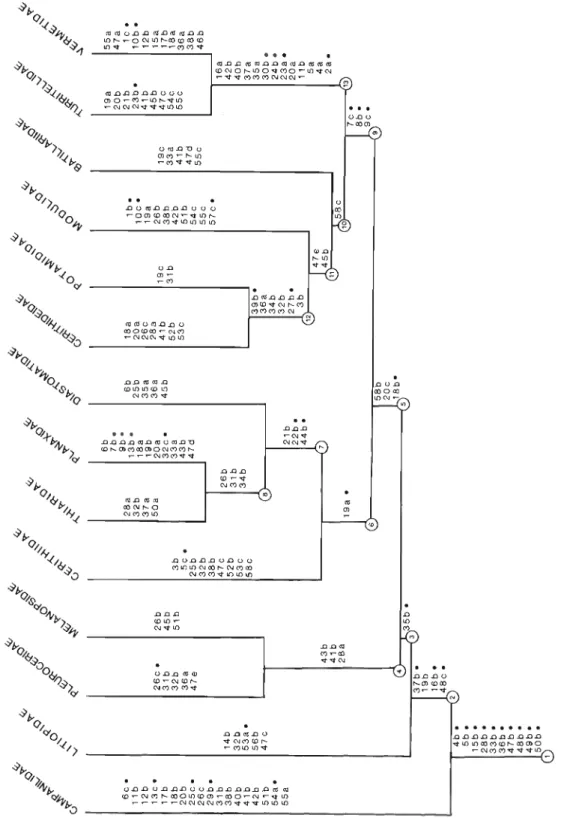
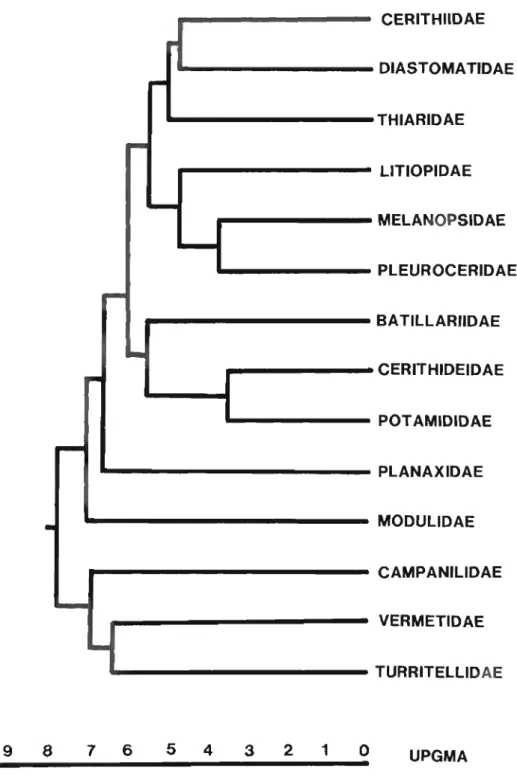
Phylogenetic analysis of fifteen families of the superfamily Cerithioidea, using 58 characters derived from shell, radula, soft anatomy, gametes, and spawn was made, using the PHYSYS algorithm. An overview of previous systematic arrangements of the superfamily, its fossil history, and general reproductive biology and ecology are presented. All characters and character states are fully discussed, and a character table of all families and a final cladogram are presented. Within the context of the cladogram, the major clades of cerithioidean evolution are identified and congruence with past phylogenetic schemes, the fossil record, and a UPGMA phenogram are discussed. The Campanilidae is the most primitive group, followed by the Litiopidae.
The four remaining major clades include the Melanopsidae and Pleuroceridae; the Cerithiidae, Thiaridae, Planaxidae, and Diastomatidae; the Potamididae, Cerithi- deidae, Modulidae, and Batillariidae; and the Turritellidae and Vermetidae, which emerge as the most highly derived families.
INTRODUCTION
In terms of familial diversity, numbers of genus-group taxa, and species diversity, the Cerithioidea Férussac, 1819 is one of the largest mesogastropod superfamilies. Only the superfamily Truncatelloidea (=Rissoacea) approaches it in this respect, and both superfamilies are distinctive in having undergone extensive adaptive radiations into freshwater as well as marine habitats.
Indeed, much of the freshwater prosobranch fauna throughout the world is composed of members of these two superfamilies. The diversity of cerithioi- deans, in terms of morphology, size, habitat, feeding methods, and reproductive biology, is notable. The group ranges in morphology from small-shelled families, such as the Dialidae and Litiopidae, to the relatively large-shelled taxa comprising the Potamididae, Cerithiidae, Turritellidae, and the sessile Vermet- idae and Siliquariidae. Shell shape may be highly turreted, as in the Turritel- lidae, Potamididae, and Cerithiidae; moderately turreted as in the Planaxidae and Pleuroceridae; turbinate as in the Modulidae; or uncoiled as in the Vermet- idae and Siliquariidae. Our present system of classification relies largely on overall conchological similarity. One looks in vain for detailed anatomical, reproductive, and ontogenetic studies necessary to identify homologies and to supply the characters delineating most families. Often, what is reported about the anatomy and biology of a family is based on the study of a single species which may not be representative of the family. For example, much of what is related about the Turritellidae is based on anatomical and ecological studies of
"Turritella" communis Risso, the common European representative of the group.
Aside from an unpublished master's thesis on an Australian species (Carrick, 1980a), the other members of this very large family are unknown. The anatomy, ecology and reproductive biology of many groups remain unknown, incomplete, or anecdotal.
The goals of this study are fourfold: 1, to determine characters derived from shell morphology, anatomy, reproductive biology; 2, to analyze the patterns of morphological diversity in cerithioidean families; 3, to diagnose each family and stabilize its classification; 4, to propose a testable hypothesis of phylogeny for the superfamily. In order to accomplish character selection and analysis, I
(88)
The goals of this study are fourfold: 1, to determine characters derived from shell morphology, anatomy, reproductive biology; 2, to analyze the patterns of morphological diversity in cerithioidean families; 3, to diagnose each family and stabilize its classification; 4, to propose a testable hypothesis of phylogeny for the superfamily. In order to accomplish character selection and analysis, I have relied on past studies and experience with the families Cerithiidae (Houbrick,1971-1978, 1980a-b, 1985), Planaxidae (Houbrick, 1987a), Modulidae (Houbrick, 1980a), Diastomatidae (Houbrick, 1981b), Campanilidae (Houbrick, 1981c), Potamididae, sensu lato (Houbrick, 1984), and Litiopidae (Houbrick, 1987b). Information about other families was derived from the literature or resulted from my own research. Some families (Siliquariidae Anton, Dialidae Ludbrook, Syrnolopsidae Bourguignat) were eliminated from the analysis because anatomical and biological information was lacking.
MATERIALS AND METHODS
A cladistic analysis of 15 taxa was made, using the PHYSYS algorithm of Farris and Mickevich (copyright: 1983, 1984, 1985), and employing 58 characters comprising 134 character states. Parsimonious interpretations of multistate char- acters were derived using the transformation series analysis of Mickevich (1982).
In addition, phenograms were produced using unweighted pair-group arithmetic averaging (UPGMA). The families chosen for analysis were those for which there exists sufficient anatomical information to compile a comprehensive data base.
Bishop (1979:77) suggested that the Potamididae are polyphyletic on the basis of anatomical and electrophoretic studies. My own anatomical research on this family convinces me that this is the case; accordingly, for the purpose of cladistic analysis, I have divided the family Potamididae H. and A. Adams, 1854 into three groups (families), Batillariidae, Cerithideidae, and Potamid- idae, although the Cerithidea group may also be considered a subfamily of Pota- mididae. The diagnostic characters and character states of each of these families are found in Table 5 and in the cladogram (Fig. 2). Transformation series of multistate characters are illustrated in Fig. 1.
Outgroup selection
At first glance, there are a number of superfamilies that would seem to be appropriate for outgroup comparison. Among these are the Cerithiopsoidea and the Triphoroidea, until recently traditionally grouped with the cerithiids on the basis of shell morphology and open pallia] gonoducts. However, these two groups are now more frequently regarded as good superfamilies in their own rights (Kosuge, 1966; Marshall, 1978,1983). They were assigned to the suborder Hetero- gastropoda by Kosuge (1966:297), and more recently to a new suborder Hetero- glossa by Haszprunar (1985a,b). Moreover, Healy (1983a:212; 1986:168) has shown that their euspermatozoan morphology separates them from the Cerithi- oidea. I therefore excluded them as useful outgroups because of their putative systematic distance from the cerithioidean lineage.
The Truncatelloidea (=Rissooidea) and Stromboidea were selected as the most
90 Richard S. Houbrick cippropriate outgroups within the Mesogastropoda. Both are large superfamilies 8ind, as microphagous grazers of marine substrates, share the same broad ecolog- ical niche. Of these two superfamilies, the Truncatelloidea were considered the closest to the Cerithioidea. Like cerithioideans, this superfamily has a large number of higher-level taxa, some of which have radiated into freshwater envi- ronments. The Truncatelloidea and Cerithioidea are sometimes considered as the stem groups from which other prosobranchs and opisthobranchs evolved (Fretter
¿c Graham, 1962:6; Gosliner, 1981: 213). Ponder (1983; 1984: 4; 1988, this volume) piostulated that the truncatelloidean families arose from a mesogastropod ancestor that had open male and female palliai gonoducts and lacked a penis, conditions characteristic of the Cerithioidea. Moreover, Ponder (1984) suggested that the earliest rissoids may have evolved from the extinct Pseudomelaniidae, the same family suggested by Bouvier (1887: 153,155) as a possible ancestor of cerithioideans. The rissoid characters used in this analysis were taken from Ponder (1985) and are derived from the genus Rissoa Desmarest, 1814, family Fvissoidae Gray, 1847.
The Stromboidea were chosen as the other outgroup because they too, comprise a large group of taxa, and share similar habitats with cerithioideans. Several authors have indicated a relationship between cerithioideans and strombids.
Risbec (1927: 17) suggested that strombids are close to the Modulidae, and Johansson (1948: 5) indicated that similarities in reproductive organs indicate a relationship between Aporrhais da Costa (Strombidae) and Cerithioidea.
While I believe there is some affinity between the two groups, I do not think it is a close one and have contested Risbec's assertion elsewhere (Houbrick, 1980a:
137). Strombid anatomical characters were taken from Woodward (1894), Yonge (1932), Little (1965) and Okutani (1965).
('haracters
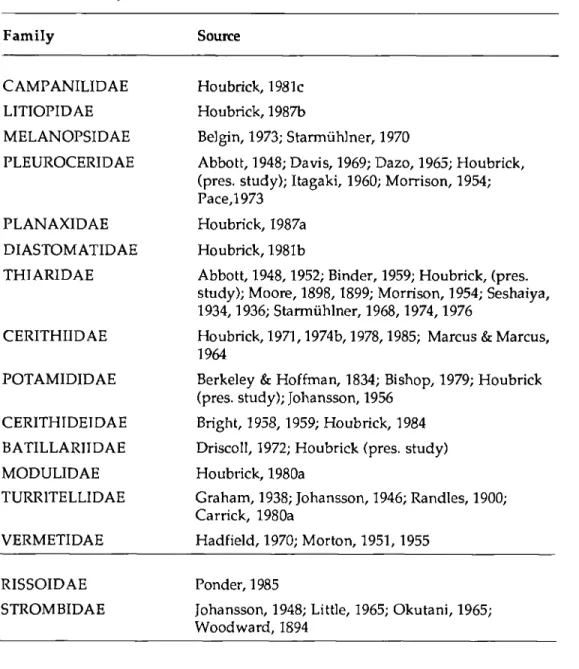
The characters resulted from my own research on the anatomy, reproductive biology, ecology, and systematics of cerithioideans and from published accounts of other authors. Families for which information is lacking or only fragmentary were not used in the cladistic analysis. These are mainly the smaller cerithi- oidean groups, such as the Finellidae, Dialidae, and Siliquariidae, whose status as families is still uncertain or doubtful. All major families were included in the analysis. The major literature sources for anatomical information about cerithi- oidean families are presented in Table 1. It should be noted that several large families, such as the Potamididae, Thiaridae, Turritellidae, and Vermetidae, are still very poorly known. On the basis of published anatomical information and my own observations, I suspect some families may be polyphyletic; thus, any comparison among them is beset with difficulties. In addition, analysis and comparison of families is complicated by the wide range of character states and simultaneous presence of binary characters within a given family. There is no easy solution to this problem, but it was thought that by limiting the characters to the taxa for which each family is named, a working cladogram would be produced and used iteratively as a basis for future phylogenetic analyses. For this reason, the characters used in this analysis are derived from the nominal taxa from which the family name was derived, and these taxa are considered as typically representative of the family. A major difficulty with this method is
TABLE 1. Major Sources of Cerithioidean Anatomical Characters Family Source
CAMPANILIDAE LITIOPIDAE MELANOPSIDAE PLEUROCERIDAE
PLANAXIDAE DIASTOMATIDAE THIARIDAE
CERITHIIDAE POTAMIDIDAE CERITHIDEIDAE BATILLARIIDAE MODULIDAE TURRITELLIDAE VERMETIDAE
Houbrick, 1981c Houbrick, 1987b
Belgin, 1973; Starmühlner, 1970
Abbott, 1948; Davis, 1969; Dazo, 1965; Houbrick, (près, study); Itagaki, 1960; Morrison, 1954;
Pace,1973 Houbrick, 1987a Houbrick, 1981b
Abbott, 1948,1952; Binder, 1959; Houbrick, (près, study); Moore, 1898, 1899; Morrison, 1954; Seshaiya, 1934,1936; Starmühlner, 1968, 1974,1976
Houbrick, 1971,1974b, 1978,1985; Marcus & Marcus, 1964
Berkeley & Hoffman, 1834; Bishop, 1979; Houbrick (près, study); Johansson, 1956
Bright, Í958, 1959; Houbrick, 1984 Driscoll, 1972; Houbrick (près, study) Houbrick, 1980a
Graham, 1938; Johansson, 1946; Randies, 1900;
Carrick, 1980a
Hadfield, 1970; Morton, 1951, 1955 RISSOIDAE
STROMBIDAE
Ponder, 1985
Johansson, 1948; Little, 1965; Okutani, 1965;
Woodward, 1894
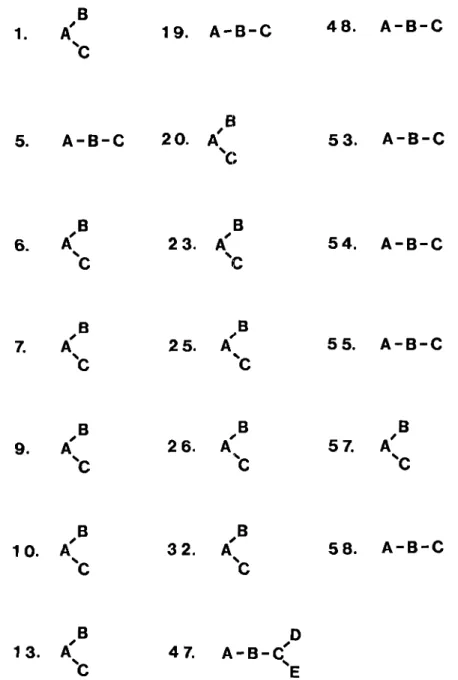
that the nominal taxon may not really be typical of the family and the apomor- phic characters distinguishing it may thus be excluded from the analysis. For binary characters, a character was considered present in a family even if it was absent in some genus-level and species-level taxa. I used homologous characters that would be applicable at the family-taxa level and that appear, from our present knowledge, to be typical of each group. Transformation series of multi- state characters are shown in Fig. 1.
92 Richard S. Houbrick
1. A"^ 19. A-B-C 48. A-B-C
"^
C
B
A-B-C 20. A' 53. A-B-C
B B
A 23. A' 54. A-B-C C C
7. A 25. A 55. A-B-C
^C ^C
B B B
A' 2 6. A" 5 7. A'
^C ^C ^C
B B
10. A 32. A 58. A-B-C
^C ^C
B D 4 7. A-B-c' C ^E
FIG. 1. Character state transformation series for the 20 multistate characters used to construct the cladogram depicted in Fig. 2. Numbers and letters correspond to the dijiracters and character states, respectively, as listed in Table 5.
OVERVIEW OF CERITHIOIDEA Systematic position
No modern reviews of the superfamily exist except as smaller parts of major works on prosobranch taxonomy and systematics (Cossmann, 1906; Thiele, 1929;
Wenz, 1939; Götting, 1974: 129; Boss, 1982: 992-996). Indeed, most cerithioidean
families have received little systematic revisory attention by recent workers.
There have been attempts to differentiate the Cerithioidea within larger molluscan classificatory schemes, but all fall short in that each relies on only one or several characters derived from a single, limited, morphological feature. This is best illustrated in the older, more traditional classifications, which were based on shell characters alone with occasional use of radular characters. Lamen- tably, even some recent revisions rely only on shell characters (Griindel, 1976a,b;
1981; 1982; Bouniol, 1981: 21). Following the lead of Troschel (1856-1863), who suggested that the radula, and not the shell, is the most important character to understand the natural classification of the Gastropoda, Bändel (1984: 31-62) recently grouped a number of cerithioidean taxa largely by radular configuration.
Several recent papers (Haszprunar, 1985a: 458; Maeda, 1986: 32-35) have relied on osphradial morphology as a taxobase. Healy (1982-1983) and Koike (1985: 66- 67) have used the ultrastructure of cerithioidean euspermatozoa as a major element defining the superfamily. Several papers review cerithioidean phylogeny on the basis of palliai oviduct morphology: Johansson (1948,1956) was the first to survey and recognize the taxonomic value of the open palliai gonoducts of the Cerithioidea. In a more recent survey of cerithioidean genital ducts, by Houston (1985) the Triphoridae and Cerithiopsidae were wrongly included in the Cerithioidea. Members of the Cerithioidea have been character- ized by their fecal pellet morphology (Bande), 1974: 20), shape of egg masses (Bändel, 1976: 266-267), and by protoconch shape and sculpture (Bändel, 1975: 20- 31).
Authors differ as to the exact composition and division of the Recent super- family, which contains a number of poorly-defined or ill-conceived higher category taxa. A rough, conservative estimate of living cerithioidean taxa, pruned of invalid and suspect higher taxa and their synonyms, reveals a super- family comprising about 25 families and over 200 genera. This estimate excludes fossil taxa and the cerithiopsids and triphorids. The latter two groups are sometimes still considered as cerithioideans (Houston, 1985) despite substantial evidence to the contrary (Kosuge, 1966; Climo, 1975; Marshall, 1983,1984; Hasz- prunar, 1985a,b; Healy, 1986c: 195). That the Cerithiopsidae and Triphoridae should be removed from the Cerithioidea has been demonstrated by Healy (1983:
212; 1986c: 168) and, in recent classifications of higher prosobranchs (Haszprunar, 1985a,b: 32), they have been assigned to a separate suborder (Heteroglossa Hasz- prunar, 1985b).
A number of authors have suggested that the Cerithioidea is the ancestral stem group from which other mesogastropod superfamilies, all other prosob- ranchs, or, in some cases, opisthobranchs, have evolved (Johansson, 1948;
Boettger, 1954; Cox, 1960: 144; Golikov & Starobogatov, 1975: 201; Fretter &
Graham, 1962: 638; Fretter, 1980: 226-227; Ponder, 1985). Gosliner (1981: 213) and Haszprunar (1985: 30) have both shown that there is no evidence for a cerithi- oidean origin of opisthobranchs. Fretter and Graham (1962: 624) have suggested that the cerithioideans are closely related to the truncatelloideans (i.e., rissoa- ceans) and that both superfamilies were derived from the Pleurotomarioidea through the Loxonematoidea. Griindel (1976b) postulated that the Diastomat- idae (cited as Diastomidae) was the primitive group that gave rise in the Jurassic to the Cerithioidea, but his concept of the Diastomatidae is inflated and
94 Richard S. Houbrick based solely on misleading shell characters. 1 have redefined and set limits to this family based on the anatomy, radula, and reproductive structures of the one living species and have shown that the Diastomatidae originated in the Paleocene and underwent an extensive radiation in the Eocene (Houbrick, 1981b:
614). It is not a primitive group and is an unlikely candidate for progenitor of the Cerithioidea.
Published work on the genetics, tissue proteins, and isoenzymes of cerithioi- deans is virtually nonexistent. Some electrophoretic work has been done on the Australian Potamididae (Bishop, 1979, unpublished master's thesis). Only six of the Recent cerithioidean families have representatives with known chromosome numbers. These are summarized in Table 2. The average haploid number is 17.1.
TABLE 2. Haploid Chromosome Numbers of Cerithioidean Families Family x haploid no. range no. taxa source THIARIDAE 17.7 (31.4)* 16-60 8 Patterson, 1969
PLEUROCERIDAE 15 7-20 14 Patterson, 1969; Davis, 1972
POTAMIDIDAE 18 18 3 Davis, 1972
BATILLARIIDAE 18 18 2 Davis, 1972
CERITHIIDAE 18 18 4 Patterson , 1969; Vitturi
and Catalano, 1984
TURRITELLIDAE 16 16 1 Patterson, 1969
*= polyploid number
Despite the numerous data available, one finds few recent higher category classifications that are based on suites of anatomical characters, and reproduc- tive characters, or that attempt to be holistic in their data bases. An exception is the work by Risbec (1955) in which numerous anatomical characters were used in a natural classification for the Cerithioidea within the larger context of the Prosobranchia.
Fossil history
The Cerithioidea is thought to be an ancient group with origins in the Late Devonian when, according to Knight et al. (1960: 316), the turritellid lineage began. Fretter and Graham (1962: 624) suggested that the superfamily made its first appearance in the Permian. Although the origin of the Cerithioidea is obscure, the conchologically similar superfamily Loxonematoidea, of Ordovician origin (Knight et al, 1960: 311), has been suggested as being ancestral to it (Houbrick, 1979a: 19). Bouvier (1887: 153,155) believed that the Pseudomela-
niidae (superfamily Subulitoidea), of Jurassic origin (Knight et ai, 1960: 125), was the stem group for many Recent cerithioidean families, while Cossmann (1906: 3) thought that the Procerithiidae of Jurassic origin (Cox, 1960: 125), gave rise to the other cerithioideans. Golikov & Starobogatov (1975: 201-202) suggested that the Cerithioidea first appeared in the Triassic and is an indepen- dent line of evolution in the subclass Pectinibranchia (=Caenogastropoda). They thought that the Cerithioidea differed sufficiently in morphology from other pectinibranchs to justify placing it into an independent order, Entomostoma.
However their concept of this order is based on misconceptions about several ceri- thioidean groups: they are in error in stating that true palliai oviducts are lacking in the Planaxidae (see Houbrick, 1987a) and that there are closed palliai gonoducts in the Modulidae (see Houbrick, 1980a). Moreover, no significant morphological characters are cited to support the integrity of this new order.
According to Cossmann (1906: 9), the superfamily Cerithioidea ("cénacle") had its roots in the Jurassic, with some Recent families (Cerithiidae, Diastomatidae) appearing in the Cretaceous and others (Modulidae, Planaxidae) in the Tertiary.
It should be noted, however, that modulids and planaxids may have poor fossil records, because of their habitats. In my opinion, this later origin (Jurassic- Cretaceous) of the superfamily is a more reasonable one to accept.
Opinions about the origin of specific cerithioidean families are likewise varied. The Turritellidae are said to originate in the Devonian (Knight et al, 1960: 316; Sepkoski, 1982: 28), and, if this were true, are thus the oldest cerithi- oidean family. Other cerithioidean families are alleged to appear in the Triassic or eariier (Bouvier, 1887: 152; Gohkov & Starobogatov, 1975: 201;
Sepkoski, 1982: 27-28), but given the likelihood of shell convergence in this span of time, it is doubtful that Devonian fossil shells attributed to the Turritellidae are true members of that family; moreover, proper familial allocation for many Paleozoic and Mesozoic fossils cannot always be decided from shell morphology alone. Most Cenozoic fossils, on the other hand, can be correlated with the correct Recent families with much greater confidence. As far as can be judged, most Recent families appear to have arisen in the late Cretaceous-early Tertiary periods.
As seen above, there are many theories about the origins of the superfamily Cerithioidea and the many families comprising it, but as the anatomical morphology of the early fossil taxa postulated as ancestors is unobtainable, their designation as progenitors of Recent groups is largely conjectural. There is no way to ascertain if fossil groups with shell morphologies similar to Recent cerithioi- deans are truly related or ancestral to them because of the pervasiveness of morphological convergence. It is thus unwise to place too much reliance on purely paleontológica! interpretations of cerithioidean origins and evolution, because these kinds of hypotheses can never be falsified, and result in a proliferation of scenarios based on mere opinion. At best, the fossil record serves as a good test of more rigorous phylogenetic hypotheses.
Ecology
Most cerithioideans occur in considerable numbers, are tropical in distribution, and many families represent adaptive radiations into specific habitats. The Cerithideidae are specialized for life in mangrove forests, some genera spending
96 Richard S. Houbrick
-g cu 'S
U o
bo
tu
01 1-^ OJ 01 l-( ^ l^
ê
9^ 5 o > o >%
% 3Í
s
5
6C o
s e e
.S ^ t-H t-< 4:1 XI ^
'S OJ OJ
(U xs 73
(U C
0 11 N ^
<J te (U X u 0) Cí^ a u-
2 0 6
bX) a;
0 lU feJD
OS 03
C 1 T3 Id
"ra u .2
a
Ui u<3 •n 0) OJ U
ai > 0) c
X
U5 x:
C
x:
T3 W) 60
e
|ê ^ ^ |ê^ -g-l i|
•^ iO -^ "^
OJ 0) (U 01
s g .s .s ^ m
o "^ "5 "5 5 5
ff C c/) en O) O)
»•^ m m I t .
^
01
^ o) 0) 01 ÍV <v çn Qj OJ > ? ? OJ g OJ O) o O O 0»
O •*- '-t- M tH 1-, M-
u Xi X Xi
m ta a ns ni
(j u M CJ 0
U- 0- ex a. ÍX
0 »-. 0 ;-.
e
n ^< 0 ^'*-• +-• 0) -t-»
O) OJ 0) 01 01 OJ CIJ
c c c c c C c
1- k. ^ 1-^ )-• u )-l
« ro 03 03 03
£i
e e e
6 Ë Ën3 (0 ,__, , , •, f•t , 1 , , ,__, 3 ^ ;o 3 H 03 '.4-» 03 •5b :2 u 03 3 3 03 03 -0 03
pela subi
'4-t
o> 0) XI X XI XI XI
i3 3 3 3 3
c c en t« 1/5 Iß en
"^ 3 '3S ScSS 303 "^j-^fi.
o»
CO OJ 01 O) i2 OJ J «^73 01^ rt 03-T30J -"OJ-^
CQ T3:S:^ ^tH42T3;-o3 «03•'
o-" • 03 o3;-j C C to m-dcr
«j »-H ^-* -tj -.-^ r^ _. LJ î-j •^-' n-( _ ._^
^ 0> 03 o^JÜXi OJ 3 <u « SI M -= .20 H u CO PU HP- Pu > HKJ D^ln
most of their lives on tree branches; the Potamididae also occur in mangrove swamps but are mostly confined to the soft mud beneath the trees, and occasion- ally attaching to the mangrove roots; the Batillariidae occur in estuarine biotopes and have moved into subtropical and temperate zones; the Cerithiidae occur mainly on tropical, marine, soft bottom habitats ranging from the high intertidal to the deep sea, with several groups highly adapted for life in marine angiosperm sea grass beds or intertidal rocky shores; the Modulidae are special- ized for subtidal grazing of microalgae on marine grasses or on hard substrates;
the Turritellidae appear to be adapted for subtidal filter feeding on soft bottoms;
the Vermetidae have uncoiled shells that are permanently attached to hard substrates; the Siliquariidae have uncoiled shells that are embedded in sponges;
the Litiopidae are highly adapted for life on algal fronds or filaments, some having a pelagic life history; the large freshwater groups Pleuroceridae and Melanopsidae tend to live in fast flowing streams and rivers while the Thiaridae span environments ranging from rocky, fast moving streams, to broad, slow moving rivers, and quiet lakes. Table 3 summarizes these radiations for several families.
All cerithioideans are herbivores or detritivores and all have a taenioglos- sate radula, paired salivary glands, a stomach complex with a style sac and gastric shield typically containing a crystalline style, and most have an esopha- geal gland. Although the majority are grazers, some groups are detritus feeders, mucous net feeders, and filter feeders (see Table 3). These kinds of feeding methods are usually limited to specific families, but feeding guilds of cerithioi- deans may comprise members of many families.
Reproductive biology
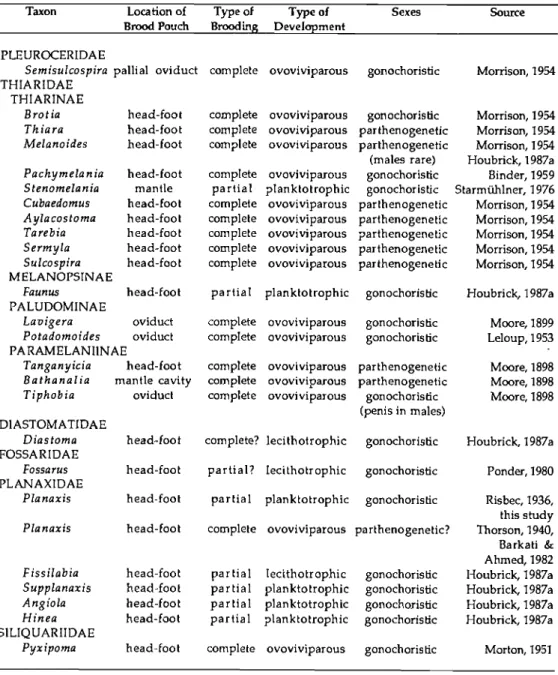
Reproduction in cerithioideans is gonochoristic except in some parthenogenetic thiarids. The aphallate males produce two kinds of sperm, euspermatozoa and paraspermatozoa, sensu Healy (1983: 178), in all known families. Sperm transfer is accomplished by spermatophores in the Cerithiidae (Houbrick, 1974b; 1985), Cerithideidae (Houbrick, 1984: 7), Batillariidae (pers. observ.), Potamididae (pers. observ.), Modulidae (Houbrick, 1980a: 127-129), Planaxidae (Houbrick, 1987a), Vermetidae (Hadfield & Hopper, 1980), and presumably, in all other families. Most cerithioideans lay their eggs in gelatinous masses or strings that are attached to the substrate. Reproduction may involve planktotrophy or lecithotrophy (mixed in most families), brooding in specialized incubatory pouches [Planaxidae (Houbrick, 1987a), Diastomatidae (Houbrick, 1987a: 39), Thiaridae (Abbott, 1948: 286-287; Morrison, 1954), Siliquariidae (Morton, 1951:
35); Fossaridae (Ponder, 1980)]; brooding in the mantle cavity and shell [Turritel- lidae (Carrick, 1980: 254), Pleuroceridae (Itagaki, 1960: 44; Davis, 1969; 1972), Vermetidae (Morton, 1951, 1965)] and parthenogenesis in many of the Thiaridae (Abbott, 1948: 286-287; Morrison, 1954). Table 4 summarizes brooding among ceri- thioidean taxa.
Healy (1983a: 71) established two groups of cerithioideans on the basis of euspermatozoan ultrastructure. Healy's "group one" is distinguished by eusper- matozoa having the midpieces and axoneme surrounded by two large and two small midpiece elements. This group may be further divided, on the basis of ultrastructural differences, into two subsets: one comprising the Cerithiidae,
98 Richard S. Houbrick
TABLE 4. Distribution of brooding and reproductive strategies among the Cerithioidea
Taxon Location of Type of Type of Sexes Source
Brood Pouch Brooding Development PLEUROCERIDAE
Semisulcospira palliai oviduct complete ovoviviparous gonochoristic Morrison, 1954 THIARIDAE
THIARINAE
Brotia head-foot complete ovoviviparous gonochorisüc Morrison, 1954 Thiara head-foot complete ovoviviparous parthenogenetic Morrison, 1954 Melanoides head-foot complete ovoviviparous parthenogenetic
(males rare)
Morrison, 1954 Houbrick, 1987a Pachymelania head-foot complete ovovivipajous gonochoristic Binder, 1959 Stenomelania mantle partial planktotrophic gonochoristic Starmilhlner, 1976 Cubaedomus head-foot complete ovoviviparous parthenogenetic Morrison, 1954 Aylacostoma head-foot complete ovoviviparous parthenogenetic Morrison, 1954 Tarebia head-foot complete ovoviviparous parthenogenetic Morrison, 1954 Sermyla head-foot complete ovoviviparous parthenogenetic Morrison, 1954 Sulcospira head-foot complete ovoviviparous parthenogenetic Morrison, 1954 MELANOPSINAE
Faunus head-foot partial planktotrophic gonochoristic Houbrick, 1987a PALUDOMINAE
Lavigera oviduct complete ovoviviparous gonochoristic Moore, 1899 Potadomoides oviduct complete ovoviviparous gonochoristic Leloup,1953 PARAMELANIINAE
Tanganyicia head-foot complete ovoviviparous parthenogenetic Moore, 1898 Bathanalia mantle cavity complete ovoviviparous parthenogenetic Moore, 1898 Tiphobia oviduct complete ovoviviparous gonochoristic
(penis in males)
Moore, 1898 DIASTOMATIDAE
Diastoma head-foot complete? lecithotrophic gonochoristic Houbrick, 1987a FOSSARIDAE
Fossarus head-foot partial? lecitholrophic gonochoristic Ponder, 1980 PLANAXIDAE
Planaxis head-foot partial planktotrophic gonochoristic Risbec, 1936, this study Planaxis head-foot complete ovoviviparous parthenogenetic? Thorson, 1940, Barkati &
Ahmed, 1982 Fissilabia head-foot partial lecithotrophic gonochoristic Houbrick, 1987a Supplanaxis head-foot partial planktotrophic gonochoristic Houbrick, 1987a Angiola head-foot partial planktotrophic gonochoristic Houbrick, 1987a Minea head-foot partial planktotrophic gonochoristic Houbrick, 1987a SILIQUARIIDAE
Pyxipoma head-foot complete ovoviviparous gonochoristic Morton, 1951
Turritellidae, Litiopidae (Healy, 1983a: 71-73), Dialidae and Siliquariidae (Healy, 1986b: 193); and the second subset including the Planaxidae and Batilla- riidae (Healy, 1983a: 71-73). Healy's "group two" is distinguished by eusperma- tozoa with four equal-sized midpiece elements and midpiece flange structures and includes the Potamididae, Modulidae, Cerithideidae (Healy, 1983a: 71-73), and possibly the Pleuroceridae (Koike, 1985; Healy, 1986b: 193) and Thiaridae (Kohnert & Storch, 1984).
DISCUSSION OF CHARACTERS
Characters were derived from conchological, radular, anatomical and repro- ductive features. Of the many characters utihzed for descriptive purposes only 70 could be confidently coded or used for all 15 families, but of these only 58 were used for cladistic analysis, as autapomorphies that appeared at terminal branches were excluded from the data matrix. Characters are grouped into cate- gories, each of which is followed by the number of characters comprising it. These are: shell (6), operculum (3), external anatomy (14), mantle cavity (6), radula(6), alimentary tract (5), nervous system (5), reproductive system (12), and spawn (1).
Of these, 38 were binary and 20 multistate characters, comprising a total of 134 character states. Transformation series of multistate characters are shown in Figure 1. The 58 characters and their states are listed in Table 5 and are discussed below, under each category.
Shell characters (1-6)
The six shell characters were based on general morphological shapes and were not derived from trivial sculptural elements, as these are subject to considerable homoplasy at the family level. Among cerithioideans, only the vermetids are sessile and uncoiled; thus, these characters were considered autapomorphies.
Most cerithioideans have an elongate, turreted shape. Only the Modulidae are turbinate, while the Planaxidae, Melanopsidae, and some thiarids and pleuro- cerids are ovate-conical in shell shape. The presence of an anterior canal in varying degrees of development and length is characteristic of most families but this character is completely lacking in the Vermetidae and Turritellidae. Long siphonal canals are common in many genera of the Cerithiidae and become pronounced in the genus Rhinoclavis Swainson and especially so in the subgenus Longicerithium Houbrick (Houbrick, 1978: 85). Ovate or round apertures are usually correlated with the presence or absence of an anterior canal, respectively.
Most cerithioideans have relatively smooth outer lips but in some families, notably the Potamididae, Batillariidae, Cerithideidae, and Cerithiidae, the outer lip may be considerably flared and crenulate. An umbilical chink is an autapomorphy of the Modulidae. Periostracum is smooth in most cerithioideans but is hispid in the Planaxidae and Diastomatidae (Houbrick, 1981b: 600; 1987a:
21,33). The unique periostracum of the Campanilidae is pitted and calcareous (Houbrick, 1981c: 268).
Opercular characters (7-9)
Opercular shape, placement of the nucleus and the number of spirals are all obviously interrelated characters. The two most common shapes are the round, multiSpiral kind with a central nucleus, and the ovate, paucispiral type with eccentric or near terminal nucleus. The former kind occur in the Potamididae (Benthem Jutting, 1956: 427, 445), Batillariidae (Bequaert, 1942), Cerithideidae (Houbrick, 1984), Modulidae (Houbrick, 1980a), Turritellidae (Randies, 1900: 57), and Vermetidae (Morton, 1965). A round operculum is not necessarily associated with a round, siphonless aperture, as the potamidids, cerithideids, and batillar- iids have round opérenla as well as well-developed siphonal canals (pers.
100 Richard S. Houbrick observ.). With the exception of the above mentioned families and the Planax- idae, which have a lenticular operculum (Houbrick, 1987a: 5), all other cerithi- oidean families have ovate, paucispiral opercula.
External anatomy characters (10-23)
Snout length appears to be related to feeding: a short snout occurs among the Turritellidae, most of which are ciliary feeders (Graham, 1938; Yonge, 1946;
Andrews, 1974: 1136-1137; Petuch, 1976: 322; Carrick, 1980a: 254; Vaughan, 1983) and among the Vermetidae, many of which are mucous net feeders (Morton, 1950, 1951, 1955, 1965; Hadfield, 1970: 306-307; Hughes & Lewis, 1974: 537-542). The Siliquariidae, known only from a single species, are ciliary feeders, but do not use a mucous net (Morton, 1951: 37). All the other cerithioidean taxa are grazers and have long snouts, except for the aberrant Campanilidae, in which a short snout occurs. The snout is especially well-developed in the Cerithideidae and Pota- mididae (pers. observ.), in the Diastomatidae (Houbrick, 1981c: 601) and in some cerithiid genera, such as Rhinoclavis (Houbrick, 1978: 6). Long, mobile, cephalic tentacles appear to have a tactile, sensory function in all families (pers. observ.) except for the sessile Vermetidae, where they are short (pers. observ., Morton, 1955) and obviously not as important as in exploratory, free-moving taxa.
However, the Campanilidae, which are free living forms, also have short, stubby cephalic tentacles (Houbrick, 1981c: 270). The Modulidae are the only cerithioideans that have eyes at the mid-tentacular stalk and have this character in common with the Stromboidea (Houbrick, 1980: 137).
All cerithioideans have a large foot except for vermetids (Morton, 1955;
Hadfield, 1970), presumably because of their sessile habit. The anterior pedal mucous gland is present at the front margin of the propodium in all families but is very highly modified for mucus production and sunk deep into the head-foot beneath the buccal cavity in the vermetids (Morton, 1955; Hadfield, 1970: 302).
The anterior pedal mucous gland extends halfway around the sole in the planaxids (Houbrick, 1987a: 27) and circles the entire edge of the sole in Campanile (Houbrick, 1981a: 271).
A large mesopodial mucous gland that produces mucous attachment threads occurs in the Litiopidae (Houbrick, 1987b: 11). This kind of gland also occurs in the rissoid outgroup (Ponder, 1985: 15) and in the Turritellidae (Randies, 1900:
57), but in the latter family presumably has a different function than in the litiopids and may not be homologous. Its presence in the Turritellidae was therefore not coded in the phylogenetic analysis, and it was considered as autap- omorphous in the Litiopidae.
Metapodial tentacles occur in the rissoids (Ponder, 1985: 15), but usually as a single posterior one, which may be secondarily divided into three or five in one genus. Among cerithioideans, they occur in the Litiopidae, where they are highly developed (Houbrick, 1987; Luque et al., 1988, this volume), and in the Vermetidae, in which there is a short pair in all genera except Vermetus, in which they are very long (Morton, 1951: 37, 1955; Hadfield, 1970: 302). Although scored in this analysis as homologous, they could be independently derived in each family.
The presence of a ciliated groove leading from the exhalant siphon down the right side of the foot in females is a common, presumably homologous character in
all cerithioideans (pers. observ.) except for the turritellids and vermetids. Feces and other debris expelled from the mantle cavity are removed by this groove, but its primary function appears to be the transport of eggs from the distal end of the palliai oviduct, from which it originates, to the foot. The groove leads to a bulbous, glandular ovipositor that is present in all groups (Houbrick, 1984: 10) except for the Vermetidae, Planaxidae, Siliquariidae, and Diastomatidae, which brood their young. There is a small gland on the right side of the foot of unknown function in Turritella (Randies, 1900: 57) that may represent the vestige of an ovipositor, but in the cladistic analysis, the Turritellidae were not scored as having an ovipositor.
Brooding cerithioideans do so in the mantle cavity, within a modified portion of the palliai oviduct, or in specialized brood pouches in the head-foot.
Vermetids attach their eggs to the interior wall of the shell adjacent to the mantle, or to the ctenidial wall (Yonge, 1932: 271; Morton, 1955: 6, 1965; Hughes, 1978: 114, 125; Hadfield et al, 1972), while turritellids brood their young in a uterine brood pouch formed from the palliai oviduct (Johansson, 1946; Carrick, 1980b: 254). In the pJanaxids, thiarids, siliquariids, and diastomatids, the ovipositor has become modified to form a brood pore which opens into a large brood pouch of ectodermal origin located in the head-foot (Thorson, 1940; Morton, 1951: 36; Abbott, 1952: 92-95, 1955: 11; Ponder, 1980; Houbrick, 1981b: 608-609, 1987a: 38-39). Table 4 shows the distribution of various methods of brooding and reproduction throughout the Cerithioidea.
A long, strap-like columellar muscle is a distinctive character of the Campa- nilidae (Houbrick, 1981c: 284) and the Vermetidae (Morton, 1965: 615; Hughes, 1978: 115). Some animals of both these groups are able to retract very deep within their shells to avoid attacks by predators. Morton (1965: 615) considered a long columellar muscle an advanced evolutionary trait. Although not mentioned specifically by him, the Turritellidae are depicted by Randies (1900:
PI. 10, fig. 2) as having a long columellar muscle, which is not surprising, as they have a very deep mantle cavity and a long turreted shell.
The mantle edge of cerithioidean taxa varies greatly in regard to the absence or presence, size and location of mantle papillae. They are lacking in the Litio- pidae (Houbrick, 1987b: 11), Planaxidae (Houbrick, 1987a: 5), and Vermetidae (Morton, 1965), very small and few in the Potamididae (pers. observ.), Cerithi- deidae (Houbrick, 1984: 3) and Batillariidae (pers. observ.), and can be quite long in the Cerithiidae (Houbrick, 1974b: 41, 1978: 6, 1985: 27), Thiaridae (Abbott, 1948: 286, 1952: 78; Pace, 1973: 54,59), Modulidae (Houbrick, 1980a), and Turritel- lidae (Randies, 1900: 57; Graham, 1938: 454). Their function is probably a sensory one, but in the Turritellidae (Yonge, 1946: 377) and in some modulids (Houbrick, 1980a: 121) mantle papillae may also serve as a coarse filter to the mantle current. Normally the mantle papillae are located only on the dorsal surface of the mantle edge but in the Campanilidae (Houbrick, 1981c: 283) and Turritel- lidae (Graham, 1938: 453; Fretter & Graham, 1962: 101) they occur around its entire circumference. As characters, mantle papillae and their disposition are of poor diagnostic value in phylogenetic analysis and have a low consistency value.
Mantle cavity characters (24-29)
One of the synapomorphies of the Turritellidae and Vermetidae is the
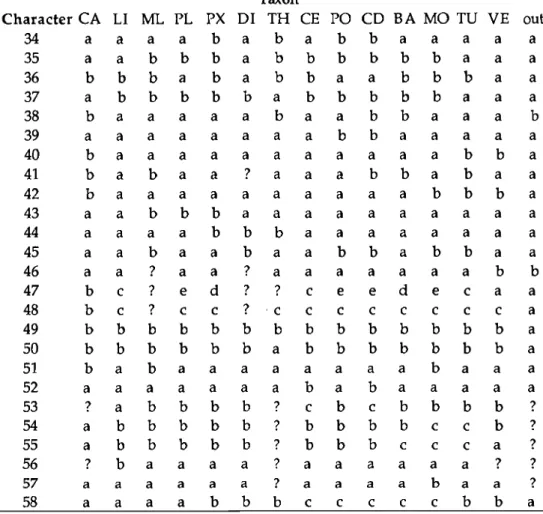
102 Richard S. Houbrick TABLE 5. Character table of cerithioidean families and rissoidae outgroup.
Legend: BA= Batillariidae; CA= Campanilidae; CD= Cerithideidae;
CE= Cerithiidae; DI= Diastomatidae; LI= Litiopidae; MO=Modulidae;
ML= Melanopsidae; PL= Pleuroceridae; PO= Potamididae; PX= Planax- idae; TH= Thiaridae; TU= Turritellidae; VE= Vermetidae; ?= missing
data or absence of character set; out = outgroup (Rissoidae).
Explanation of character states follows matrix.
Taxen
Character CA LI ML PL PX DI TH CE PO CD BA MO TU VE out 1 a a a a a a a a a a a b a c a 2
b
b bb
bb b
bb
bb
b a ab
3 a a a a a a a b
b
b a a a a a 4b
b bb
bb b
bb
b b b a a a 5b
b bb
bb b
cb
b b b a a a 6 c a a a bb
a a a a a a a a a 7 a a a a b a a a c c c c c c a 8 a a a a a a a ab b
bb b b
a 9 a a a a b a a a c c c c c c a 10 a a a a a a a a a a a c a b a 11 b a a a a a a a a a a ab
b a 12 b a a a a a a a a a a a a b a 13 c a a ab
a a a a a a a a a a 14 a b a a a a a a a a a a a a b 15 b b b bb b b
b b b b bb
a b 16 a b b bb b b
b bb
b b a a a 17 b a a a a a a a a a a a a b a 18 b a a a a b b b b a b b b a a 19 c b b b b a a a c b c a a b c 20 b a a a a c c c c a c c b a /^21 a a a a b b b a a a a a b a a 22 a a a a b b b a a a a a a a a 23 ? ? 7 ? c c c ? ? 7 ? ? b a ? 24 a a a a a a a a a a a a b b a 25 c a a a a b a b a a a a a a a 26 c a b c b a b a a c a b a a a 27 a a a a a a a a b b a a a a a 28 b b b a b b a b b a b b b b a 29 b a a a a a a a a a a a a a a 30 a a a a a a a a a a a a b b a 31 b a a b
b
a b a b a a a a a a 32 ab
a b c a b b b b a a a a a 33 bb
b b ab
b b b b ab b b
aTABLE 5 (cont.)
Taxon
Character CA LI ML PL PX DI TH CE PO CD BA MO TU VE out
34 a a a a b a b a b b a a a a a
35 a a b b b a b b b b b b a a a
36 b b b a b a b b a a b b b a a
37 a b b b b b a b b b b b a a a
38 b a a a a a b a a b b a a a b
39 a a a a a a a a b b a a a a a
40 b a a a a a a a a a a a b b a
41 b a b a a ? a a a b b a b a a
42 b a a a a a a a a a a b b b a
43 a a b b b a a a a a a a a a a
44 a a a a b b b a a a a a a a a
45 a a b a a b a a b b a b b a a
46 a a ? a a 7 a a a a a a a b b
47 b c 7 e d 7 ? c e e d e c a a
48 b c 7 c c 7 c c c c c c c c a
49 b b h b b h b b b b b b b b a
50 b b h b b h a b b b b b b b a
51 b a h a a a a a a a a b a a a
52 a a a a a a a b a b a a a a a
53 ? a b b b b 7 c b c b b b b 7
54 a b b b b b 7 b b b b c c b 7
55 a b b b b b 7 b b b c c c a 7
56 ? b a a a a 7 a a a a a a 7 7
57 a a a a a a 7 a a a a b a a 7
58 a a a a b b b c c c c c b b a
Alternative Character States SHELL
1 Morphology: a = elongate-turreted; b = turbinate; c = uncoiled 2 Aperture: a = round;b:=ovate
3 Outer lip: a = smooth, rounded; b = crenulated, flared 4 Anterior canal: a = absent; b = present
5 Anterior canal length: a = absent; b = short; c = long 6 Periostracum: a = smooth; b = hispid; c = intratacalyx OPERCULUM
7 Shape: a = ovate; b = lenticular; c = round 8 Sculpture: a = paucispiral; b = multispiral
9 Nucleus placement: a = eccentric; b = terminal; c = central EXTERNAL ANATOMY
10 Body shape: a = intermediate; b = elongate, vermiform; c = compact, tightly coiled
104 Richard S. Houbrick TABLE 5 (cont.)
11 Snout: a = long, extensible; b = short, wide
12 Cephalic tentacles: a = long, tapering; b = short, stubby
13 Anterior pedal gland: a = anterior sole margin; b = front half of sole;
c = entire sole margin
14 Epipodial tentacles: a = absent; b = present
15 Ciliated groove on right of foot: a = absent; b = present 16 Ovipositor: a = absent; b = present
17 Columellar muscle: a = short; b = long, strap-like 18 Mantle edge: a = smooth; b = fringed
19 Mantle edge papillae: a = many, long; b = absent; c = few, short 20 Mantle papillae placement: a = absent; b = entire mantle margin;
c = top half of mantle margin 21 Brood pouch: a = absent; b = present
22 Subhemocoelic brood pouch: a = absent; b = present
23 Brood pouch location: a = mantle cavity; b = palliai oviduct;
c = head-foot
MANTLE CAVITY ORGANS
24 Food groove on mantle floor: a = absent; b = present
25 Osphradium: a = ridge-like, thin; b = bipectinate, thin; c = bipectinate, oval
26 Osphradial length: a = equal to gill length; b = slightly less than gill length; c = less than one-half gill length
27 Ctenidial filaments: a = long, triangular; b = short, shallow 28 Hypobranchial gland: a = weak; b = well-developed
29 Hypobranchial gland shape: a = distal leaflets absent; b = distal leaflets present
RADULA
30 Rachidian basal plate: a = marginal ridges absent; b = marginal ridges present
31 Rachidian basal plate width: a = wide; b = narrow
32 Rachidian lateral basal extensions: a = short; b = absent; c = long 33 Rachidian basal cusps: a = present; b = absent
34 Outer marginal tooth: a = outer flange absent; b = outer flange present 35 Outer marginal shape: a = long, scythe-like; b = long, spoon-like ALIMENTARY TRACT
36 Esophageal gland: a = absent; b = present
37 Salivary gland placement: a = above and anterior to nerve ring; b = through nerve ring
38 Salivary gland shape: a = uncoiled or slightly coiled tubes; b = tubes form coiled masses
39 Style sac: a = short; b = long
40 Spiral caecum: a = absent; b = present
TABLE 5 (cont.) NERVOUS SYSTEM
41 Zygoneury: a = absent; b = present
42 Cerebral ganglia: a = short connectives; b = long connectives
43 Subesophageal ganglion: a = close to pleural; b = separated from pleural 44 Pedal extensions: a = absent; b = present
45 Cerebral-pedal connective: a = long; b = short REPRODUCTION
46 Euspermatozoan midpiece ultrastructure: a = with 4 elements; b = without 4 elements
47 Arrangement of midpiece crystal plates: a - absent; b = midpiece group 3;
c = midpiece group 1 A; d = midpiece group IB; e = midpiece group 2 48 Paraspermatozoa: a = absent; b = 2 kinds; c = 1 kind
49 Males: a = phallate; b = aphallate
50 Palliai oviduct condition: a = closed tube; b = open tube 51 Proximal palliai oviduct: a = closed; b = open
52 Number of seminal receptacles: a = one; b = two
53 Seminal receptacle location: a = lateral lamina; b = medial lamina;
c = both lanrdnae
54 Spermatophore bursa location: a = absent; b = medial lamina; c = lateral lamina
55 Sperm gutter location: a = absent; b = medial lamina; c = medial and lateral laminae
56 Sperm gutter size: a = long; b = short
57 Lateral lamina baffle: a = bafñe absent; b = baffle present
58 Egg mass deposition: a = large gelatinous mass; b = internal; c = jelly string
presence of a food groove on the mantle floor (Randies, 1900: 61; Graham, 1938:
455; Morton, 1955). This groove is probably related to filter and mucous net feeding. Similar food grooves occur in calyptraeids (Fretter & Graham, 1962:107) and struthiolariids (Morton, 1950), which have a similar filter feeding habit.
The structure of the osphradium has recently been shown by Haszprunar (1985a) to be an important character for phylogenetic estimation. Cerithioideans that have been investigated possess osphradia with laterally situated ciliated epithelia and ultrastructural features defined by the Sil/Si2/Si4 cell types, as categorized by Haszprunar (1985a: 487). The osphradium is a simple ridge in most cerithioideans but is bipectinate and well-developed in the Cerithiidae (Houbrick, 1974b: 43; 1985: 27) and Diastomatidae (Houbrick, 1981b: 602). The Campanilidae has an oval, bipectinate osphradium, autapomorphous among cerithioideans, but similar to the those seen in many Neogastropoda. The position of the osphradium in cerithioideans is adjacent to the ctenidium.
Osphradial length varies among families: it may equal the ctenidium in length, as in the Litiopidae (Houbrick, 1987b: 13), Cerithiidae (Marcus & Marcus, 1964:
500; Houbrick, 1985: 27), Potamididae, Batillariidae (pers. observ.), Vermetidae (Morton, 1965: 588), and Turritellidae (Randies, 1900: 62); may be a little less
106 Richard S. Houbrick than the ctenidial length, as in the Diastomatidae (Houbrick, 1981b: 603), Mela- nopsidae (Belgin, 1973: 382), Modulidae (Houbrick, 1980a: 123), Planaxidae (Houbrick, 1987a), and Thiaridae (Abbott, 1952: 92; Starmühlner, 1976); or may be less than half the ctenidial length as in the Campanilidae (Houbrick, 1981c:
270,272), Cerithideidae (Houbrick, 1984: 5) and Pleuroceridae (Itagaki, 1960:
pi.4; Dazo, 1965: 33, fig. 7). Osphradial length appears to be a poor comparative character as it has a low consistency index. Its polarity was determined only by outgroup comparison.
In the Cerithiidae, the bipectinate osphradium is highly developed in the genera Cerithium, Rhinoclavis, and Pseudovertagus (Houbrick, 1971, 1974b, 1978, 1985), and may be correlated with the presence of a long siphonal canal.
However, a well-developed bipectinate osphradium also occurs in Diastoma, in which there is only a shallow anterior canal (Houbrick, 1981b: 602). Although the exact significance of a bipectinate osphradium is not clear, bipectinate morphology increases surface area and may indicate high reliance on osphradial chemoreceptive ability in relation to algal food specialization. A bipectinate osphradium is undoubtedly an apomorphic character among the Cerithioidea.
Nearly all cerithioideans have long, well-developed ctenidia, but ctenidial filaments are absent or very short in some amphibious potamidids, especially in the genus Cerithidea, which occurs in mangroves above and at the high tide mark (Houbrick, 1984: 11). The ctenidium is very long and narrow in the turritel- lids (Randies, 1900: 62) and vermetids (Morton, 1951: 8), which use it in food gathering as well as for respiration.
The hypobranchial gland is thick and well-developed in most cerithioideans, but weak and thin in the Thiaridae, Melanopsidae, and Pleuroceridae (pers.
observ.), which have radiated into freshwater environments. The hypobran- chial gland may be absent in the latter two taxa as it is not shown in the figures or sections of Starmühlner (1970) or Belgin (1973). Campanile is unique in having distal leaflets of unknown function on the hypobranchial gland (Houbrick, 1981c:
274).
Radular characters (30-35)
The characters derived from cerithioidean radulae are diverse, highly homo- plastic, and in most instances, extremely difficult to polarize, except by outgroup comparison. Many have low consistency indices. The basal plate of the rachidian tooth has marginal ridges only in the Vermetidae (Morton, 1965: 623).
The rachidian basal plate is narrow in the Planaxidae (Houbrick, 1987a: 36), Pleuroceridae (Itagaki, 1960: pi. 6; Dazo, 1965: 31-32), many Thiaridae (Starmühlner, 1976; Brown, 1980: 94), and the Campanilidae (Houbrick, 1981c:
272). There are long lateral basal extensions to the rachidian tooth in the Planaxidae (Troschel, 1856: pi. 12; Houbrick, 1987a; 36) and to a lesser extent in the Diastomatidae (Houbrick, 1981b: 605). Short extensions are found in the Melanopsidae (Belgin, 1973: 380), Batillariidae (Bändel, 1984: 49; pers. observ.), Turritellidae (Troschel, 1856: pi. 12; Randies, 1900: pi. 6), and Vermetidae (Morton, 1965: 623). Basal cusps on the rachidian plate are distinctive characters of the Planaxidae (Bändel, 1984: 34-35; Houbrick, 1987a: 36) and Batillariidae (pers. observ.) and also occur in the rissoid outgroup (Ponder, 1985:125). A survey of radular types in Troschel (1856-1863) and Bändel (1984) shows nothing like
these basal cusps in any other prosobranch radula. The outer marginal teeth of turritellids and vermetids are long and scythe-shaped (Randies, 1900: pi. 6;
Morton, 1965: 623). This is also true, to a lesser extent, for the rissoids (Ponder, 1985: 125). An unusual feature of some cerithioidean radulae is the presence of a large lateral flange of unknown function on the outer marginal tooth. A lateral flange occurs in the Thiaridae (Abbott, 1952: 82-84), and Planaxidae (Bändel, 1984: 28; Houbrick, 1987a: 36), and is highly developed in some taxa of the Pota- mididae (Annandale, 1924: 550; Bishop, 1979), Batillariidae (Bishop, 1979) and Cerithideidae (Troschel, 1856: pi. 12, fig. 4; Houbrick, 1984: 6, fig. 3,h).
Alimentary tract characters (36-40)
Anterior buccal pouches occur in the Littorinoidea but are absent in all cerithi- oideans except for Campanile (Houbrick, 1981c: 275). The buccal pouches appear to share the same histology as the esophageal gland in Campanile and are thus probably homologous with those of Littorina, as discussed by Ponder (1983: 257- 258). Among cerithioideans, however, buccal pouches are autapomorphous char- acters.
An esophageal gland is present in most members of the Cerithioidea (pers.
observ.), but is lacking in the Diastomatidae (Houbrick, 1981b: 607), Pleurocer- idae (Dazo, 1965) , Vermetidae (Morton, 1965),some potamidids {Cerithidea [Houbrick, 1984: 5]), and in the rissoid outgroup. Graham (1939) stated that taxa having a style sac and crystalline style do not have an esophageal gland, but there are numerous exceptions to this among cerithioideans. In many cases, the midesophagus is enlarged by folding of its lateral walls and this has been inter- preted as a crop by some workers (Bright, 1958:134; Houbrick, 1984: 5). However, a series of intergrades between a simple midesophagus and a more elaborately folded, glandular midesophagus, which is undoubtedly an esophageal gland, have been noted. Sections of the enlarged portion of the midesophagus stain darkly in haematoxylin and are lined with glandular epithelium; thus, the line between a crop and an esophageal gland is a thin one and subject to interpretation.
This is reflected in a very low consistency index of 20 for this character.
Paired salivary glands originate behind the nerve ring and pass through it prior to emptying into the buccal cavity in all cerithioideans except in the Campanilidae (Houbrick, 1981c), Thiaridae (Abbott, 1952: 81) and Vermetidae (Morton, 1951: 12; Hadfield, 1970: 304), where they lie anterior to the nerve ring.
This needs to be confirmed, especially in the Vermetidae, as it is not entirely clear from the literature if portions of the salivary gland pass through the nerve ring, as in some Cerithiidae (Houbrick, 1985: 29). Arrangement of the salivary glands varies; for instance, only a small portion of the left salivary gland lies behind the nerve ring in the Cerithiidae (Houbrick, 1985: 29). Salivary glands comprise a pair of tubes, which vary in layout from simple narrow tubes in most families to tightly coiled masses, as in the Campanilidae (Houbrick, 1981c: 271), Modulidae (Houbrick, 1980a: 124-126), Cerithiidae (Houbrick, 1985: 29-30), and Vermetidae (Morton, 1951: 12). As there are many variations in layout, they are not easily categorized into discrete groups. Salivary glands were classified in this analysis as masses or tubes, and had a low consistency index.
The stomach in cerithioideans is a large, complex structure, comprising a protostyle or a crystalline style, a gastric shield, large folds, major and minor
108 Richard S. Houbrick typlosoles, one or two openings into the digestive diverticula, and fine sorting areas. Information on the number of digestive gland openings is lacking for many families and was not used in this analysis. The Campanilidae lack the gastric shield and appear to have only a protostyle, as I found no crystalline style present in freshly dissected specimens (Houbrick, 1981c: 275-276). The length of the style sac varies among families and may be extremely long, as in the pota- midids where it extends forward into the mantle cavity, or relatively short, comprising only a short anterior bulge, as in planaxids. The style sac and crystal- line style are very long (over a third of the animal's length) in the Potamididae (pers. observ.; Seshaiya, 1932; Berkeley & Hoffman, 1834: 437; Graham, 1939;
Johansson, 1956: 150,158 ) and in the Cerithideidae (Seshaiya, 1932; Driscoll, 1972: 379; Houbrick, 1984: 12), and are usually correlated with the ingestion of fine particulate matter. The style sac is much shorter in the Batillariidae (Driscoll, 1972: 379), Turritellidae (Graham, 1938: 458), Melanopsidae (Morton, 1952: 89), and Vermetidae (Morton, 1951;12, pi. 9, fig. 5) and is correlated with detritus feeding, ciliary and mucous net feeding. In other cerithioideans the style sac is short (less than the stomach length) and is associated with microphagous algal feeding. A degenerate spiral caecum occurs in the Turritellidae and Vermetidae and as it is found in many archaeogastropods, is considered a primitive feature by Fretter and Graham (1962: 223). A complex mechanism of spiral leaflets of unknown function occurs in the stomach of Campanile (Houbrick, 1981c: 276).
Nervous system characters (41-45)
All cerithioideans thus far examined have epiathroid, dialyneurous nervous systems (Bouvier, 1887: 155-156).
Zygoneury, a new, direct connection between parietal (esophageal) and pleural ganglia, occurs in the marine Campanilidae (Houbrick, 1981c: 277) and Turritellidae (Bouvier, 1887), and also in two freshwater families, the Melanop- sidae (Bouvier, 1887: 128-129), and Pleuroceridae (Dazo,1965: 26). Zygoneury needs to be verified in the latter family, as Dazo is not entirely clear on this matter as regards the North American pleurocerids, and Itagaki (1960: pi. 6, fig.
23) figured only dialyneury in Semisulcospira from Asia. Zygoneury occurs in the estuarine families, Potamididae, Cerithideidae, and Batillariidae (Bouvier, 1887: 142-145). It is a very homoplastic character in the cerithioideans, having a consistency index of 20. Its common presence in estuarine and freshwater groups may indicate some kind of selective advantage in this environment although it is apparently absent in the largest freshwater family, the Thiaridae (Bouvier, 1887: 129; Moore, 1899: 159; Seshaiya, 1934: 200; Starmühlner, 1976: 575).
It is thought that a highly concentrated nervous system indicates a more advanced evolutionary state than those less concentrated (Fretter & Graham, 1962: 308-309) and this has been expressed by the RPG Ratio of Davis et al (1976:
263 - length of the pleuro-esophageal connective divided by the sums of the lengths of the supraesophageal ganglion, the pleuro-esophageal connective, and the right pleural ganglion). Because RPG ratios for many families remain unknown, this character was not used in the cladistic analysis. The degree of concentration of the nervous system of various families, as expressed by the RPG ratio, is summarized in Table 6. The lowest value occurs in the Litiopidae and