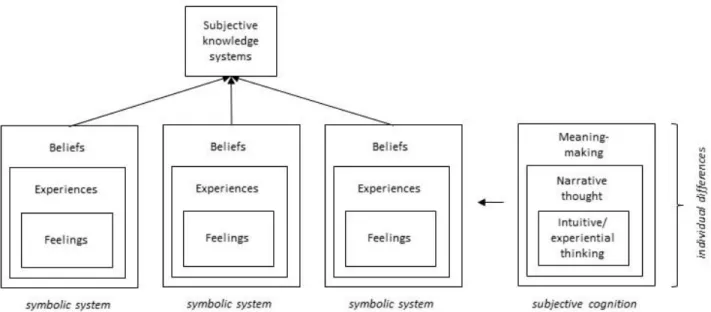
Subjective knowledge is processed through subjective cognition – experiential or intuitive thinking, narrative processing and meaning-making. Subjective knowledge as defined here will refer to knowledge of the world that is specific to human experience (or the human condition), along the lines of the naturalist/constructivist'.
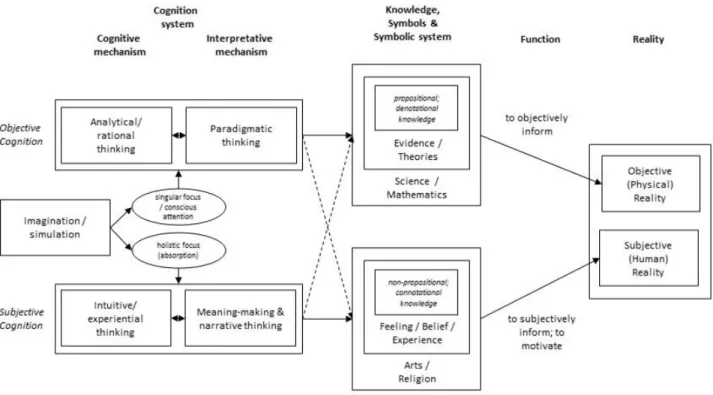
Subjective knowledge in the arts and religion
It is one of the strengths of works of art that they are not limited by verifiable facts, but that they exist in the imagination. This is not to say that the sciences have no basis in the imagination, but that the ontological status of subjective knowledge – its existence in the imagination – reflects the lack of a direct empirical counterpart of the work of art in the world: connotational rather than connotational .
Use of subjective knowledge
An example of how objective and subjective thoughts each perform their own functions is the report of the explanations of a termite-infested roof collapse by the Azande (an ethnic group in North Central Africa) by anthropologist E. Evans-Pritchard: When the roof When a granary collapses, the Azande understand that the termites were the immediate, proximate cause of the incident. However, the Azande also understand that the ultimate, distal cause of the roof collapse is witchcraft, which explains why it happened at a certain time, with certain people in the building.
Predictive processing frameworks suggest that the brain makes sense of the world through the continuous generation of predictive models of the world, which are based on previous experience, and these are compared to sensory input (Bar, 2009; Friston & Kiebel, 2009). In these cases, the internal models of the world dominate the predictions, and the signal can be experienced even if there is only noise.
Feelings
Salience and motivation
In the next section, we will discuss the forms of subjective knowledge and their functions: (4.1) feelings that contribute to perceptibility and motivation, and the noetic sense of reality, (4.2). Emotions are linked to memories in the brain through an associative learning process supported by dopamine (Bromberg-Martin, Matsumoto, & Hikosaka, 2010). The brain processes some stimuli as intrinsically rewarding (eg, a sweet taste) or intrinsically aversive (eg, a very bitter taste); such unlearned stimuli are primary reinforcers (Deeley, 2004; Rolls, 2000).
When it encounters neutral stimuli, the brain can associate these stimuli with primary reinforcers, resulting in these stimuli being encoded as secondary reinforcers themselves, by the amygdala and. Such motivational significance is attributed to otherwise neutral environmental stimuli through the 'imprinting' of memories, supported by dopamine release (Wise, 2004).
Noetic sense of realness
The 'motivational salience' hypothesis of dopamine suggests that the dopaminergic system attributes salience to stimuli (environment, events or thoughts), which then come to attract attention, influence intentions and induce action, due to its association with aversion and reward. Bromberg-Martin et al., 2010). For example, as with MDMA users, MDMA positively changes the user's self-esteem by increasing the sense of authenticity (Baggott et al., 2016). The sense that certain experiences are “real” or involve contact with a higher, truer reality than that of ordinary experiences is called their noetic quality (Hood Jr, 1975; Yaden, Le Nguyen, et al., 2017).
Yaden and colleagues found that, when asked directly to individuals, religious, spiritual, and mystical experiences were consistently perceived as more real than one's usual sense of reality (Yaden, Le Nguyen, et al., 2017). Neuropsychiatrist Quinton Deeley argued that this sense of reality, "the real", as Clifford Geertz phrases it (C. Geertz who combines human moods and motivations with conceptions of the world, is produced by a sensory route and a semantic route, both of which activate the mesolimbic dopamine system, among other cognitive-emotional processes, through which "religious ideas are turned into beliefs".
Experiences
Religious rituals
A noetic sense of reality is suggested to be found in religious and spiritual experiences in particular, which as a result feel more real than profane reality, providing insight into the way things happen. As previously mentioned, rituals have long been known to anthropologists to generate intense feelings of social cohesion and belonging (É. Durkheim V. Turner, 1969). The ritual components indeed produce a strong connection with others (Frecska & Kulcsar, 1989; Konvalinka et al., 2011; Power, 2018), although this can also be extended to connection with non-physical forces or experiences of self-transcendence.
In a series of field and laboratory studies, Charles and his colleagues demonstrated that participating in a religious ceremony together increases social bonding (Charles, Farias, et al., 2020; Charles, van Mulukom, Brown, et al., 2020; Charles, van Mulukom , Farias, et al., 2020; Charles et al., manuscript). Importantly, increases in social ties following rituals were predicted by increases in positive affect and feelings of connection to something greater during religious rituals (Charles, van Mulukom, Farias, et al., 2020), an effect that was replicated for attending secular rituals (Charles, van Mulukom, Brown, et al., 2020), as well as in an additional laboratory experiment involving five weeks of spiritual or secular yoga rituals (Charles et al., manuscript), with no significant differences between the two. groups.
Self-transcendence
James' distinction between 'I' and 'I' is particularly useful here (James, 1950): I as the self is the subject of experience, the person who looks through your eyes, who experiences sensations and lives in the present, while I because the self is a perceived object, which has a certain appearance and a personal identity. In terms of self-transcendent states, we reasoned that these may involve reductions of the rational self or “I,” allowing the experiential self or “I” to thrive (cf. Christy, Rivera, & Schlegel, 2020), in a process also called is called. This idea of a hydraulic relationship between 'I' and 'I' and its mechanisms is consistent with theories of 'hypoegoic functioning', which argue that quieting the conscious ego, or ceasing to actively attend to and think about about the self, allows for more spontaneous, automatic, and outward-oriented processes (Leary, Adams, & Tate, 2006; Leary & Guadagno, 2011).
An fMRI study further shows that absorption in awe-inspiring videos was associated with reduced activity in the default mode network, specifically in the posterior cingulate cortex (PCC)/precuneus and ventromedial prefrontal cortex (vmPFC) (van Elk et al., 2019 ). which we suggest are crucial in supporting the rational self or 'I'. The experience of self-transcendence in artistic and spiritual experiences can thus disrupt people's sense of who they are, through ego reduction or the reduction of 'I', but it can also enable people to reorient themselves and thus contribute to a better understanding of oneself – existential subjective knowledge such as authenticity and self-knowledge (Christy et al., 2020).
Belief
Through this awe-induced ego reduction, new perspectives related to group rather than personal identity—social subjective knowledge—can be acquired (Stellar et al., 2017). Moreover, while religious belief can be freely elaborated, factual beliefs are independent of context or practical setting (and lack the normative orientation that religious belief has). This distinction is further supported by empirical cross-cultural research in the United States, Ghana, Thailand, China, and Vanuatu, which shows that people use the verb (or the linguistic equivalent of) “to think” for factual beliefs and “to believe” for religious beliefs (Van Leeuwen, Weisman, & Luhrmann, 2020).
In the current framework, factual beliefs are beliefs about objective knowledge, while religious belief falls under beliefs about subjective knowledge. The two types of beliefs, like the knowledge they convey, have different functions and are appropriate in different contexts; see Contexts of objective and subjective knowledge.
Symbols
The symbols are created in a way that attracts and sustains attention and interest, and that creates, shapes and activates feelings and experiences in the symbol creator and/or witness. Declarative memory makes language crucial to being able to convey in a descriptively accurate way what happened, but memories of important events must instead capture the experience and its many associations, whether music, settings, movement, sensations, or even the mystery of the ritual (Alcorta, 2013; Deeley, 2004). Thus, as Alcorta (2013) also suggested, from a logical perspective it can be difficult to make sense of the ritual, but (sacred) symbols within the religious experience ('perpetual') in the memory of the experience) connect and condenses many meanings, in a connotational and non-propositional way. When a memory is detailed and vivid (such as memories of turning points in people's lives), it can continue to attract attention and evoke feelings.
Memories of these events can thus be persistent reminders of what to pay attention to (ie, what is valuable) and what to avoid, and can guide behavior in the present (Pillemer, 2001). Subjective cognition, on the other hand, includes the cognitive processes necessary to make sense of feelings, experiences, and beliefs, such as experiential thought, narrative thought, and meaning making, respectively.
Experiential or intuitive thought
These forms of subjective cognition can be thought of as hierarchical - whereas experiential thinking makes sense of sensory experiences at a base level, . meaning-making is involved in higher-order thinking, such as worldviews. Here we are going to explore these forms of subjective cognition further. & Fugelsang, 2013; Pennycook, Cheyne, Seli, Koehler, & Fugelsang, 2012). In this framework, intuitive thinking or intuition is considered a pre-cognitive state that occurs when an individual is fully absorbed in a situation with focused attention, and has sufficient exteroceptive and interoceptive awareness to deal with viscerosensory input while in this flow state remains.
In the context of subjective knowledge, intuitive thinking is necessary primarily for processing feelings and information based on subjective knowledge. Previous research has already linked intuitive thinking to religiosity and spirituality (Aarnio & Lindeman, 2005; Lindeman. & Aarnio Pennycook et al., 2012) and engagement in art and related creativity (van Mulukom & de Wet, manuscript; Wolfradt & Pretz , 2001).
Narrative thought
Having good exteroceptive and interoceptive awareness means more accurate previous models, and together constitute expertise and intuition (Gigerenzer, 2007). Internal and external sensory awareness contribute to correctly identifying and processing such input, and as such we expect that greater abilities in this area will contribute to greater subjective knowledge. While objective cognition or paradigmatic thinking serves correspondence, it is subjective cognition or narrative thinking that supports coherence.
Both types of memory processing are important: We have previously argued that narrative thinking and coherence are particularly important for high-arousal religious rituals (van Mulukom, 2017) and the social world more generally (van Mulukom & de Wet, forthcoming). For example, it may allow individuals to adjust their beliefs and memories to become consistent or coherent with others' perceived subjective knowledge and meaning systems, which in turn supports social cohesion and resulting behaviors such as communication and prosocial behavior (Echterhoff, Higgins, & Levine). 2009).
Meaning-making
What may unite these individual differences or characteristics is the tendency to have more porous mental boundaries of the self (Taylor, 2007)4. Tellegen, 1981, p. 222), and (3) restructuring of the phenomenal self “the capacity for marked restructuring of one's phenomenal field, especially the self and its boundaries” (Tellegen, 1992, as cited in Jamieson, 2005). We have shown that a general condition that supports these processes and forms of knowledge is that of the experiential cell.
Awe as a meaning-making emotion: On the development of awe and the origins of religions. Émile Durkheim and the Birth of the Gods: Clans, incest, totems, phratries, hordes, mana, taboos, corroborees, sodalities, menstrual blood, monkeys, churingas, cairns, and other mystical things. Making sense of the meaning literature: an integrative review of meaning making and its effects on adaptation to stressful life events.
34; Role of the feedback signal in electromyographic biofeedback: the relevance of attention" by Qualls and Sheehan.