*Author for correspondence: [email protected]
ABSTRACT
The Isthmus of Panama illustrates how the vegetation of a newly created landscape in a tropical setting evolves over time. It also allows us to investigate biological invasions, because the landscape was first connected to temperate North America, and later connected to tropical South America.
Using a large number of outcrops newly exposed during the recent expansion of the Panama Canal, we were able to complement the extensive palynological research that Alan Graham con- ducted in Panama over the past 25 years. We analyzed the palynological record of the interval 19.5–1.2 Ma, represented by 282 samples containing 27,910 grains (pollen/spores) with 496 morphotypes. Further, a revision of the plant macrofossil literature of Panama and analysis of the carbon isotope content of 14 samples were carried out. Our results indicate that since the Early Miocene, Panamanian forests have been dominated by Gondwana-Amazonian taxa, suggesting that plants were able to cross the Central American Seaway much earlier than mammals. The landscape was dominated by tropical rainforest and lower montane to montane forest, contrary to the dry and open habitats that some previous studies have proposed. Plant diversity seems to have increased over the past 10 My, but it is unclear if this increase is due to a taphonomic bias. Further studies are needed to understand the relationships of the Early Miocene Panamanian mammals derived from North American temperate forest lineages as they faced new habitats in Panama dominated by South American–derived tropical rainforest.
Key words: biogeography, GABI, Neogene, paleobotany, palynology.
A century ago, during the initial excavations for the Panama Canal, the Smithsonian Institu- tion conducted intensive natural history and geo- logical investigations, resulting in some of the first major collections that documented the high
biodiversity of the American Neotropics (e.g., Vaughan, 1919). Almost a century later, starting in 2007, after a public referendum, the govern- ment of Panama decided to widen the Panama Canal. The $5 billion project is scheduled for CHAPTER 8
PALYNOLOGICAL RECORD OF THE LAST 20 MILLION YEARS IN PANAMA
Carlos Jaramillo,* Enrique Moreno, Valentina Ramírez, Silane da Silva, Atria de la Barrera, Adara de la Barrera, Carlos Sánchez, Sara Morón, Fabiany Herrera, Jaime Escobar,
Rebecca Koll, Steven R. Manchester, and Natalia Hoyos
PALYNOLOGICAL RECORD OF THE LAST 20 MILLION YEARS IN PANAMA 135
completion in 2014. The Smithsonian Tropical Research Institute and the University of Florida have taken advantage of this extraordinary op- portunity to collect fossils and geological infor- mation to better understand the uplift of the Isthmus of Panama, which had far-reaching bio- logical, climatic, and tectonic implications. The recently exposed rocks have allowed us to compile large amounts of new geological and paleonto- logical data that otherwise would have been im- possible to collect, given that most of the Panama- nian landscape is covered by tropical rainforest.
Many highly fossiliferous sedimentary strata were exposed, giving us a glimpse of the evolution of the landscape, the formation of the isthmus, and the ecosystem, flora, and biota of Panama during the past 20 million years.
The Panamanian fossil vertebrate collections provide a good record of Miocene North Ameri- can mammal immigrants, including horses, bear- dogs, camels, rhinocerids, peccaries, and rodents (Whitmore & Stewart, 1965; Slaughter, 1981;
MacFadden & Higgins, 2004; MacFadden, 2006a, 2006b, 2009, 2010; MacFadden et al., 2012;
Rincon et al., 2012, 2013); South American im- migrants include turtles, snakes, and crocodiles (Cadena et al., 2012; Head et al., 2012; Hastings et al., 2013). The geological history of the Isthmus of Panama can be divided broadly into four seg- ments (Coates et al., 1992, 2003, 2004; Coates
& Obando, 1996; Farris et al., 2011; Montes et al., 2012a, 2012b; Sepulchre et al., 2014): (1) a pre-22 Ma interval during which most of Pan- ama was underwater, except some Late Eocene and Oligocene volcanic islands; (2) an initial col- lision with South America around 22–21 Ma with an associated broad-scale land exhumation and a narrowing of the Central American Seaway (CAS) to ca. 200 km (CAS is defined here as the oceanic seaway along the tectonic boundary of the South American plate and the Panamanian microplate); (3) a final and major exhumation at 12–10 Ma, when most of the Panamanian land- scape was exhumed above sea level and the CAS
was fully closed, ending deep and intermediate water exchange between the Caribbean and Pa- cific; (4) an intermittent exchange between 10 and 3.5 Ma of shallow waters between the Pacific and the Caribbean (Coates et al., 1992; Coates
& Obando, 1996; Haug & Tiedemann, 1998) along places other than the CAS. At 4.2–3.5 Ma a full closure of the isthmus occurred (Coates et al., 1992; Haug et al. 2001, 2004). The complete isthmus formation facilitated exchange of faunas and floras of South America with those of Cen- tral and North America, in a process that has been named GABI (the Great American Biotic Inter- change; Stehli & Webb, 1985; Coates & Obando, 1996). Modern Neotropical biodiversity and bio- geographic distributions are deeply affected by this interchange.
Our study presents an overall view of the vege- tation evolution of the isthmus for the past 20 My, using both palynological and macrofossil data.
We attempt to answer four questions, namely:
(1) what are the vegetation types that have dom- inated the Isthmus of Panama over the past 20 Ma?, (2) are there any lines of evidence for wide- spread savannas or dry forests?, (3) what is the biogeographic origin of the floras found in Pan- ama?, and (4) how has plant diversity changed?
In particular, we hypothesized that the earlier floras would have been dominated by North American (Laurasian) families, due to the rela- tively late physical connection with South Amer- ica brought on by full closure of the isthmus at ca. 3.5 Ma.
This investigation was based on the analysis of 282 palynological samples together with the ex- tensive palynological research of Dr. Alan Graham on Panamanian sedimentary formations (Graham, 1977, 1988a, 1988b, 1989, 1991a, 1991b, 1991c, 1992, 1995, 1999, 2010, 2011). Our palyno- logical work focused on the Cucaracha, Culebra, Gatun, and Chagres formations that outcrop along the canal in central Panama, together with samples from western Panama (Bocas del Toro) and eastern Panama (Darien). Macrobotanical in-
136 PALEOBOTANY AND BIOGEOGRAPHY
formation is derived from newly discovered fossil assemblages (leaves, fruits, and wood) from the Cucaracha and Gatun formations, together with a review of previous published work.
GRAHAM CONTRIBUTIONS
Graham has been a pioneer in the study of the floristic evolution of Central America and the Caribbean, publishing extensively across many regions and time periods. See Graham (2010, 2011) for an excellent synthesis of his impressive research over the past 40 years. In a series of papers, he described the palynofloras of central Panama, including La Boca, Culebra, Cucaracha, and Gatun formations. His study of La Boca For- mation (Graham, 1989), was not included here because the precise stratigraphic position of this site in relation to our stratigraphic work could not be determined, and it could correspond to the Lower Culebra or Cascadas formations. The original site, which is in an area with high struc- tural complexities, no longer exists, since it was depleted before our study in the Panama Canal started.
From the La Boca Formation (Graham, 1989), Graham found 54 morphotypes, including 39 where natural affinities could be assessed. The sediments were mostly marine, and some samples were dominated by mangrove elements (Rhizo- phora L.) and some dinoflagellates. The flora re- flects low-lying volcanic islands fringed by man- groves, with freshwater and palm swamp, marshes, and tropical wet/moist and premontane forest.
There is no evidence of dry habitats, including savannas or high elevations (> 1500 m). The flora is similar to extant coastal Panamanian floras. Cli- mate was humid-tropical, similar to that of mod- ern southern Central America.
Study of the Culebra Formation (upper Cule- bra) (Graham 1987, 1988b), where 41 palyno- morphs were identified, indicated an estuarine sequence. Ferns constitute 25% of the flora, palms 4%, and lowland vegetation 71%. Tropical
moist forest, represented by 30 genera, domi- nated the assemblages of premontane wet forest (25 genera), tropical wet forest (22 genera), and some forms of premontane moist forest (12 gen- era). Communities of higher elevations and dry to arid habitats (including savannas) are poorly represented to absent. Climate was similar to modern Panama, with 2.7–3.2 m rainfall annu- ally, and tropical temperatures. All 41 taxa iden- tified are still represented in the modern flora of Panama.
The study of the Cucaracha Formation (Gra- ham, 1988a) identified 19 palynomorphs accu- mulated in an estuarine sequence. Paleocom- munities included fern/palm marshes, mangroves, tropical wet/moist forests, and premontane forests.
There is no evidence for high-altitude (> 1500 m) vegetation or dry vegetation (savanna). The af- finity of the palynoflora showed connection to North American and Central American floras, and paleoclimatic conditions were interpreted as similar to modern Panama (tropical temperatures and high levels of rainfall). Graham (1988a) pro- posed that the volcanic activity might have pro- duced disruptions in the vegetation, with result- ing short-term open communities (savannas) that are suggested by the presence of browsers and grazers in the mammalian faunas of the Cucara- cha Formation.
Graham (1991a, 1991b, 1991c) dated the Gatun Formation as Middle Miocene, but more recent work has indicated a Late Miocene age (Hendy, 2013). Graham identified 110 palynomorphs from several habitats, including shallow marine communities, mangroves, freshwater swamps/
marshes, tropical wet/moist forests, premontane rainforests/moist forests, lower montane moist forests, and tropical dry forest. There was an in- crease in diversity compared to earlier floras, an increase of grasses (but only up to 7.5%), more de- veloped dry forest, better representation of lower montane forest, and possibly, the first indication of differentiation between a wetter Atlantic side and a drier Pacific side in Panama.
PALYNOLOGICAL RECORD OF THE LAST 20 MILLION YEARS IN PANAMA 137
VEGETATION TYPES IN THE ISTHMUS OF PANAMA
Today there are several types of forests in Panama, reflecting a variety of environmental differences—mainly differences in the mean an- nual precipitation (MAP) and the amount of pre- cipitation during the dry season. Forests include lowland wet forest (> 300 mm of rain during the dry season), seasonal lowland moist forest (100–
300 mm during the dry season), and lowland dry forest (≤ 1600 mm MAP and ≤ 100 mm during the dry season) (Pyke et al., 2001; Condit et al., 2004). The Caribbean side is also much wetter than the Pacific side. Additional forest types in- clude swamp forest, seasonally flooded riparian forest, mangrove forest, and montane and pre- montane forests. An extensive review of each of those forest types has been provided by Graham in a number of seminal works in the past few years (Graham, 1991c, 2010). We have used his vege- tation classification approach to assess the types of forest found in the fossil record (Table 1).
METHODS SAMPLES
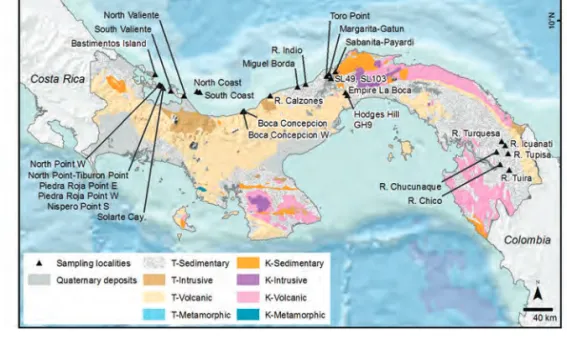
A total of 282 palynological samples were ana- lyzed. Samples came from three sources: (1) Fifty- five samples were from a measured and described stratigraphic section of the full span of Culebra and Cucaracha formations from the new excava- tions of the Panama Canal (Emperador section for the Lower Culebra, and Hodges Hill section for the Upper Culebra and Cucaracha) (Figs. 1, 2, Table 2). (2) Two hundred samples previously collected by the Panama Paleontology Project (PPP) (Collins & Coates, 1999) were processed for palynological analyses. These were collected from central Panama (from Gatun and Chagres formations), eastern Panama (Darien region), and western Panama (Bocas del Toro) (Figs. 1, 2, Table 2). (3) Palynological information previously published by Graham (1987, 1988a, 1988b, 1991a,
1991b, 1991c) was added to our stratigraphic framework (Montes et al., 2012b; Hendy, 2013), including 11 samples from the Culebra Forma- tion, seven samples from the Cucaracha Forma- tion, and nine samples from the Gatun Formation (Figs. 1, 2, Table 2). The stratigraphic position as well as the label of each sample is given in the Sup- plementary Appendix (<http://dx.doi.org/10.5479/
data.stri.jaramillo-2014>). Palynological samples were prepared by digesting 30 g of sediment in HCl and HF, then oxidizing if necessary (Tra- verse, 2007), and all slides were added to the Alan Graham Palynological Collection, the extensive pollen collection donated by Alan Graham to the Smithsonian Institution a few years ago.
AGE
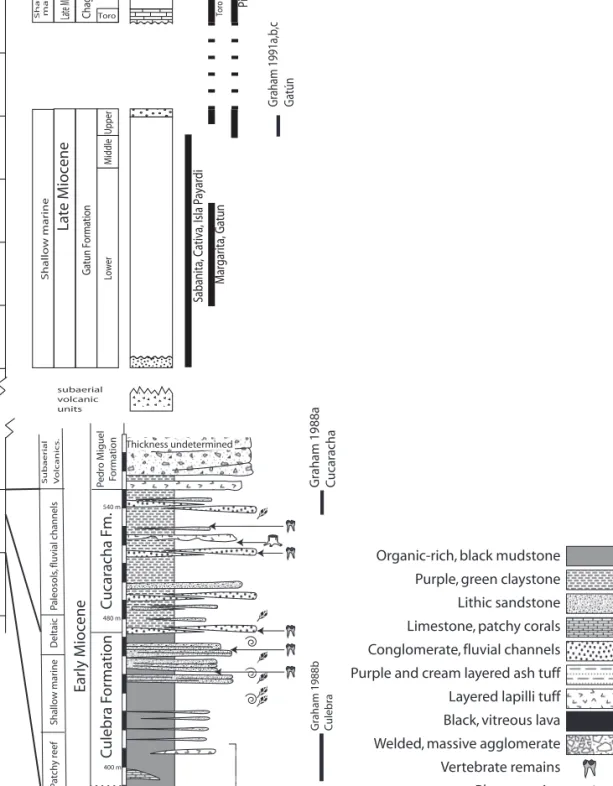
The age for the Culebra and Cucaracha has been estimated as 19.5–18.5 Ma using uranium- lead (U-Pb) geochronology and magnetostratig- raphy (MacFadden et al., 2012; Montes et al., 2012a, 2012b): 19.5–19 Ma for Culebra Forma- tion and 19–18.5 Ma for Cucaracha Formation.
For the age of individual samples within these formations, a linear and constant accumulation rate was assumed, since there are no major litho- logical changes within each formation (Supple- mentary Appendix). Age for each PPP sample has been determined using planktonic foramin- ifera and calcareous nannoplankton (Collins &
Coates, 1999). Ages of 12 to ca. 8.5 Ma (Middle to Late Miocene) for the Gatun Formation and 6.5–5.5 Ma (Late Miocene) for the Chagres For- mation have been determined using foraminifera, nannoplankton, and molluskan biostratigraphy (Collins & Coates, 1999; Hendy, 2013). See Fig- ures 1, 2, Table 2, and Supplementary Appendix.
ECOLOGICAL PREFERENCES AND BIOGEOGRAPHIC ORIGINS
Ecological preferences for fossil taxa follow mainly Graham (1991c), with additional input (Germeraad et al., 1968; Croat, 1978; Henderson et al., 1995; Correa & Valdespino, 1998; March-
138 PALEOBOTANY AND BIOGEOGRAPHY
TABLE 1. Ecological preferences for fossil taxa, based primarily on Graham (1991c), with additional input from Germeraad et al. (1968), Croat (1978), Henderson et al. (1995), Correa and Valdespino (1998), Marchant et al. (2001), Correa et al. (2004), Carrasquilla (2006), and Henderson (2011).
Taxa TRFO PMF MF TDFO SV FW MG MR
Acacia Mill. 1 1 1
Acalypha diversifolia Jacq. 1 1 1
Aegiphila Jacq. 1 1
Alchornea Sw. 1 1
Alfaroa Standl. 1
Alfaroa/Oreomunnea Standl./Oerst. 1 1 1
Allophylus L. 1 1 1
Alnus Mill. 1
Alsophila R. Br. 1 1 1
Amanoa Aubl. 1 1
Bernoullia Oliv. 1 1
Bombacopsis Pittier 1 1
Borreria G. Mey. 1 1 1
Bucida L. 1
Bucida L. 1
Bursera Jacq. ex L. 1 1 1
Cabomba Aubl. 1
Caesalpinia L. 1
Casearia Jacq. 1
Catopsis Griseb. 1
Cayaponia Silva Manso 1 1
Cedrela P. Browne 1 1 1
Ceiba Mill. 1 1 1
Ceratopteris Brongn. 1
cf. Aguiaria Ducke 1
cf. Cionosicys Griseb. 1 1
cf. Glycydendron Ducke 1
cf. Jatropha L. 1
cf. Stillingia Garden ex L. 1 1
cf. Jatropha L. 1
Chelonanthus (Griseb.) Gilg 1 1
Chomelia Jacq. 1
Chrysophyllum L. 1 1
Cnemidaria C. Presl 1 1 1
Combretum Loefl. 2
Combretum Loefl./Terminalia L. 1 1
Cordia L. 1 1
Cosmibuena Ruiz & Pav. 1 1
Crudia Schreb. 1 1
Cryosophila Blume 1 1
Ctenitis (C. Chr.) C. Chr. 1 1 1
Cupania L. 1 1
PALYNOLOGICAL RECORD OF THE LAST 20 MILLION YEARS IN PANAMA 139
(continued) TABLE 1. (continued)
Taxa TRFO PMF MF TDFO SV FW MG MR
Cyathea Kaulf. 1 1 1
Cymbopetalum Benth. 1 1
Danaea Sm. 1 1
Desmoncus-type Mart. 1
Dinoflagellates 1
Dioclea reflexa Hook. f. 1
Dioscorea L./Rajania L. 1
Doliocarpus Rol. 1 1 1
Erythrina L. 1 1
Eugenia L. 1
Eugenia L./Myrcia DC. 1 1
Euterpe Mart. 1
Faramea Aubl. 1 1
Foram lining 1
Genipa americana L. 1 1 1
Glycydendron Ducke 1
Gomphrena L. 1 1
Grammitis Sw. 1
Guarea F. Allam. ex L. 1
Hampea Schltdl. 1
Hampea Schltdl./Hibiscus L. 1
Hauya DC. 1
Hedyosmum Sw. 1 1 1
Hemitelia R. Br./Cnemidaria C. Presl 1
Hibiscus L. 1
Humiria Aubl. 1
Ilex L. 1 1
Iriartea deltoidea Ruiz & Pav. 1
Jamesonia Hook. & Grev. 1
Jatropha L. 1 1
Ludwigia L. 1 1
Lycopodium L. 1 1 1
Lygodium Sw. 1
Lygodium microphyllum (Cav.) R. Br. 1
Machaerium Pers. 1
Manicaria-type Gaertn. 1
Matayba Aubl. 1 1
Mauritia L. f. 1
Mauritia flexuosa L. f. 1
Miconia Ruiz & Pav. 1
Monolete fern spore types 1-2 (Blechnaceae) 1
Mortoniodendron Standl. & Steyerm. 1
Mutisieae type Cass. 1
140 PALEOBOTANY AND BIOGEOGRAPHY
TABLE 1. (continued)
Taxa TRFO PMF MF TDFO SV FW MG MR
Myrcia DC. 1
Oenocarpus Mart. 1 1
Ophioglossum L. 1 1 1
Oryctanthus (Griseb.) Eichler 1 1 1
Pachira aquatica Aubl. 1
Palmae type 1 1
Paullinia L. 1 1
Pelliciera Planch. & Triana 1
Petrea L. 1 1
Phytelephas Ruiz & Pav. 1
Poaceae 1 1
Podocarpus L’Hér. ex Pers. 1
Polypodiaceae/Pteridaceae 1
Posoqueria Aubl. 1 1 1
Pouteria Aubl. 1
Protium Burm. f. 1 1
Pseudobombax Dugand 1 1 1
Psidium L. 1
Pteris L. 1 1 1
Quercus L. 1 1 1
Rhizophora L. 1
Rourea Aubl. 1 1 1
Sabicea Aubl. 1 1
Sapium Jacq. 1 1
Sapium caudatum Pittier 1 1
Scheelea zonensis L. H. Bailey 1 1 1
Selaginella P. Beauv. 1 1 1
Serjania Mill. 1 1
Serjania cf. Mill. 1
Spondias L. 1 1 1
Stenochlaena palustris (Burm. f.) Bedd. 1
Stillingia Garden ex L. 1
Symphonia globulifera L. f. 1 1
Symplocos Jacq. 1 1
Tetrorchidium macrophyllum Müll. Arg. 1
Trichilia P. Browne 1
Utricularia L. 1
Vernonia Schreb. 1 1 1
Vochysia Aubl. 1
Abbreviations: TRFO = tropical wet/moist forest; PMF = premontane wet/moist/rainforest; MF = lower montane to montane moist/wet forest; TDFO = tropical to premontane dry forest; SV = savanna; FW = freshwater marsh community; MG = mangrove swamps; MR = shallow water marine community.
PALYNOLOGICAL RECORD OF THE LAST 20 MILLION YEARS IN PANAMA 141
ant et al., 2001; Correa et al., 2004; Carrasquilla, 2006; Henderson, 2011) (Table 1).
For biogeographic origins, we followed the approach of Gentry (1982). Plant families were given a biogeographic origin provided by Gen- try, including Gondwana-Amazonian families, Gondwana-northern Andean, Gondwana-south- ern Andean, Laurasian, or unassigned (Table 3).
Modern vegetational abundance data and species composition were derived from the 50-ha plot of Barro Colorado Island in Panama (Condit et al., 2004) (Appendix 1). The data from this plot include approximately 240,000 stems of 303 spe- cies of trees and shrubs more than 1 cm in diam- eter at breast height, representing ca. 96% of the biomass in the plot (Chave et al., 2003, 2005).
Pollen traps in the soil within the plot also have shown than pollen spectra produce a representa- tive sample of the vegetation within the plot (Bush
& Rivera, 1998; Haselhorst et al., 2013), conse- quently making the pollen record a good proxy to understand the forest.
STABLE CARBON ISOTOPES
We used stable carbon isotopes to identify C3 versus C4 photosynthetic pathways, as a means to identify the presence of C4 savannas (rich in C4 grasses) versus trees (C3). Sediment samples were freeze-dried and crushed with a mortar and pestle. Total carbon and total nitrogen were mea- sured using a Carlo Erba (Milan, Italy) NA1500 CNS elemental analyzer with a zero blank auto- sampler. Carbonate carbon was determined by coulometric titration using an automated acidi- fication prep device coupled with a UIC CO2 coulometer. Percentage of organic carbon was cal- culated by subtraction of carbonate carbon from total carbon. Samples for isotopic analyses were treated with 2 N HCl to remove carbonate and then washed with distilled water to remove chlo- ride. Approximately 50 mg of carbonate-free bulk sediment was loaded into tin sample capsules and placed in a 50-position automated sample zero blank carousel on the elemental analyzer. Combus- tion gases were carried in a helium stream through
FIGURE 1. Sampling localities displayed on Panama’s regional geology. “North Coast” and “South Coast” localities are on Escudo de Veraguas Island. Geology is from the National Environmental Authority (ANAM). Elevation data are from the Shuttle Radar Topography Mission (U.S.G.S., 2004) and bathymetry is from the ETOPO1 dataset (Amante & Eakins, 2009).
142 PALEOBOTANY AND BIOGEOGRAPHY
FIGURE 2. Stratigraphic profi le of the main formations and sections studied in central Panama. Stratigraphy and age of Cucaracha and Culebra formations after Montes et al. (2012b) and MacFadden et al. (2012); Gatun Formation after Hendy (2013). PPP = Panama Paleontology Project.
6
Age (Ma)
7
8
9
10
11
12
Sabanita, Cativa, Isla Payardi Margarita, Gatun Piña
Toro Point
Gatun Formation MiddleLowerChagre s Fm
Toro
PPP sections
Age (Ma)
18.5
19.5
20.5
Upper
subaerial volcanic units
Organic-rich, black mudstone Purple, green claystone Lithic sandstone Limestone, patchy corals Conglomerate, fluvial channels Purple and cream layered ash tuff Layered lapilli tuff Black, vitreous lava Welded, massive agglomerate Vertebrate remains Plant remains Invertebrate remains
Graham 1988b CulebraGraham 1988a Cucaracha Graham 1991a,b,c Gatún
Las Cascadas FormationCulebra FormationCucaracha Fm.Pedro Miguel Formation
Subaerial Volcanics.Subaerial VolcanismPaleosols, fluvial channelsShallow marinePatchy reefDeltaic
Thickness undetermined Thickness undetermined Shallow marineShallow marine
400 m 540 m
480 m
Early MioceneLate MioceneLate Miocene
PALYNOLOGICAL RECORD OF THE LAST 20 MILLION YEARS IN PANAMA 143
a Conflo II interface to a Finnigan-MAT 252 iso- tope ratio mass spectrometer (PRISM). All carbon isotopic results are expressed in standard delta nota- tion relative to Vienna Pee Dee Belemnite (VPDB).
PALYNOLOGICAL NOMENCLATURE Morphological characteristics of the palyno- morphs were compared with illustrations and
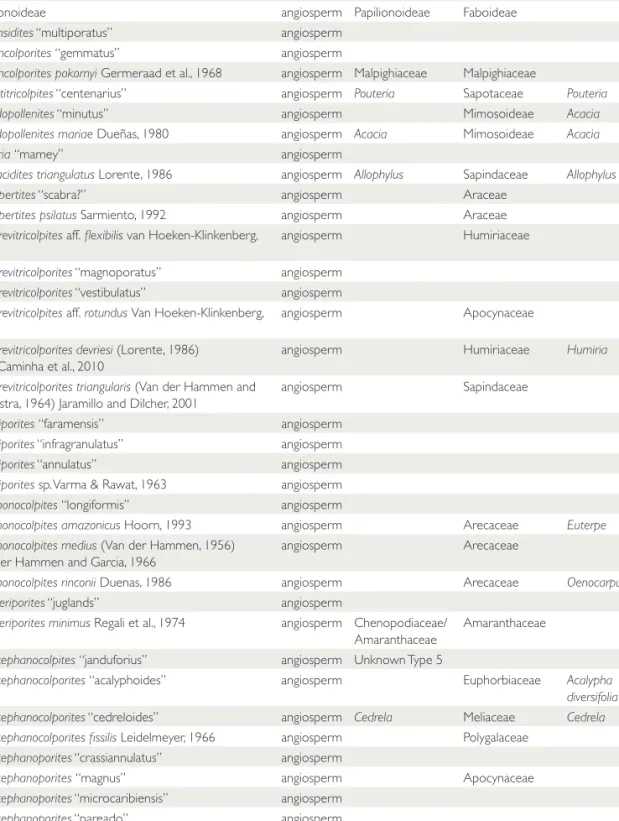
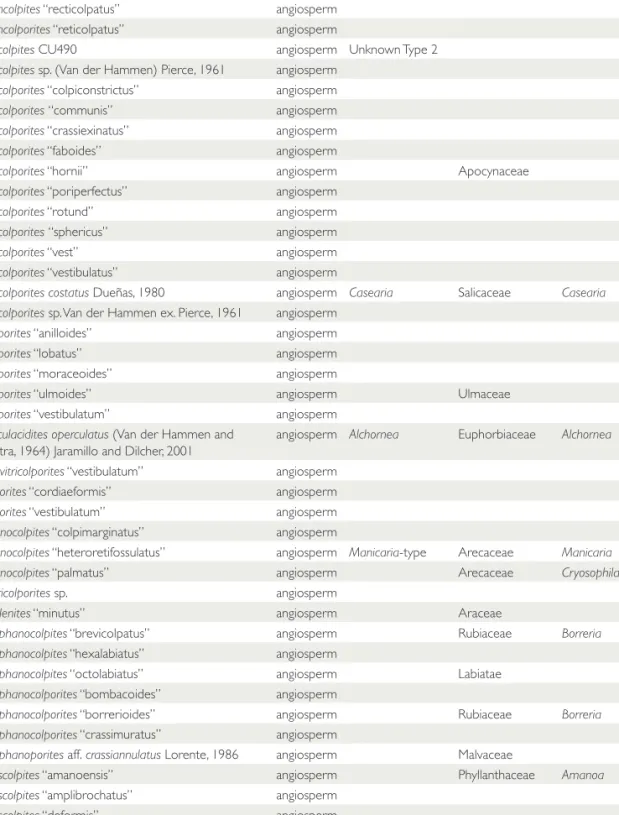
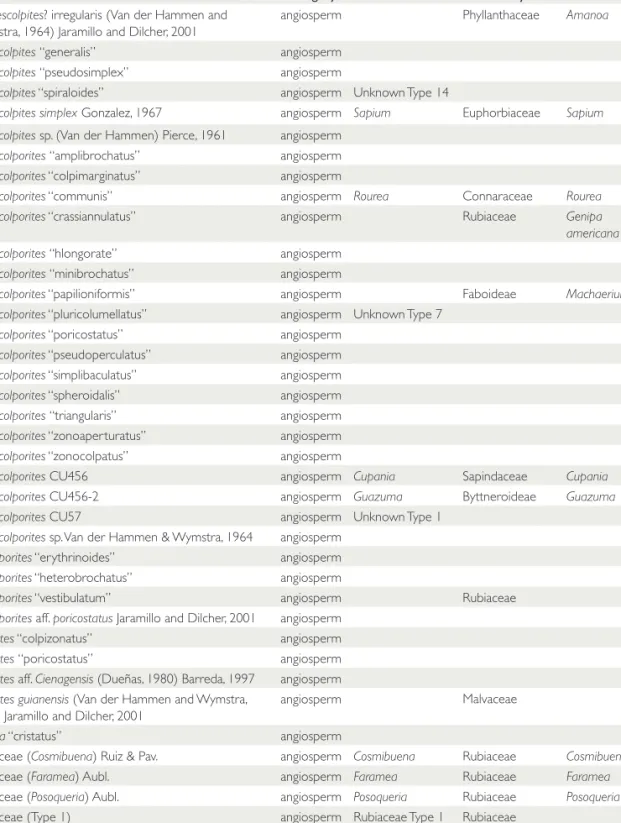
descriptions from literature and summarized in Jaramillo and Rueda (2013). Major nomencla- tural usages follow those in Jaramillo and Dilcher (2001). Informal species are those between quo- tation marks. In the taxonomic section (Appen- dix 2), 414 morphotypes are briefly described and/or illustrated. The taxa encountered and their counts are listed in the Supplementary Appendix, TABLE 2. Geographical location of the studied samples.
Region Section name Formation name Latitude Longitude Source
Central Panama Empire section La Boca Culebra 9.0827 –79.6789 this study
Central Panama Hodges Hill section Culebra/Cucaracha 9.05 –79.6534 this study
Central Panama 01-Sabanita to Payardi Gatun 9.351083333 –79.808 PPP samples
Central Panama 02-Margarita to Gatun Gatun 9.32575 –79.89133333 PPP samples
Central Panama 03-Toro point Gatun 9.296083333 –79.92466667 PPP samples
Central Panama 05- Rio Indio Chagres 9.192138889 –80.19133333 PPP samples
Central Panama 06-Miguel de la Borda Gatun 9.154833333 –80.29133333 PPP samples Central Panama 07-Boca de Concepcion Gatun 8.847583333 –80.97466667 PPP samples Central Panama 08-Boca de Concepcion West Gatun 8.841416667 –80.99133333 PPP samples
Central Panama 09 -Calzones River Gatun 9.045083333 –80.64133333 PPP samples
Western Panama 10-North Coast Escudo Veraguas 9.101444444 –81.57466667 PPP samples Western Panama 11-South Coast Escudo Veraguas 9.089944444 –81.54133333 PPP samples Western Panama 12-North Valiente Shark Hole Point 9.042777778 –81.74133333 PPP samples Western Panama 15-South Valiente Shark Hole Point 9.106666667 –81.908 PPP samples
Western Panama 16-North Point West Cayo Agua 9.18 –82.058 PPP samples
Western Panama 17-Piedra Roja Point West Cayo Agua 9.141083333 –82.008 PPP samples Western Panama 18-Piedra Roja Point East Cayo Agua 9.143138889 –82.008 PPP samples Western Panama 19- North Point-Tiburon Point Cayo Agua 9.174888889 –82.04133333 PPP samples Western Panama 20-Nispero Point South Cayo Agua 9.167527778 –82.02466667 PPP samples
Western Panama 22-Bastimentos Island unnamed 9.317777778 –82.108 PPP samples
Western Panama 23-Bastimentos Island unnamed 9.317277778 –82.108 PPP samples
Western Panama 24- Solarte Cay unnamed 9.142194444 –82.008 PPP samples
Eastern Panama Rio Chico Tuira? 8.17075 –77.708 PPP samples
Eastern Panama Rio Chucunaque Chucunaque 8.331138889 –77.758 PPP samples
Eastern Panama Rio Icuanati Lara 8.410416667 –77.64133333 PPP samples
Eastern Panama Rio Tuira Tuira 8.097 –77.59133333 PPP samples
Eastern Panama Rio Tupisa Tuira 8.308611111 –77.608 PPP samples
Eastern Panama Rio Turquesa Tuira 8.465722222 –77.69133333 PPP samples
Central Panama Core SL103 Gatun 9.266666667 –79.86666667 Graham, 1991c
Central Panama Core SL49 Gatun 9.266666667 –79.86666667 Graham, 1991c
Central Panama GH9 Culebra 9.05 –79.6534 Graham, 1988a
Central Panama Roadside K2 Cucaracha 9.05 –79.6 Graham, 1988b
Abbreviation: PPP = Panama Paleontology Project.
144 PALEOBOTANY AND BIOGEOGRAPHY
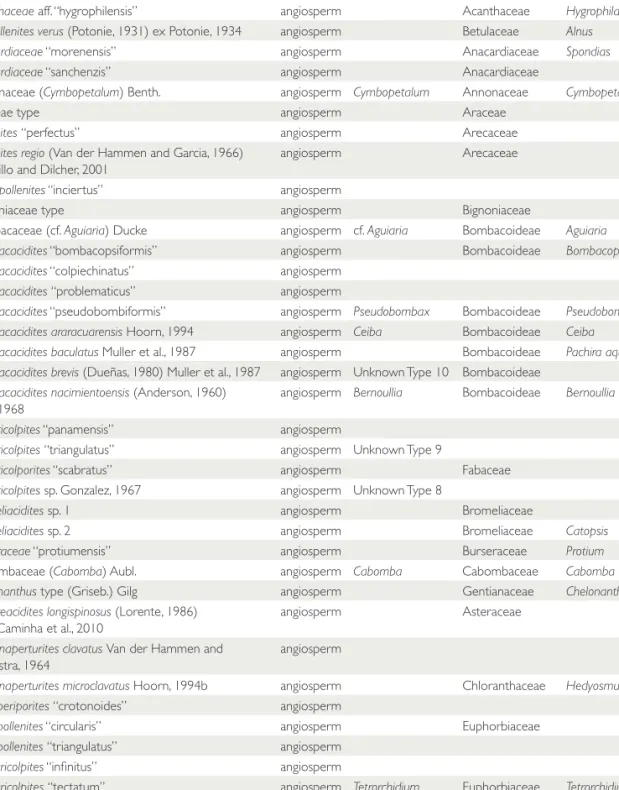
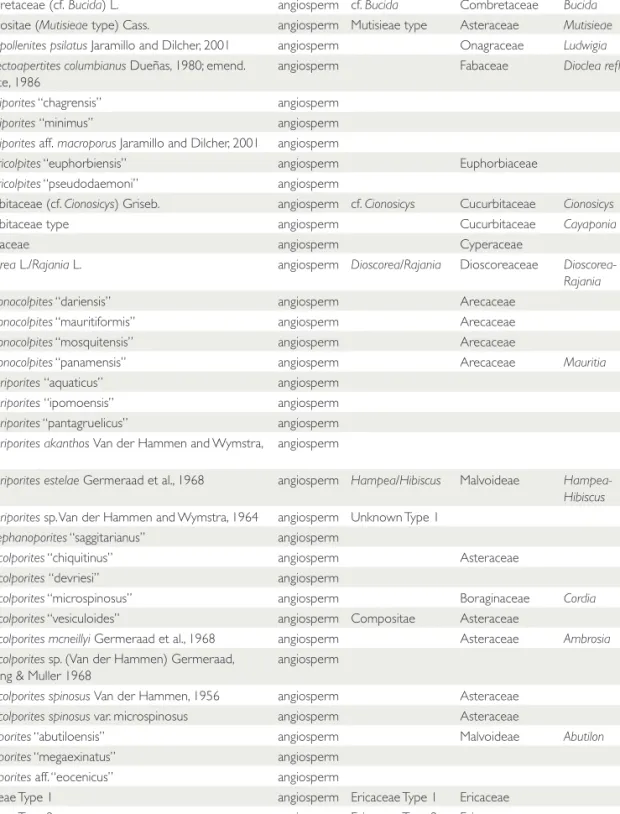
as well as in Table 4, where possible natural affin- ities are provided. We employ a nomenclature using fossil names for each taxon, even when the natural affinities are known. This approach differs from that used by Graham in all his publi cations where the fossils were referred to extant families and gen- era when possible. We feel that using a fossil taxon naming approach would be more useful when comparing to fossil floras elsewhere in the tropics, where fossil morphotaxa have mostly been used.
Also, using natural affinities as the name of a fos- sil taxon can bring nomenclatural problems in the future, because the affinity of a given fossil spe- cies can change when further research is done, specially using SEM and TEM. It would be more practical to have a fossil morphotaxon name with an informally suggested natural affinity; that is, a hypothesis of relationship can change over time, but the morphotaxon name will not.
DIVERSITY ANALYSES
A number of techniques were used to analyze the patterns of pollen and spore diversity and flo- ral composition. Diversity is used here to denote
the number of species (Rosenzweig, 1995). Diver- sity within a sample was estimated using rarefac- tion, an interpolation technique that estimates how many species may have been found if the sample had been smaller (Raup, 1975). The rar- efaction was calculated with the fungal spores excluded because they can represent a large pro- portion of the palynological sum and thus can mask possible vegetation patterns; this exclusion from the diversity analyses was also appropriate, because little taxonomic work has been under- taken on Neotropical Neogene fungi.
Species accumulation curves (Gilinsky, 1991), using the collector method, were used to calcu- late how diversity increases as more samples are analyzed. The collector method adds sites in the order they happen to be in the data (Oksanen et al., 2010). It was used to compare the three time intervals that we analyzed (see below), because each interval represents a different time span, and comparison of them would have biased the diver- sity toward the interval with the longest duration (i.e., the longest duration interval would have a greater probability to accumulate more species).
TABLE 3. Biogeographic affinities after Gentry (1982) for the families present in either the Barro Colorado Island 50-ha plot or the fossil record presented in this report.
Biogeographic Province Family
Dry area Gondwanan group Erythroxylaceae
Gondwana-Amazonian Anacardiaceae, Annonaceae, Apocynaceae, Arecaceae, Bombacoideae, Burseraceae, Byttneroideae, Caesalpinioideae, Chrysobalanaceae, Combretaceae, Connaraceae, Dilleniaceae, Ebenaceae, Elaeocarpaceae, Euphorbiaceae, Fabaceae, Faboideae, Grewioideae, Humiriaceae, Lacistemataceae, Lauraceae, Lecythidaceae, Malpighiaceae, Meliaceae, Mimosoideae, Moraceae, Myristicaceae, Ochnaceae, Olacaceae, Phyllanthaceae, Polygalaceae, Rhizophoraceae, Sapindaceae, Sapotaceae, Simaroubaceae, Sterculiaceae, Tetrameristaceae, Tiliaceae, Violaceae, Vochysiaceae Gondwana-northern Andean Acanthaceae, Araceae, Araliaceae, Asteraceae, Bromeliaceae, Clusiaceae, Ericaceae,
Loranthaceae, Monimiaceae, Nyctaginaceae, Piperaceae, Rubiaceae, Urticaceae Gondwana-southern Andean Bignoniaceae, Myrtaceae, Onagraceae, Podocarpaceae, Solanaceae
Laurasian Achariaceae, Aquifoliaceae, Betulaceae, Boraginaceae, Celastraceae, Chloranthaceae, Fagaceae, Gentianaceae, Juglandaceae, Labiatae, Lythraceae, Melastomataceae, Rhamnaceae, Salicaceae, Staphyleaceae, Symplocaceae, Ulmaceae
Unassigned Amaranthaceae, Cabombaceae, Cucurbitaceae, Cyperaceae, Dioscoreaceae, Dryopteridaceae, Lamiaceae, Lentibulariaceae, Malvaceae, Malvoideae, Nymphaeaceae, Picramniaceae, Poaceae, Polygonaceae, Rutaceae, Verbenaceae
PALYNOLOGICAL RECORD OF THE LAST 20 MILLION YEARS IN PANAMA 145
TABLE 4. List of all species used in the analysis with their possible natural affinities. The Graham taxon name corresponds to the names used by Graham in his publications. Informal species are those within quotation marks.
Taxon Category
Graham
taxon name Family Genus
Acanthaceae aff. “hygrophilensis” angiosperm Acanthaceae Hygrophila
Alnipollenites verus (Potonie, 1931) ex Potonie, 1934 angiosperm Betulaceae Alnus
Anacardiaceae “morenensis” angiosperm Anacardiaceae Spondias
Anacardiaceae “sanchenzis” angiosperm Anacardiaceae
Annonaceae (Cymbopetalum) Benth. angiosperm Cymbopetalum Annonaceae Cymbopetalum
Araceae type angiosperm Araceae
Arecipites “perfectus” angiosperm Arecaceae
Arecipites regio (Van der Hammen and Garcia, 1966) Jaramillo and Dilcher, 2001
angiosperm Arecaceae
Baculipollenites “inciertus” angiosperm
Bignoniaceae type angiosperm Bignoniaceae
Bombacaceae (cf. Aguiaria) Ducke angiosperm cf. Aguiaria Bombacoideae Aguiaria
Bombacacidites “bombacopsiformis” angiosperm Bombacoideae Bombacopsis
Bombacacidites “colpiechinatus” angiosperm
Bombacacidites “problematicus” angiosperm
Bombacacidites “pseudobombiformis” angiosperm Pseudobombax Bombacoideae Pseudobombax
Bombacacidites araracuarensis Hoorn, 1994 angiosperm Ceiba Bombacoideae Ceiba
Bombacacidites baculatus Muller et al., 1987 angiosperm Bombacoideae Pachira aquatica
Bombacacidites brevis (Dueñas, 1980) Muller et al., 1987 angiosperm Unknown Type 10 Bombacoideae Bombacacidites nacimientoensis (Anderson, 1960)
Elsik, 1968
angiosperm Bernoullia Bombacoideae Bernoullia
Brevitricolpites “panamensis” angiosperm
Brevitricolpites “triangulatus” angiosperm Unknown Type 9
Brevitricolporites “scabratus” angiosperm Fabaceae
Brevitricolpites sp. Gonzalez, 1967 angiosperm Unknown Type 8
Bromeliacidites sp. 1 angiosperm Bromeliaceae
Bromeliacidites sp. 2 angiosperm Bromeliaceae Catopsis
Burseraceae “protiumensis” angiosperm Burseraceae Protium
Cabombaceae (Cabomba) Aubl. angiosperm Cabomba Cabombaceae Cabomba
Chelonanthus type (Griseb.) Gilg angiosperm Gentianaceae Chelonanthus
Cichoreacidites longispinosus (Lorente, 1986) Silva-Caminha et al., 2010
angiosperm Asteraceae
Clavainaperturites clavatus Van der Hammen and Wymstra, 1964
angiosperm
Clavainaperturites microclavatus Hoorn, 1994b angiosperm Chloranthaceae Hedyosmum
Clavaperiporites “crotonoides” angiosperm
Clavapollenites “circularis” angiosperm Euphorbiaceae
Clavapollenites “triangulatus” angiosperm
Clavatricolpites “infinitus” angiosperm
Clavatricolpites “tectatum” angiosperm Tetrorchidium Euphorbiaceae Tetrorchidium
Clavatricolpites sp. Van Hoeken Klinkenberg, 1964 angiosperm
Colombipollis “guerrillensis” angiosperm
(continued)
146 PALEOBOTANY AND BIOGEOGRAPHY
Taxon Category
Graham
taxon name Family Genus
Combretaceae (cf. Bucida) L. angiosperm cf. Bucida Combretaceae Bucida
Compositae (Mutisieae type) Cass. angiosperm Mutisieae type Asteraceae Mutisieae Corsinipollenites psilatus Jaramillo and Dilcher, 2001 angiosperm Onagraceae Ludwigia Crassiectoapertites columbianus Dueñas, 1980; emend.
Lorente, 1986
angiosperm Fabaceae Dioclea reflexa
Cricotriporites “chagrensis” angiosperm
Cricotriporites “minimus” angiosperm
Cricotriporites aff. macroporus Jaramillo and Dilcher, 2001 angiosperm
Crototricolpites “euphorbiensis” angiosperm Euphorbiaceae
Crototricolpites “pseudodaemoni” angiosperm
Cucurbitaceae (cf. Cionosicys) Griseb. angiosperm cf. Cionosicys Cucurbitaceae Cionosicys
Cucurbitaceae type angiosperm Cucurbitaceae Cayaponia
Cyperaceae angiosperm Cyperaceae
Dioscorea L./Rajania L. angiosperm Dioscorea/Rajania Dioscoreaceae Dioscorea-
Rajania
Echimonocolpites “dariensis” angiosperm Arecaceae
Echimonocolpites “mauritiformis” angiosperm Arecaceae
Echimonocolpites “mosquitensis” angiosperm Arecaceae
Echimonocolpites “panamensis” angiosperm Arecaceae Mauritia
Echiperiporites “aquaticus” angiosperm
Echiperiporites “ipomoensis” angiosperm
Echiperiporites “pantagruelicus” angiosperm
Echiperiporites akanthos Van der Hammen and Wymstra, 1964
angiosperm
Echiperiporites estelae Germeraad et al., 1968 angiosperm Hampea/Hibiscus Malvoideae Hampea- Hibiscus Echiperiporites sp. Van der Hammen and Wymstra, 1964 angiosperm Unknown Type 1
Echistephanoporites “saggitarianus” angiosperm
Echitricolporites “chiquitinus” angiosperm Asteraceae
Echitricolporites “devriesi” angiosperm
Echitricolporites “microspinosus” angiosperm Boraginaceae Cordia
Echitricolporites “vesiculoides” angiosperm Compositae Asteraceae
Echitricolporites mcneillyi Germeraad et al., 1968 angiosperm Asteraceae Ambrosia
Echitricolporites sp. (Van der Hammen) Germeraad, Hopping & Muller 1968
angiosperm
Echitricolporites spinosus Van der Hammen, 1956 angiosperm Asteraceae
Echitricolporites spinosus var. microspinosus angiosperm Asteraceae
Echitriporites “abutiloensis” angiosperm Malvoideae Abutilon
Echitriporites “megaexinatus” angiosperm
Echitriporites aff. “eocenicus” angiosperm
Ericaceae Type 1 angiosperm Ericaceae Type 1 Ericaceae
Ericaceae Type 2 angiosperm Ericaceae Type 2 Ericaceae
Ericipites “baculatus” angiosperm Ericaceae
Ericipites “psilatus” angiosperm Ericaceae Type 2 Ericaceae
TABLE 4. (continued)
PALYNOLOGICAL RECORD OF THE LAST 20 MILLION YEARS IN PANAMA 147
Taxon Category
Graham
taxon name Family Genus
Erythrina L. angiosperm Erythrina Fabaceae Erythrina
Euphorbiaceae (cf. Glycydendron) Ducke angiosperm cf. Glycydendrum Euphorbiaceae Glycydendron Euphorbiaceae (cf. Jatropha) L. angiosperm cf. Jatropha Euphorbiaceae Jatropha Euphorbiaceae (cf. Stillingia) Garden ex L. angiosperm cf. Stillingia Euphorbiaceae Stillingia
Fagaceae (Quercus) L. angiosperm Quercus Fagaceae Quercus
Fenestrites “silanensis” angiosperm Asteraceae
Fenestrites spinosus Van der Hammen, 1956 angiosperm Asteraceae Vernonia
Foveomonocolpites “panamensis” angiosperm Desmoncus-type Arecaceae Desmoncus
Foveostephanocolpites CU488 angiosperm Unknown Type 4
Foveotricolporites “brevicolpatus” angiosperm
Foveotricolporites “cingulatum” angiosperm Euphorbiaceae Sapium
caudatum
Foveotricolporites “colonensis” angiosperm Doliocarpus Dilleniaceae Doliocarpus
Foveotricolporites “longaporatus” angiosperm
Foveotriporites “bocencis” angiosperm Unknown Type 11
and 12
Foveotriporites “ochromensis” angiosperm
Foveotriporites “protohammenii” angiosperm Sabicea Rubiaceae Sabicea
Gemmatricolporites sp. Leidelmeyer, 1966 angiosperm Unknown Type 6
Gemmatriporites “matisialis” angiosperm
Gomphrena sp. L. angiosperm Amaranthaceae Gomphrena
Grimsdalea “aparecida” angiosperm Arecaceae
Hauya DC. angiosperm Hauya Onagraceae Hauya
Heterocolpites “combretoides” angiosperm Combretaceae Combretum
Heterocolpites “irregularis” angiosperm Melastomataceae
Heterocolpites “melastomicus” angiosperm Melastomataceae
Heterocolpites “minutus” angiosperm Melastomataceae
Heterocolpites incomptus Hoorn, 1993 angiosperm Melastomataceae Miconia
Heterocolpites rotundus Hoorn, 1993 angiosperm Combretum/
Terminalia
Combretaceae Combretum- Terminalia Heterocolpites sp. Van der Hammen, 1956 angiosperm
Horniella “longicolpatus” angiosperm
Ilexpollenites “chiquitus” angiosperm
Ilexpollenites “clavavariatus” angiosperm Ilex Aquifoliaceae Ilex
Ilexpollenites “larguitus” angiosperm Aquifoliaceae Ilex
Ilexpollenites “redonditus” angiosperm
Inaperturopollenites “crotonoides” angiosperm
Inaperturopollenites “grandiosus” angiosperm
Inaperturopollenites “reticulatus” angiosperm Chomelia type Rubiaceae Chomelia
Ladakhipollenites simplex (Gonzalez, 1967) Jaramillo and Dilcher, 2001
angiosperm Lanagiopollis crassa (Van der Hammen and Wymstra,
1964) Frederiksen, 1988
angiosperm Tetrameristaceae Pelliciera rhizophorae TABLE 4. (continued)
(continued)
148 PALEOBOTANY AND BIOGEOGRAPHY
Taxon Category
Graham
taxon name Family Genus
Leguminosae angiosperm Leguminosae Fabaceae
Lentibulariaceae angiosperm Lentibulariaceae Lentibulariaceae
Lingulodinium machaerophorum (Deflandre and Cookson 1955) Wall, 1967
angiosperm
Longapertites “foveolatus” angiosperm Cryosophila type Arecaceae Cryosophila
Loranthaceae “atriensis” angiosperm
Loranthaceae “marginalis” angiosperm Loranthaceae
Loranthaceae “oryctanthusis” angiosperm Loranthaceae Oryctanthus
Loranthaceae Type 1 angiosperm Loranthaceae
Type 1
Loranthaceae
Loranthaceae Type 2 angiosperm Loranthaceae
Type 2
Loranthaceae Magnastriatites grandiosus (Kedves and Sole de Porta,
1963) Dueñas, 1980
angiosperm Ceratopteris Pteridaceae Ceratopteris
Malpighiaceae “bunchoensis” angiosperm Malpighiaceae
Malpighiaceae Type 2 angiosperm Malpighiaceae
Type 2
Malpighiaceae
Margocolporites “hematoxyformis” angiosperm Caesalpinioideae Caesalpinia
Margocolporites “simpliporatus” angiosperm
Margocolporites vanwijhei Germeraad et al., 1968 angiosperm Fabaceae
Mauritiidites franciscoi var. franciscoi (Van der Hammen, 1956) Van Hoeken Klinkenberg, 1964
angiosperm Arecaceae Mauritia
flexuosa Mauritiidites franciscoi var. minutus Van der Hammen and
Garcia, 1966
angiosperm Arecaceae
Melastomataceae angiosperm Melastomataceae Melastomataceae
Momipites “panamensis” angiosperm Alfaroa/
Engelhardia
Juglandaceae Alfaroa- Engelhardia
Momipites africanus Van Hoeken Klinkenberg, 1966 angiosperm Betulaceae Corylus
Monocolpopollenites “canalensis” angiosperm Synechanthus-type Arecaceae Synechanthus
Monoporopollenites “minutus” angiosperm Poaceae
Monoporopollenites annulatus (Van der Hammen, 1954) Jaramillo and Dilcher, 2001
angiosperm Gramineae Poaceae
Multimarginites vanderhammenii Germeraad et al., 1968 angiosperm Acanthaceae Sanchezia klugii
Myrtaceae type angiosperm Myrtaceae Psidium
Nymphaeaceae angiosperm Nymphaeaceae Nymphaeaceae
Ochnaceae type angiosperm Ochnaceae
Onagraceae angiosperm Onagraceae Onagraceae
Pachydermites diederixi Germeraad et al., 1968 angiosperm Clusiaceae Symphonia
globulifera
Palmae Type 1 angiosperm Palmae Type 1 Arecaceae
Palmapollenites “iriartoides” angiosperm Arecaceae Iriartea deltoidea
Palmapollenites “microperforatus” angiosperm Palmae Type 2 Arecaceae Oenocarpus
Palmapollenites “phytelephensis” angiosperm Arecaceae Phytelephas
Palmapollenites “scheeleaensis” angiosperm Arecaceae Scheelea
zonensis TABLE 4. (continued)
PALYNOLOGICAL RECORD OF THE LAST 20 MILLION YEARS IN PANAMA 149
Taxon Category
Graham
taxon name Family Genus
Papilionoideae angiosperm Papilionoideae Faboideae
Parsonsidites “multiporatus” angiosperm
Perisyncolporites “gemmatus” angiosperm
Perisyncolporites pokornyi Germeraad et al., 1968 angiosperm Malpighiaceae Malpighiaceae
Poloretitricolpites “centenarius” angiosperm Pouteria Sapotaceae Pouteria
Polyadopollenites “minutus” angiosperm Mimosoideae Acacia
Polyadopollenites mariae Dueñas, 1980 angiosperm Acacia Mimosoideae Acacia
Pouteria “mamey” angiosperm
Proteacidites triangulatus Lorente, 1986 angiosperm Allophylus Sapindaceae Allophylus
Proxapertites “scabra?” angiosperm Araceae
Proxapertites psilatus Sarmiento, 1992 angiosperm Araceae
Psilabrevitricolpites aff. flexibilis van Hoeken-Klinkenberg, 1966
angiosperm Humiriaceae
Psilabrevitricolporites “magnoporatus” angiosperm Psilabrevitricolporites “vestibulatus” angiosperm Psilabrevitricolpites aff. rotundus Van Hoeken-Klinkenberg,
1966
angiosperm Apocynaceae
Psilabrevitricolporites devriesi (Lorente, 1986) Silva-Caminha et al., 2010
angiosperm Humiriaceae Humiria
Psilabrevitricolporites triangularis (Van der Hammen and Wymstra, 1964) Jaramillo and Dilcher, 2001
angiosperm Sapindaceae
Psiladiporites “faramensis” angiosperm
Psiladiporites “infragranulatus” angiosperm
Psiladiporites “annulatus” angiosperm
Psiladiporites sp. Varma & Rawat, 1963 angiosperm
Psilamonocolpites “longiformis” angiosperm
Psilamonocolpites amazonicus Hoorn, 1993 angiosperm Arecaceae Euterpe
Psilamonocolpites medius (Van der Hammen, 1956) Van der Hammen and Garcia, 1966
angiosperm Arecaceae
Psilamonocolpites rinconii Duenas, 1986 angiosperm Arecaceae Oenocarpus
Psilaperiporites “juglands” angiosperm
Psilaperiporites minimus Regali et al., 1974 angiosperm Chenopodiaceae/
Amaranthaceae
Amaranthaceae Psilastephanocolpites “janduforius” angiosperm Unknown Type 5
Psilastephanocolporites “acalyphoides” angiosperm Euphorbiaceae Acalypha
diversifolia
Psilastephanocolporites “cedreloides” angiosperm Cedrela Meliaceae Cedrela
Psilastephanocolporites fissilis Leidelmeyer, 1966 angiosperm Polygalaceae Psilastephanoporites “crassiannulatus” angiosperm
Psilastephanoporites “magnus” angiosperm Apocynaceae
Psilastephanoporites “microcaribiensis” angiosperm
Psilastephanoporites “pareado” angiosperm
Psilastephanoporites “punctatus” angiosperm
Psilastephanoporites herngreenii Hoorn, 1993 angiosperm Apocynaceae
TABLE 4. (continued)
150 PALEOBOTANY AND BIOGEOGRAPHY
Taxon Category
Graham
taxon name Family Genus
Psilasyncolpites “recticolpatus” angiosperm
Psilasyncolporites “reticolpatus” angiosperm
Psilatricolpites CU490 angiosperm Unknown Type 2
Psilatricolpites sp. (Van der Hammen) Pierce, 1961 angiosperm Psilatricolporites “colpiconstrictus” angiosperm
Psilatricolporites “communis” angiosperm
Psilatricolporites “crassiexinatus” angiosperm
Psilatricolporites “faboides” angiosperm
Psilatricolporites “hornii” angiosperm Apocynaceae
Psilatricolporites “poriperfectus” angiosperm
Psilatricolporites “rotund” angiosperm
Psilatricolporites “sphericus” angiosperm
Psilatricolporites “vest” angiosperm
Psilatricolporites “vestibulatus” angiosperm
Psilatricolporites costatus Dueñas, 1980 angiosperm Casearia Salicaceae Casearia
Psilatricolporites sp. Van der Hammen ex. Pierce, 1961 angiosperm
Psilatriporites “anilloides” angiosperm
Psilatriporites “lobatus” angiosperm
Psilatriporites “moraceoides” angiosperm
Psilatriporites “ulmoides” angiosperm Ulmaceae
Psilatriporites “vestibulatum” angiosperm
Ranunculacidites operculatus (Van der Hammen and Wymstra, 1964) Jaramillo and Dilcher, 2001
angiosperm Alchornea Euphorbiaceae Alchornea Retibrevitricolporites “vestibulatum” angiosperm
Retidiporites “cordiaeformis” angiosperm
Retidiporites “vestibulatum” angiosperm
Retimonocolpites “colpimarginatus” angiosperm
Retimonocolpites “heteroretifossulatus” angiosperm Manicaria-type Arecaceae Manicaria
Retimonocolpites “palmatus” angiosperm Arecaceae Cryosophila
Retipericolporites sp. angiosperm
Retipollenites “minutus” angiosperm Araceae
Retistephanocolpites “brevicolpatus” angiosperm Rubiaceae Borreria
Retistephanocolpites “hexalabiatus” angiosperm
Retistephanocolpites “octolabiatus” angiosperm Labiatae
Retistephanocolporites “bombacoides” angiosperm
Retistephanocolporites “borrerioides” angiosperm Rubiaceae Borreria
Retistephanocolporites “crassimuratus” angiosperm
Retistephanoporites aff. crassiannulatus Lorente, 1986 angiosperm Malvaceae
Retitrescolpites “amanoensis” angiosperm Phyllanthaceae Amanoa
Retitrescolpites “amplibrochatus” angiosperm
Retitrescolpites “deformis” angiosperm
Retitrescolpites “homogeneus” angiosperm
Retitrescolpites “usualis” angiosperm
TABLE 4. (continued)