Publisher: Taylor & Francis
Informa Ltd Registered in England and Wales Registered Number: 1072954 Registered office: Mortimer House, 37-41 Mortimer Street, London WIT 3JH, UK
Ethology Ecology 8t Evolution
Publication details, including instructions for authors and subscription information:
http://www.tandfonline.com/loi/teee20
Vestiges of an orb-weaving ancestor?
The "biogenetic law" and ontogenetic changes in the webs and building
behavior of the black widow spider Latrodectus geometricus (Araneae Theridiidae)
W.G. Eberhard
ab, G. Barrantes
b& R. Madrigal-Brenes
ba Smithsonian Tropical Research Institute
b
Escuela de Biologia, Universidad de Costa Rica, Ciudad Universitaria, Costa Rica
Version of record first published: 19 May 2010
To cite this article: W.G. Eberhard, G. Barrantes & R. Madrigal-Brenes (2008): Vestiges of an orb-weaving ancestor? The "biogenetic law" and ontogenetic changes in the webs and building behavior of the black widow spider Latrodectus geometricus (Araneae Theridiidae), Ethology Ecology a Evolution, 20:3, 211-244
To link to this article: http://dx.doi.org/10.1080/08927014.2008.9522523
PLEASE SCROLL DOWN FOR ARTICLE
Full terms and conditions of use: http://www.tandfonline.com/page/terms-and- conditions
This article may be used for research, teaching, and private study purposes. Any substantial or systematic reproduction, redistribution, reselling, loan, sub-licensing, systematic supply, or distribution in any form to anyone is expressly forbidden.
The publisher does not give any warranty express or implied or make any
representation that the contents will be complete or accurate or up to date. The
accuracy of any instructions, formulae, and drug doses should be independently
verified with primary sources. The publisher shall not be liable for any loss, actions,
claims, proceedings, demand, or costs or damages whatsoever or howsoever caused
Vestiges of an orb-weaving ancestor?
The "biogenetic law" and ontogenetic changes in the webs and building behavior
of the black widow spider
Latrodectus geometricus (Araneae Theridiidae)
W.G.
EBERHARD 1-
2, G.
BARRANTES 2and R.
MADRIGAL-BRENES 21 Smithsonian Tropical Research Institute
2 Escuela de Biologia, Universidad de Costa Rica, Ciudad Universitaria, Costa Rica
Received 1 July 2008, accepted 8 August 2008
Young juveniles of L. geometricus fit the strong trend for "ontogeny to repeat phylogeny" previously documented in other web-building spiders;
younger spiders were less likely to build the derived silk retreats that occur at the edges of webs of adults. Younger individuals also consistently built more highly organized webs, with radial lines that converge on a central, horizontal disc and that support regularly spaced, sticky "gumfoot" lines.
Some details of how radial and gumfoot lines were built suggest that the radial and gumfoot lines and the behavior involved in their construction may be homologous with traits associated with radii and sticky spirals in aranoid orb webs. The numerous convergences between the webs and building behavior of young L. geometricus and the highly modified webs and building behavior of genera of the orb weaving families Theridiosoma- tidae (Wendilgarda) and Anapidae {Comaroma), which have independently replaced orbs with webs designed to capture prey on surfaces near the web, suggest a new hypothesis for how gumfoot theridiid webs may have evolved from orbs.
KEY WORDS: spider webs, orb webs, behavioral ontogeny, biogenetic law, Wendilgarda, Comaroma.
Introduction 212 Materials and methods 215 Results 216 Web designs 216 First instar 216 Adult females 219 Intermediate-sized instars 222 Building behavior 224
Previous studies 230 L. pallidus 232 Ontogenic changes 233 Possible homologies 233 Possible convergences 237 How theridiid gumfoot webs originated from orbs 240 Acknowledgements 241 References 241
INTRODUCTION
The so-called "biogenetic law", which refers to the tendency for ontoge- netic changes to occur in the same order as evolutionary changes in the same lineage, has long been a topic of controversy in evolutionary biology (NELSON
1985). Most studies have concentrated on morphology rather than behavior, and attempts to determine whether behavior follows the biogenetic pattern seem not to be common in most groups of animals. WENZEL (1993) found sev- eral apparent cases (and one possible contradiction) in the nest construction behavior of paper wasps, but used a somewhat unusual definition of ontoge- netic change that concentrated on the sequence of behavior patterns that are used (usually by different individuals) in building a nest (i.e. the ontogeny of the nest), rather than on changes in the behavior of particular individuals (the ontogeny of an individual). Web-building spiders are an exception to this neglect: there is abundant evidence that ontogenetic patterns tend to reflect past evolutionary sequences (EBERHARD 1990a). Various web building spiders show clear ontogenetic changes in web design, and in those species in which it is possible to classify the differences between the webs of young and old spiders as ancestral vs derived, younger individuals nearly always build more ancestral designs. This biogenetic pattern has been confirmed in 11 taxo- nomically scattered genera of orb weaver genera in five families: the araneids Zygiella (LEGUELTE 1966, ZSCHOKKE & VOLLRATH 1995), Scoloderus (EBERHARD
1975), Paraneus (EDMUNDS 1978), and Eustala (EBERHARD 1985); the tetragnath- ids Tetragnatha (= Eucta) (CROME 1954) and Pachygnatha (BRISTOWE 1958); the nephilids Nephila (ROBINSON & ROBINSON 1978), Herennia (ROBINSON & LUBIN
1979a), and Clitaetra (KUNTNER et al. 2008); the theridiosomatid Epeirotypus
(EBERHARD 1986); and the uloborid Uloborus (Y. LUBIN pers. comm.). One fur- ther possible example comes from the observation of radius construction by a single young Nephila pilipes (= maculata), that used a single rather than the derived double radius attachment to the frame typical of adults of this species
(KUNTNER et al. 2008) (traits Fl and F2 of EBERHARD 1982). This case needs further confirmation, and will not be included in the subsequent discussion.
Similar biogenetic patterns also occur in eight non-orb weaving groups of spiders, including the psechrid Fecenia sp. (ROBINSON & LUBIN 1979b), the diplu- rid Diplura (A. DECAE pers. comm.), the salticids Euryattus and Simaetha (R.
JACKSON pers. comm.), and the theridiids Theridion melanurum (NIELSEN 1931), Achaearanea lunata (NIELSEN 1931), Enoplognatha ovata (NIELSEN 1931), and
Latrodectus tridecimguttatus (SZLEP 1965) (farther possibilities are the prey cap- ture web of Argyrodes antipodiana which may be limited to juvenile spiders —
WHITEHOUSE (1986), and the tengellid Tengella radiata which shows clear ontoge- netic changes but in which the polarity is not known — BARRANTES & MADRIGAL- BRENES in press) (for polarization in theridiids, see EBERHARD et al. 2008). The only clear exception to the "ontogeny repeats phylogeny" pattern occurs in very young Mastophora dizzydeani (EBERHARD 1980), and ecological factors may be responsible for this exception; the relatively large size of prey attracted by the spider's chemical attractant, and/or the more rapid evaporation of liquid from smaller sticky balls (as occurs in balls made by adults) may make it necessary for very young spiders to use their own legs rather than sticky balls as traps.
In sum, 19 of the 20 well documented cases clearly follow a similar biogenetic pattern of change. The reason why the "ontogeny repeats phylogeny" pattern occurs is not known. Behavioral ontogeny would seem to differ from morpho- logical ontogeny, in that in morphology intermediate forms that link later stag- es with a very simple point of origin (e.g. the zygote) are logically necessary.
In most cases the ecological differences between younger and older spiders do not suggest any obvious selective advantage to younger individuals from retain- ing more ancestral web forms, so explanations based on differences in natural selection on different growth stages seem unlikely (EBERHARD 1985).
The present study describes an additional example of the biogenetic trend in a theridiid, the "brown widow" Latrodectus geometricus. We also doc- ument several additional ontogenetic changes in web design in this species.
The biogenetic pattern is now well documented in spiders, so we have used ontogeny to deduce the probable sequence of evolutionary changes in this line. By concentrating on newly initiated webs, in which regularities in con- struction behavior are more obvious because they have not yet been obscured by later additions to the web (EBERHARD 1987, 1990; BENJAMIN & ZSCHOKKE
2002), we are able to propose possible homologies in traits of theridiid webs with those of orbs. Comparisons with other webs that are probably relatively directly derived from orbs led us to propose a new hypothesis for how theri- diid gumfoot webs may have evolved from orb webs.
Theridiidae, the so called "cob web" spiders, constitute a large family that is thought to be derived from an orb-weaving ancestor (CODDINGTON &
LEVI 1991, GRISWOLD et al. 1998, AGNARSSON 2004, ARNEDO et al. 2004). The diversity of web designs in Theridiidae may be greater than that in any other spider family (AGNARSSON 2004, EBERHARD et al. 2008); but, perhaps surpris- ingly, no theridiids are known to build orbs, or even orb-like webs. Other than the leg positions during the attachments of sticky lines to non-sticky lines (described for only a single species of theridiid — EBERHARD 1982), there are no known homologies in web design or construction behavior of theridiids with those of orb weavers (AGNARSSON 2004). The most likely web form for ancestral theridiids is a "gumfoot" web (EBERHARD et al. 2008). Gumfoot webs typically consist of an aerial tangle of non-sticky lines, with lines running per- pendicular to the substrate below that have their distal tips coated with adhe- sive. Gumfoot webs are designed to capture pedestrian prey.
Although web construction behavior has been quite useful in deciphering phylogenetic relations in orb-weaving spiders (EBERHARD 1982, SCHARFF & COD-
theridiid webs are very poorly known (SZLEP 1965; LAMORAL 1968; BENJAMIN &
ZSCHOKKE 2002, 2003; JORGER & EBERHARD 2006). One behavioral pattern of particular significance, which is widely distributed in araneids and other orb weavers and is possibly particularly important, is "cut and reel" behavior. This behavior probably requires special coordination: while walking along a single line, the spider breaks the line, attaches its drag line to one broken end, and then reels up the other broken end as it moves forward, simultaneously paying out further drag line from its spinnerets; this line is held with the tarsus of one leg IV. The drag line replaces the line that has been reeled up, and the spider's body forms a bridge between the two broken ends of the line as it moves for- ward. Cut and reel behavior requires that the spider coordinate several sets of behavior patterns simultaneously, reeling in and packing up loose silk anteri- orly as it walks, and paying out new line posteriorly. It is probably especially important in the precision of web construction, because it allows the spider to readjust both the sites where lines are attached to each other (and thus of angles between lines), and the tensions and stresses on lines (EBERHARD 1982,
ZSCHOKKE 2000). Execution of cut and reel behavior during web construction and movements around webs clearly occurs in some theridiids with secondarily reduced webs (MARPLES 1955; EBERHARD 1979, 1981, 1991; WHITEHOUSE 1986), but its presence is controversial in others that build less derived gumfoot and tangle webs (BENJAMIN & ZSCHOKKE 2002, 2003; JORGER & EBERHARD 2006).
The world-wide genus Latrodectus is currently thought to include 30 spe- cies (GARB et al. 2003). Along with the genera Steatoda and Crustulina it forms the subfamily Latrodectinae, which branches early on the phylogenetic tree of Theridiidae (AGNARSSON 2004, ARNEDO et al. 2004). The web designs of adult females in this genus are quite diverse (summary in EBERHARD et al. 2008).
The webs of some species of Latrodectus completely lack sticky lines, those of other species have classic gumfoot lines, and still others have sticky material on lines in an aerial tangle or in a sheet above the substrate; the webs of some species have a distinct, more or less horizontal sheet in the lower portion of the tangle and directly above the gumfoot lines, while sheets are lacking in other species (SZLEP 1965, 1968; LAMORAL 1968; BENJAMIN & ZSCHOKKE 2003;
EBERHARD et al. 2008). Nothing is known regarding the webs of juvenile Latro- dectus. Current uncertainties regarding phylogenetic relationships within and among sub groups of Latrodectus (GARB et al. 2003; this study was based on data from a single molecule) and variation in web designs within some groups
(EBERHARD et al. 2008) preclude confident statements about the order in which different web designs evolved in Latrodectus, other than that gumfoot lines, a lack of both peripheral silk retreats, and more or less horizontal sheets or plat- forms are probably all ancestral (EBERHARD et al. 2008). In at least L. pallidus and (to a lesser extent) L. revivensis (closely related species from the Middle East — GARB et al. 2003), there is a small platform in the tangle portion of the web that consists of an irregular planar mesh of lines that has an at least vaguely orb-like arrangement of radial lines at its edge (SZLEP 1965).
The synanthropic species L. geometricus, possibly native to Africa (GARB
et al. 2003), is now widely distributed and still spreading (G.B. EDWARDS pers.
comm.). It forms, along with the African L. rhodesiensis, a strongly supported
sister group to all other Latrodectus species (GARB et al. 2003). Webs are typi- cally built at relatively sheltered sites. BENJAMIN & ZSCHOKKE (2003) state that the web of mature female L. geometricus consists mainly of "radiating threads extending from a peripheral point to the substrate", but photographs of a web of an adult female of this species (EBERHARD et al. 2008) show a clear horizon- tal sheet with no indication of radial organization. There are numerous gum- foot lines in the lower portion of the webs (BENJAMIN & ZSCHOKKE 2003, EBER- HARD et al. 2008). The present study shows that young juveniles build webs with quite different designs, and that these webs and the associated building behavior show possible homologies with orb webs.
MATERIALS AND METHODS
Spiders and their egg sacs were collected in the Valle Central of Costa Rica (el.
1000-1300 m). Spiders were housed in rectangular cardboard frames wrapped in self- adhesive plastic wrapping material, to which spiders usually did not attach their lines.
The dimensions of the frames varied with the size of the spider, from 12x6x5 cm for first instar nymphs to 50 x 60 x 30 cm for adult females. We concentrated on newly ini- tiated webs, in which early regularities in web construction have not yet been obscured by later additions to the web. Unless specified otherwise, the spider was left for only one or two nights in a frame before its web was photographed. The juvenile stages or instars were numbered starting with the stage at which spiderlings emerged from the egg sac and built their first prey capture webs ("first instar") (one prior instar occurs in the egg sac). First instar nymphs were placed individually in rectangular cardboard frames after they had emerged from the egg sac, but before they had built prey cap- ture webs. Webs were photographed before and after being coated with either talcum powder (early instars) or cornstarch (later instars and adults) (the finer grains of tal- cum powder provided more detailed resolution of lines). After having its first web pho- tographed, each first instar spider was placed in another frame, and fed repeatedly on its second web until it molted to the next instar. This web was photographed, and the spider was placed (about 2 to 3 days after it molted) in another empty frame and left for 2 days to produce a new web that was then photographed. All of the individuals of older juvenile instars in this study were raised from the first instar, so their ontogenetic stage was known with certainty. We included some webs built by females that were cap- tured as adults in the field. Data from older instar juveniles are less numerous because males matured after four juvenile instars while females matured after six. Web design characteristics were determined by inspecting photographs and by direct observations of webs coated with white powder. Different variables were measured using different techniques; all webs were not examined using all techniques, so sample sizes differ for different variables.
The morphology of attachments of gumfoot lines was studied by placing glass slides on the floor of a frame where a spider was induced to build a web. Gumfoot lines attached to the slides were then broken with a hot wire (thus minimizing the stress on the attachment), and the slide examined under a compound microscope. Other attach- ments were examined under the microscope the line was pulled upward to break the attachment to the substrate.
To test the effect of feeding on web designs, first instar spiders that had built a first prey capture web were randomly assigned to two treatments after 2 days: (A) "Fed spiders": the plastic wrapping was removed from the frame, a Drosophila sp. prey was
and the frame was then wrapped up again; and (B) "Unfed spiders": the frame was unwrapped, but no prey was placed in the spider's web and the frame was wrapped up again. A prey was given to "fed" spiders on alternate days over one week. Spiders in both groups were checked daily for the presence or absence of a silk retreat at the edge of the web.
Web construction behavior was observed at night in cardboard frames hung in a darkened room, by watching the spider's silhouette against a dim light on the oppo- site side of the room and using infra-red illumination using the "Night Shot" feature of a Sony DCR TRV50 digital video camera equipped with +7 close up lenses (40 min of behavior by three spiders was recorded). Positions of individual lines were checked occasionally using direct illumination with a small flashlight. All lines and legs were not visible at all moments; when visibility was only occasionally good enough to dis- cern a detail, the description is given as "in at least some cases". Most observations were made early in the evening, when most gumfoot lines were built. Because relatively minor details of construction behavior have proven to be valuable sources of taxonomic information in orb weaving spiders (EBERHARD 1982, SCHARFF & CODDINGTON 1997), we provide a detailed description of the relatively stereotyped movements involved in gum- foot line construction, as a point of reference for future studies.
RESULTS
Web designs
We will first describe the webs of first instar juveniles, then those of adult females, and finally the patterns of changes in intermediate stages (sum- marized in Table 1).
First instar
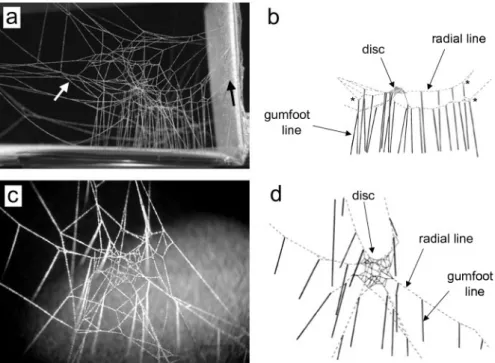
The designs of the freshly built first webs of first instar spiderlings (after 2 nights in the frame) were quite uniform, and most lines could be classified into one of seven categories (Figs 1-2). There were multiple gumfoot lines; as in all other instars, each line had a segment of a few mm at its lower tip that bore balls of adhesive (e.g., Fig. 4). Each attachment to the substrate consist- ed of a small array of fine, more or less radial lines at the tip of a short seg- ment of line that lacked sticky balls (e.g., Fig. 4a). No other lines in the web had adhesive material on them. Near the upper end of most if not all gum- foot lines there was a mass of tightly curled loose silk ("fluff mass" in Figs 3, 5a-b) (some masses of silk were less compact and stretched along a line and were thus less easily recognizable as fluff; it is probable that we missed some masses, and it is thus possible that all gumfoot lines had a fluff mass).
Most if not all gumfoot lines were attached at their upper ends to a more or less horizontal "radial line" (Fig. la-b) that was usually attached at its distal end either to the substrate beyond the lateral edge of the web or to anoth- er non-sticky line near the periphery of the web. Nearly all radial lines bore multiple gumfoot lines, and the spaces between the gumfoot lines attached to
Table 1.
Characteristics of webs of first instar nymphs (i 1) and adult females of L. geometricus.
Values (observed/
Variable Comparison total for 11,
adult)
Test P
Silk retreat Yes-No 0/15, 14/14 Fisher Exact <0.00001 Retreat with radial pattern1,2 Yes-No 6/14, 0/14 Fisher Exact 0.016 Circular disc Yes-No 15/15, 0/13 Fisher Exact <0.00001 Radial pattern lines beyond
outer edge of central Yes-No 10/10, 0/14 Fisher Exact <0.00001 disc23
Radial pattern lines inner
portion of central disc24 Yes-No 10/15, 0/14 Fisher Exact 0.001
Disc, sheet, or both2 %'(2)=26.0 <0.0001
Horizontal radial lines with
gumfoot lines attached5 Yes-No 15/15, 10/13 Fisher Exact 0.09 Signal lines from disc to
retreat12 Yes-No 15/21, 14/14 Fisher Exact 0.06 Position of disc (dist. to top/
dist. to bottom of frame)6
Medians (range)
1.97 (0.4-3.17)
0.11 (0.07-0.21) Z(i4,9)=3.16 0.001 Maximum number of Medians 5 (3-6)
Z(i4,9)=3-96 <0.0001 gumfoot lines/radial line6 (range) 2(1-2)
Number gumfoot lines/web Medians (range)
37(31-47)
19 (12-34) Z(i2,i4)=3-50 0.0005
1 Comparison is between second instar spiders and adults because first instar webs lacked retreats. The radial organization in the retreats of adults may be underestimated, as all retreats were more than a day old (retreats were built at least one night before the web was built); later additions may have obscured earlier patterns. The retreats of second instars, in contrast, were all newly built.
2 See Figs 1-2, and 6 for illustrations of criteria.
3 All small, nearly circular discs.
4 Comparison is between second instar spiders and adults; "Yes" includes partial radial organ- ization; there was no difference between first instars and adults if discs with partial radial organization were excluded.
5 In some webs of adult females gumfoot lines were attached to the sheet, and no radial lines were distinguishable; there may have been radial lines that were subsequently incorporated into the sheet that we were not able to distinguish.
6 The size and shape of the frame relative to the size of the spider probably affects the rela- tive position of the disc, and the maximum lengths of radial lines (a relatively longer, narrow- er space in which to build probably results in a larger maximum number of gumfoot lines).
each radial line were relatively uniform (Fig. 1). The inner end of each radial line was attached to the edge of a small horizontal "central disc" in the central portion of the web (Fig. lc-d). The central disc was about the size of the spi- der, and the spider's tarsi grasped lines near the edge of the disc or the radial lines themselves (Fig. 2c-d). In some discs the lines in the central portion of the disc were arranged in more or less recognizable radial or circular patterns
radial line
gumfoot line
Fig. 1. — (a) Photograph and (b) drawing of a lateral view of the web of a first instar juvenile L. geometricus; the drawing includes only the radial, gumfoot and disc lines in this web (gum- foot lines are thick and solid; radial lines are dashed; disc lines are thin and solid; all tangle lines are omitted). A radial line that is attached to the substrate is indicated in (a) with a solid black arrow on the right, while a radial line attached to other web lines is indicated with a white arrow on the left; "*" in (b) mark apparent attachments of a gumfoot line to the radial line laid on the return trip toward the disc, rather than to the radial line laid as the spider moved toward the edge (see text), (c) Photograph of a dorso-lateral view of the central disc of the web of a first instar juvenile (many lines are out of the plane of focus, and invisible); (d) drawing of this same central disc, with gumfoot, radial and disc lines coded as in (b).
(Fig. 2c-d); lines in the central portions of other discs had no obvious, geo- metrically regular pattern (Fig. lc). Above and to the sides of the central disc, there was an extensive "tangle" of many lines. The tangle varied greatly in shape and extent. Tangle lines were not concentrated in a plane, and did not have any geometrically regular arrangement.
On subsequent nights spiders sometimes added additional lines (Fig. 6a- b). In 5 of 38 "fed" spiders, there was a silk "retreat" above or beyond the edge of the tangle after the spider had been in the frame for 7 days, with its inner end against the substrate (Figs 5d, 6). No further retreats were built during subsequent days before spiders molted to the second instar. The walls of the retreat often (but not always) flared bell-like away from the inner end, and sometimes there were one or more signal lines running more or less directly from an upper wall of the retreat to the central disc (Fig. 6). When the retreat had relatively few lines and a relatively open mesh, the lines in its wall often
Fig. 2. — (a)-(b) A first instar juvenile L. geometricus resting under the central disc of its web.
Arrows in (a) indicate radial lines; arrow in (b) shows a radial line being gripped by the tar- sus of leg LI. (c)-(d) Central discs of first instar webs with radial patterns of lines in their central portions.
had clear radial and circular orientations, especially near the outer edges of the retreat (Fig. 5d). Additional lines were also often added in the region of the central disc, which came to resemble a sparse, only partially defined sheet (Fig. 6a-b).
When a first instar spider did not capture prey in its first web, it usually abandoned the web and wandered in the frame, producing a tangle of loose lines (Fig. 5c). In none of 39 spiders kept for 7 days without feeding was a retreat con- structed (P = 0.025 with Fisher Exact Test compared with fed spiders).
Adult females
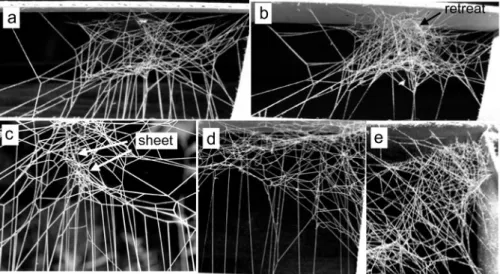
The designs of webs of adult females varied according to how long the spider had been in the frame. Spiders often built only a retreat during the first night or two in a frame, while construction of the rest of the web occurred on subsequent nights. Webs present after a single night of web construction (Fig. 7a-b) had all of the types of lines that were recognizable in first instar webs, but the design differed in several respects (Table 1). Webs never lacked a retreat, as in first instar webs. The retreat was thick-walled and cone- or
Fig. 3. — Flash photograph of a third instar spiderling of L. geometricus resting under the central disc of an unpowdered web. Short segments covered with adhesive at the bottom tips of the gumfoot lines (whiter portions) are indicated by the large solid arrows; a gumfoot line that has broken free from the substrate and is hanging free with a ball of glue at its tip is indicated by the large dotted arrow. Probable fluff masses (most near the upper ends of gum- foot lines) are indicated by small dotted arrows (some masses are out of focus, and are only identified tentatively). The long bright portions of the gumfoot lines in the central portion of the photo resulted from the glint of the photographic flash on these lines, which were slightly curved due to air movement.
bell-shaped, usually above or, less often, to the side of the web. Like the gum- foot lines of first instars, those of adult females had balls of glue at their lower tips (Fig. 4e), and were generally accompanied by a fluff mass at the upper end (Fig. 7b). There were fewer radial lines, and each radial line had fewer gumfoot lines attached to it (Table 1). There was an area where the radial lines converged that corresponded to the central disc, but the lines in the disc itself never showed signs of a radial arrangement (Fig. 7b). The disc was prob- ably more often substantially slanted (upward on the side nearest the retreat) rather than horizontal (we did not measure these angles, however). Signal lines often ran from the central area to the upper wall of the retreat (Fig. 7c), sometime directly and other times in shorter segments.
On subsequent nights, adult spiders added lines that gradually trans- formed the web's design much more substantially than the additional lines in the webs of first instar spiders. The first instar-like organization radial became
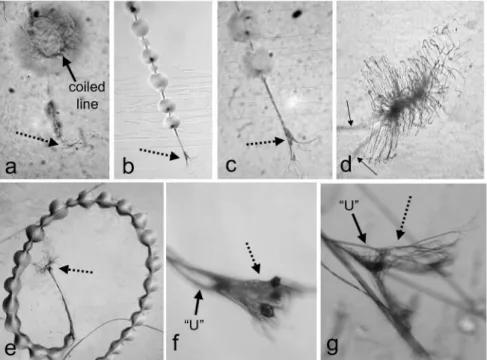
Fig. 4. — Attachment discs (dotted arrows) of gumfoot lines that were attached to glass microscope slides below the web of a first instar juvenile (a), a third instar juvenile (b-c), and an adult female (e-g); (d) is an attachment of a dry dragline by the same third instar juve- nile. The solid arrow in (a) indicates the highly coiled gumfoot baseline in the large droplet of glue that formed when the small droplets of glue coalesced as the gumfoot line collapsed after being broken. The attachments in (f) and (g) were pulled free from the substrate (the two small dark masses in (f) may be material from the substrate). The solid arrows in (f) and (g) indicate the "U" portion of the gumfoot baseline. The finer lines in the attachment disc of the first instar spiderling (a) are so thin as to be nearly invisible at this magnification. The impression that there are greater numbers of fine lines in the attachments of the larger spi- ders may be due to difficulties in seeing some of the lines of the smaller instars.
completely obscured, and the web came to resemble previous descriptions of L. geometricus webs (BENJAMIN & ZSCHOKKE 2003, EBERHARD et al. 2008) (Fig.
7d). The slanting central area was extended at the edges away from the retreat so that it formed a sloping sheet, and more signal lines from the sheet to the retreat were also added. Some of the added lines in the sheet were attached to the original radial lines, making them impossible to detect, and making the original gumfoot lines seem to be attached to the sheet itself. Additional gum- foot lines were also added. These were generally attached to a relatively short, more or less horizontal line near the edge of the sheet, and each of these short lines usually had only a single gumfoot line attached to it. These gumfoot lines also usually had a fluff mass near the upper end. Adhesive material was present only at the lower tips of the gumfoot lines.
The morphology of the attachments of the gumfoot lines to the substrate below did not vary perceptibly from that of earlier instar spiders (Fig. 4). In
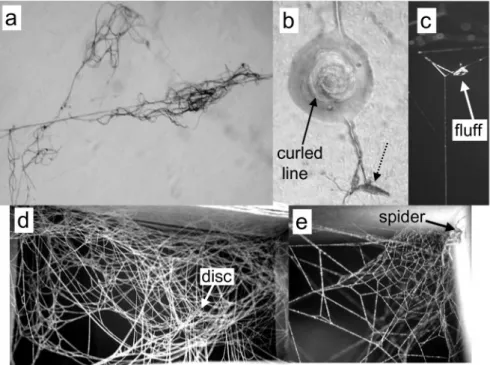
Fig. 5. — (a) Part of a fluff mass at the top of a gumfoot line in the web of a third instar spider under the compound microscope, showing the large accumulation of lax line; (b) a gumfoot attachment (dotted arrow) that was pulled away from the substrate; the glue coa- lesced into a single large ball of glue containing a tangle of gumfoot baseline (solid arrow);
(c) a fluff mass at the top of a gumfoot line in an adult female web; (d) a cardboard frame in which a first instar spider built a web (arrow marks central disc), but then left this web and wandered on subsequent nights; (e) retreat of a fourth instar spider (arrow), with approxi- mately radial and circular lines near its outer edge.
all cases a small network of fine lines radiated from the tip of a short seg- ment of line below the lowermost droplet of glue. In some adult attachments a "U" shaped arrangement was visible, making it clear that this line was dou- ble (arrow in Fig. 4f-g) (presumably one line was laid during the descent and the other as the spider ascended — see behavior below). The substrate attach- ments of gumfoot lines contrasted strongly with the attachment discs that attached non-sticky lines to the substrate (compare Fig. 4c-d).
Intermediate-sized instars
Table 1 summarizes the differences in several aspects of web design between first instar and adult female spiders, and Figs 8 and 9 illustrate the patterns of change over time in many of these aspects in intermediate instar spiders. Two general patterns are evident: ontogenetic changes were grad- ual rather than abrupt; and ontogenetic changes ceased in the late juvenile
Fig. 6. — (a)-(b) Web of a first instar juvenile L. geometricus on the first after it was built (a) and 5 days later (b) after it had captured and fed on several prey. The spider added a retreat, some tangle lines, and sketchy sheet, (c)-(d) Illustrate criteria used to recognize some of the categories in Table 1. (c) Very small sheet; (d) no radial pattern of lines beyond edge of sheet;
(e) no radial pattern in a retreat.
instars for several variables (retreat, radial organization of retreat lines, circu- lar disc, radial pattern in the interior of the disc), so that the web designs of late juveniles were generally not distinguishable from those of adult females (Fig. 8a-c).
Several of the changes in web design were independent of each other, and thus probably represent independent web traits. For example, when webs were separated into two sub-samples on the basis of whether they possessed or lacked a retreat, and the two sub-samples of webs were then compared with respect to the other variables, the more adult-like sub-sample (possess a retreat) did not have significantly more adult-like values for any of the other variables (direct hub-to-retreat lines were omitted from these analy- ses because no ontogenetic correlation was detected). Similar analyses using the maximum number of gumfoot lines/radial line, and the total number of gumfoot lines/web to form adult-like and juvenile-like sub-samples (< 4 vs >
4 gumfoot line/horizontal line, and < 40 vs > 40 gumfoot lines/web respec- tively) also failed to reveal differences in any other variables. In contrast, the other four variables in Table 1 seemed to be at least somewhat related. For instance, when webs were divided into sub-samples with respect to whether they had a radial pattern of lines beyond the edge of the central disc or sheet, the more adult-like group (no radial pattern) was also more adult-like in hav- ing fewer discs (U = 39, P = 0.007), more slanting sheets in addition to discs (U = 45.5, P = 0.016), and showed a trend toward less interior radial organi- zation (U = 58.5, P = 0.06).
Fig. 7. — (a) Lateral view of the web of an adult female after one night of web construction, (b) Dorso-lateral close-up view of central disc of the same web. (c) Slightly more advanced web of another adult female after one night of construction, with a small central sheet and signal lines running to the upper wall of the retreat at the upper right, (d) Web of an adult female after several days of web construction, with a dense sheet sloping downward from the retreat and with gumfoot lines attached below it; some gumfoot lines are attached near the edge of the sheet and others more centrally.
Building behavior
Gumfoot line construction was observed in four spiders (instars 4-6), and was uniform in many details (Figs 10-11). Gumfoot lines were laid in bursts of several lines that were apparently attached to a single horizon- tal line (these "horizontal" lines were probably the "radial lines" observed in finished webs [Fig. 1], but because we could not trace given horizontal lines and their attachments in the dark, we have called them "horizontal"
rather than "radial" lines to indicate this small degree of uncertainty; we
use "central area" instead of "central disc" in the behavioral descriptions for
the same reason). A burst of gumfoot line construction usually began just
after the spider had moved from the central area along a more or less hori-
zontal path, and had turned back near the edge of the web to move a short
distance toward the central area. In some cases it was clear that during the
trip away from the central area the spider moved along a radial line that
was already in place, attaching its drag line to this line occasionally as it
5 a*
|
2 a«E 03
retreat
r = 0.85, P = 0.015
disc
r =-0.95, P = 0.001
VI Sil FI-III
Instar number [nstar number
U
E 8
u
. interior disc radial
06 ■ r = -0.94, P = 0.002
M
1 1
0.4
1 1 III
0.J
III
0.1
00
nil
exterior disc radial
r = -0.94, P = 0.002
VI Ad Fern VI *d F«m
Instar number Instar number
line to retreat disc and sheet
r = -0.55, P = 0.20
VI Ad Fftil
Instar number
III IV v VI
Instar number
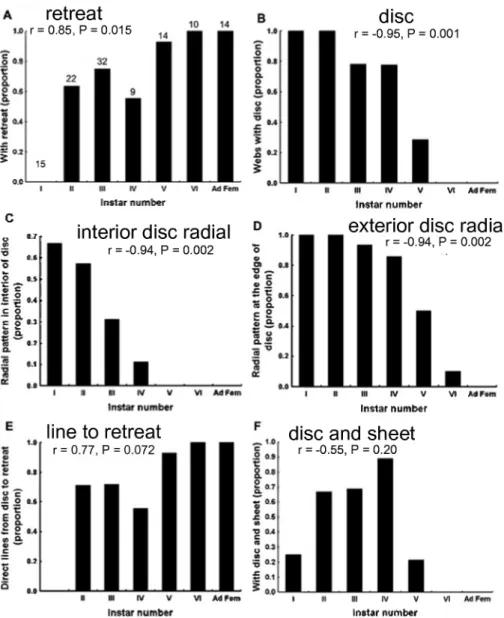
Fig. 8. — Changes in different features of newly initiated webs of L. geometricus as spiders matured, (a) Proportion of webs with retreats (increased gradually in older spiders); (b) pro- portion of webs with a clearly defined disc (decreased gradually in older spiders); (c) propor- tion of webs in which lines in the interior of the disc had a radial organization (decreased gradually in older spiders); (d) proportion in which there was a radial pattern at the edge of the disc (decreased gradually in older spiders); (e) proportion of webs with lines directly from the disc to the retreat (no significant change in different instars); (f) proportion of webs hav- ing a sheet in addition to the disc (increased in early instars, but dropped sharply after instar IV). The sample sizes for different instars are indicated in (a).
A r = -0.47, P < 0.001 B r = -0.30, P = 0.002
' 9 14
I'
■g *- 2
L 32 1*
T t
I'
M1"
10 S
x±r
21 32 12 "T" —r-
iTTJ
10 14il
E 0 *L -L 1
i ■ a w v VI Uta | II m [V V vi MFwn
In star number ln«ar number
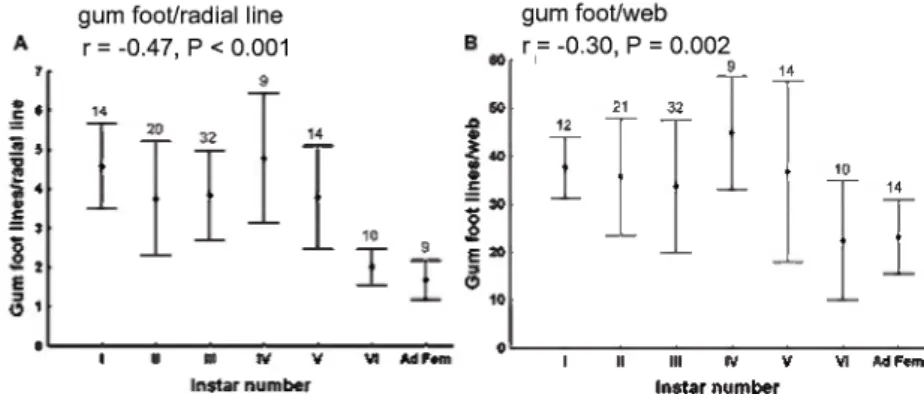
Fig. 9. — Variations in the maximum numbers of gumfoot lines/radial line (a) and total num- bers of gumfoot lines/web (b) (mean ± standard deviation) in webs of different instars of L.
geometricus. Both variables decreased gradually as spiders matured. Sample sizes are indi- cated above the bars.
%
da.
^\broken end_ broken end,
*s
broken end (with fluff) broken end/
A—
glue
broken ends glue
broken
end broken end
/
glue ^-glue
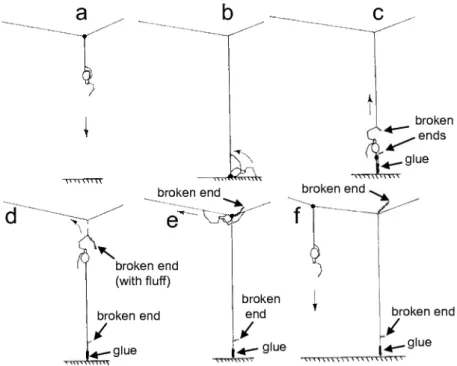
Fig. 10. — Diagrammatic representation of the behavioral sequence of gumfoot line construc- tion in L. geometricus. The spider attaches its dragline to the horizontal line and drops (a);
when it reaches the substrate below it attaches this line (b); it then turns to ascend, laying a short segment of line, some of which bears sticky material before it cuts the line laid dur- ing the descent (c). It then climbs, reeling in the line loose laid previously and laying a new dragline (d). Finally it attaches its dragline to the horizontal line above (e), moves toward the central disc along the horizontal line, and initiates the next gumfoot line (f).
moved. It did not cut and reel while moving away from the central area or while returning.
The spider initiated a gumfoot line by attaching its dragline to the hori- zontal line along which it had been moving. During an attachment, the spider usually held the line to which it was attaching its drag line with both legs III, just anterior to its spinnerets, and with one IV just posterior to the spinnerets (Fig. 11a). This initial attachment may have sometimes been to both the line which it had laid as it moved away from the central area and to the line along which it had walked along on this outward trip; but in some cases it was only to the new line it had laid on the way back, and this line was pulled away from the other horizontal line (probably producing configurations such as that marked with "*" in Fig. lb). As soon as it had attached its drag line, the spi- der descended to the floor below (Fig. 10a). All descents were rapid, and in some cases the spider seemed to simply let itself fall. In some but not all cases the spider turned about 90° on the horizontal line just before it launched itself downward, and extended both legs I anteriorly and somewhat laterally (Fig. 11a). Usually the spider hung free during the descent, but sometimes it traveled along another vertical line already in place.
As it began to descend the spider sometimes held its dragline with one IV; more often it started with no leg holding the dragline, then swung one leg IV medially to grasp the line as it was descending. By the time it reached the floor it always held the dragline with one leg IV, which was raised upward as the spider walked a short distance along the floor before attaching the new line (Figs 10b, lib). If it had descended along a vertical line already in place, the spider generally moved away from it, and it was usually out of contact with any other web lines when it attached the drag line to the floor. The spider did not perform any obvious exploratory movements as it walked on the floor, but the distribution of attachments of gumfoot lines of a mature female when the floor was composed of three glass slides placed side by side against each other revealed a clear preference (15 of 19 attachments) for the edges of the slides.
Just before attaching the dragline, as it was bending its abdomen ven- trally to touch the spinnerets to the floor, the spider extended the leg IV that held the drag line (Fig. lib), a movement that lasted about 0.1 sec. This rear- ward push may have lengthened the drag line slightly by pulling a little addi- tional silk from its spinnerets. Less than 0.1 sec later the spider dabbed its spinnerets to the floor. Contact with the floor generally lasted 1-2 sec; in some cases the spider dabbed repeatedly (up to 4-5 times), while in others it made only a single dab. As it finished making the attachment to the substrate, the leg IV that held the drag line was moved anteriorly while still holding the line, and ipsilateral legs I and II moved rearward to grasp the line. The spider pulled itself slightly upward (perhaps half a body length) with legs I and II, and paused facing upward for a second or more (Figs 10c, lie). The short seg- ment of line that emerged from its spinnerets just after it attached the line to the floor was shiny, and presumably had adhesive material on it (e.g., Figs 4e, 10c). During this pause, the tarsus of one leg II was usually (always?) brought close to its mouth, probably to break the line it was holding (Fig. lie); occa- sionally the spider's body immediately swung a short distance laterally, as if a line had been broken.
Fig. 11. — Positions of legs and lines during different stages of gumfoot line construction (traced from video images), (a) Ventro-lateral view of the spider after it has turned laterally and is making the initial attachment to the horizontal line just before beginning its descent to initiate gumfoot line construction; (b) the spider rests on the substrate below, just prior to attaching the dragline, and extends R leg IV (arrow and dotted lines) which holds its dragline;
(c) tarsus of left leg II brings the line to the mouthparts (arrow), probably to break the line laid on the descent (the gumfoot line in this drawing made an unusually acute angle with the substrate; most gumfoot lines were more nearly vertical); (d) legs I reel up the broken line, which accumulates on legs II and III as the spider ascends; (e) spider holds the horizontal line with legs RIII, LIII, and RIV as it attaches the new gumfoot line (held with tarsus LIV) to the horizontal line just after placing the mass of reeled up silk (fluff) nearby (to the side of the horizontal line farthest from the central disc).
The spider then ascended and replaced the line that it had laid on the way down, accumulating the loose silk on its legs II and replacing it with the new drag line attached to the floor (Figs lOd, lid). No legs contacted the new drag line as the spider ascended. The loose line that was reeled in accumu- lated in a skein of loose silk that was held on its legs II as it climbed. As it neared the horizontal line at the top, the spider transferred this accumula- tion of fluff to its legs III (or sometimes apparently attempted the transfer and failed), and then laid the fluff against the horizontal line on the side that was more distant from the central area as it turned in preparation to attach the new drag line (Fig. lOe). This line was attached to the horizontal line in a standard position (Fig. lie): the spider's body was more or less aligned with the horizontal line, facing toward the central area; both legs III held the hori-
zontal line just anterior to its spinnerets; one leg IV held the new drag line (the gumfoot line) that had just been laid and the other leg IV held the hori- zontal line near the mass of fluff, just posterior to its spinnerets. After making this attachment, the spider moved along the horizontal line toward the central area, then descended to begin construction of another gumfoot line as just described. In some cases it was clear that it did not cut and reel the horizon- tal line as it went. There was a mass of fluff discernable at the top of nearly every gumfoot line in newly built webs (Fig. 3), confirming that cut and reel behavior was a consistent part of gumfoot line construction.
The glandular origin and the physical properties of the baseline silk of gumfoot lines probably correspond to those of the non-sticky, drag line silk from the ampullate glands in araneids. It might seem that the extreme short- ening of gumfoot lines when the attachment to the substrate breaks (thick arrow in Fig. 3) implies that the baseline is extremely extensible. Similar "con- traction" did not occur, however, when the line was reeled up during gumfoot line construction (Fig. 5a). The "contraction" of gumfoot lines when the lower attachment broke was probably not due to a shortening of the line itself, but rather to the line coiling up tightly within the large mass of glue that formed at the tip (Fig. 5b). Similar coiling also occurred when gumfoot lines that were attached to glass slides were broken (Fig. 4a).
When the spider had laid the last gumfoot line in a burst, it was gen- erally close to the central area. Its behavior varied: it either made multiple attachments there (presumably filling in the disc), moved briefly into the tangle immediately above the central area and then returned to make more attachments in the central area, remained immobile or cleaned itself briefly, or went to its retreat. One spider added lines to the walls of the retreat after a burst of gumfoot lines, and another made several attachments in the tangle and to the lateral wall of the frame (holding the drag line with one leg IV during the attachment). The most common position of the spider's legs when it made attachments to other lines in the central area was for both legs III to grasp a line just anterior to the spinnerets (probably the line to which the attachment was being made, but this was not verified) while one IV grasped a line posterior to the spinnerets (probably the drag line). Construction of lines in the central area was not accompanied by movements to the periphery of the web, indicating that when the spider moved to the periphery to begin sub- sequent bouts of gumfoot construction, it moved along radial lines that had already been produced prior to gumfoot line construction.
The behavior used to build other parts of the web was less easily typi- fied. Cut and reel behavior was never observed directly during construction of lines in the tangle above the central disc, but probably does occur occasionally there, because it was common to see a few white masses of fluff in the tangle of a web in addition to those associated with the gumfoot lines. In one typical web, there were 20 fluff masses but only 18 gumfoot lines. The spider some- times broke lines in the tangle portion of the web and simply released them, rather than reeling them in. This behavior would produce slack lines in the tangle, but not fluff masses.
Previous studies
Our observations of L. geometricus differ in many respects with previous descriptions of the web and behavior of this species (BENJAMIN & ZSCHOKKE
2003), and of those of the closely related Steatoda triangulosa (BENJAMIN &
ZSCHOKKE 2002). Gumfoot line construction by S. triangulosa was described as lacking cut and reel behavior ("We never observed cut-and-reel behav- ior"; BENJAMIN & ZSCHOKKE 2002: 797); no mention was made of whether or not cut and reel behavior occurred during construction of L. geometricus webs (BENJAMIN & ZSCHOKKE 2003). Our direct observations and videotapes showed consistent cut and reel behavior during each upward trip in gumfoot line construction. In addition, there was a fluff mass near the upper end of all or nearly all gumfoot lines in finished webs, confirming that cut and reel behavior was a consistent component of gumfoot line construction. The spi- der's movements as it reeled up the line and deposited the fluff mass were quick and smooth, and this subtle behavior may have been missed in previous observations. We have observed similar cut and reel behavior during gumfoot line construction in Achaearanea tepidariorum (W. EBERHARD unpub.), which is a distantly related theridiid (AGNARSSON 2004, ARNEDO et al. 2004), suggest- ing that cut and reel behavior probably also occurs in the closely related S.
triangulosa. The differences in our observations are not due to our observing juveniles while other authors observed adults, as the newly built webs of adult female L. geometricus that we observed also consistently had a mass of fluff associated with the upper end of each gumfoot line (Figs 5b, 7b).
A second major difference with previous studies concerns the "radial"
lines that were especially clear in the webs of young individuals of L. geometri- cus. These lines almost certainly do not correspond to the "radiating threads"
that BENJAMIN & ZSCHOKKE (2002, 2003) described in the webs of adult L. geo- metricus and S. triangulosa. Their designation of "radial thread" in the webs of L. geometricus was unclear: they defined a radial thread as a thread that extends "from a peripheral point to the substrate", but the line labeled as a radial thread ("RT") in their figure 5C (BENJAMIN & ZSCHOKKE 2002) describing a L. geometricus web is an apparently short line in the central area of the web, some distance from both the retreat and the substrate. Their descriptions of radial lines in webs of adult S. triangulosa were inconsistent, even in successive sentences ("most of them originated primarily from a single peripheral point (retreat ..."; "radiating threads ... were not arranged in geometrically regular arrays") (BENJAMIN & ZSCHOKKE 2002: 797). The lines that we have designat- ed as "radial lines" in L. geometricus webs converged, in contrast, at a central disc that was distant from the retreat; central discs were present in webs that entirely lacked retreats. This disc was nearer the geometric center of the web than its periphery, while retreats were always peripheral (as also noted in by
BENJAMIN & ZSCHOKKE 2002, 2003 for both L. gemetricus and S. triangulosa).
BENJAMIN & ZSCHOKKE (2003) stated that each L. geometricus gumfoot line was attached at its upper end to a "supporting structure" (SSt) (a category that included "radiating threads"), but did not mention radial lines. In contrast, the
upper ends of gumfoot lines that we observed were consistently attached to radial lines in new webs (Fig. la-b). We found that both this association and the structure of the central disc were less dramatic in the webs of adults, and
BENJAMIN & ZSCHOKKE observed adult females; these apparent differences may thus be due to our observing animals at different ontogenetic stages.
There are several other differences between the details of gumfoot line construction behavior that we observed and the descriptions of BENJAMIN &
ZSCHOKKE (2002, 2003). We observed that the first gumfoot line in a burst of gumfoot line construction was usually laid soon after the spider turned 180° at a more or less peripheral site, while they describe a 90° turn that was made in the central section as marking the initiation of a series of gumfoot lines, and that these lines were built as the spider moved toward the peripheral retreat.
We saw that each descent to the substrate during a burst of gumfoot line con- struction resulted in the production of one additional new gumfoot line, while their figure 5C (2003) suggests (at least if each arrow labeled as "GF" indicates a single gumfoot line) that there were multiple descents during the construc- tion of some gumfoot lines but not others (a similar mix is in S. triangulosa is suggested by figure 6 of BENJAMIN & ZSCHOKKE 2002). Their description of the behavior just prior to initiation of gumfoot line construction in S. trian- gulosa (BENJAMIN & ZSCHOKKE 2002) also contrasts with our observations, as they describe the spider moving away from the periphery and "to more or less the central part of the web" instead of the opposite that we observed. They describe movements of the front legs to determine the positions of gumfoot lines already present, while we saw no such movements, at least during a given bout of gumfoot line construction; in our observations the spider typi- cally did not encounter other gumfoot lines as it moved along the radial line during a burst of gumfoot line construction.
There are also several points of agreement between our observations and those of BENJAMIN & ZSCHOKKE (2002, 2003). In both S. triangulosa (BEN- JAMIN & ZSCHOKKE 2002) and in our observations of L. geometricus, the spider's movements near the moment the line was attached to the substrate were espe- cially slow; the adhesive was applied near the tip of the line at the beginning of the upward journey; gumfoot lines were built in bouts or bursts, with suc- cessive gumfoot lines at least sometimes being attached at their upper ends to the same more or less horizontal line (BENJAMIN & ZSCHOKKE 2002).
The differences between our observations and those of BENJAMIN &
ZSCHOKKE of L. geometricus are substantial, and might stem from our hav- ing observed different species. The designs of the webs of different species of Latrodectus vary substantially (summary in EBERHARD et al. 2008). Another possible explanation for the differences is intra-specific variation, as has been reported for some aspects of web design in L. geometricus, mactans, and hes- perus (LAMORAL 1968, KASTON 1970). The specimens of L. geometricus that they observed came from a culture in a zoo in San Diego, California. The prec- edence of this culture was not specified; the presence of L. geometricus in southern California is thought to be due to human intervention (GARB et al.
2003), so the population there may have passed through a recent genetic bot- tleneck. This species is widely distributed, and often associated with human buildings. Molecular data indicate that there has been substantial gene flow
tropics (GARB et al. 2003, J. MILLER pers. comm.).
L. pallidus
Some aspects of the webs of young L. gemetricus that we observed can be homologized with the somewhat different webs of adult L. pallidus (Fig.
12). Both species have a central, horizontal "disc" (the "catching platform"
of SZLEP 1965). The horizontal "radial" lines of L. pallidus are very short.
They appear to originate at the edge of the central disc, and end on nearby
"frame" lines that apparently do not correspond to any lines in L. geomet- ricus webs. In contrast, the radial lines of young L. geometricus are much longer and end either on the substrate or on lines near the edge of the web (Fig. la-b). Each radial line in adult L. pallidus is associated with only a sin- gle, long, vertical gumfoot line, which is attached just beyond the inner end of the radial line (handwritten notes by R. SZLEP on a reprint of her 1965 paper indicate that plate 11, a photo of a L. pallidus web, is misoriented, and should be turned 90° clockwise). This trait resembles the webs of adult L. geometricus, which often had only single gumfoot line on each horizontal line, but contrasts with those of young spiders which had up to six gumfoot lines attached to a single radial line. Both radial and gumfoot lines are con- structed by L. pallidus during the same general period of web construction
(SZLEP 1965), but it is not clear whether construction of each radial line is accompanied by that of the associated gumfoot line, as might be expected from our observations of L. geometricus and those of BENJAMIN & ZSCHOKKE
(2003). There appears to be an accumulation of loose silk near the upper end of at least some gumfoot lines in one photo of a L. pallidus web (Fig.
12a), intimating that L. pallidus also employs cut and reel behavior during gumfoot line construction.
central disc
X&'' ,'/f __ radial line gum
foot
"*/ I, III/., \\
frame line
Fig. 12. — Photo (a) and drawing (b) of a dorsal view of the central platform area of the web of an adult L. pallidus (photo from SZLEP 1965; the tangle lines above were burned away to reveal the platform). Gumfoot lines and possible fluff masses near the upper ends of the gum- foot lines are marked with arrows in the photo. Gumfoot lines in the drawing are thick solid lines, radial lines are dashed, central disc lines are thin solid lines; other lines are dotted.
There is no sign of radial organization in the retreats of adult female L. pallidus figured by SZLEP (1965), but these retreats were probably relative- ly old, so that any early radial organization would have become obscured by later additions, as happens in L. geometricus. SZLEP (1965) reports that young spiders have retreats, in apparent contrast with those of L. geometricus.
Ontogenetic changes
Retreats at the upper or lateral edges of the web like those of adult L.
geometricus, are thought to be derived with respect to webs that lack retreats, and in which the spider rests in the central portion of the web, as in first instar L. geometricus (AGNARSSON 2004, EBERHARD et al. 2008). Our find- ing that retreats gradually became more common as L. geometricus spiders matured (Fig. 8a) thus constitutes another case in which "ontogeny repeats phytogeny" in the web designs of spiders. This increases the number of cases in which web building spiders follow the biogenetic pattern to 20 of 21 (and, as noted in the introduction, the single exception may be explained by special circumstances).
Our finding that the ontogenetic changes in many traits were gradual rather than abrupt (Figs 8-9) is in line with observations of some other spe- cies, such as Scoloderus (EBERHARD 1975) and Epeirotypus (EBERHARD 1986), though Z. x-notata changes after building the first one or two webs of its life
(LEGUELTE 1966; see PETERS 1969 for contrasting data).
The reason why the order of ontogenetic changes in web form so often reflects the order of phylogenetic changes remains a mystery. While ontogenet- ic changes clearly occur in numerous species with highly derived web designs, they just as clearly do not occur in some others with similarly derived webs, such as Hyptiotes cavatus (Uloboridae) (OPELL 1982), Comaroma simonii (Ana- pidae) (C. KROPF pers. comm.), and Wendilgarda sp. (Theridiosomatidae) (P.
PALAVICINI in prep.).
Possible homologies
The patterns in the retreats of some young L. geometricus spiders, with a hub-like combination of radial lines and more or less circular lines (Fig. 5e), indicate that spiders are able to organize lines in a radial manner in a second context. These lines resemble the radially aligned lines in some retreats of the orb weaver Araneus expletus (EBERHARD 2008). Nothing is known about retreat construction behavior that produces these radial patterns; it appears most reasonable at the moment to suppose the radially organized retreat lines in L. geometricus are not homologous with the hubs of orbs or with the retreats of A. expletus.
The question of possible homologies of sticky lines and the radial lines to which they are attached in Latrodectus webs and the sticky spirals and radii in orb webs depends heavily on whether the ancestral line that led to theridi- ids was derived directly from an orb weaving araneoid ancestor, or whether it
TON 2005). The position of theridiids within the aranoid "sheet weaver clade"
is not completely stable, and a recent analysis of six molecules and morphol- ogy (T. BLACKLEDGE et al. in prep.) gives a preliminary indication that theridiids may not belong to this clade at all, and instead be more directly derived from orb weavers (see also KUNTNER et al. 2007). Much of the following discussion is more likely to be relevant if the derivation from orb weavers was more direct.
The species L. geometricus has an interesting phylogenetic position in Theridiidae. It branches basally from the rest of the genus Latrodectus (GARB
et al. 2003), while Latrodectus branches near the base of the tree of the fam- ily Theridiidae (AGNARSSON 2004, ARNEDO et al. 2004). Given the likely ances- tral nature of gumfoot webs in theridiids (EBERHARD et al. 2008), there is thus no need to assume that the web designs of the evolutionary line of Latrodec- tus leading to geometricus underwent changes from the web design of the common ancestor of theridiids (such an assumption would be necessary, for instance, if Latrodectus were nested deep in a derived theridiid clade with another web design).
If one assumes that the biogenetic, "ontogeny repeats phylogeny" pattern seen so consistently in other traits and other spiders also applies to ontogenet- ic changes documented here in the general web design of L. geometricus, then the clear "radial lines bearing regularly spaced sticky lines" web design of the webs of early instars is ancestral to the designs of the webs of later instars, which feature reduced radial lines that bear fewer sticky lines. In the follow- ing, we explore the consequences of this polarity with respect to the possible derivation of theridiid webs from typical orb webs.
The crucial questions involve two sets of possible homologies: between the gumfoot lines of theridiids and the sticky spiral lines of typical orb weav- ers (both homologies in the lines themselves, and in the behavior used to con- struct them), and between the radial lines in theridiid webs and the radii of typical orbs (again both in the lines and in behavior employed to lay them).
Table 2 summarizes data on 24 relevant traits. Characteristics of the lines themselves (e.g., location, glandular origin) are distinguished (L) from charac- teristics of the behavior patterns used to add these lines to the web (B) (e.g., which legs hold which lines at particular moments).
With respect to sticky lines and the behavior used to build them, the first point to be noted is that the sticky lines themselves of L. geometricus are clearly not completely homologous with the sticky spirals of orbs: both carry balls of adhesive material that is presumably produced by the aggre- gate glands, but the base lines of gumfoot lines in L. geometricus webs are not highly extensible (W. EBERHARD unpub.), and are presumably not produced by the flagelliform glands, as in the sticky spiral of orb weavers (FOELIX 1996).
The "U" shaped configuration of the baseline of L. geometricus at the point of attachment to the substrate (Figs 4f-g) also suggests that these relatively non- extensible base lines of the sticky lines are continuous with the non-sticky web lines that are presumably produced by ampullate glands. A second, behavioral difference with the sticky lines of orb weavers is that the construction behav- ior of L. geometricus for sticky lines involved cut-and-reel behavior, something that apparently never occurs during sticky spiral construction in orb weavers
Table 2.
Similarities and differences between typical araneoid orb weavers, young L. geometricus, Wendilgarda spp., and Comaroma simonii with respect to sticky lines and the lines to which they are attached. The resemblances between young L. geometricus and Wendilgarda or C.
simonii that are not shared with orb weavers are probably convergences. Traits are classified with respect to whether they involve properties of the lines themselves (L), or of the spider's behavior (B). Those marked with "*" may be direct consequences of using vertical lines to gain access to prey walking on a surface near the web, or on water surface (see text). Data on Wendilgarda are from CODDINGTON & VALERIO (1980), CODDINGTON (1986), and EBERHARD (1989,
2000, 2001); data on C. simonii are from KROPF (1990a, 1990b, 2004, and pers. comm.).
Trait Orb L. Wendilgarda Comaroma Line or
weavers geometricus spp. simonii behavior Associated with radial lines
1. Are the only lines supporting sticky lines 2. Converge on single point
or area
3. There are "hub" lines at intersection
4. Interior of hub with radial organization
5. End on frame lines 6. Strict order: other lines
then radii 7. Number of radii
8. Cut and reel before sticky line(s)
9. Const, radial and hub/disc lines alternate
Associated with sticky lines 10. Orientation of sticky line 11. Build sticky lines
starting at the edge of the web and moving inward 12. Uniform spaces between
sticky
13. Cut and reel during sticky line construction 14. Push sticky line with IV
as attach
15. Reel out sticky line with IV before attach
16. Site of glue on sticky line
17. Aggregate gland produces glue
Yes Yes Yes Yes L
Yes Yes More or less Yes L
Yes Yes No Yes L
Yes Yes/No
—
No LYes No (Yes
pallidus) No No L
Yes No No ? B
High Low Low Low L
Yes/No No(?) Yes ? B
Yes
Spiral Yes
Yes (±)
Yes Yes* Yes*
No Yes Yes
Yes Yes1 No
Yes (some) No* No*
Entire line Tip* Tip*
Yes Yes(?) Yes(?)
Yes (±)
Entire (short)2
Yes(?)
B
Vertical* Vertical* Radial L Yes Yes ? B
B B B B L L (continued)
Trait Orb L. Wendilgarda Comaroma Line or weavers geometricus spp. simonii behavior 18. Baseline of sticky line is
highly elastic 19. Form of attachment
sticky line
20. Strict order: non-sticky lines then sticky lines 21. Sticky lines are built in
bursts
22. Always turn toward hub after attach
23. Const, hub/disc alternate with sticky line const.
24. Weak attachment of sticky line to substrate
Yes
Other Yes
Yes
Yes
No
No* No*3
Star* Star*
No No
Yes Yes
Yes Yes
Yes
—
Yes* Yes* No4
L L B B B B L
1 Prior to rather than following addition of glue to the line.
2 Multiple short lines near the tip of the signal line are sticky (C. KROPF pers. comm.).
3 Report of 300% extension by CODDINGTON & VALERIC- (1980) is probably wrong. The apparent contraction of the sticky line of a different species of Wendilgarda from the species observed by them was due largely to the thread being taken up windlass-fashion in a large ball of glue (as occurs in Araneus - see VOLLRATH & EDMONDS 1989) (G. BARRANTES unpub.). The apparent contraction of very long sticky lines of still a