IS ISLAMIC BANKING PERFORMANCE IN MALAYSIA TRULY BETTER THAN INDONESIA?
Abdul Hakam Naja
Padjadjaran University, Indonesia, [email protected]
ABSTRACT
This article analyzes the performance of Islamic banking in Malaysia and Indonesia using a comprehensive evaluation framework. Malaysia is known for its leading role in Islamic finance, while Indonesia has faced criticism for slower growth. The study argues that assessing Islamic banking performance solely based on financial metrics is insufficient and proposes a broader framework based on the Maqasid Shariah (objectives of Islamic law) for a more objective standard. Using data from 2010 to 2019, the study constructs a Maqasid Shariah Index of Islamic Bank (MSI-iB) and adopts a T-test as well as a panel data model to evaluate their performance. The index includes five sub-indices representing different aspects of the Maqasid Shariah framework.
Results show varied scores among Islamic banks in both countries with no statistical difference between the two countries, but with Indonesia leading in religiosity and intellectuality dimensions and Malaysia leading in the posterity dimension. These results challenge the perception that Malaysia’s Islamic banking performance is inherently superior to Indonesia’s based solely on financial metrics. Considering the Maqasid Shariah framework is crucial to evaluating Islamic banking performance, highlighting the significance of non-financial indicators. The study concludes that a comprehensive perspective is necessary, incorporating both financial and non-financial factors, to assess overall performance.
Keywords: Maqasid shariah, Islamic bank performance, Indonesia, Malaysia, MSI-iB.
JEL classification: G18; G21; G28.
Article history:
Received : July 25, 2023 Revised : October 23, 2023 Accepted : November 30, 2023 Available online : December 1, 2023 https://doi.org/10.21098/jimf.v9i4.1784
I. INTRODUCTION
Islamic banking has witnessed rapid growth in recent decades. Two leading countries in Islamic banking are Malaysia and Indonesia. Malaysia, being a pioneer in Islamic finance, has developed a comprehensive regulatory framework to support the industry’s growth. Based on Islamic Finance Development Report (IFDR) 2022, the assets of Islamic banks in Malaysia reached approximately USD 262 billion by 2021. On the other hand, Indonesia, with the world’s largest Muslim population, has made significant strides in developing its Islamic banking industry, with assets reaching USD 48 billion in the same year (The Islamic Corporation for the Development of the Private Sector/ICD-Refinitiv, 2022).
Based on the total assets, Malaysia’s figures are over five times that of Indonesia. In terms of market share, Malaysia also leads, capturing 31.5%
of Malaysia’s banking market compared to Indonesia’s mere 6.1% share in 2021 (Islamic Financial Services Board/IFSB, 2022). In terms of regulation, the government’s support for Islamic banking performance and productivity has been well-implemented by Bank Negara Malaysia (BNM), with the Financial Sector Blueprint 2011-2020 playing a key role. Malaysia has established itself as a prominent center for Islamic economics and finance, overshadowing Indonesia’s image in this regard. Consequently, several global institutions rank Malaysia as the top destination for Islamic finance, including Islamic banks. State of the Global Islamic Economy Report (SGIER) 2022, for instance, ranks Malaysia as the number 1 country for Islamic Finance. The same position is also awarded by ICD- Refinitiv in Islamic Finance Development Report 2022. Several indicators used to accredit this ranking are among others: total assets, number of institutions, number of listed institutions, and return on assets. However, the question arises:
Is Malaysia’s performance truly superior to that of Indonesia’s, especially when the performance is based on the Islamic objectives of Islamic banking?
The performance of the Islamic banking industry in Indonesia is often discredited based on lower total assets and market shares. Indonesia, as one of the largest Muslim countries, faces criticism for stagnation in its Islamic banking market share. The potential of Indonesia’s Islamic finance market is not adequately represented by its market share and total assets. This situation sometimes leads to arguments that Islamic banking in Indonesia is underperforming. The questions are: Is it fair to assess development and performance solely from a financial perspective? Are there alternative angles to appreciate the development and performance of Islamic banks?
So far, the performance of Islamic banking has been evaluated based on conventional measurement standards. In Indonesia, the performance of Islamic banking is determined by a risk-based banking soundness assessment approach known as RBBR (Risk-Based Bank Rating), also referred to as RGEC (Risk Profile, Good Corporate Governance, Earnings, Capital). As institutions guided by Shariah principles, the performance measurement for Islamic banking should extend beyond conventional standards.
One appropriate approach to consider is the concept of Maqasid Shariah, which refers to the objectives, purposes, or goals of the Islamic legal system. These objectives are to be pursued and realized through various rulings and regulations, and they can be classified into five main categories: preservation of religion,
preservation of life, preservation of intellect, preservation of property, and preservation of lineage (Auda, 2022; Al-Qaradawi, 1999). In the context of Islamic banking, Maqasid Shariah provides a framework that goes beyond conventional financial metrics for assessing institutional performance. Islamic banks, being governed by Shariah principles, aim not only to maximize profits but also to promote broader agendas such as social welfare and economic development (Karim & Archer, 2013). Therefore, it is more appropriate to assess Islamic banks based on the extent to which they achieve the objectives of Maqasid Shariah (Siddiqi, 2006).
Recent studies utilizing a variety of methodologies have stressed the significance of Maqasid Shariah in assessing Islamic financial institutions (Mohammed, Razak,
& Taib, 2008; Chapra, 2008; Bedoui & Mansour, 2014; Ascarya, Rahmawati &
Sukmana, 2016 and, Ascarya & Masrifah, 2023). Islamic banks perform well in the areas of self, faith, rights, and wealth, but there is room for development in the social and environmental domains (Chapra, 2008; Bedoui & Mansour, 2014).
Such studies as Antonio, Sanrego, & Taufiq (2012), Mohammed & Taib (2015), and Alhammadi, Alotaibi, & Hakam (2022) examine risk management, ethical investing, and corporate governance within Maqasid Shariah.
From these previous researches, there is a strong indication that conventional financial metrics such as profitability, liquidity, and asset quality are insufficient as performance measurement landscapes for Islamic banks. To determine whether Islamic banking in Malaysia truly outperforms Indonesia’s, it is essential to evaluate it using a standard beyond conventional measures, such as the Maqasid Shariah framework. Therefore, this study aims to validate whether Malaysia’s better financial performance (reflected in larger assets and market share) aligns with the nature of Shariah principles-based institutions.
This area of research is crucial to evaluate in order to challenge the prevailing argument that the sole indicator of Islamic banking performance is based on financial metrics. However, the nature of Islamic banks goes beyond these commonly used indicators. Additionally, the context of Malaysia and Indonesia is both interesting and relevant to discuss, as these two countries are currently leading in Islamic finance.
To the best of our knowledge, limited study has conducted a direct assessment of these two countries to challenge and validate the perception that Malaysia’s Islamic banking performance inherently surpasses Indonesia’s, solely based on financial metrics. While previous studies, such as the one by Ascarya &
Yumanita (2008), focus solely on comparing the aspect of efficiency, subsequent research by Mergaliyev, Asutay, Avdukic & Karbhari (2021), as well as Ascarya, Sukmana & Rahmawati (2015), attempt to compare the performance of Islamic banks across multiple countries but only using representative samples of each country’s Islamic banks. Thus, a comprehensive study that directly compares the performance of Islamic banks in Malaysia and Indonesia using a more appropriate and comprehensive framework (specifically the maqasid shariah) and a more representative sample is still lacking. This warrants the current work to be undertaken to close the gap.
To address this question and research gap, this study will employ RBBR and the Maqasid Shariah Index of Islamic banks (MSI-IB), which measures performance
based on the Maqasid Shariah framework, to test the difference in Islamic banking performance between Malaysia and Indonesia. Additionally, a data panel analysis will be conducted.
This paper is organized as follows: Section II presents the literature review, followed by Section III, which describes data and methodology. Results and Analysis are discussed in Section IV. Finally, Section V concludes the paper and provides recommendations.
II. LITERATURE REVIEW
Recent research has emphasized the importance of Maqasid Shariah in assessing the performance of Islamic financial institutions. Studies have employed various approaches and frameworks, such as Abu Zahrah’s and Ghazalian Maqasid, to evaluate Islamic banking performance. Some studies have ranked banks based on performance indicators and the Maqasid Index, while others have focused on specific dimensions of Maqasid Shariah. Overall, research indicates that Islamic banks have performed well in certain areas such as self, faith, rights, and wealth, but there is room for improvement in social and environmental aspects. Factors like population, CEO duality, and pro-Shariah policies have positively influenced performance, while variables like GDP and ownership structure have had a negative impact. Studies have also examined risk management practices, ethical investment, and corporate governance within the context of Maqasid Shariah (See among others Mergaliyev, Asutay, Avdukic & Karbhari (2021); Mohammed et al. (2008), Bedoui & Mansour (2014), Ascarya et al. (2016), Asutay & Harningtyas (2015), and. Antonio et al. (2012)).
Mohammed et al. (2008) extend Abu Zahrah’s version of the Maqasid Shariah approach to evaluate the performance of Islamic banking within the Maqasid framework. They employ Sekaran’s behavioral approach to quantify Maqasid into performance indicators and rank six Shariah banks based on performance ratios, indicator assessment, and the Maqasid Index. However, none of the banks achieve the desired performance levels in all ratios and indicators due to their incapability and inconsistency in maintaining many objectives at the same time.
Chapra (2008) develop comprehensive indicators based on the Ghazalian Maqasid approach. The study emphasizes the interconnectedness and mutual support of the five dimensions of Maqasid Shariah, highlighting the necessity of addressing all dimensions for genuine human well-being. Bedoui & Mansour (2014) propose a performance measurement approach based on Maqasid Shariah, using a pentagon-shaped structure representing the five pillars of Maqasid Shariah to promote ethical practices in business. They expand upon the approach using Najjar’s version of Maqasid, constructing an octagon scheme with eight components. The findings indicate that the examined companies prioritize financial performance over other dimensions of Maqasid Shariah.
Studies directly assessing the performance of Islamic banks using the Maqasid Shariah framework have been conducted. Asutay & Harningtyas (2015) evaluate the social performance of Islamic banks based on Maqasid Shariah, utilizing concepts developed by Najjar. The study integrates various research methodologies and indices, analyzing 13 banks from six countries over a five-year period. The results
reveal that Islamic banks perform well in certain dimensions of Maqasid Shariah but obtain low scores in social and environmental aspects, indicating the need for improvement.
Ascarya et al. (2016) assess the level of Shariah compliance in Islamic banks in Indonesia and other countries using the Islamic Bank Maqasid Index (IBMI), based on formulations by Chapra (2008) and Bedoui (2012). These are primarily theoretical, adopting distinct approaches to the concept of maqasid sharia. The former aligns with As-Syatibi’s perspective, while the latter adheres to Najjar’s approach. These differing methodologies serve as significant sources for the index construction in our study. In contrast to our approach, Ascarya et al. (2016) employ the Analytic Network Process (ANP) and construct the index through surveys and secondary data analysis. The findings emphasize the importance of aligning business orientation with Shariah values and balancing financial and social aspects.
Mergaliyev et al (2021) evaluate the ethical, social, environmental, and financial performance of Islamic banks using an index based on Maqasid Shariah. Panel data analysis of 33 Islamic banks from 12 countries reveals a slight improvement in overall performance over a nine-year period. Factors such as population, CEO duality, and pro-Shariah policies positively influence performance, while variables like GDP, financial development, HDI, political rights, and ownership structure have a negative impact.
Furthermore, some studies have explored Islamic banking performance, risk management practices, performance measures, and ethical investment within the context of Maqasid Shariah. Antonio et al (2012) measure the performance of Islamic banks in Indonesia and Jordan using the Maqasid Index, with Indonesian banks exhibiting better performance. Rahman, Alsmady, Ibrahim & Muhammad (2014) compare risk management practices in Malaysia and Jordan, highlighting differences influenced by historical factors and Islamic norms. Mohammed & Taib (2015) emphasize the focus of Islamic banks in Malaysia on Maqasid Shariah, prioritizing justice over profitability. Other studies have investigated topics such as profitability, transparency, corporate governance, and the ethical performance of Islamic banks, all within the framework of Maqasid Shariah.
The prevailing research can be categorized into several groups. Some studies focus on formulating Shariah Maqasid measures as instruments for evaluating the performance of Islamic banks, including Mohammed et al (2008), Bedoui &
Mansour (2014), Ascarya et al (2016), and Asutay & Harningtyas (2015). Other studies utilize existing indices to measure performance, such as Antonio et al (2012), Mohammed & Taib (2015), and Alhammadi et al (2022). Various related variables, such as bank structure, asset size, political support, ownership, and managerial aspects, have been commonly employed to analyze factors influencing the performance of Shariah-compliant banks based on Maqasid Shariah (Bedoui &
Mansour (2014), Antonio et al (2012), Mohammed & Taib (2015), and Alhammadi et al. (2022)). In fact, while studying consumer behaviour, this Maqasid technique has been extended to incorporate quantitative surveys (Amin, 2022). The current study, on the other hand, makes better use of the maqasid theory to assess the performance of Islamic banks in both Malaysia and Indonesia, where fresh viewpoints are included.
III. METHODOLOGY 3.1. Data
The dataset in this study comprises Islamic banks in Indonesia and Malaysia spanning the period from 2010 to 2019. We consider the sample till 2019 based on two primary considerations. First, the truncation of the data in 2020 is necessary due to the unprecedented impact of the Covid-19 pandemic. The pandemic era necessitates a distinct analysis due to its anomalous conditions. Secondly, in 2021, there were significant corporate actions involving three Islamic banks under the ownership of the Indonesian government i.e Bank Syariah Mandiri, Bank Rakyat Indonesia Syariah and Bank Negara Indonesia Syariah. Including the 2021 data within the time frame would introduce data irregularities for these three prominent Islamic banks in Indonesia after merging.
The primary sources of data are the annual and financial reports of the banks, supplemented by pertinent data extracted from publications by the central banks of each respective country. Table 1 provides a list of the banks included in this study. Note that some banks have to be excluded from the analysis due to insufficient data.
Table 1.
List of Banks Included in the Study
No Indonesia Malaysia
1. Bank Central Asia Syariah (BCAS) Affin Islamic Bank Berhad 2. Bank Jabar Banten Syariah (BJBS) Alliance Islamic Bank Berhad
3. Bank Mega Syariah (BMS) AmBank Islamic Berhad
4. Bank Muamalat Indonesia (BMI) Bank Muamalat Malaysia Berhad 5. Bank Negara Indonesia Syariah (BNIS) CIMB Islamic Bank Berhad 6. Bank Rakyat Indonesia Syariah (BRIS) HSBC Amanah Malaysia Berhad 7. Bank Syariah Bukopin (BSB) Hong Leong Islamic Bank Berhad
8. Bank Syariah Mandiri (BSM) Maybank Islamic Berhad
9. Bank Victoria Syariah (BVS) OCBC Al-Amin Bank Berhad
10. Panin Bank Syariah (PBS) Public Islamic Bank Berhad
11. RHB Islamic Bank Berhad
All the necessary data from the banks are utilized to construct the Maqasid Shariah Index, which serves as a measurement to assess the performance of Islamic banks in Indonesia and Malaysia.
3.2. Methodology
Two main methodologies are adopted in this study, namely indexation and inferential analysis. The indexation method to construct the so called Maqasid Shariah Index of Islamic Bank (MSI-iB) is the composite index methodology.
Meanwhile, for the inferential analysis, we utilize T-test and data panel analysis.
3.2.1. Index Construction - Maqasid Shariah Index of Islamic Bank (MSI-iB) The first stage of this study involves constructing the MSI-iB. The MSI-iB is derived from the conceptual framework of Maqasid Shariah, incorporating the five dimensions proposed by As-Syatibi and Umar Chapra (see Chapra, 2008), as depicted in Figure 1. These dimensions are religiosity, life, intellectuality, posterity, and wealth. Each dimension is further divided into elements, and each element consists of indicators. The derivation of dimensions, elements, and indicators is a combination of frameworks by Najjar, Abu Zahrah, and Chapra, drawing from several studies, including Alhammadi et al (2022), Mergaliyev et al (2021), Ascarya et al (2016), Asutay & Harningtyas (2015), Antonio et al (2012), and Mohammed et al (2008). The wealth index (WI), representing financial indicators, follows the indicators of RBBR.
The indicators of MSI-iB are categorized into quantitative and qualitative indicators. Quantitative indicators are normalized using Equation 1(a) and its inverse, Equation 1(b), to convert them into an index. Equation 1(a) calculates indicators with positive conceptual meaning, while Equation 1(b) calculates indicators with negative conceptual meaning. The actual values represent the bank’s indicator score, while the maximum and minimum values represent the highest and lowest possible values of the respective indicators within the theoretical range. The formula used in this composite index technique is widely employed and shares similarities with other well-known indices, such as the Human Development Index (HDI). Additionally, a study by Jatmiko & Azizon (2022) also adopt this formula for constructing an index to measure development performance within the Maqasid Sharia framework. This further supports the validity and applicability of the chosen approach.
To construct the index for qualitative data, Equation 2 is employed. The aggregation of qualitative data occurs at the element level, where qualitative assessments represent indicators. The negative tuning of the indicator is adjusted directly, as the assessment process aligns the indicators with the Maqasid Shariah principle. Indicators related to the Maqasid Shariah statement receive a score of 1, while the opposite assessment is given a score of 0. This approach is also followed by other studies such as Mergaliyev et al. (2021); Srairi (2019); Kabir, Sobhani, Omar & Mohamad (2019); Fahlevi, Irsyadillah & Randa (2017); Asutay &
Harningtyas (2015); Belal, Abdelsalam & Nizamee (2014); Farook, Hassan & Lanis (2011); Haniffa & Hudaib (2007).
1(a) 1(b)
(2a)
Where p represents the number of indicators with a value of 1, indicating the relevant assessment to Maqasid Shariah, and n is the number of indicators in an element. The indicators are aggregated using the arithmetic mean approach, starting from the quantitative elements to the dimensions, and then from the dimensions to the sub-indices. The aggregation of the MSI-iB from the five sub-indices employs the geometric mean, with both arithmetic and geometric calculations given equal weightage. The choice of the geometric approach is aimed at balancing the objectives of maqasid shariah. By using the geometric mean approach, the compensation effect resulting from overemphasizing a single sub- index achievement is minimized.
Moqoshid Sharia Index of Islamic Bank (MSI-iB)
Religiosity Life Intellectuality Posterity Wealth
Dimension Element Dimension Element Dimension Element Dimension Element
Dimension Affordability Product (Justice)
Soul development - Function of
distribution - Affordable price
- Invest in real sector
Development Intellectuality
Sustainability of
life Risk Profile
Earnings
Capital Support for social
life, and human entities
Environment
Improved Technology Manageme Organization
Policy
Kinship and Social Solidarity
- Education grant - Study - Training - Publicity
- Liability Loan soft (Qardh) and donations - Liability for employee welfare - Liability for the welfare of shareholders - Income
- Non performing Financing - Cost of Funds Ratio - Financing to Deposit Ratio - Financing to Asset Ratio - Cash ratio - Gross Profit Margin - Gross Yield on Total Assets - Net Income Margin - Net Profit Margin - Profit Margin - Return on Equity - Return on Total Assets - BOPO - Capital Adequacy Ratio - Individual
Income - Zakat, charity/aims, and soft loans - Community - Policy purpose and environmental issues - Allocation of CSR funds for environmental issues - Healthy work environment - Technology Procurement Literacy Costs - Company
governance - non-Halal profit
- Finance ability - Micro finance
- ZISWAF and Qardh - Existence of sharia bank
- Workers
- Employee - Board of direction - Committee nomination, remuneration, and Audit - Sharia supervisor Employment opportunities
Kinship and Social Solidarity
Dignity
Happiness and Mental Health
Commitment to protect human rights Suitability with the
sharia law
Social contribution societal
- Disclosure of Organizational vision and mission - Quality aspect of product - Qualiry aspect of product - Tax contribution - Tolerance to borrowers - Social awareness - Evenness
Element
Figure 1.
MSI-iB Construction Framework
Note: The dimensions, elements and, indicator of MSI-iB were reclassified from Alhammadi et al (2022), Mergaliyev et al (2021), Ascarya et al (2016), Asutay and Harningtyas (2015), Antonio et al (2012), and Mohammed et al (2008).
3.2.2. Statistical Test and Model
To test the difference between the performance of Islamic banking in Malaysia and Indonesia, T-tests are conducted by comparing the MSI-iB (and each sub-index) scores of Malaysia and Indonesia. To complement the T-test, data panel regression analysis is employed Ascarya and Indra, 2022). Taking lead from Mergaliyev et al (2021), we specify the following regression model:
MSI-iBit [RI,LI,PI,II,WI]= β0i + β1TA + β2GDPit + β3Uit + β4PPit + β5SKBit + β6SBRit + β7Nit + uit (3) MSI-iB : Maqasid Shariah Index of Islamic Bank
TA : Total Assets (Bank Size in USD)
U : Age (years)
PP : Market Share (percentage)
SKB : Bank Ownership Status (Government ownership or not) GDP : Gross Domestic Product (In USD)
SBR : Real Interest Rate (percentage)
N : Country (Dummy variable: 1=Indonesia and 0=Malaysia) RI,LI,II,PI,WI : Religiosity, Life, Intellectuality, Posterity and Wealth Index
In the panel data analysis, the determinants of MSI-iB and its sub-index scores are examined, with a particular focus on the country’s effect and factors influencing the performance of Islamic banks based on MSI-iB and its dimensions.
This analysis provides robustness checks for the t-test results. The study includes several independent variables, which can be categorized into three groups: (i) bank size indicators represented by total assets and market share, (ii) bank type indicators represented by bank status (government-owned/SOE subsidiary) or private ownership (BUMS), and the age of the bank, and (iii) macro indicators represented by gross domestic product (GDP) and real interest rates. These indicators are based on previous studies on the determinants of Islamic bank performance (See Table 1 for details).
Table 2.
List of Previous Studies for Dependent Variables References
Variables Previous Studies
Total Asset Mergaliyev et al. (2021); Al-Malkawi & Pillai (2018); Malim, Masron & Pitchay (2017); Abdelsalam, Dimitropoulos, Elnahass, &
Leventis (2016); Bitar, Saad & Benlemlih (2016); Abedifar, Ebrahim, Molyneux & Tarazi (2015); Beck, Demirgüç-Kunt & Merrouche (2013); Tajgardoon, Behname & Noormohamadi (2012); Akhtar, Ali
& Sadaqat (2011); and Goddard, Molyneux & Wilson (2004).
Age Mergaliyev et al. (2021); Al-Malkawi & Pillai (2018); Rizkiningsih &
Dewi (2015); and Abedifar et al. (2015).
Market Shares Maghfuriyah, Azama & Shukri (2019); Malim et al. (2017); Beck et al.
(2013) and Abedifar et al. (2015)
Ownership Mergaliyev et al. (2021); Al-Malkawi & Pillai (2018); Abdelsalam et al. (2016); Beck et al. (2013); Zouari and Taktak (2012).
Gross Domestic Product Mergaliyev et al. (2021); Rashid & Jabeen (2016)
Real Interest Rate Rashid & Jabeen (2016); Anbar & Alper (2011); Kasri & Kassim (2009), Aysan, Disli & Ozturk (2018); Zulkhibri (2018)
IV. RESULTS AND ANALYSIS
This section consists of three subsections. In the first subsection, we provide a descriptive analysis of the Maqasid Shariah Index of Islamic Bank (MSI-iB). The second subsection presents the results of an independent T-test, comparing the performance of Malaysia and Indonesia. Finally, the third subsection discusses the panel data analysis of MSI-iB, further strengthening the previous findings and examining the impact of various determinants on Islamic bank performance.
4.1. Maqasid Shariah Index of Islamic Bank (MSI-iB)
As mentioned earlier, the MSI-iB is composed of five sub-indices derived from the Maqasid Shariah framework. Among these sub-indices, the religiosity index (RI) has the highest average score over the ten-year period for Islamic banks in both Indonesia and Malaysia. It is followed, in consecutive order, by the wealth index (WI), life index (LI), intellectuality index (II), and posterity index (PI). The MSI-iB score itself falls within this range, as it is geometrically aggregated from these sub- indices. The RI, WI, and LI sub-indices have scores higher than the MSI-iB, while the other two have scores lower. Overall, this composition of sub-indices indicates a wide variation. Each sub-index demonstrates an average value that includes outstanding scores, such as the religiosity index, as well as poor scores, such as the posterity index. Within each sub-index, there is also a wide distribution of scores, as evident from the range values and standard deviations. This implies that the scores within each sub-index vary among Islamic banks and over different periods.
0.75
0.50
0.25
Score
a.RI b.LI c.II d.PI e.WI f.MSI-iB
Items Items MSI-iB (INA+MLY)
a.RI b.LI c.II d.PI e.WI f.MSI-iB
Figure 2.
MSI-iB and its Sub-Indices Calculation Result Distribution (for each Islamic bank per year from 2010 to 2019 – Combining between Indonesia and Malaysia)
(Note: The red and blue dot line respectively shows the median and mean of each index. The violin illustrates the distribution of scores for each Islamic bank over the years. The abbreviations RI, LI, II, PI, WI, and MSI-iB respectively denote key dimensions in the context of religiosity, life, intellectuality, posterity, wealth, and the Maqashid Syariah Index)
Upon closer examination of the data for each country, as depicted in the violin plot above, it is apparent that Shariah-compliant banks in Indonesia exhibit highly variable average values for the Maqasid Shariah Index of Islamic Bank (MSI-iB) and its sub-indices. The aggregate value of the MSI-iB in Indonesia hovers around 0.5, with a wide dispersion of banks above the mean value. Further analysis reveals that the religiosity index (RI) has the highest score among the sub-indices that
constitute the MSI-iB, with an average value of approximately 0.6. Conversely, the posterity index (PI) has the lowest value among the sub-indices in Indonesia.
Meanwhile, the life index (LI) and wealth index (WI) have values that are close to the average MSI-iB value, implying that these variables do not demonstrate a superiority or inferiority in comparison to other variables within the index. The dispersion of values for each bank is narrower for the LI and WI compared to the RI, indicating a narrower range of values among the banks. The low value and wide dispersion of the PI in Indonesia warrant further attention compared to other sub-indices.
Similar to Indonesia, the average MSI-iB value in Malaysia is not significantly higher. The composition of the violin plot suggests that two sub-indices, namely the intellectuality index (II) and posterity index (PI), have average values below 0.5 in Malaysia. In contrast, only the posterity index (PI) is below 0.5 in Indonesia. On the other hand, the wealth index (WI) has an average value higher than 0.5 in Malaysia.
The religiosity index (RI) still maintains the highest average value among the MSI sub-indices in Malaysia, albeit slightly lower compared to Indonesia and with a wider range of values among the banks. This result highlights the significance of Sharia compliance for Islamic banks in both Indonesia and Malaysia, even though the level of strictness might vary between the two countries. Some argue that Malaysia is relatively more lenient, permitting practices like bay al inah aqad, which are not allowed in Indonesia. Consequently, the religiosity index, primarily based on profit-loss sharing contracts such as mudharabah and musyarakah, is expected to enhance the Islamic banks’ religiosity index in Indonesia.
0.8
0.4 0.6
0.2
Score
a.RI b.LI c.II d.PI e.WI f.MSI-iB
Items Items MSI-iB (INA)
a.RI b.LI c.II d.PI e.WI f.MSI-iB
In a comparative analysis of banks across different countries, it is evident that in Indonesia, Islamic banks with the highest average MSI-iB (Multidimensional Syariah Index) are Bank Panin Dubai Syariah, showing commendable stability in all sub-indices, particularly excelling in the posterity index. Following closely is BRI Syariah, which exhibits superiority in the average life index. Bank Muamalat Indonesia stands out for its remarkable performance in the religiosity and intellectuality sub-indices. While not among the top three in MSI-iB, Bank BCA Syariah stands out as the bank with the highest average wealth index.
The elevated average value of Panin Dubai Syariah’s MSI-iB is attributed to its consistent performance across all sub-indices throughout the observed period, except for a noticeable decrease in the wealth index during the later years. On the other hand, BRI Syariah’s expertise in micro-financing contributes to its highest average life index and other commendable sub-indices. Being the first Islamic bank in Indonesia, Bank Muamalat Indonesia boasts profound experience, which reflects in its highest average religiosity and intellectuality indices. As for Bank BCA Syariah, its highest wealth index is likely a result of its association with Bank BCA, a well-managed private bank with substantial capitalization.
Meanwhile, in Malaysia, the top three banks with the highest average MSI- iB for the period 2010-2019 are AmBank Islamic Berhad, RHB Islamic Bank Berhad, and OCBC Al Amin Bank Berhad. AmBank stands out for exceptional scores in the religiosity and wealth indices. RHB Islamic Bank Berhad excels in the intellectuality sub-index. OCBC Al Amin Bank Berhad, on the other hand, leads in the wealth index. Beyond these top three banks in the MSI-iB ranking, Affin Islamic Bank Malaysia Berhad is noteworthy for having the highest life index, significantly surpassing other banks in Malaysia in this aspect
0.75
0.50
0.25
Score
a.RI b.LI c.II d.PI e.WI f.MSI-iB
Items Items MSI-iB (MLY)
a.RI b.LI c.II d.PI e.WI f.MSI-iB
Figure 3.
Indonesia and Malaysia Islamic Banking’s MSI-iB and its Sub-Indices Calculation Result Distribution (for each Islamic banks per year from 2010 to 2019)
Table 3.
Average of MSI-iB and its Sub-Indices for Each Islamic Banks in Indonesia and Malaysia
Banks RI LI II PI WI MSI-
IB Indonesian Banks
Bank Jabar Banten Syariah 0.622 0.418 0.385 0.396 0.526 0.447
Bank Mega Syariah 0.578 0.426 0.726 0.252 0.391 0.434
Bank Muamalat Indonesia 0.734 0.353 0.745 0.396 0.437 0.532
Bank Panin Dubai Syariah 0.627 0.500 0.536 0.587 0.641 0.570
Bank Syariah Bukopin 0.621 0.600 0.348 0.319 0.453 0.447
Bank Syariah Mandiri 0.601 0.302 0.550 0.450 0.386 0.434
Bank Victoria Syariah 0.670 0.539 0.520 0.421 0.487 0.512
BCA Syariah 0.530 0.526 0.574 0.301 0.685 0.502
BNI Syariah 0.601 0.479 0.572 0.293 0.507 0.469
BRI Syariah 0.653 0.660 0.491 0.450 0.563 0.552
Malaysian Banks
Affin Islamic Bank Malaysia 0.552 0.732 0.418 0.465 0.512 0.524
Alliance Islamic Bank Berhad 0.475 0.314 0.509 0.387 0.378 0.412
AmBank Islamic Berhad 0.815 0.536 0.415 0.517 0.624 0.565
Bank Muamalat Malaysia Berhad 0.359 0.515 0.325 0.571 0.709 0.469
CIMB Islamic Bank Berhad 0.545 0.374 0.393 0.518 0.567 0.463
Hong Leong Islamic Bank Malaysia 0.582 0.344 0.481 0.462 0.355 0.425
HSBC Amanah Malaysia Berhad 0.703 0.398 0.348 0.328 0.446 0.424
Maybank Islamic Bank Berhad 0.599 0.561 0.558 0.372 0.457 0.501
OCBC Al-Amin Bank Berhad 0.621 0.598 0.294 0.567 0.728 0.533
Public Islamic Bank Berhad 0.67 0.501 0.331 0.372 0.501 0.46
RHB Islamic Bank Berhad 0.585 0.601 0.67 0.41 0.559 0.556
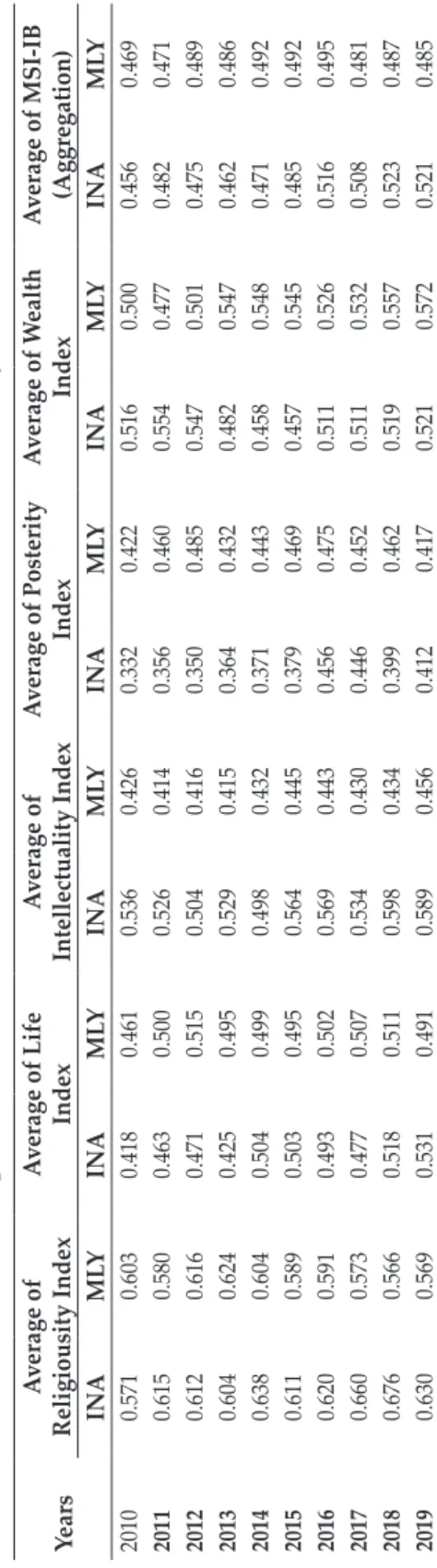
In a more detailed analysis from a temporal perspective, both countries under study have displayed a gradual yet positive development in the Maqasid Shariah Index of Islamic Bank (MSI-iB) over time (see Figure 4). The analysis of temporal movements indicates an improvement in the MSI-iB and all of its sub-indices in both Indonesia and Malaysia. Specifically, the average MSI-iB value in Indonesia increased from 0.456 in 2010 to 0.521 in 2019, while Malaysia experienced a modest increase from 0.469 to 0.485 during the same period. Almost all sub-indices exhibited a similar increasing trend, except for the posterity index in Malaysia, which showed a decline.
0.700 0.650 0.600 0.550 0.500 0.450 0.400 0.350 0.300 0.250
2010 2011 2012 2013 2014 2015 2016 2017 2018 2019
Average of Religionity Index Average of Life Index Average of Intellectuality Index Average of Posterity Index Average of Wealth Index Average of MSI-iB (Agregasi)
Indonesia
0.650 0.600 0.550 0.500 0.450 0.400 0.350 0.300 0.200 0.250
2010 2011 2012 2013 2014 2015 2016 2017 2018 2019
Average of Religionity Index Average of Life Index Average of Intellectuality Index Average of Posterity Index Average of Wealth Index Average of MSI-iB (Agregasi)
Bank Malaysia
Figure 4.
Indonesia and Malaysia Islamic Banking’s Average MSI-iB and its Sub-Indices Calculation Result (for each MSI-iB and Sub-Indices)
When examining the components that form the MSI-iB, it is evident that the religiosity index (RI) in both countries has the highest average score compared to other indices. However, the sub-indices with the lowest values vary between the two countries, with the posterity index (PI) consistently having the lowest average value in Indonesia and the intellectuality index (II) having the lowest average value in Malaysia. The ranking order of the other sub-indices fluctuates in Indonesia throughout the period from 2010 to 2019, but their movements are more stable in Malaysia, with the life index (LI) having the second-highest average score, followed by the posterity index (PI).
It is worth noting that the average level of the Maqasid Shariah Index and its components in both countries is influenced by the values held by individual Islamic banks. Analyzing each Islamic bank in both countries indicates that the average value of the MSI-iB remains relatively similar throughout the period, although there are differences in the trends of their sub-indices.
Table 4. Comparison of MSI-iB and its Sub-Indices Between Indonesia and Malaysia YearsAverage of Religiousity IndexAverage of Life IndexAverage of Intellectuality IndexAverage of Posterity IndexAverage of Wealth IndexAverage of MSI-IB (Aggregation)
INAMLYINAMLYINAMLYINAMLYINAMLYINAMLY 20100.5710.6030.4180.4610.5360.4260.3320.4220.5160.5000.4560.469 20110.6150.5800.4630.5000.5260.4140.3560.4600.5540.4770.4820.471 20120.6120.6160.4710.5150.5040.4160.3500.4850.5470.5010.4750.489 20130.6040.6240.4250.4950.5290.4150.3640.4320.4820.5470.4620.486 20140.6380.6040.5040.4990.4980.4320.3710.4430.4580.5480.4710.492 20150.6110.5890.5030.4950.5640.4450.3790.4690.4570.5450.4850.492 20160.6200.5910.4930.5020.5690.4430.4560.4750.5110.5260.5160.495 20170.6600.5730.4770.5070.5340.4300.4460.4520.5110.5320.5080.481 20180.6760.5660.5180.5110.5980.4340.3990.4620.5190.5570.5230.487 20190.6300.5690.5310.4910.5890.4560.4120.4170.5210.5720.5210.485
4.2. Statistical Differences (Independent T-Test)
We perform a T-test to investigate performance differences in MSI-iB and its sub- indices between the two countries. The results indicated no statistically significant difference in MSI-iB scores between Islamic banks in Indonesia and Malaysia. This can also be observed from the similar average MSI-iB scores for both countries over the period of 2010-2019, with only a slight difference of 0.0052. However, there is statistically significant difference in three sub-indices between Islamic banks in Indonesia and Malaysia. Religiosity and intellectuality indices are higher for Indonesian Islamic banks, while posterity index has a significantly higher score for Malaysian Islamic banks. As for the remaining two sub-indices, while Malaysia has a higher average score in wealth index (with a difference of 0.023 points), this difference is not statistically significant. Similarly, the life index has a non-significant difference of 0.017 points with higher scores for Malaysian Islamic banks.
Table 5.
Independent t-test Result
Index Mean Difference t-value Df p-value
Indonesia Malaysia
Religiosity Index 0.6237 0.5914545 0.032246** 2.0118 193.48 0.04563
Life Index 0.4803 0.4976364 -0.01734 -0.86807 206.36 0.3864
Intellectuality Index 0.5447 0.4310909 0.113609*** 5.9432 184.11 <0.001 Posterity Index 0.3865 0.4517273 -0.06523*** -4.0294 199.64 <0.001
Wealth Index 0.5076 0.5305455 -0.02295 -1.2414 207.66 0.2159
MSI-IB 0.4899 0.4847273 0.005173 0.58165 204.52 0.5614
4.3. Regression Analysis
To further strengthen our analysis, we conduct a panel regression. Due to the multicollinearity of the initial model for GDP and total assets, we interact them in the model. The Hausman and Lagrange Multiplier (LM) tests recommend the Random Effects Model (REM). The multicollinearity test also indicates that none of the independent variables have a variance inflation factor (VIF) score above 10.
The results of the panel data analysis indicate that the country effect is not a significant. Other independent variables, such as the interaction of total assets and GDP, age, and market share significantly impact either the MSI-iB or sub-indices.
The interaction of total assets and GDP has a positive and significant effect on Islamic bank performance in the context of MSI-iB, as well as the life and posterity aspects. The age of the bank positively impacts the increase in the intellectuality index. On the other hand, variables such as bank status and real interest rate are not significant determinants for MSI-iB and each sub-index.
Overall, based on the independent t-test and panel analysis, there is no significant and extreme difference in the performance of Malaysia’s Islamic banks compared to Indonesia’s Islamic banks. Although the financial indicators (specifically the wealth index) show better performance for Islamic banking in Malaysia in terms of average scores during 2010-2019, this difference is not statistically significant. The country effect for the wealth index in the data panel analysis also shows a similar pattern. Statistically, Malaysia’s Islamic banks outperform Indonesia’s only in the posterity index. However, Indonesia has two significant aspects, namely religiosity and intellectuality index, which are better compared to Malaysia.
These results demonstrate that, despite Malaysia’s higher total assets, it does not guarantee significantly better performance for Islamic banks in either financial or non-financial aspects. Conversely, Indonesia, with lower assets, has the advantage of better financial performance, indicating that its overall performance is not necessarily worse. In other words, these results also indicate that financial performance does not always guarantee better performance in non-financial indicators.
4.4. Discussion
The results provide evidence that Indonesia’s Islamic banking performance is comparable to that of Malaysia. In fact, there is indication that Islamic banks in Malaysia exhibit stronger financial performance than those in Indonesia. This is evident from the higher absolute value of the WI aggregate for the period 2010- 2019 and the consistent higher scores of Malaysia’s WI during that time. However, this trend does not extend to other sub-indices, except for the posterity index, which consistently favors Malaysia.
When using the comprehensive aspect (MSI-iB) that combines financial and non-financial indicators, the average performance of Indonesia’s Islamic banking during 2010-2019 does not differ significantly from that of Malaysia. In fact, upon closer examination of annual data, Indonesia’s MSI-iB appears to be superior to Malaysia’s in the latest period. This finding suggests that a larger total asset in Malaysia does not guarantee better performance across all non-financial aspects.
Table 6.
Data Panel Analysis Result Independent
/ Dependent
Variable MSI-IB Religiosity
Index (RI) Life
Index (LI) Intellectually
Index (II) Posterity Index (PI)
Wealth Index
(WI) ln total aset x GDP 0.0009803** 0.0011717 0.0021086** -0.0010409 0.0018252** -0.000562 Age 0.0012228 -0.0038161 -0.0022048 0.0096467*** -0.00000848 0.0037133 Market share -6.85759 1.907986 -17.64065* -1.073583 -11.90739 -4.785608 Bank Status -0.0034566 -0.0548591 0.0261627 0.0505892 -0.0240974 0.0082844 Real Interest Rate 0.0005206 0.0018255 0.0027337 -0.0008003 0.0006653 0.0017427 Country 0.0499775 0.0707015 0.0813801 0.0687628 0.0208399 -0.0461894 Note: The numerical values presented represent the regression coefficients, while the symbols ***, **, and * signify the significance levels of the variables, corresponding to standard errors of 1%, 5%, and 10%, respectively.
In other words, achieving superior non-financial performance does not necessarily require a larger total asset. However, based on panel data analysis, it is evident that total assets play a crucial role in achieving good performance for Islamic banks, whether measured comprehensively (MSI-iB) or specifically for aspects related to sustainability and posterity. It is worth highlighting that a high total asset remains important. A larger asset base provides Islamic banks with more flexibility to improve both financial and non-financial indicators, but it must be complemented by external factors to encourage these banks to focus on achieving more than just financial success.
Referring to the competitive performance of Indonesia’s Islamic banking, there is an indication that achieving good performance in non-financial indicators is not solely attributable to financial performance and the size of total assets. This is in line with the result of Islamic microfinance research conducted by Masyita and Ahmed (2013). As commonly known, improving non-financial aspects can enhance reputation and influence customer interactions. It is reasonable to expect that Indonesian Islamic banking, with relatively smaller assets, places significant emphasis on non-financial performance. This explanation is also applicable to Malaysian Islamic banks. The substantial government support aimed at improving the Islamic banking market has, to some extent, had a negative impact on business strategies, reducing the importance of organic strategies in attracting customers.
Furthermore, it is essential to acknowledge the influence of external factors such as regulations and market culture in encouraging businesses to achieve non-financial goals, including ESG considerations, strict adherence to Shariah principles, and other relevant regulations. Strict adherence to Shariah principles, for example, aligns with the religious aspect. Countries with more stringent regulations are naturally more cautious when it comes to Shariah compliance, which positively affects religiosity indicators. The market nature of each country likely offers further explanation. In Indonesia, Islamic banking is predominantly driven by retail customers, necessitating innovative and attractive strategies to enhance market presence.
Based on these findings, it is evident that solely relying on financial indicators is insufficient for measuring the success of Islamic banks. Considering the objective nature of Islamic banks, as highlighted by prominent scholars such as Siddiqi (2006), Karim & Archer (2013), and supported by other studies conducted by Mergaliyev et al. (2021), Mohammed et al. (2008), Bedoui & Mansour (2014), Ascarya et al. (2016), Asutay & Harningtyas (2015), Antonio et al (2012), Mohammed
& Taib (2015), and Alhammadi et al (2022), a comprehensive measure like MSI-iB is more appropriate. The size of the Islamic banking industry also needs to be accompanied by a broader set of objectives to assess its overall development.
Understanding this comprehensive view of Islamic bank performance indicators is not only crucial for the government but also for the general public.
It is important to appreciate Islamic banks beyond their total assets because their sustainability depends not only on business performance but also on their impact on society. Although Indonesian Islamic banks may have smaller total assets, their balanced performance in non-financial aspects can compensate for this weakness.
A balanced non-financial and financial performance is extremely important to create sustainability in banking industry (Masyita, 2017). However, this does not
imply that Islamic banks neglect their financial standing. The point is to create an Islamic banking sector that excels in both financial and non-financial indicators, thus establishing an appreciation framework for Islamic bank performance.
V. CONCLUSION AND RECOMMENDATION
This study compares the performance of Islamic banking in Indonesia and Malaysia using the Maqasid Shariah Index of Islamic Bank (MSI-iB) as a measurement tool. The adoption of the MSI-iB highlights the holistic evaluation of Islamic banking, considering not only financial aspects but also social responsibilities.
This approach integrates financial performance, represented by the wealth index, with non-financial aspects aligned with Maqasid Shariah, such as religiosity, life, intellectuality, posterity, and wealth dimensions. The findings reveal that despite the significant difference in asset size and market share, Islamic banking in Indonesia is not inferior to its counterpart in Malaysia. Both countries exhibit comparable performance according to the MSI-iB and the wealth index. Notably, each country excels in different sub-indices, with Indonesia emphasizing religiosity and intellectuality, while Malaysia outperforms in posterity and wealth. This finding highlights the unfairness of solely measuring Islamic bank performance based on financial aspects, emphasizing the importance of considering the social responsibilities achieved by Islamic banks.
Moreover, the implications of this research underscore the significance of integrating social missions into the strategies and business models of Islamic banks. By aligning with Maqasid Shariah and the MSI-iB, Islamic banks can transcend financial optimization and prioritize non-financial aspects, including social welfare, human capital development, and environmental sustainability. This approach ensures compliance with Shariah principles and provides a competitive advantage by delivering social value-added services. Furthermore, it reinforces the notion that choosing Islamic banks is driven not only by financial gains but also by the desire to make a positive social impact.
Another key finding is the importance of Shariah-based products rather than mere compliance. Islamic banks should develop products that not only fulfill financial needs but also contribute to the survival and financial inclusion of small and micro-entrepreneurs. By adopting a broader perspective of financial success that incorporates social impact, Islamic banks can compensate for potential lower profitability compared to conventional banks. To further enhance the social role of Islamic banks, efforts to increase financial literacy and educate the public about the social objectives of Islamic banking are crucial. This will enable individuals to make informed choices and understand that Islamic banking aims to provide financial access and generate positive social outcomes.
From a strategic and business model standpoint, Islamic banks should prioritize financing for micro, small, and medium enterprises (MSMEs). MSMEs play a significant role in driving the Indonesian economy, contributing substantially to the GDP and employment. Islamic banks can better serve this crucial sector by providing direct financing to MSMEs, developing specialized microfinance products, and collaborating with microfinance institutions. However, addressing challenges related to financial literacy and inclusion remains essential, as these
are relatively low in the microfinance sector. A comprehensive approach that combines Shariah compliance, social mission integration, and efforts to improve financial literacy will position Islamic banks as engines of economic growth and agents of positive social change.
This study highlights the framework provided by the MSI-iB for Shariah banks to align their business activities with their mission. However, the lack of formal regulations governing the performance guidelines of Shariah banking based on maqasid Shariah hinders the implementation of strategies to enhance their performance. Current financial regulations primarily focus on material aspects, neglecting non-material aspects such as the impact on customers’ quality of life and financing for the real sector.
Despite the absence of formal regulations, this research reveals that Shariah banks in Indonesia excel in non-material aspects, including the religiosity index, intellectuality index, and posterity index, aligning with sustainable development principles. However, the life index, crucial for protecting human life, lacks formal regulation encompassing human rights, dignity, happiness, and mental health.
Based on the findings and the implications of this research, the following recommendations are proposed for the government and Islamic bank practitioners in order to optimize the role of Shariah banks. First, the government should implement formal regulations that integrate MSI-iB measures into the evaluation of Shariah bank performance. This regulation is important for establishing maqasid shariah as a comprehensive framework for assessing Islamic banks, as discussed earlier. In support of this regulation, it is crucial to mandate Islamic banks to report on maqasid Shariah aspects in their annual reports. These reports should provide the necessary data for calculating the MSI-iB. Currently, the annual reports are incomplete and do not adequately inform stakeholders about significant data.
Additionally, the government should introduce policies that foster the growth of Islamic banks, ensuring that both financial and non-financial indicators are given due attention.
On the other hand, business practitioners should adopt MSI-iB as an evaluation standard for corporate decision-making. This approach will align corporate actions with the overarching goals of Islamic banks. Working together with the government, Islamic banks need to promote the value of Shariah banks using the MSI-iB framework. This will help shape public perception and encourage them to recognize the added value of non-financial performance. Moreover, to expand the market size, enhance social impact, and bolster the national economy, it is essential to strengthen collaborations between Shariah banks, social finance institutions, and the real sector.
Regarding future research, several areas for improvement can be identified.
Firstly, the study’s timeframe could be extended, or the focus could shift to the post-Covid 19 pandemic and merging of three Islamic banks under the ownership of the Indonesian government period, as it would provide valuable insights.
Furthermore, using the MSI-iB framework to compare the performance of Islamic banks and conventional banks would be beneficial, serving as an assessment to demonstrate the competitive advantages of Islamic banks. Implementing the MSI- iB framework in other countries would also enrich the analysis and contribute to a broader understanding of Islamic banking performance.
In conclusion, this study highlights the importance of considering both financial and non-financial aspects when evaluating the performance of Islamic banking.
The findings show that Islamic banking in Indonesia and Malaysia demonstrates comparable performance according to the MSI-iB and the wealth index. The study emphasizes the need for formal regulations and strategic initiatives that align Islamic banks with Maqasid Shariah, promote social value-added services, support MSMEs, and enhance financial literacy. By adopting these recommendations, Islamic banks can fulfill their social responsibilities, drive economic growth, and contribute to positive social changes.
REFERENCES
Abdelsalam, O., Dimitropoulos, P., Elnahass, M., & Leventis, S. (2016). Earnings management behaviors under different monitoring mechanisms: The case of Islamic and conventional banks. Journal of Economic Behavior and Organization, 132(Supplement), 155-173.
Abedifar, P., Ebrahim, S., Molyneux, P., & Tarazi, A. (2015). Islamic banking and finance: Recent empirical literature and directions for future research. Journal of Economic Surveys, 29(4), 637-670.
Akhtar, M. F., Ali, K., & Sadaqat, S. (2011). Factors influencing the profitability of Islamic banks of Pakistan. International Research Journal of Finance and Economics, 66(66), 125-132.
Alhammadi, S., Alotaibi, K. O., & Hakam, D. F. (2022). Analysing Islamic banking ethical performance from Maqāṣid al-Sharī‘ah perspective: Evidence from Indonesia. Journal of Sustainable Finance & Investment, 12(4), 1171-1193.
Al-Malkawi, H. A. N., & Pillai, R. (2018). Analyzing financial performance by integrating conventional governance mechanisms into the GCC Islamic banking framework. Managerial Finance, 44(5), 604-623.
Al-Qaradawi, Y. (1999). A comparative study. London: Dar al-Taqwa Ltd.
Amin, H. (2022). Maqasid-based consumer preference index for Islamic home financing. International Journal of Ethics and Systems, 38(1), 47-67.
Anbar, A., & Alper, D. (2011). Bank specific and macroeconomic determinants of commercial bank profitability: Empirical evidence from Turkey. Business and Economics Research Journal, 2(2), 139-152.
Antonio, M. S., Sanrego, Y. D., & Taufiq, M. (2012). An analysis of Islamic banking performance: Maqashid index implementation in Indonesia and Jordania.
Journal of Islamic Finance, 1(1), 12-29.
Ascarya, A., & Indra. (2022). Standard Methodology for Research in Islamic Economics and Finance (Chapter 17). In Billah, M.M. (Ed). Teaching and Research Methods in Islamic Economics and Finance. Abingdon-on-Thames, England, UK:
Routledge.
Ascarya, A., & Masrifah, A. R. (2023). Developing maqasid index for Islamic CSR:
The case of Ummah’s endowment fund in Indonesia. International Journal of Islamic and Middle Eastern Finance and Management, 16(4), 835-855.
Ascarya, A., & Yumanita, D. (2008). Comparing the efficiency of Islamic banks in Malaysia and Indonesia. Buletin Ekonomi Moneter dan Perbankan, 11(2), 95-119.