Technium
41/2023
2023 A new decade for social changes
Social Sciences
Technium.
Self-esteem and unconditional acceptance of oneself, in HIV positive people
Sandu Mihaela Luminita1, Călin Mariana Floricica2, Fusea R. Mariana-Violeta3
1,2 Ovidius University of Constanta, Faculty of Psychology and Educational Sciences,
3Independent researcher
[email protected], [email protected]
Abstract. The present work entitled "Self-esteem and unconditional acceptance of oneself, in seropositive people", highlights the problem of real states, which seropositive people face, to situations and intercessions related to self-esteem. This followed the behavior of HIV positive people, attitudes towards other people or vis-à-vis their own lives. Self-esteem is an element of the self and refers to affective living, to the emotions that the individual experiences when referring to himself. It is a make-up of the cognitive scheme relating to oneself. The idea that self-esteem is one of the factors that are associated with mental health is an integral part of psychology. The level of self can influence the habits and manifestations of the individual, so in the case of a low level the person gives up a succession of attractive goals, such as establishing close interpersonal relationships, choosing desired professions or living a pleasant life full of accomplishments and satisfactions. A low self-esteem can turn a healthy and intelligent person into a powerless person. The transition from a healthy and high self-esteem to a low self-esteem can be achieved by triggering strong mechanisms, in critical situations such as in the case of the presented theme, the establishment of a positive serodiagnostic. This fact causes the person to adopt ub devaluation behavior. The work being focused on self-esteem is designed so as to highlight the main aspects of the subject, so it is structured on chapters as follows in those presented below.
Keywords. self-esteem, acceptance, seropozitiv
1. Self-esteem
1.1. Conceptual delimitations
Self-esteem is the force that guides people's lives and that includes their feelings about the "comfort" or "discomfort" felt in the adoption of the various roles assumed in the course of their existence, namely, those of friend/ girlfriend, brother or sister, husband or wife, son or daughter. In the socio-professional context, they can be that of employee respectively employer, student or licensee, organization leader or subordinate. The development of self-esteem, maintaining it at an optimal level, determines the individual to fulfill both his own potential and that of a member of a family, group, ethnicity, community (Enache, R.G., 2017).
"In principle, self-esteem is generally stable, but it can fluctuate, even from day to day, depending on the pattern of thoughts, which can be influenced, among other things, by physical Technium Social Sciences Journal
Vol. 41, 147-168, March, 2023 ISSN: 2668-7798 www.techniumscience.com
health, internal chemistry, physical appearance and relationships" (Dr. Glenn R. Schiraldi, 2017, p. 42).
"The definition of self-esteem is the focus of our journey. Self-esteem is a realistic and appreciative opinion of oneself. Realistic means true and sincere. Appreciative involves the existence of positive feelings and self-acceptance. Some talk about low self-esteem and high self-esteem, but that makes self-esteem seem like a competitive and comparative number game.
It is preferable to simply say that people have self-esteem when they have a realistic and appreciative opinion of themselves" (Dr. Glenn R. Schiraldi, 2017, p. 42-43).
Those with self-saboteur vanity are trying to be a superior human species. They are arrogant and narcissistic, which means that they imagine that they are better and more important people than others. Their opinion of others is vertical, or comparative, which implies that in order to be superior, others must be lower than them. Saboteur car hubrisis often rooted in uncertainty (Dr. Glenn R. Schiraldi, 2017, p. 43).
Those with feelings of self-sabotaging shame, or self-sabotaging modesty, have the impression that they are an inferior human species. And they look at people vertically, but they see themselves as the "dust on the ground." They have an unrealistic and critical opinion of themselves.
In contrast to the above visions, people with self-esteem do not believe themselves to be either superior or inferior to others. Knowing their flaws and less good parts, they are deeply glad that they are themselves (Briggs, 1977). They are like a good friend who knows youvery well and likes you however you are, because they recognize the kindness, excellence and potential that coexist alongside imperfections. People with self-esteem relate to others as being equal to them, on a level or plane horizonal ( Dr. Glenn R. Schiraldi, 2017).
Self-esteem is often ignored, because it and the concepts related to it can be somehow confusing and complex.
Identity
Identity answers the questions: "Who am I? What defines me and what defines the essence of my character?" Identity ensures self-awareness and individuality (Dr. Glenn R.
Schiraldi, 2017, p. 44).
Appreciation
To think well about, to cherish and to enjoy; gratefully accepting; to correctly assess the quality or importance of someone or something (Dr. Glenn R. Schiraldi, 2017, p. 44).
Acceptance
"To receive (as if it is a thing that already belongs to you) benevolently and with pleasure; approve; to believe favorably. Self-acceptance means believing in yourself and accepting yourself favorably and with pleasure. You can be aware of your weaknesses accurately, you can be determined to improve yourself and yet accept yourself as you are" (Dr.
Glenn R. Schiraldi, 2017, pp. 44-45).
Self-confidence
Refers to confidence in one's own abilities; it is linked to competence and its own effectiveness. When personal competence increases, self-confidence also increases. In a broader and deeper sense, self-confidence means trusting yourself as a person, leading to a constant feeling. Competence and self-confidence are correlated with self-esteem, but they are not causal. If we base our self-esteem on competence and achievements, then if we fail, this too will disappear (Dr. Glenn R. Schiraldi, 2017, p. 45).
Technium Social Sciences Journal Vol. 41, 147-168, March, 2023 ISSN: 2668-7798 www.techniumscience.com
Hubris
The English minister Charles Caleb Colton (1780-1832 wrote: "Hubris makes some people ridiculous, but it keeps others from becoming so" (Dr. Glenn R. Shiraldi, 2017, pag. 45).
Modesty
There are two facets of modesty: self-sabotaging modesty and healthy modesty. Self- sabotaging modesty is an extreme lack of self-esteem. Healthy modesty, on the other hand, implies: the absence of self-saboteur hubris; recognition of imperfections or weaknesses;
awareness of their own shortcomings and of the country; the ability to learn. It means the consciousness that all are equal. Healthy modesty has to do with good-natured behavior (in the positive sense), meaning calmness and patience (Dr. Glenn R. Schiraldi, 2017, pp. 46-47).
Selfishness
Some people mistakenly equate selfishness with self-esteem. So, let's specify an important principle: the purpose of self-esteem is to transcend the self. Healing pain through love allows to center attention outwards. A person with self-esteem chooses to love having a safe basis, as opposed to an individual who has neither self-esteem nor choice. Therefore, building self-esteem involves efforts (Dr. Glenn R. Schiraldi, 2017, p.47).
1.2.Factors influencing self-esteem Educational climate in the family
The parents, not once, stubbornly notice not to notice that the one who was a child another time, grew up, became preadolescent. Yesterday's child, is today a preadolescent with his world, with his concerns and opinions, with his friends. In this context, they, as parents, do not change their attitude. It does not change some of its requirements, "which become absurd in the optics of the preadolescent" (A. Chircev, D. Salade, 2000, p. 62).
Low self-esteem, as stated by C. Rogers (1980), can have its origins in receiving inadequate emotional support from the important adults around the child. Also, the verbal aggressiveness of parents, taken separately, separately from physical punishment can help reduce the level of self-esteem of children. Given the proportion of verbal aggression used by parents, R.C. Solomon, Fr. Serres (1999) suggested the need for parental education in order for them to know and apply positive methods of education of children.
Parental misconduct
C. Andre and F. Lelord (1999/2003, p. 208) brought to the fore some very important aspects related to the typology of families, aspects with an important role in forming the stability of the child's self-esteem:
• the parents of "intrusive controllers" do not give freedom of choice to the child and they decide instead of him. This type of family climate increases the chances of developing parental dependence, which can then easily become a marital addiction. It would be desirable for a child to be able to make decisions on his own, as soon as he can do so.
• Distant parents take care of themselves more than the child, hence the child's need to attract attention, to value himself, to show them his merits, to ultimately be worthy of their interest;
• Parents who themselves exhibit a low self-esteem will transmit the parental model through imitation (S.C. Anderson, M.L. Lauderdale, 1982);
Technium Social Sciences Journal Vol. 41, 147-168, March, 2023 ISSN: 2668-7798 www.techniumscience.com
School
School negatively influences the level of self-esteem of students by: using competition for good behaviors (the best child, the most altruistic), helping in excess / hyperprotecting the child and by judging children in their absence (without them being able to defend themselves) (J. Hendrick, 2002). In this context, it is recommended to the people of the school, to observe the basic principles for the development of a positive self-esteem of the students: the positive attitude manifested in working with the child, the respect given to him, the honest recognition of the merits and encouragement through deserved praise of them.
Social economic factors and their implications for projection capacity (the ideal self) have been studied by A. Shumski, J. Rousselet and S. Levine (1998) who noticed that children who lived in a hostile environment, who suffered repeated frustrations, who had a limited perspective of tomorrow, could develop a capacity to design self-realization in the future and a lower self-confidence than their peers who had the aforementioned environmental conditions.
The elements of the scheme of the Self depend largely on the context. Thus, a person might have a high level of self-esteem in one context and a low level in another context (Caprara and Cervone, 200). Petru Iluţ (2001) and E. Higgins (1985) related the level of self-esteem to the importance or significance that individuals attach to the desired qualities, or to the perceived frequency of different qualities among the population.
1.3. F-ordination and development of self-esteem
"Self-esteem is formed since childhood, through the intervention of genetic and environmental factors, family, school and general socio-cultural influences. The individual will acquire adaptive behavior if he has received enough attention from his parents, if teachers and teachers have supported and encouraged him in his efforts. On the contrary, a neglected or abused child will have low school performance and will develop in most cases, antisocial tendencies. " (Enache, R.G. ,2017, p.184)
In the period of adolescence, most individuals will be prepared for the formation and development of their own identity, gradually assuming their gender roles, trying to gain independence in raprt with their parents and gradually becoming full-fledged members of society. The adult will be influenced in strengthening his self-esteem by the assimilated experiences, by the positive or negative messages received over time from family, friends, teachers, colleagues, coordinators, supervisors, mass-media. (Enache, R.G., 2017, p.184)
Self-esteem in adulthood is based on comparison with others, according to a number of criteria (Miller apud Reece,2011):
- the materialituation of the individual, the assets owned by him - constitute in many cases a primary source of self-esteem;people who feel "valuable" owning movable or immovable property and thus living a great satisfaction, will make efforts to acquire, accumulate even more; these people define themselves by what they have and not by what they are or could achieve.
- the source of income (or the way in which a person earns a living) highlights the professional sub-identity, reflected in the social status and in the value of the work performed by him for the benefit of the community.
According to Amy Saltzman (apud Reece, 2011) the professional status "can gradually take control over the life of the individual", which gives him the feeling that only in the context of a fulfilled professional life, of a successful career, life is worth living.
- individual value system and emotional control; those people who base their self- confidence on a sense of competence and respect for themselves and on family values, who do
Technium Social Sciences Journal Vol. 41, 147-168, March, 2023 ISSN: 2668-7798 www.techniumscience.com
not identify with their job or material possessions, can form a "healthy" self-esteem (Enache, R.G., 2017, p. 184).
People in this category more easily overcome unfavorable events (job loss, a divorce, missing a promotion), managing to avoid depression, anxiety, or inferiority complexes.
Increased self-esteem causes the individual to be less vulnerable to the criticisms or unfavorable opinions of others and as such, to show more tolerance and more respect for their fellows.
The formation of self-esteem involves a long process. It is correlated with the formation of self-image and self-awareness. Its evolution over time involves periods of fall, especially in periods of transition, from one stage to another, from one status to another, for example, in adolescence (due to psycho-somatic changes) or at high age, as a consequence of changing status, retirement and changing tasks and responsibilities (Orth, Trzesniewski and Robins, 2010). While self-esteem seems to decrease during adolescence, it increases during the younger age (Tsai, Ying and Lee, 2001).
The affective model of the development of self-esteem assumes that:
a) self-esteem is formed at the beginning of life in response to relational and temperamental factors;
b) once formed, it gives people a high self-esteem with the ability to promote, protect and restorefeelings of self-worth (Brown et al., 2001).
"Many studies have highlighted the essential role of the family environment in personality formation, especially in early childhood." (Talib, Mohamad and Mamat, 2011) Early studies by Rosenberg (1965) and Coopersmith (1967) showed that "parental involvement and the desire to give autonomy and freedom to adolescents are positively correlated with a high self-esteem in the adolescent."
Basics of self-esteem 1. Unconditional value 2. Love
3. Development
While all three factors are essential for building self-esteem, their order is crucial. Self- esteem is based, firstly, on unconditional value, secondly on love, and then on development.
"Development" (or "flowering") refers to actions carried out in the desired direction. Too many people become frustrated because they try to start with development and neglect the first two important factors: unconditional value and love. Without a reliable basis, self-esteem overturns.
The process cannot be shortat (Dr. Glenn R. Schiraldi, 2017).
1.4.Use of the self in assistive practice
"The use of the self" is arelatively difficult phrase to define. In the literature of the field, this means combining the knowledge, values and skills acquired by social workers with aspects of their personality, their own value system, personal experiences and cultural dowry (Dewane apud Heath Walters, 2008).
The use of the self (personality profile, personal development capacity, relationship ability) makes social workers manifest authenticity and originality in the relationship with customers, while respecting the ethics and values specific to the field.
Successful social workers have managed to perfectly combine the work of the siste, with their authentic self. Dewane (2006), quoted by Walters, formulates five different perspectives in this sense:
- use of personality,
Technium Social Sciences Journal Vol. 41, 147-168, March, 2023 ISSN: 2668-7798 www.techniumscience.com
- the use of one's own system of beliefs and values, - relationship dynamics
- self-disclosure Use of personality
Social work practitioners can discover step by step the attributes that allow them to relate to their clients in an authentic, unique and represent way. The practitioner's skills have the least impact on customer satisfaction, compared to honest attitude and the use of personality traits in everyday work (Edwards & Bess, 1998; Baldwin, quoted by Walters).
In terms of authenticity, it is necessary to emphasize the importance of an individual constantly reflecting his real self, in other words, social workers to prove behaviorally consistency in professional and private life. To this end, they must really know themselves, fully understand who they are and what they represent as individuals, as well as what their professional status implies, thus fully integrating the two roles.
The first step towards this authentic integration is the discovery of the self. Knowing one's own personality, highlighting the dominant character traits and identifying how they can support effective relationship with clients, will be a useful exercise for practitioners. Also, the introspection, the reflection on the reasons that determined them to choose their profession, the influences of the affective transfer of clients, as well as the efforts made for the prsonal development, have a significant role in self-knowledge (Enache, R.G., Giurgiu, L.R., 2017).
Value system
The social worker has an unconscious tendency to project his own vision of the world and life, on the problems of the clients. It is important for practitioners to evaluate their personal views on the world. Part of the structure of motivation and of the attitudinal system are the beliefs or "ideas forstrength" that guide a person's behavior, ideals, the meaning of life, the purpose of life and its life model and also the general conception of the world and life (Enache, R.G., Giurgiu, L.R., 2017).
Relational dynamics
Followers of the humanistic perspetive, developed by Carl Rogers (1957) emphasize the importance of self-representation and the self-image of the individual (Pelletier apud. Neamţu, 2003). These components of the personality engage in the structuring of ecestea, both the cognitive plane (what the person knows about himself, how well he knows himself) and the affective plane (what the person feels about the self-image). Practitioners who acquire over time a correct, objective self-knowledge, manage to transfer to their profession, in the way of relating to clients, the necessary and sufficient conditions that substantiate the relationships of help and unconditional respect.
Strategies by which social workers collect information can contribute to clients' sense of competence and hope by activating their resources. The use of personal qualities and professional expertise in the development of the professional relationship determines the orientation towards the client's desirable objectives and the triggering of the desire for change for the better, of his life (Enache, R.G., Giurgiu, L.R., 2017).
2. Self-acceptance
2.1. Accept yourself to be esteemed
People with high self-esteem have flaws and doubts, they also know failures not only successes, they also feel, sometimes or often in the case of some of them, doubts and feelings of fragility. It simply accepts them. Failures affect them, but they know they are inevitable if Technium Social Sciences Journal
Vol. 41, 147-168, March, 2023 ISSN: 2668-7798 www.techniumscience.com
you have chosen to act. Criticism disturbs them, especially if they are well-founded, but they then manage to admit your mistakes without feeling the excessive need to justify themselves or, worse, to deny them. Their limits and insufficiencies bother and embarrass them at times, but they do not encourage them to run away from social situations or shut up. But fragilities incite them to seek to learn and progress, instead of affirming and progressing, inhibiting themselves or trembling.
In short, the most important catacteristics of subjects with good self-esteem is that they are able to tolerate and accept their imperfections, because they have built and integrated a good global self-image, and I assume that their honest and benevolent interlocutors will be more sensitive to this global image than to ,, the detail that kills" -in any case. They are, in fact, able not to let themselves be "broken" by the malevolent and have learned that there is no point in leading your life and behaviors after them: they will follow your opinions, interests and tricks, whatever we do to convince them of the opposite. We do not face any risk with those who appreciate us, instead no risk and no success will be enough for those who do not appreciate us (Christophe Andre, 2009).
To accept is not only to tolerate (which is, in fact, totuna with refusal, but by looking elsewhere), nor to resign yourself and give up the thought of acting and changing, but to look the problem in the face.
If acceptance issues are of such interest to psychotherapists, as well as philosophers, it's because you change more easily by accepting yourself. To treat yourself you have to admit that you are sick: "Ifyou do not accept your disease, you add anguish to your symptoms and here you are sick of existence (Compte-Sponville A., 1997)." And to progress, you must recognize yourself and accept yourself as imperfect (Cristophe Andre, 2009).
2.2. Benefits of self-acceptance
They are twofold: improving emotional well-being and facilitating personal change.
The first benefit of self-acceptance lies in the better emotional state thus obtained. Let's listen, for example, to Williams James, the father of the self-esteem, which he describes in 1892:
"It's strange, but you feel your heart extremely light once you've accepted your incompetence in a particular field in good faith." Or also, "How good it is when we give up being young (James W., ap. cit)!" James, who knows what self-esteem is, understood the benefits of giving up all these struggles and spasms, this futile battle with himself, the poisonous search for an illusory perfection.
The second aspect is perhaps the most paradoxical: you change more easily if you accept yourself. This does not correspond to a frequently spread dogma: dissatisfaction would be the great engine of change, and even of any form of action. It's an important mistake. If we start from the principle that psychological change is more related to the laws of learning (training in order to practice new styles of behaviors and thinking) than to those of self-discovery (finally discovering the (unique) cause of our sufferings), then tension and dissatisfaction become toxic and unmobilizing, because they disrupt learning (Cristophe Andre, 2009).
2.3 Harm to non-acceptance of oneself
An important part of the problems of self-esteem is related to the non-acceptance of that which we are: of our weaknesses and limits... And, at the same time, not accepting our difficulties in changing ourselves: we get angry, we are desperate that we do not progress, that we do not make our lives what we would like to do, that we are not what we would like to be.
These non-acceptance problems have been identified in numerous cases of psychological Technium Social Sciences Journal
Vol. 41, 147-168, March, 2023 ISSN: 2668-7798 www.techniumscience.com
distress and especially in the three families of frequent mental disorders: depression, anxiety and alcohol abuse (Hayes S.C. et al., 1999).
In anxious and phobic disorders, patients' difficulties in accepting the fear in them, of accepting to face the worst images of fear (,,catastrophe scenarios") are considered the main sources of chronicization of these fears (Orsillo S.M. et al. , in S.C. Hayes et al., 2004, pp. 66- 95). In the dpressive disturbances, the same is true of the inability to accept to give up excessive exigencies towards oneself (Morgan S.P., in Germer CK et al., 2005, pp. 130-151). In problems with alcohol, at the same time, numerous symptoms are based on the inability to accept notable aspects of realityand then this ability is sought in alcohol, this elixir of acceptance (Marlatt G.A.
et al., in S.C. Hayes et al. 2004, pp. 261-287).
2.4. The practice of self-acceptance
Self-acceptance is not only a concept, but a kind of being, which can therefore only be acquired through a repeated practice (Christophe Andre, 2009, p. 112).
The sufferings of self-esteem are often linked to non-acceptance of oneself
It often happens that the problem of self-esteem corresponds to some thoughts or emotions of self-denial. When we tell ourselves, or rather we hear ourselves say , "I'll never succeed" (Christophe Andre, 2009).
Situationsat risk for non-acceptance of oneself
There are all situations in which we are confronted with our own limits: as a result of a failure or a difficulty in achieving a goal that we set ourselves, or as a result of a comparison with others who seem "better", and just as well as a result of a remark, a criticism, an irony, even friendly benigme (Christophe Andre, 2009, pag. 114) .
Examples:
• In conversations with people we believe more than us: smarter, more diplomatic, more cultured, more refined, more important. We imagine that we have the right to talk only if we have new, funny, original things to say. As a result, we often prefer to be silent, so as not to risk revealing our gaps or platitudes. But we blame ourselves for this. We don't accept each other.
• When we are asked a question and we want at all costs to give the right answer. If this is not the case, we can feel humiliated, inferiorized, incompetent. We do not accept to find ourselves caught in flagrante delicto of ignorance (Christophe Andre, 2009).
Important paths on which efforts should be focused:
1. Maintaining awareness.
2. Let's say,"yes."
3. Making the effort to accept the idea of the greatest evil, which means neither to be desired nor resigned.
4. Accepting the past alike (Christophe Andre, 2009).
Risks of self-acceptance:
If self-acceptance is so hard for us, it's because many fears are connected to it in our minds.
Among them:
✓ Fear of becoming complesent with oneself, soft and resigned
✓ Fear of becoming without flavor, without color. This reluctance frequently appeared in people with high unstable social esteem, who preferred to consider their angers and axageries as evidence of personality, putty that their entourage suffered more or less.
Technium Social Sciences Journal Vol. 41, 147-168, March, 2023 ISSN: 2668-7798 www.techniumscience.com
In reality there are two different problems: the gain of serenity brought by self- acceptance is not done at the expense of the personality, but only rids the person of some of his pathological emotions.
✓ The fear that this will make everyone similar, underlining the fear of a formatted universe, in which each, thanks to self-acceptance, will be quiet and serene. This kind of fear seems above all rhetoric (Christophe Andre, 2009).
Most of these fears are "theoretical" and unfounded in practice. They depend on implicit beliefs. These beliefs are only toxic because we apply them without recoil and without flexibility. Self-acceptance does not push us to give up values that are important to, but not to become slaves or their victims. It is worth mentioning that psychotherapies do not change the personality from one end to the other, but only help the person to cope differently with personality traits and excessive internal demands that do not pose problems (Christophe Andre, 2009).
The dicerence in self-acceptance
Let's mention once again the evidence: self-acceptance is not done "instead of something", we do not eliminate anything. It does not eliminate the fact of living, of acting, of enjoying ourselves, of feeling emotions, of protesting, of jumping up for joy... It comes in addition to all this. Its maxim is not "to accept or act", but to "accept and then to act".
Training as we have seen, slowly acquiring the taste of quality and lucidity of the action when it follows acceptance. Thus, self-acceptance does not at all re-energize us to give up the efforts of change that seem necessary to us. It helps us to carry them out quietly and with goodwill towards ourselves. Given that these efforts of personal evolution last a lifetime, it is easy to understand the need for self-acceptance in order to live and change in a calm indoor climate. It is the only way to continue to feel the pleasure of working on ourselves over time! It is the only philosophy of life possible in relation to oneself. It is the only endeavor that allows the effort focused on self-esteem to continue to be a pleasure and not a violence or coercion (Christophe Andre, 2009).
Self-affirmation
"Self-affirmation is the expression of needs, thoughts and emotions" (Andre c., Legeron P., 2000).
We are not born ready-made, but we generally become through an adapted education that encourages us to express our libe, without punishing ourselves for having expressed ourselves. Or, subsequently, through a deliberate apprenticeship in adulthood.
Theoretically, it always seems simple to assert yourself, if you are not in certain situations, such as the one to ask, to refuse, to have an opinion different from that of the interlocutor, to negotiate, to express dissatisfaction, etc. Difficulties in asserting yourself are extremely widespread: massive and chronic in diseases such as social phobia, occasionally during certain forms of depression, they can affect most people punctually (Andre C., Legeron P., 2000).
The lack of self-affirmation is frequently associated with problems of low self-esteem and then causes numerous avoidance behaviors, which in turn strengthen the bad self-image.
By and large, the person avoids facing all the situations that seem to him to pose a social risk in terms of the possibility of being rejected or devalued.
The lack of self-affirmation can also be found in people with a high fragile self-esteem, but then only in the form of unfirmed gi aggressive behaviors: these people ask with aggression Technium Social Sciences Journal
Vol. 41, 147-168, March, 2023 ISSN: 2668-7798 www.techniumscience.com
(to be sure that they get what they want), they refusethebone (because they do not feel intheir larment) etc. This surface aggression is not a good disguise of fear from othersand their possible impotence (Christophe Andre, 2009).
The manifestations of assertive deficiency are multiple:
• Behavioral: not to dare to say no, not to dare to ask or disturb, not to dare to recognize what you do not know, not to dare to say that you do not agree; to be hard to respond to criticism... When you manage to be able to express yourself, you do it with crispness or anger, or aggressively.
• Emotional: frustration, restrained anger, sad resentment towards oneself or others, etc.
• Psychological: the image of a vulnerable, addicted, dominated self... Small repeated blows to self-esteem, the accumulation of small toxic renunciations (Christophe Andre, 2009).
3. Research methodology 3.1 Research objectives
1. Identify the behavior of HIV-positive people compared to that of people who do not face any kind of condition.
2. Identify their integration into society (work, school, group of friends, family).
3. Identifying the degree of acceptance of oneself.
4. Obsevation of the level of self-esteem and its characteristics.
3.2 Formulation of assumptions
1. It is presumed that there are significant differences in self-esteem in HIV positive people depending on gender.
2. It is presumed that unconditional acceptance in HIV positive people differs depending on gender.
3.3. Study participants
Presentment of research methods
Din urban areas the percentage for women is 92.31% while for men it is 7.69%. In rural areas it is noticed that the percentage is equal for women and men.
3.4. Tools used
- Questionnaire- Interpretation of the self-esteem scale (Rosenberg, 1965) - The questionnaire of unconditional acceptance of oneself
4. Data analysis and processing
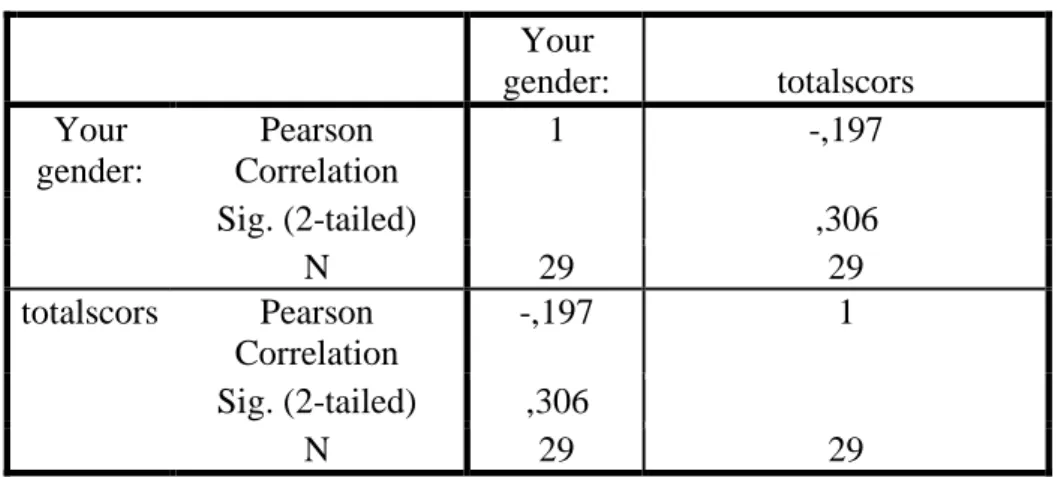
In the next figură is shown the correlation on the total resulting score on the inner instrument. It is noticed that a Pearson correlation coefficient equal to -,197 was obtained, which means that between the two variables there is a direct correlation, the value of the coefficient being close to one.
Technium Social Sciences Journal Vol. 41, 147-168, March, 2023 ISSN: 2668-7798 www.techniumscience.com
Table 2 represents the comparison between gels two biological genera, it being noted that there is a very large difference between the percentages. For females, a percentage of 96.7%
is obtained, and for the male persons a percentage of 3.3%.
Table 2. Represents the comparison between the two genur
Assumption 1. It is presumed that there are significant differences in self-esteem in HIV positive people depending on gender.
In the next figure is the demontodeal with hypothesis 1. Depending on the answers provided by the subjects, it is noted that we have for the variant of total response agreed 60.00%
answers from women, and 40.00% from male people, which means that there are differences in self-esteem depending on gender.
Table 1. Correlations Your
gender: totalscors Your
gender:
Pearson Correlation
1 -,197
Sig. (2-tailed) ,306
N 29 29
totalscors Pearson Correlation
-,197 1
Sig. (2-tailed) ,306
N 29 29
Cases
Included Excluded Total
N Percent N Percent N Percent
Your genre: * totalscoruri
29 96,7% 1 3,3% 30 100,0%
Technium Social Sciences Journal Vol. 41, 147-168, March, 2023 ISSN: 2668-7798 www.techniumscience.com
Figure 1. Represents the comparison of the level of self-esteem in relation to the biological gender
Assumption 2. It is presumed that unconditional acceptance in HIV positive people differs depending on gender.
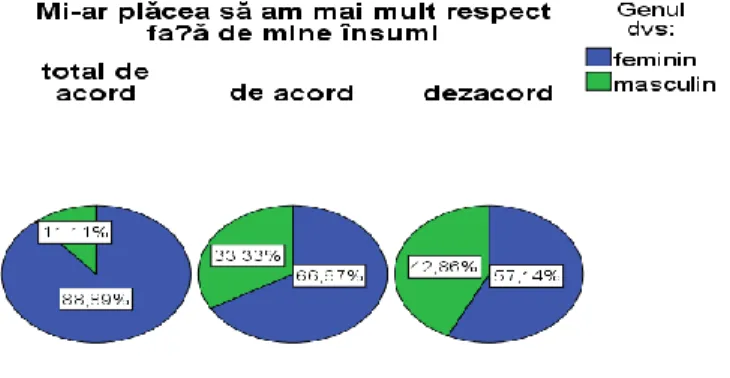
In the figure below, hypothesis 2 is demonstrated. It is noticed that following the variant of total answer of agreement , women have a percentage of 88.89% which means that they have problems in accepting themselves, while male people do not encounter problems in this regard having a percentage of 11.11%.
Figure 2. There are differences in unconditional acceptance by gender.
Analysis of respondents' responses on items.
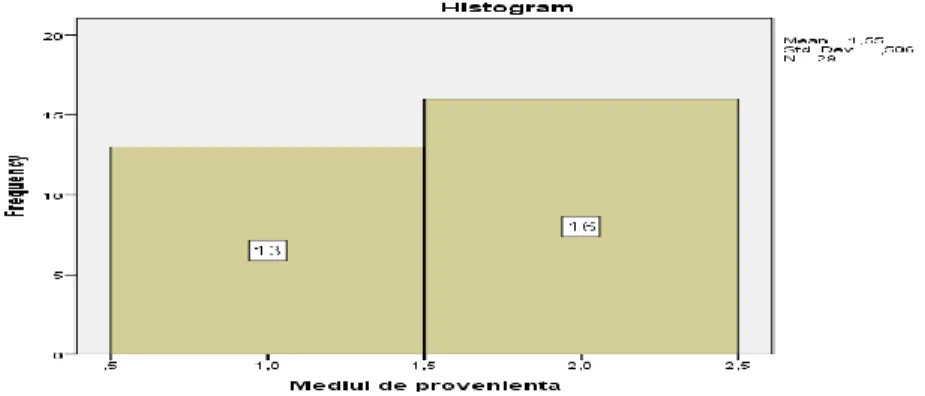
From the first question we note that a number of 13 people come from urban areas, and 16 people from rural areas.
Technium Social Sciences Journal Vol. 41, 147-168, March, 2023 ISSN: 2668-7798 www.techniumscience.com
Fig. 3 Results to the question "background"
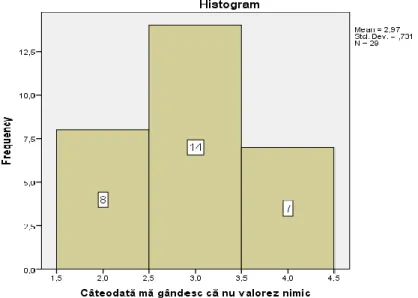
To the question "sometimes I think that I am not worth anything", the results show that a number of 14 people responded with disagreement, and the minimum number is 7 people who responded with total disagreement.
Fig. 4. The results of question 4 of the Rossenberg scale
On the 5th statement "I think I have a number of good qualities", 15 people agreed , and 14 people totally disagreed.
Technium Social Sciences Journal Vol. 41, 147-168, March, 2023 ISSN: 2668-7798 www.techniumscience.com
Fig.
Fig. 5. Results from the 5th statement.
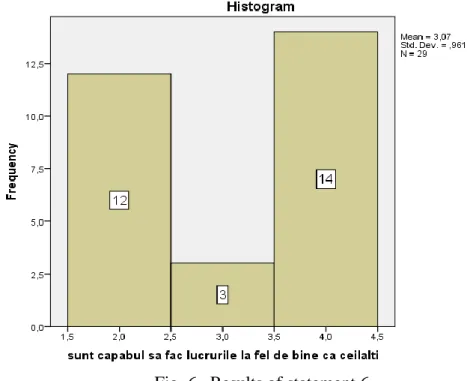
To the statement "I am able to do things as well as the others", the maximum number of respondents with the total disagreement answer is 14, and the minimum who responded with disagreement is 3 respondents.
Fig. 6. Results of statement 6
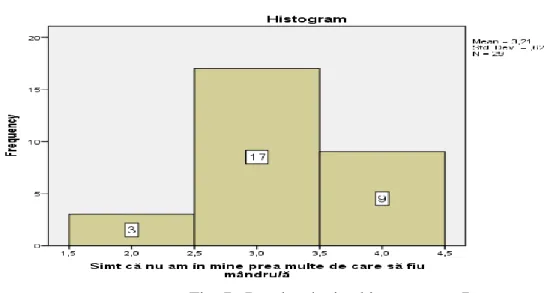
To the statement "I feel that I have too much in me to be proud of", a number of 17 respondents responded disagreed, and 3 respondents agreed, which shows that in general these people consider that they do not have values to be proud of.
Technium Social Sciences Journal Vol. 41, 147-168, March, 2023 ISSN: 2668-7798 www.techniumscience.com
Fig. 7. Results obtained in statement 7
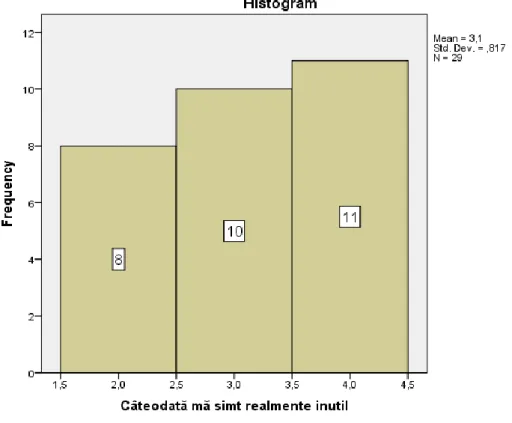
To the statement "sometimes I feel really useless", 11 people responded totally disagreed , and 8 people agreed.
Fig. 8. Results of statement 8
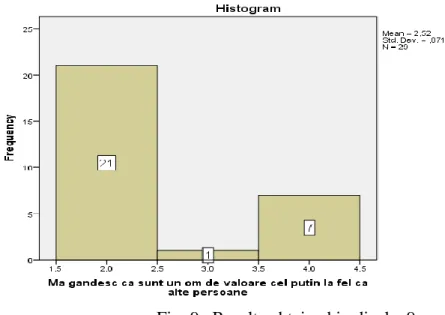
To the statement "I think I am a man of value at least the same as other people", most people have agreed, and the fewest with disagreement, which means that the respondents conside themselves equally with others.
Technium Social Sciences Journal Vol. 41, 147-168, March, 2023 ISSN: 2668-7798 www.techniumscience.com
Fig. 9. Results obtained in display9
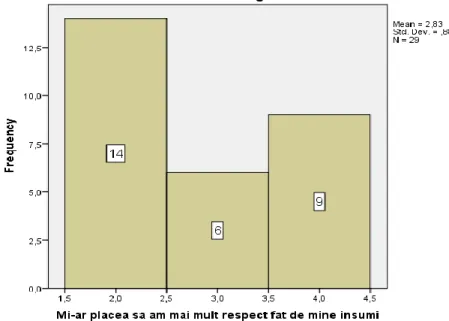
To the statement "I would like to have more respect for myself", the maximum number of people who agreed is 14, and the minimum number who responded with total disagreement was 6 people. That means that people generally and would like to respect each other more.
Fig. 10. The results obtained in statement 10
The results of the research on the basis of the questionnaire of unconditional acceptance of oneself.
To the statement "I feel valuable even if I fail to achieve certain goals that are important to me", most have usually responded true, and the few with more often false than true.
Technium Social Sciences Journal Vol. 41, 147-168, March, 2023 ISSN: 2668-7798 www.techniumscience.com
Fig. 11. Results obtained from the 1st statement of the USAQ test
In the next statement ,,the fact that I am praised makes me feel more valuable as a person", we notice that most of the answers have been allocated to the usually true variant, and the fewest answers allocated to the variants more often false than true and more often true than false.
Fig. 12. Results obtained in statement 2 of the USAQ test
Technium Social Sciences Journal Vol. 41, 147-168, March, 2023 ISSN: 2668-7798 www.techniumscience.com
Fig. 13. Results obtained in affirmation 3 of usaq test
Some people believe that others have more values than them and that they are always the ones on the bad side. This is evidenced by the result obtained from the statement "I feel that some people are more valuable than others", where most have usually responded true.
Fig. 14. Bar diagram
The statement , "sometimes I find myself thinking about whether I am a good or bad person", indicates that most of the time we end up asking ourselves such questions not being sure of how we are as humans.
Technium Social Sciences Journal Vol. 41, 147-168, March, 2023 ISSN: 2668-7798 www.techniumscience.com
Fig. 15. Bar diagram
"I set goals in the hope that they will make me happy or happier", here most of them usually responded with true, believing that only setting goals and fulfilling them can make them happier and ensure their well-being.
Fig 16. Bar diagram
Theslight resultyou say indicates thatthe respondents do not set their value according to the result of the comparison with others: "my valuar feeling depends, to a large extent, on the outcome of the comparison with other people", most of them usually responding falsely.
Technium Social Sciences Journal Vol. 41, 147-168, March, 2023 ISSN: 2668-7798 www.techniumscience.com
Fig. 17 Bar diagram
At the next statement, the number of respondents who have chosen the usually true variant indicates that they consider themselves valuable by the simple fact that they exist and that they are human beings. "I think I'm valuable by the simple fact that I'm a human being."
Fig. 18. Bar diagram
To the statement "when I receive a negative comment I find it hard to be open to what is said about me", the number of people who have usually responded falsely is 12, which means that respondents easily accept negative criticism and comments.
Technium Social Sciences Journal Vol. 41, 147-168, March, 2023 ISSN: 2668-7798 www.techniumscience.com
Fig. 19 Bar diagram
In the following statement: "I feel that I am a valuable person even when other people disapprove of me", we notice that the same number of people are in the version usually true and almost always true. Which means that people don't change their opinion about them even if others don't approve of them.
Fig. 20. Bar diagram
Conclusions
As a result of this study andresearch based on the create tools, we concluded that there are significant differences in gender for self-esteem and unconditional acceptance
It has been noted that women have a higher self-esteem compared to male people.
Acceptance comes from within, along with self-love, trust and respect. The participants of this study showed that they do not feel complex due to this health problem, it is worth noting that they have learned to accept themselves and move forward. They are aware of their flaws, Technium Social Sciences Journal
Vol. 41, 147-168, March, 2023 ISSN: 2668-7798 www.techniumscience.com
fears and needs. They don't necessarily need other people's approval, they don't need to be promised reassurances in terms of behavior, qualities, ablities and the way they look at life.
If in other situations in everyday life, other people would have been on the ground with the psyche and with emotional health, well the participants of the study done have a good development in terms of confidence and acceptance. They are trained to think positively and not to perceive the problems in their lives as tragic and with no way out of escape or even living with some of the problems. This is due to the environment they come from, the way they were raised, educated and taught to perceive life.
Beyond all this we are all equal. Even though some of us have different needs, different problems, different perceptions of life we humans are the same. We are born the same, only life we live it and perceive it differently.
This study indicates that we must love, respect and accept ourselves more exactly as we are. Then all these things come from others naturally.
Bibliography
[1] Anderson, S.C. & Lauderdale, M.L. (1982), "Charactristics of abusive parents: A look at self-esteem", Child Abuse & Neglect, 6(3): 285-293
[2] Andre, C.H. & Legeron, P. (2001), How do we free ourselves from fear of others?
Bucharest: Editura Trei.
[3] Andre, C.H. (2009), Imperfect, free and happy. Bucharest: Editura Trei.
[4] Andre C.H. & Lelord, F. (2003), How to Love Yourself to Get Along Better with Others.
Bucharest: Editura Trei.
[5] Dr. Glenn R. Schiraldi, (2017), The Handbook of Self-Esteem. Bucharest: Curtea Veche Publishing
[6] Enache R.G. & Giurgiu L.R. (2017), General Psychology with applications in the practice of social work. Bucharest: Editura Universitară.
[7] Hendrick, J. (2002), The Whole Child. Toronto: Maxwell Macmillan Canada.
Technium Social Sciences Journal Vol. 41, 147-168, March, 2023 ISSN: 2668-7798 www.techniumscience.com