89
Student Leadership and Improvement of Tertiary Institutions in Nigeria
Nimota Jibola Kadir Abdullahi University of Ilorin, Nigeria
Abstract: The main objective of this research was to determine how students’ leadership affected improvement of tertiary institutions. Total of 400 participants were selected purposefully from the sample universities in Kwara State. The findings of the study shown that students’ welfare services, information dissemination and sport development enhanced effective improvement of university education. Pearson product moment correlation coefficient and linear regression analysis were used to test the hypotheses. Therefore, it was recommended that tertiary institutions authorities should continue to improve students’ welfare services so as to motivate learners to learn, encourages freshers to get acquainted with school programs through orientation activities. Also, university authorities should encourage effective dissemination of information to make school life easy ad comfortable for students. Furthermore, school authority should continue to encourage development of sport activities in order to help helps student to manage emotions, develops students’ self-esteem and self-confidence as well as makes students to be disciplined so as to enhance effective school improvement.
Keywords: leadership; students’ welfare services; information dissemination; improvement.
INTRODUCTION
Since the late 1970s, Nigeria’s education sector has been beset by a series of problem including chronic under funding, rapid increase in student enrolment, deterioration of physical infrastructure, demoralization of staff and students, periodic staff strikes and student riot.
Several student rallies and unrest have occurred in Nigeria’s tertiary institutions over the years, with some resulting in violence that led to destruction of public property, large-scale injuries, rustication, loss of life due to lack of students participation in decision making, lack of student leadership, poor staff welfare services, as well as poor provision of basic amenities for students.
Thus, student need to create groups and form unions in order to detect their skills, qualities, resilience and value as well as to take on independent roles and express their passion in a well- organized setting.
Tertiary education follows after secondary education in such institutions as Universities, Colleges of education, and Polytechnics/Monotechnics. University in Nigeria are Indonesian Educational Administration and Leadership Journal
(IDEAL) Vol 04 Nomor 02 Hal 89-109
90 engaged in conventional roles such as teaching, research and community service in order to develop workforce and impact necessary knowledge needed in the country and other areas. It is a place where students obtained third stage education, which aim to provide students with new knowledge and abilities in order for learners to participate in nation-building (Osuji &
Fekarurhobo, 2020). This implies that, universities serve as a hub for personnel training and development for national growth.
Some studies have been conducted on student leadership/unionism and tertiary institutions development. Yan et al (2016) conducted another study on school governance and tokenism of student participation. Osuji and Fekarurhobo (2020) carried out social interaction and management of students’ union government in universities in River State. Stacey et al (2021) embarked on students’ union collaborative approach and success of instruction. Sinem and Barry (2021) investigated the effectiveness of student leadership program in Turkey.
Abdullahi (2017) treatise has a focus on student personnel services administration and sustainable education in Nigeria. Questionnaire titled “Student Personnel Service Administration and Sustainable Education” (SPASASE) was used for data collection. The finding revealed that there was a significant relationship between student guidance and counselling orientation programme and sustainable education. Mylah (2019) focused on evaluation of student affairs ad quality improvement in tertiary institutions. However, none of the author sited in this study focused on student leadership and improvement of tertiary institutions in Nigeria. Also, the previous studies did not focus on students’ welfare services, information dissemination and sport development as critical indices to measure students’
leadership. Another obvious gap that warranted this research is that the aforementioned extant studies location and region varied significantly from the study. Thus, the goal of this study is to fill in the gaps left by the previous researchers. To guide the study’s progress, the following objectives were established.
a) Examine the relationship between students’ welfare services and improvement of tertiary institutions in Nigeria.
b) Examine the relationship between dissemination of information and improvement of tertiary institutions in Nigeria.
c) Examine the relationship between sport development and improvement of tertiary institutions in Nigeria.
91 d) Examine the relationship among students’ welfare services, information dissemination,
sport development and improvement of tertiary institutions in Nigeria.
Research Questions
Some of the questions that were raised and answered are as follows.
1) Does students’ welfare services enhance improvement of tertiary institutions in Nigeria?
2) Does information dissemination brings about improvement of tertiary institutions in Nigeria?
3) Does sport development encourage improvement of tertiary institutions in Nigeria?
RELATED LITERATURE REVIEW Student Leadership
Leadership is an important human component in an organized system which is developed through training and exhibited through interaction with members of the group who voluntarily accept the responsibility to work for the attainment of common goals. Leadership is generally seen as the art of influencing people so that they will strive willingly towards the achievement of group goals. It is the process of persuading people so that they strive willing toward achievement of set goals ad solutions to a mutual problem (Uketui, 2010). Leadership is described as an interpersonal influence applied in a situation through effective communication and directed at activities so as to achieve organisational objectives (John, 2014). This implies that, leadership refers to a social influence process that entails setting a group’s goals and objectives. Lea
Student leadership is defined as the process of identifying, acquiring, allocating, coordinating and utilizing the human, social and material resources required to create the condition for possible innovation towards promoting students’ interest and achievement of better learning (Sinem & Barry, 2021; Eesuola, 2012). it is also a process of influencing other students to follow appropriate direction and coordination of an evolving collection of strategies aimed at improving teaching and learning (McGhie, 2012). Student leadership I this study
92 refers to process of improving students’ welfare services, information dissemination as well as sport development toward the betterment of tertiary institutions.
Students' welfare services involves monitoring the cost of commodities on campus, enhancing public transit near the school, increasing services in sick bays and clinics as well as showing solidarity in supports of members (Osuji & Fekerurhobo, 2020). Welfare services comprised everything student leaders do to address students’ personal, social and learning requirement that will enhance their overall well-being. Student leaders working with school authority to reduce accommodation fees and provide basic amenities such as piped water, electricity, functioning clinic, hostel facilities and other necessary amenities that will make life easier and comfortable for students on campus and encourage them to stay in school and complete their academic programs (Stacey et al, 2021).
Information is a data with a definite meaning and context. It is a process of obtaining, storing and distributing knowledge in other to establish fact and proof (Reynolds, 2010).
Dissemination on the other hand refers to the process of widely passing information and making it available to the public. Therefore, information dissemination entails passing on knowledge to individuals and groups in an organisation so as to achieve certain purposes (Marcellina, 2020). Information can be disseminated through different platforms or means such as electronic mails, short service message (SMS), and mode in phones and the likes.
Information dissemination in school is a process of making new and returning students aware of important information using notice boards, social media, banners and other means (Zuokemefa & Sese, 2015; Temitope et al, 2018). Students’ information dissemination is a method of raising awareness in order to increase knowledge, promote increase participation and generate action that leads to practice change (Rabin et al, 2008; King, 2003; Gravestock, 2002). It is a way of adopting and tailoring best practices to meet the demand of learners and achievement of schools.
Sport development refers to the process of organizing competition in sports across faculties, departments and programes in order to engage students and uncover skills in sports such as football, volley ball, hand ball, swimming and athletics (Milambo & Titus, 2021). Sport development activities were viewed as extra-curriculum activities carried out by students outside of the school’s regular curriculum. These exercises can help student improve their abilities, discipline, physical fitness, talent and creativity (Adeyemo, 2010). sports activities are instructional methods that uses body movement to educate and individual’s physique.
93 Everyone in the school should have ample opportunities to practice physical fitness and achieve a degree of sporting performance in accordance with his or her natural sporting tradition (Abdullahi et al 2021).
School improvement
School improvement is characterized as a gradual increase in efficiency through time with efficiency focusing on organisation capacity and the effects of that capacity’s deployment, particularly on student learning (Hallinger & Heck, 2010). school improvement in this context refers to quality teaching, student development as well as better programme and services.
University is expected to contribute maximally to the nation’s development. University education is the country’s highest degree of education, and university research is supposed to contribute to the country’s development goals. Depending on the field of study, the length of time spent in university might range from three (3) to six(6) years.
THEORETICAL CONTRIBUTION
The theoretical contribution of this study was based on transformation leadership theory postulated by Slocum and Hellriegel (2007) as cited by Marence et al (2017). they posit that transformation leadership theory is divided into four main components. The components is made up of an attitude that shows consideration of individual based, build intellectual stimulation, stimulate motivation and nature an ideas influence among his follower. This implies that leadership model involves adoption of exemplary behaviour of planning organisation future, inspiring followers to become better leader and embarrassment of new ideas and innovation towards improvement of organisation.
This theory can be applicable in education setting in that, student leadership guide the follow students by providing necessary information and exploring new ways of copping with any situation with a new methods so as to improve the welfare of its members. Also, focused specifically on each member, particularly in terms of the need to succeed in achieving the stated goals and objectives of schooling.
94 METODOLOGY
Research Design
The study used a quantitative research approach to investigate the correlation between student leadership and improvement of tertiary institutions. It was chosen because it facilitates in the discovery of social realities by utilizing a single source of data to categorize attributes and develop a quantitative, objective and statistically acceptable model to interpret the data collection (Dilliman et al, 2014; Bell et al, 2007).
Population and Sampling Technique
The population of this study comprised over 15,000 students of public universities in Kwara State, Nigeria. The data were acquired from 400 registered undergraduates students at two public universities in Kwara State (University of Ilorin & Kwara State University). the participating universities were identified and 200 participants were chosen from each university through purposeful sampling.
Instrumentation
Self-constructed questionnaire titled “Student Leadership Questionnaire (SLQ) and Adapted questionnaire titled “Improvement of Tertiary Institution Questionnaire were used as the research instrument in this study. A total of 28 items were used to measure student leadership with three sub-variable: students’ welfare service (5 items), information dissemination (12 items) and sport development (11 items). the items of questionnaire concerning improvement of questionnaire were concluded from Mylah (2019) on quality teaching with (5 items), Manga (2019) on conducive environment with (5 items) and Galvez (2018) on student development with (5 items). Participants responded to four Likert scale from the range of 1 representing “Strongly Disagreed” to 4 being “Strongly Agreed”. The criterion mean depicts that any item that is above or equal to the criterion mean value of 2.50 is agreed by the participants, but any item that is below the criterion mean value is disagreed (Patton, 2002; Gay et al, 2009) decided that answering on a 4-point Likert scale was quicker and easier than answering on 5- to 7-point range.
95 Validity and Reliability
The validity of the instrument was determined by sending draft copies to two test and measurement specialist and two experts in educational management who evaluated the instrument’s relevance and application. The questionnaire was revised and adjusted based on professional recommendation and observations. Also, copies of the questionnaire were sent to 40 students in the sample universities through WhatsApp account to check their understanding of the instructions, scale and phrasing to see whether they had any issues filling it out.
Cronbach’s Alpha was used to determine the instrument’s reliability as indicated in Table 1.
Table 1: Reliability Test of SLQ and ITIQ
Variable Sub-construct N Cronbach’s
Alpha
Decision Student Leadership students' welfare
services
5 0.902 All items are dependable and reliable
Information Dissemination
12 0.876 All items are dependable and reliable Sport Development 11 0.823 All items are dependable and reliable Improvement of
Tertiary Institutions
Quality Teaching 5 0.823 All items are dependable and reliable Conducive
Environment
5 0.901 All items are dependable and reliable Student Development 5 0.837 All items are dependable and reliable
Cronbach’s Alpha is a measure of internal consistency, and it will be used to see if the reliability of numerous or multiple questions on the Likert scale survey. As a rule of thumb, consider the following when evaluating alpha is α ≥ 0.9 (Excellent), 0.9 > α ≥ 0.8 (Good), 0.8 > α ≥ 0.7 (Acceptable), 0.7 > α ≥ 0.6 (Questionable), 0.6 > α ≥ (Poor), and 0.5 > α (Unacceptable). Table 1 reveals the reliability test for SLQ for effective improvement of tertiary institutions, these are students' welfare services, information dissemination, and sport development. Cronbach Alpha value of sub-construct are 0.902 for students' welfare services with (5 items), 0.876 for information dissemination with (12 items), and 0.823 for sport development with (11 items). Also, on improvement of tertiary institutions variables, the Cronbach’s alpha value for sub-construct are0.823 for quality teaching, 0.901 for conducive environment and 0.837 for student development. Value above 0.70 are concluded as dependable and reliable (Hesse-Biber & Leavy, 2011; Dianantopoulos et al, 2012).
96 Data Collection Technique
The survey was given out from March 5 to April 7, 2022 and 460 participants responded. In order to get a high response rare, students were emailed a link to online questionnaire via their WhatsApp account. The consent form was on the first page of the questionnaire. The questionnaire was set up in such a way that without filling the consent page, the participants couldn’t move on to the next page in order to carefully follow ethical consideration according to guideline of Stanley (2010). Also, 412 surveys were found and correctly filled. The obtained numbers correlates with 400 participants being used in this study.
Data Analysis
Descriptive statistics are a set of data that provides a general trend such as mean, median, variance, standard deviation, skewness, count of minimum and maximum, and are used to summarize a large pool of data into useful information for educational managers to make decision, whereas descriptive analysis is the process of transforming raw data into a form that is easy to understand and turn into useful insights. A good analysis that can tell a story will be based on good data. Good and quality data is defined as data that is accurate, complete, relevant and consistent, especially when it is legitimate and available on a timely basis. The data was analyzed using the mean and standard deviation to determine the study’s goal. At the (0.5) significant level, inferential statistics such as Pearson product moment correlation and linear multiple regression analysis were utilized to evaluate the hypotheses and determine whether they were rejected or accepted (Dillman et al, 2014; Mayer, 2013).
FINDINGS
Demographic data of the participants
This part utilizes simple percentage to discuss the demographic information of the participants.
Table 2: Demographic Data of the Participants
N= 400 PERCENTAGE (%)
SEX Male
Female
189 211
47%
53%
400 100%
AGE 16 - 20
21 - 25
233 119
58%
30%
97
25 Above 48 12%
400 100%
LEVEL 100L
200L 300L 400L Above
56 115 113 116
14%
29%
28%
29%
400 100%
Table 2 reveals the demographics data of the participants in the study. Majority of the population is female 211 which make up of (53%) while male 189 (47%). Majority of the participants is between the age of 16-20 years 233(58%) while 48(12%) are between age 25 year and above. In term of level, majority 116 and 115 (29%) are in 300L and 400L and above while 56 (14%) are in 100L.
Students' welfare services
RQ1: Does students' welfare services enhance improvement of tertiary institutions in Nigeria?
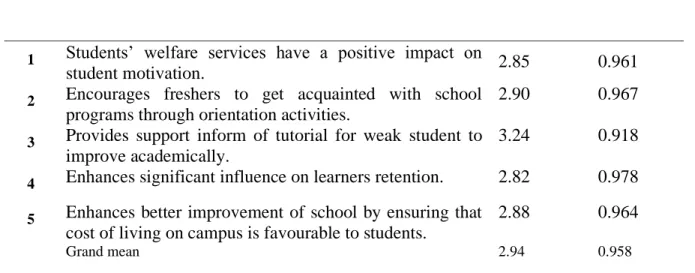
The mean and standard deviation responses of students on students’ welfare services are shown in table 3
Table 3: Mean and Standard Deviation of Items on Students’ welfare services
S/N Students' Welfare Services Mean Standard Deviation
1 Students’ welfare services have a positive impact on
student motivation. 2.85 0.961
2 Encourages freshers to get acquainted with school programs through orientation activities.
2.90 0.967
3 Provides support inform of tutorial for weak student to improve academically.
3.24 0.918
4 Enhances significant influence on learners retention. 2.82 0.978
5 Enhances better improvement of school by ensuring that cost of living on campus is favourable to students.
2.88 0.964
Grand mean 2.94 0.958
98 Table 3 shows that the participants overall perception on students’ welfare services is
‘Agreed” (M = 2.94, SD = 0.958). this shows that participants agreed that students’ welfare services enhances improvement of tertiary institutions in Nigeria. In addition, all of the responses had mean values more than 2.50, which was the criterion value. This indicates that participants agreed that students' welfare services i) have a positive impact on student motivation (M = 2.85, SD = 0.961), ii) encourages freshers to get acquainted with school programs through orientation activities (M = 2.90, SD = 0.967), iii) provides support inform of tutorial for weak student to improve academically (M = 3.24, SD = 0.918), iv) enhances significant influence on learners retention (M = 2.82, SD = 0.978), v) enhances better improvement of school by ensuring that cost of living on campus is fovourable to students (M
= 2.88, SD = 0.964).
Information dissemination
RQ 2: Does information dissemination bring about improvement of tertiary institutions in Nigeria?
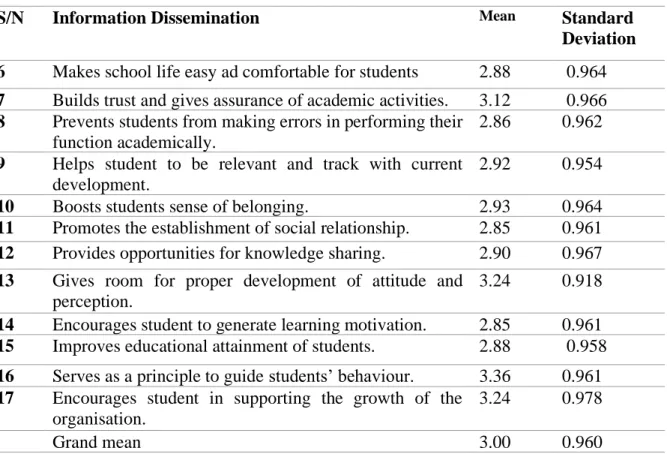
Table 4 presents participants responses on information dissemination
Table 4. Mean and Standard Deviation of Items on Information Dissemination
S/N Information Dissemination Mean Standard
Deviation 6 Makes school life easy ad comfortable for students 2.88 0.964 7 Builds trust and gives assurance of academic activities. 3.12 0.966 8 Prevents students from making errors in performing their
function academically.
2.86 0.962 9 Helps student to be relevant and track with current
development.
2.92 0.954 10 Boosts students sense of belonging. 2.93 0.964 11 Promotes the establishment of social relationship. 2.85 0.961 12 Provides opportunities for knowledge sharing. 2.90 0.967 13 Gives room for proper development of attitude and
perception.
3.24 0.918 14 Encourages student to generate learning motivation. 2.85 0.961 15 Improves educational attainment of students. 2.88 0.958 16 Serves as a principle to guide students’ behaviour. 3.36 0.961 17 Encourages student in supporting the growth of the
organisation.
3.24 0.978
Grand mean 3.00 0.960
99 Table 4 reveals that the participants’ overall perception on information dissemination is ‘Agreed” (M = 3.00, SD = 0.960). this shows that participants agreed that information dissemination brings about improvement of tertiary institutions in Nigeria. In addition, all of the responses had mean values greater than 2.50, which was the criterion value. This reveals that participants agreed that information dissemination i) makes school life easy ad comfortable for students (M = 2.88, SD = 0.964), ii) builds trust and gives assurance of academic activities (M = 3.12, SD = 0.966), iii) prevents students from making errors in performing their function academically (M = 2.86, SD = 0.962), iv) helps student to be relevant and track with current development (M = 2.92, SD = 0.954), v) boosts students sense of belonging (M = 2.93, SD = 0.964), vi) promotes the establishment of social relationship (M = 2.85, SD = 0.961), vii) provides opportunities for knowledge sharing (M = 2.90, SD = 0.967), viii) gives room for proper development of attitude and perception (M = 3.24, SD = 0.918), ix) encourages student to generate learning motivation (M = 2.85, SD = 0.961) x) improves educational attainment of students (M = 2.88, SD = 0.958), xi) serves as a principle to guide students’ behaviour (M = 3.36, SD = 0.961), xii) encourages student in supporting the growth of the organisation (M = 3.24, SD = 0.978).
Sport Development
RQ 3: Does sport development encourage improvement of tertiary institutions in Nigeria?
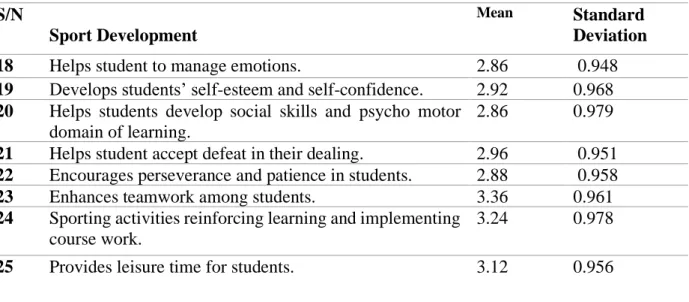
Table 5. Shows the participants responses on sport development
Table 5. Mean and Standard Deviation of Items on Sport Development S/N
Sport Development
Mean Standard Deviation 18 Helps student to manage emotions. 2.86 0.948 19 Develops students’ self-esteem and self-confidence. 2.92 0.968 20 Helps students develop social skills and psycho motor
domain of learning.
2.86 0.979 21 Helps student accept defeat in their dealing. 2.96 0.951 22 Encourages perseverance and patience in students. 2.88 0.958
23 Enhances teamwork among students. 3.36 0.961
24 Sporting activities reinforcing learning and implementing course work.
3.24 0.978
25 Provides leisure time for students. 3.12 0.956
100 26 Provides sense of unity and cooperation which promote
students’ academic performance.
2.84 0.966
27 Creates physical fitness or health at large. 2.90 0.967
28 Makes students to be disciplined. 3.24 0.918
Grand Mean 3.02 0.959
Table 5 shows the that participants’ overall perception on sport development is
‘Agreed” (M = 3.02, SD = 0.959). This displays that participants agreed that sport development encourages improvement of tertiary institutions in Nigeria. In addition, all of the responses had mean values higher than 2.50, which was the criterion value. This shows that participants agreed that sport development i) helps student to manage emotions (M = 2.86, SD = 0.948), ii) develops students’ self-esteem and self-confidence (M = 2.92, SD = 0.968), iii) helps students develop social skills and psycho motor domain of learning (M = 2.86, SD = 0.979), iv) helps student accept defeat in their dealing (M = 2.96, SD = 0.951), v) encourages perseverance and patience in students (M = 2.88, SD = 0.958), vi) enhances teamwork among students (M = 3.36, SD = 0.961) vii) reinforcing learning and implementing course work (M = 3.24, SD = 0.978), viii) provides leisure time for students (M = 3.12, SD = 0.956), ix) provides sense of unity and cooperation which promote students academic performance (M = 2.84, SD = 0.966), x) Creates physical fitness or health at large (M = 2.90, SD = 0.967) xi) makes students to disciplined (M = 3.24, SD = 0.918).
Research Hypotheses
The following hypotheses were developed and tested:
1) There is no significant relationship between students' welfare services and improvement of tertiary institutions in Nigeria.
2) There is no significant relationship information dissemination and improvement of tertiary institutions in Nigeria.
3) There is no significant relationship between sport development and improvement of tertiary institutions in Nigeria.
101 Pearson Correlation
Pearson’s R can range from -1 to +1 according to Choy (2014) where positive Pearson correlation means that one variable rises at the the same time as the other, whereas negative Pearson correlation suggests that one variable increases while the other drops.
H01: There is no significant relationship between students' welfare services and improvement of tertiary institutions in Nigeria.
Table 6. Pearson Correlation of students' Welfare Services and Improvement of Tertiary Institutions
students' Welfare Services
Improvement of Tertiary Institutions
Students’ Welfare Services Pearson correlation
1 .702**
Sig. (2-tailed) .000
N 400 400
Improvement of Tertiary Institutions
Pearson Correlation
.702** 1
Sig. (2-tailed) .000
N 400 400
The Pearson correlation (Table 6) displays a high positive correlation between students' welfare services and improvement of tertiary institutions (r = 0.702, n = 400, p = .000). The Extremely significant p < 0.01 correlation show a high level of relationship and supported, which implies high level of confidence in the link (Creswell and Creswell, 2017; Mugenda &
Mugenda, 2013).
H02: There is no significant relationship between information dissemination and improvement of tertiary institutions in Nigeria.
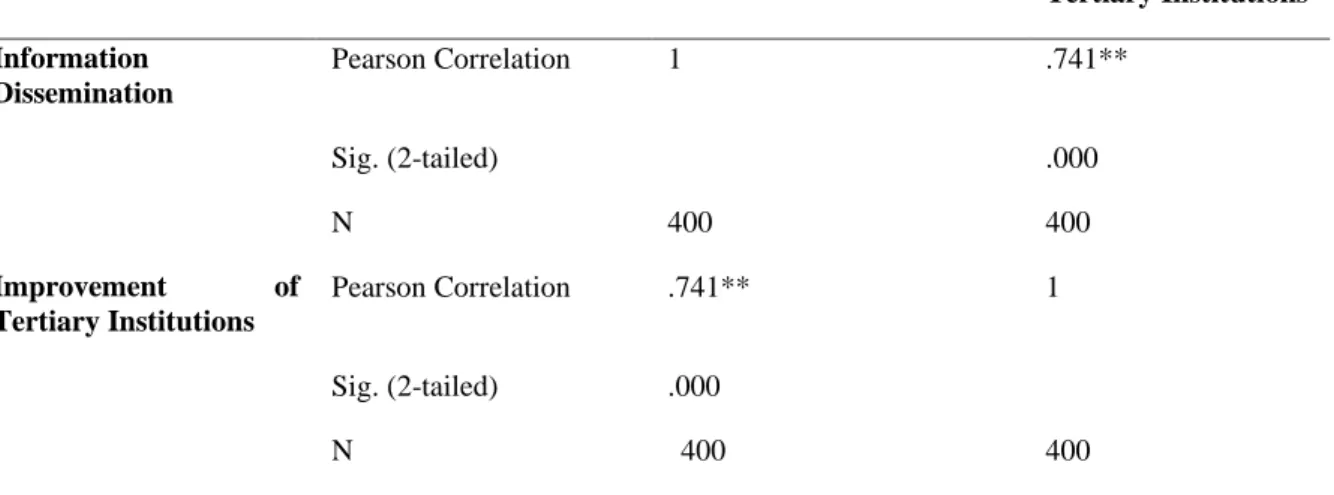
102 Table 7. Pearson Correlation of Information Dissemination and Improvement of Tertiary
Institutions
Information Dissemination Improvement of Tertiary Institutions Information
Dissemination
Pearson Correlation 1 .741**
Sig. (2-tailed) .000
N 400 400
Improvement of Tertiary Institutions
Pearson Correlation .741** 1
Sig. (2-tailed) .000
N 400 400
The Pearson correlation (Table 7) indicates a high positive correlation between information dissemination and improvement of tertiary institutions (r = 0.741, n =400, p = .000). The Extremely significant p < 0.01 correlation shows a high level of relationship and supported, which implies high level of confidence in the association (Creswell, 2015; Neuman, 2013).
H03: there is no significant relationship between sport development and improvement of tertiary institutions in Nigeria.
Table 8. Pearson Correlation of Sport Development and Improvement of Tertiary Institutions
Sport Development Improvement of Tertiary Institutions
Sport Development Pearson Correlation 1 .795**
Sig. (2-tailed. .000
N 400 400
Improvement of Tertiary Institutions
Pearson Correlation .795** 1
Sig. (2-tailed) .000
N 400 400
103 The Pearson correlation (Table 8) reveals a strong positive correlation between sport development and improvement of tertiary institutions (r = 0.795, n =400, p = .000). The Extremely significant p < 0.01 correlation indicate a high level of relationship and supported, which implies high level of confidence in the link (Yilmaz., 2013; Miller et al, 2013).
Linear Regression Analysis
Objective 4: Examine the relationship among students’ welfare services, information dissemination, sport development and improvement of tertiary institutions in Nigeria This section shows the linear regression analysis on student leadership and improvement of tertiary institutions in Nigeria.
Table 9. Linear Regression of Student Leadership and Improvement of Tertiary Institutions
Model R R Square Adjusted R Square Std. Error of the Estimate
1 .0118 .706 .604 .546
a. Predictors: (constants), students' welfare services, information dissemination and sport development
Table 9 reveals that student leadership has significant impact on improvement of tertiary institutions with 0.706 of R square value.
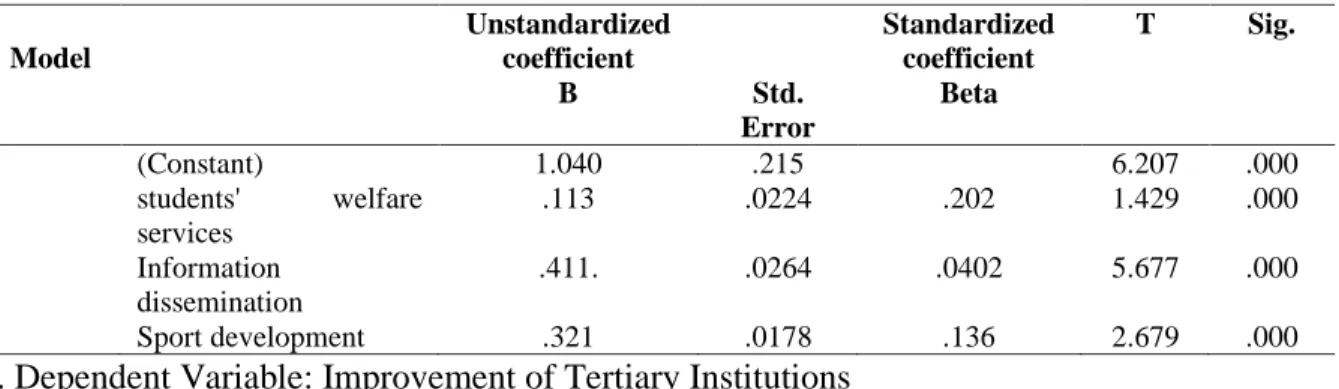
Table 10. Linear Regression Coefficient for Student Leadership and Improvement of Tertiary Institutions
Model
Unstandardized coefficient
Standardized coefficient
T Sig.
B Std.
Error
Beta
(Constant) 1.040 .215 6.207 .000
students' welfare services
.113 .0224 .202 1.429 .000
Information dissemination
.411. .0264 .0402 5.677 .000
Sport development .321 .0178 .136 2.679 .000
a. Dependent Variable: Improvement of Tertiary Institutions
Linear regression was carried out to determine whether students' welfare services, information dissemination and sport development mastery goal, effective classroom instruction and evaluation could significantly predict effective improvement of tertiary institutions. The results of running linear regression model as shown in Table 10 explained that the standard
104 regression weight of the beta coefficients value for student leadership was 1.040 which reveals that student leadership enhances improvement of tertiary institutions. Also, revealed that student leadership and improvement of tertiary institutions undeniable correlated. T-test of 6.207 was sufficiently high with corresponding p-value of .000. Thus, in addition, information dissemination has the highest effect (Beta = 0.411) follow by sport development (Beta = 0.321) and students’ welfare services (Beta = 0.113). In summary, the findings from this multiple linear regression research affirm that students' welfare services, information dissemination and sport development are positively related to improvement of tertiary institutions in Nigeria.
DISCUSSION
The findings in Table 3 shows that students’ welfare services enhance improvement of tertiary institutions in Nigeria. Such that it have a positive impact on student motivation, encourages freshers to get acquainted with school programs through orientation activities, provides support inform of tutorial for weak student to improve academically, enhances significant influence on learners retention as well as enhances better improvement of school by ensuring that cost of living on campus is favourable to students. Hypothesis one results reveals that there is positive and close relationship between students’ welfare services and improvement of tertiary institutions in Nigeria. The finding concurred with Kilik (2001) that students; welfare services aid in attracting and keeping top achievers as well as enhancing the universities reputation and position. This finding support the Wiers-Jenssen et al (2002) that proper provision of welfare services has been identified as a critical factor of school improvement. In addition, this finding support the Hallinger and Heck (2010); Galvez (2018);
Osuji and Fekarurhoo (2020) that mastery goal help to reduce or prevent anxiety student experience in classroom.
The findings in Table 4 reveals that information dissemination brings about effective improvement of tertiary institutions in Nigeria. As a result, it makes school life easy ad comfortable for students, builds trust and gives assurance of academic activities, prevents students from making errors in performing their function academically, helps student to be relevant and track with current development, boosts students sense of belonging, promotes the establishment of social relationship, provides opportunities for knowledge sharing, gives room for proper development of attitude and perception, encourages student to generate learning motivation, improves educational attainment of students, serves as a principle to guide
105 students’ behaviour as well as encourages student in supporting the growth of the organisation.
Results from hypothesis two shows that there is a significant link between information dissemination and improvement of tertiary institutions in Nigeria. The finding is in line with Marcellina (2020) that information dissemination helps to attain effective management of school. The findings also agreed with Mylah (2019) that information dissemination is extremely important because it improves the entire learning process as well as students’
experiences. This finding is germane to Hagg and Cumming (2014) that effective information dissemination improves the process of education and sustain qualities.
Table 5 shows that sport development enhance effective improvement of tertiary institutions in Nigeria. Such that, it helps student to manage emotions, develops students’ self- esteem and self-confidence, helps students develop social skills and psycho motor domain of learning, helps student accept defeat in their dealing, encourages perseverance and patience in students, enhances teamwork among students, reinforcing learning and implementing course work, provides leisure time for students, provides sense of unity and cooperation which promote students’ academic performance, Creates physical fitness or health at large, as well as makes students to disciplined. Results from hypothesis three reveals that there is positive correlation between sport development and improvement of tertiary institutions in Nigeria. The finding agreed with Acar and Gunduz (2017); Invaniushina and Zapletina (2015) that participating in sport activities provide positive impact in building self-confidence in students as well as interpersonal relationship skills. This finding concurred with Milambo and Titus (2021) that sport development brings positive result on students’ academic performance which in turn lead to school improvement. The finding also in line with Pacho (2015) that sport activities enhancing creative thinking, productivity and well-being of students as well as community development. The finding concurred with Abdullahi et al (2021) and Mandelbaum (2005) that sport activities enhances democracy, equality and shaping students discipline in school.
The results of regression analysis shows that there is close and strong relationship between student leadership and improvement of tertiary institutions in Nigeria. The finding agreed with Eesuola (2012) that student leadership play a significant role and serve as a communication link between students and the authorities of the universities. Also, the finding is in line with Sinen and Barry (2021); Zuokemefa and Sese (2015) that student leadership help learners build their organisational skills, character strength and preparing them for future position of greater responsibility.
106 LIMITATION AND IMPLICATION OF THE STUDY
The importance of students’ leadership in the effectiveness of tertiary institutions is highlighted in this study, but it also identified a few research limitations that should be addressed in future studies. In addition to the factors used in this study, another indices might be utilized in a similar study. This findings will assist the school authorities in encouraging student leadership for effective improvement of tertiary institutions. The findings of this study could also be used as a reference point for future research in the field of education.
CONCLUSION
The current study has conceptualized the relationship between independents variable such as students’ welfare services, dissemination of information and sport development. Based on the findings, all of which promising indices for boosting effective improvement of tertiary institutions. During the analysis of the finding, all of the research objectives and hypotheses were supported.
RECOMMENDATIONS
Tertiary institutions authorities should continue to improve students’ welfare services so as to motivate learners to learn, encourages freshers to get acquainted with school programs through orientation activities, provides support inform of tutorial for weak student to improve academically, enhances significant influence on learners retention as well as enhances better improvement of school by ensuring that cost of living on campus is favourable to students.
Also, University authorities should encourage effective dissemination of information to make school life easy ad comfortable for students, build trust and gives assurance of academic activities, prevents students from making errors in performing their function academically, help student to be relevant and track with current development, boost students sense of belonging, promotes the establishment of social relationship, provides opportunities for knowledge sharing, give room for proper development of attitude and perception, encourage student to generate learning motivation, improves educational attainment of students, serve as a principle to guide students’ behaviour as well as encourage student in supporting the growth of the organisation. In addition, school authority should continue to encourage development of sport activities in order to help student to manage emotions, develops students’ self-esteem and self- confidence, helps students develop social skills and psycho motor domain of learning, helps student accept defeat in their dealing, encourages perseverance and patience in students,
107 enhances teamwork among students, reinforcing learning and implementing course work, provides leisure time for students, provides sense of unity and cooperation which promote students academic performance, Creates physical fitness or health at large, as well as makes students to be disciplined so as to enhance effective school improvement.
REFERENCES
Abdullahi, N. J. K. (2021). Student personnel services administration and sustainable education in Nigeria. Pakistan Journal of Education Research and Evaluation. 2(2), 23- 36. http://[email protected]
Abdullahi, N. J. K., Isiaka, B. A., Atolagbe, A. A., & Etejere, P. A. O. (2021). National consciousness and management of secondary education for sustainable development in Kwara State, Nigeria. International Journal of Innovation in Teaching and Learning, 7(2), 1-8.
Acar, Z., & Gunduz, N. (2017). participating motivation for extra curriculum activities:
Students on primary school student. Universal Journal of Educational Research, 5(5), 901-910.
Adeyemo, S. A. (2010). The relationship between student participation in school-based extra curricular activities and their achievement in physics. International Journal of Science and Technology Education Research, 1(6), 111-117.
Bell, E., Bryman, A., & Harley, B. (2007). Business research methods (5th ed.) New York:
Oxford University Press.
Choy, L. T. (2014). The strengths and weaknesses of research methodology: Comparison and complimentary between qualitative and quantitative approaches. Journal of Humanities and Social Sciences, 19(4), 99-104.
Creswell, J. W. (2015). A concise introduction to mixed methods research. Thousand Oaks, California: SAGE.
Creswell, J. W., & Creswell, J. D. (2017). Research design: Qualitative, quantitative and mixed methods approach, USA: Sage Publication
Diamantopoulos, A., Marko. S., Chrisoph, F., Petra, W. & Sebastian, K. (2012). Guideline for choosing between multi-item and single-item scales for construct measurement:
A predictive validity perspective. Journal of the Academy of Marketing Science, 40(3), 434- 449.
Dillman, D. A., Jolene, D., & Leah, M. C. (2014). Internet, phone, mail and mixed mode surveys: The Tailored design method (4th ed.). Hoboken, NJ: John Wiley.
Eesuola, O. (2012). Declining political activitism among Nigerian university students, Uilag Journal of Politics, 6, 47-64.
Galvez, R. (2018). student affairs and services of Lacosolucion University Philippies: An evaluation. International Journal of Education and Research, 6(2), 75-84.
Gay, L. R., Mills, G. E., & Airasian, P. (2009). Educational research: Competencies for analysis Gravestock, P. (2002). Making an impact through dissemination in managing educational
development projects. Effective management for maximum impact. London:
Routledge.
Hagg, S., & Cummings, M. (2014). Management information systems. Mcgraw Hill International Publishers.
Hallinger, P., & Heck, R. H. (2010). Collaborative leadership and school improvement:
Understanding the impact on school capacity and student learning. School
108
Leadership and Management, 30(2), 95-110.
http://dx.doi.org/10.1080/13632431003663214
Hesse-Biber, S. & Leavy, P. (2011). The practice of qualitative research. Thousand Oak, CA:
Invaniushina, V. A., & Zapletina, O. (2015). Participating in extra curricular activities and development of personal and interpersonal skills in Adolescents. Journal of Siberia, 10(8), 2408-2420.
John, I. N. (2014). Management in education. Modern Approach in Education Management.
Giraffe Book: Ibadan, Oyo State.
King, H. (2003). Dissemination educational development. A Guide to Staff and Educational Development. London: Kogan.
Kulik, J. A. (2001). Student rating: Validity, utility and controversy. New Direction for Institutional Research, 27(1), 9-25.
Mandelbaum, M. (2005). The meaning of sports, retrieved on 20 February, 2022.
http://www.amazon.com
Manga, S. D., (2019). Safety and security considerations in school plant construction in West Africa: Implications for research and development. The Online Journal of New Horizons in Education, 9(3), 196-200.
Marcellina, O. E. (2020). Effective information for sustainable quality service delivery.
International Journal of Institutional Leadership, Policy and Management, 2(1), 78-91.
Marence, L. T., Mahaliza, M., & Zahari, H. (2017). A review theory of transformational leadership for school. International Journal of Academic Research in Business and Social Sciences, 7(3), 792-799.
Mayer, A. (2013). Introduction to statistics and SPSS in psychology (1st ed.) England: Pearson Education Limited.
McGhie, V. F. (2012). Factor impacting on first-fear student academic progress at a South African University: Stellenbosch University.
Milambo, M., & Titus, O. P. (2021). Influence of sports and games in enhancing students academic performance in public secondary schools in Nyam agana district.
Journal of Humanities and Education Development, 3(1), 54-72.
Miller, V. D., Poole, M. S, Seibold, D. R., Myers, K. K., Hee Sun, P., & Monge, P. (2013).
Advancing research in organizational communication through quantitative methodology. Management Communication Quarterly, 25(1), 4-58.
Mugenda, A., & Mugenda, O. (2013). Research methods: Qualitative and quantitative approaches. Nairobi: ACTS Press.
Mylah, S. (2019). Evaluation of student affair and programs: A tool for quality improvement.
International Journal of Education and Research, 7(10), 97-112.
Neuman, W. L. (2013). Social research methods: Qualitative and quantitative approaches.
USA: Pearson Education.
Osuji, C. U. & Fekarurhobo, B. E. (2020). Management of students’ union government (SUG) in universities for social interaction of students in Rivers State.
International Journal of Innovative Social and Science Education Research, 8(3). 11-23.
Pacho, T. O. (2015). Experiences using case study. International Journal of Humanities and Social Science, 5(4), 44-53.
Patton, M. Q. (2002). Qualitative research and evaluation methods. 3rd Sage Publications:
Thousand Oaks, CA.
Rabin, B. A., Brownson, R. C., Haire-Joshua, D., Kreuter, M.W., & Weaver, N. (2008). A glossary for dissemination and implementation research in health. Journal of Public Health Management and Practices, 1-17
109 Reynolds, G. W. (2010). Information technology for managers, Engage Learning Academic
Research Centre.
Sinen, K., & Barry, Z. P. (2021). The effectiveness of a student leadership program in Turkey.
Journal of Leadership Education, 79-102.
Slocum, J. W. & Hellriegel, D. (2007). Fundamental of Organisational Behaviour. Belmont:
Thomson the multi-factor leadership questionnaire. Redwood City, CA: Mind Garden.
Stacey, S., Amber, W. O., & Eoghan, C. (2021). Partinering for success: A students union academic collaborative approach to supplemental instruction. Irish Education Studies, 40(4), 669-688.
Stanley, L., & Wise, S. (2010). The ESRC’s 2010 Framework for Research Ethics: fit for research purpose? Sociological Research Online, 15(4), 12-13.
Temitope, A. S., Ahmad, R., & Olanrewaju, A. (2018). Examining the information dissemination process on social media during the Malaysia 2014 floods using social network analysis. Journal of Information Communication and Technology, 17(1), 141-166.
Uketui, F. A. (2010). Principalship. In I.L. anukam, P.O.O. Okunamiri & R.N.O. Ogbonna.
(Eds.) Basic text on educational management. Imo State, EeHech Versatile Publishers.
Wiers-Jenssen, J., Stansaker, B., & Grogaad, J. B. (2002). Student satisfaction: Towards an empirical deconstruction of the concept. Quality in Higher Education, 8(1), 183-195.
Yan, W. L., Timothy, Y., Eric, C. K., & Chinlan, G. (2016). Is student union a tokenism of student participation in school governance? Citizenship Teaching and Learning, 157-174.
Yilmaz, K. (2013). Comparison of quantitative and qualitative research traditions:
Epistemological, theoretical, and methodological differences. European Journal of Education, 48(2), 311-325.
Zuokemefa, E. P. & Sese, T. E. (2015). student leadership and organisation skills character strength. European Scientific Journal, 11(25), 382-392.