Consequently, villagers did not have sufficient information to participate in the village decision-making process and to criticize the BLT DD assistance and the process of distributing aid related to COVID-19. In addition, the village budget must be submitted, reviewed, discussed and approved by the BPD before it is submitted to the higher authority. Consequently, the role and function of the BPD is often neglected by the village headman.
The accountability relationship between the actor (village government officials) and forum (village residents) will be examined in terms of the amount of information released, the number of discussions held and the consequences given by the villagers to the village government officials. . Studies related to the village fund program in Indonesia mainly focus on aspects of accountability as well as factors influencing accountability. Studies on accountability of Indonesian village funds have mostly held that accountability has been adequately carried out if there is any information published by the village government.
Meanwhile, Rakhman (2019) suggested that the full realization of the village fund budget is the indicator of village fund accountability. What is the accountability mechanism and level of responsibility of the village in terms of availability, information required, discussions held and consequences given by the villagers. What is the role of women BPD members in increasing the accountability of the village fund and other government support.
To examine the role of BPD and its women members in enhancing the accountability of the village foundation.
Methods
With a population of over 6 million in 2020, Bogor Regency is estimated to be the most densely populated in Indonesia. Bogor Regency is also the area with the highest initial local government revenue in West Java province with a value reaching 6.4 trillion rupiah in 2019 (Detik.com, 2019). According to Bogor Regency Bureau of Statistics (2017), there were 395 million poor people (or 6.66%) in Bogor Regency.
It is estimated that in 2020, due to the COVID-19 pandemic, the number of poor people in Bogor District will be the highest in Indonesia and is expected to reach 6 million people (Republika.co.id, 2020). This figure means that the average expenditure of the poor is even further than the poverty line. In 2017, this village had a population of 54,808 with an almost balanced proportion (Bogor Regency Bureau of Statistics, 2018a).
This village is categorized as Independent Village according to the 2020 Village Development Index (Ministry of Rural Development of Disadvantaged Regions and Transmigration of Indonesia, 2020). Therefore, this village was given the status of an independent village, which means that this village would be able to meet its own needs with very minimal assistance from the Government. As of 2020, Tegal Village is considered a Developing Village according to the Village Development Index (Ministry of Rural Development of Disadvantaged Regions and Transmigration of Indonesia, 2020).
However, this village rarely updated its social media and no relevant information was found about the state of the village. Almost 96% of villagers had agriculture as a source of income (Bogor Regency Statistical Bureau, 2018b). This village does not have a dedicated website and social media to provide detailed information about the village.
From a video on Bogor Regency's Youtube channel, the Village Head said that Bojong Village has the potential to develop their vegetable agriculture sector and their MSME enterprises (Bogor Tegar Beriman TV, 2016a). This village also has the least productive harvest out of every village in Cirebon Regency. No further information has been obtained about this village due to the lack of publicly available information.
Results and Discussion Research findings
The RW leaders then submitted the list of proposed beneficiaries to the village apparatus for final approval by the village head and the head of the BPD. After checking the list of potential recipients of BLT DD assistance, the list was approved by the village head and the head of the BPD. However, the BPD has always been satisfied with a mere verbal explanation from the village government without the need to issue an objection notice.
The objection contains only a request for an explanation of the implementation carried out by the village head. The least amount of discussion occurred when the BPD and the village government were not in a good position. The village government did not ask the BPD chief to approve the village fund budget submitted to the district office.
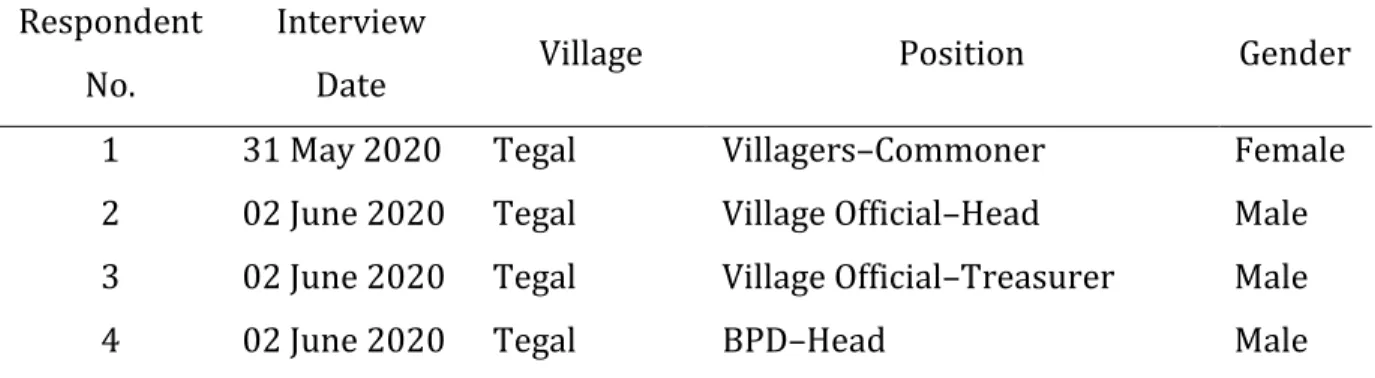
Instead, the village government unilaterally stated that the proposed budget of the village fund was approved by the head of the BPD (respondent. The involvement of the women members of the BPD in providing consequences for violations that could be carried out by the village government was not apparent. The village officials turned over the aid to the recipient's residence accompanied by RT, RW and BPD leaders as explained by respondent #2 (2020).
The lack of information from the Village Government on the management of village funds is not only experienced by ordinary villagers. The village government does not submit an accountability report for the implementation of village funds to the Chairman of the BPD for approval, but instead. This turned out to be caused by a disharmonious relationship between the village headman and the BPD chairman.
The BPD chief reported the incident to the district office, but there was no follow-up from the district office to the village government. This is because female members of the BPD are not directly involved in overseeing the activities of the village government. The consequence is given to the village officials by the BPD and the villagers because their performance (satisfactory or less satisfactory) in managing the village fund was close.
The village council felt that they were not obliged to provide information to the village community. First, female members of the BPD are only involved in female roles and activities and are not involved in the supervisory role of the village government.
Conclusion
First, not only that the study strengthened the discussion about the accountability of the public institutions (ie less accountable institutions), this study has contributed by providing a systematic and solid measurement of the accountability of the public institutions. Women were not part of the governance process, but rather were considered a non-essential "complementary" part of village governance. The authors would also like to thank Dinas Kesbangpol Bogor Regency for issuing permits to conduct the field study of this research.
Last but not least, we would also like to thank all the respondents from the village officials, BPD and villagers in Tegal Village, Bojong Village and Bojonggede Village, Bogor Regency, and in Pasindangan Village, Cirebon Regency, who have been very supportive and actively participated in solving our research questions and provide valuable input to this study. All authors are investigating the outbreak of COVID-19 and monitored the results of this work, which also includes Village Fund Direct Cash Assistance (BLT DD) distribution. Six of one and a half dozen of the others: The gender subtext of Taylorism and team-based work.
The development of principal-agent, contracting and accountability relationships in the public sector: Conceptual and cultural issues. A reflective journey into research into the rarity of women in the highest ranks of accountancy. Local government decision making – citizen participation and local responsibility: some evidence from Kenya and Uganda.
Women are weak when they are among men': women's participation in rural water committees in South Africa. Gender congruence between managers and employees and the bureaucratic responsibility of public sector employees: Evidence from schools. Developing an accountability model for local government organizations: from administrative responsibility to public accountability (naturalistic study on local government Tana Toraja).