Gross Human Rights Violations Research Trend: A Bibliometric Analysis and Future of Research Agenda
(Tren Riset Pelanggaran HAM Berat: Analisis Bibliometrik dan Agenda Riset Masa Depan)
Iwan Santoso, Murtir Jeddawi, Yana Sahyana, Romli Arsyad, Alma’arifProgram Pasca Sarjana Institut Pemerintahan Dalam Negeri, Jakarta
ABSTRACT: This study aims to analyze research trends related to human rights, identify countries, organizations, and authors who contribute significantly to the aforementioned research. Furthermore, this paper identifies related articles that strongly influence these scientific publications. VosViewer collects data from Scopus Database Journal and analyzes it using bibliometric analysis. As a result of the study, the United States has the highest number of publications. Furthermore, the Department of Epidemiology at the Johns Hopkins Bloomberg School of Public Health in Baltimore, Maryland, is the organization that has focused the most attention and influence on the issue of resolving gross human rights violations. Aside from that, Professor C. Beyrer of the United States is the most prolific and influential researcher on the topic of resolving gross human rights violations. Bibliometric analysis and content analysis show that the trend of resolving gross human rights violations in several countries since 2015 has been more toward resolution with non-judicial mechanisms. However, the results of the research show that several relevant articles do not provide a clear definition of gross human rights violations.
Therefore, further research from other databases, such as the Web of Science, is required.
ABSTRAK: Studi ini bertujuan untuk menganalisis tren penelitian terkait hak asasi manusia, mengidentifikasi negara, organisasi, dan penulis yang berkontribusi signifikan terhadap penelitian tersebut. Selanjutnya, tulisan ini mengidentifikasi artikel-artikel terkait yang berpengaruh kuat terhadap publikasi ilmiah tersebut.
VosViewer mengumpulkan data dari Database Journal Scopus dan menganalisisnya menggunakan analisis bibliometrik. Penelitian tersebut menunjukkan Amerika Serikat memiliki jumlah publikasi tertinggi. Selanjutnya, Departemen Epidemiologi di Johns Hopkins Bloomberg School of Public Health di Baltimore, Maryland, adalah organisasi yang paling memusatkan perhatian dan pengaruhnya pada masalah penyelesaian pelanggaran HAM berat. Selain itu, Profesor C. Beyrer dari Amerika Serikat adalah peneliti paling produktif dan berpengaruh dalam topik penyelesaian pelanggaran HAM berat. Analisis bibliometrik dan analisis isi menunjukkan bahwa kecenderungan penyelesaian pelanggaran HAM berat di beberapa negara sejak tahun 2015 lebih mengarah pada penyelesaian dengan mekanisme non-yudisial. Namun, hasil penelitian menunjukkan bahwa beberapa pasal yang relevan tidak memberikan definisi yang jelas tentang pelanggaran HAM berat. Oleh karena itu, diperlukan penelitian lebih lanjut dari database lain, seperti Web of Science.
Keywords:
bibliometric analysis;
collaborative governance;
content analysis;
gross human rights violation;
multi-stakeholder governance Kata Kunci:
analisis bibliometrik;
analisis isi;
pelanggaran HAM berat;
tata kelola kolaboratif;
tata kelola multi-stakeholder
Diserahkan/Submitted:
02-03-2022
Diterima/Accepted:
28-04-2023
Cara Mengutip/How to cite:
Santoso, Iwan, et.al. “Gross Human Rights Violations Research Trend: A Bibliometric Analysis and Future of Research Agenda”. Jurnal HAM. Vol. 14 No. 1, April 2023, 69-90. DOI.
10.30641/ham.2023.14.69-90 Hak Cipta/Copyrights (c) 2023 Iwan Santoso, Murtir Jeddawi, Yana Sahyana, Romli Arsyad, Alma’arif
1. Introduction
Since 2018, Indonesia has been experiencing a significant increase in its scientific research publications, including journals, paper conferences, and proceedings, ahead of Malaysia and Iran (Elango & Oh, 2022). In 2008, only four journal articles were published in the country, which then increased significantly to 79 in 2017.
Publications of paper conferences also show a positive trend, increasing from none to 44 publications1. A similar trend is also observed in the Scimago database, which reveals that Indonesian publications across all subjects showcase a positive growth from 2000 to 20202.
These large number of publications in the past few years provide the basis for researchers to conduct studies on certain subjects using bibliometric analysis. First, bibliometric research examines health and human rights3. Second, research related to terrorism and human rights4. Third, those related to land misuse5 and convenience in tourism6. More specifically, bibliometric analysis examines trends and settlement of human rights issues related to health7 and transgender8 in the last 150 years (1900-2017).
Human rights studies are currently broadening its focus. Human rights issues range from law enforcement9, the role of CSR in the human rights fulfillment of affected communities10, and the state’s role in public health improvement11. While research on gross human rights violations in Indonesia is still related to the enforcement
1 Rochman Achwan et al., “University Reform and the Development of Social Sciences in Indonesia,” International Journal of Educational Development 78, no. August (2020): 102269, https://doi.org/10.1016/j.ijedudev.2020.102269.
2 Prakoso Bhairawa Putera et al., “A Bibliometric Analysis of Articles on Innovation Systems in Scopus Journals Written by Authors from Indonesia, Singapore, and Malaysia,” Science Editing 7, no. 2 (2020): 177–83, https://doi.org/https://
doi.org/10.6087/kcse.214.
3 Waleed M Sweileh, “A Bibliometric Analysis of Global Research Output on Health and Human Rights ( 1900 – 2017 ),”
Global Health Research and Policy 3, no. 30 (2018): 1–10, https://doi.org/https://doi.org/10.1186/s41256-018-0085-8;
Waleed M Sweileh, “Bibliometric Analysis of Peer-Reviewed Literature in Transgender Health ( 1900 – 2017 ),” BMC International Health and Human Rights 18, no. 16 (2018): 1–11, https://doi.org/https://doi.org/10.1186/s12914-018- 0155-5.
4 Fayaz Ahmad Loan and Refhatunnisa Shah, “Research Output on Terrorism by India and Pakistan : A Bibliometric Study,” Collection and Curation, 2017, https://doi.org/https://doi.org/10.1108/CC-01-2017-0004; Priscilla Paola Severo et al., “Thirty Years of Human Rights Study in the Web of Science Database ( 1990 – 2020 ),” 2021.
5 Marii Rasva and Evelin Jürgenson, “Europe ’ s Large-Scale Land Acquisitions and Bibliometric Analysis,” 2022.
6 Huiru Li et al., “Research Progress and Future Agenda of COVID-19 in Tourism and Hospitality : A Timely Bibliometric Review,” no. 2019 (2022), https://doi.org/10.1108/IJCHM-04-2022-0424.
7 Sweileh, “A Bibliometric Analysis of Global Research Output on Health and Human Rights ( 1900 – 2017 ).”
8 Sweileh, “Bibliometric Analysis of Peer-Reviewed Literature in Transgender Health ( 1900 – 2017 ).”
9 Monika Heupel, “With Power Comes Responsibility: Human Rights Protection in United Nations Sanctions Policy,”
European Journal of International Relations 19, no. 4 (2013): 773–96, https://doi.org/10.1177/1354066111426621.
10 Daniel Augenstein, “Negotiating the Hard/Soft Law Divide in Business and Human Rights: The Implementation of the UNGPs in the European Union,” Global Policy 9, no. 2 (2018): 254–63, https://doi.org/10.1111/1758-5899.12530; Grace A. Ballor and Aydin B. Yildirim, “Multinational Corporations and the Politics of International Trade in Multidisciplinary Perspective,” Business and Politics 22, no. 4 (2020): 573–86, https://doi.org/10.1017/bap.2020.14; Uwafiokun Idemudia and Cynthia Kwakyewah, “Analysis of the Canadian National Corporate Social Responsibility Strategy: Insights and Implications,” Corporate Social Responsibility and Environmental Management 25, no. 5 (2018): 928–38, https://doi.
org/10.1002/csr.1509; Anna F.S. Russell, Incorporating Social Rights in Development: Transnational Corporations and the Right to Water, International Journal of Law in Context, vol. 7, 2011, https://doi.org/10.1017/S1744552310000388.
11 Chris Beyrer et al., “Neglected Diseases, Civil Conflicts, and the Right to Health,” Lancet 370, no. August 2018 (2007):
521–27; Monica Malta and Chris Beyrer, “The HIV Epidemic and Human Rights Violations in Brazil,” Journal of the International AIDS Society 16, no. March (2013): 10–12, https://doi.org/10.7448/IAS.16.1.18817; Enrico Partiti and Steffen van Der Velde, “Curbing Supply-Chain Human Rights Violations through Trade and Due Diligence. Possible WTO Concerns Raised by the EU Conflict Minerals Regulation,” Journal of World Trade 51, no. 6 (2017): 1043–68;
Penelope Simons, “Selectivity in Law-Making: Regulating Extraterritorial Environmental Harm and Human Rights Violations by Transnational Extractive Corporations,” in Research Handbook on Human Rights and the Environment, 2015, 473–507, https://doi.org/10.4337/9781782544432.00034.
of regulations12 and legal analysis of regulatory substance13, limited research has been found that examines cases of gross human rights violations that exist in Indonesia, including the governance of their handling. However, previous research does not mention the settlement of gross human rights violations, which in the Indonesian context have not been resolved through judicial mechanisms.
Gross human rights violations is a complicated term. Human rights violations involve denying basic human moral rights. For example, the prohibition of freedom of thought and movement is the right of all human beings by law14. In contrast, gross human rights violations are ones that are especially serious in nature due to the severity of the cruelty involved15. Torture, arbitrary, and protracted confinement are all examples of large-scale violations with terrible character16. The complete definition of gross human rights violations, including torture and cruel, inhuman, and degrading treatment or punishment, summary and arbitrary executions, disappearances, arbitrary detention, all forms of racism, racial discrimination and apartheid, foreign occupation, and foreign domination, xenophobia, poverty, hunger and other denials of economic, social and cultural rights, religious intolerance, terrorism, discrimination against women and lack of rule of law17. The only regulation in Indonesia that defines gross violation of human rights is Act number 26 year 2000 on the Human Right Court. Article 7 of the act provides that gross human rights violations include genocide and crime against humanity18. Genocide, in Article 8, is defined as any act committed with the intent of destroying or annihilating all or part of a national, racial, ethnic, or religious group by killing group members, causing serious physical or mental suffering, creating living conditions for a group that will result in physical destruction in whole or part, imposing measures aimed at preventing births within the group, or forcibly transferring children from one group to another. While the definition of crimes against humanity, explained in Article 9, is one of the acts committed as part of a widespread or systematic attack, directed directly against the civilian population. Such actions can be in the form of murder, extermination, enslavement, expulsion or forced displacement of the population, deprivation of liberty or other arbitrary deprivation of physical freedom, torture, rape, sexual slavery, forced prostitution, forced pregnancy, forced sterilization or sterilization. Besides that, other forms of sexual violence of the equivalent, the persecution of a particular group, the disappearance of forced persons, or the crimes of apartheid are also included in it.
Therefore, this article aims to present research trends that examine the issue of settlement of gross human rights violations up to 2022. This study will answer several research questions, including:
(1) What are the research trends related to gross human rights violations?
(2) What are the trends in the settlement of gross human rights violations?
The findings of this study are meant to help human rights academics, and practitioners explore themes relevant to human rights that are yet contextual and are rarely carried out.
12 Abdul Haris Samendawai, “Rights of Gross Human Rights Violation Victims (International and National Law Perspective),” Jurnal Hukum IUS QUIA IUSTUM 16, no. 2 (2009), https://journal.uii.ac.id/IUSTUM/article/view/537.
13 Bernhard Ruben Fritz Sumigar, “Pelanggaran Berat HAM Dalam RUU KUHP: Tinjauan Dari Hukum Internasional (Gross Violations of Human Rights in the Criminal Code Bill: An Overview from International Law),” Negara Hukum:
Membangun Hukum Untuk Keadilan Dan Kesejahteraan 11, no. 2 (2020): 125–44, https://doi.org/10.22212/jnh.
v11i2.1639.
14 Simon Ekpa, “Human Rights Violation” (SSRN, 2016), https://doi.org/https://dx.doi.org/10.2139/ssrn.2738447.
15 E Hariharan and S Tharika, “Gross Human Rights Violation-The Enforcement Challenge,” International Journal of Law Management & Humanities 1, no. 5 (2018): 2581–5369, www.ijlmh.com.
16 Roger-Claude Liwanga, “The Meaning of Gross Violation of Human Rights: A Focus on International Tribunals’
Decisions over the DRC Conflicts,” Denver Journal of International Law & Policy 44, no. 1 (2015): 67–81.
17 WCHR, “World Conference on Human Rights, Vienna Declaration and Programme of Action” (Vienna, 1993).
18 Samendawai, “Rights of Gross Human Rights Violation Victims (International and National Law Perspective).”
2. Method
This research employs both content and bibliometric analysis, an analytical method to comprehensively identify articles related to specific themes19. At the same time, content analysis is a research method used to make conclusions that can be replicated and validated from the text in the context of its use20. Data was collected using the Scopus database search engine with the latest data access on 9 December 2022. Scopus is the largest and most comprehensive database21. Besides that, Scopus is also the most widely used database in bibliometric studies22. The database was selected for the data mine considering its high-quality and reputable articles23. Boolean Procedures were used to determine the keywords and strategies with the query TITLE-ABS-KEY ((“gross human rights violation” OR “human rights violation”) AND (“management” OR “governance”)) and several inclusion criteria in the Scopus database.
Table 1. Strategy for selecting paper
Inclusion Criteria Aspect Number
Year Until 9 December 2022 359
Open Access All open access 337
Document type Article 329
Source type Journal 324
Publication stage Final 323
Language English 323
Source: managed by authors, 2023.
This process resulted in 323 related articles. In addition, bibliometric analysis was conducted using: co- authorship with units of analysis by country and author; co-occurrence by authors’ keywords; citation by document and source; and bibliographic coupling by recording, source, author, and country. VosViewer application version 1.6.17 was used for this bibliometric analysis. It is an application to display results and draw bibliometric visual maps with unique data24. At the same time, content analysis is used to analyze the potential for implementing collaborative governance in handling gross human rights violations practiced in several countries based on existing trends.
19 Ida Hamidah, Sriyono, and Muhammad Nur Hudha, “A Bibliometric Analysis of Covid-19 Research Using VosViewer,”
Indonesia Journal of Science & Technology 5, no. 2 (2020): 209–16, https://doi.org/https://doi.org/10.17509/ijost.
v5i2.24522.
20 Yanuar Luqman, “Content Analysis on Energy Issue in Kompas Daily,” Komunikator 11, no. 1 (2019), https://doi.
org/10.18196/jkm.111020.
21 Jeroen Baas et al., “Scopus as a Curated, High-Quality Bibliometric Data Source for Academic Research in Quantitative Science Studies,” Quantitative Science Studies 1, no. 1 (2020): 377–86, https://doi.org/10.1162/qss_a_00019.
22 Waleed M. Sweileh et al., “Bibliometric Analysis of Publications on Campylobacter: (2000-2015),” Journal of Health, Population, and Nutrition 35, no. 1 (2016): 35–39, https://doi.org/10.1186/s41043-016-0076-7.we conducted this bibliometric overview of publications on Campylobacter. This study can be used to assess extent of interaction and response of researchers, food regulators, and health policy makers to global burden of campylobacateriosis. METHODS:
Scopus database was used to retrieve publications with the following keywords (Campylobacter/campylobacteriosis, C.
jejuni, C. coli
23 “Discover Why the World’s Leading Researchers and Organizations Choose Scopus,” Elsevier, 2022, https://www.
elsevier.com/solutions/scopus/why-choose-scopus#:~:text=Scopus helps%3A,bolster performance%2C rank%2C and reputation.
24 Nees Jan van Eck and Ludo Waltman, “Software Survey : VosViewer, a Computer Program for Bibliometric Mapping,”
Scientometrics, no. 84 (2010): 523–38, https://doi.org/10.1007/s11192-009-0146-3.
Figure 1. Stage on Bibliometric Analysis using VosViewer
Source: managed by authors, 2023.
In Figure 1, steps one to three relate to searching for articles using keywords in the Scopus database, while steps four to 9 relate to visualization using VosViewer. While in the final stage, researchers analyze the result and cooperate in network analysis.25
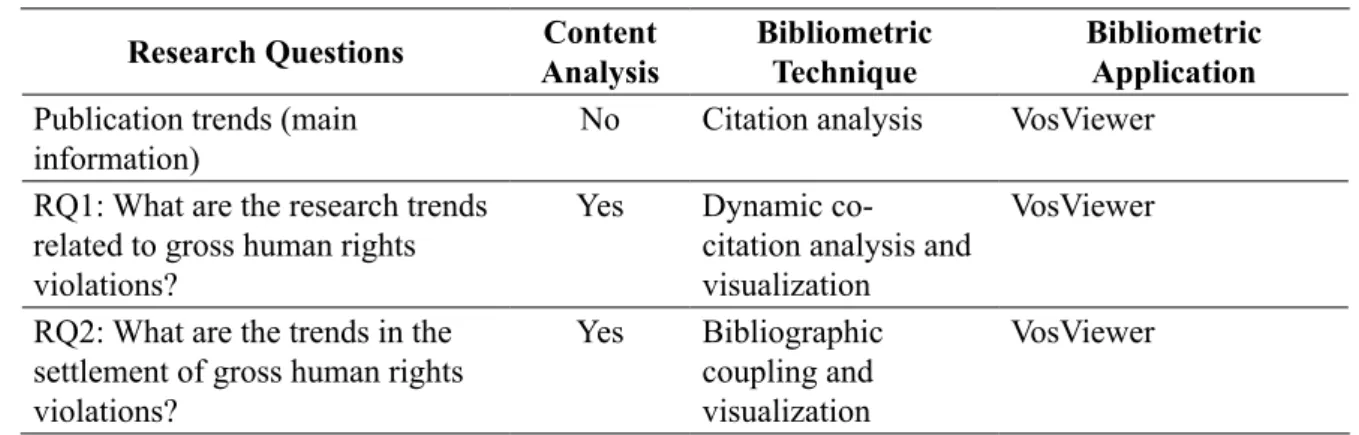
Table 2. Method and application for data analysis Research Questions Content
Analysis Bibliometric
Technique Bibliometric Application Publication trends (main
information) No Citation analysis VosViewer
RQ1: What are the research trends related to gross human rights violations?
Yes Dynamic co-
citation analysis and visualization
VosViewer
RQ2: What are the trends in the settlement of gross human rights violations?
Yes Bibliographic coupling and visualization
VosViewer
Source: managed by authors, 2023.
3. Findings and Discussion
3.1 Publication Trends Related to Gross Human Rights Violations
The Scopus database has 323 published research results about the gross violation of human rights (consisting of journal articles, conferences, books, book reviews, and book chapters). Most of the research, as many as 40 25 Ida Widianingsih et al., “Evolutionary Study of Watershed Governance Research: A Bibliometric Analysis,” Science and
Technology Libraries 40, no. 4 (2021): 416–34, https://doi.org/10.1080/0194262X.2021.1926401.
articles, were published in 2021-2022. While the least number of articles, as many as one article, were published in the years 1990, 2002, 2003, and 2006. Referring to graphic 1, the highest increase in published works on the topic of gross violation of human rights happened between the years 2020 (26 articles) to 2021 (40 articles).
Graph 1. Research Trends on the Settlement of Gross Violation of Human Rights
Source: scopus.com 3.1.1 The Influential Countries of Publication
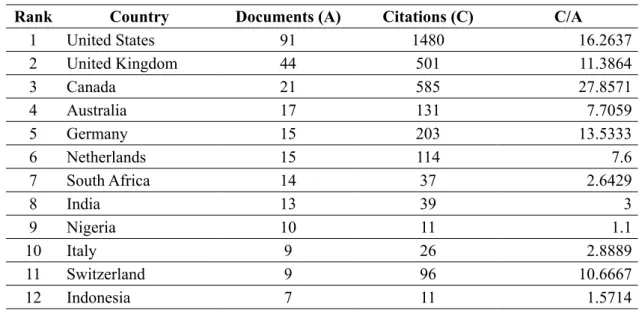
Authors from 63 different countries produced 290 publications that were used as research topics. The list of 12 countries with publications that cite “gross violation of human rights” is as follows.
Table 3. Top 12 Countries With Publications that Cite “Gross Violation of Human Rights”
Rank Country Documents (A) Citations (C) C/A
1 United States 91 1480 16.2637
2 United Kingdom 44 501 11.3864
3 Canada 21 585 27.8571
4 Australia 17 131 7.7059
5 Germany 15 203 13.5333
6 Netherlands 15 114 7.6
7 South Africa 14 37 2.6429
8 India 13 39 3
9 Nigeria 10 11 1.1
10 Italy 9 26 2.8889
11 Switzerland 9 96 10.6667
12 Indonesia 7 11 1.5714
Source: VosViewer Data Analysis, processed by authors, 2022.
Table 3 shows that the United States has the most publication and citations among the 12 states, with as many as 91 articles and 1.480 citations. The United Kingdom, Canada, and Australia place second to fourth as the country with the most publications. While in terms of the number of cited works, the second to fourth rank consists of Canada, the United Kingdom, and Germany. Sixth to twelfth rank of publication quantity consists of
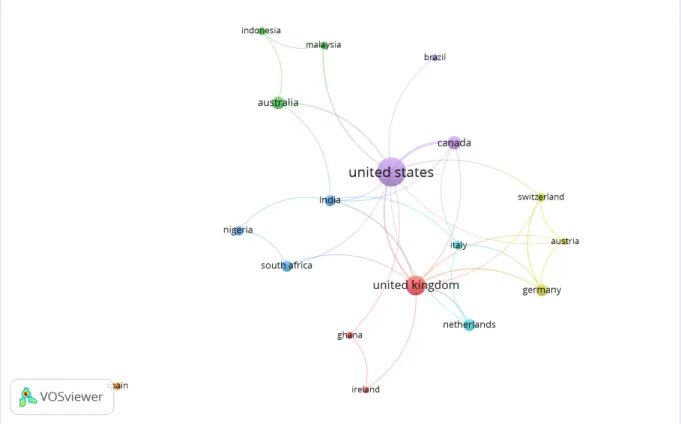
the Netherlands, South Africa, India, Nigeria, Italy, Switzerland, and Indonesia. Regarding the number of cited works, Switzerland, India, South Africa, Italy, Nigeria, and Indonesia, ranks sixth to twelve. Some countries with publications and citations mentioned had links in terms of international collaborations that resulted in 18 collaborating countries. The United States has the most productive country because the United States was the first to internationalize human rights issues26, and several cases and types of human rights violations occurred in the United States27. Table 3 also shows that the top 5 countries which publish human rights articles are the Anglo- Saxon countries. This is because the Anglo-Saxon countries strongly support individual rights and freedoms28.
Figure 2. Network Visualization of the Most Productive Countries Publishing “The Settlement of Gross Violation of Human Rights”
Source: processed by authors, 2022
3.1.2 The Influential Journal of Publication
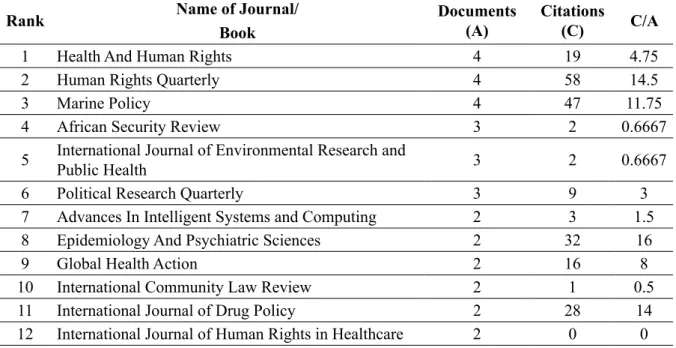
There is a noticeable gap among the publication sources regarding article and citation quantity. Journal of Social Science and Medicine ranks first as the most cited, with as many as 97 citations. This is because the themes discussed in the aforementioned journal consist of health and social issues, such as the process and implementation of health and social policies. World Development Journal ranks second with as many as 59 citations, followed by Human Rights Quarterly Journal, which ranks third with 58 citations. Regarding article quantity, Health and Human Rights Journal, Human Rights Quarterly Journal, and Marine Policy Journal rank first concurrently with four published articles. At the same time, the African Security Review-Journal, International Journal of Environmental Research and Public Health, and Political Research Quarterly Journal rank second with three published articles.
26 Gillian MacNaughton and Mariah McGill, “Economic and Social Rights in the United States : Implementation Without Ratification Universal Declaration of Human Rights , Which Has since Become,” Northeastern University Law Journal 4, no. 2 (2012): 365–406.
27 Xinhua, “The Report on Human Rights Violations in the United States in 2021,” SCIO Republic of China, 2022, http://
english.scio.gov.cn/m/scionews/2022-02/28/content_78076572.htm.
28 Mukti Ali, “Perbandingan Konsep Negara Hukum,” Biro Hukum Sekretariat Jenderal Kementerian, 2020, 1–32.
Table 4. Top 12 Journals on “The Settlement of Gross Violations of Human Rights” based on the Number of Articles
Rank Name of Journal/
Book Documents
(A) Citations
(C) C/A
1 Health And Human Rights 4 19 4.75
2 Human Rights Quarterly 4 58 14.5
3 Marine Policy 4 47 11.75
4 African Security Review 3 2 0.6667
5 International Journal of Environmental Research and
Public Health 3 2 0.6667
6 Political Research Quarterly 3 9 3
7 Advances In Intelligent Systems and Computing 2 3 1.5
8 Epidemiology And Psychiatric Sciences 2 32 16
9 Global Health Action 2 16 8
10 International Community Law Review 2 1 0.5
11 International Journal of Drug Policy 2 28 14
12 International Journal of Human Rights in Healthcare 2 0 0 Source: scopus.com, 2022.
Table 5. Top 12 Journals on “The Settlement of Gross Violations of Human Rights” based on the Number of Citations
Rank Name of Journal/Book Documents
(A) Citations
(C) C/A
1 Social Science and Medicine 2 97 48.5
2 World Development 2 59 29.5
3 Human Rights Quarterly 4 58 14.5
4 Marine Policy 4 47 11.75
5 Reproductive Health 2 34 17
6 Third World Quarterly 2 33 16.5
7 Epidemiology And Psychiatric Sciences 2 32 16
8 International Journal of Drug Policy 2 28 14
9 Orbis 2 27 13.5
10 Sustainability (Switzerland) 2 23 11.5
11 Health And Human Rights 4 19 4.75
12 Global Health Action 2 16 8
Source: scopus.com, 2022.
3.1.3 The Influential Organizations of Publication
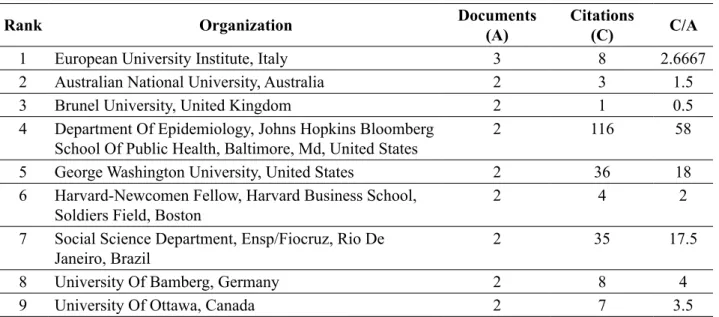
In terms of author organizations of published articles with the topic of gross violation of human rights up until the year 2022, there are 677 authors of 533 organizations published 323 articles. The connections between co-authors of their respective organizations with other organizations are visualized by VosViewer, as shown in Figure 2. There are nine authors organizations with at least two authors that focused their research on gross violation of human rights. Among those nine organizations, there are two linked organizations that collaborate in publishing articles, namely the University of Bamberg, Germany, with European University Institute, Italy, written by Zürn M., Heupel M., and the Department of Epidemiology with Social Science Department, Brazil which written by Malta M., Beyrer C.
Figure 3. Network of Authors Based on Organization
Source: processed by authors, 2022
Department of Epidemiology from John Hopkins Bloomberg School of Public Health is the organization with the most cited works with 116 citations, followed by George Washington University with 36 citations on two published articles. In terms of the number of published articles, European University Institute from Italy ranks first as the organization with the highest number of published articles on the topic related to gross violation of human rights, with three articles and eight citations. Australian National University, Brunel University, and Department of Epidemiology from John Hopkins Bloomberg School of Public Health ranks second concurrently with two articles. The top 9 author organizations categorized by citation and publication quantity are shown in the following table.
Table 6. Top 9 Influential Organizations of Publication based on the Number of Articles
Rank Organization Documents
(A) Citations
(C) C/A
1 European University Institute, Italy 3 8 2.6667
2 Australian National University, Australia 2 3 1.5
3 Brunel University, United Kingdom 2 1 0.5
4 Department Of Epidemiology, Johns Hopkins Bloomberg
School Of Public Health, Baltimore, Md, United States 2 116 58
5 George Washington University, United States 2 36 18
6 Harvard-Newcomen Fellow, Harvard Business School,
Soldiers Field, Boston 2 4 2
7 Social Science Department, Ensp/Fiocruz, Rio De
Janeiro, Brazil 2 35 17.5
8 University Of Bamberg, Germany 2 8 4
9 University Of Ottawa, Canada 2 7 3.5
Source: Scopus, 2022.
Table 7. Top 9 Influential Organizations of Publication based on the Number of Citations
Rank Organization Documents (A) Citations (C) C/A
1 Department of Epidemiology, Johns Hopkins Bloomberg School of Public Health, Baltimore, Md, United States
2 116 58
2 George Washington
University, United States 2 36 18
3 Social Science Department, Ensp/Fiocruz, Rio De Janeiro, Brazil
2 35 17.5
4 European University
Institute, Italy 3 8 2.6667
5 University Of Bamberg,
Germany 2 8 4
6 University Of Ottawa,
Canada 2 7 3.5
7 Harvard-Newcomen Fellow, Harvard Business School, Soldiers Field, Boston, Ma
2 4 2
8 Australian National
University, Australia 2 3 1.5
9 Brunel University, United
Kingdom 2 1 0.5
Source: Scopus, 2022.
3.1.4 Citation Network Among Authors
Figure 4. Network of Citation Based on Authors
Source: processed by authors, 2022
Figure 4 visualizes author clusters by the number of articles with at least two cited works. It is shown that there were no attachments between authors in publishing an article. Nevertheless, in terms of the quantity of cited works, Beyrer C. had the most cited works with 172 citations, followed by Ahmed with 37 citations, and Malta M. with 35 citations. The details can be further observed in the following table.
Table 8. The Influential Authors of Publication based on the Number of Articles Rank Author Documents (A) Citations (C) C/A
1 Beyrer C. 4 172 43
2 Augenstein D. 3 16 5.3333
3 Heupel M. 3 28 9.3333
4 Zanotti J. 3 0 0
5 Ahmed R. 2 37 18.5
6 Ballor G.A. 2 4 2
7 Idemudia U. 2 12 6
8 Malta M. 2 35 17.5
9 Partiti E. 2 6 3
10 Russell A.F.S. 2 16 8
11 Simons P. 2 7 3.5
12 Yildirim A.B. 2 4 2
Source: Scopus, 2022.
Table 9. The Influential Authors of Publication based on the Number of Citations
Rank Author Documents
(A) Citations (C) C/A
1 Beyrer C. 4 172 43
2 Ahmed R. 2 37 18.5
3 Malta M. 2 35 17.5
4 Heupel M. 3 28 9.3333
5 Augenstein D. 3 16 5.3333
6 Russell A.F.S. 2 16 8
7 Idemudia U. 2 12 6
8 Simons P. 2 7 3.5
9 Partiti E. 2 6 3
10 Ballor G.A. 2 4 2
11 Yildirim A.B. 2 4 2
12 Zanotti J. 3 0 0
Source: Scopus, 2022.
Based on the data of popular authors that published their works on the topic of gross violation of human rights, until the year 2022, more than 677 authors and co-authors published their works in the Scopus database.
There are 12 authors with at least two published articles related to the topic of gross violation of human rights.
Beyrer rose to prominence as the most prolific and influential writer on human rights. Beyrer’s four important articles discuss the Brazilian government’s role in reducing the rate of HIV/AIDS cases by subsidizing HIV/
AIDS treatment costs and making HIV/AIDS treatment mandatory for all citizens, from children to the elderly29. On the one hand, the state is responsible for providing health services to reduce the spread of HIV/AIDS. On the 29 Malta and Beyrer, “The HIV Epidemic and Human Rights Violations in Brazil.”
other hand, requiring children and some community groups to inject drugs is a sign of human rights violations.
Other Beyrer articles also discuss the role of the government, which actually ignores its citizens in cases of neglected diseases while at the same time demonstrating the role of non-governmental actors such as academics and researchers who advocate for society to recover, as shown in Burma and Colombia30. In the case of Burma, the government’s limitations in overcoming maternal mortality in conflict areas as a result of limited resources, infrastructure, and logistics resulted in the emergence of the role of local communities in overcoming this problem in the form of Mobile Obstetric Maternal Health Workers (MOM)31. Beyrer wrote about LGBT discrimination during the Covid era, when the government saw the LGBT community as a vulnerable group and restricted all of their activities, including the permanent closure of nightclubs. The existence of harassment, exclusion, suppression, and violence in the LGBT community by the government, religious leaders, and community leaders is considered a violation of human rights32.
3.1.5 Top Cited Articles
The most popular articles relating to the settlement of gross human rights violations are shown by the highest number of citations. The article entitled “Neglected Diseases, Civil Conflicts, and the Right to Health”
written by Beyrer C., Villar J.C., Suwanvanichkij V., Singh S., Baral S.D., Mills E.J. publicized in Lancet Journal of Public Health. This article has the highest citation because the result of the research reveals the poor role of the Government in tackling infectious diseases and the political justification for oppression on the basis of national security, as occurred in Burma with Filariasis disease and in Colombia with yellow fever, Chagas disease, and leishmaniasis disease. In addition, the research overviews the relationship between the decision to violate human rights with infectious and deadly diseases. The research outlines several conclusions and recommendations, which are 1) the need for ethics in state administration and an understanding of human rights to overcome challenges relating to disease and vulnerable populations; 2) The lack of awareness of the disease by society becomes the main source for the spread of the disease and thus threatens humanity33. Therefore, the research recommends reconciliation and peace between ethnic groups facilitated by the government.
Table 10. The Influential Articles
Rank Title Authors Code Year Source Title Total
Citations Document Type 1 Neglected Diseases,
Civil Conflicts, and the Right to health
34 2007 Lancet 94 Article
2 The HIV Epidemic and Human Rights Violations in Brazil
35 2013 Journal of the International AIDS Society
23 Article
3 With Power Comes Responsibility: Human rights Protection in United Nations Sanctions Policy
36 2013 European Journal of International Relations
20 Article
30 Beyrer et al., “Neglected Diseases, Civil Conflicts, and the Right to Health.”
31 Katherine C Teela et al., “Social Science & Medicine Community-Based Delivery of Maternal Care in Conflict-Affected Areas of Eastern Burma : Perspectives from Lay Maternal Health Workers Q,” Social Science & Medicine 68, no. 7 (2009): 1332–40, https://doi.org/10.1016/j.socscimed.2009.01.033.
32 Sara Wallach et al., “HHr Viewpoint Address Exacerbated Health Disparities and Risks to LGBTQ + Individuals during COVID-19” 22, no. 2 (2020): 313–16.
33 Beyrer et al., “Neglected Diseases, Civil Conflicts, and the Right to Health.”
34 Beyrer et al.
35 Malta and Beyrer, “The HIV Epidemic and Human Rights Violations in Brazil.”
36 Heupel, “With Power Comes Responsibility: Human Rights Protection in United Nations Sanctions Policy.”
4 Hide-and-seek in Corporate Disclosure:
Evidence from Negative Corporate Incidents
37 2019 Corporate
Governance (Bingley)
17 Article
5 Incorporating Social Rights in Development:
Transnational
Corporations and The Right to Water
38 2011 International Journal of Law in Context
16 Article
6 Analysis of the Canadian National Corporate Social Responsibility Strategy: Insights and Implications
39 2018 Corporate Social Responsibility and Environmental Management
12 Article
7 Negotiating the Hard/
Soft Law Divide in Business and Human Rights: The Implementation of the UNGPs in the European Union
40 2018 Global Policy 9 Article
8 Selectivity in Law- Making: Regulating Extraterritorial Environmental Harm and Human Rights Violations by Transnational Extractive Corporations
41 2015 Research
Handbook on Human Rights and the Environment
5 Book
Chapter
9 Curbing supply-chain human rights violations through trade and due diligence. Possible WTO concerns raised by the EU conflict minerals regulation
42 2017 Journal of World
Trade 5 Article
37 Bradley Rudkin et al., “Hide-and-Seek in Corporate Disclosure: Evidence from Negative Corporate Incidents,”
Corporate Governance (Bingley) 19, no. 1 (2019): 158–75, https://doi.org/10.1108/CG-05-2018-0164.
38 Russell, Incorporating Social Rights in Development: Transnational Corporations and the Right to Water.
39 Idemudia and Kwakyewah, “Analysis of the Canadian National Corporate Social Responsibility Strategy: Insights and Implications.”
40 Augenstein, “Negotiating the Hard/Soft Law Divide in Business and Human Rights: The Implementation of the UNGPs in the European Union.”
41 Simons, “Selectivity in Law-Making: Regulating Extraterritorial Environmental Harm and Human Rights Violations by Transnational Extractive Corporations.”there has been little effort to tackle in any concerted or effective way the environmental and human rights impacts of transnational corporations (TNCs
42 Partiti and van Der Velde, “Curbing Supply-Chain Human Rights Violations through Trade and Due Diligence. Possible WTO Concerns Raised by the EU Conflict Minerals Regulation.”tantalum and tungsten, their ores, and gold originating from conflictaffected and high-risk (CAHR
10 Multinational Corporations and the Politics of International Trade in Multidisciplinary Perspective
43 2020 Business and
Politics 5 Article
Source: Scopus, 2022.
Table 10 shows a list of the ten articles with the highest number of citations relating to the settlement of gross human rights violations. The article entitled “Neglected diseases, civil conflicts, and the right to health”
from The Lancet of Public Health 44 has the highest number of citations, with a total of 94 citations. This article discusses health management policies and the government’s role in relation to inter-ethnic conflict, which became the beginning of the spread of infectious diseases. The result of the research indicates the poor role of the government in handling infectious diseases and the existence of political justification for committing violence against patients of disease45. The article “The HIV Epidemic and Human Rights Violations in Brazil,” written by Malta and Bayrer from the Journal of the International AIDS Society, is in second position with a total of 23 citations. This article looks at the policy of coercion and acts of violence against drug users by the government compared to the prison policy that has reduced HIV and drug cases in Brazil46.
The article in the third position is “With Power Comes Responsibility: Human Rights Protection in United Nations Sanctions Policy” from the European Journal of International Relations47, with a total of 20 citations. The article highlights the development of mechanisms for protecting against human rights violations by international organizations, shifting the role of the state, which is considered traditional. By raising several cases of the Security Council and the European Union, the article recommends the need to institutionalize the involvement of international organizations in protecting against national human rights violations48. Some of the preceding articles demonstrate a connection between infectious diseases49, neglected diseases50, social conditions in society51, and the roles of government and non-government actors in combating these diseases52. Even the government’s dominant role has the potential to result in human rights violations.
The most influential articles that were netted in the search also showed information that differed from the definition of gross human rights violations. Most of the articles that were netted explained the failure of the state to guarantee human rights and violations of human rights by the state, either directly or indirectly. Human rights violations by the government aimed at the disease’s condition and the status of society have not portrayed the conditions of gross human rights violations that occurred in Indonesia, the majority of which occurred due to 43 Ballor and Yildirim, “Multinational Corporations and the Politics of International Trade in Multidisciplinary Perspective.”
44 Beyrer et al., “Neglected Diseases, Civil Conflicts, and the Right to Health.”
45 Beyrer et al.
46 Malta and Beyrer, “The HIV Epidemic and Human Rights Violations in Brazil.”
47 Heupel, “With Power Comes Responsibility: Human Rights Protection in United Nations Sanctions Policy.”
48 Heupel.
49 Li et al., “Research Progress and Future Agenda of COVID-19 in Tourism and Hospitality : A Timely Bibliometric Review”; Malta and Beyrer, “The HIV Epidemic and Human Rights Violations in Brazil.”
50 Beyrer et al., “Neglected Diseases, Civil Conflicts, and the Right to Health.”
51 Li et al., “Research Progress and Future Agenda of COVID-19 in Tourism and Hospitality : A Timely Bibliometric Review”; Wallach et al., “HHr Viewpoint Address Exacerbated Health Disparities and Risks to LGBTQ + Individuals during COVID-19.”
52 Raylinn Nuckolls and Leticia Villarreal Sosa, “Human Rights, Collaborative Advocacy, and a Global Approach to Practice: Lessons from a Field Experience in Indonesia,” Journal of Human Rights and Social Work 6, no. 1 (2021):
82–89, https://doi.org/10.1007/s41134-020-00149-7; Augenstein, “Negotiating the Hard/Soft Law Divide in Business and Human Rights: The Implementation of the UNGPs in the European Union”; Russell, Incorporating Social Rights in Development: Transnational Corporations and the Right to Water; Heupel, “With Power Comes Responsibility: Human Rights Protection in United Nations Sanctions Policy”; Idemudia and Kwakyewah, “Analysis of the Canadian National Corporate Social Responsibility Strategy: Insights and Implications.”
separatist movements, religious sects considered heretical by the government, and conflicts between citizens and the government because they smelled SARA53.
Based on the top 10 articles that appeared, gross human rights violations appeared as the poor role -if not failure- of the government’s role in dealing with large-scale social problems such as communicable diseases, HIV/AIDS, victims of war, and refugees. The result has a slight difference from the definition of gross human rights violations provided by WCHR Vienna. The emergence of these different definitions is probably due to the complexity of the terms of gross violation of human rights itself, let alone the elements in it, such as degrading treatment or systematic attack. Furthermore, the concept of gross human rights violation is interpreted diversely among human rights experts54. Some institutions or researchers use different terms that refer to gross violations of human rights, such as massive violations of human rights, systematic violations of human rights, or flagrant violations of human rights55. The next part of this article discusses several keywords that appeared along with gross human rights violations.
3.1.6 Keyword Analysis
The mapping of articles relating to the settlement of a gross violation of human rights that has been publicized until 2022 is illustrated in the keyword cluster marked with different colors and the number of nodes.
Figure number 4 shows that based on co-occurrence by authors’ keywords, with the keyword “Human Rights”
stands out compared to other words. Visualization based on the analytical result using VosViewer, the wider the circle size, the more frequently the keyword appears. Keywords with the same color indicate that they are in the same cluster and are closely related to other keywords.
Figure 5. Keyword Network Visualization
Source: processed by authors, 2022
The image shows that there is 3 cluster, where the first cluster is marked with five nodes in red which focuses on human rights, governance, democracy, Covid 19, and Corporate Social Responsibility. The first cluster, denoted by a thicker line, depicts the relationship between human rights and governance. This demonstrates the 53 Dony Setiawan, “Ombudsman Finds Maladministration in Talangsari Massacre ‘Peace Declaration,’” The Jakarta Post, 2019, https://www.thejakartapost.com/news/2019/12/06/ombudsman-finds-maladministration-in-talangsari-massacre- peace-declaration.html; Amiruddin Amiruddin, “Komnas HAM , Investigating Serious Human Rights Violations : Dynamics and Challenges,” Journal of Southeast Asian Human Rights 5, no. December (2021): 244–54, https://doi.
org/10.19184/jseahr.
54 Liwanga, “The Meaning of Gross Violation of Human Rights: A Focus on International Tribunals’ Decisions over the DRC Conflicts.”
55 Takhmina Karimova, “What Amounts to ‘ a Serious Violation of International Human Rights Law’’? An Analysis of Practice and Expert Opinion for the Purpose o the 2013 Arms Trade Treaty’” (Geneva, 2014), https://repository.
graduateinstitute.ch/record/295203.
importance of governance in dealing with human rights violations. According to Nuckols & Sosa, and Bartunek’s research, the handling of recent human rights violations cannot be carried out unilaterally by the state but requires the involvement of community actors and non-state actors in order to realize collaborative advocacy56. Since human rights infractions are always handled through the courts, this circumstance becomes novel. Several researchers have revealed that developing solutions to human rights violations through non-judicial mechanisms or collaboration can be done through collaborative lawyering carried out by the government with indigenous communities in the Amazon Forest in the face of multinational corporations57, collaborative advocacy to protect civilians affected by conflict impacts such as those in Syria, Yemen, South Sudan, and Myanmar58, and through the role of civil society organizations to hold consultative meetings59. In the same cluster, the importance of democracy in protecting and enforcing human rights60 because democracy is a political system that rewards fundamental human rights. The struggle to sustain democracy is an attempt by mankind to ensure and protect their human rights61. The second cluster is characterized by five nodes in green which focus on international law, immigration, refugee, Africa, and human rights violation. The third Cluster is marked with three nodes in blue which focus on risk management, accountability, and conflict. The result of this research is illustrated by overlay visualization based on co-occurrence by the author’s keywords. Figure 5 is the density network which indicates the level of research based on co-occurrence by author’s keyword. The more concentrated the color in certain keywords shows the relevance of research conducted on these keywords.
Figure 6. Keyword Density Visualization
Source: processed by authors, 2022
The above image shows that the research relating to gross violation of human rights conducted until 2022 mostly uses the keyword human rights. There is no topic that is researched with many keywords except by including the keyword human rights in the research.
56 Jean M Bartunek, Pennie G. Foster-Fishman, and Christopher B. Keys, “Using Collaborative Advocacy to Foster Intergroup Cooperation: A Joint Insider-Outsider Investigation,” Human Relations 49, no. 6 (1996); Nuckolls and Villarreal Sosa, “Human Rights, Collaborative Advocacy, and a Global Approach to Practice: Lessons from a Field Experience in Indonesia.”
57 Marissa Vahlsing and Benjamin Hoffman, “Collaborative Lawyering in Transnational Human Rights Advocacy,”
Clinical Law Review, 2014, 1–28.
58 Victoria Metcalfe-hough, “Collaborative Advocacy between Humanitarian and Human Rights Actors Opportunities and Challenges,” no. October (2021).
59 Lorna Davidson and Raj Purohitt, “Note from the Field The Zimbabwean Human Rights Crisis : A Collaborative Approach to International Advocacy,” no. February 2004 (2003): 1–24.
60 Neil A. Englehart, “State Capacity, State Failure, and Human Rights,” Journal of Peace Research 46, no. 2 (2009):
163–80, https://doi.org/10.1177/0022343308100713.
61 Fikre Jesus Amahazion, “Human Trafficking: The Need for Human Rights and Government Effectiveness in Enforcing Anti-Trafficking,” Global Crime 16, no. 3 (2015): 167–96, https://doi.org/10.1080/17440572.2015.1019613.
3.2 Patterns of Gross Human Rights Violations Settlements
Prior to 2010, egregious human rights breaches were dealt with judicially or through courts in numerous countries across the world62. This is due to the fact that the affected victims continue to demand that the perpetrators of human rights violations be tried and punished in accordance with the judge’s judgment63. Furthermore, pressure from the international community was applied to countries with cases to investigate perpetrators of grave human rights breaches64.
Figure 7. Keyword Overlay Visualization
Source: processed by authors, 2022
Meanwhile, the term governance has emerged in egregious human rights breaches since 2015 (see Figure 7). Governance in gross human rights breaches is carried out through a process of reconciliation between impacted victims and the government, which includes satisfying all of the requirements of victims of previous crimes, including social, psychological, economic, and environmental situations. Some analysts believe that this can be accomplished through non-judicial procedures, including collaboration between government and non- government parties65. On the one hand, the collaboration arose from the shared goal of the government and non- state entities to handle issues as rapidly as possible. Yet, because not all of the players involved have the same resources, a collaborative procedure is required to limit the danger of actors engaging in advocacy66. As a result, some professionals refer to this method of teamwork as collaborative advocacy or collaborative lawyering.
62 International Commission of Jurists (ICJ), “Achieving Justice for Gross Human Rights Violations in Cambodia Baseline Study, October 2017” (Geneva, 2017); International Commission of Jurists, “Civil Remedies for Gross Human Rights Violations,” International Commission of Jurists (Geneva, 2018), https://doi.org/10.4324/9781315203454-19.
63 Englehart, “State Capacity, State Failure, and Human Rights.”
64 Jorge Contesse, “Settling Human Rights Violations,” Harvard International Law Journal 60, no. 2 (2019): 317–75.
65 Metcalfe-hough, “Collaborative Advocacy between Humanitarian and Human Rights Actors Opportunities and Challenges”; Davidson and Purohitt, “Note from the Field The Zimbabwean Human Rights Crisis : A Collaborative Approach to International Advocacy”; Bartunek, Foster-Fishman, and Keys, “Using Collaborative Advocacy to Foster Intergroup Cooperation: A Joint Insider-Outsider Investigation”; Nuckolls and Villarreal Sosa, “Human Rights, Collaborative Advocacy, and a Global Approach to Practice: Lessons from a Field Experience in Indonesia.”
66 Chris Ansell and Alison Gash, “Collaborative Platforms as a Governance Strategy,” Journal of Public Administration Research and Theory 28, no. 1 (2018): 16–32, https://doi.org/10.1093/jopart/mux030.
Figure 7 indicates the different trends in publications relating to human rights in which human rights governance has been studied since 2015. Meanwhile, recent research relating to human rights has always been linked to refugees and the covid-19 pandemic. On the other side, international law, conflict, and Africa are topics that emerged in 2015-2016. Moreover, figure 6 shows that research relating to human rights, the issue of refugees, Covid-19, and corporate social responsibility policy are topics that have emerged in 2019 to date, which is marked with a yellow node. It appears that recent research linking CSR policies with Covid-19 has been carried out. During the Covid-19 pandemic, CSR initiatives led to a growth in the psychological capital of working people and increased the perception of security of firm management67. Thus, some premium and middle-class hotels issued CSR policies for the community, staff, and customers during the Covid-19 epidemic to mitigate the negative impact of the pandemic, which resulted in potential human rights abuses68. Meanwhile, there has been no human rights research linking CSR policies to refugee management. Human rights research related to refugees is only related to international law (2015), migration (2018), and human rights violations (2019).
In addition, none of the articles that were filtered discussed gross human rights violations in Indonesia.
This does not indicate that there has been no research related to gross human rights violations in Indonesia. The complexity of the terms used in gross human rights violations results in the possibility that articles that examine gross human rights violations in Indonesia are not captured.
4. Conclusion
Up to 2022, research focusing on the settlement of gross human rights violations has grown significantly in number. The United States has become the country with the highest number of publications. In addition, the Department of Epidemiology, Johns Hopkins Bloomberg School of Public Health, Baltimore, Md, United States, is the organization that paid the most attention and influence on the issue of the settlement of gross violations of human rights. In addition, Social Science and Medicine is a journal publisher that highly focuses on the issue of the settlement of gross violations of human rights. Based on the number of publications, Professor C. Beyrer from the United States has the highest number of publications and is the most influential researcher related to the topic of settlement of gross human rights violations. Based on density visualization, research on human rights violations is still a relevant research topic today. Based on the co-occurrence and overlay visualization, future research related to human rights in the future can be carried out with a focus on CSR policies in handling refugees. In addition, research related to the handling of human rights violations through non-judicial mechanisms is interesting to do.
This research has several limitations that need to be considered, particularly bibliometric analysis with regard to the topic of gross human rights violations is limited to the Scopus database. While the Scopus database is certainly among the largest databases with regard to scientific literature, it is highly likely that the database does not exhaustively include all existing literature related to gross human rights violations. In addition, this article recommends the need for more writing on gross human rights violations in Indonesia from various perspectives.
Hence, it is recommended that future research also include other databases, such as Web of Science or Google Scholar, for a more comprehensive overview of the literature.
ACKNOWLEDGEMENT
The authors would like to convey its gratitude to the Director General of Human Rights and Head of Research and Development Ministry of Law and Human Rights of the Republic of Indonesia who have provided access to literatures.
67 Yan Mao et al., “Effects of Tourism CSR on Employee Psychological Capital in the COVID-19 Crisis: From the Perspective of Conservation of Resources Theory,” Current Issues in Tourism 24, no. 19 (2021): 2716–34, https://doi.org /10.1080/13683500.2020.1770706; Viachaslau Filimonau, Belen Derqui, and Jorge Matute, “The COVID-19 Pandemic and Organisational Commitment of Senior Hotel Managers,” International Journal of Hospitality Management 91, no.
August (2020): 102659, https://doi.org/10.1016/j.ijhm.2020.102659.
68 Li et al., “Research Progress and Future Agenda of COVID-19 in Tourism and Hospitality : A Timely Bibliometric Review.”
REFERENCES
Achwan, Rochman, Meuthia Ganie-Rochman, Andi Rahman Alamsyah, and Lidya Triana. “University Reform and the Development of Social Sciences in Indonesia.” International Journal of Educational Development 78, no. August (2020): 102269. https://doi.org/10.1016/j.ijedudev.2020.102269.
Ali, Mukti. “Perbandingan Konsep Negara Hukum.” Biro Hukum Sekretariat Jenderal Kementerian, 2020, 1–32.
Amahazion, Fikre Jesus. “Human Trafficking: The Need for Human Rights and Government Effectiveness in Enforcing Anti-Trafficking.” Global Crime 16, no. 3 (2015): 167–96. https://doi.org/10.1080/17440572.2 015.1019613.
Amiruddin, Amiruddin. “Komnas HAM , Investigating Serious Human Rights Violations : Dynamics and Challenges.” Journal of Southeast Asian Human Rights 5, no. December (2021): 244–54. https://doi.
org/10.19184/jseahr.
Ansell, Chris, and Alison Gash. “Collaborative Platforms as a Governance Strategy.” Journal of Public Administration Research and Theory 28, no. 1 (2018): 16–32. https://doi.org/10.1093/jopart/mux030.
Augenstein, Daniel. “Negotiating the Hard/Soft Law Divide in Business and Human Rights: The Implementation of the UNGPs in the European Union.” Global Policy 9, no. 2 (2018): 254–63. https://doi.org/10.1111/1758- 5899.12530.
Baas, Jeroen, Michiel Schotten, Andrew Plume, Grégoire Côté, and Reza Karimi. “Scopus as a Curated, High- Quality Bibliometric Data Source for Academic Research in Quantitative Science Studies.” Quantitative Science Studies 1, no. 1 (2020): 377–86. https://doi.org/10.1162/qss_a_00019.
Ballor, Grace A., and Aydin B. Yildirim. “Multinational Corporations and the Politics of International Trade in Multidisciplinary Perspective.” Business and Politics 22, no. 4 (2020): 573–86. https://doi.org/10.1017/
bap.2020.14.
Bartunek, Jean M, Pennie G. Foster-Fishman, and Christopher B. Keys. “Using Collaborative Advocacy to Foster Intergroup Cooperation: A Joint Insider-Outsider Investigation.” Human Relations 49, no. 6 (1996).
Beyrer, Chris, Juan Carlos Villar, Voravit Suwanvanichkij, Sonal Singh, Stefan D Baral, and Edward J Mills.
“Neglected Diseases, Civil Conflicts, and the Right to Health.” Lancet 370, no. August 2018 (2007): 521–
Contesse, Jorge. “Settling Human Rights Violations.” Harvard International Law Journal 60, no. 2 (2019): 317–27.
Davidson, Lorna, and Raj Purohitt. “Note from the Field The Zimbabwean Human Rights Crisis : A Collaborative 75.
Approach to International Advocacy,” no. February 2004 (2003): 1–24.
Elsevier. “Discover Why the World’s Leading Researchers and Organizations Choose Scopus,” 2022. https://www.
elsevier.com/solutions/scopus/why-choose-scopus#:~:text=Scopus helps%3A,bolster performance%2C rank%2C and reputation.
Eck, Nees Jan van, and Ludo Waltman. “Software Survey : VosViewer, a Computer Program for Bibliometric Mapping.” Scientometrics, no. 84 (2010): 523–38. https://doi.org/10.1007/s11192-009-0146-3.
Ekpa, Simon. “Human Rights Violation.” SSRN, 2016. https://doi.org/https://dx.doi.org/10.2139/ssrn.2738447.
Englehart, Neil A. “State Capacity, State Failure, and Human Rights.” Journal of Peace Research 46, no. 2 (2009): 163–80. https://doi.org/10.1177/0022343308100713.
Filimonau, Viachaslau, Belen Derqui, and Jorge Matute. “The COVID-19 Pandemic and Organisational Commitment of Senior Hotel Managers.” International Journal of Hospitality Management 91, no. August (2020): 102659. https://doi.org/10.1016/j.ijhm.2020.102659.
Hamidah, Ida, Sriyono, and Muhammad Nur Hudha. “A Bibliometric Analysis of Covid-19 Research Using VosViewer.” Indonesia Journal of Science & Technology 5, no. 2 (2020): 209–16. https://doi.org/https://
doi.org/10.17509/ijost.v5i2.24522.
Hariharan, E, and S Tharika. “Gross Human Rights Violation-The Enforcement Challenge.” International Journal of Law Management & Humanities 1, no. 5 (2018): 2581–5369. www.ijlmh.com.
Heupel, Monika. “With Power Comes Responsibility: Human Rights Protection in United Nations Sanctions Policy.” European Journal of International Relations 19, no. 4 (2013): 773–96. https://doi.
org/10.1177/1354066111426621.
Idemudia, Uwafiokun, and Cynthia Kwakyewah. “Analysis of the Canadian National Corporate Social Responsibility Strategy: Insights and Implications.” Corporate Social Responsibility and Environmental Management 25, no. 5 (2018): 928–38. https://doi.org/10.1002/csr.1509.
International Commission of Jurists. “Civil Remedies for Gross Human Rights Violations.” International Commission of Jurists. Geneva, 2018. https://doi.org/10.4324/9781315203454-19.
International Commission of Jurists (ICJ). “Achieving Justice for Gross Human Rights Violations in Cambodia Baseline Study, October 2017.” Geneva, 2017.
Karimova, Takhmina. “What Amounts to ‘ a Serious Violation of International Human Rights Law’’? An Analysis of Practice and Expert Opinion for the Purpose o the 2013 Arms Trade Treaty.’” Geneva, 2014. https://
repository.graduateinstitute.ch/record/295203.
Li, Huiru, Xinyi Liu, Hengli Zhou, and Zhiyong Li. “Research Progress and Future Agenda of COVID-19 in Tourism and Hospitality : A Timely Bibliometric Review,” no. 2019 (2022). https://doi.org/10.1108/
IJCHM-04-2022-0424.
Liwanga, Roger-Claude. “The Meaning of Gross Violation of Human Rights: A Focus on International Tribunals’
Decisions over the DRC Conflicts.” Denver Journal of International Law & Policy 44, no. 1 (2015): 67–81.
Loan, Fayaz Ahmad, and Refhatunnisa Shah. “Research Output on Terrorism by India and Pakistan : A Bibliometric Study.” Collection and Curation, 2017. https://doi.org/https://doi.org/10.1108/CC-01-2017-0004.
Luqman, Yanuar. “Content Analysis on Energy Issue in Kompas Daily.” Komunikator 11, no. 1 (2019). https://
doi.org/10.18196/jkm.111020.
MacNaughton, Gillian, and Mariah McGill. “Economic and Social Rights in the United States : Implementation Without Ratification Universal Declaration of Human Rights , Which Has since Become.” Northeastern University Law Journal 4, no. 2 (2012): 365–406.
Malta, Monica, and Chris Beyrer. “The HIV Epidemic and Human Rights Violations in Brazil.” Journal of the International AIDS Society 16, no. March (2013): 10–12. https://doi.org/10.7448/IAS.16.1.18817.
Mao, Yan, Jie He, Alastair M. Morrison, and J. Andres Coca-Stefaniak. “Effects of Tourism CSR on Employee Psychological Capital in the COVID-19 Crisis: From the Perspective of Conservation of Resources Theory.” Current Issues in Tourism 24, no. 19 (2021): 2716–34. https://doi.org/10.1080/13683500.2020.
1770706.
Metcalfe-hough, Victoria. “Collaborative Advocacy between Humanitarian and Human Rights Actors Opportunities and Challenges,” no. October (2021).
Nuckolls, Raylinn, and Leticia Villarreal Sosa. “Human Rights, Collaborative Advocacy, and a Global Approach to Practice: Lessons from a Field Experience in Indonesia.” Journal of Human Rights and Social Work 6, no. 1 (2021): 82–89. https://doi.org/10.1007/s41134-020-00149-7.
Partiti, Enrico, and Steffen van Der Velde. “Curbing Supply-Chain Human Rights Violations through Trade and Due Diligence. Possible WTO Concerns Raised by the EU Conflict Minerals Regulation.” Journal of World Trade 51, no. 6 (2017): 1043–68.
Putera, Prakoso Bhairawa, Suryanto Suryanto, Sinta Ningrum, and Ida Widianingsih. “A Bibliometric Analysis of Articles on Innovation Systems in Scopus Journals Written by Authors from Indonesia, Singapore, and Malaysia.” Science Editing 7, no. 2 (2020): 177–83. https://doi.org/https://doi.org/10.6087/kcse.214.
Rasva, Marii, and Evelin Jürgenson. “Europe ’ s Large-Scale Land Acquisitions and Bibliometric Analysis,”
2022.
Rudkin, Bradley, Danson Kimani, Subhan Ullah, Rizwan Ahmed, and Syed Umar Farooq. “Hide-and-Seek in Corporate Disclosure: Evidence from Negative Corporate Incidents.” Corporate Governance (Bingley) 19, no. 1 (2019): 158–75. https://doi.org/10.1108/CG-05-2018-0164.
Russell, Anna F.S. Incorporating Social Rights in Development: Transnational Corporations and the Right to Water. International Journal of Law in Context. Vol. 7, 2011. https://doi.org/10.1017/S1744552310000388.
Samendawai, Abdul Haris. “Rights of Gross Human Rights Violation Victims (International and National Law Perspective).” Jurnal Hukum IUS QUIA IUSTUM 16, no. 2 (2009). https://journal.uii.ac.id/IUSTUM/
article/view/537.
Setiawan, Dony. “Ombudsman Finds Maladministration in Talangsari Massacre ‘Peace Declaration.’” The Jakarta Post, 2019. https://www.thejakartapost.com/news/2019/12/06/ombudsman-finds-maladministration-in- talangsari-massacre-peace-declaration.html.
Severo, Priscilla Paola, Leonardo B Furstenau, Michele Kremer Sott, Danielli Cossul, Mariluza Sott Bender, and Nicola Luigi Bragazzi. “Thirty Years of Human Rights Study in the Web of Science Database ( 1990 – 2020 ),” 2021.
Simons, Penelope. “Selectivity in Law-Making: Regulating Extraterritorial Environmental Harm and Human Rights Violations by Transnational Extractive Corporations.” In Research Handbook on Human Rights and the Environment, 473–507, 2015. https://doi.org/10.4337/9781782544432.00034.
Sumigar, Bernhard Ruben Fritz. “Pelanggaran Berat HAM Dalam RUU KUHP: Tinjauan Dari Hukum Internasional (Gross Violations of Human Rights in the Criminal Code Bill: An Overview from International Law).”
Negara Hukum: Membangun Hukum Untuk Keadilan Dan Kesejahteraan 11, no. 2 (2020): 125–44. https://
doi.org/10.22212/jnh.v11i2.1639.
Sweileh, Waleed M., Samah W. Al-Jabi, Ansam F. Sawalha, Adham S. AbuTaha, and Sa’ed H. Zyoud. “Bibliometric Analysis of Publications on Campylobacter: (2000-2015).” Journal of Health, Population, and Nutrition 35, no. 1 (2016): 35–39. https://doi.org/10.1186/s41043-016-0076-7.
Sweileh, Waleed M. “A Bibliometric Analysis of Global Research Output on Health and Human Rights ( 1900 – 2017 ).” Global Health Research and Policy 3, no. 30 (2018): 1–10. https://doi.org/https://doi.org/10.1186/
s41256-018-0085-8.
———. “Bibliometric Analysis of Peer-Reviewed Literature in Transgender Health ( 1900 – 2017 ).” BMC International Health and Human Rights 18, no. 16 (2018): 1–11. https://doi.org/https://doi.org/10.1186/
s12914-018-0155-5.
Teela, Katherine C, Luke C Mullany, Catherine I Lee, Eh Poh, Palae Paw, Nicole Masenior, Cynthia Maung, Chris Beyrer, and Thomas J Lee. “Social Science & Medicine Community-Based Delivery of Maternal Care in Conflict-Affected Areas of Eastern Burma : Perspectives from Lay Maternal Health Workers Q.”
Social Science & Medicine 68, no. 7 (2009): 1332–40. https://doi.org/10.1016/j.socscimed.2009.01.033.
Vahlsing, Marissa, and Benjamin Hoffman. “Collaborative Lawyering in Transnational Human Rights Advocacy.”
Clinical Law Review, 2014, 1–28.
Wallach, Sara, Alex Garner, Sean Howell, Tyler Adamson, Stefan Baral, and Chris Beyrer. “HHr Viewpoint Address Exacerbated Health Disparities and Risks to LGBTQ + Individuals during COVID-19” 22, no. 2 (2020): 313–16.
WCHR. “World Conference on Human Rights, Vienna Declaration and Programme of Action.” Vienna, 1993.
Widianingsih, Ida, Caroline Paskarina, Riswanda Riswanda, and Prakoso Bhairawa Putera. “Evolutionary Study of Watershed Governance Research: A Bibliometric Analysis.” Science and Technology Libraries 40, no.
4 (2021): 416–34. https://doi.org/10.1080/0194262X.2021.1926401.
Xinhua. “The Report on Human Rights Violations in the United States in 2021.” SCIO Republic of China, 2022.
http://english.scio.gov.cn/m/scionews/2022-02/28/content_78076572.htm.
Author Statement:
Author Contribution - Iwan Santoso: Writing-Original Draft, Conceptualization, Resources. Murtir Jeddawi:
Writing-Review and Editing. Yana Sahyana: Writing-Original Draft. Romli Arsyad: Writing-Review and Editing.
Alma’arif: Conceptualization, Methodology, Resources, Visualization.
Conflict of Interest - The authors whose names are listed certify that they have NO affiliations with or involvement in any organizations or entity any financial interest (such a honoraria; educational grants; participation in speaker’s bureaus; membership; employment, consultancies, stock ownership, or other equity interest; and expert testimony or patent-licensing arrangements), or non-financial interest (such as personal or professional relationship, affiliations, knowledge or beliefs) in the subject matter or materials discussed in this manuscript.
Statement of Originality – The correspending author certify that this manuscript is original and its publication does not infringe any copyright; the manuscript has not been previously published, in whole or in part in any other journal or scientific publishing company; the manuscript does not participate in any other publishing process; all persons listed hereafter were committed in the creation of the paper and were informed about their participation.