These joint efforts led to the development of the Waste Wise Cities Tool, a diagnostic tool that cities apply to assess their municipal solid waste management performance and use as a basis for sustainable solid waste management planning. Habitat launched Waste Wise Cities on World Habitat Day in 2018 with a call to action to tackle the global challenge of waste management.
Niveau de contrôle
Control Level
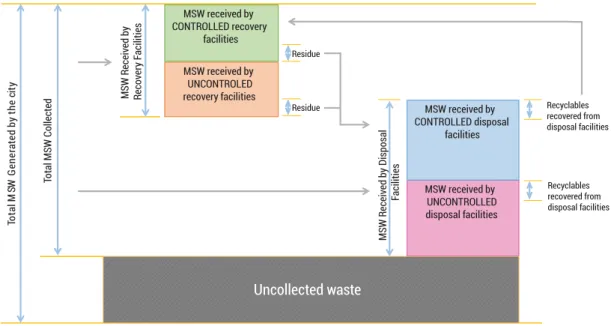
- Total MSW 1 collected
- Total MSW managed in controlled facilities
- Total uncollected MSW
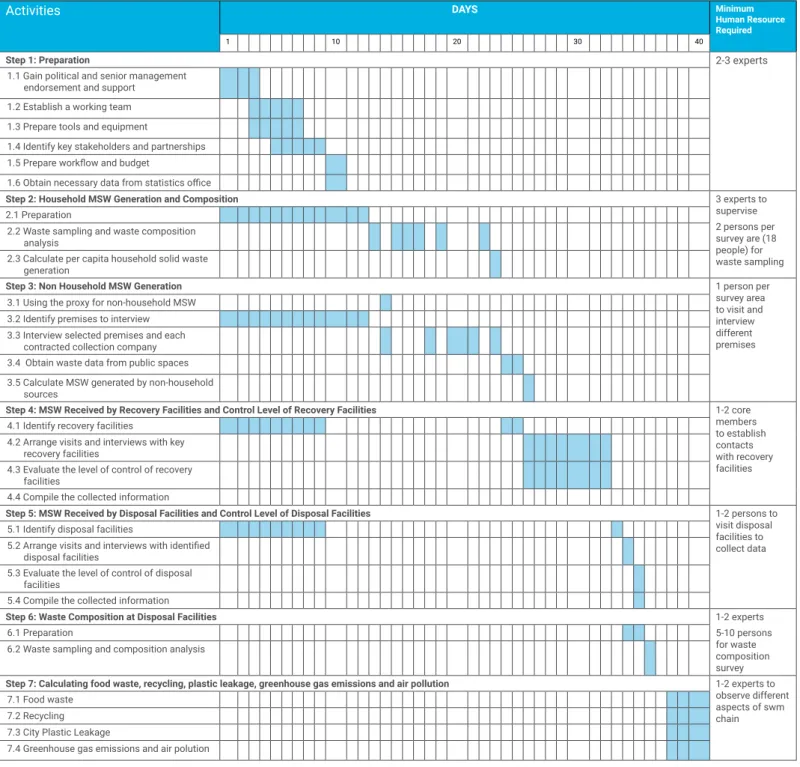
- Gain political and senior management endorsement and support
- Establish a working team
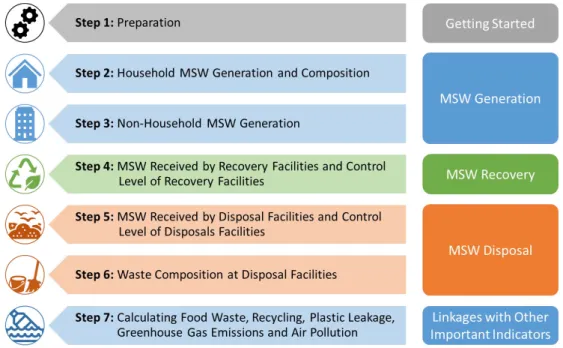
- PREPARATION
- Prepare tools and equipment
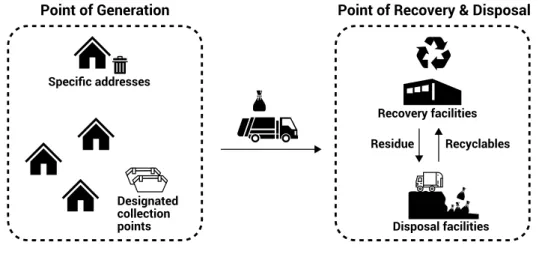
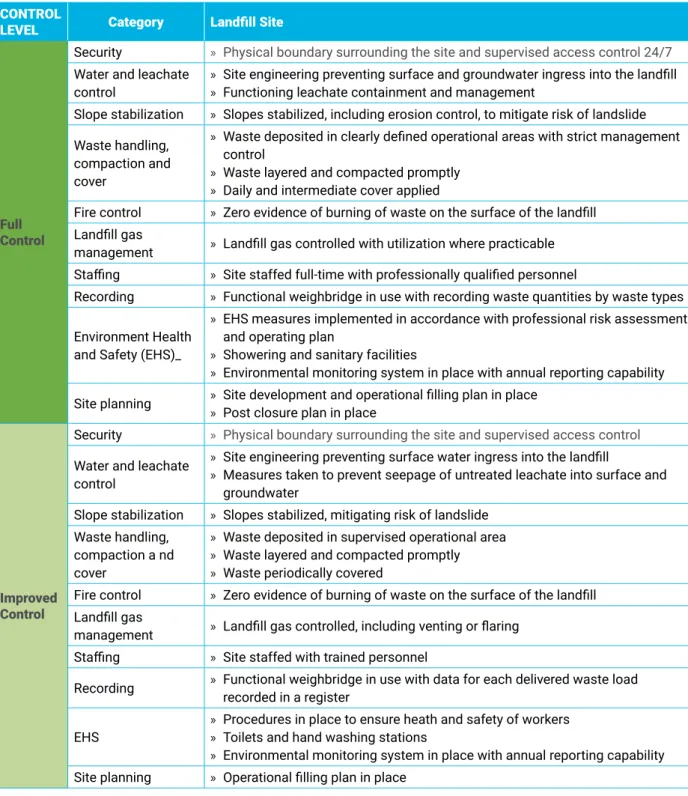
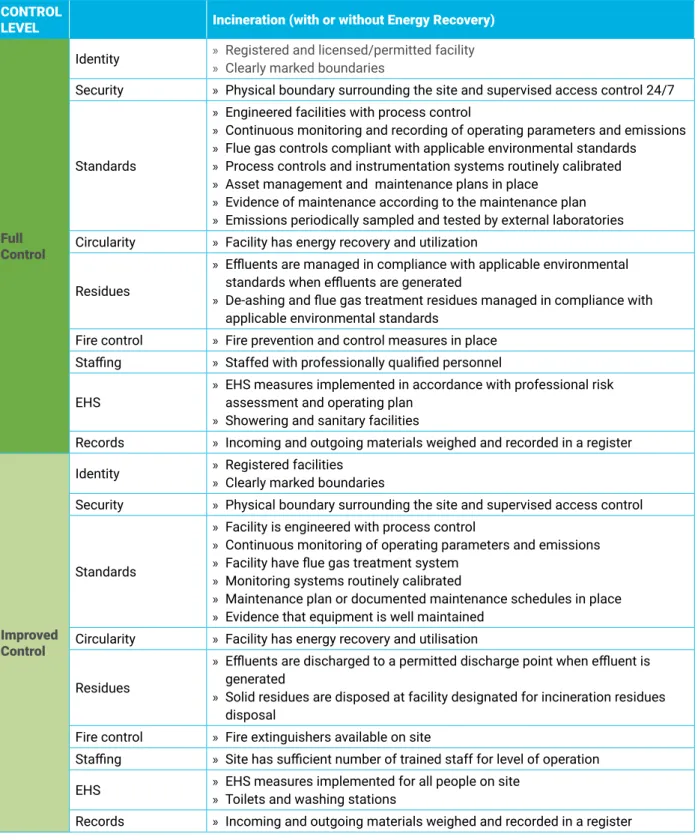
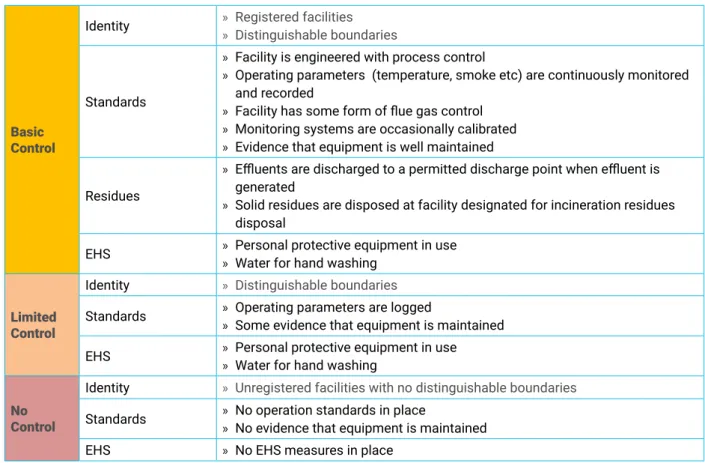
MSW managed in controlled facilities refers to MSW collected and transported to recycling and disposal facilities operating under basic, enhanced or full control according to the Learning of Waste Management Facilities control level (Table 2). Fire control » No evidence of burning of waste on the surface of the landfill Vullistreingas.
PREPARATION
BUDGET FOR AND ORGANIZE FOR
Identify key stakeholders and partnerships Stakeholders include individuals and entities involved
Successful evaluation implementation depends on identifying and obtaining information from key stakeholders. Achieving a clear understanding of the city's MSWM system is an essential basis for identifying key intervention areas for improvement. Official providers of private recovery or disposal services: registered or licensed entities involved in the processing, recovery and disposal of waste.
They have a business case for running their operations, must comply with regulations and are often supported by contractual payments, entry fees or incentives from city or national government. The waste management department must take the lead as it will facilitate many steps of the process (contact with operators, access to waste producers and organizations in the community, provision of a list of waste collection, processing and disposal companies operating in the city, etc. ).
Prepare workflow and budget
National ministries or environmental regulatory bodies include policy-making, regulatory bodies responsible for setting framework conditions, licensing/permitting, inspections and enforcement of MSW collection, processing and disposal activities. Stakeholder identification and analysis is usually an iterative process, where stakeholder interviews elicit information about other important stakeholders.
Obtain necessary data from statistics office The data necessary for the survey includes
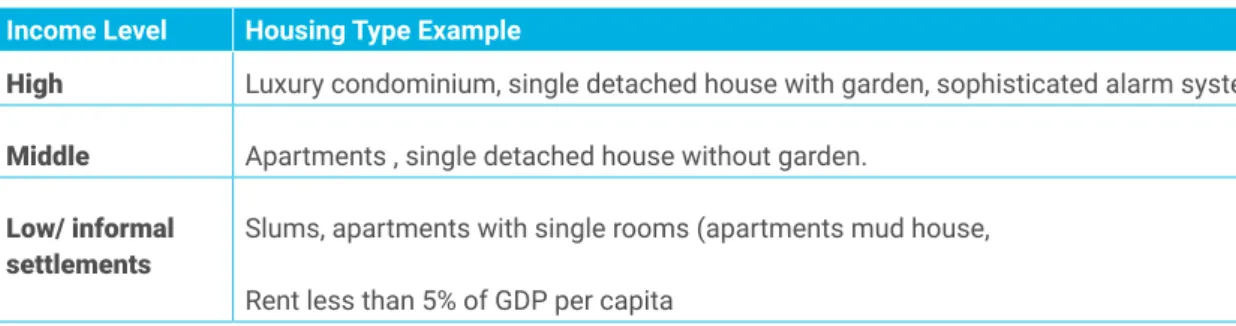
Waste generation varies according to the household's income level or housing type, therefore waste samples must be collected from different income groups (or housing types) in the city;. Waste generation from households varies depending on weekdays and weekends, therefore waste must be collected daily throughout a whole week (7 days). It is important to record the number of people actually living in the house, rather than taking the official average number of family members.
It is important to take into account the local variables that may affect waste production during the study.
HOUSEHOLD MSW GENERATION AND COMPOSITION
- Define sample size: the sample size will determine the statistical significance of the
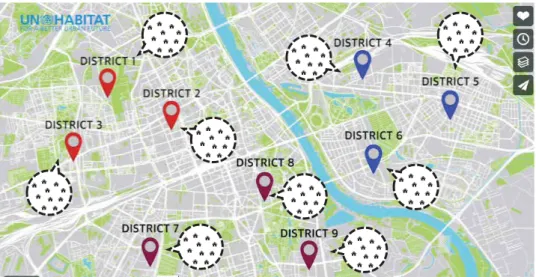
- Select survey areas and households: select 3 (5 for megacities) representative high, middle and
- Prepare informed consent letter from municipal government explaining the purpose of the survey, how the information will be used and requesting the consent of households to participate in the survey. This
- Prepare the survey team, equipment, and transport: The below table shows the number of survey team members, transport for collected waste samples and other items needed per survey area and in total
- Print recording sheets and prepare the WaCT Data Collection Tool: Print the forms included in Annex 2 of this document and download the WaCT Data Collection Application (DCA) and Data Collection Manual (DCM) from
- Find a location for the waste amounts and composition measurement: According to the estimate of the volume of daily collected waste from the households, choose a site where you can store waste and conduct
Option B: have a computer make a random selection from your list of all households in the selected neighborhood. Once in the field, be consistent in how you select your sample household from each cell. Option D: in the case of cities where households with different income levels are intermingled and difficult to clearly identify.
Prepare an informed consent letter from the municipal government that explains the purpose of the study, how the information will be used, and requests consent from households to participate in the study. The information is used for this purpose and households' permission is requested to participate in the study.
Use this day to check whether all the survey households have been identified, to overcome any problems or gaps, and to initiate the non-household waste survey (Step 3)
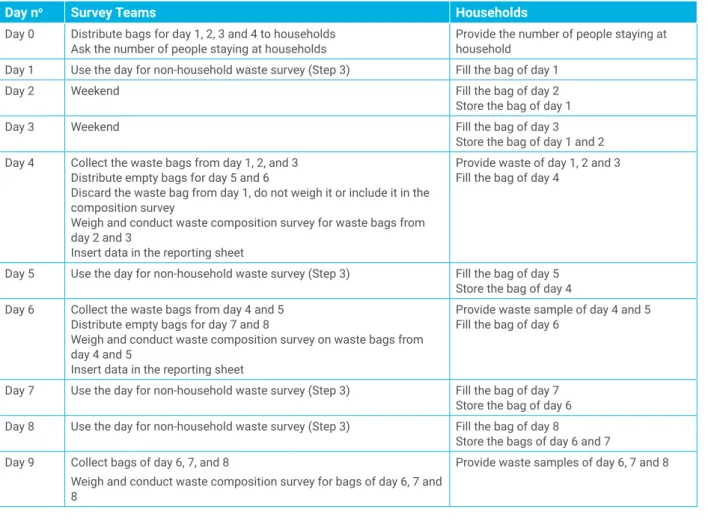
Below is a suggested schedule for household waste sampling and composition study, taking weekend days into account. It is important to obtain the consent and cooperation of the family by explaining the purpose of the survey. Once the householder has agreed to participate, ask them to store all waste generated that day at home in the appropriate bag and not to give any materials (eg recyclables) to anyone outside the home.
The survey teams collect the bags of day 1, 2 and 3 (filled) while distributing the two liner bags of day 5 and 6 to each household. Bring the collected waste to the identified location for sample
After ensuring that the individual sample weights per household per day have been recorded, open the bags and spread the waste on the plastic film. You can now mix the samples together, because the composition is an average for the entire sample (i.e. not per household per day).
The survey teams collect the bags of day 4 and day 5 (filled) and provide the labelled bags for day 7 and 8 to each household. Process the collected waste following the same steps done on Day 4
Use this day to follow-up and cross check on the household sampling, overcome any problem or gaps, and conduct non-household waste survey (Step 3)
Use this day to follow-up and cross check on the household sampling, overcome any problem or gaps, and conduct non-household waste survey (Step 3)
The survey team collects the bags of day 6, 7 and 8 (filled) and repeats the same steps as on Days 4 and 6
- Calculate average per capita household waste generation rate: Enter the data into the WaCT DCA. The figure below shows how the per capita household waste generation is calculated from the data collected through
Provide waste bag from day 1 Fill the bag for day 2 Day 3 Collect the waste bags from day 2 Weigh and do waste composition survey for bags from day 6 Enter data in the reporting sheet. Weigh and carry out waste composition survey for bags from day 7 Enter data into the reporting sheet.
Give waste bag from day 7 Fill the bag for day 8 Day 9 Collect the waste bags from day 8 Weigh and carry out waste composition study for bags from day 8 Enter data in the report sheet.
NON-HOUSEHOLD MSW GENERATION
- Identify premises for interview: After selecting the 9 survey areas (15 for mega cities) for the
- Prepare questionnaire for interview: Both the premises generating MSW, as well as their
- Schedule visits to selected premises: Visit selected premises on the days not needed for the
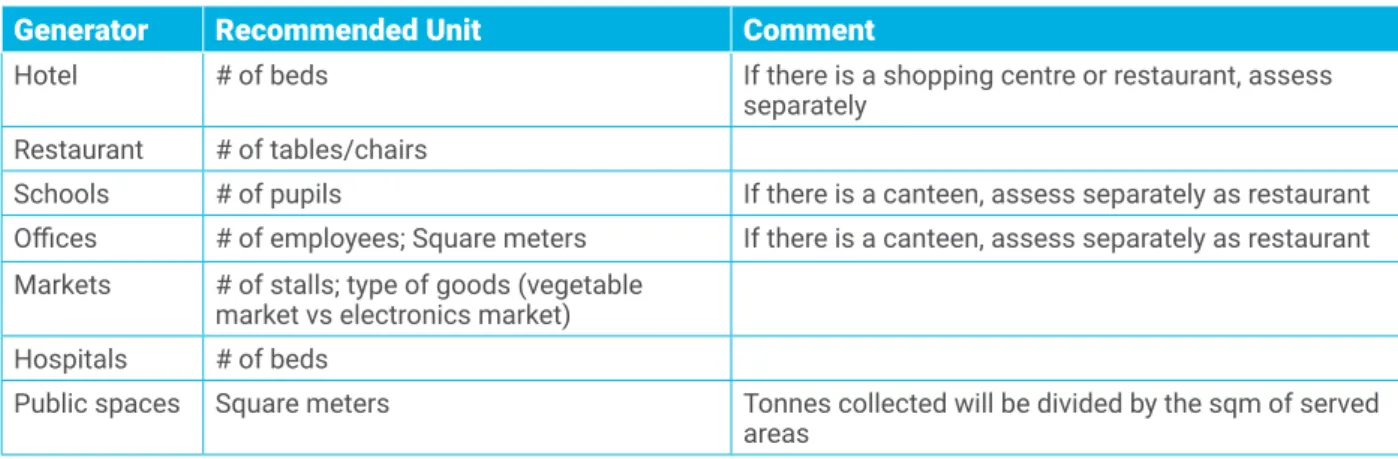
- Choose “unit” for calculation: Household waste is normally calculated through multiplying “per
- Interview waste collection service providers
- Identify responsible entity/department for public space cleaning: Identify responsible entity or
- Obtain data related to waste from public spaces including: 1) average collected tonnage
- Estimate total MSW generated by non- household sources: Enter the total number
Commercial establishments (e.g. markets, restaurants, shops, hotels, etc.) and institutions (e.g. schools, administrative buildings, offices, etc.) as well as public spaces (e.g. parks and streets) also contribute significantly in the total amount of MSW produced. . Visit the selected premises on days not required for the selected premises on days not required for the household survey as described in Step 2. Ask the manager where they store the waste generated by the facility, note the volume and if possible, weigh the remains. If you have decided to conduct an interview-based survey to gain a more complete and accurate assessment of non-family MSW, follow the steps below.
Obtain data about waste from public spaces including: 1) average tonnage collected spaces including: 1) average accumulated tonnage of waste per day, 2) approximate square meter of cleared area per accumulated tonnage of waste. Calculate the total MSW generated from non-household sources: Enter the total number of household sources: Enter the total number of units (chairs, rooms, students, employees, stalls, beds, square meters) derived from business licensing data and public domain data in the WaCT DCA to obtain the total MSW generation per day from each facility and the total MSW generated from non-domestic sources.
MSW RECEIVED BY RECOVERY FACILITIES AND CONTROL LEVEL OF RECOVERY FACILITIES
- Make a list of major recovery facilities: through business licensing data, identify and list recycling
- Categorise the recovery facilities in the list
- Determine the system boundary and priority interviews: sketch out the recovery system in
- Establish contact with the key recovery facilities through phone call or email and set up an
- Quantifying rejects from the recovery system
- Input of the collected data: After interviewing the recovery facilities using the questionnaire in
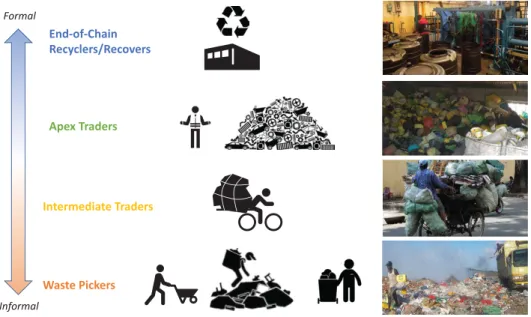
Note that the focus of data collection (for WaCT purposes) is on the facilities that are the first entry point into the recovery system for each of the MSW/material streams. Not all materials that enter the recycling system will be reused or recycled; some. A proxy estimate is sufficient for the purpose of the WaCT assessment because a more detailed and accurate assessment can take a long time (and budget) and distracts from understanding the volumes and level of control at the entrance to the recovery system.
Input of the collected data: After interviewing the repair facilities using the questionnaire in the repair facilities using the questionnaire in Annex 6 and determining their level of control, compile the information for the WaCT DCA. WaCT assessment is to identify the quantities of material entering the recycling system at the first observable point of entry.
Dumpsites receive
MSW RECEIVED BY DISPOSAL FACILITIES AND CONTROL LEVEL OF DISPOSAL FACILITIES
- Arrange a visit for the identified disposal facilities: once all the disposal facilities have
- Obtain records of waste received by the disposal facilities: quantitative data of waste arriving at
Leachate emitted from landfill facilities can pollute waterways, and uncontrolled landfill gas emissions pose health and safety concerns as well as environmental concerns. This step includes a methodology to measure the quantities of municipal waste received by repositories, the level of control of such facilities and how to estimate the recyclable materials recovered from repositories into the recovery chain (highlighted in orange in Figure 9). It is important to include disposal facilities that may not be legally approved (or licensed) but are still recognized by the local government.
Even when disposal facilities are located outside the city, this includes if they receive MSW generated from the city. Arrange a visit for the identified disposal facilities: once all the disposal facilities have facilities: once all the disposal facilities are identified, arrange site visits to each of them.
IF THE SITE DOESN’T HAVE A WEIGHBRIDGE
SI LE SITE N’EST PAS ÉQUIPÉ D’UN PONT-BASCULE
- Estimate total waste materials diverted from the disposal facility to the recovery chain: By
- Input the collected data: After visiting the disposal facilities, interviewing their site
- Recruit and train workers: for the composition survey around 15 workers are needed. If there are
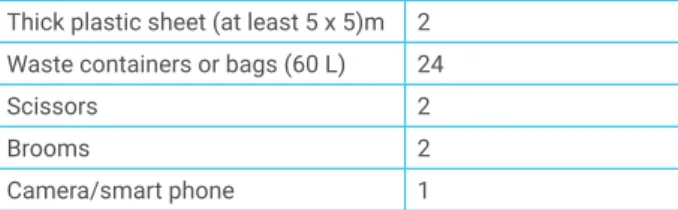
- Acquire necessary equipment: Table 12 shows the main items that are required for
- Prepare site for the survey: find a place where you can store and handle a sample of around 200
- Quartering technique: once you accumulated the MSW sample of 200-300 kg you need to derive a
- Sort the waste: Prepare labelled containers and sort the sample of 50-70 kg into 12 categories in
- Weigh the waste fractions: weigh each fraction in their containers and record the weight. Remember
Acquisition of necessary equipment: Table 12 shows the main elements required for shows the main elements needed to characterize the waste at a disposal site. Cover the surface with a thick tarpaulin on which the waste sample is deposited. Parameters of SDG indicator 11.6.1 are closely related to other SDGs on waste (12.3 on food waste and 12.5 on recycling).
Additionally, WaCT has been developed in parallel with the Waste Flow Diagram (WFD) for assessing potential plastic leakage from MSWM systems. The data collected for the evaluation of SDG indicator 11.6.1 can contribute to the evaluation of SDG indicator 12.3.1.b Food Waste Index, providing the generation of household food waste per capita through the following formula.
An estimated 820 million people do not
CALCULATING FOOD WASTE, RECYCLING, PLASTIC LEAKAGE, GREENHOUSE GAS EMISSIONS AND AIR POLLUTION
WaCT also generates data for the assessment of air pollution and greenhouse gas emissions with the Solid Waste Emissions Assessment Tool (SWEET). Municipal solid waste is an important source of methane and black carbon, two short-lived climate pollutants. Methane and black carbon emissions from a city can be measured using the Solid Waste Emissions Assessment Tool, or SWEET.
SWEET is an Excel-based tool that quantifies emissions of methane, black carbon and other pollutants from sources in the municipal solid waste sector. In addition, the Water Framework Directive allows the creation of scenarios that predict how proposed interventions may affect the solid waste management system and plastic pollution.
Recording sheet for household waste sampling This form should be used for each survey area
Recording sheet for waste composition analysis
Sorting guideline
All waste electrical and electronic equipment, such as watches, toasters, power tools, hair dryers, telephones, laptops, PCs, printers, monitors, smoke detectors, etc;.
Questionnaire for non-household waste generation
Recovery survey questionnaire
For each of these recyclable/recyclable materials you receive from non-MSW stream(s), please provide how much you source from which companies. Out of the total amount you receive, how much is estimated to have been collected informally*. What proportion of the total material recycled in your city do you think you process.
Please tell us how much residue/waste is generated during your recycling process in tons per day and where the residue is transported to.
Decision making tree for determining control level of waste management facilities
B12 Are basic personal protective equipment in use B13 End >> No control Other B13 Is there a site drawing showing the landfill boundary and fill area End >> Basic. End Control >> Restricted Control Security L1 Is there any level of access control to be restricted. F13 Records Are incoming/outgoing materials weighed and recorded in a register End >> Full Control End >> Basic Control.
B2 Does the site have clear boundaries? B3 End >> No EHS control B3 Are personal protective equipment in use and is there water available? Registration F18 Are incoming/outgoing materials weighed and recorded in a register. End >> Full Control End >> Basic Control.