Public Disclosure AuthorizedPublic Disclosure AuthorizedPublic Disclosure AuthorizedPublic Disclosure AuthorizedPublic Disclosure AuthorizedPublic Disclosure AuthorizedPublic Disclosure AuthorizedPublic Disclosure Authorized
80491
I
I ,
Fernando Loayza, editor
© 2012 The World Bank Group 1818 H Street, NW
Washington, DC 20433, U.S.A.
Telephone: 202-473-1000
Internet: www.worldbank.org/environment E-mail: [email protected]
All rights reserved.
Published September 2012
This volume is a product of the staff of the World Bank Group. The findings, interpretations, and conclusions expressed in this volume do not necessarily reflect the views of the Executive Directors of The World Bank Group or the governments they represent.
The World Bank Group does not guarantee the accuracy of the data included in this work. The boundaries, colors, denominations, and other information shown on any map in this work do not imply any judgment on the part of the World Bank Group concerning the legal status of any territory or the endorsement or
acceptance of such boundaries.
R I G H T S A N D P E R M I S S I O N S
The material in this publication is copyrighted. Copying and/or transmitting portions or all of this work without permission may be a violation of applicable law. The World Bank Group encourages dissemination of its work and will normally grant permission to reproduce portions of the work promptly.
For permission to photocopy or reprint any part of this work, please send a request with complete information to the Copyright Clearance Center Inc., 222 Rosewood Drive, Danvers, MA 01923, USA;
telephone 978-750-8400; fax 978-750-4470; Internet: www.copyright.com.
iii
Acronyms And AbbreviAtions ...v
Acknowledgments...vii
foreword ...1
chapter 1. introduction ...3
Objective and Scope ...3
Methodology ...3
Structure of the report ...6
references ...7
chapter 2. seA experience in the world bAnk: synthesis And conclusions ...8
the evolutionary Nature of Sea practice in the World Bank ...9
The Strategic Role of SEA as a Priority Setting and Multistakeholder Dialogue Process ...9
What Makes SEA Effective? ...10
Lessons and Good practices ...13
Influence in Decision Making ...13
Multistakeholder Dialogue ...15
Country Ownership ... 17
Timing...18
Strengthening the World Bank’s Sea agenda ...18
Final remarks ...20
references ...21
chapter 3. world bAnk seA experience in eAst AsiA And the pAcific: A tool for environmentAl sAfeguArding...22
Introduction and Methodology ...23
evolution of Sea in east asia and the pacific ...23
Findings ...24
Drivers of SEA ...24
Timing of SEA ...25
Stakeholder Participation ...25
Ownership ...26
Learning Process ...27
Environmental Awareness and Capacity Building within Institutions ...27
Shifting Priorities ...28
Applying Recommendations from SEA ...29
Looking at the Future of Sea in the region ...29
references ...32
annex 3.1. Questionnaire ...33
annex 3.2. Seas in east asia and pacific region ...34
annex 3.3. case Studies ...35
chapter 4. world bAnk seA experience in middle eAst And north AfricA: A policy And plAnning tool...40
Introduction ...41
evolution of Sea in Middle east and North africa ...41
Initial Drivers ...41
New Drivers ...42
Energy-Environment Review for Egypt (2003) ...44
Energy-Environmental Review for Iran (2004) ...47
Lessons Learned ...48
Strong Link between Country Ownership and Effective Implementation of SEA ...48
SEA as an Instrument to Mainstream Environment to Promote Policy Dialogue...48
Regional Technical Assistance that Facilitates Donor Partnership and Contributes to Capacity Building...48
Supplemental Quantitative Tools that Make SEA More Effective in Priority Setting ...49
Way Forward ...49
references ...51
chapter 5. world bAnk seA experience in south AsiA: from impAct-centered to policy ApproAches ...52
Introduction and Methodology ...53
evolution of Sea in South asia ...53
case Studies ...55
Impact-centered SEAs ...55
Policy and Institution-Centered SEAs ...56
Country Environmental Analyses ...58
Blend of Impact and Institution-Centered SEA: Strategic Basin Assessment ...60
Discussion of case Studies ...60
Moving Forward ...63
references ...65
annex 5.1. Seas Undertaken in the South asia region 66 annex 5.2. comments from Field Office Staff on advancing the regional Sea agenda ...67
chapter 6. world bAnk seA experience in sub-sAhArAn AfricA: from environmen- tAl sAfeguArding to informing policy diAlogue ... 68
Introduction ...69
evolution of Sea in Sub-Saharan africa ...69
Elements of an Effective SEA ...70
Design and Use of SEA in Africa ...71
Main Drivers of SEA in Africa ...73
contents
strAtegic environmentAl Assessment in the world bAnk iv
Key Lessons Learned in the Use of Sea
in the africa region ...74
Country Ownership ...74
Timing...74
Stakeholder Engagement ...74
Capacity Constraints ...75
Legal Basis for SEA ...75
Future trends: New applications of Sea in africa ...75
Moving Forward: Developing a Structured approach to Mainstreaming Sea in africa ...76
references ...77
annex 6.1. Seas completed, Ongoing, and in the pipeline in africa, 1999–early 2012 ...78
chapter 7. world bAnk seA experience in lAtin AmericA And the cAribbeAn: enhAncing infrAstructure developments And sector reforms ...80
Introduction and Methodology ...81
evolution of Sea in Latin america and the caribbean 81 Impact-Centered Approaches ...82
Institution-Centered or Policy Approaches ...82
Current Status of SEA in LAC ...83
Main Drivers and Limitations of SEA ...85
Discussion and trends ...87
Sectors Not Always in the “Driver’s Seat” ...87
Certain Sectors More Amenable to SEA ...88
Bank Regional Experience in SEA Limited in Key Sectors ...88
Impact on Stakeholder Engagement ...88
Capacity Building for SEA ...88
conclusions ...89
Coordination with IDB and International Finance Corporation (IFC)...89
Private Sector Involvement ...89
Regional Priorities for Action ...89
references ...91
chapter 8. world bAnk seA experience in europe And centrAl AsiA: the mixed effects of regulAtion ...92
Introduction ...93
evolution of Sea in europe and central asia ...93
Application of SEA in the ECA Region ...95
Summary of Results and Lessons Learned ...99
Ongoing and potential Sea Development in the eca region ...100
conclusions and recommendations ...101
references ...103
boxes Box 1.1. What is Sea in the World Bank’s experience? ...4
Box 1.2. Generic terms of reference for taking Stock of Bank regional experience in Sea ...5
Box 2.1. consultations in the West africa Mineral Sector Strategic assessment (WaMSSa) ...16
Box 3.1. rea for Manila third Sewerage project, philippines (2005) ...26
Box 3.2. Sea of tourism Development in Guizhou province, china (2007) ...28
Box 3.3. environmental assessment for Wuhan’s Urban transport Development Strategy ...29
Box 4.1. cost of environmental Degradation ... 43
Box 4.2. Gepap ...45
Box 4.3. Sustainable MeD ... 50
Box 7.1. colombian experience with country environmental analysis ...84
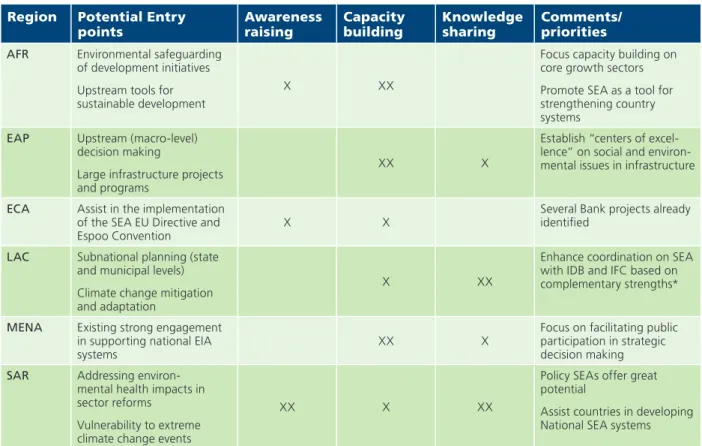
tAbles table 2.1. Key elements of proposed regional Sea agendas ...19
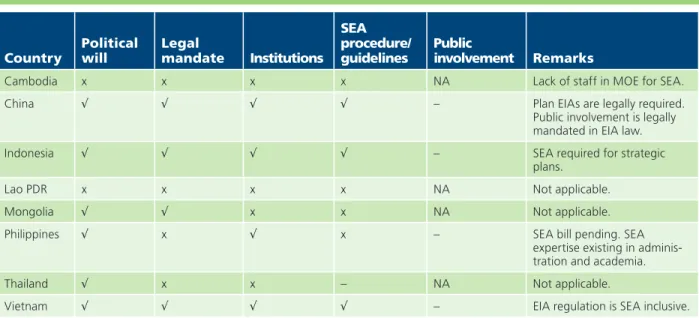
table 3.1. Status of Sea Indicators in the region ...30
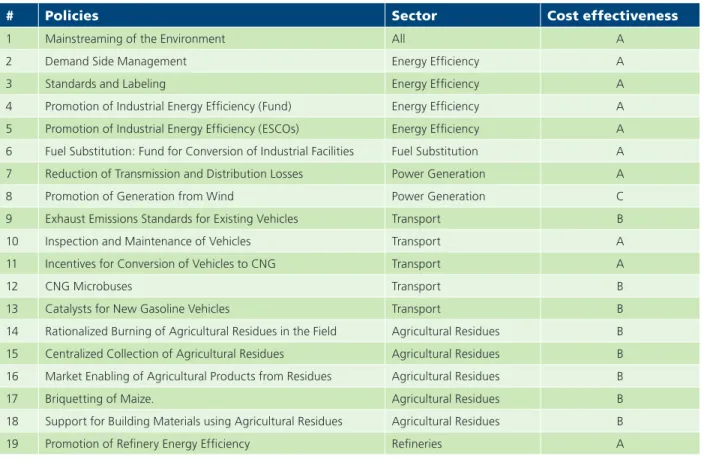
table 4.1. egypt: assessment of policies to reduce Damage costs ...46
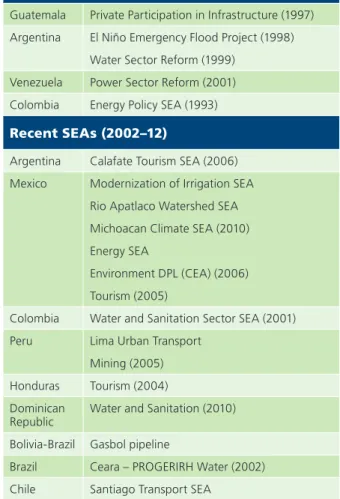
table 7.1. Select Seas in Lac ...82
table 7.2. country environmental analysis ...83
table 7.3. current planned or Ongoing Seas with World Bank Support in the Lac region ...84
figures Figure 4.1. egypt: eer Methodology Flowchart ...44
Figure 4.2. egypt: estimated Local Damage costs ...47
Figure 5.1. proportion of Seas in Sar by country ...54
Figure 5.2. proportion of Seas in Sar by Sector ...54
v acrONyMS aND aBBrevIatIONS
Afr Sub-Saharan africa cbA cost-benefit analysis
ceA country environmental analysis ciA cumulative impact assessment coed cost of environmental degradation cop community of practice
cpp consultation and public participation cso civil society organization
dpl development policy loan dpo development policy operations eA environmental assessment eAp east asia and the pacific ecA europe and central asia
eeAA egyptian environmental affairs agency eer energy-environment review
eiA environmental impact assessment eib european Investment Bank emAp environmental Management
action plan
emu environment Management Unit esmf environmental and social
management framework esmp environmental and social
management plan eu european Union
fcpf Forest carbon partnership Facility fpdp Forest protection and
Development plan gdp gross domestic product gef Global environment Facility
gepAp Gulf environmental partnership and action program
hpcd hubei provincial
communication Department hrnp hubei road Network plan
iAiA International association for Impact assessment
ibrd International Bank for reconstruction and Development
idA International Development association idb Inter-american Development Bank ifc International Finance corporation iirsA Initiative for the Integration
of regional Infrastructure of South america
Jmp Joint Multipurpose program lAc Latin america and caribbean lao pdr people’s Democratic republic of Lao mArd Ministry of agriculture and
rural Development
menA Middle east and North africa metAp Mediterranean environmental
technical assistance program mtsp Manila third Sewage project mw megawatt
neAp National environmental action plan ngo nongovernmental organization nis newly independent states nltA non-lending technical assistance nsp National Spatial plan
nt2 Nam theun 2 op Operational policy pdp power Development plan
ppcr pilot program for climate resilience prsp poverty reduction strategy paper psiA poverty and social impact analysis rAp resettlement action plan
rdp regional Development plan reA regional environmental assessment rec regional environmental center
Acronyms And AbbreviAtions
strAtegic environmentAl Assessment in the world bAnk vi
redd reducing emissions from deforestation and forest degradation
s&r screening and ranking sAp Strategic action program sAr South asia region
sbA strategic basin assessment scd Southern coastal Development sdi spatial development initiative sdp Sibovc Development plan
seA strategic environmental assessment sechsA strategic environment, cultural
heritage, and social assessment sepsA strategic environmental, poverty, and
social assessment
sesA strategic environmental and social assessment
siA strategic impact assessment tA technical assistance
tdA transboundary Diagnostic analysis undp United Nations
Development programme wAmssA West africa Mineral Sector
Strategic assessment wmp Waste Management plan
vii acKNOWLeDGMeNtS
Acknowledgments
this report was made possible by the contribution of the core group of the World Bank strategic envi- ronmental assessment (Sea) community of practice: cary anne cadman (africa), peter Leonard and aradhna Mathur (east asia and the pacific), adriana Damianova and ruxandra Floriou (europe and central asia), Francis Fragano (Latin america and the caribbean), Suiko yoshijima and Kulsum ahmed (Middle east and North africa), and ernesto Sánchez-triana and paula posas (South asia). Most of them are authors or coauthors of the regional reviews included here.
chapter discussants included yewande awe, Dan Biller, Diji chandrasekharan, adriana Damianova, Francis Fragano, Nagaraja rao harshadeep, ernesto Sánchez-triana, Xiaoxin Shi, and Gothard Walser.
the assistance of Linda Starke in editing this report is also acknowledged. this reflection on the World Bank Sea practice would not have been possible without the support of Mary Barton-Dock (eNv Director) and Sari Soderstrom (eNv Sector Manager). Financial support from the government of Sweden is also kindly acknowledged.
strAtegic environmentAl Assessment in the world bAnk viii
1
In recent years, the World Bank Group has seen an increase in client demand for support strategic envi- ronmental assessment (Sea) to integrate environmental considerations into policies, plans and programs. the drivers for this are multiple—
ranging from the adoption of national Sea legislation by client countries, to support provided by donors, and the inclusion of Sea in the Bank’s environmental safeguards policy Op 4.01 on environmental assessment. Increased client demand was marked by a simultaneous increase in demand from stakeholders to partic- ipate in decision-making around policies and plans affecting them. a process of learning and struc- tured analytical work was necessary to be able to meet client and stakeholder demand.
the process resulted in considerable knowledge generation that informed national and regional approaches to planning and policy-making. For example, in West africa, the regional Sea of the minerals sector in Guinea, Liberia and Sierra Leone established a multi-stakeholder dialogue that raised awareness and support for a regional approach to enhance environmental management and minerals sector governance. a strategic assessment in colombia supported the preparation of a devel- opment policy program that improved colombia’s National environmental System through inte- grating principles of sustainable development in key sectors’ policies. this served to protect vulnerable groups and foster a debate that led to the passage of the air pollution control bill in addition to strengthening regional environmental authorities.
In Lao pDr the hydropower Development plan Sea resulted in the adoption of the “National policy
on environmental and Social Sustainability for the hydropower Sector” that improved resettlement and consultation practices, integrated river basin planning, and enhanced understanding of trans- boundary riparian risks along the Mekong.
the Bank’s Sea community of practice (cop) was established to develop and share knowledge building on the structured learning process on Sea.
the community enabled practical learning across Bank activities, at the country and regional level.
Learning by reflection was based on a stock-taking exercise, examining Sea experience to date and assessing the relevance of Sea for existing environ- mental mainstreaming challenges at the regional level. Learning by knowledge sharing helped high- light lessons learned in Seas, including identifying good practice within and across regions. Learning by doing is occurring through practical experience in applying Seas to specific cutting-edge, inno- vative Bank projects. Lessons gleaned from the former two learning processes are analyzed and highlighted in this report.
enhancing knowledge from the practical application of Seas in the Bank’s activities is consistent with the increasing trend to support client countries at the programmatic and policy level, and will remain a crucial focus across activities in the coming years.
Because Seas engage multiple stakeholders in an adaptive learning process they are an excellent vehicle for promoting green, clean, resilient and inclusive development, in line with the World Bank Group’s environment Strategy 2012–22*. I thank the Sea community of practice for their valuable work, and encourage them to continue moving the Sea learning agenda ahead in the World Bank.
Washington, DC September 2012
* Available at: http://siteresources.worldbank.org/ENVIRONMENT/Resources/Env_Stratgy_2012.pdf mary barton-dock
Director
Environment Department
foreword
2 strAtegic environmentAl Assessment in the world bAnk
Objective and Scope
this report presents the results of a review of the World Bank’s strategic environmental assessment (Sea) experience undertaken by the World Bank learning community—the Sea community of practice (Sea cop). the review included regional reviews that analyzed the World Bank’s Sea expe- rience for all regions in which the Bank is oper- ating. these reviews were complemented by the production of a synthesis and conclusion chapter to draw lessons and good Sea practices.
the review has been a vehicle for environmental assessment and sector specialists to dialogue about Sea practice in the World Bank (see Box 1.1). Ultimately, the review is an attempt to launch a process of continuous learning in order to strengthen the World Bank Sea capacity in response to an increasing interest of client countries in upstream environmental and social analytical work. thus this report is no more than a first step. Its findings and results cannot be treated as conclusive. rather, they set a baseline upon which new and complementary learning activities can be undertaken over time.
Methodology
Despite its tentative nature, the regional and synthesis chapters were carried out following a common methodology and a systematic review process. Draft reports were circulated to the Sea cop, the environmental assessment regional constituencies, and environmental specialists at the World Bank’s environment Department. then the draft reports were presented in cOp meetings by the authors and commented on by designated discussants, some of whom were members of the Sea cop. the main results of these discussions were documented in minutes that were publicly disclosed to ensure transparency and to minimize potential inadequacies or inaccuracies. verbal and written comments informed the preparation of final reviews that led in some cases to substantive revision of the chapters. this systematic review process was aimed not only at ensuring the quality of the analytical work but also, more important, at fostering dialogue and reflection within the Sea cop.
1 Fernando Loayza is Senior Environmental Economist at the World Bank’s Environment Department.
Fernando Loayza
1Introduction chapter 1
INtrODUctION 3
The World Bank follows the Organisation for Economic Co-operation and Development in describing SEA as “analytical and participatory
approaches to strategic decision-making that aim to inte- grate environmental considerations into policies, plans and programmes, and evaluate the inter linkages with economic and social considerations” (OECD-DAC 2006).
Originally, SEA was designed as an extension of envi- ronmental impact assessment (EIA) of projects to plans, programs, and policies. Over time SEA has become more strategic by bringing different groups of stakeholders into an environmental and social dialogue in an iterative and adaptive way. Most countries’ SEA legislation falls under and extends existing EIA legislation to programs and plans. Many developing countries have recently adopted legislation or regulations on SEA, and the use of this assessment tool is increasing rapidly (Slunge and Loayza 2012).
In the World Bank, SEA is mainly but not exclu- sively known as SESA (strategic environmental and social assessment) to stress the inclusion and relevance of social issues as well as environmental ones. SEA/
SESA is an umbrella term for assessment processes that aim to integrate environmental and social considerations into strategic decision making by using impact-centered approaches that originated in EIA practice or policy SEA approaches that are centered on institutions and systems for environmental and social management.
Impact-centered approaches to SEA best fit to integrate environmental considerations in plans and programs where environmental impacts and risks can be identified and predicted. In Bank practice, these approaches have been used for large infrastructure projects like dams, power generation investment plans, and land use plans. However, several of these SEAs have resulted in long descriptions of environmental conditions and potential risks that are of little use in decision making.
Regional and sectoral environmental assessments (REAs and sectoral EAs) are impact-centered SEAs that have been widely used at the World Bank to comply with its safeguard policies. They are instruments that examine environmental issues and impacts associated with a particular strategy, policy, plan, or program or with a series of projects for a particular region (e.g., an urban area, watershed, or coastal zone) or sector (e.g., power, transport, or agriculture); that evaluate and compare the
impacts against those of alternative options; that assess legal and institutional aspects relevant to the issues and impacts; and that recommend broad measures to strengthen environmental management in the region or the sector. REAs and sectoral EAs pay particular attention to potential cumulative impacts of multiple activities.
Policy SEA is a process to establish a policy dialogue for mainstreaming environmental and social considerations in policy and sector reforms (see World Bank et al. 2011).
Policy SEA can be applied for high-level plans and strat- egies and sometimes even for programs involving complex interventions that combine civil works with regulatory and policy reforms. Policy SEAs have been used at the World Bank to help in the preparation of technical assistance projects and adaptable program loans and to inform and implement development policy loan (DPL) operations.
Policy SEA is process-oriented and influenced by institu- tional and political factors that shape policy formulation and implementation.
Country environmental analysis is a type of policy SEA developed to inform the dialogue between the Bank and client countries on national environmental priorities.
“Rationales for preparation of CEAs can be broadly clus- tered in four areas: (a) to meet the requirements of the World Bank Operational Policy on [DPLs] (OP 8.60); (b) to provide an analytical basis for …environmental and sustainable development DPLs; (c) to strengthen or rees- tablish policy dialogue with a partner country on environ- mental issues; and (d) to integrate environmental issues into a range of Bank or country-level processes such as [country assistance strategies] and PRSPs” (Pillai 2008).
Hybrid SEAs that combine policy and impact- centered SEA approaches have been used for basin management (strategic basin assessment), REDD+
readiness, and development corridors. A development corridor is the coordinated and synergic development of investment projects to unleash the economic potential of a geographic area. In Mozambique, a programmatic SESA including an umbrella policy SEA and three corridor- specific SEAs is being undertaken to inform the prepa- ration and implementation of the Mozambique Spatial Development Planning Technical Assistance project. SESAs are mandatory for receiving grants to support REDD+
readiness. They are undertaken in an integrated way with the preparation of the country’s REDD+ strategy.
Box 1.1 What is SEA in the World Bank’s Experience?
strAtegic environmentAl Assessment in the world bAnk 4
authors of regional chapters had common terms of reference (see Box 1.2). there were three main questions to be addressed:
■ What have been the main drivers of Bank- supported Sea in the region?
■ What are the main lessons learned and good practices for Sea effectiveness in the region?
■ What are the implications of the review for the future Sea agenda in the region?
the review was based mostly on secondary infor- mation and complementary one-on-one interviews on selected cases. the african, east asian and the pacific, and South asian reviews also included ques- tionnaires that were disseminated to regional ea constituencies. as a result, they list for the first time all Seas undertaken by these regions with support of the Bank since the late 1990s. however, the regional reviews did not include fieldwork and gath- ering of primary information. the voices of govern- ments and civil society could not be heard in the review. thus, unless already documented information
Objectives
The main objective is to strengthen Bank staff’s capacity on SEA by fostering learning in applying SEA in World Bank–supported projects and thus contribute to sustainable development outcomes in programs, plans, and policies of client countries.
To achieve this objective, among other activities of the SEA CoP, there is a component to take stock of the Bank’s recent regional experience with the following scope of work.
Scope
SEA regional chapters will be prepared for all regions in which the Bank is operating. The first section of the chapter will take stock of the evolution of SEA appli- cation in the Region with a view to selecting cases that illustrate good practices. This section would address the following questions:
●How has use of SEA in Bank activities evolved in the Region during the last decade? Have different approaches for policy SEA and SEA of plans, programs, and large projects been used? Has there been any cross-sector application of SEAs?
●What have been the main drivers for SEA? Have drivers of policy SEA and SEA of plans, programs, and large projects been different? Has use of SEA originated in the client country or in the Bank’s requirements, such as compliance with OP 4.01, OP 8.60, etc.?
●What are good practice cases of SEA preparation, including consultation and disclosure?
The second section will focus on results and lessons learned. The discussion would be illustrated by SEA cases and guided by the following questions:
● What have been the results of using SEA? When possible, distinguish between policy SEA and SEA of plans, programs, and large projects. Have decision making and strategic planning and sequencing been influenced by the SEA? How? Has SEA created a space for stakeholders to participate and voice their needs in decision making? How? Has SEA been used to examine and consider alternatives or priorities? How? Has SEA been a vehicle for capacity building? How? Has SEA been a vehicle for strengthening environmental management systems such as the EIA system? How?
● What analytical and participatory approaches have worked best? Why?
● What are the main factors that influenced the success or failure of SEA? Have political and institu- tional factors such as involvement of civil society and nongovernmental organizations in SEAs had an impact on effectiveness?
The third section of the report will present the recom- mendations for moving the regional SEA agenda forward.
It will identify regional priorities for action. It will also include a discussion on the role of the ENV anchor, the Region’s environment sector, and the regional safeguards team in enhancing SEA capacity in the Region.
Box 1.2 Generic Terms of Reference for Taking Stock of Bank Regional Experience in SEA
INtrODUctION 5
about results and impacts was publicly available, the reviews validated with key informants any additional information found on impacts of Sea activities.
Involving Bank staff based in the regions in the review has proved difficult. While there is major knowledge and capacity potential to be mined in the country offices—for example, to collect primary information on the impacts of ea studies—there seems to be a lack of incentives for local staff to engage in knowledge-generating activities such as the Sea cop. If the World Bank is to become a knowledge Bank, the incentive system to unleash this huge dormant knowledge potential in the country offices warrants attention.
Undoubtedly, looking ahead a major challenge for the Sea cop is how to reach out beyond envi- ronmental and social staff based at headquarters.
Structure of the report
chapter 2 presents the synthesis and conclusions from the cross-analysis of the regional reviews.
considering the variety of factors that influenced Sea practice in the different regions, it attempts to address the following questions:
■ can a common trend in the evolution of Sea practice in the regions be identified?
■ If so, how has the role of Sea evolved in the Bank business process? Why?
■ has the time come for Sea to become mandatory for specific Bank activities?
■ If so, what are the potential advantages and disadvantages of this change?
after addressing these questions, the chapter focuses on drawing lessons and good prac- tices from Sea cases discussed in the chapters.
Lessons based on robust evidence can be drawn from the regional reviews in four areas: Sea influence in decision making, promotion of multi- stakeholder dialogue, country ownership, and timing of the Sea. all these areas are relevant in
the Sea literature. Other important issues in the literature, such as assessment of cumulative and induced environmental and social impacts, are also discussed in the chapter but the findings are not encouraging. the evidence points out that cumulative impact assessment and assessment of induced development impacts have not been fruitful, and this has been leading impact-centered Sea to a dead end. Uncertainty in predicting complex social phenomena and adaptive behavior would explain these poor results.
the last section of chapter 2 discusses proposals for the World Bank’s Sea agenda building on the proposals made by the authors of the regional reviews and the results of the meeting where the draft version of this chapter was discussed.
chapters 3 through 8 present the findings and conclusions of the regional reviews. each one presents a unique and distinctive case that can be read as a standalone story; altogether they provide a wealth of information on Sea practices.
the chapters have been organized in a way that is consistent with the evolution of Sea practice.
chapter 3 on the Sea experience in east asia and the pacific focuses on the use of Sea mainly as a tool for environmental safeguarding. In contrast, chapter 4 analyzes the use of Sea as a planning and policy tool drawing on the Middle east and North africa experience. a mixed experience with impact-centered and policy Sea approaches is described by chapter 5 on South asia. Interestingly, this region shows a clear evolution of Sea practices from impact-centered to policy Sea approaches.
Likewise, chapter 6 on Sub-Saharan africa shows a trend of using Sea initially for environmental safe- guarding but later for informing policy making. the economic policy and legal context in shaping Sea practices is a distinctive feature of the reviews in Latin america and the caribbean and in europe and central asia. chapter 7 shows that sector reforms and infrastructure developments have influenced the use of Sea in Latin america. and the mixed results of promoting Sea practice by making it regionally mandatory through the european Union’s Sea Directive are described in chapter 8 on europe and central asia.
strAtegic environmentAl Assessment in the world bAnk 6
OECD-DAC (Organisation for Economic Co-operation and Development–Development Assistance Committee). 2006. Applying Strategic Environmental Assessment: Good Practice Guidance for Development Cooperation. Paris.
Pillai, Poonam. 2008. Strengthening Policy Dialogue on Environment—Learning from Five Years of Country Environmental Analysis.
Washington, DC: World Bank.
Slunge, D., and F. Loayza. 2012. “Greening Growth Through Strategic Environmental Assessment of Sector Reforms.” Public Administration and Development 32(3): 245–61.
World Bank, University of Gothenburg, Swedish University of Agricultural Sciences, and Netherlands Commission for Environmental Assessment. 2011. Strategic Environmental Assessment in Policy and Sector Reform: Conceptual Model and Operational Guidance. Washington, DC: World Bank.
REFERENCES
INtrODUctION 7
People do behave in the same manner toward things, not because these things are identical in a physical sense, but because they have learned to classify things as belonging to the same group… In fact, most of the objects of social and human action are not “objective facts” in the special narrow sense in which this term is used by the [hard] sciences and contrasted to “opinions,” and they cannot at all be defined in physical terms. So far as human actions are concerned the things are what the acting people think they are.
Hayek 1979, p. 44
Sea experience in the
chapter 2
World Bank SyntheSiS and concluSionS
Fernando Loayza
22 Fernando Loayza is Senior Environmental Economist at the World Bank’s Environment Department. The author gratefully acknowledges written comments to an early draft of this chapter received from Adriana Damianova, Diji Chandrasekharan, Paula Posas, and Kennan Rapp.
Valuable feedback was provided by members of the World Bank SEA Community of Practice and other colleagues who attended the 11 June 2012 meeting where a draft version of this chapter was discussed.
8 strAtegic environmentAl Assessment in the world bAnk
The Evolutionary Nature of SEA Practice in the World Bank
a striking result of the regional reviews and the discussions of the strategic environmental assessment (Sea) community of practice (cop) is that Sea practice in the Bank largely evolved spontaneously. Sometimes compliance with the World Bank’s safeguards policies—mostly, but by no means exclusively, Operational policy 4.01 (Op 4.01)—posed challenges to Sea practice in the Bank’s operations. the need for Sea arose often from Bank projects with potential signif- icant impacts at a regional scale (such as when a hydropower plan was prepared or river basin management was required), at a sectoral scale (such as when several changes were planned in the investment plan and the regulatory and insti- tutional framework of the water sector), or when the sheer size of an investment project required the assessment of impacts at a national or regional level. these Seas (regional eas and sectoral eas) mainly attempted to expand the understanding of potential environmental and social impacts beyond environmental impact assessment (eIa) practices in order to define adequate environmental and social mitigation plans. almost invariably, however, they faced difficulties in assessing cumulative impacts from existing and future projects within the sector or region under study or in assessing induced or indirect impacts over time. Uncertainty about future developments has usually been the stumbling block. also, access to information from other existing or planned projects has proved to be difficult.
the constraints on robustly predicting envi- ronmental and social impacts undermined in several cases the purpose for which Sea had been implemented in the first place. When Sea was unable to assess cumulative and induced impacts, the attempt to move environmental impact assessment to a higher level would be frustrated. Some Sea reports resulted in long and tedious descriptions of environmental and social conditions with little relevance for decision
making (chapters 3, 5, 6, and 8). In two out of five review meetings of the Sea cop,3 when the discussion about the added value of Sea was at its highest, the meeting attendants asked themselves whether Sea was distracting efforts and resources that could be best invested in enhancing eIa practice—as one participant put it, “from eIa to Sea and now back to eIa.” there was no conclusive answer in these meetings. But, as argued below, this limitation could be inherent in the adaptive nature of the phenomena that Sea attempts to assess using eIa methods that were developed for the study of non-evolutionary phenomena such as investment projects.
The Strategic Role of SEA as a
Priority Setting and Multistakeholder Dialogue Process
In other occasions, the push for Sea evolution has come out of the need to undertake upstream analytical work to inform policy reform and devel- opment strategies supported by the World Bank. this Sea work was largely disconnected from the World Bank’s safeguard policies, which allowed Bank staff to try new approaches different from assessing impacts and risks. In these new approaches, the assessment of cumulative and induced impacts could be avoided as there was no link to specific projects, given the high upstream level of the decisions under consider- ation such as sector policies and development strategies. Not surprisingly, in Seas such as the Water Sector adjustment Loan in 1999, the palar Basin (World Bank 2003), and the colombia cea, the approach taken was opportunistic as it meant using analytical and participatory approaches and techniques that best fit the issue under consider- ation. as chapter 4 on the evolution of Sea in the Middle east and North africa (MeNa) so clearly illustrates, in some cases the gist of the Sea was simply to highlight the cost of environmental degradation of existing policies as a percentage
3 These were the meetings where the draft reviews of the South Asia review (16 February 2012) and the East Asia and the Pacific review (22 March 2012) were presented and discussed.
Sea eXperIeNce IN the WOrLD BaNK: SyNtheSIS aND cONcLUSIONS 9
of the gross domestic product. this attracted the attention of policy makers and Ministers of Finance, leading to the incorporation of specific environmental considerations in reform packages to reduce pollution, such as reducing fuel
subsidies in egypt and Iran.
Fostered by the adoption of Operational policy 8.60 (Op 8.60) on policy lending, which specifically excludes the application of Op 4.01 on policy loans, and the World Bank’s 2001 Environment Strategy, an analytical tool known as country environmental analysis (cea) was developed from this emerging policy Sea approach. In addition to being a vehicle to discuss national environmental priorities, cea incorporates an institutional and policy gap analysis to identify key weaknesses affecting environmental management in countries and targeted sectors, and it recommends specific capacity building and institutional strengthening actions (pillai 2008). cea use has extended across all regions in the World Bank. In parallel, policy Sea also evolved into elaborated
policy dialogue approaches to support sector reforms in client countries by drawing attention to environmental priorities, fostering a policy learning process through sustained stakeholder interaction, and facilitating access to information and empowerment of environmental constituencies (World Bank et al. 2011). In sector policy Sea, socioeconomic assessment has gone hand-in-hand with environmental assessment (chapter 5).
What Makes SEA Effective?
flexibility and multiplicity of seA Approaches as the first generation of Seas that developed out of efforts to scale up eIa approaches to higher levels of decision making showed, the forecasting ability of practitioners has not improved significantly. there seem to be limits for the use of impact assessment methodol- ogies in Seas, particularly for assessing and forecasting cumulative and induced impacts.
the greater the need for assessing the induced
and cumulative impacts associated with a development decision, the stronger these limits are felt. From a different perspective, centered on policy processes and environ- mental management systems, policy Seas are gradually increasing in Bank Sea practice (chapters 4, 5, and 6). they are opening the policy process to a variety of stakeholders and influencing the policy dialogue between the World Bank and client countries and between governments and affected stakeholders.
But this evolution is not free of tensions. For instance, in some discussions within the Sea cop, senior staff experienced in eIa perceived policy Sea as a planning tool with little if any rela- tionship to environmental assessment practice.
also, senior staff experienced in policy Sea were concerned about regulating Sea in the context of Op 4.01 because it could undermine policy Sea effectiveness. there are, however, reasons to expect a constructive resolution of these tensions. the evolution of Sea practice in the Bank shows that these two approaches have also had successful meeting points and, under specific circumstances, can reinforce each other for enhancing Sea effectiveness.
Strategic basin assessment (SBa), an Sea-like assessment, combined elements of impact- centered and policy Sea even before policy Sea was developed. With the aim of setting a common framework for managing water resources, the SBa of the palar Basin in tamil Nadu, India, developed detailed information on the environmental situ- ation of the basin through consideration of economic and social issues (chapter 5). this infor- mation was widely consulted by key public and civil society stakeholders. the discussions set the basis for policy and institutional reforms that led, among other outcomes, to a shared vision of the problems and potential of the basin and an agreement on the subbasin development and management plan (World Bank 2003).
More recently, the Forest carbon partnership Facility (FcpF) supports countries’ efforts to become ready for reDD+ (reducing emissions
strAtegic environmentAl Assessment in the world bAnk 10
from deforestation and forest degradation).4 Building on the Bank’s experience in environ- mental assessment and policy Sea, the FcpF requires beneficiary countries to conduct stra- tegic environmental and social assessment (SeSa). the SeSa for FcpF consists of two largely sequential stages that combine policy Sea and impact-centered approaches. In the first stage, a policy Sea—which includes an extensive and comprehensive consultation and participatory process—is undertaken to integrate environ- mental and social considerations into the prep- aration of a country’s reDD+ strategy. Out of a recognition that at that moment a compre- hensive assessment of potential impacts and risks arising from the reDD+ strategy is not feasible, the preparation of an environmental and social management framework (eSMF) compliant with the relevant World Bank safeguard policies is left for the later steps of the SeSa process. the eSMF lays out the processes and procedures for managing potential environmental and social impacts of specific policies, investments, and actions to be undertaken during subsequent phases of reDD+, when the country implements its finalized reDD+ strategy. SeSas for FcpF are now under way in at least seven countries, but it is in the initial stages in all but the Democratic republic of congo, and no eSMF has yet been drafted. While the effectiveness of this approach that combines policy Sea and eSMF remains to be seen, this adaptation by the FcpF shows that policy Sea and impact-centered Sea approaches can complement each other in order to promote environmental and social sustainability at different levels of the decision-making ladder.
the insight that comes out of studying the evolution of Sea practice in the World Bank is that although Sea originated in eIa practice, it is not a scaled- up version of eIa methods and techniques. as Sea practice accumulated, the limits of using eIa
4 Tropical forest countries from four major world regions are receiving support from the FCPF Readiness Fund for strategic planning, interin- stitutional coordination, and capacity building activities of the type that will render them “ready” to receive performance-based payments for actions that will lead to reduced deforestation and forest degradation and better, more sustainable forest management (REDD+). The FCPF is structured as a multidonor trust fund for which the World Bank serves as Trustee, Secretariat, and one among several Delivery Partners.
methods became evident, particularly when evalu- ation of induced and cumulative impacts is critical in the assessment. consequently, in response to needs from client countries, Sea methods and process evolved away from eIa practice.
Identification of environmental and social priorities, often highlighting the economic cost of pollution and natural resources degradation, substituted for impact scoping. assessment of potential impacts and risks was replaced by analysis of the institu- tional framework and existing systems for environ- mental and social management. In lieu of project consultation, public participation as a process to engage multiple stakeholders in dialogue, nego- tiation, and deal making has been established in cutting-edge Sea practice.
a characteristic of this evolutionary path has been the variety of approaches that have been used and tested over time. this is reflected in the variety of names used for Sea approaches in the World Bank. policy Sea approaches also have adapted to the boundaries set by the World Bank safeguard policies through the SeSa for the FcpF, in which policy and impact-centered approaches complement each other.
continuous Adaptation and learning Sea also evolved by adapting to changing circumstances in the political and cultural contexts in which it has been applied.
Sometimes policy Sea was a response to the demand for structural reform, as in Latin america. In other cases policy Sea was
confined to analytical work to inform the World Bank and country dialogue, as in MeNa. But in this region the arab Spring is now permeating public participation in Sea practice. Ultimately, the adaptive evolution of Sea practice in the World Bank seems to originate in the fact that upstream decision making, such as devel- opment and sector policy, evolves through the actions of different persons and organizations in a process of mutual continuous adaptation.
this may explain why potential cumulative and induced impacts can hardly be assessed in advance in Seas.
Sea eXperIeNce IN the WOrLD BaNK: SyNtheSIS aND cONcLUSIONS 11
Unlike project eIa, Sea is not under the control of an individual (the owner of the project) whose actions can be predicted or defined. also, this is why Sea cannot be reduced to a procedure for the preparation of a report on which a permit can be issued. public participation and social learning are as critical for effective Sea as they are for effective policy making (ahmed and Sánchez-triana 2008; World Bank et al. 2011). as the evolution of World Bank practice is demon- strating, Sea is a process that convenes multiple stakeholders through interactive modes of public involvement to facilitate adaptive learning.
as a result of this evolutionary adaptive approach, Sea has a dual role in the World Bank. First, it is an environmental assessment instrument that client countries can choose to comply with Op 4.01. During the discussion of the Sea cop meetings, the question arose about whether to keep the optional character of Sea as a safe- guard instrument or to make Sea a safeguard requirement for certain types of operations focusing on policy or upstream technical assis- tance. While there is no doubt that making Sea a requirement for certain types of World Bank operations would widen its use across the Bank, it would be counterproductive if it came at the price of curtailing Sea flexibility. as this analysis has shown, Sea’s greatest strengths are its evolu- tionary adaptive nature and its ability to facil- itate interactive modes of public involvement.
restricting Sea to a standard process would impair its effectiveness and potential, as happened with Sea practice in the european Union (eU), which was heavily regulated by the Sea eU Directive (chapter 8). Sea is likely to continue evolving. as discussed in this report, the expected outcome of an effective Sea can be defined,5 but the process to achieve this outcome is essentially a response to the internal and external factors that shape Sea adaptive behavior.
Sea, especially policy Sea, is also an environ- mental governance tool that feeds into planning
5 For example, the process outcomes of policy SEA are greater attention to environmental priorities, strengthened constituencies, improved social accountability, and policy learning (World Bank et al. 2011).
and policy making. Its effectiveness is ultimately measured through its ability to integrate environ- mental and social considerations in plans, policies, sector reforms, and national development strat- egies. this report shows that Sea as an environ- mental governance tool has been increasingly used in sectors of high environmental and social risks, such as water, forestry, and mining (chapters 5, 6, and 7). here, the greatest strength of policy Sea has been to facilitate dialogue, negotiation, and agreements among multiple stakeholders on environmental sustainability that are supported by good analytics. again, making this policy dialogue mandatory, as in the case of the SeSa for the FcpF, would significantly increase the use of Sea across the Bank and would likely gain the support of civil society. But a mandatory process requires a clear definition of requirements, procedures, and standards, which directly affects the ability of Sea to adapt and evolve. the SeSa for the FcpF cannot necessarily be adapted to other sectors or policy challenges.
the trade-off between regulating Sea and keeping it adaptive and flexible cannot be considered in isolation from the evolutionary nature of Sea. this is a main finding of this report and the discussions of the Sea cop. yet the way in which this trade-off is addressed would likely affect the place that Sea could have in the World Bank’s business model. all regional reviews confirm the need for Sea as an important sustain- ability tool. But whether Sea should be regulated under the umbrella of the Bank’s environmental and social safeguard policies remains unclear, as the implications for Sea effectiveness are not yet fully understood. continued application of an adaptive evolutionary approach in using Sea in the Bank’s activities seems the most sensible way ahead. If a regulated Sea is restricted to specific and well-defined processes such as the FcpF- supported readiness preparation, the potential advantages and disadvantages of this course of action will be better understood over time. For other uses of Sea in the Bank’s activities, keeping Sea flexible and using it as a development rather than a regulatory instrument would be consistent with the findings of this review.
strAtegic environmentAl Assessment in the world bAnk 12
Lessons and Good Practices
this section analyzes the results of the regional reviews from the perspective of Seas’ influence in decision making, their ability to establish multistakeholder frameworks, and their capacity to promote country ownership. the results provide lessons on how and when Sea approaches can be effective. the section finishes by challenging the assumption that timeliness is critical for Sea effectiveness because it shows that the higher we move up in the decision-making ladder, the more Sea faces a continuous process of decision making without a clearly defined beginning or end.
Influence in Decision Making
although the regional reviews found mixed results on the influence of Sea in decision making, there is enough evidence to identify situations in which Sea is likely to be influential.
also, good practices on making Sea influential can be identified. In the following discussion, the analysis of these results is facilitated by discussing impact-centered Sea separately from policy Sea.
impact-centered seA: esmf and Alternatives Analysis
Impact-centered Seas have been influential when they provide a framework to assess environ- mental and social impacts of programs in which the investment activities are not fully defined and identified at appraisal (when the World Bank operation is assessed internally). this has been the case, for example, for the Sea for the Kenya education Sector Support program; the Strategic environmental, cultural heritage and Social assessment of the regional Development Strategy of Kakheti; the sectoral eas of tamil Nadu, Karnataka, Kerala, Uttar pradesh, Mizoram, and Manipur highway projects; and the regional environmental assessment for the Mindanao rural Development project. the Seas contributed to decision making by providing an environmental management framework to screen potential invest- ments under the Bank operation that informed the selection of investment projects down the pipeline.
possibly influenced by the successful results of this type of Sea, ea practice in the Bank has evolved to include the increasing use of the envi- ronmental and social management framework.
an eSMF establishes a unified process appli- cable to development project designs that entail subsequent funding for multiple, small-scale subprojects whose exact nature and location is not known at the time of project appraisal (World Bank 2005). this unified process addresses all environmental and social safeguards issues on subprojects—from preparation through review and approval to implementation. effective implementation of an eSMF ensures that the substantive concerns of all applicable World Bank safeguards policies are satisfactorily addressed.
Less common across regional practice than the eSMF role has been the use of Sea as a tool for alternatives analysis, which has also been influential in decision making. In these Seas, investment alternatives are identified and assessed against sustainability criteria in order to inform the selection of an optimal or adequate choice. Some relevant examples identified in the regional reviews are the Sea for the Ghana Micro, Small, and Medium enterprise project; the Santiago Urban transport Sea; and the Water and Sanitation Sea for the Dominican republic.
a good practice in using Sea for alternatives selection is illustrated by the Nepal Medium hydropower Sectoral ea (chapter 5). In this exercise, screening and ranking of alternatives was the backbone of the sectoral ea. From a national inventory of 138 sites suitable for medium-scale hydropower, 7 sites were selected as of high acceptability through a two-staged assessment process that considered technoeconomic, social, and environmental parameters. the Sea added value by helping decision makers discard more than 90 percent of the sites, and only the selected 7 sites proceeded to the feasibility stage.
policy seA: expanding policy horizons, public participation and Accountability
analysis of the influence of Sea in policy making requires acknowledging the continuum of policy
Sea eXperIeNce IN the WOrLD BaNK: SyNtheSIS aND cONcLUSIONS 13
making (ahmed and Sánchez-triana 2008; World Bank et al. 2011). any policy Sea faces a situ- ation in which the existing state of policy affairs is accepted (policy status quo), the existing policies are called into question (policy review), or the policy is being changed (policy reform).
Influencing policy making will mean different things in each situation.
Under conditions of policy status quo, the regional experience shows that Sea could often bring about planning or policy recommendations to improve environmental and social sustainability through raising awareness and changing atti- tudes toward sustainable development. One example of this is the Sea of the National Spatial plan in Montenegro that affected the attitude and capacity of some stakeholders positively, but it fell short of making an impact on institu- tional capacities (chapter 8). Similarly, the Sea for the hubei road Network plan 2002–2020 increased awareness of senior managers at the hubei provincial communication Department about macro-level environmental implications of road transport. It also showed the advantages of sharing data in the context of a rigidly compart- mentalized subsector planning culture (chapter 3).
In some cases, when conditions for policy review are maturing, the Sea may widen an opportunity for policy reform. this appears to be the case in the India cea that influenced policy on environ- mental governance by highlighting the need to improve access to information, empowering local governments, and establishing clear account- ability mechanisms. as a result, the India cea has been influential in several Bank projects, and it elevated environmental and social accountability priority issues in the country assistance strategy (chapter 5).
among the first policy Seas supported by the World Bank are those that attempted to influence policy in a context of policy reform. their
strengths were translating environmental issues into economic and environmental health effects and the application of cost-benefit analysis to evaluate policy options. In these initial policy
Seas, the emphasis is still on the production of a report. It is assumed that in order to influence decision makers, a high-quality piece of analytical work is required (Sánchez-triana and enriquez 2006). consultations are treated as instrumental to the preparation of the Sea report. Stakeholder analysis, political economy, and the strengthening of environmental and social constituencies are not yet at the core of the Sea process. examples are the Water and Sanitation Sector Sea in colombia, the Water Sector reform in argentina, and the energy and environment reviews of egypt and Iran.
arguably the most influential policy Seas are responsive to a situation of policy review by linking environmental and social priorities to economic or development outcomes, by giving centrality to the Sea as a process by engaging key stakeholders in a policy dialogue, and by sustaining the Sea process during policy reform through a policy loan. an emblematic policy Sea is the colombia cea that between 2005 and 2009 influenced a series of development policy loans (DpLs) by highlighting that pollution and environmental degradation had an estimated cost of 3.7 percent of gross domestic product and caused approximately 6,000 deaths annually, especially of children. the cea also showed that the environmental priority setting process was disconnected from investments made in regional and local jurisdictions. consequently, it suggested a set of policy and institutional strengthening recommendations that were taken on board by the DpLs. More recently, the Gulf environmental partnership and action program (Gepap) incorporates the following key policy Sea principles in its design (chapter 4):
■address priority environmental issues at the regional level to be implemented at the national level
■Underpin policy and institutional issues of envi- ronmental sustainability on environmental asset valuation methods to clarify the importance of protecting and restoring environmental quality
strAtegic environmentAl Assessment in the world bAnk 14
■ expand the Gulf environmental community to include sector ministries, private and financial sectors, and civil society through environmental education and communications based on Gulf regional priorities
■ Increase consultation and communica- tions among Gulf countries and stakeholders to prioritize actions and define the Gepap investment portfolio
■ Share lessons with similar international waters initiatives.
Multistakeholder Dialogue
the critical role of public consultation and partici- pation in effective Sea is now commonplace.
Increasingly, Sea practitioners agree that the Sea process is more important than the Sea report for influencing decision making and planning (IaIa 2011). this sets public participation and multistakeholder frameworks at the core of Sea effectiveness. Not surprisingly, all the regional reviews stressed the importance of meaningful public participation in Sea. even in MeNa, where consultation at the strategic level was limited to government officials, public participation was an attractive Sea feature because it could help address the demand for civil society participation as a result of the changes brought about by the arab Spring.
the regional chapters identified the main advan- tages of public participation processes. public participation provides stakeholders with an entry point to voice their needs in planning and policy making. this was the case, for instance, in the regional environmental assessment of the Manila third Sewerage project. More specifi- cally, public participation at the policy level was found to empower weaker stakeholders, particu- larly the poor. In the europe and central asia (eca) region, where Sea practice has been mostly impact-centered, public involvement has the potential to enhance quality control and assurance of the Sea process, as happened in the SeSa of the Kosovo Lignite power technical
assistance project. accordingly, through effective public participation, Sea can open policy
and planning processes to broader groups of stakeholders, empower traditionally sidelined constituencies, enhance quality of outcomes, and strengthen monitoring. If achieved, these outcomes by themselves justify the use of Sea.
however, the regional reviews and discussions about them within the Sea cop also showed that effective Sea public participation is not free from challenges. Identifying who is to be consulted or who is “the public” is a major chal- lenge in upstream Sea processes. even when stakeholder analysis through techniques well known to social scientists (see, for example, World Bank et al. 2011) helps in identifying “the public,” the reviews found that two problems were likely to emerge. Usually, stakeholders come to the policy or planning dialogue with vested or group interests. Distilling a common good from competing and sometimes conflicting interests is not easy. One way to ease political tensions could be stressing that Sea is a recommended rather than a mandatory process of policy dialogue, as happened in the Sea of the Nam theun 2 in Laos (see also Morgan et al. 2009). Furthermore, Sea teams need to be strengthened by incorpo- rating social and political specialists capable of managing political economy challenges.
another problem that came up was how to attract the attention of grassroots stakeholders to Sea consultations, as environmental and social impacts from strategic decision making are not always tangible and may not affect them directly (chapters 3 and 5). In the Strategic environment, cultural heritage, and Social assessment of the Kakheti regional Development plan in Georgia, local communities were not interested in the environmental aspects of the plan but were concerned about resettlement and job opportu- nities. One way to address such disinterest is to design the Sea process with attention to specific concerns of local communities, as in the Sea of the palar Basin. here the challenge was to strike a balance between strategic and local priorities and concerns. a balanced representation of civil
Sea eXperIeNce IN the WOrLD BaNK: SyNtheSIS aND cONcLUSIONS 15
Consultations for WAMSSA consisted of:
●Focus groups meetings for industry, government, and civil society in the capital cities of Guinea, Liberia, and Sierra Leone
●Mining community surveys in 10 communities selected across these three countries, which were representative of the breadth, depth, and diversity of communities affected by mining-infrastructure developments
● National workshops in capital cities to select WAMSSA’s priorities, validate WAMSSA’s main findings, and propose policy recommendations.
Seven priority issues were identified. The priorities of insti- tutional stakeholders coincided only partially with those of community stakeholders. WAMSSA accounted for these differences throughout the SEA exercise. (A similar finding was reported for the Colombia CEA in the different cultural context of Latin America.)
Box 2.1 Consultations in the West Africa Mineral Sector Strategic Assessment (WAMSSA)
Priority issues Institutional
stakeholders Community stakeholders Environmental Issues
Deforestation and loss of biodiversity X
Land degradation and need for reclamation X
Social Issues
Poverty in mining areas X
Governance Issues
Insufficient transparency/consistency of decision
making X X
Lack of capacity X X
Disenfranchisement of local communities X X
Rent-seeking behavior X
Source: Adapted from World Bank 2010 and Annandale 2011.
society between grassroots groups and institu- tional stakeholders such as nongovernmental organizations (NGOs) and civil society organiza- tions (cSOs) can also help because institutional stakeholders are more are likely to have a broader and more strategic perspective. this requires, however, that the priorities of institutional and grassroots stakeholders are accounted for sepa- rately during the Sea process (see Box 2.1).
all in all, there is a need to in