Webster & Watson/Guest Editorial
1http://www.misq.org/misreview/announce.html
MIS Quarterly Vol. 26 No. 2, pp. xiii-xxiii/June 2002 xiii
A NALYZING THE P AST TO P REPARE FOR THE F UTURE : W RITING A
L ITERATURE R EVIEW
By: Jane Webster
Queen’s School of Business Queen’s University
Kingston, ON K7L 3N6 CANADA
Richard T. Watson Terry College of Business The University of Georgia Athens, GA 30602-6273 U.S.A.
A review of prior, relevant literature is an essential feature of any academic project. An effective review creates a firm foundation for advancing knowledge. It facilitates theory development, closes areas where a plethora of research exists, and uncovers areas where research is needed.
In the information systems (IS) field, we see few published review articles. As a result, the progress of our field is impeded. To address this concern, the MIS Quarterly launched MISQ Review several years ago.
The clear intention was to accelerate the accumulation of IS knowledge. A particular goal was to advance the state of theory within the IS field. The stated purpose of MISQ Review is to
…promote MIS research by publishing articles that conceptualize research areas and survey and synthesize prior research. These articles will provide important input in setting directions for future research.1
The lack of theoretical progress in the IS field may be surprising. From an empirical viewpoint, the IS field resembles other management fields. Specifically, as fields of inquiry develop, their theories are often placed on a hierarchy from ad hoc classification systems (in which categories are used to summarize empirical observations), to taxonomies (in which the relationships between the categories can be described), to conceptual frameworks (in which propositions summarize explanations and predictions), to theoretical systems (in which laws are contained within axiomatic or formal theories) (Parsons and Shils 1962). In its short history, IS research has developed from classification systems to conceptual frame- works. In the 1970s, it was considered pre-paradigmatic. Today, it is approaching the level of development in empirical research of other management fields, like organizational behavior (Webster 2001). However, unlike other fields that have journals devoted to review articles (e.g., the Academy of Management Review), we see few review articles in IS—and hence the creation of MISQ Review as a device for accelerating development of the discipline.
One reason we see so few theoretical articles in IS relates to the youth of the field. Another concerns the complexity of assembling a review in an interdisciplinary field. That is, constructing a review is a chal-
Webster & Watson/Guest Editorial
2While this article is centered around MISQ Review, we believe much of what we say has general value for most IS literature reviews.
xiv MIS Quarterly Vol. 26 No. 2/June 2002
lenging process because we often need to draw on theories from a variety of fields. Moreover, we have so few theories of our own. Nevertheless, the literature review represents the foundation for research in IS. As such, review articles are critical to strengthening IS as a field of study.
Another challenge relates to methods of structuring and presenting these reviews. As the initial senior editors for MISQ Review, we quickly learned that many IS scholars are not familiar with the structure and format of reviews, which provided the motivation for this article. Unfortunately, this finding is not uncommon in other areas, as has been noted:
Authors of literature reviews are at risk for producing mind-numbing lists of citations and findings that resemble a phone book—impressive case, lots of numbers, but not much plot. [In contrast] a coherent review emerges only from a coherent conceptual struc- turing of the topic itself. For most reviews, this requires a guiding theory, a set of competing models, or a point of view about the phenomenon under discussion [Bem 1995, p. 172].
Like Bem in psychology, we seek to encourage more conceptual structuring of reviews in IS. Drawing on our editorial experiences, as well as other editors’ experiences in related areas (e.g., Daft 1985; Sutton and Staw 1995; Whetten 1989), we believe that we can help prospective MISQ Review authors and IS scholars in general by setting forth some guidelines and thoughts on how to write a review article.2 In this paper, we first consider who should write for MISQ Review and identify the types of articles that are appropriate. Next, we spend most of the paper providing advice to would-be authors based on what we have learned from our experiences. We then discuss the reviewing process. Finally, we conclude by summarizing our expectations for a review article.
Prospective Authors and Topics
There are two points in a scholar’s life that lend themselves naturally to writing a literature review. First, those who have completed or made substantial progress on a stream of research are well positioned to tell their colleagues what they have learned and where the field can most fruitfully direct its attention.
Second, scholars who have completed a literature review prior to embarking on a project and have developed some theoretical models derived from this review are also potential authors.
From another angle, two types of reviews exist. First, authors could deal with a mature topic where an accumulated body of research exists that needs analysis and synthesis. In this case, they would conduct a thorough literature review and then propose a conceptual model that synthesizes and extends existing research. Second, authors could tackle an emerging issue that would benefit from exposure to potential theoretical foundations. Here, the review of current literature on the emerging topic would, of necessity, be shorter. The author’s contribution would arise from the fresh theoretical foundations proposed in developing a conceptual model.
Because literature reviews are more time-consuming and have fewer outlets than research articles, prospective authors should contact the current senior editor of MISQ Review prior to commencing. An
Webster & Watson/Guest Editorial
MIS Quarterly Vol. 26 No. 2/June 2002 xv outline of the review will enable the senior editor to advise whether another author is currently working on the topic and to give broad guidance on the direction of the work.
Writing a Review Article
To assist you in crafting your paper, we indicate the broad structure of a review paper and provide several suggestions on executing your review. We reflect on some pragmatic issues (e.g., what should be included in the introduction to your paper?) and some more ambiguous issues (e.g., how can you justify a proposition?). Throughout, we provide examples from past articles in a variety of fields to give you exemplars of how others have addressed these issues.
Beginning Your Article
In some papers we have received, the topic does not “emerge” until well into the article. Moreover, the contributions are not clear. In contrast, to hook your reader early, the introduction to your paper needs to motivate your topic, provide a working definition of your key variable(s), and clearly articulate the paper’s contributions. Ways of demonstrating contributions include providing a new theoretical understanding that helps to explain previously confusing results, noting that little research has addressed this topic, providing calls from well-respected academics to examine this topic, bringing together previously-disparate streams of work to help shed light on a phenomenon, and suggesting important implications for practice.
The next section of your paper should provide more elaborate definitions of your key variables and set the boundaries on your work. Boundaries include issues like level(s) of analysis, temporal and contextual limitations, the scope of your review, and your implicit values (Bacharach 1989; Whetten 1989). For example, you should clearly state the unit or units of analysis undertaken in the review; however, be wary of trying to go beyond a single unit unless you can provide a strong rationale for a multilevel perspective.
Further, if your theory applies only to certain contexts (e.g., types of occupations, organizations, or countries) or to certain time periods, this should be identified for the reader. You also need to support the scope of your review: state what literature and fields you will draw upon and why these define an appropriate boundary for the chosen topic and level of analysis. Finally, identify the values bounding your theory—that is, your implicit assumptions concerning whose interests are served (such as top manage- ment, IS professionals, users, or other stakeholders: Bacharach 1989; Iivari et al. 1998).
To show how these suggestions might be implemented, consider Griffith’s (1999) paper on “technology features.” She motivates her topic by providing examples of practice ranging from aboriginals’ use of the steel axe to users’ concerns with Pentium chip errors (p. 472). She then articulates the contributions by (1) outlining past research and highlighting its gaps, (2) suggesting that she will address these short- comings by proposing new theory, (3) listing academics who have called for this research, and (4) indicating that this research has important implications for practice (pp. 473-474). Her subsequent sec- tions provide definitions of her key concepts and delineate the boundaries on her research (pp. 474-478).
Identifying the Relevant Literature
A high-quality review is complete and focuses on concepts. A complete review covers relevant literature on the topic and is not confined to one research methodology, one set of journals, or one geographic
Webster & Watson/Guest Editorial
3http://www.webofscience.com/
xvi MIS Quarterly Vol. 26 No. 2/June 2002
region. However, a comment we receive frequently from reviewers is that MISQ Review submissions focus solely on North American or a small set of “top” publications. As one reviewer tellingly noted:
Studies of the IS literature have consistently been limited by drawing from a small sample of journals. Even though the [ones] investigated here may have reputations as our top journals, that does not excuse an author from investigating “all” published articles in a field.…I just can’t see the justification for searching by journal instead of searching by topic across all relevant journals.
We recommend a structured approach to determine the source material for the review:
(1) The major contributions are likely to be in the leading journals. It makes sense, therefore, to start with them. While journal databases like ABI/Inform (ProQuest) accelerate identification of relevant articles, scanning a journal’s table of contents is a useful way to pinpoint others not caught by your keyword sieve. You should also examine selected conference proceedings, especially those with a reputation for quality.
Because IS is an interdisciplinary field straddling other disciplines, you often must look not only within the IS discipline when reviewing and developing theory but also outside the field. Malone and Crowston (1994) provide an excellent example of reviewing literature in related areas like computer science, economics, operations research, organization theory, and biology. Robey et al. (2000) present another admirable example of reviewing two major streams of research to inform their research topic.
(2) Go backward by reviewing the citations for the articles identified in step 1 to determine prior articles you should consider.
(3) Go forward by using the Web of Science3 (the electronic version of the Social Sciences Citation Index) to identify articles citing the key articles identified in the previous steps. Determine which of these articles should be included in the review.
A systematic search should ensure that you accumulate a relatively complete census of relevant literature.
You can gauge that your review is nearing completion when you are not finding new concepts in your article set. Of course, you will miss some articles. If these are critical to the review, however, they are likely to be identified by colleagues who read your paper either prior to or after your submission.
Structuring the Review
A literature review is concept-centric. Thus, concepts determine the organizing framework of a review. In contrast, some authors take an author-centric approach and essentially present a summary of the relevant articles. This method fails to synthesize the literature. The two approaches are easily recognized, as illustrated in Table 1.
Webster & Watson/Guest Editorial
MIS Quarterly Vol. 26 No. 2/June 2002 xvii Table 1. Approaches to Literature Reviews
Concept-centric Author-centric
Concept X … [author A, author B, …]
Concept Y … [author A, author C, …]
Author A … concept X, concept Y, … Author B … concept X, concept W, …
Table 2. Concept Matrix
Articles Concepts
A B C D …
1 W W W
2 W W
… W W
Table 3. Concept Matrix Augmented with Units of Analysis
Articles Concepts
A B C D …
Unit of
analysis O G I O G I O G I O G I O G I
1 W W W
2 W W W W
… W W W
Legend: O (organizational), G (group), I (individual)
To make the transition from author- to concept-centric, we recommend that you compile a concept matrix as you read each article (Table 2), an idea we have adapted from Salipante et al. (1982). When your reading is complete, synthesize the literature by discussing each identified concept. Before commencing this step, take some time to develop a logical approach to grouping and presenting the key concepts you have uncovered.
You might need to add a further dimension to the concept matrix to handle the unit of analysis (Table 3).
For example, Te'eni (2002) found that the concept “communication strategy” had different meanings when considered from the organizational, group, individual, and cognitive utterance levels. Isolating concepts by unit of analysis should result in a crisper review because it is easier to detect when you let a concept stray outside the scope of its domain.
Webster & Watson/Guest Editorial
xviii MIS Quarterly Vol. 26 No. 2/June 2002
Tables and figures can be an effective means of communicating major findings and insights. Nonetheless, tables cannot be merely lists of articles. They need to add value by categorizing articles based on a scheme that helps to define the topic area, such as types of variables examined, level of analysis, gaps in the literature, or other important theoretical issues.
For instance, DeLone and McLean (1992) include a set of tables summarizing the literature on IS success by level of analysis, type of study, and success measures. As another example, Bem (1995) describes a review in which past research is categorized by whether the studies support one of three competing models—by doing so, the authors are able to discover a recognizable pattern supporting one of the models. Alavi and Leidner’s (2001) table of knowledge taxonomies makes it easy for the reader to quickly determine the meaning of a particular knowledge type, which is especially useful in a long article. Finally, the six figures and 13 tables in Te'eni’s (2001) review article help to communicate his message more clearly.
A review succeeds when it helps other scholars to make sense of the accumulated knowledge on a topic.
We believe that sense-making is enhanced when a review is logically structured around the topic’s central ideas and makes good use of tables and figures to convey economically the key findings and relationships.
Tone
A successful literature review constructively informs the reader about what has been learned. In contrast to specific and critical reviews of individual papers, tell the reader what patterns you are seeing in the literature. Do not fall into the trap of being overly critical, as Daft (1985, p. 198) argued when describing why he rejected some journal submissions:
…another indicator of amateurism was an overly negative approach to the previous literature.…Previous work is always vulnerable. Criticizing is easy, and of little value; it is more important to explain how research builds upon previous findings rather than to claim previous research is inadequate and incompetent.
Respect the work of those who labored to create the foundation for your current work by keeping in mind that all research is flawed (McGrath 1982). Of course, you cannot cite others’ work blindly—sometimes research is poorly designed and conducted, and you will need to make hard decisions about whether to include this work in your review or to downplay its significance. Further, if a research stream has a common “error” that must be rectified in future research, you will need to point this out in order to move the field forward. In general, though, be fault tolerant. Recognize that knowledge is accumulated slowly in a piecemeal fashion and that we all make compromises in our research, even when writing a review article.
Tense
Opinion is varied on whether when writing about prior research you should mainly use the present or past tense. When either tense can communicate equally effectively, we opt for the present for several reasons.
First, it gives the reader a greater sense of immediacy. Second, when discussing concepts, and in line with our concept-centric approach to literature reviews, it is logical to use the present tense because concepts are always here and now. Third, the present tense is terser and thus faster for the reader to process. There is an exception to this recommendation. An author’s opinions can change with time. When attributing a statement or idea to a person, therefore, use the past tense: “Max Weber may no longer be saying what he once said” (Starbuck 1999).
Webster & Watson/Guest Editorial
MIS Quarterly Vol. 26 No. 2/June 2002 xix
Theoretical Development in Your Article
A review should identify critical knowledge gaps and thus motivate researchers to close this breach. That is, writing a review not only requires an examination of past research, but means making a chart for future research. For example, the MISQ Review articles by Alavi and Leidner (2001) and Te'eni (2001) pinpoint questions for future inquiry.
Highlighting the discrepancy between what we know and what we need to know alerts other scholars to opportunities for a key contribution. Usually, this roadmap is accomplished by developing a conceptual model with supporting propositions. In this paper, we focus on this traditional approach. However, there are other means of making a significant contribution (Whetten 1989). For instance, showing how competing theories or philosophical assumptions explain an important phenomenon can be very influential (e.g., Allison’s [1969] analysis of the Cuban missile crisis).
Extending current theories or developing new theories will create directions for future research. However, extending or developing theories is a difficult task and is often the weakest part of a review. Nonetheless, it is the most important part of a review and generally needs the most elaboration. Here, we provide some recommendations for researchers who wish to develop a model and justify its propositions.
Conceptual models are generally derived from variance (factor) or process theories (Markus and Robey 1988; Mohr 1982). Variance theories incorporate independent variables that cause variation in dependent variables. In contrast, process theories use events and states to help explain dynamic phenomena. Thus, models may look very different in the two approaches (see Figure 1 of Langley [1999] for examples of these two types of models). Of course, review articles may draw from both variance and process research to develop conceptual models to guide future research. In fact, DiMaggio (1995, p. 392) argued that “many of the best theories are hybrids, combining the best qualities” of these approaches. Moreover, Sabherwal and Robey (1995) demonstrate how the two approaches can be reconciled in one study. Thus, do not treat the results of variance and process research as independent elements of a review. Rather, make every effort to show how these two approaches reveal a deeper understanding of the topic. For example, the explanatory power of a process model might be contingent on the strength of a particular variable, as Newman and Sabherwal (1991) illustrate.
Models and propositions capture relationships between variables, but do not, on their own, represent theory (Sutton and Staw 1995). For example, Griffith’s (1999) proposition 1a (p. 480) states that,
“New/adapted concrete features are more likely to be experienced as novel than new/adapted abstract features.” Rather, the reasoning or justification for these relationships represents the crucial part of the theory-development process.
The reasoning for propositions may come from three main sources: theoretical explanations for “why,” past empirical findings, and practice or experience. The why or logical reasoning is the most important compo- nent of the explanation. It must always be part of any justification. It represents “the theoretical glue that welds the model together” (Whetten 1989, p. 491). Past empirical research also should be included if it exists. If it does not exist in the specific area of interest, however, empirical research in related areas should be presented as (weaker) support (Gay and Diehl 1992). Experience, if available, can also help to justify a proposition; it may arise from the author’s own experiences in interacting with organizations or from the practice literature. Nonetheless, while past findings and experience can help to support a proposition, keep in mind that they are not a substitute for logical reasoning (Sutton and Staw 1995).
As justifying propositions often represents one of the most challenging aspects of a review paper, let us look at several examples. First, if we examine Griffith’s research concerning technology features, we see
Webster & Watson/Guest Editorial
xx MIS Quarterly Vol. 26 No. 2/June 2002
that she draws on each of the three types of justification sources at various times. For example, for one proposition, she provides a theoretical explanation (concerning verification) and gives an example from practice (Lotus Notes). For another proposition, she draws on past empirical research in a related area (concerning reward systems) and provides an example from her own experience (at several automobile assembly plants).
As another example, examine Moorman and Miner’s (1998) paper on organizational memory. Many of the propositions use all three types of justification sources. For example, to justify a proposition concerning procedural memory and speed, the authors first draw on theory about the automatic quality of procedural memory (from cognition), then report on empirical support from a related area (teachers), and end with an example from practice (improvisation during war).
Evaluating Your Theory
Once you have developed your theory (such as model, propositions, and justifications), how do you know if it is good? This evaluation is difficult and nebulous.
Writers argue that good theories should be memorable and provide answers to why. They should explain, predict, and delight (Weick 1995). Others propose that they should be interesting (Davis 1971) yet parsimonious, falsifiable, and useful (Sutton and Staw 1995). Some argue that theories should be built from multiple paradigms (metatriangulation). Thus, they should exhibit creativity, relevance, and comprehen- siveness (Lewis and Grimes 1999, p. 685).
Reviewers are looking for good theories, but there is no cookbook approach to accomplishing this. One important way to assist you in this evaluation process is to have colleagues read and comment on your work before submitting it for review (Bem 1995). As Daft (1985, p. 207) observed:
With each revision, the paper ripens. Expose your paper to the fresh air and sunshine of collegial feedback. With each discussion, new ideas emerge. The ripening process is facilitated with hard work and frequent revisions.
Creating Your Discussion and Conclusions
Some reviews end abruptly with a short conclusion. However, even though you have completed the majority of your review paper at this point, you can still tell your colleagues more. For instance, returning to Griffith, we see that after she justifies her propositions, she goes on to demonstrate how her work extends past research, to suggest ways that her theory can be empirically examined, and to draw implications for practice and future theorizing (pp. 484-486).
The Reviewing and Revision Process
A review paper embodies the “state of the field.” As such, it represents a benchmark for others conducting future research in your area. You should reap the benefits of citations to your article for years to come because your work should hew a path for others. Because of the value and importance of a high-quality review for the field, the first choices for reviewers are current MIS Quarterly Associate Editors. We also
Webster & Watson/Guest Editorial
MIS Quarterly Vol. 26 No. 2/June 2002 xxi contact senior experts conducting research on the particular topic of the review. Thus, reviews are written by well-qualified, accomplished scholars. The benefit is that you will receive a detailed, developmental review. The downside is that these reviewers will recognize many opportunities for you to improve the quality of your work. As a result, the revision will take more effort than the revision for a regular article.
What concerns have reviewers generally pointed out in their comments on MISQ Review papers? “What’s new?” always seems to be highlighted by reviewers, and earlier we listed ways of demonstrating the contributions of your paper. However, reviewers are looking for not one, but a combination of contributions.
Saying that "it hasn't been done before" on its own will not convince your reviewers. More generally, and consistent with Whetten’s (1989) most-frequently occurring types of reviewer concerns, we have found that reviewers are looking for contribution (“what’s new?”), impact (“so what?”), logic (“why so?”), and thoroughness (“well done?”). You will be well on your way to a publishable paper if you can address these four major concerns when first submitting your paper.
Responding to the reviewers’ concerns differs from a traditional research paper in two major aspects. First, the revision process is generally longer because it takes time to reread and reinterpret the literature on which your article is based. You also will need to read and integrate articles suggested by the reviewers.
Second, because a revision to a long paper can involve many changes, it is helpful to develop a plan for the review and share it with the editor and reviewers. A plan clarifies how you will handle the possibly disparate recommendations of reviewers. If the reviewers disagree on how you will reconcile their advice, then considerable time and anguish is saved if this divergence of views is sorted out before you launch on a major revision. MISQ Review does not require authors to submit a plan prior to revision, but we certainly urge you to consider this option.
Summary
An ideal article:
• motivates the research topic and explains the review’s contributions
• describes the key concepts
• delineates the boundaries of the research
• reviews relevant prior literature in IS and related areas
• develops a model to guide future research
• justifies propositions by presenting theoretical explanations, past empirical findings, and practical examples
• presents concluding implications for researchers and managers.
And on top of this, the exemplary review article should be explanatory and creative!
MISQ Review articles are significantly longer than regular MIS Quarterly articles, so authors have the space to develop such an ideal article. Nevertheless, this task is not straightforward. We challenge you to craft such contributions for MISQ Review to move the field forward. Like Sutton and Staw’s (1995, p.
380) conclusion about organizational research, we believe that
Without constant pressure for theory building, the field would surely slide to its natural resting place in dust-bowl empiricism.
Webster & Watson/Guest Editorial
xxii MIS Quarterly Vol. 26 No. 2/June 2002
Acknowledgments
We thank Brent Gallupe, Terri Griffith, Dorothy Leidner, Ji-Ye Mao, Shan Ling Pan, Dan Robey, Mikko Siponen, and Dov Te'eni for their comments on an earlier draft of this paper. Their insights and experiences added considerable valuable.
References
Alavi, M., and Leidner, D. E. “Knowledge Management and Knowledge Management Systems:
Conceptual Foundations and Research Issues,” MIS Quarterly (25:1), March 2001, pp. 107-136.
Allison, G. T. “Conceptual Models and the Cuban Missile Crisis,” The American Political Science Review (63:3), 1969, pp. 689-718.
Bacharach, S. B. “Organizational Theories: Some Criteria for Evaluation,” Academy of Management Review (14:4) 1989, pp 496-515.
Bem, D. J. “Writing a Review Article for Psychological Bulletin,” Psychological Bulletin (118:2), 1995, pp.
172-177.
Daft, R. L. “Why I Recommended That Your Manuscript Be Rejected and What You Can Do About It,” in Publishing in the Organizational Sciences, L. L. Cummings and P. J. Frost (eds.), Irwin, Homewood, IL, 1985, pp. 193-209.
Davis, M. S. “That’s Interesting!,” Philosophy of Social Science (1), 1971, pp. 309-344.
DeLone, W. H., and McLean, E. R. “Information Systems Success: The Quest for the Dependent Variable,” Information Systems Research (3:1), 1992, pp. 60-95.
DiMaggio, P. J. “Comments on ‘What Theory Is Not’,” Administrative Science Quarterly (40:3), 1995, pp.
391-397.
Gay, L. R., and Diehl, P. L. Research Methods for Business and Management, Macmillan, New York, 1992, pp. xxiv, 679.
Griffith, T. L. “Technology Features as Triggers for Sensemaking,” Academy of Management Review (24:3), 1999, pp. 472-488.
Iivari, J., Hirschheim, R. A., and Klein, H. K. “A Paradigmatic Analysis Contrasting Information Systems Development Approaches and Methodologies,” Information Systems Research (9:2), 1998, pp. 164- 193.
Langley, A. “Strategies for Theorizing from Process Data,” Academy of Management Review (24:4), 1999, pp. 691-710.
Lewis, M. W., and Grimes, A. J. “Metatriangulations: Building Theory from Multiple Paradigms,” Academy of Management Review (24:4), 1999, pp. 672-690.
Malone, T. W., and Crowston, K. “The Interdisciplinary Study of Coordination,” ACM Computing Surveys (26:1), 1994, pp. 87-119.
Markus, M. L., and Robey, D. “Information Technology and Organizational Change: Causal Structure in Theory and Research,” Management Science (34:5), 1988, pp. 583-598.
McGrath, J. E. “Dilemmatics: The Study of Research Choices and Dilemmas,” in Judgment Calls in Research, J. E. McGrath, J. Martin, and R. A. Kulka (eds.), Sage, Beverly Hills, CA, 1982, pp. 69-102.
Mohr, L. B. Explaining Organizational Behavior (1st ed.), Jossey-Bass, San Francisco, 1982, pp. xv, 260.
Moorman, C., and Miner, A. S. “Organizational Improvisation and Organizational Memory,” Academy of Management Review (23:4), 1998, pp. 698-723.
Newman, M., and Sabherwal, R. “Information Systems Development: Four Process Scenarios with Case Studies,” Journal of Information Systems (5:1), 1991.
Parsons, T., and Shils, E. A. Toward a General Theory of Action, Harper & Row, New York, 1962.
Webster & Watson/Guest Editorial
MIS Quarterly Vol. 26 No. 2/June 2002 xxiii Robey, D., Boudreau, M.-C., and Rose, G. M. “Information Technology and Organizational Learning: A Review and Assessment of Research,” Accounting, Management, and Information Technologies (10:2), 2000, pp. 125-155.
Sabherwal, R., and Robey, D. “Reconciling Variance and Process Strategies for Studying Information Systems Development,” Information Systems Research (6:4), 1995, pp. 303-323.
Salipante, P., Notz, W., and Bigelow, J. “A Matrix Approach to Literature Reviews,” in Research in Organizational Behavior, B. M. Staw and L. L. Cummings (eds.), JAI Press, Greenwich, CT, 1982, pp.
321-348.
Starbuck, W. H. “Fussy Professor Starbuck’s Cookbook of Handy-Dandy Prescriptions for Ambitious Academic Authors,” 1999, http://www.stern.nyu.edu/~wstarbuc/Writing/Fussy.htm (accessed March 30, 2002).
Sutton, R. I., and Staw, B. M. “What Theory Is Not,” Administrative Science Quarterly (40), 1995, pp. 371- 384.
Te'eni, D. “A Cognitive-Affective Model of Organizational Communication for Designing IT,” MIS Quarterly (25:2), 2001, pp. 251-312.
Te'eni, D. Personal Communication, 2002.
Webster, J. (in Lee, A. S.). “What We Haven't Learned,” MIS Quarterly (25:4), 2001, pp. xii-xiii.
Weick, K. “Definition of ‘Theory’,” in Blackwell Dictionary of Organizational Behavior, N. Nicholson (ed.), Blackwell, Oxford, 1995.
Whetten, D. A. “What Constitutes a Theoretical Contribution?,” Academy of Management Review (14:4), 1989, pp. 490-495.
About the Authors
Jane Webster is the current senior editor for MISQ Review. She received her Ph.D. from New York University and is a professor in the School of Business at Queen’s University in Canada. Her research interests center around electronic monitoring, organizational communication, and computer-based selec- tion, training, and testing issues. She has published in a variety of journals, including MIS Quarterly, Academy of Management Journal, Communication Research, and Organization Science.
Richard Watson is the J. Rex Fuqua Distinguished Chair for Internet Strategy and Director of the Center for Information Systems Leadership in the Terry College of Business, the University of Georgia. He has published in leading journals in several fields as well as authored books on data management and elec- tronic commerce and given invited seminars in nearly 20 countries. He is VP of Communications of AIS.
He was a senior editor of MIS Quarterly with responsibility for MISQ Review. He is a visiting professor at Agder University College, Norway, and a consulting editor to John Wiley & Sons.
1
Perbandingan Analisis Sentimen Terhadap Digital Payment “T-cash dan Go-pay”
Di Sosial Media Menggunakan Orange Data Mining
1. PENDAHULUAN
Saat ini pembicaraan publik di sosial media menjadi salah satu hal menarik untuk diteliti. Dari topik pembicaraan itu menghasilkan komentar yang sebagian besar mengandung opini sentimen. Contohnya topik viral yang sering dibicarakan saat ini adalah digital payment yang merupakan hasil analisis kebutuhan prilaku manusia dan menghasilkan inovasi baru berupa sebuah alat pembayaran digital. Hasilnya saat ini banyak jenis digital payment yang telah di kenal masyarakat dua dari mereka adalah T-cash dan Go-pay, keduanya sama – sama digital payment yang memiliki jumlah pengguna yang banyak saat ini.
T-cash dan Go-pay merupakan digital payement tersebut merupakan produk yang digemari oleh pengguna saatr ini. Contohnya saja T-cash, dimana T-cash telah sukses menjangkau sekitar 25 juta pelanggan di 34 provinsi, serta bisa digunakan di lebih dari 75.000 merchant outlets [1]. Sama halnya dengan T-cash, Go-pay juga digital payment yang memiliki jutaan pengguna yang mengemari aplikasi raksasa dengan vendor Go-jek ini. Lalu dari keduanya lalu muncul pertanyaan siapakah yang lebih baik? Pada dasarnya penelitian ini mencoba menganalisis persepsi berdasarkan komentar pengguna dimedia sosial. Hasilnya adalah penelitian ini memikirkan bagaimana suatu komentar dapat diekstrak dan memeberikan hasil berupa nilai positif, negatif, dan neutral dengan analisis sentimen (Sentiment Analysis).
Tujuan dari penelitian ini adalah mencoba melihat perbandingan seberapa positif, negatif, dan neutral komentar pengguna dari analisis sentimen. Penelitian serupa pernah dilakukan sebelumnya, contohnya pada penelitian [2] yang mencoba menganalisis komentar namun menggunakan skala kecil data, dimana data dianalisis masih memerlukan ahli bahasa untuk dapat membenarkan analisisnya. Lalu bagaimana jika jumlah data yang besar seperti pada penelitian ini? Komentar pengguna dimedia sosial adalah data yang tak terhingga yang didapatkan dengan tehnik scraping web, dimana komentar dikeruk berdasarkan link, sehingga perlu tehnik khusus untuk mengolahnya dari instagram. Hasillnya, penelitian ini mencoba menganalisis komentar dengan metode analisis vader, yaitu metode analisis lexicon-based berbasis rule-based sentiment analysis.
Vader akan menganalisis text berdasarkan lexicon (a library) yang menghasilkan class sentimen berupa positif, negatif, dan neutral dengan tambahan skor total atau compound (combined score). Dalam melakukan sentiment analist sendiri penelitian ini menggunakan Orange Data Mining. Penelitian ini juga memanfaatkan Prepocess text dalam Orange Data Mining yang meliputi transformation, tokenization, normalization, dan filtering yang bertujuan agar text bisa dianalisis oleh Orange Data Mining guna mendapat perbandingan analisis sentimen terhadap T-cash dan Go- pay di sosial media. Penelitian ini juga memerlukan alih bahasa dari id ke en karena vader merupakan metode analisis sentimen dengan bahasa english [3]. Namun pada penerapannya vader sangat membantu sekali bagi perusahaan – perusahaan besar untuk dapat menganalisis perspektif pelanggan dengan bantuan Orange Data Mining hal ini dikarenakan jika menggunakan pengkategorian manual seperti pada penelitian sebelumnya [2]
dinilai kurang efektif. Maka dari itu dalam proses mengumpulkan data dengan teknik Information Scraping pada penelitian ini memanfaatkan MT (machine translating) menggunakan fungtion GoogleTranslate() dari Google drive spreadsheet dengan filtering ejaan terlebih dahulu barulah di translate guna mendapatkan data dengan source bahasa en (english) untuk menunjang proses penelitian berbasis machine learning menggunakan Orange Data Mining.
Penelitian ini mencoba melihat perbandingan dari seberapa positif, negatif, dan netral dari hasil analisis sentimen menggunakan Orange Data Mining. Data yang diambil dalam kurun waktu beberapa bulan postingan terakhir akan dianalisis dan direkaptulasi hasilnya lalu barulah hasil rekaptulasi dibandingkan.
2. KONSEP ANALISIS SENTIMEN
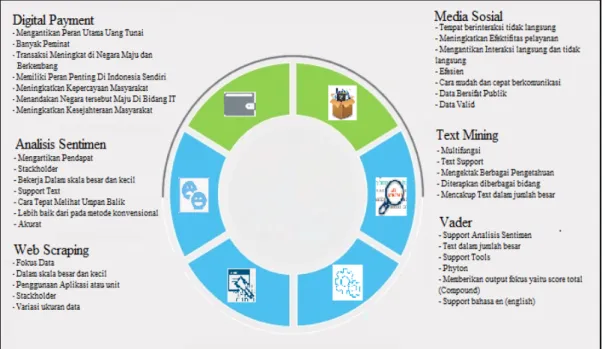
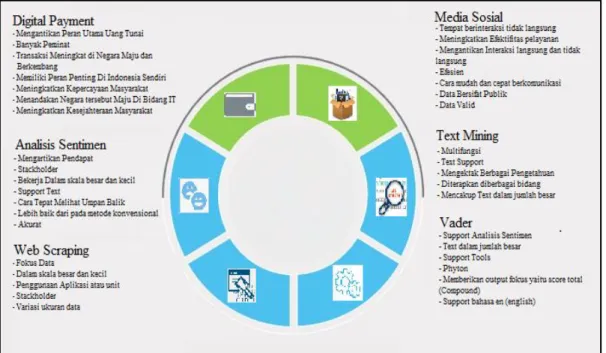
Analisis sentimen selalu dikaitkan dengan data berbentuk textual, penerapan analisis sentimen digunakan untuk menklasifikasikan text untuk dimengerti maknanya. Apakah itu positif, negatif, ataukah netral. Dalam hal ini menerapkan proses analisis untuk mendapatkan hasil memiliki dasar – dasar teori, guna mendukung penelitian yang baik. Untuk membangun penelitian yang baik, konsep dan literature yang releven dapat dijadikan alasan yang kuat penelitian ini ada. Dalam penelitian ini membahas beberapa teori tentang digital payment, sosial media, web crawling, sentiment analysis, text mining, serta metode analisis vader. Berikut ini penjelasan beberapa konsep pendukung penelitian ini:
DIGITAL PAYMENT
2 | Perbandingan Analisis Sentimen Terhadap Digital Payment “T-cash dan Go-pay” Di Sosial Media Menggunakan Orange Data Mining
Dalam penyelelarasannya dengan penelitian ini, digital payment digunakan sebagai alat pembayaran yang sedang tren saat ini. Menurut peraturan Bank Indonesia (BI), (20/6/pbi/2018), pembayaran elektronis adalah pembayaran yang memanfaatkan teknologi informasi dan komunikasi seperti integrated circuit (IC), cryptography dan jaringan komunikasi. Menurut Cohn (2001); EU (2014) dalam [4], Digital Payment (juga disebut uang elektronik, mata uang digital, atau e-cash) tersedia dalam dua bentuk dasar; jaringan komputer dan sistem penyimpanan digital. Di tahun-tahun belakangan ini ada minat yang cukup besar dalam pengembangan skema uang digital. Uang digital dipandang memiliki potensi untuk mengambil alih dari uang tunai sebagai alat pembayaran utama. Jaminan uang jenis ini adalah kepercayaan masyarakat [5]. Faktanya, uang digital secara luas diperdebatkan untuk menjadi lebih besar potensi untuk menggantikan mata uang bank sentral [4]. Jumlah dan populasi penggunaan transaksi non-tunai semakin meningkat tiap tahunnya, hal ini ditandai dengan penelitian [4] yang menunjukkan contoh negara dan jumlah pembayaran yang mereka lakukan tanpa menggunakan uang tunai (non-tunai) lebih banyak digunakan saat ini. Kehadiran digital payment memiliki peran penting dalam transaksi jual beli di indonesia sendiri. Adanya T-cash dan Go-pay adalah sebagian dari perkembangan digital payment di indonesia. Kedepannya mungkin lebih banyak lagi jenis digital payment dengan teknologi yang lebih modern. Adanya e-money merupakan indikator sebuah negara telah maju dibidang IT, dikarenakan menurut Dias (2000) mengemukakan bahwa penggunaan alat pembayaran non-tunai oleh masyarakat secara luas dimungkinkan jika keberadaan alat pembayaran non tunai dapat memberikan manfaat atau meningkatkan kesejahteraan masyarakat [5].
SOSIAL MEDIA
Menurut Constantinides, dkk., (2013) dalam [6] Sosial media adalah aplikasi web generasi kedua yang memungkinkan penciptaan jaringan online individu. Untuk lebih lanjut Yu & Wu (2014) dalam penlitian [6], mengungkapkan sosial media memungkinkan pengguna untuk membangun jaringan sosial dan berinteraksi satu sama lain dalam lingkungan internet. Sosial media telah menjadi gaya hidup bagi semua orang di seluruh dunia. Penggunaan teknologi memungkinkan peningkatan efektifitas dalam pemulihan layanan. Seperti diungkapkan Fan et al, (2010) dalam penelitian [6], saat ini interaksi manusia telah digantikan oleh teknologi layanan online. Layanan online seperti sosial media memberikan kesempatan pelanggan untuk menyampaikan keluhan secara mudah dan cepat (Ding & Lii, (2016) dalam [6]. Sosial media telah banyak digunakan perusahaan sebagai layanan pelanggan (Menne & Halova (2013); Einwiller & Steilen (2015) dalam [6] dengan sosial media, pelanggan dapat menyampaikan pertanyaan, keluhan, atau saran mengenai produk dan layanan yang diberikan oleh perusahaan. Sosial media merupakan sasaran penting untuk sample mendapatkan data yang valid. Begitu pula dengan penelitian ini untuk melihat bagaimana respon pengguna terhadap digital payment T-cash dan Go-pay peneliti menggunakan sosial media sebagai sumber data. Saat ini perusahaan besar menggunakan sosial media sebagai kebutuhan analisis umpan balik produk dimana hal ini lebih efisien dibandingkan survey lapangan. Review – review poduk lebih mudah di dapatkan melalui sosial media yang mengunakan data dari sosial media. Penelitian ini menggunakan Instagram sebagai sumber data dengan alasan yaitu instagram adalah sosial media yang sedang tren beberapa tahun belakangan ini, jumlah followers akun resmi objek di instagram lebih banyak dan followers lebih aktif berkomentar dari pada di sosial media lainnya, dan yang terakhir dengan melihat ketersediaan data dari pengguna yang berkomentar di instagram telah memadai.
WEB SCRAPING
Proses pengambilan informasi dari website - website yang ada ini disebut dengan “web scraping”. Pada penelitian ini pengumpulan informasi terkait data penelitian, dilakukan dengan teknik web scraping (Turland, 2010) dalam [7]. Web scraping sering dikenal sebagai screen scraping. Web Scraping tidak dapat dimasukkan dalam bidang data mining karena data mining menyiratkan upaya untuk memahami pola semantik atau tren dari sejumlah besar data yang telah diperoleh. Aplikasi web scraping (juga disebut intelligent, automated, atau autonomous agents) hanya fokus pada cara memperoleh data melalui pengambilan dan ekstraksi data dengan ukuran data yang bervariasi.
Saat ini penggunaan web scarping digunakan untuk mengeruk informasi dari website – website bahkan beberapa sosial media seperti Instagram untuk mendapatkan data penelitian. Dalam penelitian ini web scraping dilakukan dengan menggunakan aplikasi bernama Jarvee. Manfaat dari web scraping ialah agar informasi yang dikeruk lebih terfokus sehingga memudahkan dalam melakukan pencarian sesuatu. (Juliasari & Sitompul, 2012).
TEXT MINING
Text – text dalam jumlah besar merupakan kesulitan utama dalam mengestrak berbagai pengetahuan. Dalam
penerapannya tidak segala text dapat diambil sebagai bahan. Inilah pemicu yang dalam perumusan penelitian
agar menggunakan Text Mining. Menurut Fan, Dkk., (2006) dalam penelitian (Talib dkk., 2016), Text Mining
adalah proses untuk mengekstrak menarik dan pola signifikan untuk mengeksplorasi pengetahuan dari
sumber data tekstual. Text mining adalah bidang multi-disiplin berdasarkan pencarian informasi, penambangan
data, pembelajaran mesin, statistic, dan linguistik komputasional. Beberapa teknik penambangan teks seperti
Novita Anggraini | 3 summarization, classification, clustering, dll., dapat diterapkan untuk mengekstrak pengetahuan. Menurut Weiss, dkk., (2010) dalam penelitian [8], Teknik Text Mining terus diterapkan di industri, akademisi, web aplikasi, internet, dan bidang lainnya. Dan menurut He, (2013) dalam penelitian [8], area aplikasi seperti mesin pencari, sistem manajemen hubungan pelanggan, email filter, analisis saran produk, deteksi penipuan, dan analisis media sosial menggunakan text mining untuk mendapat opini mining, ekstraksi fitur, sentiment, prediksi, dan analisis tren (trending topic). Text mining menjadi pendukung penelitian ini dimana text mining digunakan untuk mendapatkan hasil sentimen dari sumber textual yang dimulai dari pengolahan data hingga mendapatkan hasil analisis dalam penelitian ini.
ANALISIS SENTIMEN
Menurut Putranti & Winarko, (2014) dalam [9], Analisis Sentimen adalah riset komputasional dari opini, sentimen dan emosi yang diekpresikan secara tekstual. Analisis sentimen juga sebuah proses penentuan apakah sebuah kalimat atau abstrak atau bagian dari kategori positif, negatif atau neutral. Itu juga diistilahkan sebagai Opini Mining karena memperoleh pendapat atau pembicara atau penulis sehubungan dengan beberapa topik atau keseluruhan konteks dokumen. Analisis sentimen banyak diterapkan untuk ulasan atau media sosial untuk menemukan bagaimana orang atau pelanggan merasa tentang beberapa topik. Tugas dasar analisis sentimen adalah menganalisis dan mengklasifikasikan "polarity" dari teks yang diberikan dalam sebuah dokumen atau kalimat, apakah yang diungkapkan pendapat dalam dokumen atau kalimat positif, negatif atau netral. Pada dasarnya target analisis sentimen adalah untuk temukan pendapat, umpan balik atau ulasan, dan kemudian mengidentifikasi sentimen yang ingin mereka ekspresikan dan kemudian mengklasifikasikan polarity disana yaitu positif, negatif atau neutral (Wu., dkk., (2011) dalam [10]. Menurut [11] dalam penelitiannya mengungkapkan bahwa sentiment analysis tepat untuk melihat umpan balik sebuah produk dengan melihat review di sebuah website, blog, atau sosial media dibandingkan dengan metode survey. Dalam penelitian ini penulis
mendapatkan hasil dengan memanfaatkan sistem berbasis Rule based dan Machine learning dan ditemukan bahwa prosedur pembelajaran mesin lebih tepat dan akurat dalam mengantisipasi kesimpulan dari kalimat atau menemukan sentimen yang terkait dengan kalimat.[10]. Analisis sentimen menggunakan Orange Data Mining melibatkan SentimentAnalyzer. SentimentAnalyzer adalah alat (tools) untuk menerapkan dan memfasilitasi tugas analisis sentimen menggunakan fitur NLTK (Natural Language Toolkit) dan pengklasifikasi, terutama untuk tujuan pengajaran dan demonstratif [12]. NLTK adalah platform terkemuka untuk membangun program Python untuk bekerja dengan data bahasa manusia (bahasa sehari-hari). Menyediakan antarmuka yang mudah digunakan untuk lebih dari 50 sumber daya korporat (corpora) dan leksikal (perpustakaan) seperti WordNet, bersama dengan seperangkat perpustakaan pengolahan teks untuk klasifikasi, tokenization, stemming, tagging, parsing, dan penalaran semantik, pembungkus untuk lexicon NLP (Natural Language Processing) dengan kekuatan industri, dan forum diskusi aktif [13] NLP menjadi semakin luas penerapannya. Misalnya pada, telepon dan komputer genggam mendukung teks prediktif dan pengenalan tulisan tangan; mesin pencari web memberikan akses ke informasi yang terkunci dalam teks tidak terstruktur, mesin terjemahan memungkinkan kita untuk mengambil teks yang ditulis dalam bahasa Mandarin dan membacanya dalam bahasa Spanyol. Dengan menyediakan lebih banyak antarmuka natural human-machine, dan akses yang lebih canggih ke informasi yang disimpan, pemrosesan bahasa telah memainkan peran sentral dalam masyarakat informasi multi-bahasa [14].
PREPOCESS TEXT
Menurut Hemalatha, dkk dalam penelitian [15] Preprocessing dilakukan untuk menghindari data yang kurang sempurna, gangguan pada data, dan data-data yang tidak konsisten. Preprocess Text membagi teks sehingga menjadi unit - unit yang lebih kecil (token), filtering, melakukan normalisasi (stemming, lemmatization), membuat n-gram dan tag token dengan label part-of-speech. Langkah-langkah dalam analisis adalah diterapkan secara berurutan dan dapat diaktifkan atau dinonaktifkan. Prepocess text akan melaporan beberapa hal seperti jumlah dokumen (tentang jumlah dokumen di memasukkan), total token (menghitung semua token dalam corpus (kumpulan dokumen)), dan token yang dilaporkan hanya pada token unik di corpus bukan token duplikat [16, hlm. 3]. Dalam prepocess text data penelitian ini akan melali tahap – tahap berikut:
1. Transformation, Mengubah data input. Meliputi: Lowercase, akan mengubah semua teks menjadi huruf kecil.
2. Tokenization, Tokenisasi adalah metode memecah teks menjadi komponen yang lebih kecil (kata, kalimat, bigrams).
3. Normalization, berlaku stemming (menguraikan) dan lemmatization (memilah) kata-kata. (contoh I’ve always loved cats → I have always loved cats).
4. Filtering, Pemfilteran menghapus atau menyimpan pilihan kata. Meliputi: Stopwords menghapus kata -
kata penutup dari teks (misalnya menghapus 'and', 'or', 'in' dll).
4 | Perbandingan Analisis Sentimen Terhadap Digital Payment “T-cash dan Go-pay” Di Sosial Media Menggunakan Orange Data Mining
VADER (Lexicon- and Rule-Based Sentiment Analysis)
VADER (for Valence Aware Dictionary for Sentiment Reasoning) termasuk jenis analisis sentimen yang didasarkan pada lexicon (a library) kata-kata yang terkait sentimen. Dalam pendekatan ini, masing-masing kata di dalam lexicon dinilai apakah itu positif atau negatif, dan dalam banyak kasus, seberapa jumlah positif dan seberapa jumlah negatif dalam penelitian ini mencoba mencari seberapa positif, negatif dan netral. Di bawah ini kita dapat melihat kutipan dari VADER Lexicon, di mana lebih banyak kata positif memiliki peringkat positif lebih tinggi dan lebih banyak kata negatif memiliki peringkat negatif yang lebih rendah. Proses analisis sentimen menggunakan Orange data mining dengan memanfaatkan metode analisis sentimen Vader (Lexicon- and Rule- Based Sentiment Analysis), menghasilkan Output score untuk beberapa kategori (negatif, positif, neutral) dan menambahkan score sentimen total yang disebut compound (combined score) dengan nilai score berupa negative score untuk negative sentiment, positive untuk positive, 0 adalah neutral [17, hlm. 3]. Metode analisis vader merupakan package bahasa pemrograman phyton dari fitur NLTK (Natural Language Toolkit) bersamaan dengan metode liu hu dan sentimenanalyzer tools yang dapat digunakan untuk pengkategorian class sentimen pada Orange Data Mining dengan source bahasa metode vader yaitu en (english) [18].
Gambar 2.1. Konsep Analisis Sentimen
Dibawah ini
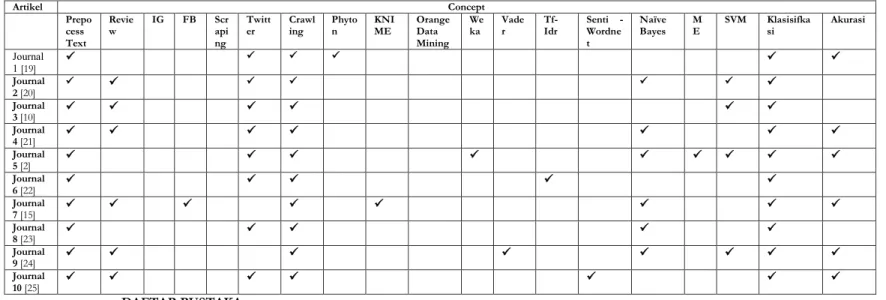
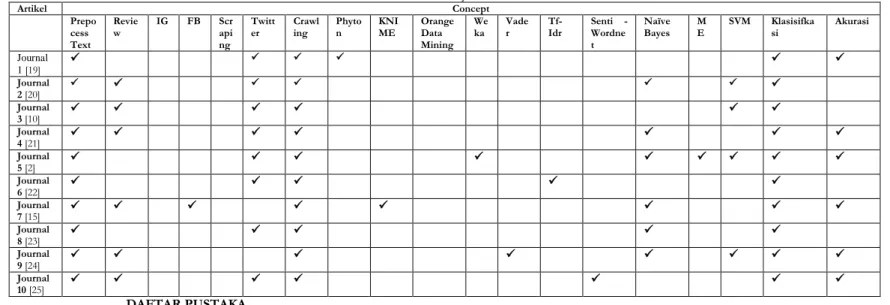
Concept Matrix
untuk melihat faktor – faktor apa saja yang terlibat dalam analisis sentimen berdasarkan penelitian terdahulu yang melandasi penelitian ini.Tabel 2.1.
Concept Matrix
Artikel Concept
Prepo cess Text
Revie
w IG FB Scr
aping Twitt
er Crawl
ing Phyto
n KNI
ME Orange
Data Mining
Weka Vade
r Tf-
Idr Senti - Wordne t
Naïve
Bayes M
E SVM Klasisifka
si Akurasi
Journal
1 [19]
Journal
2 [20]
Journal
3 [10]
Journal
4 [21]
Journal
5 [2]
Journal
6 [22]
Journal
7 [15]
Journal
8 [23]
Journal
9 [24]
Journal
10 [25]
DAFTAR PUSTAKA
Novita Anggraini | 5
[1] “Tentang Kami | SEMUA BISA #pakeTCASH.” [Daring]. Tersedia pada: https://www.tcash.id/about. [Diakses:
03-Des-2018].
[2] G. A. Buntoro, “Analisis Sentimen Calon Gubernur DKI Jakarta 2017 Di Twitter,” J. Tek. Inform., hlm. 11, 2017.
[3] NLTK, “nltk.sentiment package.” [Daring]. Tersedia pada:
http://www.nltk.org/api/nltk.sentiment.html#module-nltk.sentiment. [Diakses: 30-Nov-2018].
[4] A. M. Al-Khouri, “Digital Payment Systems: Global Opportunities Still Waiting to be Unleashed,” Bus. Econ. Res., vol. 4, no. 2, hlm. 136, Sep 2014.
[5] B. Pramono, T. Yanuarti, P. D. Purusitawati, dan Y. T. Emmy D.K., “Dampak Pembayaran Non Tunai Terhadap Perekonomian Dan Kebijakan Moneter.” 2006.
[6] R. A. Setiawan dan D. B. Setyohadi, “Analisis Komunikasi Sosial Media Twitter sebagai Saluran Layanan Pelanggan Provider Internet dan Seluler di Indonesia,” J. Inf. Syst. Eng. Bus. Intell., vol. 3, no. 1, hlm. 16, Apr 2017.
[7] A. Josi dan L. A. Abdillah, “Penerapan Teknik Web Scraping Pada Mesin Pencari Artikel Ilmiah,” Program Studi Tek. Inform. Dan Program Studi Sist. Inf., hlm. 6, 2014.
[8] R. Talib, M. Kashif, S. Ayesha, dan F. Fatima, “Text Mining: Techniques, Applications and Issues,” Int. J. Adv.
Comput. Sci. Appl., vol. 7, no. 11, 2016.
[9] I. Zulfa dan E. Winarko, “Sentimen Analisis Tweet Berbahasa Indonesia Dengan Deep Belief Network,” IJCCS Indones. J. Comput. Cybern. Syst., vol. 11, no. 2, hlm. 187, Jul 2017.
[10] Anshuman, S. Rao, dan M. Kakkar, “A rating approach based on sentiment analysis,” dalam 2017 7th International Conference on Cloud Computing, Data Science & Engineering - Confluence, Noida, India, 2017, hlm. 557–562.
[11] M. Karim dan S. Das, “Sentiment Analysis on Textual Reviews,” IOP Conf. Ser. Mater. Sci. Eng., vol. 396, hlm.
012020, Agu 2018.
[12] “nltk.sentiment package — NLTK 3.4 documentation.” [Daring]. Tersedia pada:
http://www.nltk.org/api/nltk.sentiment.html#module-nltk.sentiment. [Diakses: 03-Des-2018].
[13] “Natural Language Toolkit — NLTK 3.4 documentation.” [Daring]. Tersedia pada: https://www.nltk.org/.
[Diakses: 03-Des-2018].
[14] “Preface.” [Daring]. Tersedia pada: http://www.nltk.org/book_1ed/ch00.html. [Diakses: 03-Des-2018].
[15] S. Gusriani, K. D. K. Wardhani, dan M. I. Zul, “Analisis Sentimen Terhadap Toko Online di Sosial Media Menggunakan Metode Klasifikasi Naïve Bayes (Studi Kasus: Facebook Page BerryBenka),” hlm. 7.
[16] “Preprocess Text — Orange3 Text Mining documentation.” [Daring]. Tersedia pada: https://orange3- text.readthedocs.io/en/latest/widgets/preprocesstext.html. [Diakses: 03-Des-2018].
[17] “Sentiment Analysis — Orange3 Text Mining documentation.” [Daring]. Tersedia pada: https://orange3- text.readthedocs.io/en/latest/widgets/sentimentanalysis.html. [Diakses: 03-Des-2018].
[18] “nltk.sentiment package — NLTK 3.4 documentation.” [Daring]. Tersedia pada:
http://www.nltk.org/api/nltk.sentiment.html#module-nltk.sentiment. [Diakses: 03-Des-2018].
[19] N. Buslim, B. Busman, N. S. Sinatrya, dan T. S. Kania, “Analisa Sentimen Menggunakan Data Twitter, Flume, Hive Pada Hadoop dan Java Untuk Deteksi Kemacetan di Jakarta,” J. Online Inform., vol. 3, no. 1, hlm. 1, Jun 2018.
[20] A. Cambero, “A Comparative Study of Twitter Sentiment Analysis Methods for Live Applications,” Theses Rochester Inst. Technol. RIT Sch. Works, hlm. 43, 2016.
[21] D. P. Artanti, A. Syukur, dan A. Prihandono, “Analisa Sentimen Untuk Penilaian Pelayanan Situs Belanja Online Menggunakan Algoritma Naïve Bayes,” hlm. 6, 2018.
[22] I. Sunni dan D. H. Widyantoro, “Analisis Sentimen dan Ekstraksi Topik Penentu Sentimen pada Opini Terhadap Tokoh Publik,” hlm. 7.
[23] E. U. Artha dan A. Dahlan, “Klasifikasi Model Percakapan Twitter Mengenai Ujian Nasional,” J. Inform., hlm. 5, 2018.
[24] C. J. Hutto dan E. Gilbert, “VADER: A Parsimonious Rule-based Model for Sentiment Analysis of Social Media Text,” hlm. 10, 2014.
[25] F. M. Kundi, A. Khan, S. Ahmad, dan M. Z. Asghar, “Lexicon-Based Sentiment Analysis in the Social Web,” J.
Basic Appl. Sci. Res., hlm. 12, 2014.
1
Perbandingan Analisis Sentimen Terhadap Digital Payment “T-cash dan Go-pay”
Di Sosial Media Menggunakan Orange Data Mining
1. PENDAHULUAN
Saat ini pembicaraan publik di sosial media menjadi salah satu hal menarik untuk diteliti. Dari topik pembicaraan itu menghasilkan komentar yang sebagian besar mengandung opini sentimen. Contohnya topik viral yang sering dibicarakan saat ini adalah digital payment yang merupakan hasil analisis kebutuhan prilaku manusia dan menghasilkan inovasi baru berupa sebuah alat pembayaran digital. Hasilnya saat ini banyak jenis digital payment yang telah di kenal masyarakat dua dari mereka adalah T-cash dan Go-pay, keduanya sama – sama digital payment yang memiliki jumlah pengguna yang banyak saat ini.
T-cash dan Go-pay merupakan digital payement tersebut merupakan produk yang digemari oleh pengguna saatr ini. Contohnya saja T-cash, dimana T-cash telah sukses menjangkau sekitar 25 juta pelanggan di 34 provinsi, serta bisa digunakan di lebih dari 75.000 merchant outlets [1]. Sama halnya dengan T-cash, Go-pay juga digital payment yang memiliki jutaan pengguna yang mengemari aplikasi raksasa dengan vendor Go-jek ini. Lalu dari keduanya lalu muncul pertanyaan siapakah yang lebih baik? Pada dasarnya penelitian ini mencoba menganalisis persepsi berdasarkan komentar pengguna dimedia sosial. Hasilnya adalah penelitian ini memikirkan bagaimana suatu komentar dapat diekstrak dan memeberikan hasil berupa nilai positif, negatif, dan neutral dengan analisis sentimen (Sentiment Analysis).
Tujuan dari penelitian ini adalah mencoba melihat perbandingan seberapa positif, negatif, dan neutral komentar pengguna dari analisis sentimen. Penelitian serupa pernah dilakukan sebelumnya, contohnya pada penelitian [2] yang mencoba menganalisis komentar namun menggunakan skala kecil data, dimana data dianalisis masih memerlukan ahli bahasa untuk dapat membenarkan analisisnya. Lalu bagaimana jika jumlah data yang besar seperti pada penelitian ini? Komentar pengguna dimedia sosial adalah data yang tak terhingga yang didapatkan dengan tehnik scraping web, dimana komentar dikeruk berdasarkan link, sehingga perlu tehnik khusus untuk mengolahnya dari instagram. Hasillnya, penelitian ini mencoba menganalisis komentar dengan metode analisis vader, yaitu metode analisis lexicon-based berbasis rule-based sentiment analysis.
Vader akan menganalisis text berdasarkan lexicon (a library) yang menghasilkan class sentimen berupa positif, negatif, dan neutral dengan tambahan skor total atau compound (combined score). Dalam melakukan sentiment analist sendiri penelitian ini menggunakan Orange Data Mining. Penelitian ini juga memanfaatkan Prepocess text dalam Orange Data Mining yang meliputi transformation, tokenization, normalization, dan filtering yang bertujuan agar text bisa dianalisis oleh Orange Data Mining guna mendapat perbandingan analisis sentimen terhadap T-cash dan Go- pay di sosial media. Penelitian ini juga memerlukan alih bahasa dari id ke en karena vader merupakan metode analisis sentimen dengan bahasa english [3]. Namun pada penerapannya vader sangat membantu sekali bagi perusahaan – perusahaan besar untuk dapat menganalisis perspektif pelanggan dengan bantuan Orange Data Mining hal ini dikarenakan jika menggunakan pengkategorian manual seperti pada penelitian sebelumnya [2]
dinilai kurang efektif. Maka dari itu dalam proses mengumpulkan data dengan teknik Information Scraping pada penelitian ini memanfaatkan MT (machine translating) menggunakan fungtion GoogleTranslate() dari Google drive spreadsheet dengan filtering ejaan terlebih dahulu barulah di translate guna mendapatkan data dengan source bahasa en (english) untuk menunjang proses penelitian berbasis machine learning menggunakan Orange Data Mining.
Penelitian ini mencoba melihat perbandingan dari seberapa positif, negatif, dan netral dari hasil analisis sentimen menggunakan Orange Data Mining. Data yang diambil dalam kurun waktu beberapa bulan postingan terakhir akan dianalisis dan direkaptulasi hasilnya lalu barulah hasil rekaptulasi dibandingkan.
2. KONSEP ANALISIS SENTIMEN
Analisis sentimen selalu dikaitkan dengan data berbentuk textual, penerapan analisis sentimen digunakan untuk menklasifikasikan text untuk dimengerti maknanya. Apakah itu positif, negatif, ataukah netral. Dalam hal ini menerapkan proses analisis untuk mendapatkan hasil memiliki dasar – dasar teori, guna mendukung penelitian yang baik. Untuk membangun penelitian yang baik, konsep dan literature yang releven dapat dijadikan alasan yang kuat penelitian ini ada. Dalam penelitian ini membahas beberapa teori tentang digital payment, sosial media, web crawling, sentiment analysis, text mining, serta metode analisis vader. Berikut ini penjelasan beberapa konsep pendukung penelitian ini:
DIGITAL PAYMENT
2 | Perbandingan Analisis Sentimen Terhadap Digital Payment “T-cash dan Go-pay” Di Sosial Media Menggunakan Orange Data Mining
Dalam penyelelarasannya dengan penelitian ini, digital payment digunakan sebagai alat pembayaran yang sedang tren saat ini. Menurut peraturan Bank Indonesia (BI), (20/6/pbi/2018), pembayaran elektronis adalah pembayaran yang memanfaatkan teknologi informasi dan komunikasi seperti integrated circuit (IC), cryptography dan jaringan komunikasi. Menurut Cohn (2001); EU (2014) dalam [4], Digital Payment (juga disebut uang elektronik, mata uang digital, atau e-cash) tersedia dalam dua bentuk dasar; jaringan komputer dan sistem penyimpanan digital. Di tahun-tahun belakangan ini ada minat yang cukup besar dalam pengembangan skema uang digital. Uang digital dipandang memiliki potensi untuk mengambil alih dari uang tunai sebagai alat pembayaran utama. Jaminan uang jenis ini adalah kepercayaan masyarakat [5]. Faktanya, uang digital secara luas diperdebatkan untuk menjadi lebih besar potensi untuk menggantikan mata uang bank sentral [4]. Jumlah dan populasi penggunaan transaksi non-tunai semakin meningkat tiap tahunnya, hal ini ditandai dengan penelitian [4] yang menunjukkan contoh negara dan jumlah pembayaran yang mereka lakukan tanpa menggunakan uang tunai (non-tunai) lebih banyak digunakan saat ini. Kehadiran digital payment memiliki peran penting dalam transaksi jual beli di indonesia sendiri. Adanya T-cash dan Go-pay adalah sebagian dari perkembangan digital payment di indonesia. Kedepannya mungkin lebih banyak lagi jenis digital payment dengan teknologi yang lebih modern. Adanya e-money merupakan indikator sebuah negara telah maju dibidang IT, dikarenakan menurut Dias (2000) mengemukakan bahwa penggunaan alat pembayaran non-tunai oleh masyarakat secara luas dimungkinkan jika keberadaan alat pembayaran non tunai dapat memberikan manfaat atau meningkatkan kesejahteraan masyarakat [5].
SOSIAL MEDIA
Menurut Constantinides, dkk., (2013) dalam [6] Sosial media adalah aplikasi web generasi kedua yang memungkinkan penciptaan jaringan online individu. Untuk lebih lanjut Yu & Wu (2014) dalam penlitian [6], mengungkapkan sosial media memungkinkan pengguna untuk membangun jaringan sosial dan berinteraksi satu sama lain dalam lingkungan internet. Sosial media telah menjadi gaya hidup bagi semua orang di seluruh dunia. Penggunaan teknologi memungkinkan peningkatan efektifitas dalam pemulihan layanan. Seperti diungkapkan Fan et al, (2010) dalam penelitian [6], saat ini interaksi manusia telah digantikan oleh teknologi layanan online. Layanan online seperti sosial media memberikan kesempatan pelanggan untuk menyampaikan keluhan secara mudah dan cepat (Ding & Lii, (2016) dalam [6]. Sosial media telah banyak digunakan perusahaan sebagai layanan pelanggan (Menne & Halova (2013); Einwiller & Steilen (2015) dalam [6] dengan sosial media, pelanggan dapat menyampaikan pertanyaan, keluhan, atau saran mengenai produk dan layanan yang diberikan oleh perusahaan. Sosial media merupakan sasaran penting untuk sample mendapatkan data yang valid. Begitu pula dengan penelitian ini untuk melihat bagaimana respon pengguna terhadap digital payment T-cash dan Go-pay peneliti menggunakan sosial media sebagai sumber data. Saat ini perusahaan besar menggunakan sosial media sebagai kebutuhan analisis umpan balik produk dimana hal ini lebih efisien dibandingkan survey lapangan. Review – review poduk lebih mudah di dapatkan melalui sosial media yang mengunakan data dari sosial media. Penelitian ini menggunakan Instagram sebagai sumber data dengan alasan yaitu instagram adalah sosial media yang sedang tren beberapa tahun belakangan ini, jumlah followers akun resmi objek di instagram lebih banyak dan followers lebih aktif berkomentar dari pada di sosial media lainnya, dan yang terakhir dengan melihat ketersediaan data dari pengguna yang berkomentar di instagram telah memadai.
WEB SCRAPING
Proses pengambilan informasi dari website - website yang ada ini disebut dengan ―web scraping‖. Pada penelitian ini pengumpulan informasi terkait data penelitian, dilakukan dengan teknik web scraping (Turland, 2010) dalam [7]. Web scraping sering dikenal sebagai screen scraping. Web Scraping tidak dapat dimasukkan dalam bidang data mining karena data mining menyiratkan upaya untuk memahami pola semantik atau tren dari sejumlah besar data yang telah diperoleh. Aplikasi web scraping (juga disebut intelligent, automated, atau autonomous agents) hanya fokus pada cara memperoleh data melalui pengambilan dan ekstraksi data dengan ukuran data yang bervariasi.
Saat ini penggunaan web scarping digunakan untuk mengeruk informasi dari website – website bahkan beberapa sosial media seperti Instagram untuk mendapatkan data penelitian. Dalam penelitian ini web scraping dilakukan dengan menggunakan aplikasi bernama Jarvee. Manfaat dari web scraping ialah agar informasi yang dikeruk lebih terfokus sehingga memudahkan dalam melakukan pencarian sesuatu. (Juliasari & Sitompul, 2012).
TEXT MINING
Text – text dalam jumlah besar merupakan kesulitan utama dalam mengestrak berbagai pengetahuan. Dalam penerapannya tidak segala text dapat diambil sebagai bahan. Inilah pemicu yang dalam perumusan penelitian agar menggunakan Text Mining. Menurut Fan, Dkk., (2006) dalam penelitian (Talib dkk., 2016), Text Mining adalah proses untuk mengekstrak menarik dan pola signifikan untuk mengeksplorasi pengetahuan dari sumber data tekstual. Text mining adalah bidang multi-disiplin berdasarkan pencarian informasi, penambangan data, pembelajaran mesin, statistic, dan linguistik komputasional. Beberapa teknik penambangan teks seperti
Novita Anggraini | 3
summarization, classification, clustering, dll., dapat diterapkan untuk mengekstrak pengetahuan. Menurut Weiss, dkk., (2010) dalam penelitian [8], Teknik Text Mining terus diterapkan di industri, akademisi, web aplikasi, internet, dan bidang lainnya. Dan menurut He, (2013) dalam penelitian [8], area aplikasi seperti mesin pencari, sistem manajemen hubungan pelanggan, email filter, analisis saran produk, deteksi penipuan, dan analisis media sosial menggunakan text mining untuk mendapat opini mining, ekstraksi fitur, sentiment, prediksi, dan analisis tren (trending topic). Text mining menjadi pendukung penelitian ini dimana text mining digunakan untuk mendapatkan hasil sentimen dari sumber textual yang dimulai dari pengolahan data hingga mendapatkan hasil analisis dalam penelitian ini.ANALISIS SENTIMEN
Menurut Putranti & Winarko, (2014) dalam [9], Analisis Sentimen adalah riset komputasional dari opini, sentimen dan emosi yang diekpresikan secara tekstual. Analisis sentimen juga sebuah proses penentuan apakah sebuah kalimat atau abstrak atau bagian dari kategori positif, negatif atau neutral. Itu juga diistilahkan sebagai Opini Mining karena memperoleh pendapat atau pembicara atau penulis sehubungan dengan beberapa topik atau keseluruhan konteks dokumen. Analisis sentimen banyak diterapkan untuk ulasan atau media sosial untuk menemukan bagaimana orang atau pelanggan merasa tentang beberapa topik. Tugas dasar analisis sentimen adalah menganalisis dan mengklasifikasikan "polarity" dari teks yang diberikan dalam sebuah dokumen atau kalimat, apakah yang diungkapkan pendapat dalam dokumen atau kalimat positif, negatif atau netral. Pada dasarnya target analisis sentimen adalah untuk temukan pendapat, umpan balik atau ulasan, dan kemudian mengidentifikasi sentimen yang ingin mereka ekspresikan dan kemudian mengklasifikasikan polarity disana yaitu positif, negatif atau neutral (Wu., dkk., (2011) dalam [10]. Menurut [11] dalam penelitiannya mengungkapkan bahwa sentiment analysis tepat untuk melihat umpan balik sebuah produk dengan melihat review di sebuah website, blog, atau sosial media dibandingkan dengan metode survey. Dalam penelitian ini penulis mendapatkan hasil dengan memanfaatkan sistem berbasis Rule based dan Machine learning dan ditemukan bahwa prosedur pembelajaran mesin lebih tepat dan akurat dalam mengantisipasi kesimpulan dari