Ad Hoc Multi-Input Functional Encryption
Shweta Agrawal?, Michael Clear??, Ophir Frieder? ? ? Sanjam Garg†, Adam O’Neill‡, and Justin Thaler§
Abstract. Considersourcesthat supply sensitive data to anaggregator.
Standard encryption only hides the data from eavesdroppers, but using specialized encryption one can hope to hide the data (to the extent pos- sible) from the aggregator itself. For flexibility and security, we envision schemes that allow sources to supply encrypted data, such that at any point a dynamically-chosen subset of sources can allow an agreed-upon joint function of their data to be computed by the aggregator. A primi- tive called multi-input functional encryption (MIFE), due to Goldwasser et al.(EUROCRYPT 2014), comes close, but has two main limitations:
– it requires trust in a third party, who is able to decrypt all the data, and
– it requires function arity to be fixed at setup time and to be equal to the number of parties.
To drop these limitations, we introduce a new notion ofad hoc MIFE.
In our setting, each source generates its own public key and issues in- dividual, function-specific secret keys to an aggregator. For successful decryption, an aggregator must obtain a separate key from each source whose ciphertext is being computed upon. The aggregator could obtain multiple such secret-keys from a user corresponding to functions of vary- ing arity. For this primitive, we obtain the following results:
– We show that standard MIFE for general functions can be boot- strapped to ad hoc MIFE forfree, i.e. without making any additional assumption.
– We provide a direct construction of ad hoc MIFE for the inner prod- uct functionality based on the Learning with Errors (LWE) assump- tion. This yields the first construction of this natural primitive based on a standard assumption.
At a technical level, our results are obtained by combining standard MIFE schemes and two-round secure multiparty computation (MPC) protocols in novel ways highlighting an interesting interplay between MIFE and two-round MPC in the construction ofnon interactiveprim- itives.
?Dept. of Computer Science and Engineering, IIT Madras. Email:[email protected]
?? Dept. of Computer Science, Georgetown University. Email:[email protected]
? ? ? Dept. of Computer Science, Georgetown University. Email:
†Dept. of EECS, University of California at Berkeley. Email:[email protected]
‡Dept. of Computer Science, University of Massachusetts, Amherst. Email:
§Dept. of Computer Science, Georgetown University. Email:
1 Introduction
In modern society, there is an inherent need for external entities to aggregate and analyze sensitive data from a variety of sources. A few prominent examples are:
– To track diseases, disease control centers would like hospital patients’ medical information.
– To determine medication efficacy for a given subpopulation, pharmaceutical companies would like patients’ genomic information.
– To provide targeted advertising to consumers, corporations would like buy- ers’ demographic information.
However, this release of sensitive data to external entities is unsettling, as these entities must now be trusted to preserve the confidentiality of the released data.
We would like to avoid the need for this trust and believe that specialized en- cryption schemes will be an important tool for doing so. At a high level, we would like schemes that allow users to encrypt their data before transferring them to an external entity, such that only certain user-specified joint functions of the data are revealed to the entity holding it. We would like this security guarantee to be supported in a flexible way, allowing joint functions of the data to be revealed by any dynamically-chosen subset of users that permit it.
A primitive that comes close, due to Goldwasser et al. [42], is multi-input functional encryption (MIFE). To understand MIFE, we first recall the simpler notion of functional encryption (FE) [19]. Just as in traditional encryption, in functional encryption ciphertexts can be generated with an encryption key. How- ever, eachdecryption key is associated with a functionf, and decryption of an encryption of musing this key results in not m but f(m). Intuitively, security requires that nothing more thanf(m) can be learned from the encryption ofm and the decryption key forf. In MIFE, decryption keys allow computing joint functions of (possibly) different plaintexts underlying multiple ciphertexts. That is, decryption takes a key for a function f and ciphertexts c1, . . . cn encrypting m1, . . . , mn, and outputs f(m1, . . . , mn).
However, MIFE has an important drawback: encryption and decryption keys are generated via a global setup procedure run by an external entity usually called the key authority. This begs the question of whether putting trust in the key authority is really better than putting trust in the external entities that aggregate and analyze the data in the first place. A similar point was made by Rogaway about identity-based encryption (IBE) [57]. Indeed, removing this in the simpler case of IBE (and other settings) has been an active area of investigation, e.g. see [17, 46, 33]. We contend that for MIFE (and indeed FE) the concern is heightened, as the authority can not only decrypt all the data but is also the one in charge of which functions of the data other external entities can compute. Hence, MIFE does not allow users to enforce their own privacy policies.
Additionally, from a flexibility standpoint, MIFE is limited in that it fixes the number of senders and function arity at setup time. This does not support
a dynamic setting in which users can join or leave. Progress on removing this limitation was made by Badrinarayananet al. [10], who introduced a notion of MIFE for unbounded arity functions. However, their notion does not allow any subset of users to reveal a joint function of their data to an external entity with- out coordination from all other users, and moreover relies on strong “knowledge type” assumptions.
1.1 Our Notion: Ad Hoc MIFE
To address the above limitations, we introduce a new notion ofad hoc MIFE. In ad hoc MIFE, each source (aka. sender or user) will run alocal setup procedure to generate some public parameters as well as a private encryption key. (One can also consider a public-key setting, but this puts limits on achievable security and we do not do so in this work.1) Each source publishes their public parameters and encrypts using their private key. These ciphertexts can be sent to an aggregator (aka. decryptor). Furthermore, using their private keys, sources can issue “partial decryption keys” to an aggregator. Each partial decryption key is associated with an`-ary functionf for some`and is generated using the public keys of`−1 other (dynamically chosen) sources. If these other`−1 sources also issue “matching”
partial decryption keys forf to this aggregator, it can decrypt any`ciphertexts c1, . . . , c`, each produced by the corresponding source, to f(m1, . . . , m`) where m1, . . . , m` are the plaintexts. One can also consider restricted versions of the above notion, that bound the number of users or fix `(or both). In particular, taking the number of users equal to`gives a version of MIFE that still drops the global setup procedure but lacks the dynamic aspect. Finally, we also consider the restricted notion ofbounded ad hoc MIFE, where we place a bound on the number of “partial decryption keys” a user is allowed to issue. Intuitively, for security, we require that an aggregator learns only the functions of the data for which it has been given all of the matching partial decryption keys.
Note that while we assume each source can obtain the authentic public pa- rameters of other sources with whom it wants to allow joint functions of the data to be computed, there is no other prior coordination between users. In particu- lar, there is no external entity that generates public parameters or keys. In some of our constructions, we work in the common reference string (CRS) model, but note that this is still much weaker than having an authority who can decrypt all the data.
1.2 Our Results
Our results may be summarized as follows:
1 In more detail, in the public-key setting a decryptor could launch an attack where it replaces one user’s input with various values to determine information about the input of another user.
– Feasibility result for general functions: First, we show that standard MIFE for general functions can be bootstrapped to ad hoc MIFE for general func- tions for free. More specifically, we show that ad hoc MIFE for any func- tionality is implied by standard MIFE for that functionality combined in a novel way with general FE and a special type oftwo-round secure multiparty computation (MPC) protocol. The latter two are implied by standard MIFE for general functions.
While very general, the result leaves open the goal of obtaining ad hoc MIFE under standard assumptions. In general, this is challenging as standard MIFE is already known to be equivalent to indistinguishability obfuscation [31, 8, 16], which is a central open problem in cryptography. In fact, some negative evidence about the hardness of obtaining such constructions has also been provided [35, 36]. Thus, with the goal of moving towards using standard as- sumptions, we consider the task of ad hoc MIFE for special but natural functionalities.
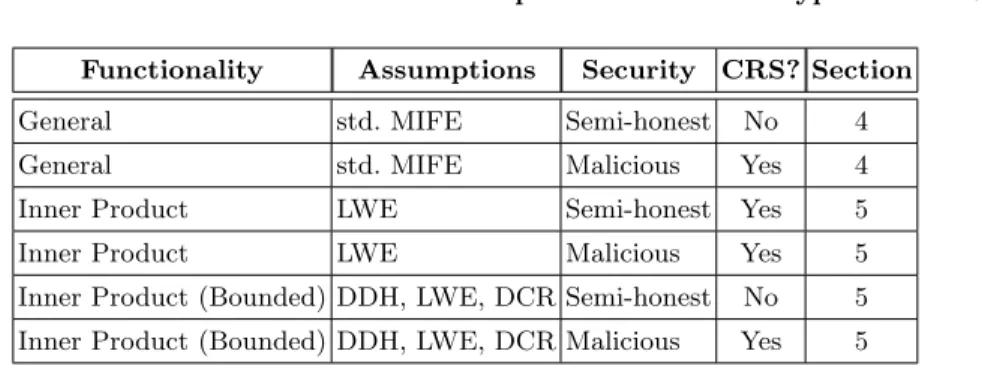
– Constructions for Inner Products from Standard Assumptions: We provide a construction of ad hoc MIFE for the inner product functionality from standard assumptions, namely LWE.2 Introduced by Abdalla et al. [1] in the single-input setting, this functionality has applications in data mining and information retrieval. Our result is obtained via a general paradigm for constructing ad-hoc MIFE schemes from standard MIFE schemes sat- isfying certain natural properties; or, what we call “ad hoc friendly” stan- dard MIFE schemes. We show that certain constructions of standard MIFE scheme for inner products from the literature [3, 2] based on standard as- sumptions (DDH, LWE, or DCR) already satisfy these properties. Addition- ally, we use a specific two-round MPC protocol [54] that can also be obtained via LWE. We note that by using two-round MPC protocol from any two- round OT protocol [39, 40, 14] here, we also obtain results for the case of boundedad hoc MIFE for inner products — namely, we get bounded ad hoc MIFE for inner products from DDH, LWE and DCR as well.3 We remark that since our general construction (first result) already relies on general MIFE for circuits, there is no advantage to mitigating assumptions for the two-round MPC protocol in that setting.
We emphasize that our transformation is general. Thus, our transformation can be used to upgrade the security of any “ad hoc friendly” standard MIFE for a given to ad hoc MIFE for the same functionality. This result might also be useful in obtaining future constructions of ah hoc MIFE. Furthermore, the modularity of this approach allows for simplifications in our constructions.
2 We stress that this functionality outputs inner products in the clear and is therefore a different type of functionality than that of Katz et al.in [51], which tests if an inner product is zero or not.
3 Note that semi-honest constructions of two-round OT are known under each of these assumptions.
Functionality Assumptions Security CRS? Section
General std. MIFE Semi-honest No 4
General std. MIFE Malicious Yes 4
Inner Product LWE Semi-honest Yes 5
Inner Product LWE Malicious Yes 5
Inner Product (Bounded) DDH, LWE, DCR Semi-honest No 5 Inner Product (Bounded) DDH, LWE, DCR Malicious Yes 5
Fig. 1.Our new constructions of ad hoc MIFE.
We tabulate our results in Figure 1 and provide explanation of which MPC protocol is needed for each of the results in Section 1.3.
1.3 Technical Overview
In this section, we describe at a high level the challenges involved in constructing ad hoc MIFE and our techniques for overcoming them.
Ad Hoc MIFE for Arbitrary Functions. Standard MIFE and ad hoc MIFE can be seen as secure multiparty computation (MPC) prtocols with a particular allowable interaction pattern and certain additional reuse capabilities.4To begin, let us consider the interaction pattern followed by standard MIFE. In standard MIFE, there is a trusted global setup which receives as input the number of parties `, and outputs a public key and a set of ` encryption keys. Addition- ally, global setup on input a function f generates the decryption key DKf. Of these, the public parameters are broadcast to all users and encryption key EKi is provided to encryptor i, for i ∈ [`]. The encryptors then compute their ci- phertextsCT(mi) and send these to the aggregator who may now compute the function output f(m1. . . , m`) using the decryption/function key DKf. Finally, the system supports arbitrary number of decryption keys and ciphertexts. As ex- plained in Section 1.1, in ad hoc MIFE, we seek to eliminate the trusted global procedure as well as support dynamic choice of parties involved in any function computation.
Challenges Involved. An approach to eliminating the trusted setup from stan- dard MIFE is to use MPC to replace the global setup. However, naively com- puting the setup procedure using MPC would introduce interaction between the parties, which the syntax of MIFE does not allow. Moreover, this (interactive) procedure would need to be rerun each time a function key is required to be
4 Recall that MPC allows a set of parties to compute a joint function of their inputs without revealing anything else but in general allows these parties to freely interact (although restrictions may apply in special cases).
generated. Using two round MPC, one may hope to overcome the barrier of in- teraction using the following natural idea: let parties perform a two-round MPC to perform the setup and key generation for a standard MIFE. In more detail, parties in the first round could publish as their public parameters the first round MPC messages with their secret randomness as input. Given the first round mes- sages, parties could send the second round MPC message to the aggregator, who could use it to compute the function key. However, this approach does not suffice since:
1. MIFE requires that the public parameters be published only once whereas the above template requires publishing fresh public parameters for each func- tion key.
2. Even more fundamentally, the above approach precludes users from being able to encrypt, as their encryption keys are not available given just the first round MPC message.
In particular, the above approach does not decouple ciphertexts and functions as in traditional MIFE, which leads to the limitation that an evaluator can- not evaluate the same function on multiple inputs chosen by the parties, nor evaluate other functions on the same set of inputs. Additionally, the problem is made challenging by the fact that in MIFE an aggregator might obtain arbi- trary number of secret keys and an encryptor might generate arbitrary number of ciphertexts.
Overcoming the first barrier: Function re-runnable two-round MPC. In order to mitigate the first problem above, we require that the first round MPC message be sent only once, and reused for all subsequent second round messages thus pro- viding re-usability/re-runnability for secret key generation. Towards achieving this re-usability, an idea is to use function rerunnable two-round MPC protocols, where the same first round message can be reused for multiple functions in the second round. As we will see, certain existing two-round MPC protocols satisfy this requirement (see later), but this still does not solve the problem. This is because in adhoc MIFE, we additionally need that for the MPC protocol, the function or even its arity are not known at the time the first round message is sent. We overcome this hurdle by using “function delayed” protocols, which permit the choice of function to be delayed to the second round of the proto- col. Together, these special protocols may be used to overcome the first barrier outlined above.
Overcoming the second barrier: Delaying Encryption. In order to overcome the second barrier, we allow the encryptor to delay the encryption process until the encryption keys are known. In more detail, we will have each source indepen- dently run the setup algorithm of a single input FE scheme, denoted asFE and compute the first round message of an MPC protocol using theFEmaster key as input. This message is published as part of the public key and made available to all other sources. Additionally, each source provides an encryption of its input mi using the algorithmFE.Encrypt.
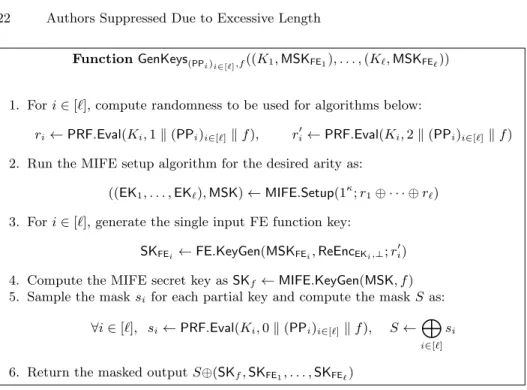
The sources may choose the functionf to be computed and the group that will participate in the computation dynamically. At this point, each source inde- pendently executes the partial key generation algorithm as follows: it generates the second round message of an MPC protocol for a suitablef dependent func- tionalityGenKeysfand sends this to the aggregator. Intuitively, the functionality GenKeysf has the circuitf hard-coded in it, and enables the aggregator to com- pute the output.
However, recall that the inputs to theGenKeysfunctionality are not the mes- sages on which the computation must be performed, but rather the FE master keys generated independently by each player. To proceed, the functionality in- stead uses theFE master keys to computeFEfunction keys for a re-encryption procedure, whichtranslatesFEciphertexts toMIFEciphertexts for a freshly gen- erated (standard) MIFE scheme. During this time, the arity of the function f is known, so a suitable standard MIFE scheme may be instantiated. It further outputs anMIFEfunction key for the functionf.
We are almost done:GenKeysf runs the setup procedure for a suitable fixed arity standardMIFEscheme, computes FE function keys for each party for the re-encryption functionality, computes theMIFEfunction key forf and outputs these. The aggregator uses theFEkeys together with theFEciphertexts provided by each encryptor to translateFE.Enc(mi) toci=MIFE.Enc(mi) and then runs theMIFEdecryption procedure to obtainf(m1, . . . , m`).
Put together, we resolved all difficulties by carefully nesting a a multi-input FE schemeMIFE, within the single input FE schemeFE, which in turn is nested within a re-runnable two-round MPC protocolMPC. For the above idea to work, the MPC protocol must allow the function to be declared after the first round messages have been sent. Fortunately, we can use the re-runnable two-round MPC protocols which come with this “function delayed” property to achieve this.
One final problem remains: the adversary could get some partial information from an “incomplete” set of partial decryption keys for some function. This is because standard MPC makes no guarantee when an honest party does not send their final message. We solve this problem by masking the output of MPC by pseudorandom values generated for each party. The partial decryption keys contains the respective user’s pseudorandom masks value so that only a complete set of user keys can be used to unmask the output.
While security appears to follow intuitively from the security ofMPC,FEand MIFE, the proof must contend with several technical hurdles as we are forced to deal with indistinguishability style security of FE, MIFE(simulation security for these primitives is known to be impossible [19, 6]). We argue security via a careful sequence of hybrids, please see Section 4 for details.
Instantiating MPC. We now discuss possible instantiations of MPC to fit the above template. Depending on the properties of the underlying two-round MPC protocol, we obtain different properties of the resulting ad hoc MIFE scheme. In both the semi-honest (passive decryptor) and the malicious (active decryptor) settings, the most general function-rerunnable, two-round MPC protocols with-
out CRS can be constructed [30, 45] from indistinguishability obfuscation [31], which itself can be constructed from multi-input functional encryption [8]. Fur- thermore, as already noted in [38], we remark that in the semi-honest setting the construction of [30] can actually be instantiated in the plain model. This is based on the observation that the CRS in the protocol of [30] was only needed for the computation in the second round. Thus semi-honest parties could obtain a CRS by just performing a one-round coin flipping in the first round. This yields our first result: we get ad hoc MIFE for general functions from standard MIFE for general functions. In the semi-honest setting, the ad hoc MIFE construction is in the plain model. On the other hand, in the malicious setting, these protocols work in the common reference string (CRS) model.
Alternatively, function-rerunnable two-roundMPCin the common reference string (CRS) model can be constructed [27, 54, 23, 56] from learning-with-errors (LWE). This yields ad hoc MIFE from LWE and standard MIFE in the CRS model (either semi-honest or malicious). While bounded two-roundMPCin the CRS model can be constructed from bilinear maps [39] and even two-round obliv- ious transfer [14, 40, 37] or information theoretically [9, 34], these constructions are not function-rerunnable so do not suffice for our general construction. We note that these constructions would suffice for obtaining bounded ad hoc MIFE, where a user issues only a bounded number of partial decryption keys and main- tains state across key issues. However, since in our general result we anyway require the minimum assumption of FE/MIFE, instantiating MPC from weaker assumptions does not yield any benefits, and we do not discuss this further. Our results are highlighted in Figure 1.
Ad Hoc MIFE for Inner Products. While our construction of ad hoc MIFE above applies to arbitrary functionalities, it requires use of standard MIFE for general functions. Unfortunately, as noted above, standard MIFE implies indis- tinguishability obfuscation. Hence, there is limited hope of basing it on standard assumptions. Additionally, our general transformation uses an FE scheme for a potentially complicated re-encryption functionality and also requires general- purpose, function-rerunnable two-round MPC for computing a complex func- tionality. These aspects limit the practical applicability of our general result.
Next, we describe a paradigm for constructing ad-hoc MIFE schemes from standard MIFE schemes that are “ad hoc friendly” and a (hopefully simple) two-round MPC protocol. This paradigm significantly simplifies our general con- struction and provides a way for basing it on standard assumptions. We then show that the standard MIFE scheme for inner products [3, 2], which may be based on DDH, LWE or DCR, is ad hoc friendly and the corresponding two- round MPC protocol is only required to compute inner-products, thus obtaining an efficient ad hoc MIFE scheme for inner products.
More formally, in the inner product functionality a decryption key corre- sponds to a concatenated vector y = (y1 k · · · k yn) where yi ∈ Zmq , and a ciphertext encrypts a vector xi ∈ Zmq . The desired result of decryption is Pn
i=1hxi,yii. Importantly, the decryptor should not learn the partial sumshxi,yii.
The inner product functionality has applications in data mining and information retrieval [1, 3]. We use constructions of standard MIFE for inner product by [3, 2].
Below, we start by summarizing our notion of “ad hoc freindliness,” which (as we see later) is indeed satisfied by the above mentioned standard MIFE for inner product by [3, 2]. Our notion of ad hoc friendliness may be summarized as follows:
1. Decentralized Setup.TheMIFE.Setupalgorithm of the MIFE is decentralized in the sense that:
(a) The encryption keys EKi for i ∈ [n] corresponding to party i may be generatedindependentlyof the encryption keys of the remaining parties [n]\i.
(b) The master secret key MSK can be decomposed into n components {MSKi}i∈[n]. The partial MSKi corresponding to party i may be gen- erated locally by party i, without any interaction or shared state with the remaining parties.
2. Local Encryption. The encryption algorithm only takes its encryption key and message as input and does not depend on the number of parties or their public parameters.
3. Piecewise Master Secret Key.The master secret in standard MIFE
MSK={MSK1, . . . ,MSKn}, if restricted to some subsetS⊆[n] with|S|=`, has the same distribution as a master secret generated for functions of arity
`.
We show that a standard MIFE with the above properties can be upgraded to ad hoc MIFE described above in a more direct manner than our generic transformation from standard MIFE to ad hoc MIFE. To see this, recall that one of the key challenges in ad hoc MIFE is that the encryptor must encrypt her messages without knowing the encryption key for the underlying standard MIFE. This is because the members or size of the group that will participate in the computation are chosen dynamically later.
To handle this, we used single inputFE to encrypt messages and the MPC protocol for functionalityGenKeysto sample anMIFEscheme and then translate theFE ciphertexts to MIFEciphertexts. In the current setting however, due to properties (1) and (2) above, the encryption key of each party can be generated locally and each party can directly perform MIFEencryption locally. Since the re-encryption functionality involves computing a PRF and computing anMIFE encryption, the savings accrued by skipping this step are significant.
We will still requireMPCto compute the MIFEfunction key, but no longer need theMPCfunctionality to sample the master secret key, so for simple func- tionalities this protocol may be much leaner than our general MPC protocol. For instance, in the case of inner products, we show that the required MPC protocol only needs to support inner product computations.
While the structural requirements described above may seem very strong, as mentioned earlier, we show that these requirements are enjoyed by theMIFE for inner products recently constructed by Abdalla et al. [2] and can be used to
instantiate our compiler providing a very simple and efficient ad hoc MIFEfor inner products. Please see Section 5 for details.
Instantiating MPC. As discussed for the case of our generic construction, we use two-round MPC protocols to obtain ad hoc MIFE for inner products. Specifi- cally, since function-rerunnable two-roundMPCin the common reference string (CRS) model can be constructed [27, 54, 23, 56] from learning-with-errors (LWE), we immediately get ad hoc MIFE from LWE. This result can be upgraded to the malicious setting at the additional cost of NIZKs. On the other hand, con- struction of two-round MPC from two-round oblivious transfer [14, 40, 37], yields boundedad hoc MIFE for inner products under DDH, LWE or DCR, albeit with the requirement that the sources maintain state across key issues. One nice fea- ture of these schemes is that they work without the need for a CRS in the semi-honest setting and upgrade to the malicious setting can be made just using CRS. Please see Section 5 for details.
Our results are highlighted in Figure 1.
Related Work. In this section, we discuss the prior work in this area.
Functional Encryption. FE started with the notion of “attribute-based encryp- tion” [58, 47] and evolved over time to a more general primitive that encompasses several primitives such as (hierarchical) identity based encryption [18, 28, 21, 41, 24, 4], attribute based encryption [58, 47, 15, 32], predicate encryption [20, 44, 51, 52, 5, 59, 44] and reusable garbled circuits [43]. Formal definitions of the general primitive were first given in [19, 55]. While there has been substantial progress in constructing FE from standard assumptions [1, 7, 53], the general notion of FE for arbitrary polynomial sized circuits was constructed in the breakthrough work of [31] from indistinguishability obfuscation (iO) [12, 31, 53]. Functional en- cryption for restricted functionalities such as inner products [1, 7], and quadratic functions [53, 11] from more standard assumptions has also been developed.
Multi-Input Functional Encryption. Extending the more basic concept of func- tional encryption (FE) [58, 19, 55], the notion of multi-input function encryption (MIFE) was first introduced by Goldwasseret al.[42] and there have since been a number of follow-up works. Ananth and Jain [8] show that private key MIFE for general polynomial-arity functions implies iO. On the other hand, Braker- ski, Komargodski and Segev [22] construct private-key MIFE for constant-arity functions, based on a private-key single-input FE scheme. They achieve adaptive security but also do not consider sender corruption. Badrinarayananet al. [10]
construct MIFE schemes for “unbounded arity” functions. More recent work [3, 2] constructsinner-product MIFE.
Multi-Party Computation. Traditional MPC is interactive. Ad hoc MIFE can be seen as a special form of non-interactive MPC [29, 13, 50]. In particular, ad hoc MIFE separates inputs and functions, which affords greater flexibility —
one can use the same encrypted inputs with different functions, or different encrypted inputs with the same function. Moreover, previous non-interactive MPC protocols require a global setup procedure. In a recent work, [48] constructs non-interactive MPC from indistinguishability obfuscation and DDH, assuming a PKI setup and a CRS, without this requirement. In contrast, our schemes are based on standard MIFE for a given functionality and do not require a CRS in general, as we do not necessarily consider sender corruption.
Multi-Authority Functional Encryption. Our work should also be compared to that of Chandran et al. [25], who proposed a notion of “multi-authority” FE (MAFE). In MAFE, key authorities independently generate their own keys.
Roughly speaking, to derive a decryption key for a function f, a user must obtain a partial decryption key for f from each authority. In our context, we could think of the authorities as sources. However, a fundamental difference be- tween multi-authority FE and ad hoc MIFE is that in the former, to encrypt, one needs to know the master public keys of all authorities (users). This is a severe limitation, as a user may not be aware of which other parties are to be involved in a computation at the time of encryption. Furthermore, in multi- authority FE, a given ciphertext can only be used in a computation associated with one fixed group, unlike ad hoc MIFE, where a ciphertext can be used in an unbounded number of dynamically-chosen groups. Finally, in MAFE, decryp- tion only operates on asingleciphertext, unlike our notion which is intrinsically multi-user.
Decentralized Multi-Client Functional Encryption. Very recently, Chotard et al [26] proposed the notion of decentralized multi-client functional encryption (D- MCFE). While the motivation for the two works is similar in removing the common key authority, our notion of adhoc MIFE is significantly more general in that:
1. MCFE itself is more restricted than MIFE, since only CTs with the same labels can be combined. In MIFE there is no such restriction. MIFE for circuits captures MCFE for circuits (by checking for equal labels within the MIFE functionality) but not vice versa.
2. Crucially, the setup algorithm in D-MCFE is a protocol that is run between multiple senders, requiring interaction, whereas our setup algorithm is run independently by each source and is thusnon-interactive. Note that devel- oping a non-interactive solution is one of the main motivations of this work.
3. The work of Chotard et al [26] only provides a construction for inner prod- ucts. We provide a general construction as well as one for inner products.
Since our model is stronger, our inner product construction is significantly more involved than theirs.
4. Decentralized MCFE lacks the dynamic aspect, which is one of the main contributions of our work. We permit the function arity and participating parties to be chosen dynamically – a feature no other construction supports (to the best of our knowledge).
Non-Interactive MPC. Another related notion is that of non-interactive MPC (NI-MPC), where a group of asynchronous parties may evaluate a function over their inputs by sending a single message to an evaluator who computes the output [49]. While they appear superficially similar, we note that the model of ad hoc MIFE is fundamentally different from NI-MPC since, unlike NI-MPC, it separates inputs and functions, i.e. provides ciphertexts and function keys which allows reusing an input/ciphertext with many different functions, and a function with many different inputs. On the other hand, NI-MPC does not support function reusability at all, and only a very restricted version of input re- usability, namely where only ciphertexts in the same “session” may be combined.
The function arity in NI-MPC is also fixed, unlike ad hoc MIFE.
2 Preliminaries
In this section we define the notation and preliminaries used in our work.
2.1 Notation and Conventions
PPT stands for “probabilistic polynomial time” and PT stands for “polyno- mial time.” Algorithms are PPT unless otherwise noted. Throughout, κ de- notes the security parameter and 1κ its unary encoding. For a probabilistic algorithm A, we denote by A(x;r) the output of A on input x with random taper. We denotey←$A(x) as the process of samplingrat random and letting y ← A(x;r). For a finite set S, we denote x←$S as the process of sampling x uniformly fromS. For a distribution D we denote x←$D as the process of sampling x according to D. For k ∈ N we let [k] denote the set {1,· · ·, k}.
If s is string then |s| denotes its length and s[i] denotes its i-th bit. If x is a vector then |x| denotes its number of components and x[i] denotes its i-th component. We will usenegl(·) to denote an unspecified negligible function and poly(·) to denote an unspecified polynomial. We say that (families of) distribu- tions{D0,κ}κ∈N,{D1,κ}κ∈Nare computationally indistinguishable if for all PPT adversaries A, Pr [A(D0,κ) = 1 ]−Pr [A(D1,κ) = 1 ] = negl(κ). We write this D0,κ≈
C D1,κ.
2.2 Two-Round MPC
A 2-round MPC protocol MPC for message-space {Mκ}κN and functionality {Fκ}κ∈Nwhere for eachκ∈Neachf ∈ Fκis a function on (Mκ)n for some n, consists of three algorithms with the following syntax:
– RunRoundOne(1κ,1n, f, i, x): A PPT algorithm taking the security parame- terκ, number of usersn, a (description of a) functionf ∈ Fκof arityn, an indexi∈[n], an inputx∈ Mκ, and outputting a first protocol messageρ(1) and secrets.
– RunRoundTwo(s,(ρ(1)1 , . . . , ρ(1)n )): A PPT algorithm taking a secretsand the first protocol message for allnpartiesρ(1)1 , . . . , ρ(1)n , and outputting a second protocol messageρ(2).
– ComputeResult: A PT algorithm taking as input thensecond-round protocol messagesρ(2)1 , . . . , ρ(2)n for each party and outputting a valuey.
Correctness. We say thatMPCiscorrect if for allκ, n,∈N,x1. . .xn∈ Mκand f ∈ Fκ
Pr
y=f(x)
(ρ(1)i ,si)←$RunRoundOne(1κ,1n, f, i,xi) ∀i∈[n]
ρ(2)i ←$RunRoundTwo(si,(ρ(1)1 , . . . , ρ(1)n )) ∀i∈[n]
y←ComputeResult(ρ(2)1 , . . . , ρ(2)n )
= 1.
Remark 1. The above definition of two-round MPC is without setup (i.e., a CRS). We also consider the case that there is an additional algorithm CRSGen taking 1κ and outputting a common reference string CRS that is input to the remaining algorithms. We call this two-round MPCin the CRS model.
We say thatMPCisunbounded if the output of RunRoundOnedoes not de- pend onn. In this case, we inputntoRunRoundTwoinstead ofRunRoundOne. We call MPC input-delayed (resp.function-delayed) if the output ofRunRoundOne does not depend on x (resp. f) but just on 1|x| (resp. 1|f|). In this case, we input x (resp. f) to RunRoundTwo instead of RunRoundOne. We call MPC input-rerunnable(resp.function-rerunnable) if it isinput-delayed(resp.function- delayed) and ifRunRoundTwocan be executed multiple times with different input choices (resp. function choices) while still preserving the security properties of theMPCprotocol (see below).
Security. LetMPCbe a 2-round MPC protocol as above. LetCoinsbe the coin- space for the protocol. For an adversaryA= (A0,A1) and simulatorS, consider the experiments in Figure 2. We say that A is passive (aka. semi-honest) of I =∅. We say that MPC is SIM-secure if for any PPT adversary A there is a stateful PPT simulatorS = (CRSGen,^ Extract,^ Sim) such thatg REALMPCA (·) and IDEALMPCA,S(·) are computationally indistinguishable. Note that simulation of the first-round protocol messages for the honest parties are independent of the inputs, so for convenience and ease of presentation we will partition the algorithm Simg into two algorithms:Sim]1 andSim]2, defined as follows:
– Sim]1()7→(ρ(1)i )i /∈I: Outputs the first-round protocol messages for the honest parties.
– Sim]2((xi)i∈I, y)7→(ρ(2)i )i /∈I: On input the inputs of the corrupted parties along with the target output value of the protocol,Sim]2outputs the second- round protocol messages for the honest parties.
Remark 2. We note that by representing the circuitfas an input to the universal circuit U so that f(x) = U(f, x), we may also hide the circuit f in the above definition. This will be useful for some of our proofs.
Experiment REALMPCA (1κ) (Optional)crs←$CRSGen(1κ) (1n, I, f,(xi)i /∈I)←$A0(1κ)
//f∈ Fκof arityn,xi∈ Mκ
((ρ(1)i )i∈I,st)←$A1(n, I, f) Fori /∈I do:
ri←$Coins(1κ) (ρ(1)i ,si)
←$RunRoundOne(1κ,1n, f, i, xi;ri) Fori /∈I do:
ρ(2)i
←$RunRoundTwo(si,(ρ(1)1 , . . . , ρ(1)n );ri) α←$A2(st,(ρ(1)i , ρ(2)i )i /∈I)
Returnα
Experiment IDEALMPCA,S(1κ) (Optional)crs←$CRSGen(1^ κ) (1n, I, f,(xi)i /∈I)←$A0(1κ)
//f∈ Fκof arityn,xi∈ Mκ
((ρ(1)i )i∈I,st)←$A1(n, I, f) xi←Extract(ρ^ (1)i ) ∀i∈I (ρ(1)i , ρ(2)i )i /∈I
←$Sim((xg i)i∈I, f(x1, . . . , xn)) α←$A2(st,(ρ(1)i , ρ(2)i )i /∈I) Returnα
Fig. 2.Experiments for SIM-security of two-round MPC.
Input/Function-Rerunnability. For simplicity, the definition in Figure 2 does not capture input/function-rerunnability. It is straightforward to see how the definition can be extended. For example in the case of function-rerunnability (the situation is analogous for input-rerunnability where inputs and functions are swapped), the changes to the definition are (1)A0outputs a set of functions {fi} instead of a single function, (2) in the real experiment RunRoundTwo is executed for each function, (3) in the ideal experiement Sim]2 is called for each function, and (4) the complete set of second-round protocol messages for all functions is given toA2.
Input Extractability. Our results in this work rely on the simulator’s ability to extract the inputs of the corrupted parties, hence the need for theExtract^ algo- rithm. In the semi-honest setting, extraction is not necessary. In the malicious case, both known constructions of two-round MPC [31, 54] for general functions satisfy the above extractability property, albeit in the CRS model.
2.3 Prefix Punctured Pseudorandom Functions
A PRFFis specified by two algorithms:
– PRF.Setup(1κ) : The setup algorithm takes as input the security parameter and outputs a description of the key spaceKκ, domainX, range Y as well as the PRF keyK.
– PRF.Eval(K, x) : The eval algorithm takes a keyK ∈ Kκ and domain point x∈ Xκ and outputs a range pointy∈ Yκ.
We require that for all adversariesA Prh
APRF.Eval(K,·)outputs 1i
−Prh
A$(·)outputs 1i
is negligible inκ, whereK←PRF.Setup(1κ) and $(·) denotes a random function fromXκ toYκ.
A prefix punctureable PRF additionally includes an algorithm PRF.Punc which takes as input a PRF keyKand a prefixx∗∈ X and outputs a punctured key Kx∗. For correctness, we require that PRF.Eval(Kx∗, x) = PRF.Eval(K, x) for all pointsxthat do not havex∗as a prefix and⊥whenxhasx∗ as a prefix, i.e. whenx= (x∗|y) for somey.
Security of prefix punctured PRF: The security game between the challenger and the adversary A consists of the following four phases.
Setup Phase: The challenger samples a PRF keyK and a random bitb.
Evaluation Query Phase: The adversary A queries for polynomially many evaluations. For each evaluation queryx, the challenger sendsF(K, x) toA.
Constrained Key Query Phase: A chooses a challenge prefix x∗ and the challenger computesKx∗←PRF.Punc(K, x∗) and returns it.
Challenge Phase:Achooses a pointxwhich hasx∗ as a prefix and sends it to the challenger. The challenger chooses a random bitb. Ifb= 0, it outputs F(K, x). Else, the challenger outputsy←$Y chosen uniformly at random.
Guess: The adversaryAoutputs a guessb0 ofb.
The adversaryAwins ifb0 =band the adversary did not query for evaluation on any points with prefixx∗. The advantage of Ais defined to be
AdvFA(1κ) =|Pr[Awins]−1/2|
The PRF Fis a secure puncturable PRF if for all probabilistic polynomial time adversariesA, we have thatAdvFA(1κ) is negligible inκ.
2.4 Multi-Input Functional Encryption
Ann-input FE scheme [42]MIFEfor a message space{Mκ}κ∈Nand a function- ality{Fκ}κ∈N, where for eachκ∈N, eachf ∈ Fκis a (description of a) function on (Mκ)n, is given by a set of algorithms with the following syntax:
– MIFE.Setup(1κ,1n): A PPT algorithm taking the security parameter κand number of usersn, and outputting the master secret keyMSKand encryption keys (EK1, . . . ,EKn).
– MIFE.KeyGen(MSK, f): A PT algorithm taking a master secret keyMSK, a functionf ∈ Fκ and outputting a corresponding decryption keyDKf. – MIFE.Enc(EK,x): A PPT algorithm taking an encryption keyEKand a mes-
sagex∈ Mκ, and outputting a ciphertextc.
– MIFE.Dec(DKf,(c1, . . . , cn)): A PT algorithm taking decryption key DKf
and vector of ciphertexts (c1, . . . , cn), and outputting a stringy.
Correctness We say that MIFE iscorrect if for allκ,∈N,x1. . .xn ∈ Mκ and f ∈ Fκ
Pr
y=f(x1,· · ·,xn)
((EK1, . . . ,EKn),MSK)←$MIFE.Setup(1κ) ci←$MIFE.Enc(EKi,xi) ∀i∈[n]
DKf←$MIFE.KeyGen(MSK, f) y←MIFE.Dec(DKf,(c1, . . . , cn))
= 1. Remark 3. We remark that our formulation of MIFE assumes that the senders (as in our application an encryptor is referred to as a sender or source) are ordered. This allows for consistency with our formulation of ad hoc MIFE and allows us to simplify exposition versus [42].
Indistinguishability-Based Security. For an n-input FE scheme MIFEas above and adversaryA= (A0,A1,A2), consider the experiment in Figure 3.
Experiment INDMIFEA (1κ) (I, st)←$A0(1κ) b←${0,1}
((EK1, . . . ,EKn),MSK)
←$MIFE.Setup(1κ) st←$AO1enc(·,·,·),Okg(·)(st)
b0←$AO2enc(·,·,·),Okg(·)((EKi)i∈I, st) Return (b=b0)
OracleOenc(i,x0,x1)
Ifx0,x1∈ Mκand|x0|=|x1| cb←$MIFE.Enc(EKi,xb) Returncb
Else Return⊥ OracleOkg(f)
Iff∈ Fκ
DKf←$MIFE.KeyGen(MSK, f) ReturnDKf
Else return⊥
Fig. 3.Experiment for IND-security of standard MIFE.
We call A legitimate if for all κ ∈ N, in all transcripts INDMIFEA (1κ) it holds that for every key generation queryf there does not exist two sequences (y1,0,· · · , yn,0) and (y1,1,· · ·, yn,1) such that
f(y1,0,· · ·, yn,0)6=f(y1,1,· · · , yn,1) and for every j∈[n]
– j∈I,i.e.j is corrupted (so there is no restriction onyj,0, yj,1 above), or – there is an encryption query (j,x0,x1) such thatyj,0=x0andyj,1=x1. We assume adversaries are legitimate unless otherwise stated. We callApassive if I = ∅. We call A selective if A2 makes no queries. We say that MIFE is IND-secure if for any adversaryA
|Prh
INDMIFEA (·) outputs 1i
−1/2|=negl(·).
2.5 Function-Private Functional Encryption
A functional encryption scheme, denoted asFE [19], is a tuple of algorithms FE= (FE.Setup,FE.KeyGen,FE.Enc,FE.Dec) for a message space {Mκ}κ∈N and a functionality{Fκ}κ∈N, where for eachκ∈N, eachf ∈ Fκ is a (description of a) function onMκ. The syntax is the same as for a 1-input MIFE scheme where EK1 =MSKand I=∅. The correctness requirement remains the same, as well the notion of indistinguishability based security (which we refer to as “message privacy”).
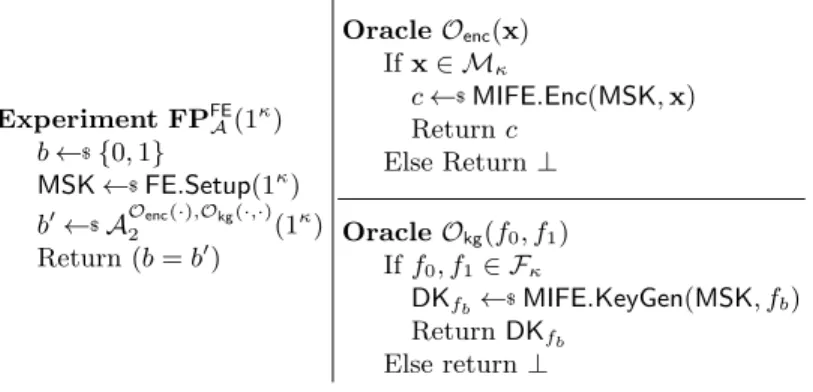
Function Privacy. We additionally define the notion of function privacy as fol- lows. For an FE schemeFEas above and adversary A= (A0,A1,A2), consider the experiment in Figure 4.
Experiment FPFEA(1κ) b←${0,1}
MSK←$FE.Setup(1κ) b0←$AO2enc(·),Okg(·,·)(1κ) Return (b=b0)
OracleOenc(x) Ifx∈ Mκ
c←$MIFE.Enc(MSK,x) Returnc
Else Return⊥ OracleOkg(f0, f1)
Iff0, f1∈ Fκ
DKfb←$MIFE.KeyGen(MSK, fb) ReturnDKfb
Else return⊥
Fig. 4.Experiment for FP-security of FE.
We callAlegitimateif for allκ∈N, in all transcriptsFPFEA(1κ) it holds that for every key generation query f0, f1 there does not exist an encryption query x∈ Mκ such that
f0(x)6=f1(x).
We assume adversaries are legitimate unless otherwise stated. We say thatFEis FP-secure if for any adversaryA
|Prh
FPFEA(·) outputs 1i
−1/2|=negl(·).
3 Ad hoc Multi-Input Functional Encryption
We are now ready to define our new notion of ad hoc multi-input functional encryption (MIFE). For simplicity, we define ad hoc MIFE in the private-key setting only. We leave the study of ad hoc MIFE in the public-key setting for future work.
3.1 Syntax and Correctness
Anad hoc multi-input functional encryption scheme aMIFEfor a message space {Mκ}κ∈N and a functionality{Fκ}κ∈N, where for each κ∈ N, each f ∈ Fκ is a (description of a) function on (Mκ)` for some` (which may depend onf), is given by a set of algorithms with the following syntax:
– aMIFE.Setup(1κ): A PPT algorithm taking the security parameter κ, and outputting the master secret keyMSKand the public parametersPP.
– aMIFE.KeyGen(i,MSKi,(PP1,· · ·,PP`), f): A PT algorithm taking an index i ∈ [`], a master secret key MSKi corresponding to PPi, a set of public parameters PP1,· · ·,PP`, a function f ∈ Fκ of arity `, and outputting a corresponding partial decryption keyPDKi,f.
– aMIFE.Enc(MSK,x): A PPT algorithm taking a master secret keyMSKand a messagex∈ Mκ, and outputting a ciphertext c.
– aMIFE.Dec((PDK1,f, . . . ,PDK`,f),(c1, . . . , c`)): A PT algorithm taking par- tial decryption keys (PDK1,f, . . . ,PDK`,f) and ciphertexts (c1, . . . , c`), and outputting a stringy.
Definition 4 (Correctness). We say that aMIFE is correct if for all κ∈ N and`=poly(κ), allx1. . .x`∈ Mκ and all f ∈ Fκ of arity `
Pr
y=f(x1,· · ·,x`)
(PPi,MSKi)←$aMIFE.Setup(1κ) (∀i∈[`]) ci←$aMIFE.Enc(MSKi,xi)
PDKi,f←$aMIFE.KeyGen(i,MSKi,(PPi)i∈[`], f) y←aMIFE.Dec((PDKi,f)i∈[`],(ci)i∈[`])
= 1.
Remark 5. We highlight two ways that ad hoc MIFE differs from standard MIFE [42]. First, theaMIFE.Setupalgorithm is run per user and does not output all of theMSK1, . . .MSKn at once. Second, the total number of usersnand the function arity`are not fixed and input to theaMIFE.Setupalgorithm. We also note that for simplicity in our formulation of ad hoc MIFE the public parameters of the parties input to the key generation algorithm are ordered.
Remark 6. We can allow an additional algorithm CRSGen taking 1κ and out- putting a common reference string CRS that is input to the remaining algo- rithms. We refer to this as ad hoc MIFEin the CRS model. The CRS model is weaker than having a key generation authority who can decrypt all the data.
3.2 Indistinguishability-Based Security
We first present an indistinguishability-based security notion. We note that the fact that the public parameters of the parties input to the key generation algo- rithm are ordered allows us to work with a somewhat simpler definition than the corresponding one in [42] for the standard MIFE case.
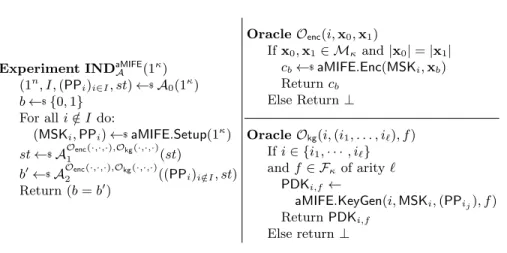
For an ad hoc MIFE schemeaMIFEas above and adversaryA= (A0,A1,A2), consider the experiment in Figure 5.
Experiment INDaMIFEA (1κ) (1n, I,(PPi)i∈I, st)←$A0(1κ) b←${0,1}
For alli /∈Ido:
(MSKi,PPi)←$aMIFE.Setup(1κ) st←$AO1enc(·,·,·),Okg(·,·,·)(st)
b0←$AO2enc(·,·,·),Okg(·,·,·)((PPi)i /∈I, st) Return (b=b0)
OracleOenc(i,x0,x1)
Ifx0,x1∈ Mκand|x0|=|x1| cb←$aMIFE.Enc(MSKi,xb) Returncb
Else Return⊥
OracleOkg(i,(i1, . . . , i`), f) Ifi∈ {i1,· · ·, i`} andf∈ Fκof arity`
PDKi,f ←
aMIFE.KeyGen(i,MSKi,(PPij), f) ReturnPDKi,f
Else return⊥
Fig. 5.Experiment for IND-security of ad hoc MIFE.
We say that f ∈ Fκ is queried if for every user associated with its input wires, either the user is corrupt, or has submitted it’s partial decryption key to the adversary. Formally, for everyk∈` where` is the arity off either ik ∈I, i.e. user corresponding to ik is corrupted or there is a key-generation query (ik,(PPi1,· · · ,PPi`), f).
We callAlegitimate if for allκ∈N, in all transcriptsINDaMIFEA (1κ) it holds that for every queriedf ∈ Fκ, there do not exist two sequences (yi1,0,· · ·, yi`,0) and (yi1,1,· · · , yi`,1) such that
f(yi1,0,· · ·, yi`,0)6=f(yi1,1,· · · , yi`,1) and for every j∈ {i1,· · ·, i`}
– There is an encryption query (j,x0,x1) such that yj,0 =x0 and yj,1 =x1, or
– j∈I,i.e.j is corrupted (so there is no restriction onyj,0, yj,1 above) We assume adversaries are legitimate unless otherwise stated. We call A passive ifI=∅. We callAselective ifA2makes no queries. We say thataMIFE is IND-secure if for any adversaryA
|Prh
INDaMIFEA (·) outputs 1i
−1/2|=negl(·).
4 Ad Hoc Multi Input Functional Encryption for General Functionalities
We show how to construct of ad hoc MIFE for any polynomial sized circuit from standard MIFE for the same functionality and a two-round MPC protocol.
Building Blocks. Our scheme will be using the following building blocks:
– A MIFE scheme
MIFE= (MIFE.Setup,MIFE.KeyGen,MIFE.Enc,MIFE.Dec)
for some message-space{Mκ}κ∈Nand functionality{Fκ}κ∈N. For simplicity, we assume MIFE.KeyGen is deterministic; note that this is without loss of generality since it can be made so by using a PRF.
– A two-round two-round MPC protocol
MPC= (MPC.RunRoundOne,MPC.RoundRoundTwo,MPC.ComputeResult) for programs of the formGenKeysf in Figure 6 forf ∈ Fκ. We assumeMPC is function-rerunnable, unbounded and without setup (we discuss the other cases below).
– A PRF F and a prefix punctured PRF puncF. We leave the domain and ranges implicit for readability, taking the output to be sufficiently long.
– A private-key single input functional encryption scheme FE= (FE.Setup,FE.KeyGen,FE.Enc,FE.Dec) {Kκ}κ∈N,
4.1 Construction
Below we provide our construction for adhoc MIFE for general circuits. Note that setup, encryption and key generation are done independently and in parallel by all the parties in the system. Also note that there is no interaction between different parties in the system.
aMIFE.Setup(1κ): Upon input the security parameter, do the following:
1. Sample the seed of PRF K←$PRF.Setup(1κ) and the seed of a punc- turable PRFKpunc←$PRF.Setup(1κ). Puncturing will only be required in the proof.
2. Invoke the single input FE scheme, (PPFE,MSKFE)←$FE.Setup(1κ).
3. Invoke the first round of the MPC protocol
(ρ(1),s)←$MPC.RunRoundOne(1κ,(K,MSKFE)) Note that the function is specified later.
4. Return (PP=ρ(1),MSK= (K, Kpunc,MSKFE,s)).
aMIFE.KeyGen((PPi)i∈[`], f,MSK): Upon input the public parameters of the ` parties that are chosen to participate in the computation, and the master secret key, do the following:
1. Parse the public parameters of each party as the first message in an MPC protocol, i.e.ρ(1)i ←PPi ∀i∈[`].
2. Parse the master secret key as (K, Kpunc,MSKFE,s)←MSK
3. Run round two of the MPC protocol using round 1 messages as input, for the functionalityGenKeysdescribed in Figure 6:
ρ(2)←$MPC.RunRoundTwo(s,GenKeys(PP
i)i∈[`],f,(ρ(1)i )i∈[`]) 4. Compute the masks←PRF.Eval(K,0k(PPi)i∈[`]kf)
5. Return (ρ(2), s).
aMIFE.Enc(MSK,x): Upon input the master secret key and the message x, do the following:
1. Parse the master secret key as (K, Kpunc,MSKFE,s)←MSK.
2. Sample the tagT←${0,1}κ.
3. Initialize the data structureTrapdefined in Figure 8 by settingmode-real= 1 and all other fields as⊥. This indicates that we are in the real system.
The remaining fields are only relevant in the proof.
4. Compute the ciphertextc←$FE.Enc(MSKFE,(x, T, Kpunc,Trap)).
5. Returnc.
aMIFE.Dec((PDKi,f)i∈[`],(ci)i∈[`]): Upon input the partial decryption keys from all relevant parties, as well as ciphertexts from all relevant parties, do the following:
1. Parse (ρ(2)i , si)←PDKi,f ∀i∈[`]
2. Compute the output of the MPC protocol asZ ←MPC.ComputeResult((ρ(2)i )i∈[`]) 3. Unmask the output using partial shares provided by all parties. In more
detail, computeS←L
i∈[`]si; Z←Z⊕S.
4. Parse the output of the MPC computation as (SKf,SKFE1, . . . ,SKFE`)← Z.
5. Perform decryption of the single input FE scheme to obtain MIFE ci- phertextsψi←FE.Dec(SKFEi, ci) ∀i∈[`].
6. Perform decryption of the MIFE scheme to obtain the output y ← MIFE.Dec(SKf, ψ1, . . . , ψ`).
7. Returny.
Correctness. Correctness follows from the correctness of MPC, MIFE and FE.
In more detail, we have:
1. Step 1: MPC:By correctness of MPC, we have that the decryptor recovers the outputS⊕(SKf,SKFE1, . . . ,SKFE`). Next, if each partyi ∈[`] provides a partial decryption key for f, then this contains partial mask si as part of the output of aMIFE.KeyGen. Using these, the decryptor can compute
S←L
i∈[`]si and recover (SKf,SKFE1, . . . ,SKFE`).
FunctionGenKeys(PPi)
i∈[`],f((K1,MSKFE1), . . . ,(K`,MSKFE`)) 1. Fori∈[`], compute randomness to be used for algorithms below:
ri←PRF.Eval(Ki,1k(PPi)i∈[`]kf), r0i←PRF.Eval(Ki,2k(PPi)i∈[`]kf) 2. Run the MIFE setup algorithm for the desired arity as:
((EK1, . . . ,EK`),MSK)←MIFE.Setup(1κ;r1⊕ · · · ⊕r`) 3. Fori∈[`], generate the single input FE function key:
SKFEi ←FE.KeyGen(MSKFEi,ReEncEKi,⊥;r0i) 4. Compute the MIFE secret key asSKf ←MIFE.KeyGen(MSK, f) 5. Sample the masksifor each partial key and compute the maskS as:
∀i∈[`], si←PRF.Eval(Ki,0k(PPi)i∈[`]kf), S←M
i∈[`]
si
6. Return the masked outputS⊕(SKf,SKFE1, . . . ,SKFE`)
Fig. 6. Functionality computed by the MPC protocol to generate single and multi input FE keys.
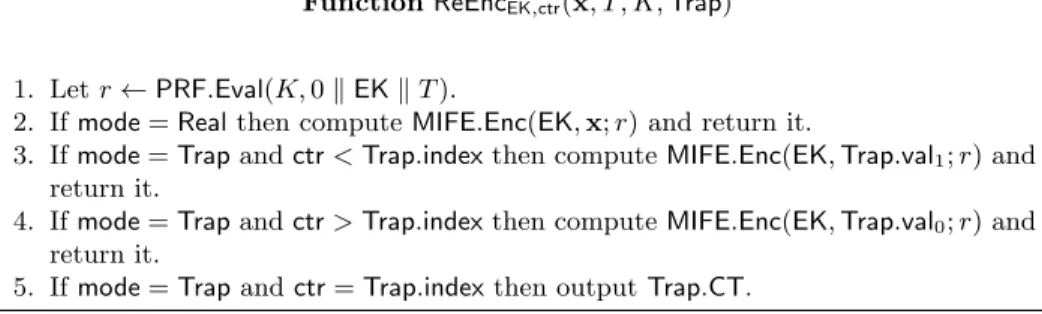
FunctionReEncEK,ctr(x, T, K,Trap) 1. Letr←PRF.Eval(K,0kEKkT).
2. Ifmode=Realthen computeMIFE.Enc(EK,x;r) and return it.
3. Ifmode=Trapandctr<Trap.indexthen computeMIFE.Enc(EK,Trap.val1;r) and return it.
4. Ifmode=Trapandctr>Trap.indexthen computeMIFE.Enc(EK,Trap.val0;r) and return it.
5. Ifmode=Trapandctr=Trap.indexthen outputTrap.CT.
Fig. 7.Functionality for translating the ciphertext from FE to MIFE using dynamically generated encryption keys
2. Step 2: FE:Next, by correctness of FE, we have that if ψi=FE.Dec(SKFEi, ci) ∀i∈[`]
Then,ψi are the MIFE ciphertexts computed asMIFE.Enc(EKi,xi;ri).
3. Step 3:MIFE:Finally, by correctness of MIFE, we have that f(x1, . . . ,x`) =MIFE.Dec(SKf, ψ1, . . . , ψ`)
4.2 Security Proof
In this section, we argue that the scheme described above is secure. In more detail:
Theorem 7. Assume that:
1. MPCis a 2-round MPC protocol satisfying SIM security as defined in Section 2.2.
2. MIFEsatisfies selective security as defined in Section 2.4.
3. FEis a single key FE scheme satisfying selective security with function pri- vacy, as defined in Section 2.5.
4. puncFis a prefix punctured PRF satisfying security defined in Section 2.3.
5. Fis a secure PRF.
Then our construction satisfies selective security as defined in Section 3.2.
Proof. The proof of security makes use of a trapdoor data structure which is defined in Figure 8.
The trapdoor data structure. Here, modeis used to indicate whether we are in the real mode Real or trapdoor modeTrap. CT indicates the hardwired MIFE CT which must be output if the fieldindexequals the counterctrset in theFE key. The fieldsval0andval1 are used to indicate the values corresponding to bit 0 and bit 1 respectively, where the latter is used whenindex>ctrand the former whenindex<ctr.
mode CT index val0 val1
Fig. 8.Data StructureTrapused for Proof
The Hybrids. We prove the theorem via a hybrid argument. We describe our hybrids below.
Hybrid 0: This is the real game in which on every encryption query (i,x0,x1), x0 is encrypted.
Suppose there are Qc encryption queries (made selectively). For each k ∈ [Qc], leti be the party index queried,x0 andx1 the challenge plaintexts, letT be the tag used during encryption and I be the set of users corrupted by the adversary. We use these definitions in the remainder of the proof.
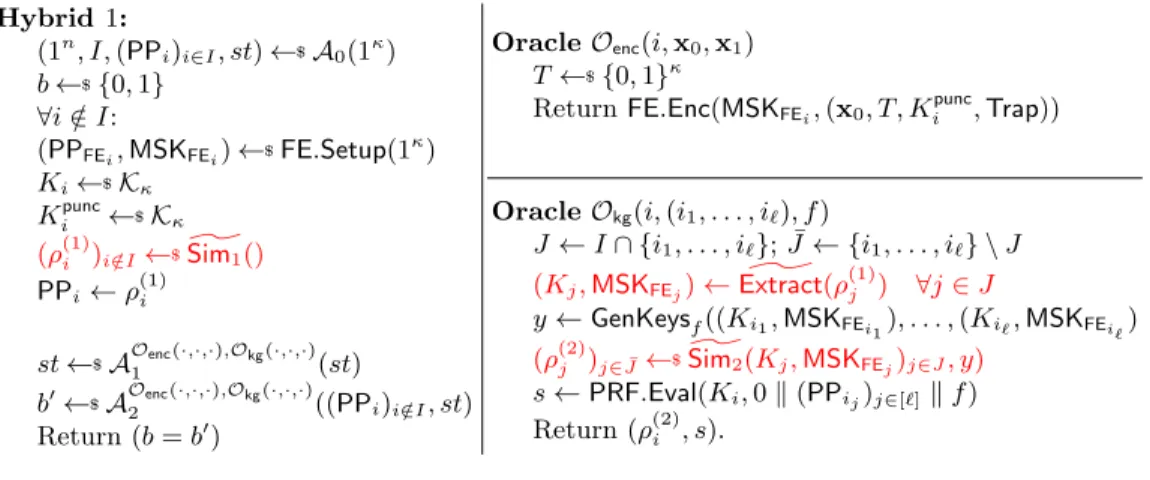
Hybrid 1: The change in this hybrid is twofold.
1. Simulate the Public Parameters.We set the first-round protocol mes- sage ρ(1)i for MPC in the public parameters to the output of the simulator Sim]1 for each uncorrupted useri /∈I.