The bilayer La0.7Sr0.3MnO3/SrRuO3 and La0.7Sr0.3MnO3/SrTiO3 are reported to have special micromagnetic and electrical transport properties. As mentioned above, the growth of La0.7Sr0.3MnO3 and La0.7Ca0.3MnO3 thin films by various techniques has been extensively investigated to achieve their electrical and magnetic properties comparable to those in the bulk state. Nd0.7Sr0.3MnO3 is one of the well-known CMR materials, which has a TC value of around 250 K and also contains a rare earth magnetic element.
It would be interesting to study the interfacial effects of manganite thin films in a heterostructural configuration as a bilayer form of ferromagnetic and AFM or charged phases such as Nd0.7Sr0.3MnO3/Nd0.8Na0.2MnO3 and La0.7Sr0.3MnO3 / LaFeO3. Nd0.7Sr0.3MnO3 is filmed on the 001-LaAlO3 substrate by varying the film thickness in the range of 12-200 nm and annealing separately in air and oxygen atmospheres. Nd0.7Sr0.3MnO3 is filmed on the 001-MgO substrate by changing the thickness in the range of 60-200 nm and annealing them separately in air and oxygen environments.
Nd0.7Sr0.3MnO3 films with different thicknesses were grown on different substrates such as (001)-Al2O3, (001)-MgO and (001)-LaAlO3 by varying the temperature and environment after annealing. We have successfully grown a bilayer of ferromagnetic and antiferromagnetic films, such as Nd0.7Sr0.3MnO3/Nd0.8Na0.2MnO3 and La0.7Sr0.3MnO3/LaFeO3.
Introduction
Crystal Structure
Magnetism in Manganites
- Crystal Field and Jahn – Teller Effect
- Exchange Interactions
- Magnetic Structure
- Charge - Ordering in Manganites
Electrical Transport in Manganites
Review of Bulk Perovskite Manganites
Manganite Thin Films
Role of Deposition Conditions
- Post-processing Conditions
- Substrate Effects
- Epitaxial Growth
- Effect of Film Thickness
Homogeneous and Heterogeneous Magnetic Thin Films
Motivation of Present Thesis Work
Experimental Techniques
Sample Preparation
- Preparation of Sputtering Target
- Thin Film Growth Techniques
Characterisation Techniques
- X-ray diffractometer
- Raman Spectroscopy
Electrical Resistivity Measurements
- Magneto-Resistivity Measurements
Magnetic Properties
- Vibrating Sample Magnetometer
- Electron Spin Resonance Spectrometer
- Introduction
- Preparation and Characterisation of Nd 0.7 Sr 0.3 MnO 3 Target
- Nd 0.7 Sr 0.3 MnO 3 Films under Different Post-annealing Temperature
- Thin Film Preparation
- Structural Properties
- Morphology of NSMO Films
- Electrical Resistivity
- Magnetic Properties
- Conclusions
- Nd 0.7 Sr 0.3 MnO 3 Films on Different Substrates
- Thin Film Deposition
- Structural Properties
- Electrical Resistivity
- Magnetic Properties
- Conclusions
- Effect of Film Thickness in Nd 0.7 Sr 0.3 MnO 3
- Thin Films preparation
- Structural Properties
- Surface Morphology of NSMO Films
- Magnetic Properties
- Electrical Resistivity
- Magneto-Resistivity of NSMO Films
- Conclusions
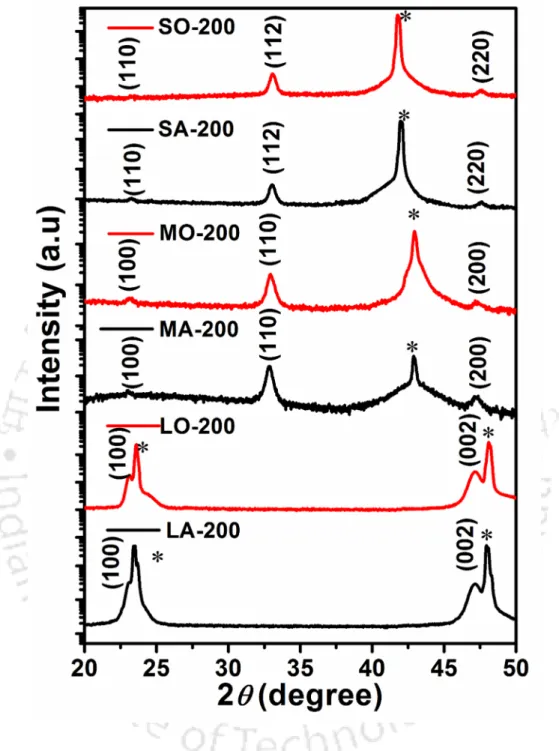
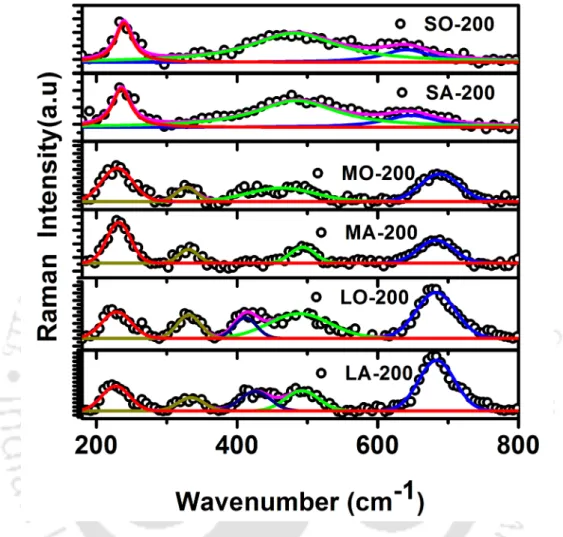
Here, the samples were imaged using the angle-of-incidence grazing angle technique..57 Figure 3.5: Raman spectra of NSM7, NSM8 and NSM9 films at room temperature along with Lorentzian fits......58 Figure 3.6: Atomic microscope images of the annealed films force NSM7, NSM8 and. The star represents the (00l) top of the substrates………..65 Figure 3.11: Raman spectra of NSMO films annealed in air and oxygen, on different substrates………..67 Figure 3.12: Temperature change of electrical resistivity of air and oxygen annealed NSMO films, grown on ALO, MgO and LAO substrates……….68 Figure 3.13: Graph of ln ρ vs. T-1/4 along with fitting to the Mott-VRH model……….69 Figure 3.14: Temperature change during cooling with zero field (H = 2 kOe) magnetization for NSMO films annealed in air and oxygen on ALO, MgO and LAO substrates………..71 Figure 3.15: MH-loops recorded at 50 K for NSMO films on different substrates………72 Figure 3.16 : Initial magnetization curves fitted to Eq
Deposition and Characterisation of
Introduction
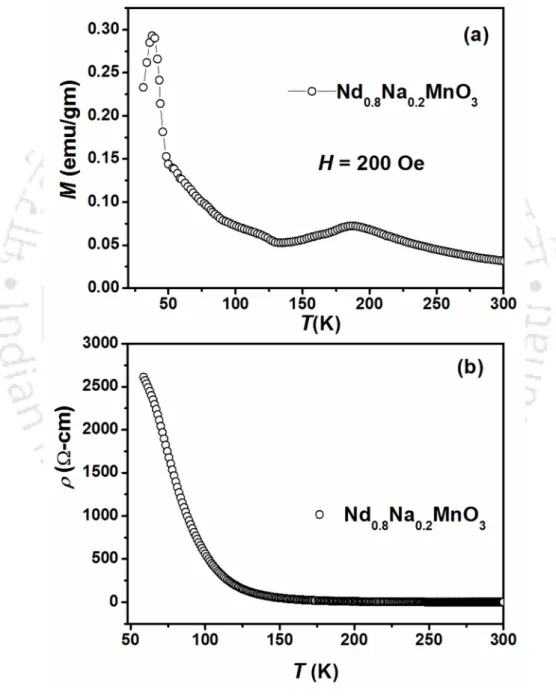
In this chapter, we report on the deposition of Nd0.7Sr0.3MnO3 (NSMO) and Nd0.8Na0.2MnO3 (NNMO) bilayer films and study their electrical and magnetic properties. Here we have deposited the NSMO layer based on the optimized conditions discussed in the previous chapter. Before depositing the bilayers, we optimized the deposition of charge-ordered (CO) Nd0.8Na0.2MnO3 thin layers and studied their electrical transport and magnetic properties.
The bandwidth decreases with decreasing mean ionic radius at the rare-earth site and leads to a weakening of the double-exchange ferromagnetic interaction and a strengthening of antiferromagnetism caused by competing charge ordering (CO) [205]. Several authors have worked on thin-film CO materials to optimize their electrical and magnetic properties for potential applications in memory devices. CO suppression is studied by changing the particle size, film thickness, applied electric and magnetic fields.
In view of the above conflicting reports and due to the lack of thickness-dependent study of electrical and magnetic properties of (Nd, Na)MnO3 series, we undertook a detailed study on Nd0.8Na0.2MnO3 thin films. Nd0.7Sr0.3MnO3 (NSMO) is one of the interesting manganites with ferromagnetic and metal–insulator transitions in the vicinity of room temperature together with large magnetoresistance [217, 218]. Furthermore, the film thickness and the substrate dependence of electrical and magnetic properties on NSMO films [80] were investigated.
The electrical and magnetic properties of Nd0.67Sr0.33MnO3/Nd0.5Ca0.5MnO3 bilayers are reported to be quite sensitive to the film thickness [220]. Therefore, it would be interesting to study the effect of interlayer coupling of ferromagnetic Nd0.7Sr0.3MnO3 (NSMO) films with an ordered antiferromagnetic Nd0.8Na0.2MnO3 (NNMO) charge [222]. In this paper, we have deposited bilayer films of Nd0.7Sr0.3MnO3/Nd0.8Na0.2MnO3 by varying the thickness of the NSMO layer and studied their structural, electrical and magnetic properties.
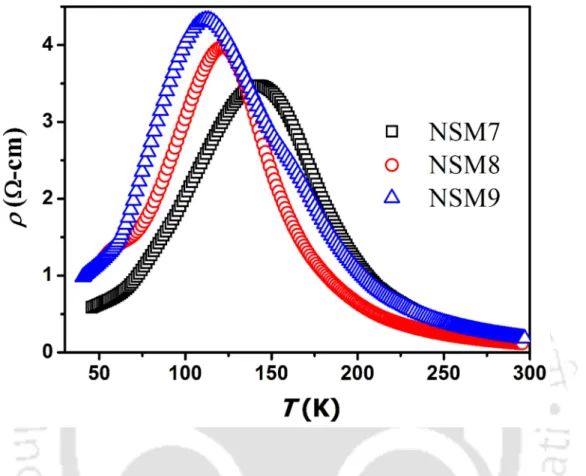
The value of the out-of-plane lattice constant, determined from (002) reflection, is found to decrease as the film thickness increases, as shown in Table 4.1. The broad peak observed at 680 cm-1 can be attributed to oxygen off stoichiometry and its intensity is found to increase with the increase of film thickness [224]. It is found that the electrical resistance at a given temperature decreases with an increase in film thickness, apart from an anomaly for 75 nm film.
The Eh value is found to decrease as the film thickness increases, except for an anomaly for 75 nm film. The saturation magnetization is found to decrease as the film thickness increases due to the enhancement of the charge ordering as the lattice voltage decreases. The well-resolved (002) peaks corresponding to NSMO (solid diamond) and NNMO (open diamond) are seen and the peak position is found to shift to a higher 2θ angle with increase in film thickness.
The magnetization at a given temperature for T < TC is found to increase systematically with increase in film thickness. The transition temperature is found to be 358 K and it is almost comparable to the literature [226]. It is found that the intensity of (002) peaks increases systematically with increase in layer thickness of LSMO films as shown in Fig.5.5 in enlarged scale.
The average diameter of grains is found to increase from 40 nm for BL-30 to 120 nm with increase in film thickness. The width of the transition is found to decrease with increase in film thickness and TC is found to increase from 290 K for 30 nm film to 332 K for 200 nm film. All bilayer films typically show soft ferromagnetic behavior, but the saturation magnetization is found to increase with film thickness.
5.5) and (5.6), the resonance fields H|| and H⊥ is expected to be smaller and larger than Hr of the paramagnet, respectively. Furthermore, the resonance field is found to shift towards the lower field as the film thickness increases. The magnitude of the resistance value is found to decrease drastically as the thickness of the LSMO layer increases.
The effective magnetic anisotropy constant (K), estimated from the above analysis, is found to decrease with an increase in film thickness due to the relaxation of the lattice stress. The saturation magnetization value is found to decrease with increase in film thickness due to the enhancement of charge ordering as the lattice voltage decreases.
![Figure 1.15: The phase diagram of the LSMO films established from the relation 1.15 for the thickness 250 and 500 Å [123].](https://thumb-ap.123doks.com/thumbv2/azpdfnet/10537591.0/56.892.151.750.638.1049/figure-phase-diagram-lsmo-films-established-relation-thickness.webp)