This preheating during combustion in a porous matrix is carried out due to the manifestation of volumetric thermal radiation. The second part of the study is devoted to the development of a domestic self-priming LPG stove with a porous radiant burner (PRB).
Nomenclature
Contents
3 Development of Medium-scale LPG Cooking Stove with Porous Radiant Burner
4 Self-aspirated Domestic LPG Cooking Stove with Porous Radiant Burner
5 Self-Aspirated Porous Radiant Burner for Medium- scale LPG Cooking Applications
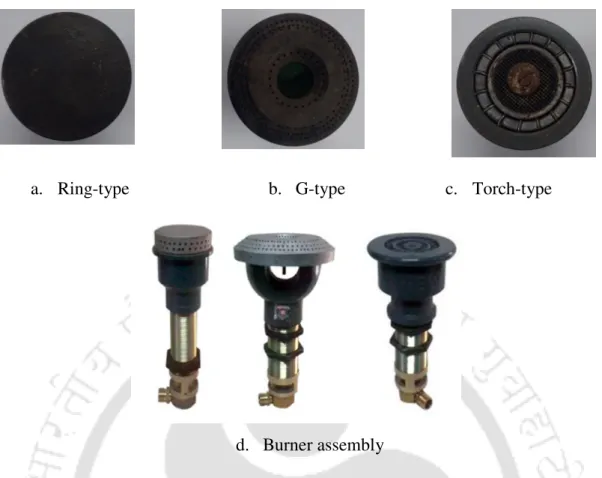
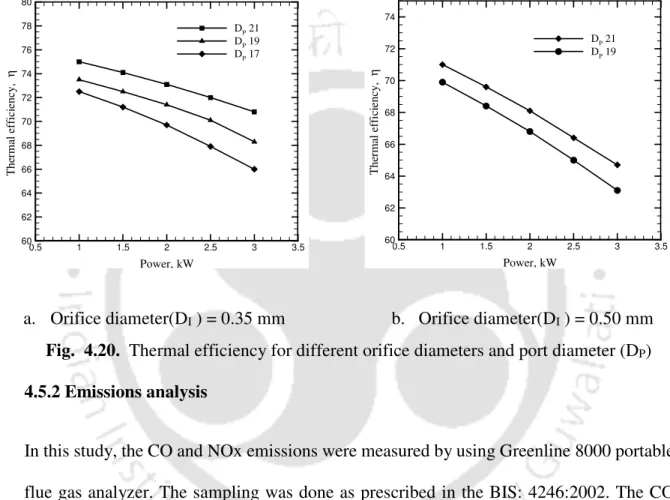
76 4.1 Conventional domestic gas stove with mixing chamber 79 4.2 Photograph of the free flame in conventional domestic stove 80 4.3 Pictorial images of the various conventional burner heads available in. 92 4.20 Thermal efficiency for different orifice diameters and port diameter 95 4.21 Emission characteristics of PRB with an orifice diameter of 0, 35 mm and.
List of Tables
Introduction
- Motivation
- Conventional domestic LPG cooking stove
- Energy crisis
- Pollutant formation and their Effects
- Porous medium combustion
- Working principle of porous medium combustion
- Excess enthalpy combustion
- Advantages of porous medium combustion
- Applications of porous medium combustion
- Materials used in porous medium combustion
- Aim and objectives
- Organization of thesis
In matrix-stabilized combustion (Fig.1.8.a), the flame stabilizes close to the inlet, and the combustion takes place completely inside the porous matrix. In contrast, in surface-stabilized combustion (Fig.1.8.b), the flame stabilizes on the downstream surface of the porous matrix and the maximum volumetric heat release there.

State-of-the-Art
History of porous medium combustion
- Initial developments
- Some recent patents based on PMC
The second was related to improving the combustion efficiency by a method where combustible mixture burned in the porous matrix. Your burner has an increase in pore size from the inlet to the outlet of the burner.
Combustion of gaseous fuels in porous medium burners
- Experimental investigations Flame stabilization
- Numerical investigations Flame stabilization
They found that as the excess air increased, the flame gradually moved to the lower side of the burner causing a decrease in thermal efficiency. The experimental results showed that the radiation efficiency of the burner increased significantly with the increase of oxygen concentration in the combustion air. They found that flame stabilization depended on several parameters such as flow rate, heat transfer coefficient and thermal conductivity of the porous matrix.
Sahraoui and Kaviany (1994) found that the flame speed was strongly influenced by the geometry of the porous medium. With a decrease in gas velocity, the time constant of the system was found to increase and varied widely in the porous medium.
Applications of porous medium burner
- Domestic applications
- Gas turbines and boilers
- Fuel cell and hydrogen production
- Furnaces, process and IC engines
- Combined heat and power generation and miscellaneous applications
Jugjai and Rungsimuntuchart [2002] implemented the idea of the PMC in an LPG cookstove for improved efficiency. They also investigated the effect of burner diameter on the thermal efficiency of the PRB and found that increasing the diameter of the burner from 6 cm to 9 cm increased the efficiency from 55% to 68%. From their results, they concluded that using the porous medium in the chemical gas turbine would be a good choice.
Experiments showed that the aluminum beads had a longer lifetime than the foams and the conversion efficiency of the burner was also high. The radiation efficiency of the burner was found to be higher and the temperature inside the CZ was homogeneous.
Porous surface combustion
A mobile phone was connected to the TE charging system to demonstrate that the cogeneration system can generate electric power. 1992] conducted the experimental investigation of surface combustion with premixed mixtures of methane and air inside and closed the downstream of the porous matrix. The maximum rate of heat release was found at or above the surface of the porous matrix.
Nakamura et al [1993] studied combustion with a premix of methane and air at the combustion surface and found that the maximum height at which the flame should be stabilized is 1 mm for a better balance between combustion speed and gas flow to prevent flashback. It was found that the temperature at the surface is proportional to the thickness of the porous matrix because the air-fuel mixture will have enough time to preheat to high temperatures.
Literature closure
Radiation production is found to depend on various parameters such as equivalence ratio, ignition rate, flame support layer thickness, porosity and aspect ratio, which in turn affect combustion and thermal efficiency. In PMB, due to heat recirculation, the CZ temperature decreases and combustion is almost complete with sufficient residence time. Reduced temperature has been found to be one of the most effective means of controlling thermal NOx and due to almost complete combustion, the CO level is significantly low.
From the literature survey it was observed that most researchers investigated the use of porous medium combustion for cooking application for low thermal load in the range of 1-2 kW, with the help of external air supply. It was also found that no researchers tested the double-layer porous PRB with the capacity range of 5-15 kW for medium-scale cooking applications.
Objectives of the present work
No researchers have investigated the use of double-layer PRB in home cooking without external air supply. To test a dual-layer porous radiant burner for use in mid-range LPG cooking (5-10 kW) and also to investigate the effects of power input and equivalence ratio on the thermal efficiency and emissions of a dual-layer porous radiant burner. To develop a self-priming double layer porous radiant burner for domestic use in LPG cooking in the power range of 1-3 kW and to study the effects of power input on the thermal efficiency and emissions of a self-priming double layer porous radiant burner.
To develop an improved medium-scale self-aspirating air-enclosed cookstove with a two-layer porous radiator in the power range of 5 - 15 kW and to investigate the effects of input power on thermal efficiency and emissions for the same thing. To ascertain the applicability of the porous radiant burner for indoor LPG cooking as well as medium scale cooking applications.
Development of Medium-Scale LPG Cooking Stove with Porous Radiant Burner
- Experimental setup for conventional medium-scale LPG cooking stove
- Experimental procedure
- Experimental set-up of medium-scale LPG cooking stove with PRB
- Material and specifications
- Design of mixing chamber and base plate
- Start-up procedure and stability analysis
- Results and discussion
- Temperature distribution
- Thermal efficiency
- Emissions
- Summary
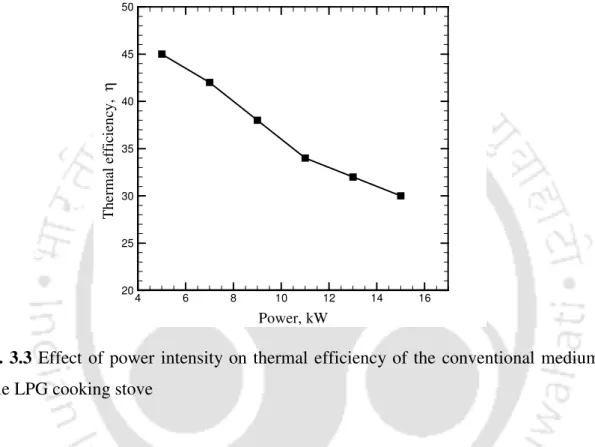
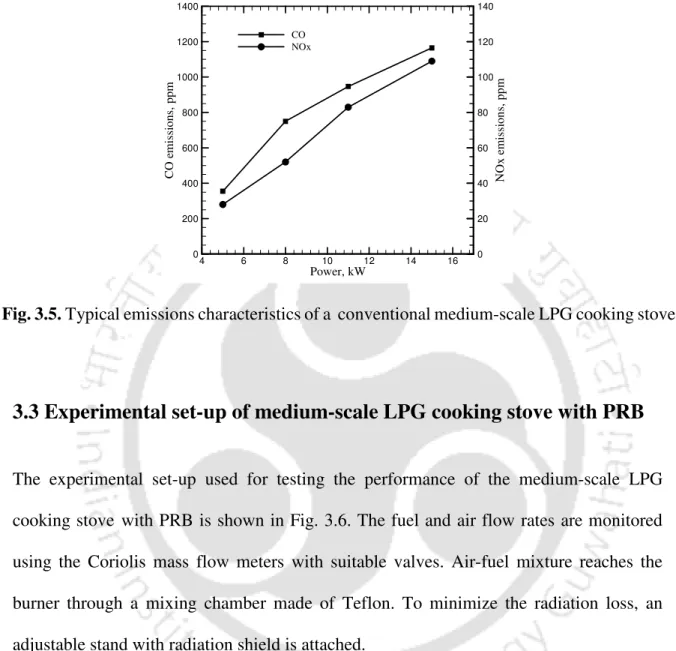
For different powers, the measured efficiency of common medium-scale cooking burners is shown in Fig. Detailed specifications of the instruments/equipment used in the experiments are given in Appendix - IV. Typical measured emission levels of conventional medium-scale cooking burners are shown in Fig.
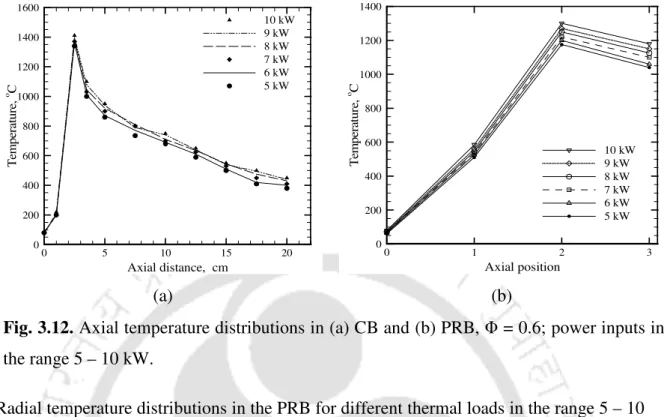
The thermal efficiency also depends on the loading height, ie the distance between the top surface of the PRB and the vessel. The maximum axial temperature in PRB was about 200 °C lower than that of CB.
Self-aspirated Domestic LPG Cooking Stove with Porous Radiant Burner
Performance analysis of domestic LPG cooking stove
Experimental procedure
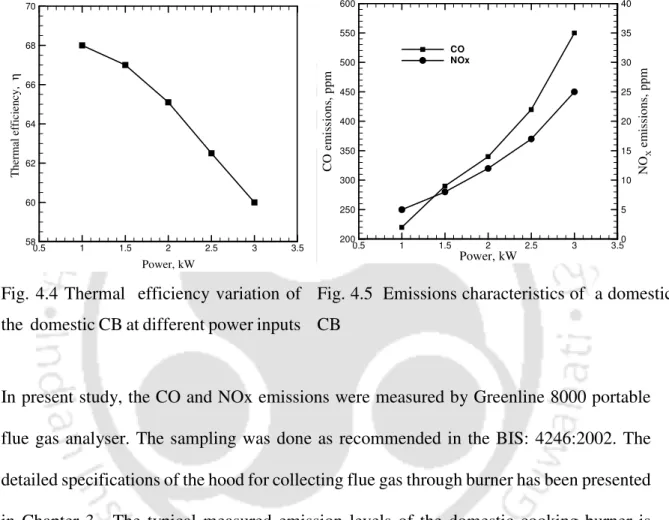
According to the guidelines of IS, the thermal efficiency of cooking appliances in the present work was estimated by conducting the water boiling test and the procedure has already been briefly described in Chapter 3. The typical thermal efficiency variation of the conventional household cooking burner at different power inputs is shown in Fig. In the current study, CO and NOx emissions were measured with the Greenline 8000 portable flue gas analyzer.
The detailed specifications of the hood for collecting flue gases through the burner were presented in Chapter 3. Therefore, further research is needed to redesign the cooktop that can work with natural draft.
Necessary modifications in conventional LPG stove with PRB
- Arrangement of PRB with PZ with secondary air opening
- Arrangement of two layer PRB in flat mixing chamber without secondary air opening
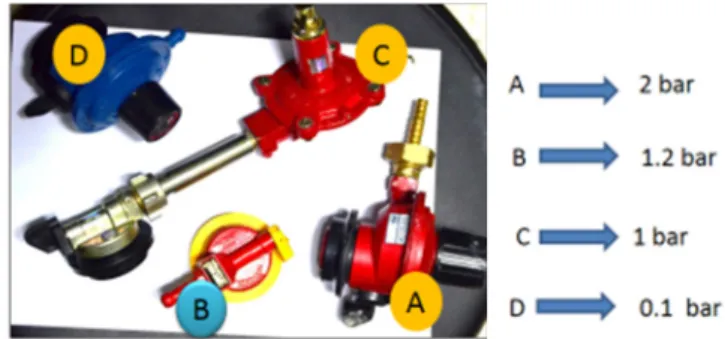
- Arrangement of a two-layer PRB with a high pressure regulator
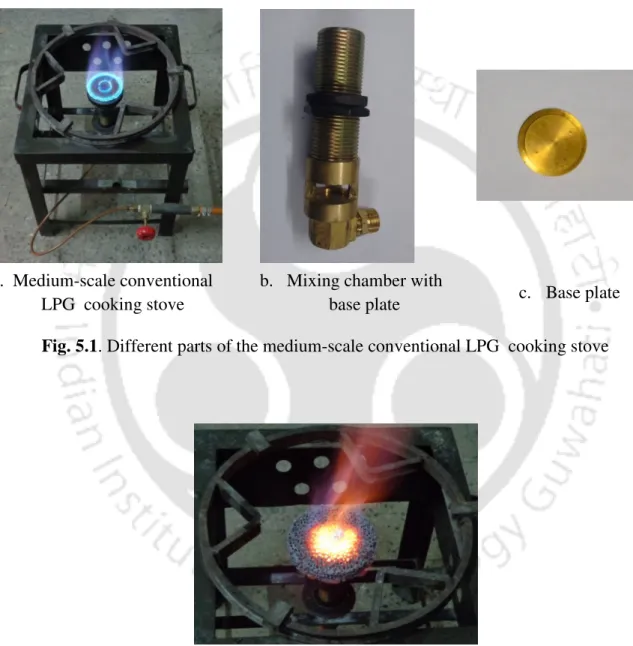
The biggest difference between the old designs of the stoves and the stove with PRB is the design of the mixing chamber. In the ordinary stoves, the mixing chamber has the hole in the middle part to provide the necessary secondary air entertainment (shown in Fig.4.1b). While in the new stove with PRB, the hole in the middle of the mixing chamber is not provided.
The height of the mixing chamber has also been increased by 20mm, providing the required secondary air from the perimeter. The operation of a porous radiant burner instead of CB has been tried using the same mixing chamber as shown in Fig.4.8.
Development of self–aspirated LPG cooking stove with PRB
- Basic design Considerations for air–entrainment
- Orifices
- Burner port
- Mixing chamber
- Burner casing
- Stability of PRB based on experimental analysis
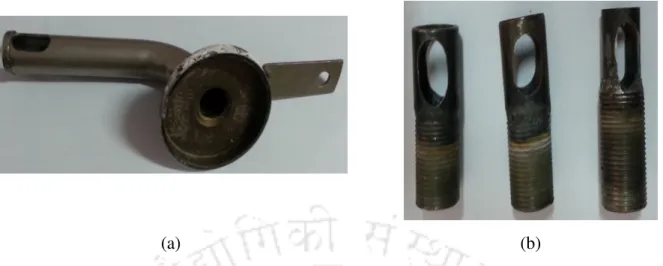
Initially, a stainless steel mixing chamber (Fig. 4.13) was investigated for proper mixing of air-fuel mixture. When stainless steel mixing chamber was used in conventional stove (shown in Fig. 4.13), during combustion, a significant part of heat was lost to the environment. As a first attempt, the burner casing was made with the cast iron (Fig. 4.15a) to have better mechanical strength.
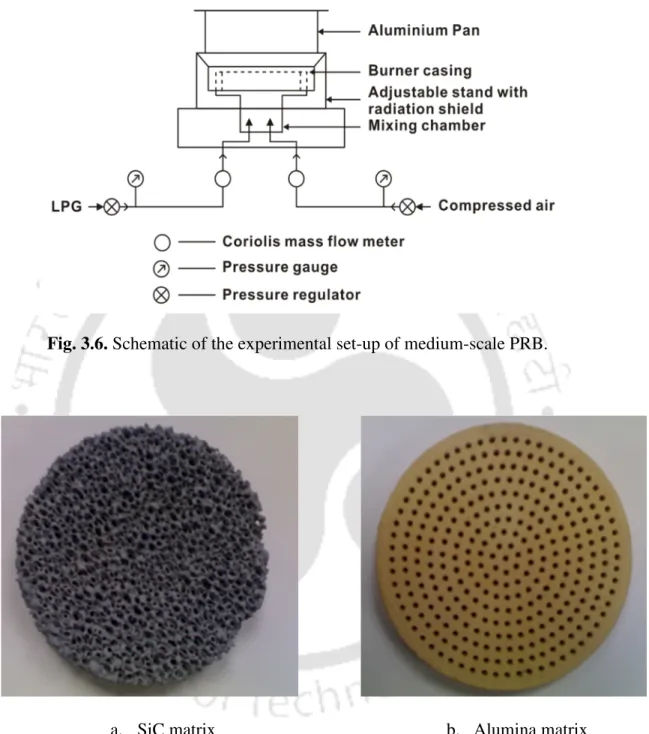
Air and gas move via the burner port through a mixing chamber and reach the burner housing. Photographic view of experimental setup for measuring emissions and thermal efficiency is shown in Figs. 4.18 and fig. 4.19.
Results and discussions for self-aspirated Porous Radiant Burner
- Thermal efficiency
- Emissions analysis
- Temperature distributions
With input power in the range of 1-3 kW, the CO and NOx variations of PRB with different ports and opening diameters are shown in fig. Due to the lower global temperature (burner surface temperature), the NOX emission in PRB is also found to be much lower than that of CB. In PRB, temperature distributions were measured in both axial (Fig. 4.23) and radial (Fig. 4.24) directions.
With a port diameter of 21 mm and an orifice diameter of 0.35 mm, the axial temperature distributions in the PRB are shown in Fig. Radial temperature distributions in the PRB for different thermal loads in the range of 1-3 kW with an orifice diameter of 21 mm and an orifice diameter of 0.35 mm are shown in the figure.
Summary
Therefore, a significant amount of LPG can be saved by using the self-aspirating LPG cookstove with a double-layer PRBO. The measured CO and NOx emissions of the currently developed PRB stove were found to be in the ranges of 30-140 ppm and 0.2-3.5 ppm respectively. While CO and NOx emissions from common domestic LPG cooking stoves (1 – 3 kW) are in the range of 220 ppm to 550 ppm and 5 ppm to 25 ppm respectively.
Self-aspirated Porous Radiant Burner for Medium-scale LPG Cooking Applications
- Proto-type of conventional medium-scale LPG stove with PRB
- Development of self–aspirated medium-scale LPG cooking stove with PRB
- Stability analysis of PRB
- Working principle of self-aspirated medium-scale LPG cooking stove with PRB
- Results and discussions for self-aspirated Porous Radiant Burner
- Thermal efficiency
- Emissions analysis
- Temperature distributions
- Summary
It can be seen that at a thermal load of 5 kW, the maximum thermal efficiency of the PRB is 55% for port diameter 21 mm and opening diameter 0.25 mm. Thermal efficiency of self-aspirated medium-scale LPG cookstove with PRB for different power inputs. With port diameter 21 mm and opening diameter 0.25 mm, the axial temperature distributions in the PRB are shown in Fig.
In Fig. While CO and NOx emissions from conventional mid-scale LPG cooking stoves are in the range of 355 ppm to 1165 ppm and 28 ppm to 110 ppm respectively.
Conclusions and Future work
Conclusions
Chapter 4 of the study was devoted to the development of the domestic self-priming LPG cookstove with a porous radiant burner (PRB). This has been one of the main limitations in the use of PRB in LPG cooking stoves. Development of medium-scale self-priming PRB for LPG cooking stoves is chapter 5 of the study.
A considerable amount of LPG can be saved by using a mid-range self-priming LPG stove with a double-layer PRB. The measured CO and NOx emissions of the currently developed furnace were much lower than CB.
Scopes for future work
Hoffman JG, Echigo R, Yoshida H and Tada S (1997), Experimental investigation of combustion in porous media with a reciprocating flow system, Combust. Mital R, Gore JP and Viskanta R (1997), A study of the structure of submerged reaction in porous ceramic radiant burners, Combust. Sathe SB, Peck RE and Tong TW (1989a), A numerical analysis of combustion and heat transfer in porous jet burners, Heat Transfer Phenom.
Sathe SB, Kulkarni MR, Peck RE and Tong TW (1989b), An experimental study of combustion and heat transfer in porous radiant burners, Meeting of Western Sates Section, The Combust. Tong TW, Lin WQ and Peck RE (1987), Radiative heat transfer in porous media with spatially dependent heat generation, Int.
APPENDIX – I
Power/ Thermal load of a burner
APPENDIX – II
Estimation of Equivalence ratio ( Φ )
The equivalence ratio can be changed by changing the mass flow rate of air (Actual) according to the requirement.
15.6 A F actual
APPENDIX - III
Error Analysis
APPENDIX – IV
Technical Specifications of the Instruments Used in the Experiments
Digital pressure gauges
Pressure regulator (LPG)
Compressor
Pressure regulator (Compressed air)
Thermocouples
Mass flow meter
Portable gas analyser
Data acquisition unit (DAQ)
IR camera
Patents and Publications
Patents
Journal
Conferences

![Table 1.2: Thermo-physical properties of most commonly used ceramics for PMC applications [Avdic, 2004]](https://thumb-ap.123doks.com/thumbv2/azpdfnet/10509870.0/39.892.133.815.201.620/table-thermo-physical-properties-commonly-ceramics-applications-avdic.webp)