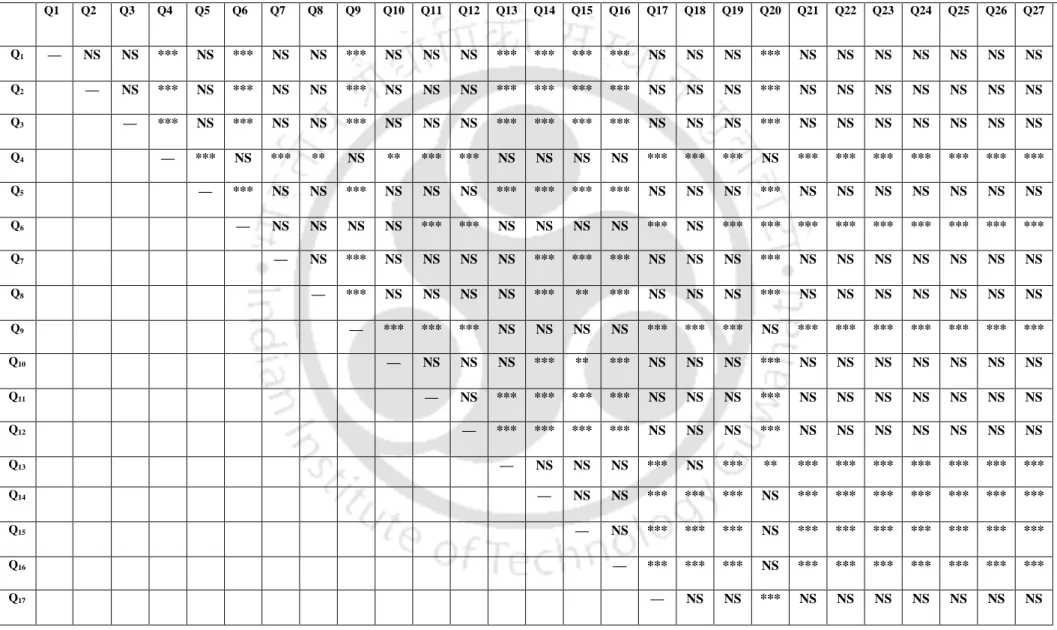
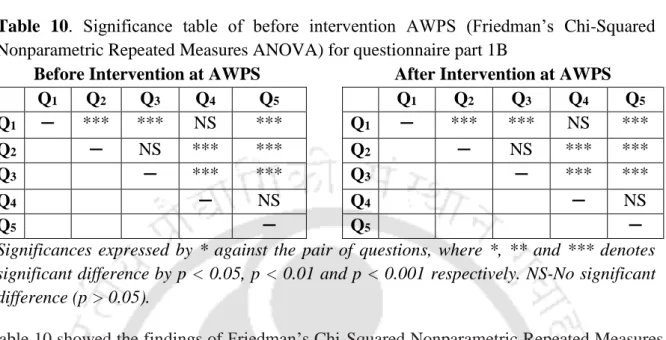
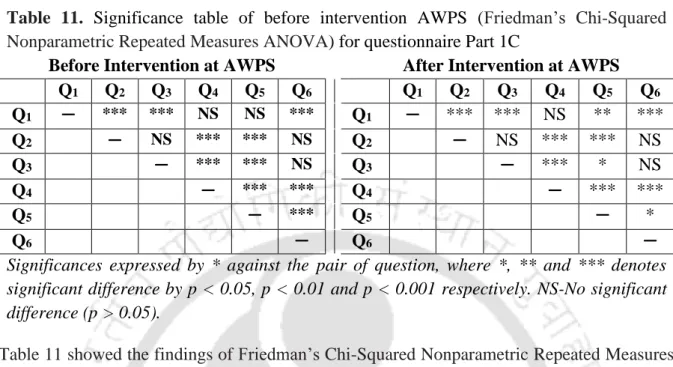
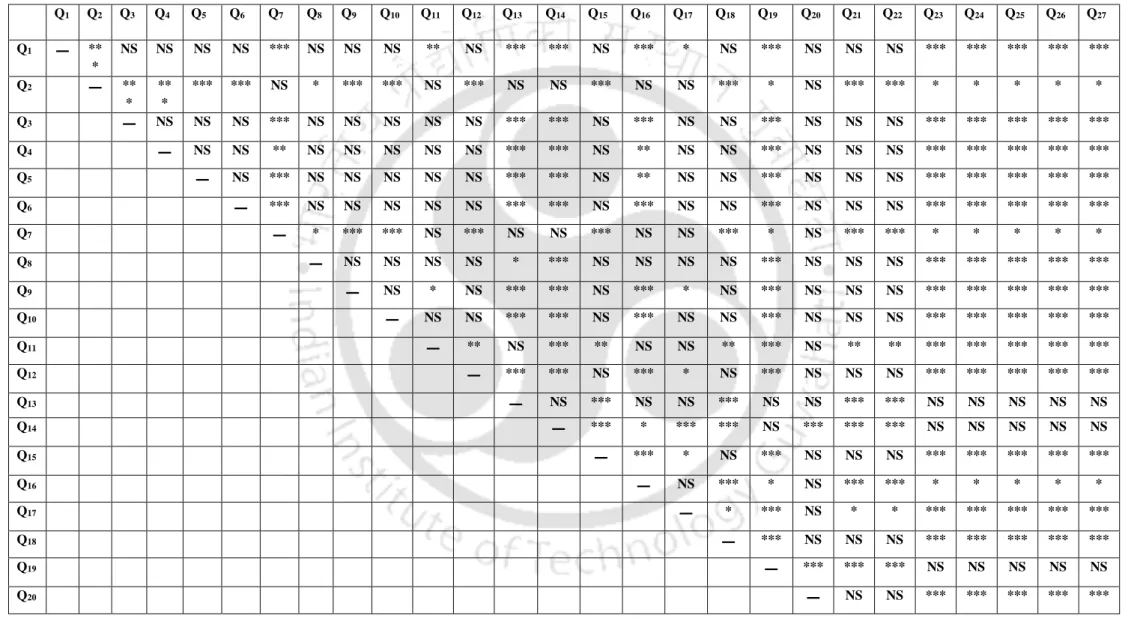
Before and after intervention of AWPS (Friedman's Chi- Squared Nonparametric Repeated Measures ANOVA) for questionnaire part 1B. Before and after intervention of AWPS (Friedman's Chi- Squared Nonparametric Repeated Measures ANOVA) for questionnaire Part 1C.
DESIGN INTERVENTION WITH REFERENCE
Before and after intervention by TSK (Friedman's Chi-Square Nonparametric Repeated Measures ANOVA) for questionnaire part 1B. Before and after intervention by TSK (Friedman's Chi-Square Nonparametric Repeated Measures ANOVA) for questionnaire part 1C.
DISCUSSION: KEY ISSUES FOR BETTERMENT
Before After CPS (Friedman's Chi-Squared Nonparametric Repeated Measures ANOVA) intervention for Part 1C questionnaire.
SUMMARY AND CONCLUSION 175-183
23 Overview of demographic statistics (a) age (b) height (c) weight d) level of education e) type of service f) work experience g) family size h) family type i) female status (married women) j) female status (unmarried policewomen). 31 Overview of significant results from table.4 shows great agreement and disagreement about occupational well-being issues faced by female police officers in Tinsukia.
List of Tables
INTRODUCTION: WOMEN WORKFORCE IN LAW ENFORCEMENT, ASSAM
Stress is one of the main concerns to be looked into, taking into account issues relevant to women such as menstruation, pregnancy, nursing mothers, motherhood that affect performance in this male-dominated field. It leads to the possibility of ergonomic assessment of the working condition and well-being of female police officers.
INTRODUCTION: WOMEN WORKFORCE IN LAW ENFORCEMENT, ASSAM
Introduction
Policewomen play a fundamental role in the police force and in recent times the number of women joining the police force has increased dramatically. Very few studies on the work stress of policewomen were presented in the literature review.
Review of Literature
- Womanness and Police Job
- On-Job Stress and Occupational Well-Being
- On-Job stress
- Occupational well-being
- Police Service as a Job
- Various Rank and Task of Police in Assam
- Policewomen in Service – the Women’s Perspectives
- Handling of Uniforms, Equipment and Fittings in The Police Station: A Part of Duty Rosters
- Live Firearms Training
- Accidental Shootings and Accessories design
- Workplace Amenities: A Possible Stressor for Policewomen
- Policewomen at All Women Police Station (AWPS), Pan Bazar, Guwahati
- Stress of Policewomen in Assam
- Ergonomics Application in Police Station Towards Improved Occupational Well-Being
- Infrastructure of the AWPS / CPS
- Requirements to Look into Police Station Facilities in Assam
It must also meet the functional and welfare requirements of the police personnel posted at the respective workplace. Introducing more women into the police force will help to reduce crime against women and children.
Scope of Ergonomic / Design Intervention
Accommodation: Non-availability of accommodation is one of the contributing factors for low intake of women in police force (Parliamentary report 2014-2015). A mini utility van with a conceptualized interior plan can increase the occupational well-being and increase the working condition of the women police personnel.
Necessities for Ergonomic Evaluation
Espinoza (2010) mentioned that belt discomfort is a common complaint and a significant health and safety issue for police personnel in uniform and recommended that police departments should consider different options to reduce belt discomfort, such as Alternatives to the duty belt, Loading the duty belt, start with a better belt, Don't forget the buckle. Realizing the importance, ergonomic study was carried out in detail about the benefit of female police personnel in the workplace (in the police station and while on patrol duty) of Assam.
Research Gap
Scope of Work and Problem Statement
There is a crucial lack of systematic research approach summarizing occupational well-being and workplace stress of women in police organizations with reference to femininity.
Research Question
Motivation of Research in Women Police Force
Justification of Research
Hypothesis
Station / Tinsukia Police Station) will contribute positively to professional welfare and relief for women relevant issues specific to police women of Assam. As shown in Figure.18, there are many issues related to occupational health that affect the policewomen's performance at work.
Aim and Objectives
By providing basic amenities such as seating/privacy/special amenities, it would provide relief from job stress and burnout and improve work efficiency for women police officers.
Objectives
Outcome
Outline of the Thesis
Introduction: Women workforce in law enforcement, Assam
Occupational wellbeing issues and assessment
Design intervention with reference to workstation and amenities
Discussion: key issues for betterment of work situation
Summary and Conclusion
OCCUPATIONAL WELLBEING ISSUES AND ASSESSMENT
OCCUPATIONAL WELLBEING ISSUES AND ASSESSMENT
Introduction
The questionnaire was further subjected to analysis with Kendall's coefficient of concordance (W) to determine whether the respondents agreed with the questions in the questionnaire.
Flow Diagram of Overall Study
Location of the Study
Similar to Guwahati in India, Hangzhou is also one of the metropolitan cities in China.
Participants
- Demographic and Occupational Information The below sample selection was conducted for the study
- Sampling
Map of Assam showing areas covered for the current study (Source: hhttps://www.google.co.in/search?q=assam+map&tbm=isch&tbo=u&sour ce=univ&sa=X&ved=0ahUKEwiL5fjq9qvYAhWJto8KHREmBjsQsAQIJw&biw=19 20&bih= 974# imgrc=TYVjApBLP3OAv). CPS Guwahati and AWPS Pan bazar were selected; but due to shortage thereof, the female police personnel were informed to participate in the study from North and South Guwahati also (as only one female police was stationed in each police station).
Study Design
Sampling procedure adopted for survey. reliability) and personal interviews followed by visual interpretations of the workplace. Respondents were explained the purpose of research in detail and investigated the extent of improvement through questionnaire and personal interviews.
Research Paradigm
- Interactive Personal Interview and Discussion: Personal interview (strictly one to one, and the interactive discussion therein) with the policewomen regarding the
- Experts Views and Existing Document Search: The researcher surveyed and explored the documents / reports available in literature, including the articles published in news
Part 1B included perceptions of job satisfaction of the female police personnel in the workplace. Part 1C consisted of workplace burnout of the female police staff at work.
Work Plan
- Phase 1. Exploratory Study
- Phase 3. Ergonomic Design Intervention
The researcher observed the continued behavior of the female police officers and the way they feel if there were any irregularities in the working environment. Recommendations were suggested along with the respondent's opinion, followed by assessment of the effectiveness and comfort in the workplace resulting from the implantation of the ergonomic design interventions.
Statistical Analysis
- Reliability of Questionnaire
- Friedman’s Chi-Squared (χ 2 F ) Test for Independence
- Correlation Between Environmental Factors and Their Subjective Perception
Assessment of Environmental and Occupational Stress of Policewomen
Exposure to Environmental and Occupational Stress and Perceived Well-Being of Policewomen at the Existing Workplace
- AWPS Pan Bazar, Guwahati
- CPS Pan Bazar, Guwahati
- All 7 Police Stations of Distt. Tinsukia, combined (TSK)
- Policewomen at Hangzhou, China
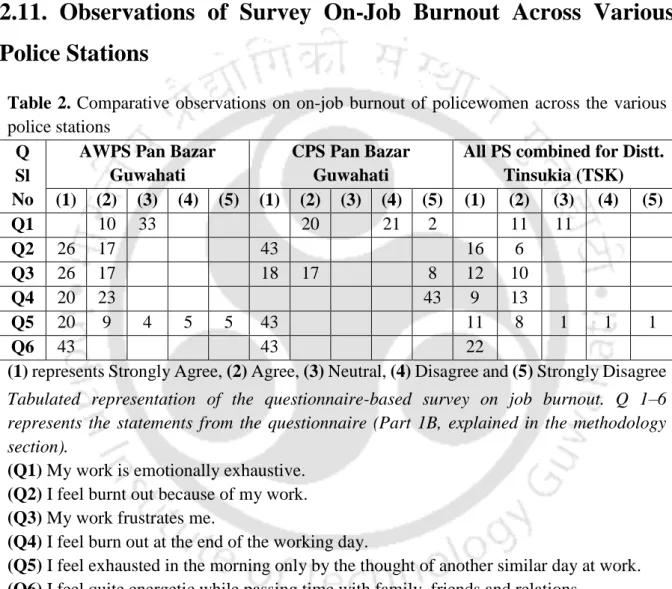
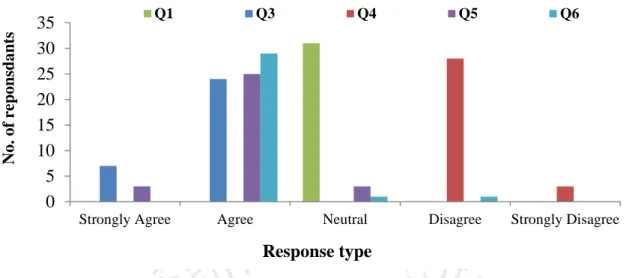
Overview of major findings from Table.1, it shows major agreement and disagreement on occupational well-being issues faced by policewomen at AWPS Guwahati. Overview of major findings, it shows great agreement and disagreement about occupational well-being issues faced by policewomen in Hangzhou, China.
Observations of Survey On-Job Burnout Across Various Police Stations
- AWPS Pan Bazar, Guwahati
- CPS Pan Bazar, Guwahati
- All 7 Police Stations of Distt. Tinsukia, combined (TSK)
- Policewomen at Hangzhou, China
Similar to AWPS, there was an increase in satisfaction during their family and friends meetings. It could be seen that there was somewhat similar type of stress experienced by policewomen in China regarding policing as a profession.
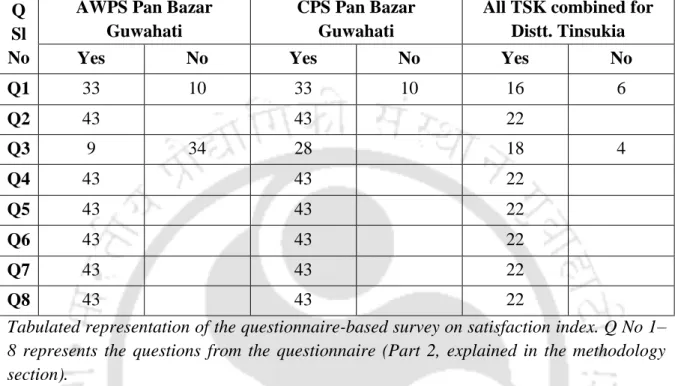
Observations Related to On-Job Satisfaction Survey Results Across Police Stations
- AWPS Pan Bazar, Guwahati
- CPS Pan Bazar, Guwahati
- All 7 Police Stations of Distt. Tinsukia, Combined (TSK)
- Policewomen at Hangzhou, China
Summary of key findings from job satisfaction survey conducted among constables in CPS Guwahati from Table 3. Summary of key findings from job satisfaction survey conducted among constables in Tinsukia from Table 3.
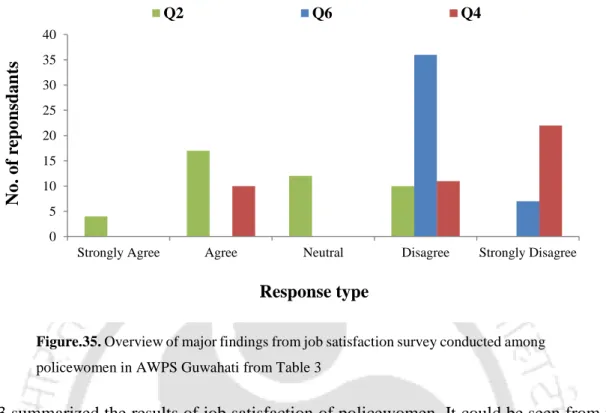
Comparative Notes Regarding Satisfaction Index of Policewomen Across the Various Police Stations
- AWPS Pan Bazar, Guwahati
- CPS Pan Bazar, Guwahati
- All 7 Police Stations of Distt. Tinsukia, Combined (TSK)
- Policewomen at Hangzhou, China
Apart from that, there was no difference in satisfaction index with that of police women in AWPS. The satisfaction index (Table 4) judgment of police women in Tinsukia was similar to that of CPS Guwahati.
Reliability of Questionnaire for Subjective Assessment of Workplace and On-Job Amenities
However, Kendall's coefficient of concordance represented little agreement between the preference ratings of the questionnaire questions rated by the respondents (W=0.132), thus indicating that the respondents correctly understood the rating/points of the questionnaire and scored the them after they realized it. questions properly. However, Kendall's coefficient of concordance represented little agreement between the preference ratings of the questionnaire questions rated by the respondents (W=0.030), thus indicating that the respondents correctly understood the rating/points of the questionnaire and scored the them after they realized it. questions properly.
- AWPS (Before and After Intervention)
- CPS (Before and After Intervention)
- TSK (Before and After Intervention)
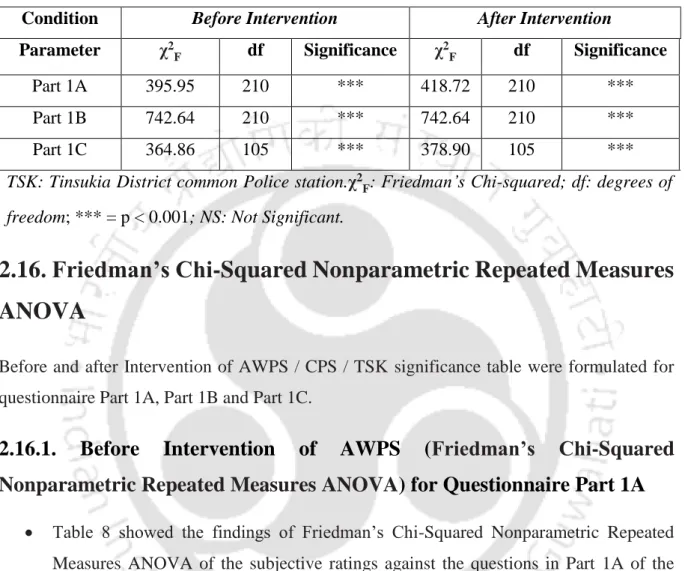
809.13 (p < 0.001) for Part 1B; and (χ2F): 257.93 (p < 0.001) for Part 1C], indicating that the questions in the questionnaire were all independent (unbiased) of the subjective responses of CPS participants, again confirming the construct validity of the questionnaire and methodological features . of its administration procedure. TSK participants, which again confirms the construct validity of the questionnaire and methodological properties of its administration procedure.
Friedman’s Chi-Squared Nonparametric Repeated Measures ANOVA
- Before Intervention of AWPS (Friedman’s Chi-Squared Nonparametric Repeated Measures ANOVA) for Questionnaire Part 1A
- After Intervention of AWPS (Friedman’s Chi-Squared Nonparametric Repeated Measures ANOVA) for Questionnaire Part 1A
- Before and After Intervention of AWPS (Friedman’s Chi-Squared Nonparametric Repeated Measures ANOVA) for Questionnaire part 1B
- Before and after intervention of AWPS (Friedman’s Chi-Squared Nonparametric Repeated Measures ANOVA) for Questionnaire Part 1C
- Before Intervention of CPS (Friedman’s Chi-Squared Nonparametric Repeated Measures ANOVA) for Questionnaire Part 1A
- After Intervention of CPS (Friedman’s Chi-Squared Nonparametric Repeated Measures ANOVA) for Questionnaire Part 1A
- Before and After Intervention of CPS (Friedman’s Chi-Squared Nonparametric Repeated Measures ANOVA) for questionnaire part 1B
- Before and After intervention of CPS (Friedman’s Chi-Squared Nonparametric Repeated Measures ANOVA) for questionnaire Part 1C
- Before Intervention of TSK (Friedman’s Chi-Squared Nonparametric Repeated Measures ANOVA) for questionnaire Part 1A
- After Intervention of TSK (Friedman’s Chi-Squared Nonparametric Repeated Measures ANOVA) for questionnaire Part 1A
- Before and After Intervention of TSK (Friedman’s Chi-Squared Nonparametric Repeated Measures ANOVA) for questionnaire part 1B
- Before and After Intervention of TSK (Friedman’s Chi-Squared Nonparametric Repeated Measures ANOVA) for questionnaire part 1C
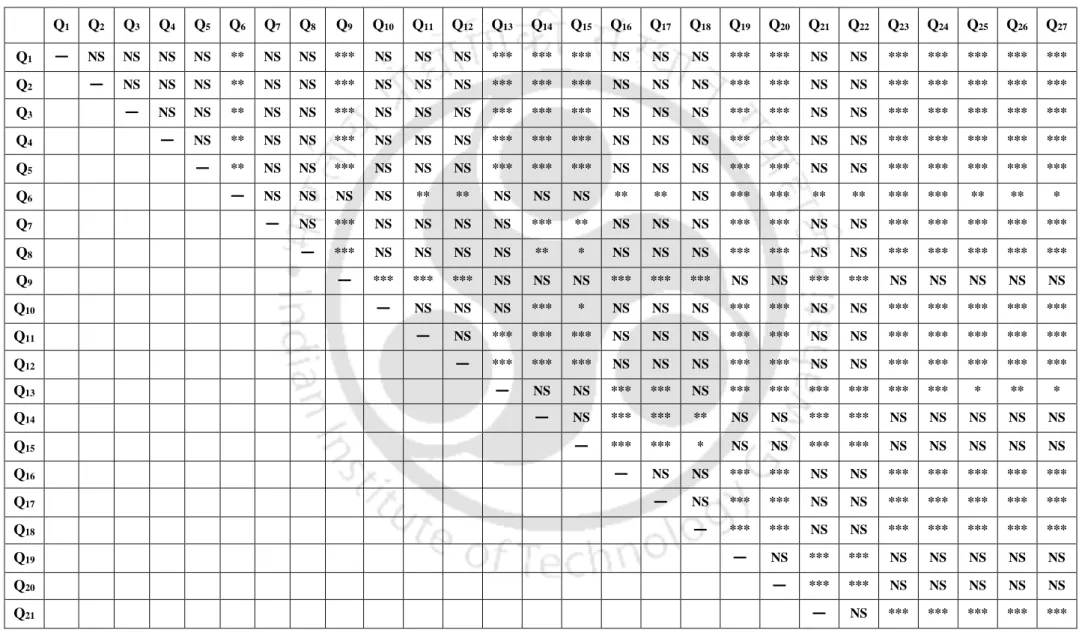
Significance table of post-intervention AWPS (Friedman's Chi-Squared nonparametric repeated measures ANOVA) for questionnaire Part 1A. Significance table of post-intervention CPS (Friedman's Chi-Squared nonparametric repeated measures ANOVA) for questionnaire Part 1A.
Conclusion
CHAPTER 3- DESIGN INTERVENTION WITH REFERENCE TO WORKSTATION AND AMENITIES
DESIGN INTERVENTION WITH REFERENCE TO WORKSTATION AND AMENITIES
Introduction
Proposal regarding Ergonomics Design Intervention for AWPS / CPS / TSK in India and Implementation at AWPS
- Ergonomics Design Intervention for AWPS, Pan Bazar, Guwahati
Women Barrack
Entrance
Record room
Office at upstairs
Office for Policewomen
Entrance Office at
Counselling room
CPS Pan Bazar Guwahati
Comparative observations on job burnout of police women for CPS Pan Bazar Guwahati before and after intervention. Comparative observations on job satisfaction of police women for CPS Pan Bazar Guwahati before and after intervention.

All PS (Police Station) Combined for District Tinsukia (TSK)
Comparative observations on burnout among police women for all SPs combined for Tinsukia District before and after the intervention. Comparative observations of police women's job satisfaction for all SPs combined for Tinsukia District before and after the intervention.
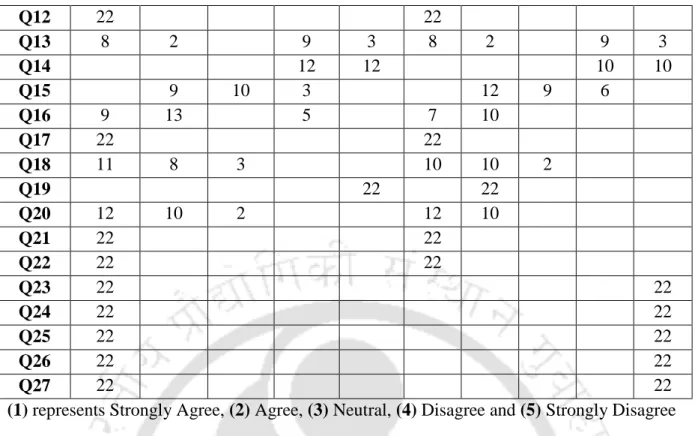
Statistical Interpretation of Improvements due to Ergonomic Design Interventions
Moreover, policewomen at PS Tinsukia also expressed optimistic views that no further utility requirements would be required after the physical implementation of the design. The correlation with the changes after intervention only for MEWP was significant, perhaps due to the physical implementation of ergonomic design interventions for MEWP, which for the rest of the cases (CPS and TSK) were only on paper (physical implementation to follow). upwards).
Motivation Behind Modular Utility Van
These types of toilet units are available in public places and can serve as a reference. Considering these existing solutions for moving toilets, a mobile utility van can be proposed to the police organization to improve the work well-being of police women at the workplace.
Concept of Mini Truck Mounted Mobile Toilet Unit
Restrooms will have an ozone sterilizer, hand sanitizer, and occasional use of pesticides in a mobile toilet. These tasks, which contain measurements of female police officers, can be used to explore the design of the workstation and the necessary infrastructure.
Survey of Responses with Proposed Modular Utility Van
Proposed schematic concept for a detachable / modular mobile van for police force considering police personnel. Overview of a final proposed schematic diagram (2D concept) of the Mobile Utility Van considering both male and female police officers with an interior plan. Diagrammatic representation, aspect ratio not locked and not to scale).
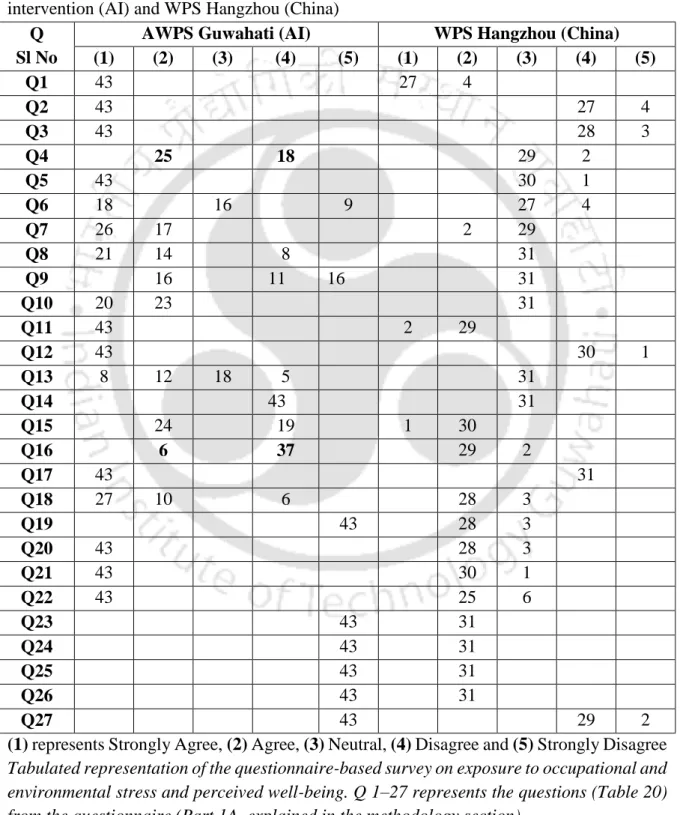
Comparison of Policewomen at AWPS Pan Bazar, Guwahati (after intervention) and WPS Hangzhou (China)
This is probably due to the larger number of female police officers in WPS Hangzhou than in AWPS Guwahati. In addition, female police officers in Hangzhou were neutral in response to the supervisor's competency question, compared to mixed responses from female police officers in AWPS Guwahati.
Conclusion
Policewomen in Hangzhou [Figure.ure.58 (a)] appeared to be equipped with better uniforms than those in India [Figure.ure.58 (b)], where the uniform designs for male and female policemen were almost the same. Similarly, the patrol vehicle in China was found to be more sophisticated with the presence of a red beacon, a shelf for storing the necessary equipment and a siren [Figure 59 (a)].
DISCUSSION: KEY ISSUES FOR BETTERMENT OF WORK SITUATION
- Status of well-being of women police: An Indian perspective
- Identifying key issues related to well-being of women police in India
- Framework of police work station: Inclusion of key elements related to womanness
- SUMMARY AND CONCLUSION
One of the main concerns expressed by police women is the need to improve privacy in the workplace (Bora et al, 2016; The Economic Times, 2016; Police and Nation, 2016). Necessary design interventions in police stations can certainly improve the working condition of female police personnel, thereby enhancing their scholarly progress and overall well-being (Shewta and Iqbal, 2016).
SUMMARY AND CONCLUSION 5.1. Summary
- Conclusion
- Contribution of the Research Work: Novelty of the Thesis
- Recommendation
- Limitations
- Future scope
Basic facilities such as seating area, office furniture, privacy, counseling room and toilet were implemented at AWPS to improve the working capacity and professional well-being of the policewomen; Moreover, the comfort of female visitors should be considered. A need was felt for long-term monitoring of occupational well-being and environmental stress, which could provide more detailed insights into the impact of the interventions implemented.
Chandigarh | Released: March 7. http://indianexpress.com/article/cities/chandigarh/chandigarh-give-lighter-duties- for-women-cops-in-pregnancy-report/). Improve Workplace Amenities for Women in Police: Acting Chief Justice.(http://www.thehindu.com/todays-paper/tp-national/improve-workplace-amenities-for-women-in-police-acting-chief-. justice/ article3685026.ece).
APPENDIX A: A questionnaire used for the survey
Survey on peace, comfort, efficiency, demands, comfort and job satisfaction for Women Police under Ministry of Home Affairs, Government of Assam.