The Simple Economics of Optimal Reservation Policies
Delhi School of Economics Glenn C. Loury
December 14, 2016
Part One: The Development vs. the Assignment Margin
Part Two: Generalized ‘Color-Blind’ Reservation Policies
A Tribute: What Is Meant by
“Schelling-esque”
• Broad interests; playful mind; mastery of strategic analysis; elegant writing; imaginatively linking theory with policy.
• Taught “Public Policy in Divided Societies” with Tom in 1980s. Encountered writers like: Amartya Sen; Albert Hirschman; Erving Goffman; Leo Strauss; Kenneth Arrow; Robert Merton (Sr.); Howard Raiffa; Mancur Olson; Michael Spence; Harold Isaacs; Jon Elster;
Thomas Pettigrew; Michael Walzer; Gunnar Myrdal;
Thomas Kuhn … (I got an education!)
• Our students investigated such topics as: the Roma in Europe; the indigenous in Central America;
untouchabililty in India; slave maroon communities in the Caribbean; skin color caste in cities of New Orleans and Charleston; sign language vs. lip-reading among the deaf; name and accent changes to disguise
ethnic/regional origins; collective punishment, pride, shame and reputation; racial profiling; stigma; sexual divisions of labor at home and in the workplace;
endogamy and assortative mating …
•
We explored conceptual puzzles in lectures from that course about the workings of:
rumors; seduction; riots; “passing for white”;
anonymity; plausible deniability; signaling;
strategic imprecision; group think; code words and dog-whistle politics; discursive taboos and naked emperors; knowledge of another’s state of knowledge; behavior in public; difference between promises, threats and bluffs.
•
In short, I incurred an enormous intellectual debt to Tom in those years, one which I shall never be able adequately to discharge … He forever altered my way of thinking about the intersection between economic theory, social policy and race – in the United States and
throughout the world
The Problem of
Optimal Reservation Policy
(An exercise in optimal taxation theory.
See, e.g., Fryer and Loury, JPE 2013)
Part One
Reservations (Affirmative Action) = {concern about ‘groupness’}
+ {concern for ‘equality’} + {rationing access to elite positions}
AFFIRMATIVE ACTION PRESUPPOSES THAT:
(1) there is a hierarchy of more/less desired positions,
(2) there is significant racial/ethnic group diversity of identities (3) there is substantial social disparity between these groups, (4) there is a political/economic need for group representation
A GENERAL DEFINITION of “POSITIVE DISCRIMINATION”
(5) a policy maker seeks to increase the disadvantaged group’s representation in high status positions in an optimal way.
I (with Roland Fryer) build “Economic Model” of reservation policies.
This Is a Classic (i.e., old fashioned!) Applied Theory Exercise Here are the key elements of our “model” :
(1) Two identity groups, one relatively “disadvantaged.” (Such
“backwardness” exogenous; yet has resource allocation implications.) (2) A scarcity of desired positions; competition for access to them;
AA presupposes the rationing of top positions (assignment margin) (3) A possibility for people to raise productivity with costly effort; AA alters incentives to make these investments (development margin)
(4) Reservation policies to improve position of disadvantaged group (5) We contrast “development” vs. “assignment-oriented” policies;
as well as “color-blind”(CB) vs. “color-sighted” (CS) policies.
Theoretical Questions of Interest
1) What kind of policy accomplishes reservation goal at least social cost? (Taking “cost” seriously – that is, considering both opportunity and investment costs.) 2) How does the optimal policy alter incentives for human capital investment in each group?
3) Where in productive life-cycle – at “development”
or “assignment” margin – is it best to intervene?
Applied Theory is useful when it supplies insight into problem that can guide our thinking. The intuitive insights of this exercise are as follows:
(One a default option paying zero)
Elements of The Baseline Model
- A continuum of agents of unit measure; two groups, A and B - A continuum of scarce ‘slots’ of less than unit measure
- Two production stages:
- (i) ex ante workers acquire human capital; HC is costly; the distribution of this cost differ between groups
- (ii) ex post workers bid in a competitive marketplace for access to ‘slots’
- An agent + a ‘slot’ creates output valued at agent’s productivity.
- Investment in HC (stochastically) makes agents more productive.
- ‘Slots’ inelastically supplied (this easily relaxed). Representation among slot-holders derives from a group’s ex post distribution of productivity. Policy aims to help “disadvantaged” gain slots.
- AA policy a subsidy/tax on HC investment or on slot acquisition.
Here are our three main results:
(1) LF Equilibrium allocation is efficient and unequal
(2) Optimal CS Policy Entirely “Assignment”-Oriented when agents fully and correctly anticipate late-stage rents which vary by productivity and group membership
(3) Optimal CB Policy Subsidizes HC acquisition only if the
“disadvantaged” are better represented on the development
margin than on the assignment margin
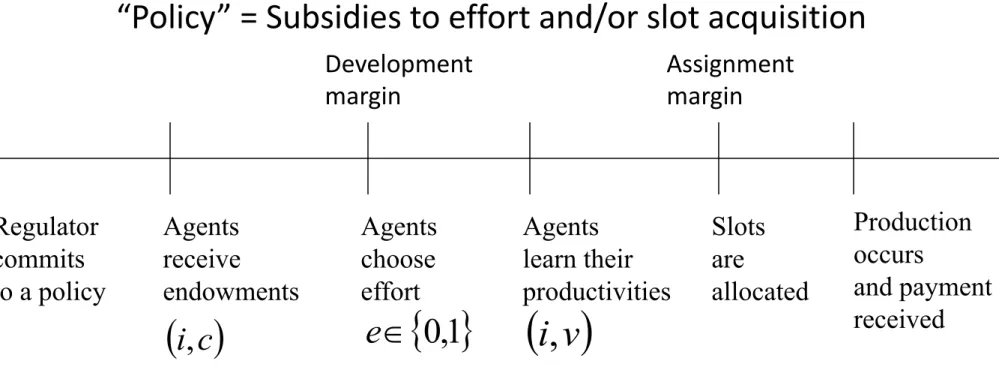
Regulator commits to a policy
Agents receive
endowments
( )
i,cAgents choose effort
{ }
0,1Î e
Agents learn their productivities
( ) i, v
Slots are
allocated
Production occurs
and payment received
Figure 1: Sequence of Actions
Dimensions of Affirmative Action Policy considered:
(A) Development vs. Assignment Margin (B) Blind vs. Sighted preferential policy.
“Policy” = Subsidies to effort and/or slot acquisition
Development
margin Assignment
margin
decreasing
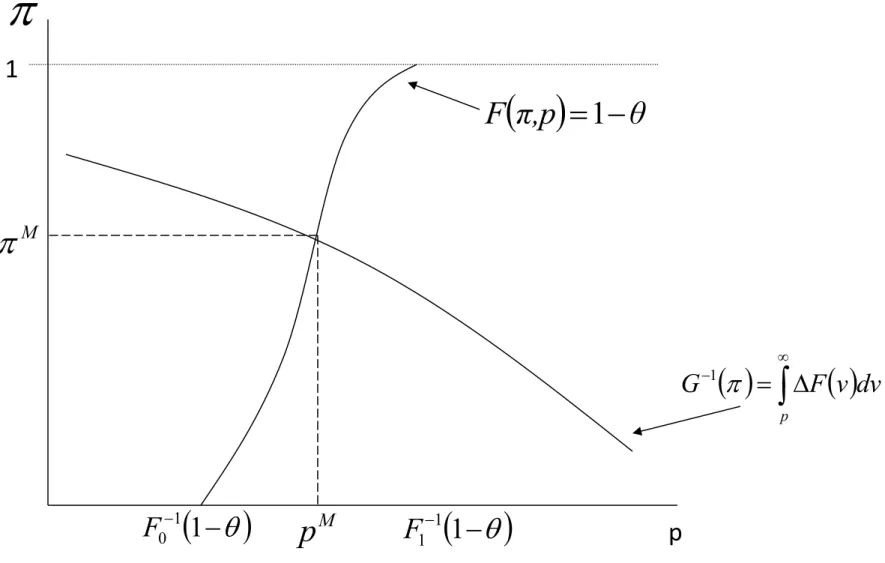
(1) First we analyze the LF Equilibrium allocation of HC and slots:
Let π be the fraction who acquired HC and let p be the price of a slot. Then the fraction of population willing to buy a slot is:
Figure 2: Competitive Equilibrium under Laissez-faire p
p
1 F
( )
π,p =1-θ( )
ò
¥ ( )- = D
p
dv v F G 1 p
p M
pM
( -q)
-1 1
F0 F1-1
(
1-q)
If slots go to most productive:
If HC acquired by best endowed:
But, what would efficiency require?
Private return for the
marginal HC investor Social MB of HC investment
Intuition for why LF Equilibrium Allocation is Efficient Equating marginal social benefits and costs requires:
A’s get more HC
than B’s under LF A’s better represented in slots than B’s under LF
Reservation policies aim to increase representation of B’s amongst slot holders above this LF equilibrium level
(2) Consider now the optimal CS reservation policy
0 μ
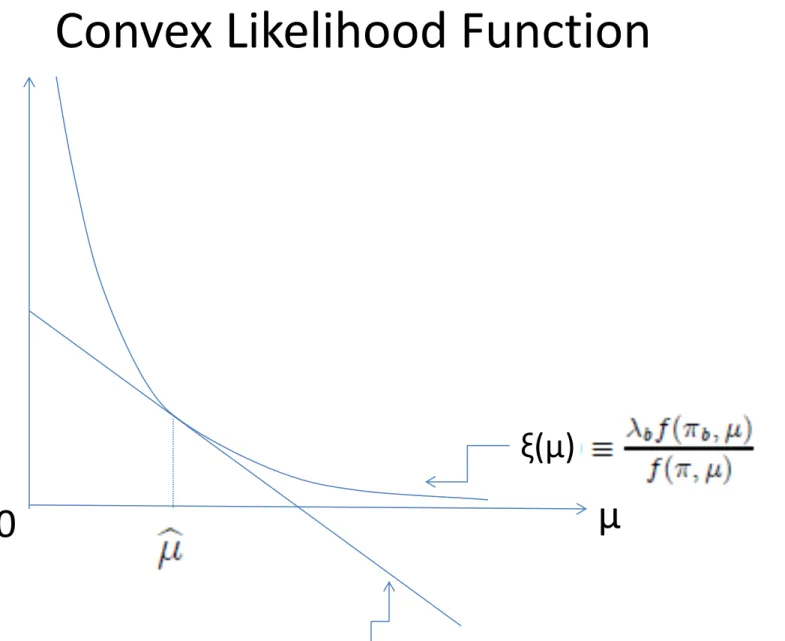
Figure 4: Uniqueness of Equilibrium Under a Convex Likelihood Function
ξ(μ)
μ
[a(μ) - ]dF(π,μ)
0
Figure 4
+
Φ(μ)=
Φ(μ)
- -
+
On the Relative Efficiency of Generalized Color-Blind Policy
(An empirical exercise drawn from work with Tolga Yuret and Roland Fryer)
Part Two
Affirmative Action without Explicit Racial Discrimination
• Color-blind (non-racially discriminatory) affirmative action exploits statistical associations in the population between an applicant’s racial identity and his/her non-racial traits
[Texas 10% Plan famously illustrates the non-transparency]
• A policymaker alters the weight given to non-racial traits for all applicants in such a way as to increase the yield in
selection process from a targeted group.
• One consequence of this kind of policy is that selection
efficiency must in general be reduced for all applicants. Policy can’t be ‘conditionally’ (within group) meritocratic.
An Illustrative Example of Color-Blind Affirmative Action
Students in area A are excluded, and in area B are included, by the policy. There are more disadvantaged group students to be found in area B than in area A.
Finding an Optimal Policy: The Planner’s Problem
Academic Performance Equation:
Racial Identity Equation [prob {applicant in targeted group}]:
Use Data to Estimate (presumed) Linear Relationships
Laissez-Faire Solution: Threshold Rule on Predicted Performance
Color-Sighted Affirmative Action Solution: Race-Specific Thresholds
Color-Blind Affirmative Action: Modified weights in scoring equation