
Naveen Kashyap Associate Professor of Psychology, Department of Humanities and Social Sciences, IIT Guwahati, has been a great mentor to me. Comparison of false memories elicited through semantic and categorical relations in 3rd National Conference on Recent Advances in Cognition and Health (NCRACH) at BHU Varanasi, India.
LIST OF TABLES
LIST OF GRAPHS
INTRODUCTION AND LITERATURE REVIEW
- Stimuli Presentation Modality: Smith and Hunt (1998) found that visual presentation of items leads to less false memory than auditory presentation. They argue that visual presentation
- Retention Interval and Level of Processing: There are few studies on retention interval effects on false recall and false recognition. Some contradictory findings are available for these
- In Activation/Monitoring Theory: The activation/monitoring theory explains that in DRM paradigm presentation of list items during study phase activates the semantic/lexical system
False memory for category associates was investigated in children (Brainerd, Reyna & Kneer, 1995b) and found that false recognition in younger children was higher than in older children over a 1-week retention interval (Brainerd & Reyna, 1996). Whether sleep deprivation has any role to play in false memory formation.
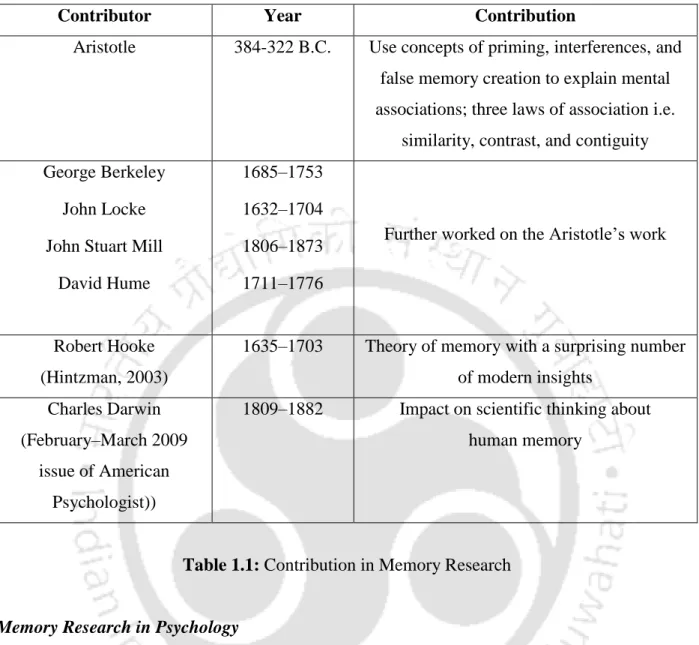
RESEARCH AIMS AND GENERAL METHODOLOGY
- False memory generation
- Role of sleep in false memory
In this section, we briefly describe the various tools and equipment that we used in this thesis. In this thesis: The MMSE is used to screen subjects with mild to severe cognitive impairment. In the present thesis: The mood questionnaire is used to scan for abnormal mood changes among participants in different experiments.
In attention test, participants have to write words starting with the alphabet "A" within one minute. In the current thesis: the DAST-20 is used to screen participant's involvement in drugs and is an important part of exclusion criteria. Mean ESS scores obtained by subjects over experimental nights were indicative of a very low propensity for daytime sleepiness (N=30). 1) Words: Semantically associated words were used as stimuli in the DRM (Deese-Rodieger- McDermott) task list used for the induction of false memory.
Behavioral experiments: In the current thesis, the behavioral experiments were carried out with two false memory induction methods.
STIMULI DEVELOPMENT
To test whether intra-item BAS values of group A (recognition) and group B (recall) and inter-item BAS values of both group are different or same/comparable
To test whether the intra-item word lengths of group A (recognition) and group B (recall) and inter-item word lengths of group A and group B are same or different
Two groups were made where each group consisted of a total of 10 lists with 10 words (semantically associated) included for study phase. The semantically associated words are extracted from previously developed false memory literature (Stadler, Roediger & McDermott, 1999; Roediger & McDermott, 1995; Roediger et al., 2001; Deese, 1959a, 1959b) and served as word stimuli. All words were of particular backward associative strength and listed in descending BAS value.
Each list word was analyzed independently by one-way ANOVA with BAS value and word length. We found that the word length of all list words in each list of each group are comparable, they do not differ from each other. Similarly, with respect to BAS values also all words in each list in each group are similar to each other.
But between group A and group B, all the words from all lists differ significantly from each other in both word length as well as BAS values.
Development of simple line drawings
To check whether each line drawing and their characteristics are significantly comparable
At the start of the task, the participants have described the purpose of the task and instructed to perform the task very carefully and attentively. They were asked to write the name of each picture in the English language, and if they remembered the name of the picture in their native language, they can also write the picture name in that language. All participants at the time of task performance instructed to participate in the entire picture very carefully and attentively.
In the name agreement section, participants were asked to write the name of the picture that was first in their mind. If they could not identify the object when they received the instruction, they should answer with DKO (I do not know the object). In this parameter, the participants were asked to rate their opinion about the familiarity of each picture.
Here the definition of complexity is 'the amount of detail of the line in the image'. Participants were instructed to rate their response on a 5-point Likert scale, with responses ranging from 1 (indicating very simple) to 5 (indicating very complex).
BEHAVIORAL AND SLEEP EXPERIMENTS
The present study aimed at testing the role of retrieval strategy and retention interval on semantically induced false memory performance
The results are presented as mean correct responses of studied words, intrusion words and critical lure words (CL). Studied words are identified in almost similar amount in both recall and recognition test in DRM paradigm of false memory formation. Across the retention interval, critical lures did not differ in quantity, they were almost the same in both recall and recognition showing the persistence of false memory.
Bonferroni post hoc analysis shows that identification of critical cue words (false memory identifier) was unaffected by retention intervals (immediate, 24 h, 48 h) in the recall and recognition strategies. Another interesting finding of this study is that at the immediate, 24-hour, and 48-hour retention intervals, the critical cue words did not show any significant changes between the recall and recognition tests (see Table 01). The result of this study supports the "persistence of the false memory effect" (Toglia et al., 1999).
The overall conclusion of the present study is that recognition leads to more false memory than recall, and across retention intervals false memory persists in both recall and recognition for critical lure words, but for intrusive words and studied words the pattern is surprisingly different.
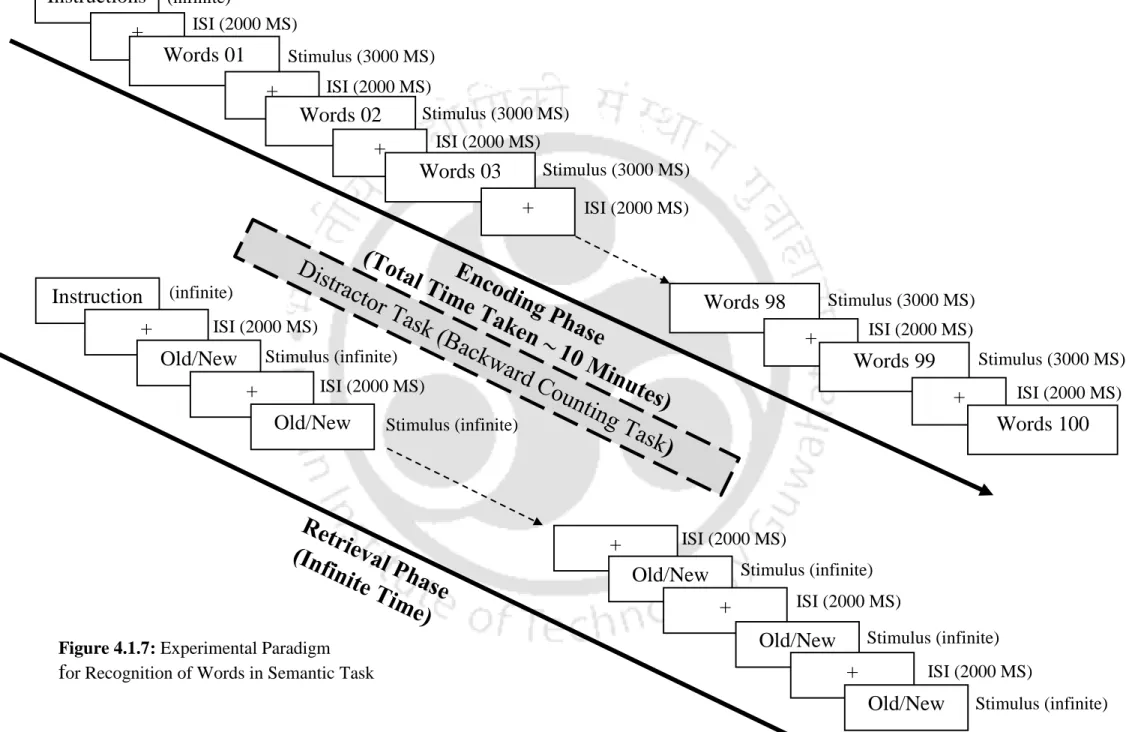
The present study aimed at testing the effect of retrieval strategy and retention interval on false memory induced through category associate method
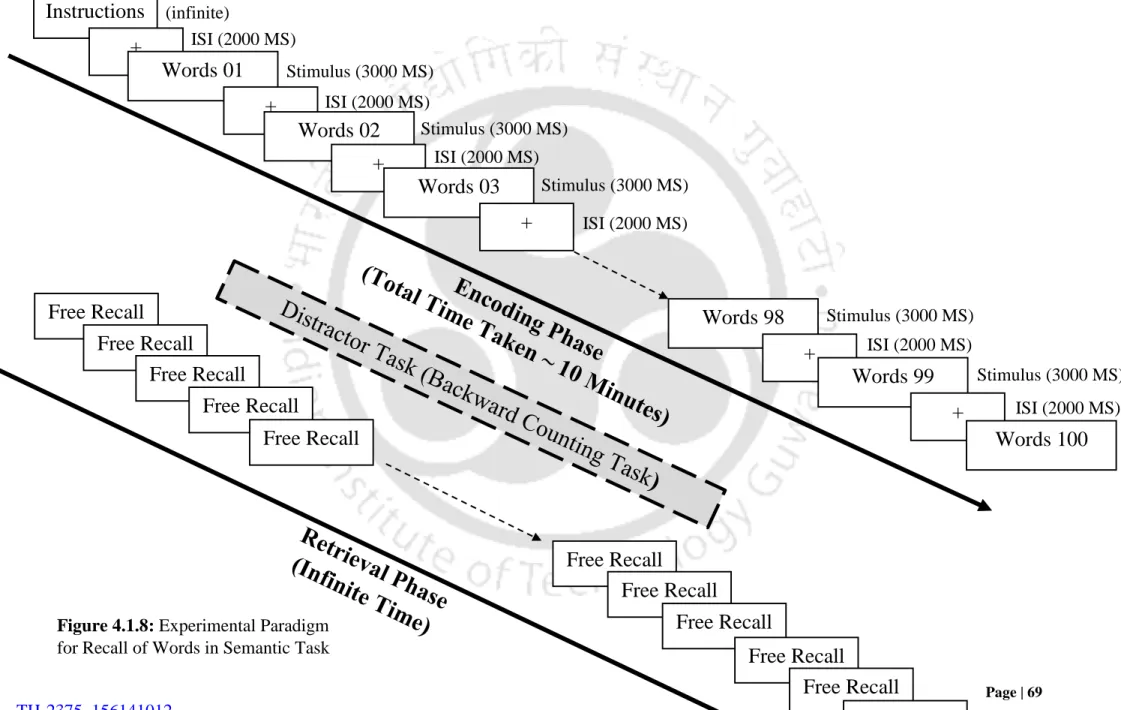
The subjects of one group took a recall test, and the subjects of the other group took a recognition test. The line drawings were presented using e-prime version 2 in the center of the computer screen in sequential order. The line pictures in each list were ranked in descending order of their frequency of availability (Seamon et al., 2000).
Subjects in each group were made to study the given lists of line drawings and later perform on the retrieval tests assigned to that group. At the beginning of the experiment, each participant completed battery of behavioral questionnaires which included mood questionnaire, MMSE, memory and attention test and memory functioning questionnaire. List items were presented sequentially during the study phase, but at the time of the retest intralist items were presented randomly.
The distractor task was also inserted between study and recall to prevent repetition of list items.
Encoding Phase Instructions
Infinite Time)
Total Time Taken ~ 10 Minutes)
Immediate 24 Hours 48 Hours Immediate 24 Hours 48 Hours
Across retention intervals, the recall test shows the persistence/permanence effect of false memory on category associates. This study reported that at immediate retrieval, recall and recognition did not differ in the number of false memory identifiers (critical lures). However, after a 24-hour retention interval, the number of false memory identifiers (critical lures) increased for recognition.
The present study reported that the number of false memory identifiers (critical lures) increased on recognition trials when tested after a 24-hour retention interval (p < 0.014). EXPERIMENT 03-A: Comparison of category and semantic association methods for inducing false memory across a memory retrieval strategy. H3A-2: Retention interval between learning and retrieval will modulate false memory generation in the associative and semantic set task.
Semantic association task: DRM paradigm was used to induce false memory for pre-selected word lists.
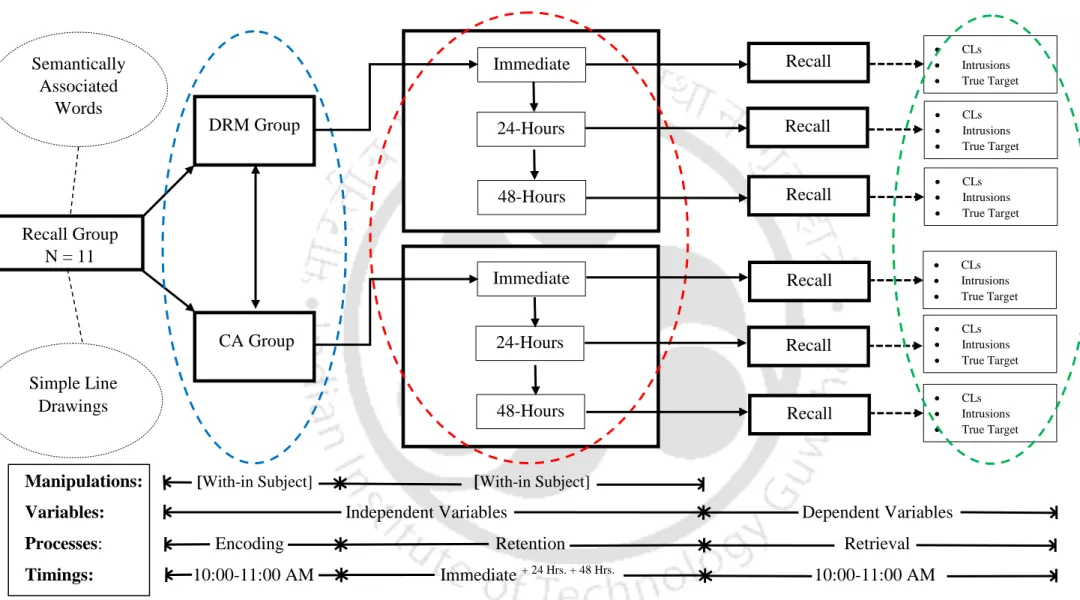
Dependent Measure
Task Type
DRM Task (for Words) CA Task (for Pictures)
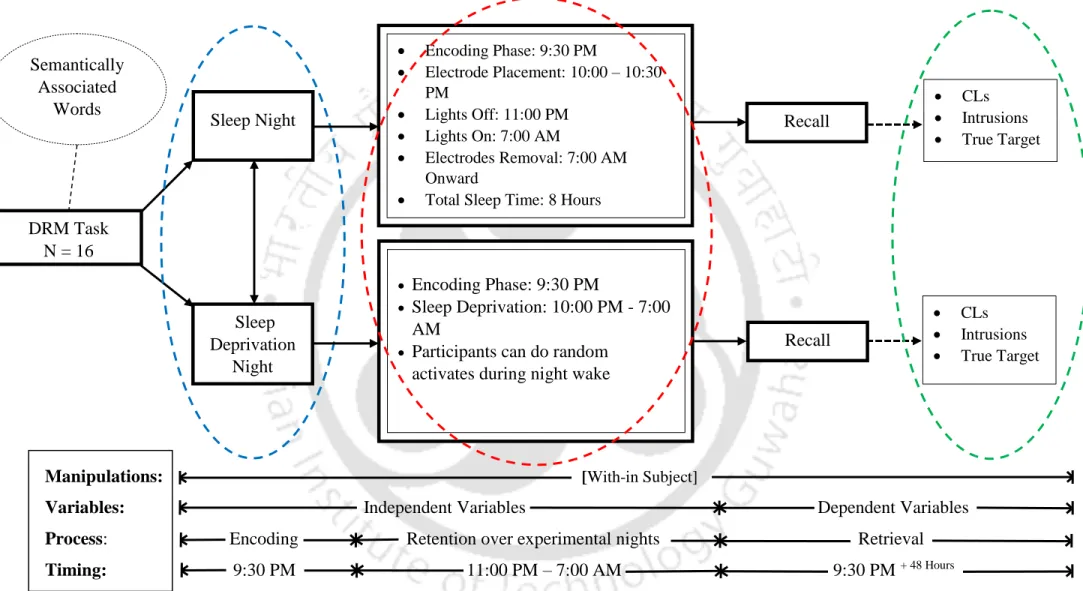
This study aimed is to find the effect of sleep and sleep deprivation nights in the induction of category associated false memories through recall retrieval strategy
This study aimed is to find the effect of sleep and sleep deprivation nights in the induction of category associated false memories through recognition retrieval strategy
The effect of experimental nights on the generation of false memories at recall: A one-way repeated-measures ANOVA was conducted to compare the effect of sleep and sleep deprivation on critical lures. The liberal response bias was found in both the sleep and sleep deprivation conditions [sleep sleep deprivation = - 0.364]. Comparisons are made between sleep-deprived and sleep-deprived nights to recall the true target, critical lures, and intruders.
This current study is devoted to finding out the role of experimental nights (sleep vs. sleep deprivation) in generating false memories through category-associated tasks by presenting simple line drawing images. In the current study, false memories and false recognition are both higher with full night's sleep compared to sleep deprivation. For the real target items, the response bias appeared to be liberal during both the sleep and sleep deprivation nights.
In this current study, false recognition biased the conservative response and sleep deprivation showed a liberal biased response.
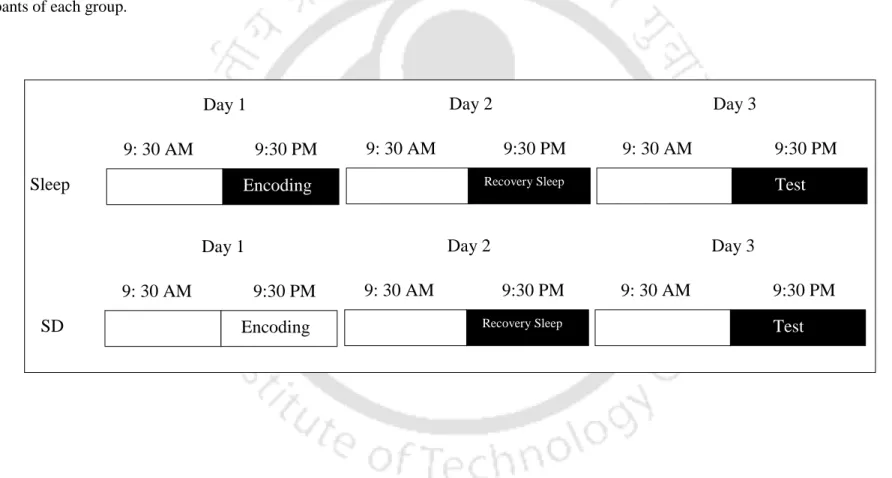
This study aimed is to find the effect of sleep and sleep deprivation nights in the induction of semantic associated false memories through recall retrieval strategy
This study aimed is to find the effect of sleep and sleep deprivation nights in the induction of semantic associated false memories through recognition retrieval strategy
A non-significant effect of experimental nights [F p > 0.05, ƞ2 = 0.073] on false memory was reported, suggesting that sleep and sleep deprivation both nights produce the critical cues equally. Analysis of response bias for false recall was found to be liberally biased for both experimental nights [for sleep = -0.03; for lack of sleep = - 0.03]. For the true target items, the response bias analysis was found to be conservative in both sleep and sleep deprivation conditions [sleep = 0.0162, sleep deprivation = 0.0063].
Recognition of critical lure words and real target words are all recovered equally after the 48-hour retention shortly after sleep and sleep deprivation. The response bias for critical lures is liberal for both sleep and sleep deprivation nights, while in real target words the response bias is conservative for both sleep and sleep deprivation nights. Word item retrieval was recorded after 48 hours of full-night sleep retention and sleep-deprived nights.
In the current study, the response bias for false recognition in both sleep and sleep deprivation was found to be liberal, whereas that in real word recognition was conservative for both sleep and sleep deprivation.
GENERAL DISCUSSION
Similarly, Monds et al., 2017, reported results similar to the current study for false memory generation by semantic associates. In category association tasks (line drawing), both recall and recognition recovery strategies produce false memories almost equally. The third research question examined the effect of retention intervals (between encoding and retrieval) on the formation of false memories.
Retention interval is one of the key factors through which false memory performance can be modulated. The fourth research question examines the effect of sleep nights on false memory generation. Previous studies on sleep and false memories (McKeon et al., 2012; Payne et al., 2009) support the idea that sleep helps form both false memory and true memory, which is in direct contrast to the result of this study.
This study reported an increase in false memories after sleep in a category-related task.
![Table 4.2: Mean Scores of Critical Lure Words [Representation: Mean±SD]](https://thumb-ap.123doks.com/thumbv2/azpdfnet/10557426.0/89.1188.236.950.153.784/table-mean-scores-critical-lure-words-representation-mean.webp)
