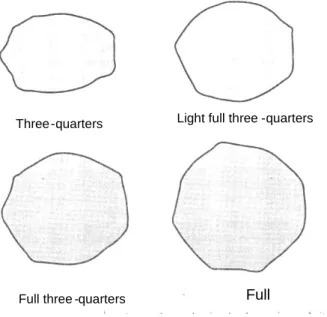
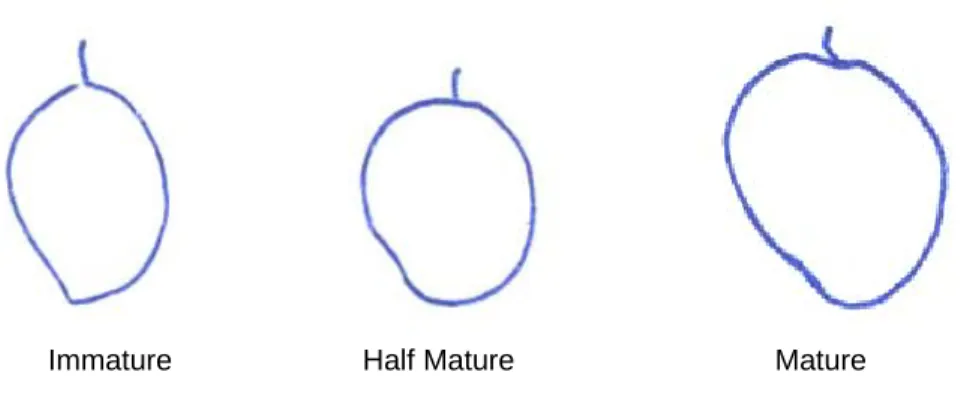
According to the Oxford English Dictionary, fruit can be defined as “the edible product of a plant or tree, consisting of seed and its integument, especially the latter if juicy or fleshy.” This instrument can accurately measure small color differences and can be automated in the packaging line. For many fruits such as apple, pear, peach, plum, guava, kinnow, etc., firmness can be used to determine the ripeness of the harvest.
To give greater flexibility to the test and make it more precise, a salt or sugar solution can be used instead of water. The total soluble solids of the fruit can be measured with refractometer, which indicates the harvest ripeness of fruit. A drop of juice is then placed on the prism of the refractometer and TSS content can be read directly on the scale.
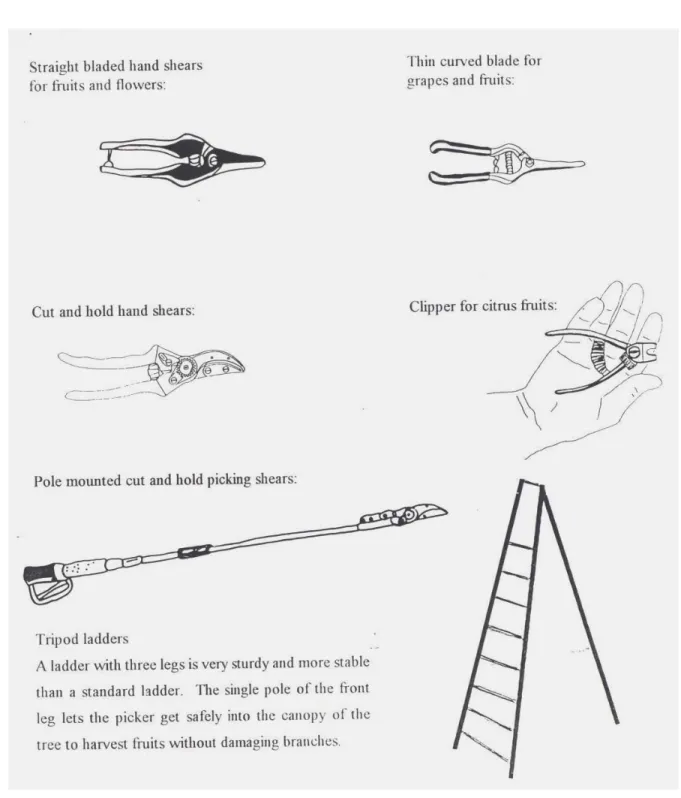
TA expressed as a percentage of malic, citric or tartaric acid can be calculated as follows: the following acid meq. the factor can be used for different fruits. Using containers that can be easily filled and transported by workers minimizes damage to produce. Fig.4: Picking bags (Source: Friend manufacturing Co ii) Picking poles and grab bags: These tools can be easily made by hand.
These can be used for harvesting, storage, cooling, transportation and even retail display.
Handling
The fruits needed for processing can be harvested by machine, but it is important to process them as soon as possible, otherwise spoilage may occur. Field packing: Selecting, sorting, trimming and harvesting the produce in the field at harvest time is called field packing and has great potential to reduce mechanical damage by reducing the number of handling steps between the field and the consumer.
Packing house operations: The packing house operations include the following steps:- - Dumping / collection
After drying or storage, kiwi should be dry cleaned or brushed. iv) Size / Sorting: Sorting can be done manually or by automatic sorting lines. Fruit grading plays an important role in domestic and export marketing of fruit. Class designation and fruit quality: The minimum requirements are: the fruits must be .. a) clean, round, without visible foreign bodies, b) fresh in appearance, without pests.
Difference between the diameter of the smallest and largest onion in the same package (in mm.).
Precooling of Horticulture Produce
The product can be cooled and stored in the same room, thus saving handling costs. Horticultural crops suitable for room cooling are: Potato, onion, apple and citrus fruits.. ii) Forced air cooling: Forced air cooling is mostly used for a wide range of horticultural produce. In this method, uniform cooling of the product can be achieved if the stacks of pallet bins are properly aligned.
Cooling times can be controlled for different types of products by controlling the air flow rate. Horticultural products suitable for forced air cooling include: grapes, berries, pears, peaches, oranges, strawberries, tomatoes and other tropical and subtropical fruits. iii). This method of cooling not only avoids water loss, but can even add water to the product.
In this type of hydrocooler, cold water is pumped to an overhead perforated pan which produces a shower over the products, which may be in containers or boxes or loose on a conveyor belt passing below. The water leaving the product can be filtered to remove debris and then passed over the cooling coil where it is recooled. In this type of hydrocooler, the products are brought into contact with cold water by using a conveyor (flume type) or by lowering containers/boxes into a tank of water, which is continuously cooled by a mechanical cooling system.
Flume hydrocoolers carry the product either against (counterflow) or across (crossflow) the flow. Hydrocooler can be easily integrated into a package and become a step within a simple packing line. Horticultural products suitable for hydrocooling are: Mango, peach, cherry, asparagus, etc. iv) Vacuum cooling: Vacuum cooling takes place by evaporating water from the product at very low air pressure.
In this method, air is pumped from a larger steel chamber into which the product is charged for precooling. To overcome the major water loss from production, another water spray vacuum method, (modification of vacuum cooling), called hydro-vac cooling, is used. v) Packaging creaming: In some goods, crushed or chipped ice is packed together with the products for rapid cooling. Packaged Glade can only be used with water-tolerant, non-chill-sensitive products and water-tolerant packaging (waxed fibreboard, plastic or wood).
Packaging of Horticulture Produce
It must have sufficient strength in compression and against shocks and vibrations. It must be stable throughout the distribution chain. CFB has almost replaced wood and jute and is considered the most important packaging material used in combination with other materials. Produce is damaged in these baskets when they are stacked on top of each other during transport and distribution. iii) Wooden field box: It is made of thin pieces of wood widely spaced, so it is light and cheap to make.
It can be used for all kinds of fruits and vegetables. iv) Plastic field boxes: They are strong and durable. Initially, it is expensive to buy, but can be used repeatedly. v) Pallet boxes: They are mostly based on the standard size for a European pallet of 1 x 1.2 m and about 0.5 m high. They are used for a whole range of crops, which are usually loaded into them in the field and transported directly to the store. vi) Fibreboard boxes: They are made of either laminated or more commonly corrugated fibreboard.
They can be used for direct packaging of products and transported to warehouse or destination market. vii). Collapsible containers can be easily and cheaply flattened and stacked during marketing and transport, and take up much less space to store while empty in the warehouse. Wood inserts, or fiberboard folded into tight triangles and placed in all four corners, can be particularly useful when a cardboard needs to be reinforced.
When a locally produced container has sharp edges or rough interior surfaces, a simple, inexpensive liner can be used to protect products from damage during handling. The packages must be sturdy and able to withstand handling, refrigeration and storage conditions. Avoid using very large packaging as the product suffers more damage when handling large packaging.
In order to properly ventilate the packages, approximately 5% of the surface per side should be vented. Use packaging materials such as trays, cups, wraps, mats and pads to immobilize the produce in the package. Perforated plastic sheets should be used to reduce the rate of water loss from products such as cherries.
Post harvest Treatments
Storage
Temperature and relative humidity management are the most important factors determining the shelf life of horticultural products. However, with the development of innovative technologies, it is possible to achieve an optimal climate in the insulated stores. Do not overload storage areas and do not stack containers close together. Ensure sufficient ventilation in the storage space.
Storage of compatible groups of fruits and vegetables: Some fruits and vegetables can be stored together due to their common temperature and relative humidity conditions, and some cannot be stored together. Table3 provides an overview of the storage of compatible groups of fruits and vegetables. The symptoms of cold damage are as follows: If fruits and vegetables are stored at a temperature lower than their optimum temperature, they will be subject to cold damage (Table 4).
Therefore, in order to maintain adequate quality, the produce must be stored under the recommended conditions of temperature and relative humidity (Table 5). It is thus possible to manipulate the levels of carbon dioxide, oxygen, nitrogen, ethylene and metabolic volatiles in the atmosphere. Controlled atmosphere storage generally refers to the storage of products in a reduced oxygen concentration and increased carbon dioxide concentration and in a suitable range of temperature and relative humidity.
In MAP (modified atmospheric packaging) the product is enclosed in polymeric films and allowed to generate its own atmosphere (passive MAP) or air of known composition is poured into the bag (active MAP) and depending on the gas/vapor transmission characteristics of the film . in suitable atmosphere develops in packaging to extend shelf life. Relieve some physiological disorders, such as chilling damage to various commodities, brown spots on lettuce and some storage disorders, including apple burning. The onset or worsening of some physiological disorders may occur, such as black heart on potatoes, brown spot on lettuce, and brown heart on apples and pears.
Irregular ripening of fruits such as banana, mango, pear, and tomato may result from exposure to O2 levels below 2% or CO2 levels above 5% for more than 2 to 4 weeks. Ripening of fruit is delayed by hypobaric storage due to the reduction in the partial pressure of oxygen and, for some fruits, also due to the reduction in Hypobaric storages are expensive to construct due to the low internal pressure required and these high costs of application see appear to limit hypobaric storage to high value products such as cut flowers.
Ripening of Fruits
Ripening facilities
Ripening Techniques