This confirms that the work in the dissertation entitled "Development of the design and production of conjugated polymers based on thiophene and benzothiadiazole for photovoltaics" by Dr. Radhakrishna Ratha. All the above features within the CP directly affect the solar cell parameters such as Jsc, VOC, FF, PCE (definition given in Chapter 1) and in recent years we have seen a significant improvement in PSC performance by modifying the structure.
Chapter 4: Substituting non-conjugating ester group into side chain of benzothiadiazole improves optical, electrochemical properties, morphology of active
The photovoltaic performance of both CPs was investigated by fabricating a BHJ solar cell with the configuration ITO/PEDOT:PSS/Polymer-PC71BM/LiF/Al, yielding a PCE of 0.34% and 1.31% with P(BDT -NTTh) and P(BDT-ThNTTh) respectively (Figure 11a and 11b). The hole mobility for a mixture of P(BDT-NTTh) and P(BDT-ThNTTh) with PC71BM was calculated using the Space Charge Limited Current (SCLC) method by fabricating hole-only devices with the ITO/PEDOT configuration: PSS/Polymer-PC71BM/ Cu and results in a mobility of 2.2*10-6 and 1.5*10-5 cm2V-1s-1, respectively.
Conclusion and thesis overview
Introduction: An Overview of Conjugated Polymers and Solar Cell
Introduction
- Discovery of conjugated polymer
- Solar cell
- Characterizations and parameters of solar cell
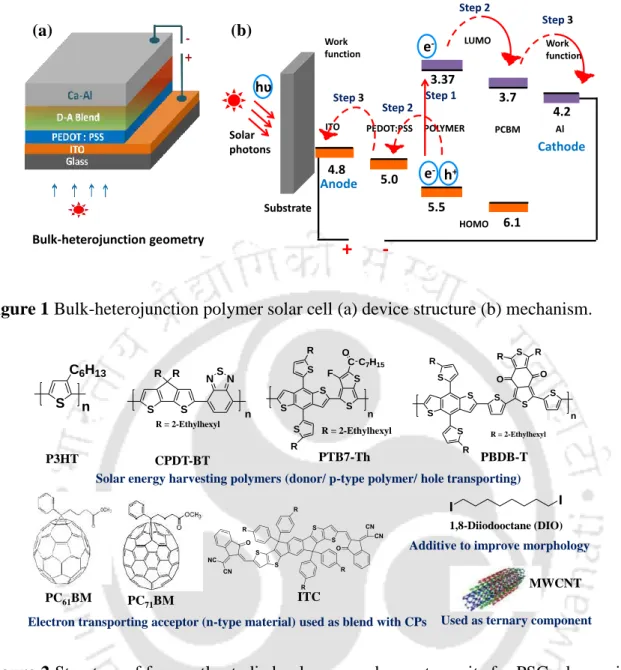
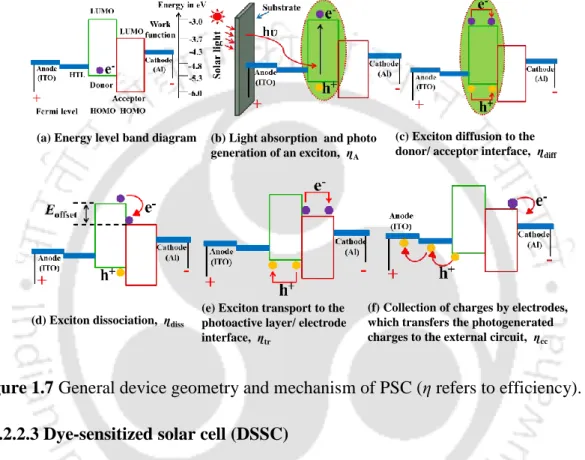
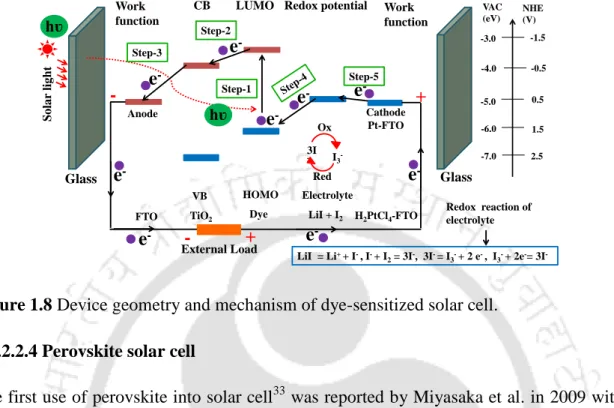
- Types of solar cell
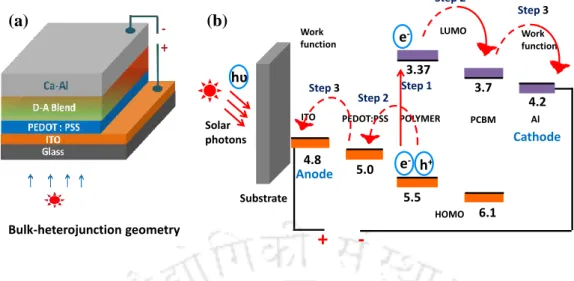
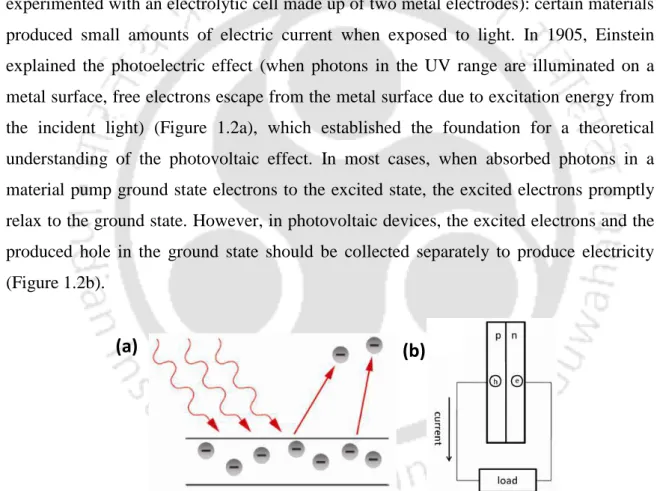
It depends on many factors such as: (i) the surface of the solar cell; it has been seen with a small area of the cell that the short circuit current is high, to remove the dependence of the solar cell performance on the area of the active layer, it is generally represented as the short circuit current density (Jsc) (unit , mA/cm2 ) instead of short circuit current (mA); (ii) ISC from a solar cell directly depends on the light intensity (which is related to the number of photons and the power of the incident light); and (iii) absorption and reflection of the solar cell. FF is defined as the ratio of the maximum power from the solar cell to the product of Voc.
Designing conjugated polymers for solar cell
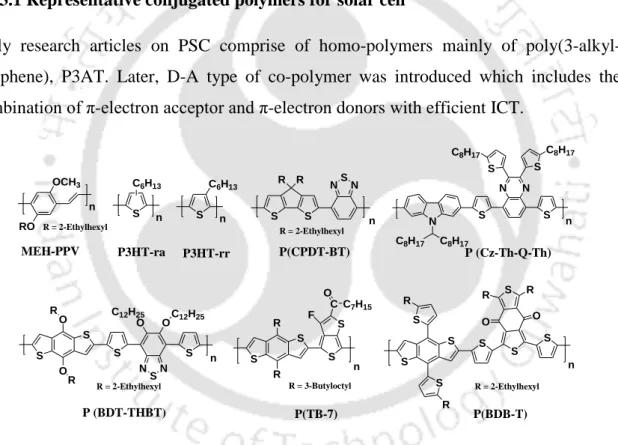
- Representative conjugated polymers for solar cell
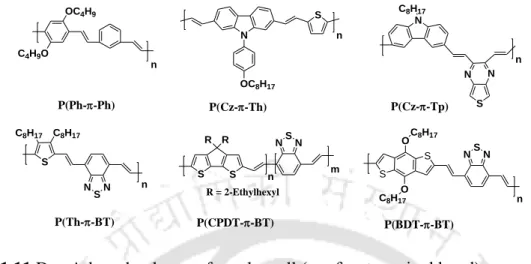
- Donor-π-Acceptor (D-π-A) type of design (π refers to vinyl bond)
- Use of different linkage position for polymerization
- Two-dimensional (2D) polymers
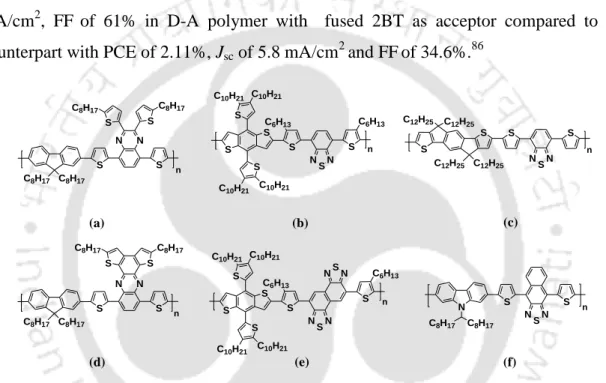
- Substituting EW group and choosing right combination of D and A
- Substituting non-conjugated functional group into the side chain of CPs In addition, to main chain chemistry, many efforts have been given on side chain
- Improving solar cell performance by variation of side chain
- Lowering of dihedral angle and introducing alkyl chain on D and A
- New D-A polymers using previous established concepts
In contrast, the oxygen counterpart of polymer (Figure 1.10) could only result in a maximum PCE of 5%. Another example of side chain substitution is azide-substituted block copolymer of 3-alkylthiophene97 (Figure 1.16c) by Bumjoon J.
Further efforts to improve PSC performance
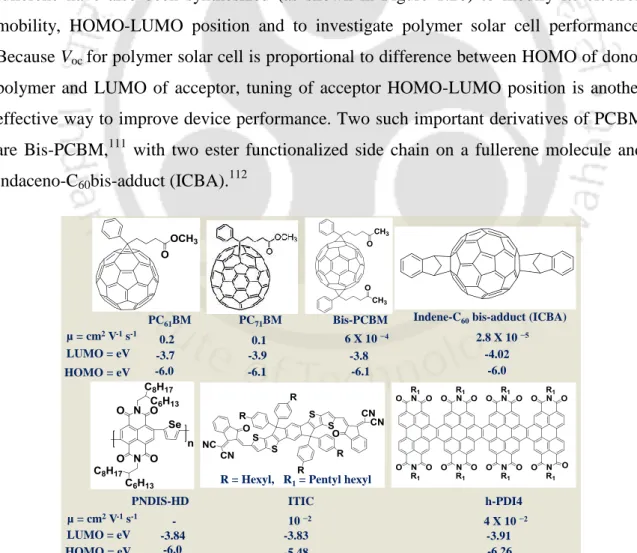
- Major types of acceptors for PSC
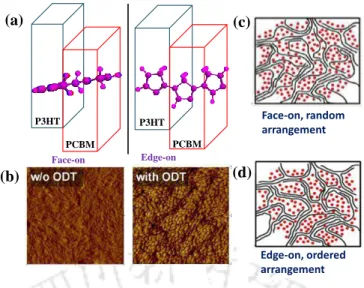
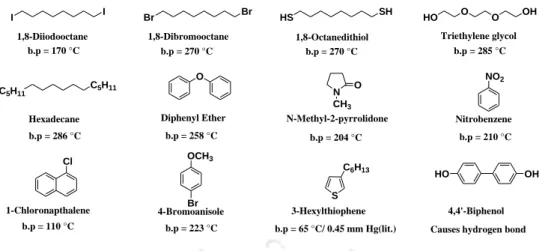
- Morphology tuning by use additives in PSC
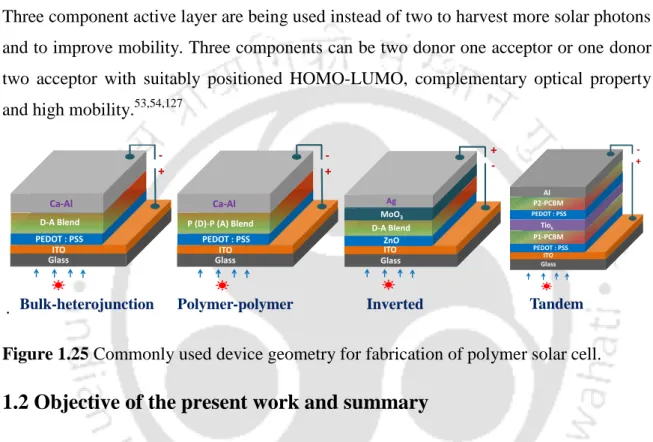
- Ternary component used in active layer of polymer solar cell
- Device engineering in solar cell
Morphology of D-A mixture has a great impact on solar cell performance, as it affects exciton dissociation at active layer. Therefore, silver (Ag) was used as cathode and MoO3 was used as an HTL in reverse geometry of polymer solar cell.124,125.
Objective of the present work and summary
The above problems can be solved by making a tandem cell with two devices connected by a conductor in between, generally the first with a high-bandgap polymer and the second with a low-bandgap, so that all solar photons can be absorbed from 400 to 800 nm.126. The three components can be two donors one acceptor or one donor two acceptors with properly positioned HOMO-LUMO, complementary optical properties and high mobility.53,54,127.
- References
P3HT PC 61 BM MWCNT
Abstract
- Introduction
- Results and discussion
- Solution state photo-degradation study via UV-visible spectra
- Thin-film state photo-degradation study via UV-visible spectra
- FE-SEM and TEM analysis of composites
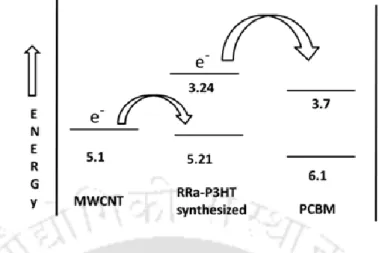
- Charge transfer investigation with in prepared nano-composites
- Understanding the reason for photo stability
- Conclusion
- Experimental procedures
- Synthesis of poly(3-hexylthiophene)
- Degradation studies in UV chamber
- References
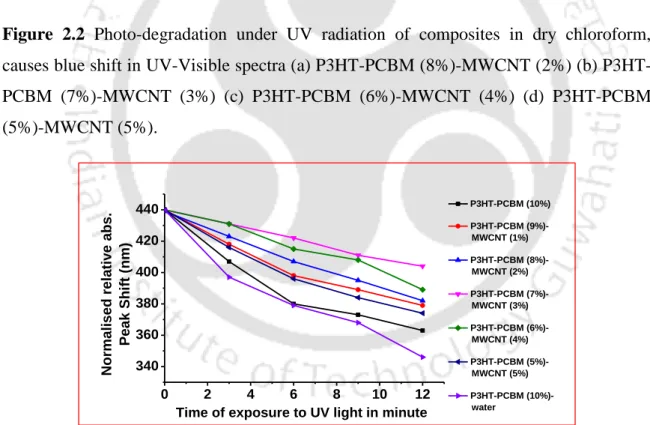
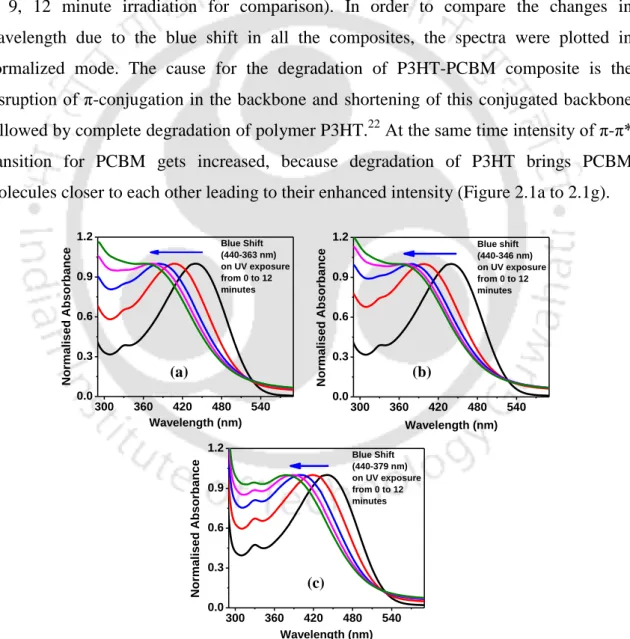
For P3HT-PCBM (7%)-MWCNT (3%), 3% MWCNT may have been the optimum amount to adequately cover the polymer surface (established using FE-SEM images), leading to better CH-π and π -π interaction with in the compound. Better stability is observed in the case of P3HT-PCBM (9%) - MWCNT (1%) composite (Figure 2.1c) compared to the binary P3HT-PCBM composite. CH-π and π-π interaction between P3HT and MWCNT together with PCBM leads to the enhancement of photostability of P3HT- PCBM (9%)-MWCNT (1%) nanocomposite.
Insight into The Synthesis and Fabrication of 5,6-alt- Benzothiadiazole Based D-π-A Conjugated Co-polymers
- Introduction
- Results and discussion
- Reaction scheme
- Thermal properties
- Optical properties
- Theoretical calculation
- Solar cell performance
- Morphology of active layer
- Conclusion
- Experimental Procedures
- Synthetic procedures of monomers, polymer P1 and P2
- Procedure and spectra
- References
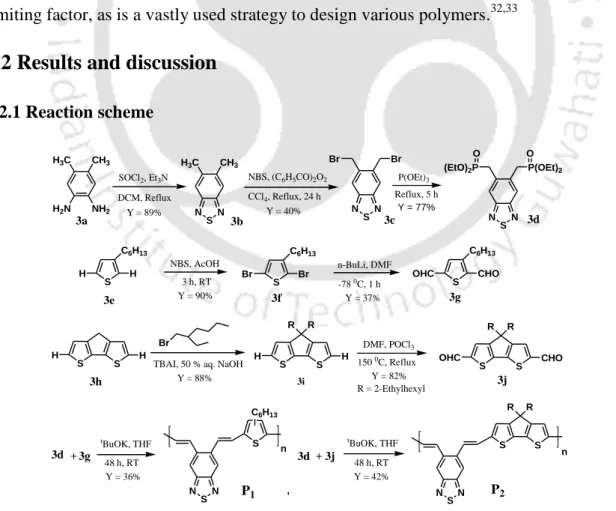
Here, two novel poly(o-arylene-vinylene) (POAV)-based D-π-A conjugated copolymers (POAVs), namely P1 and P2, were synthesized using the Horner-Wittig reaction, which were characterized by UV-visible , 1H-NMR, 13C-NMR and CV. Differential scanning calorimetry (DSC) was recorded in a stream of N2 to determine the phase change in the polymer with respect to temperature change, showing a glass transition temperature (Tg) of 158 ⁰C for P1 and 148 ⁰C for P2 (Figure 3.2b). ) in an exothermic cycle. The HOMO and LUMO ground state frontier orbitals for CP, P1, and P2 were calculated using a dimer model of the polymer.
Substituting Non-conjugating Ester Group into Side Chain of Benzothiadiazole Improves Optical,
LiF:Al P-PC 71 BM
GLASS
Introduction
The ester group is one such important functional group among all that is used both in the side chain and the main chain of conjugated polymers for solar cells. In this approach, BT has been modified to design and synthesize acceptor unit with methyl acetate group substituted as side chain in the 5,6 position of BT. Herein, it has been established that the side-chain ester group in the 5,6-position of BT, (i) can lower the dihedral angle along the conjugation main chain, resulting in the increase in molar absorption coefficient (ii) red shifts in the absorption spectra in the film state (iii) lowers the optical LUMO level due to electron-withdrawing nature and (iv) improves the solar cell performance of the polymer compared to its methyl counterpart.
Results and discussion
- Reaction scheme
- Optical properties
- Electrochemical properties
- Solar cell performance
- Morphology of active layer of fabricated PSCs
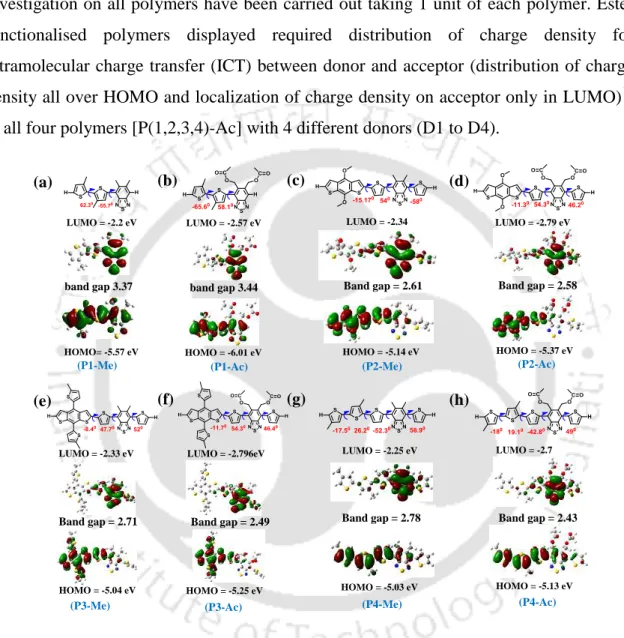
The ester-functionalized polymer has low dihedral angle in the case of D2 and D4 compared to their methyl counterpart (Figure 4.3c,d,g,h), due to the potential oxygen (negatively charged in the ester group)- sulfur (positive charge on the thiophene ring) interactions. But in the case of D1 and D3, the dihedral angle increases in the ester functionalized polymers (Figure 4.3a,b and 4.3e,f) compared to its methyl counterpart due to the steric hindrance caused by D1 with. All ester-functionalized polymers have low T5D and exhibit dual degradation pattern compared to their methyl counterpart (Figure 4.6a and 4.6b), which may have occurred due to the brittleness/thermo-deactivating nature of the ester group. side chain (here methyl acetate).15 .
Conclusion
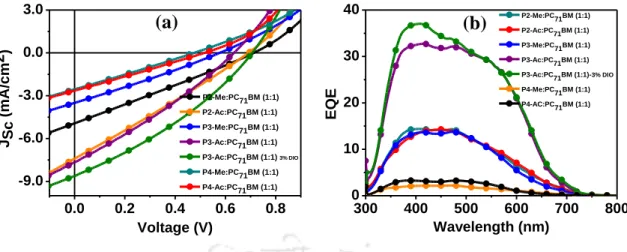
Thin-film X-ray diffraction was performed by spin-coating equal concentrations of methyl and the corresponding ester-substituted polymers to investigate the effect on the π-π stacking distance in the thin-film state with ester substitution of the side chain at the 5,6-position of BT. The close π-π stacking distance in the case of the ester-substituted P4-Ac polymer compared to P4-Me further confirms the improved π-π stacking within the polymer chain in the film state and thus better solar cell performance. 32, 33 Furthermore, between P3-Me and P3-Ac, the ester substituted at the 5,6-position of the BT polymer, P3-Ac showed a similar/small increase in the π-π stacking distance (2θ = 23.16⁰, π stacking distance -π = 0.3837 nm), which is evident from the small increase in the dihedral angle (Figure 4.9b) (determined by DFT) compared to its methyl counterpart P3-Me (2θ = 23.25⁰, stacking distance π-π = 0 .3822 nm). Ester-substituted polymers are also prone to extrinsic effects, for example with P3-Ac as donor polymer and PC71BM as acceptor, it achieved a PCE of 1.14%, which was improved to 1.96% with the addition of 3% DIO as an additive.
Experimental procedures .1 Synthetic procedures
- Methods, procedure and spectra
The reaction mixture was purified by column chromatography (eluent 15% CHCl3 in hexane) to give 0.33 g of compound 4f as a yellow-green solid (yield = 81%). The reaction mixture was then degassed three times and purged with argon at each stage. After cooling to room temperature, the reaction mixture was concentrated and poured into 400 mL of methanol.
Both NT-based acceptors were designed using the 5,6-position of benzothiadiazole (BT) and synthesized by the Wittig coupling reaction. Alternative D-A copolymer of novel NT-based acceptors with the commonly used donor 4,8-bis((2-ethylxyl)oxy)benzo[1,2-b:4,5-bˊ]dithiophene (BDT) via coupling results New conjugated polymer styles (CPs) namely P(BDT-NTTh) and P(BDT-ThNTTh). The dihedral angle for the optimized geometry and ICT of the newly synthesized NT-based polymers have also been investigated using DFT.
Introduction
In addition to the design used for the synthesis of D-A, CPs using donors and acceptors are not only 1-dimensional (1D) polymers ("D" and "A" copolymer in D-A/D-A-D/D-π - Moda with conjugation units only in the main chain of the polymer), (2D) polymers have also been synthesized and fabricated in PSCs. In the 2-dimensional structure, the π-electron donor such as Th)/BDT13,14 and the π-electron acceptor such as BT15 were replaced by a conjugated unit as a side chain, which can improve the optical/electrochemical/transport properties and/ or improves the stiffness of the polymer.16 The purpose of this article is to investigate the use of NT derivatives as an innovative 2D acceptor unit for D-A CP in a BHJ solar cell. Previously existing literature showing the use of Q/Bz/Tp and their derivatives as acceptor units in D-A CPs used as an active layer for optoelectronic devices was possible and/or synthesized by the formation of two C=N bonds at the near ortho position of the corresponding core conjugated acceptor unit.1,24 However, there has been no report of C=C bond formation of a similar type that could lead to the formation of NT derivatives from BT. Here, two NT derivatives, namely NT-Th and Th-NT-Th, were synthesized.
Results and discussion
- Reaction scheme
- Optical properties
- DFT calculation
- Solar cell performance
- Morphology of active layer
- Hole-mobility of active layer
- Thin film X-ray diffraction patterns
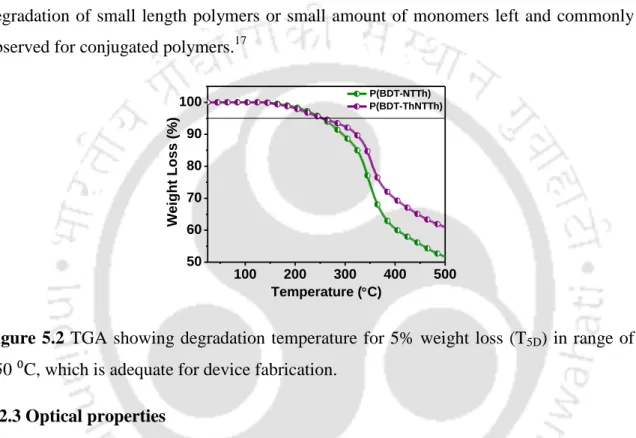
The performance of the solar cell with P(BDT-ThNTTh) is better than that of P(BDT-NTTh), which is evident from the high absorption coverage of the solar spectrum with a high absorption coefficient of P(BDT-ThNTTh) over P(BDT-NTTh) ( Figure 5.3a ) and the P(BDT-ThNTTh):PC71BM blend film has low roughness (Figure 5.6) along with higher hole mobility (Figure 5.7) compared to P(BDT-NTTh):PC71BM. The P(BDT-ThNTTh):PC71BM (1:1) blend showed a better morphology (Figure 5.6b) compared to P(BDT-NTTh):PC71BM (1:1) with a lower RMS roughness of 1.6 nm and smaller aggregate conditions. . Furthermore, no distinct phase separation (crystallinity) was observed between NT and PC71BM-based polymers in the blended films (Fig. 5.6a to 5.6c).34 The reason for the smaller.
Conclusion
Experimental procedure
- Synthetic procedures
- Methods, procedure and spectra
The reaction mixture was stirred for another 3 hours at room temperature, followed by extraction with chloroform and water. Subsequently, the organic phase was dried in vacuo followed by column chromatography (SiO2, using 15% CHCl3 in hexane). Purification of the reaction mixture by chromatography (SiO 2 , 10% CHCl 3 in hexane) afforded compound 5c 0.7 g (dark yellow solid) in 92% yield.
A1.1 Device fabrication method for polymer solar cell
Here glass/ITO/PEDOT:PSS/active layer (polymer and PC71BM)/LiF-Al were taken as standard for fabricated polymer solar cells for all synthesized methyl ester substitution polymers and their results are compared with their counterpart methyl. In the case of devices fabricated with additives (1,8-diiodooctane), a volume ratio of 3% with respect to the active layer is added prior to the deposition of the active layer. Solar cells were fabricated for NT-based polymers in Chapter 5 with the Glass /ITO/PEDOT:PSS/Active Layer(polymer and PC71BM)/LiF:Al device configuration and following the similar device configuration and method as Chapter 4.
A1.2 Absorbance Spectra
In the case of devices with Ca-Al as cathode, Ca was deposited 20 nm and then 75 nm thickness of Al was deposited on top of calcium for both polymers. Fabricated solar cell was tested under simulated air mass (AM) 1.5 solar irradiance (100 mW cm-2) inside the glove compartment. As the cathode, LiF 1 nm and Al (80 nm) were evaporated using a thermal evaporator, respectively, one after the other.
A1.3 Cyclic voltammetry
The active areas of the devices were generally 20 mm2 and the cell size was reduced to 8 mm2 to achieve a PCE of 0.15 in P2. The photovoltaic cells without protective encapsulation were removed from the glove box for EQE measurement. Both the oxidation and reduction potentials were determined from the intersection of two tangent lines drawn at the rising and background currents of the cyclic voltammogram.
A1.4 SCLC method for determination of hole-mobility
- Energy level band diagram for charge transfer in ternary composite
- PL spectra of pure P3HT recorded in the same conditions (before and after irradiation)
A wide variety of CPs are used for polymer solar cell (PSC) and other optoelectronic devices. The substitution of non-conjugating ester group in side chain of benzothiadiazole improves optical, electrochemical properties, morphology of active layer and solar cell performance of D-A polymer for photovoltaics (to be communicated). Insertion of non-conjugating ester groups in side chain of benzothiadiazole improves optical, electrochemical, crystalline property and photostability of D-A polymer used for solar cell (20th CRSI National Symposium in Chemistry 02-05 February 2017, Guwahati University, India) (poster) .
Implementation of a new strategy to improve the durability of D-A and D-π-A type conjugated polymers used for solar cell applications (Research Conclave-17, March 16-19, 2017, IIT Guwahati, India) (Poster). Implementation of a new strategy to improve the durability of D-A and D-π-A type conjugated polymers used for solar cell applications (Reflux-2017, March 24-26, 2017, IIT Guwahati, India) (Poster).