S No.
Information of the Medical College / Institution
Year of Inception:
Government / Private
A.J. Institute of Medical Sciences & Research Centre, N.H. – 66, Kuntikana, Mangaluru – 575004
2002-03 Private
1 Name A.J. Institute of Medical Sciences & Research Centre, Mangaluru
2 Address with pin code
A.J. Institute of Medical Sciences & Research Centre
N.H-66, Kuntikana Mangaluru – 575 004 Karnataka, India
3 University Address with pin code
Rajiv Gandhi University of Health Sciences Jayanagar 4
th“T” Block
Bengaluru – 560 041.
Karnataka, India
4 Official Website
www.ajims.edu.in
5 Dean / Principal / Director
Dr. Ashok Hegde
6 Mobile No.
9845132949
7 Email ID of Dean
[email protected] / [email protected]
8 Hospital
A.J. Institute of Medical Sciences Hospital, Mangaluru
9 Date and Year of Registration of theHospital (DD/MM/YYYY)
Reg. No. DKA00396AAHP dt: 24.10.2017
10 Number of Beds
910 Beds
11 Number of Beds for emergency
30 Beds
12 Date of the First Letter of Permission(LOP) of MBBS (DD/MM/YYY) &
Number of Seats
LOP No.U.12012/43/2001-ME(P-II) dt: 14.08.2002 100 Intake
13 Status of Recognition
Recognized
http://ajims.edu.in/WebPages/ViewGovtApproval.aspx
14 Number of MBBS and PG broadspecialty and Super specialty students admitted in this session*
MBBS : 150 MD/MS: 97 DM/MCh: 6
15 Inpatients registered and admitted(01.01.2021 – 31.12.2021)**
2021 – 37243 (Till 30.11.2021) 2020 - 29146
2019 - 50160
16 Outpatients registered(01.01.2021 – 31.12.2021)**
2021 – 395867 (Till 30.11.2021) 2020 - 320211
2019 - 594754
17 Number of Deaths reported to theMunicipality / village register
2021 – 284 (Till 30.11.2021) 2020 - 312
2019 - 359
18 Address and pin code of theCorporation / village where the Death records are reported
The Registrar of Birth & Death City Corpoation
Lalbagh
Mangaluru – 575 003.
19 Website link / email ID / hyperlink of the corporation in case Death
Records are reported
https://ejanma.karnataka.gov.in
20 Number of Births reported
2021 – 1002 (Till 30.11.2021) 2020 - 1082
2019 - 1184
21 Address and pin code of theCorporation / village where the Birth records are reported
The Registrar of Birth & Death City Corpoation
Lalbagh
Mangaluru – 575 003.
22 Website link / email ID / hyperlink of the corporation in case Birth Records are reported
https://ejanma.karnataka.gov.in
23 Number of Rooms in men’s Hostel and students accommodated
Total : 240 Rooms x double Occupancy (with attached Toilets)
UG Boys – 200 Rooms x Double Occupancy Intern Boys – 40 Rooms x Double Occupancy Total students accommodated : 265 (UG)
Provided with independent and separate furniture which include chair, Study Table, Bed and full size cupboard, Book Shelf & Shoe Rack.
24 Total Number of Rooms in Women’s Hostel and Students accommodated
Total : 240 Rooms x double Occupancy (with attached Toilets)
UG Girls – 200 Rooms x Double Occupancy Intern Girls – 40 Rooms x Double Occupancy Total students accommodated : 331 (UG)
Provided with independent and separate furniture which include chair, Study Table, Bed and full size cupboard, Book Shelf & Shoe Rack.
25 Name of the Grievance Redressal Officer (PIO & CPIO)
Dr. Kalpana Shridhar Murulya Professor
Department of General Surgery
26 Address with Pin code
A.J. Institute of Medical Sciences & Research Centre, N.H-66, Kuntikana,
Mangaluru – 575 004
27 Telephone NumberEmail ID
0824 – 2225541, 2223359
[email protected]28 Grievances reported
2021 - Nil
2020 - Nil
2019 - Nil
29. Details of Post-Graduation Courses offered Postgraduate Course Year of
Commencement of the Course
Number of Students Currently pursuing the
Course
Number of Students admitted in the current session
MD Anatomy 2009 Nil Nil
MD Physiology 2009 Nil Nil
MD Biochemistry 2009 Nil Nil
MD Microbiology 2009 Nil Nil
MD Pathology 2009 09 05
MD Pharmacology 2009 02 02
MD Forensic Medicine 2011 Nil Nil
MD Community Medicine
2009 04 04
MD General Medicine 2009 24 12
MD Dermatology 2009 06 03
MD Psychiatry 2016 02 01
MD Respiratory Medicine
2009 05 03
DTCD 2014 01 01
MD Paediatrics 2009 15 (One DCH) 08
MS General Surgery 2009 20 12
MS Orthopaedics 2009 16 08
MS Ophthalmology 2009 07 04
MS ENT 2009 08 05
MS Obstetrics &
Gynaecology
2009 12 06
MD Anaesthesiology 2009 20 12
MD Radio Diagnosis 2009 16 08
MD Radiation Oncology
2016 06 03
M.Ch Plastic &
Reconstructive Surgery
2012 Nil Nil
DM Cardiology 2014 02 02
M.Ch Urology 2014 08 04
30
. Department wise list of Faculty Members
Departm ent
Name of the Faculty
Qualificatio n
IMR Number
Current Designat ion &
Date of Promoti
on
Nature of Employ
ment
Regular / perman
ent or contract /outsou rced
Details of Service in last 5 years Number of lectures taken/year Topics covered
1 2 3 4 5
2018 2019 2020 2021 2022
Anatomy Dr. Ajay Dutt Udyavar M.B.B.S., M.S.(Anatom
y) 38088
Professor
& HOD 13/12/20
18
Permane nt
Prof.&
HOD
Prof
&
HOD.
Prof.
&
HOD
Prof.
&
HOD
Prof.
&
HOD
23
1. Gen. anatomyof CVS-- arteries. veins, anastamosis, collateral circulation:
Lymphatics&lymphnodesinbrief 2. Brachial Plexus-- including applied
anatomy
3. Brachial artery ; Anastamosis around elbow; Biceps brachii muscle; Musculo- cutaneous nerve
4. Triceps brachii muscle; Radial nerve—
origin, course, distribution & applied ana.;
Extensor retinaculum
5. Lungs I-- Features, surfaces, lobes, fissures, root of lung
6. Lungs II-- Broncho-pulmonary segments, Blood supply & nerve supply of lungs;
applied ana.
7. General Embryology VIII: Foetal membranes-- Amnion, amniotic fluid, Chorion; Fate (derivatives) of germ layers 8. Revision of I Sessional topics
9. Stomach (in detail)
10. Embryology of CVS- I: Primitive heart tube; devt of right atrium, devt of inter- atrial septum; fate of sinus venosus 11. Embryology of CVS- II: Devt of inter-
ventricular septum; fate of bulbuscordis;
bulbar/spiral septum; related anomalies 12. Anal canal-- in detail
13. Front of thigh- I : Superficial inguinal lymph nodes, Fascia lata, Ilio-tibial tract, Quadriceps femoris
14. Knee joint
15. Embryology of GIT- 1 (of 2) 16. Embryology of GIT- 2 (of 2)
17. Thyroid gland (in detail); Parathyroid glands
18. Muscles of mastication
19. Embryology : Pharyngeal arches, clefts and pouches– I
20. Embryology : Pharyngeal arches, clefts and pouches– II
21. Pons– internal structure (TS at 2 levels) Classification of white matter of cerebrum;
22. Corpus callosum & Internal Capsule (detail), Horizontal section of cerebrum 23. Revisionclass--- Gen. anatomy of Joints
(classification, structure of a typical synovial joint); Imp. muscles of shoulder and arm (Deltoid, Biceps, Triceps);
Axillary nerve and Musculocutaneous N.;
Shoulder joint
24. Revision/ Diagram class: V Singh Vol 3:
Fig 7.9; 7.13; 8.4; 8.6
Departm ent
Name of the Faculty
Qualificatio n
IMR Number
Current Designat ion &
Date of Promoti
on
Nature of Employ
ment
Regular / perman
ent or contract /outsou rced
Details of Service in last 5 years Number of lectures taken/year Topics covered
1 2 3 4 5
2018 2019 2020 2021 2022
Anatomy Dr. Vinay Kumar V M.B.B.S., M.D.(Anatom
y) 73737
Professor Permane nt
Prof. Prof. Prof. Prof. Prof. 24
1. Orientation to Anatomy Department 2. Introduction- Anatomical terminologies 3. Exam Pattern introduction
4. Muscle-- gen. ana(classfn. etc)
&Histology 5. Pectoral region 6. Pleura-- in detail
7. Fibrous skeleton of heart; Conducting system of heart; Nerve supply of heart 8. Oesophagus; Descending aorta (in
brief); Transverse sections of thorax at T3 , T4 & T5 levels
9. General Embryology VI-- Intra- embryonic mesoderm-- subdivisions;
paraxial mesoderm (somites), differentiation of somite 10. Embryology: Development of
Respiratory system 11. Caecum & Appendix 12. Perineum- II: Anal triangle--
Ischiorectal fossa , Pudendal canal, Pudendal nerve
13. Urinary Bladder (in detail) 14. Gluteus Maximus; Gluteus
medius&minimus (& abductor mechanism of hip)
15. Muscles of the anterior & lateral compartments of leg; Dorsalispedis A.
; Cutaneous innervation of foot (both dorsal and plantar aspects) 16. Deep fascia of neck (Deep cervical
fascia)
17. Anterior Triangle— subdivisions;
Digastric &Submental triangles;
Digastric &mylohyoid muscles (in brief)
18. Cranial cavity- II: Dural venous sinuses --- classification; Cavernous sinus in detail; Superior sagittal sinus (in brief);
19. Orbit- II: Oculomotor (III cranial) nerve; Ciliary ganglion, Ophthalmic artery, Superior orbital fissure 20. Histology: Spinal cord, cerebrum,
cerebellum
21. Pharynx- II: Laryngopharynx, Piriform Recess; Muscles of Pharynx, Nerve supply, etc.
22. Embryology: Development of Face &
Palate
23. Development of CNS
24. Revision/ Diagram class: V Singh Vol 1:
23.10; 24.2; 24.6; 25.2;
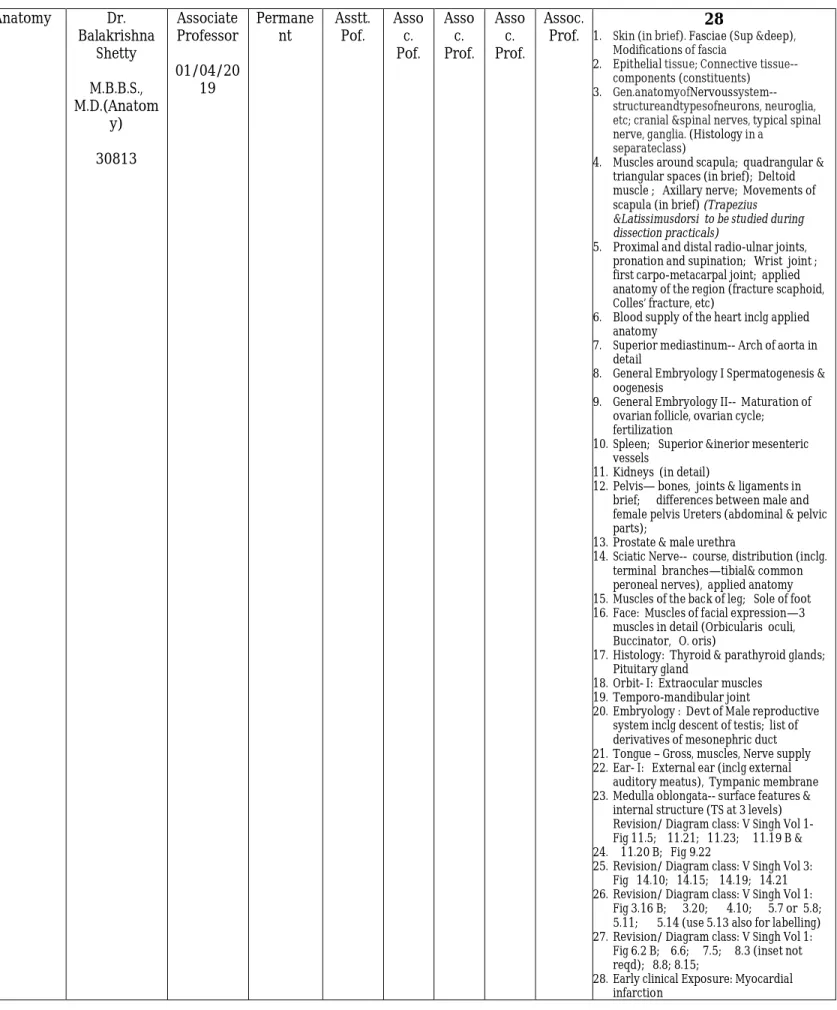
Anatomy Dr.
Balakrishna Shetty M.B.B.S., M.D.(Anatom
y) 30813
Associate Professor 01/04/20
19
Permane nt
Asstt.
Pof.
Asso c.
Pof.
Asso c.
Prof.
Asso c.
Prof.
Assoc.
Prof. 28
1. Skin (in brief). Fasciae (Sup &deep), Modifications of fascia
2. Epithelial tissue; Connective tissue-- components (constituents) 3. Gen.anatomyofNervoussystem--
structureandtypesofneurons, neuroglia, etc; cranial &spinal nerves, typical spinal nerve, ganglia. (Histology in a
separateclass)
4. Muscles around scapula; quadrangular &
triangular spaces (in brief); Deltoid muscle ; Axillary nerve; Movements of scapula (in brief) (Trapezius
&Latissimusdorsi to be studied during dissection practicals)
5. Proximal and distal radio-ulnar joints, pronation and supination; Wrist joint ; first carpo-metacarpal joint; applied anatomy of the region (fracture scaphoid, Colles’ fracture, etc)
6. Blood supply of the heart inclg applied anatomy
7. Superior mediastinum-- Arch of aorta in detail
8. General Embryology I Spermatogenesis &
oogenesis
9. General Embryology II-- Maturation of ovarian follicle, ovarian cycle;
fertilization
10. Spleen; Superior &inerior mesenteric vessels
11. Kidneys (in detail)
12. Pelvis— bones, joints & ligaments in brief; differences between male and female pelvis Ureters (abdominal & pelvic parts);
13. Prostate & male urethra
14. Sciatic Nerve-- course, distribution (inclg.
terminal branches—tibial& common peroneal nerves), applied anatomy 15. Muscles of the back of leg; Sole of foot 16. Face: Muscles of facial expression—3
muscles in detail (Orbicularis oculi, Buccinator, O. oris)
17. Histology: Thyroid & parathyroid glands;
Pituitary gland
18. Orbit- I: Extraocular muscles 19. Temporo-mandibular joint
20. Embryology : Devt of Male reproductive system inclg descent of testis; list of derivatives of mesonephric duct 21. Tongue – Gross, muscles, Nerve supply 22. Ear- I: External ear (inclg external
auditory meatus), Tympanic membrane 23. Medulla oblongata-- surface features &
internal structure (TS at 3 levels) Revision/ Diagram class: V Singh Vol 1- Fig 11.5; 11.21; 11.23; 11.19 B &
24. 11.20 B; Fig 9.22
25. Revision/ Diagram class: V Singh Vol 3:
Fig 14.10; 14.15; 14.19; 14.21 26. Revision/ Diagram class: V Singh Vol 1:
Fig 3.16 B; 3.20; 4.10; 5.7 or 5.8;
5.11; 5.14 (use 5.13 also for labelling) 27. Revision/ Diagram class: V Singh Vol 1:
Fig 6.2 B; 6.6; 7.5; 8.3 (inset not reqd); 8.8; 8.15;
28. Early clinical Exposure: Myocardial infarction
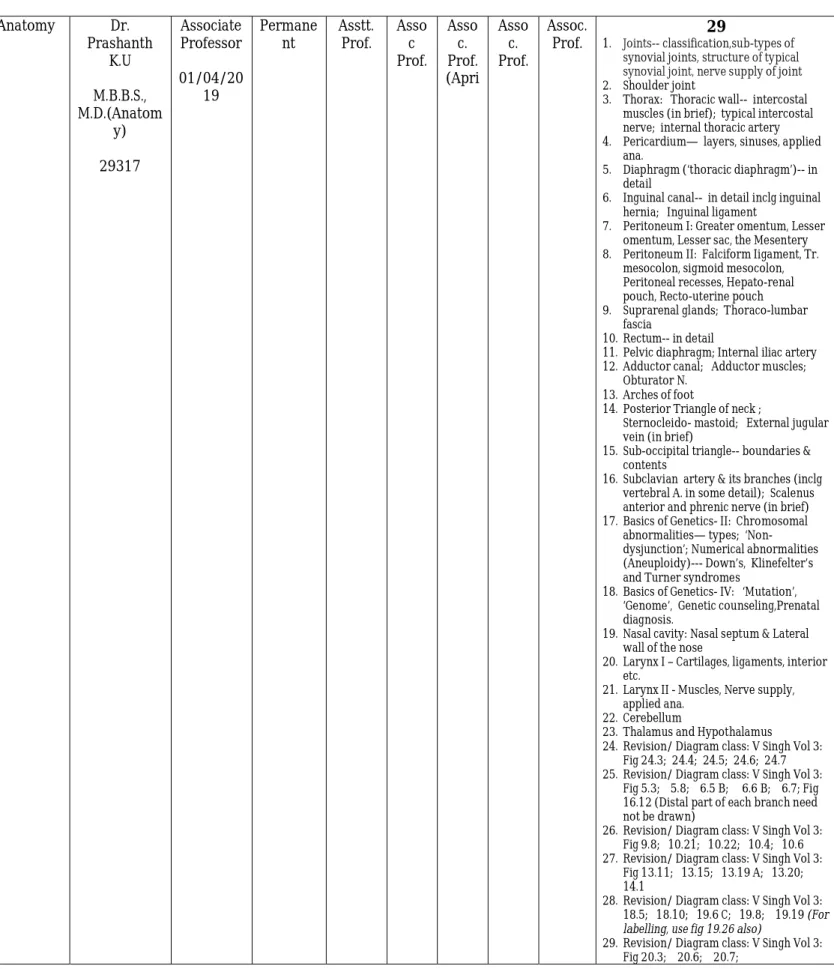
Anatomy Dr.
Prashanth K.U M.B.B.S., M.D.(Anatom
y) 29317
Associate Professor 01/04/20
19
Permane nt
Asstt.
Prof.
Asso c Prof.
Asso c.
Prof.
(Apri Asso
c.
Prof.
Assoc.
Prof. 29
1. Joints-- classification,sub-types of synovial joints, structure of typical synovial joint, nerve supply of joint 2. Shoulder joint
3. Thorax: Thoracic wall-- intercostal muscles (in brief); typical intercostal nerve; internal thoracic artery 4. Pericardium— layers, sinuses, applied
ana.
5. Diaphragm (‘thoracic diaphragm’)-- in detail
6. Inguinal canal-- in detail inclg inguinal hernia; Inguinal ligament
7. Peritoneum I: Greater omentum, Lesser omentum, Lesser sac, the Mesentery 8. Peritoneum II: Falciform Iigament, Tr.
mesocolon, sigmoid mesocolon, Peritoneal recesses, Hepato-renal pouch, Recto-uterine pouch 9. Suprarenal glands; Thoraco-lumbar
fascia
10. Rectum-- in detail
11. Pelvic diaphragm; Internal iliac artery 12. Adductor canal; Adductor muscles;
Obturator N.
13. Arches of foot
14. Posterior Triangle of neck ;
Sternocleido- mastoid; External jugular vein (in brief)
15. Sub-occipital triangle-- boundaries &
contents
16. Subclavian artery & its branches (inclg vertebral A. in some detail); Scalenus anterior and phrenic nerve (in brief) 17. Basics of Genetics- II: Chromosomal
abnormalities— types; ‘Non- dysjunction’; Numerical abnormalities (Aneuploidy)--- Down’s, Klinefelter’s and Turner syndromes
18. Basics of Genetics- IV: ‘Mutation’,
‘Genome’, Genetic counseling,Prenatal diagnosis.
19. Nasal cavity: Nasal septum & Lateral wall of the nose
20. Larynx I – Cartilages, ligaments, interior etc.
21. Larynx II - Muscles, Nerve supply, applied ana.
22. Cerebellum
23. Thalamus and Hypothalamus
24. Revision/ Diagram class: V Singh Vol 3:
Fig 24.3; 24.4; 24.5; 24.6; 24.7 25. Revision/ Diagram class: V Singh Vol 3:
Fig 5.3; 5.8; 6.5 B; 6.6 B; 6.7; Fig 16.12 (Distal part of each branch need not be drawn)
26. Revision/ Diagram class: V Singh Vol 3:
Fig 9.8; 10.21; 10.22; 10.4; 10.6 27. Revision/ Diagram class: V Singh Vol 3:
Fig 13.11; 13.15; 13.19 A; 13.20;
14.1
28. Revision/ Diagram class: V Singh Vol 3:
18.5; 18.10; 19.6 C; 19.8; 19.19 (For labelling, use fig 19.26 also)
29. Revision/ Diagram class: V Singh Vol 3:
Fig 20.3; 20.6; 20.7;
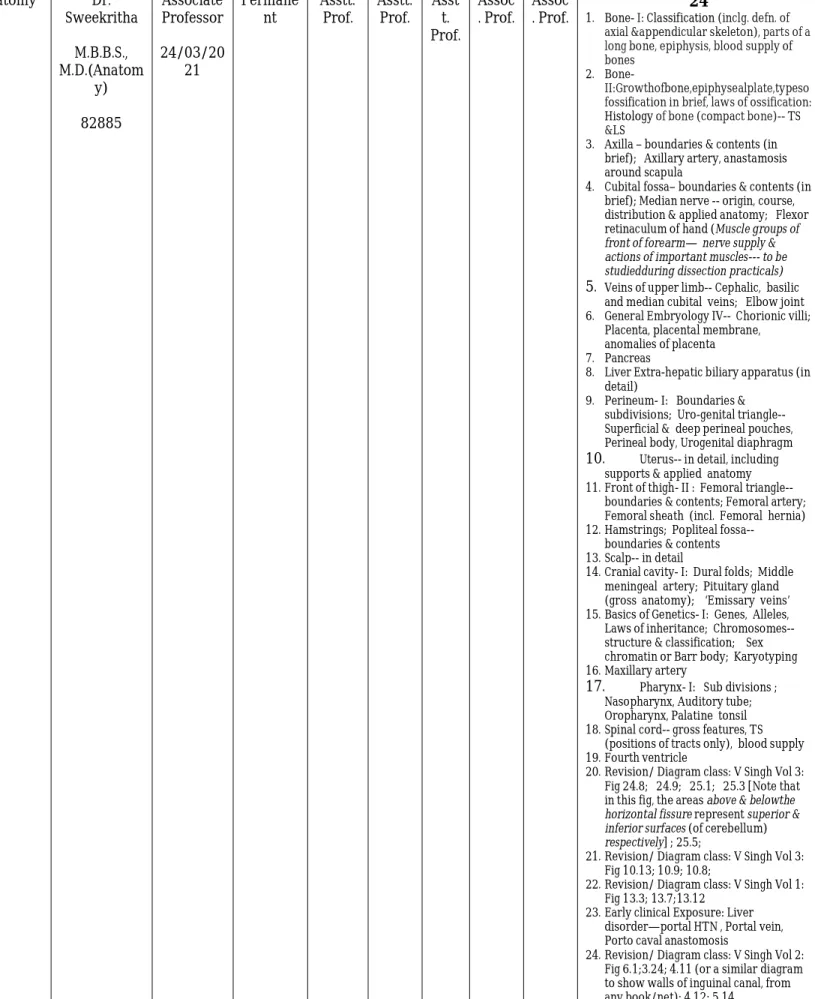
Anatomy Dr.
Sweekritha M.B.B.S., M.D.(Anatom
y) 82885
Associate Professor 24/03/20
21
Permane nt
Asstt.
Prof.
Asstt.
Prof.
Asst t.
Prof.
Assoc . Prof.
Assoc
. Prof. 24
1. Bone- I: Classification (inclg. defn. of axial &appendicular skeleton), parts of a long bone, epiphysis, blood supply of bones
2. Bone-
II:Growthofbone,epiphysealplate,typeso fossification in brief, laws of ossification:
Histology of bone (compact bone)-- TS
&LS
3. Axilla – boundaries & contents (in brief); Axillary artery, anastamosis around scapula
4. Cubital fossa– boundaries & contents (in brief); Median nerve -- origin, course, distribution & applied anatomy; Flexor retinaculum of hand (Muscle groups of front of forearm— nerve supply &
actions of important muscles--- to be studiedduring dissection practicals)
5. Veins of upper limb-- Cephalic, basilic and median cubital veins; Elbow joint 6. General Embryology IV-- Chorionic villi;
Placenta, placental membrane, anomalies of placenta 7. Pancreas
8. Liver Extra-hepatic biliary apparatus (in detail)
9. Perineum- I: Boundaries &
subdivisions; Uro-genital triangle-- Superficial & deep perineal pouches, Perineal body, Urogenital diaphragm
10. Uterus-- in detail, including supports & applied anatomy 11. Front of thigh- II : Femoral triangle--
boundaries & contents; Femoral artery;
Femoral sheath (incl. Femoral hernia) 12. Hamstrings; Popliteal fossa--
boundaries & contents 13. Scalp-- in detail
14. Cranial cavity- I: Dural folds; Middle meningeal artery; Pituitary gland (gross anatomy); ‘Emissary veins’
15. Basics of Genetics- I: Genes, Alleles, Laws of inheritance; Chromosomes-- structure & classification; Sex chromatin or Barr body; Karyotyping 16. Maxillary artery
17. Pharynx- I: Sub divisions ; Nasopharynx, Auditory tube;
Oropharynx, Palatine tonsil 18. Spinal cord-- gross features, TS
(positions of tracts only), blood supply 19. Fourth ventricle
20. Revision/ Diagram class: V Singh Vol 3:
Fig 24.8; 24.9; 25.1; 25.3 [Note that in this fig, the areas above & belowthe horizontal fissure represent superior &
inferior surfaces (of cerebellum) respectively] ; 25.5;
21. Revision/ Diagram class: V Singh Vol 3:
Fig 10.13; 10.9; 10.8;
22. Revision/ Diagram class: V Singh Vol 1:
Fig 13.3; 13.7;13.12 23. Early clinical Exposure: Liver
disorder—portal HTN , Portal vein, Porto caval anastomosis
24. Revision/ Diagram class: V Singh Vol 2:
Fig 6.1;3.24; 4.11 (or a similar diagram to show walls of inguinal canal, from any book/net); 4.12; 5.14
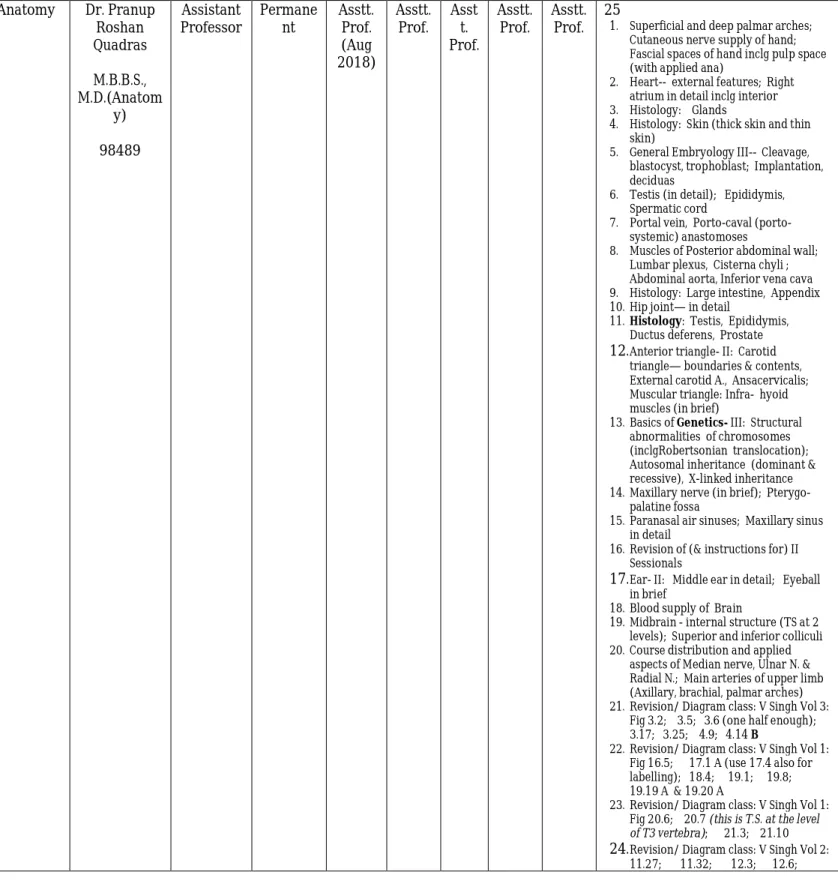
Anatomy Dr. Pranup Roshan Quadras M.B.B.S., M.D.(Anatom
y) 98489
Assistant Professor
Permane nt
Asstt.
Prof.
(Aug 2018)
Asstt.
Prof.
Asst t.
Prof.
Asstt.
Prof.
Asstt.
Prof.
25
1. Superficial and deep palmar arches;
Cutaneous nerve supply of hand;
Fascial spaces of hand inclg pulp space (with applied ana)
2. Heart-- external features; Right atrium in detail inclg interior 3. Histology: Glands
4. Histology: Skin (thick skin and thin skin)
5. General Embryology III-- Cleavage, blastocyst, trophoblast; Implantation, deciduas
6. Testis (in detail); Epididymis, Spermatic cord
7. Portal vein, Porto-caval (porto- systemic) anastomoses
8. Muscles of Posterior abdominal wall;
Lumbar plexus, Cisterna chyli ; Abdominal aorta, Inferior vena cava 9. Histology: Large intestine, Appendix 10. Hip joint— in detail
11. Histology: Testis, Epididymis, Ductus deferens, Prostate
12. Anterior triangle- II: Carotid triangle— boundaries & contents, External carotid A., Ansacervicalis;
Muscular triangle: Infra- hyoid muscles (in brief)
13. Basics of Genetics- III: Structural abnormalities of chromosomes (inclgRobertsonian translocation);
Autosomal inheritance (dominant &
recessive), X-linked inheritance 14. Maxillary nerve (in brief); Pterygo-
palatine fossa
15. Paranasal air sinuses; Maxillary sinus in detail
16. Revision of (& instructions for) II Sessionals
17. Ear- II: Middle ear in detail; Eyeball in brief
18. Blood supply of Brain
19. Midbrain - internal structure (TS at 2 levels); Superior and inferior colliculi 20. Course distribution and applied
aspects of Median nerve, Ulnar N. &
Radial N.; Main arteries of upper limb (Axillary, brachial, palmar arches) 21. Revision/ Diagram class: V Singh Vol 3:
Fig 3.2; 3.5; 3.6 (one half enough);
3.17; 3.25; 4.9; 4.14 B
22. Revision/ Diagram class: V Singh Vol 1:
Fig 16.5; 17.1 A (use 17.4 also for labelling); 18.4; 19.1; 19.8;
19.19 A & 19.20 A
23. Revision/ Diagram class: V Singh Vol 1:
Fig 20.6; 20.7 (this is T.S. at the level of T3 vertebra); 21.3; 21.10
24. Revision/ Diagram class: V Singh Vol 2:
11.27; 11.32; 12.3; 12.6;
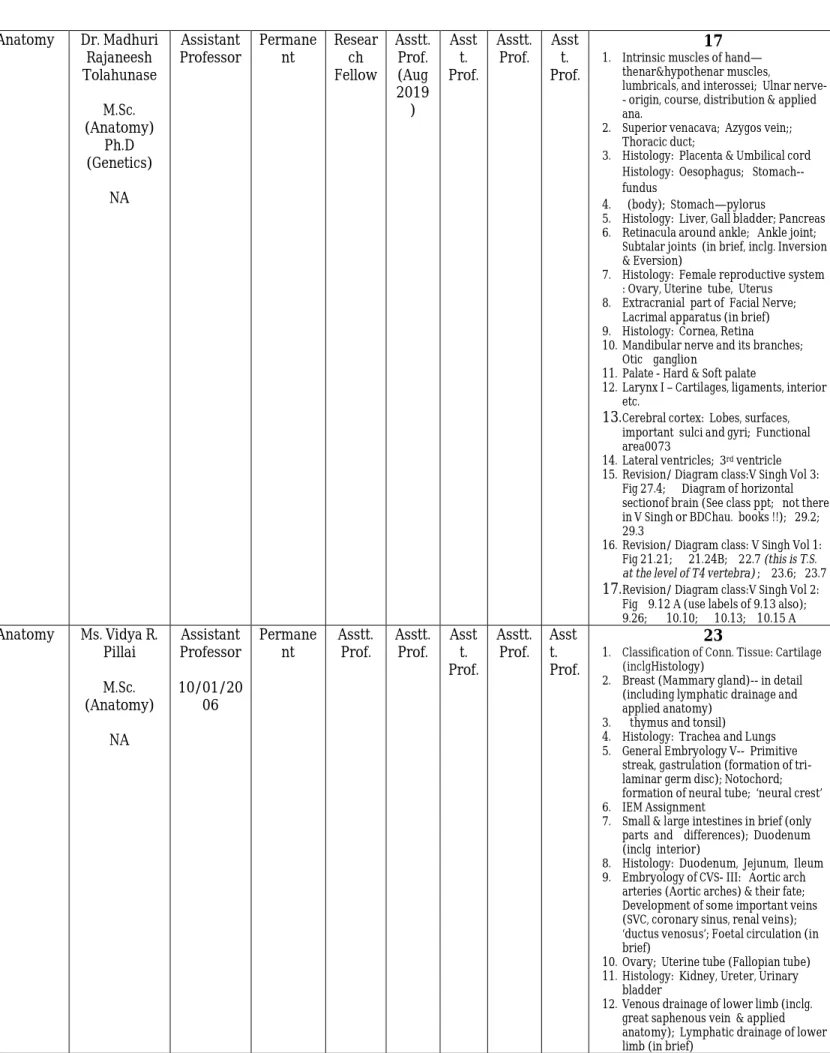
Anatomy Dr. Madhuri Rajaneesh Tolahunase
M.Sc.
(Anatomy) Ph.D (Genetics)
NA
Assistant Professor
Permane nt
Resear ch Fellow
Asstt.
Prof.
(Aug 2019 )
Asst t.
Prof.
Asstt.
Prof.
Asst t.
Prof.
17
1. Intrinsic muscles of hand—
thenar&hypothenar muscles,
lumbricals, and interossei; Ulnar nerve- - origin, course, distribution & applied ana.
2. Superior venacava; Azygos vein;;
Thoracic duct;
3. Histology: Placenta & Umbilical cord Histology: Oesophagus; Stomach-- fundus
4. (body); Stomach—pylorus
5. Histology: Liver, Gall bladder; Pancreas 6. Retinacula around ankle; Ankle joint;
Subtalar joints (in brief, inclg. Inversion
& Eversion)
7. Histology: Female reproductive system : Ovary, Uterine tube, Uterus
8. Extracranial part of Facial Nerve;
Lacrimal apparatus (in brief) 9. Histology: Cornea, Retina
10. Mandibular nerve and its branches;
Otic ganglion
11. Palate - Hard & Soft palate
12. Larynx I – Cartilages, ligaments, interior etc.
13. Cerebral cortex: Lobes, surfaces, important sulci and gyri; Functional area0073
14. Lateral ventricles; 3rd ventricle 15. Revision/ Diagram class:V Singh Vol 3:
Fig 27.4; Diagram of horizontal sectionof brain (See class ppt; not there in V Singh or BDChau. books !!); 29.2;
29.3
16. Revision/ Diagram class: V Singh Vol 1:
Fig 21.21; 21.24B; 22.7 (this is T.S.
at the level of T4 vertebra) ; 23.6; 23.7
17. Revision/ Diagram class:V Singh Vol 2:
Fig 9.12 A (use labels of 9.13 also);
9.26; 10.10; 10.13; 10.15 A
Anatomy Ms. Vidya R.
Pillai M.Sc.
(Anatomy) NA
Assistant Professor 10/01/20
06
Permane nt
Asstt.
Prof.
Asstt.
Prof.
Asst t.
Prof.
Asstt.
Prof.
Asst t.
Prof.
23
1. Classification of Conn. Tissue: Cartilage (inclgHistology)
2. Breast (Mammary gland)-- in detail (including lymphatic drainage and applied anatomy)
3. thymus and tonsil) 4. Histology: Trachea and Lungs 5. General Embryology V-- Primitive
streak, gastrulation (formation of tri- laminar germ disc); Notochord;
formation of neural tube; ‘neural crest’
6. IEM Assignment
7. Small & large intestines in brief (only parts and differences); Duodenum (inclg interior)
8. Histology: Duodenum, Jejunum, Ileum 9. Embryology of CVS- III: Aortic arch
arteries (Aortic arches) & their fate;
Development of some important veins (SVC, coronary sinus, renal veins);
‘ductus venosus’; Foetal circulation (in brief)
10. Ovary; Uterine tube (Fallopian tube) 11. Histology: Kidney, Ureter, Urinary
bladder
12. Venous drainage of lower limb (inclg.
great saphenous vein & applied anatomy); Lymphatic drainage of lower limb (in brief)
13. Facial artery in the face ; Facial vein;
Sensory nerve supply of face (diagram) 14. Parotid gland in detail
15. Submandibular salivary gland (in detail); Hyo-glossus muscle 16. Embryology : Dev. of Female
reproductive system ovary. uterus, vagina; list of derivatives of paramesonephric duct; Devt of External genitalia
17. Meninges of brain (except dura—
discussed under head & neck); CSF formation & circulation; Subarachnoid cisterns
Anatomy Dr.Vidhisha S. Shetty
M.B.B.S.
136071
Tutor Permane nt
- - - - Tuto
r
1. Basal ganglia (basal nuclei)-- inclg applied aspects
2. Revision/ Diagram class: V Singh Vol 3:
Fig 23.2; 23.3; 27.1; 27.2;
3.
Anatomy Dr. Akash E M.B.B.S.
124063
Tutor Permane nt
- - - Tutor Tuto
r
Revision/ Diagram class:V Singh Vol 3: Fig 21.6; 21.8; 21.11 A & B; 21. 16; Fig.
21.17 (or an equivalent diagram from any other book)
Anatomy Dr.
Nireeksha M.
Shetty M.B.B.S.
134598
Tutor Permane nt
- - - - Tuto
r
1. Revision/ Diagram class:V Singh Vol 3:
Fig 7.9; 7.13; 8.4; 8.6
2. Revision/ Diagram class: V Singh Vol 3:
Fig 15.10; 15.12; 15.6 C; 16.20;
17.4; 17.7;
Anatomy Dr. Spardha Jain M.B.B.S.
145480
Tutor Permane nt
- - - - Tuto
r
1. Histology: Blood vessels and Nervous system Histology : Lymphoid organs (lymph node, spleen,
Anatomy Dr. Rukya Nazia M.B.B.S.
145420
Tutor Permane nt
- - - - Tuto
r
1. Abdominal Regions; Anterior abdominal wall muscles (in brief);
Rectus sheath (in detail)
Physiolog y
Dr. Smrithi Shetty C M.B.B.S., M.D.(Physiol
ogy) 73441
Professor
& HOD 17/01/20
20
Permane nt
Assoc.
Prof.
Assoc . Prof.
Prof.
&
HOD
Prof.
&
HOD
Prof.
&
HOD
24
1. Introduction to CVS, Conducting system 2. Properties of Cardiac muscle
3. Cardiac cycle – I
4. Heart sounds, JVP, Arterial pulse 5. Transport of O2
6. Oxygen transport 7. Transport of CO2
8. Neural regulation of respiration 9. Endocrines -I MAO, General Principles 10. Hypothalamo- Hypophyseal axis 11. Posterior pituitary hormones 12. Anterior pituitary hormones 13. GH- applied
14. CNS Introduction & structure of synapse 15. EPSP, IPSP
16. Properties of synapse 17. Receptors
Properties of receptors 18. Muscle spindle, reflexes
19. Properties of reflexes 20. Smell
21. Taste 22. Arterial pulse
23. Myoglobin & fetal Hb, Dissociation curve
24. Growth hormone disorders
Physiolog y
Dr.
Shirahatti Das Krishna
M.B.B.S., M.D.(Physiol
ogy) 19596
Professor Permane nt
Prof. &
HOD
Prof.
&
HOD
Prof. Prof. Prof. 22
1. Regional circulation- Coronary circulation
2. Cerebral circulation
3. Cutaneous & other circulation 4. Shock, Hypertension
5. Chemical regulation of respiration 6. GIT- Introduction, Salivary secretion 7. Deglutition & applied, Oesophagus
peristalisis
8. Stomach, Hcl secretion 9. Phases of Hcl secretion 10. Gastric motility, emptying,
vomiting,clinical aspects of peptic ulcer 11. Insulin, DM
12. Glucagon
13. Adrenal cortex & medulla- Adrenal cortex synthesis/ actions of cortisol 14. Actions of cortisol, regulation, Cushing's
syndrome
15. Adrenal cortex ( Mineralo cortisil- Aldosterone, Actions, regulation, clinical aspects)
16. Adrenal medulla
17. Motor system- Motor cortex 18. Pyramidal tracts & lesions 19. Extrapyramidal tracts 20. Transection of spinal cord 21. Cardio respiratory changes during
exercise
22. GIT- Important question
Physiolog y
Dr. Bindiya R S M.B.B.S., M.D.(Physiol
ogy) 67841
Professor Permane nt
Assoc.
Prof.
Assoc . Prof.
Asso c.
Prof.
Prof.
(July 2021
)
Prof. 11
1. Cerebellum- I 2. Cerebellum – II 3. Basal ganglia- I 4. Basal ganglia- II 5. Regulation of posture
6. Regulation of posture & equilibrium 7. Special senses- Hearing, functional
anatomy of ear
8. Physiology of hearing – II 9. Applied aspects of hearing 10. CNS- Chorea, Athetosis
11. Cerebellum - Extra topics
Physiolog y
Dr. Kalpana Ashfaque
M.Sc.
(Physiology) Ph.D (Physiology)
NA
Associate Professor
Permane nt
Assoc.
Prof.
Assoc . Prof.
Asso c.
Prof.
Assoc . Prof.
Asso c.
Prof.
32
1. Muscle Physiology- Types, Structure, function
2. Excitation contraction coupling 3. Sliding filament mechanism 4. Muscle – Miscellaneous
5. Introduction to respiratory system, respiratory tract function
6. Non respiratory functions & respiratory membrane
7. Muscles of respiratory, surfactant, pulmonary pressure
8. Spirometry, Dead space
9. Compliance/ Ventilation- Perfusion ratio
10. Applied aspects of respiratory system 11. Cyanosis, Asphyxia, SCUBA
12. Renal physiology- Introduction/
Structure
13. Structure & functions of the tubular/
types of nephrons
14. JGA, Functionals, Renal blood flow 15. Renals
16. GFR, factors, measurement 17. Tubular reabsorption & secretion 18. Sex determination & differences 19. Male reproductive system 20. Testosterone, Sertoli cells 21. Spermatogenesis
22. Semen analysis, Male infertility 23. Vision- Structure
24. Visual pathway, Aqueous humor 25. Vision- Lens, retina, reduced eye, optics 26. Visual pathway & lesions
27. Light reflex, accomodation, EOM 28. Binocular vision, Refractive errors,
colour vision
29. Phototransduction, dark & light adaptation
30. Vision - Colour vision 31. Types of muscle
32. Functions of lymphocytes
Physiolog y
Dr. Sarah Varghese M.B.B.S., M.D.(Physiol
ogy) 85298
Assistant Professor
Permane nt
Asstt.
Prof.
Asstt.
Prof.
Asst t.
Prof.
Asstt.
Prof.
Asst t.
Prof.
25
1. ECG- Principles, Einthoven;s law, lead systems, Recording
2. ECG- Waves, segments 3. ECG- Heart block, Axis, Clinical
application
4. Heart rate & regulation 5. Cardiac output & its regulation 6. WBC- Types, functions 7. WBC- Phagocytosis 8. Immunity
9. Lymph, Tissue- Macrophage 10. Dilute urine formation 11. Counter current mechanism 12. Diuretics
13. Thyroid gland- Hormones, synthesis 14. Thyroid hormone- applied aspects 15. Calcium homeostasis
16. Applied aspects of thyroid hormone 17. Parathyroid
18. Hypothalamus- Structure, connection, functions
19. Functions of hypothalamus, Reticular formation- Connections
20. Reticular formation function & ANS 21. ANS- Receptors & response on
stimulation, CSF 22. CSF- Appled, Sleep, Types 23. Sleep, EEGVestibular apparatus 24. Refractory period
25. Uses of ECG
Physiolog y
Dr. Shruthi R Belloor
M.Sc.
Physiology Ph.D (Physiology)
NA
Assistant Professor
Permane nt
Lectur er
Lectu rer
Lect urer
Lectu rer
Lect urer
22
1. Blood Introduction & plasma proteins 2. Erythropoiesis
3. Factors regulating erythropoiesis 4. Haemoglobin, Anemias
5. Classification of Anemia 6. Blood pressure determinants, BP
regulating mechanisms 7. Jaundice & BP recording 8. Blood pressure regulation 9. Haemodynamics
10. Female reproductive system 11. Menstrual cycle- I
12. Menstrual cycle- II
13. Fertilization, Implantation, Pregnancy, Placenta, Fetal circulation
14. Pregnancy diagnostic tests, maternal changes in pregnancy
15. Lactogenesis & Contraceptive measures 16. Contraceptive & fetal circulation
Physiolog y
Dr. Charan R K M.B.B.S.
137660
Tutor Permane nt
- - - Tutor Tuto
r
1. Limbic system 2. Cerebral cortex 3. Learning 4. Memory
Physiolog y
Dr.
Sangarsha M N M.B.B.S.
139942
Tutor Permane nt
- - - Tutor Tuto
r
1. Iron Deficiency anemia
2. Ovulation tests
Biochemi stry
Dr. Sushith M.B.B.S., M.D.(Bioche
mistry) 69562
Professor
& HOD 03/02/20
17
Permane nt
Prof. &
HOD
Prof.
&
HOD
Prof.
&
HOD
Prof.
&
HOD
Prof.
&
HOD
14
Relevance of Biochemistry
Chemistry of amino acids and proteins Fat soluble vitamins
Normal Urine Analysis Fat soluble vitamins Molecular biology techniques Blood urea Estimation Molecular biology techniques
Biochemi stry
Dr.
Mohammed Ali Imtiaz
M.B.B.S., M.D.(Bioche
mistry) 40034
Professor 03/02/20
17
Permane nt
Prof. Prof. Prof. Prof. Prof. 5
Chemistry of Carbohydrate
Biochemi stry
Dr. Hilda Priya D'Souza M.B.B.S., M.D.(Bioche
mistry) 43818
Professor 14/12/20
13
Permane nt
Prof. Prof. Prof. Prof. Prof. 33
Carbohydrate metabolism Abnormal Urine Analysis Lipid metabolism III Normal Urine Analysis Heme metabolism
Blood urea Estimation olism Nucleic acid chemistry Blood Glucose Estimations Metabolism of nucleotides
Estimation of serum creatinine & clearance Nutrition
Biochemi stry
Dr. Prathima M.B M.B.B.S., M.D.(Bioche
mistry) 53001
Associate Professor 21/10/20
16
Permane nt
Assoc.
Prof.
Assoc . Prof.
Asso c.
Prof.
Assoc . Prof.
Asso c.
Prof.
26
Plasma proteins Chemistry of lipids Abnormal Urine Analysis Normal Urine Analysis Acid base balance
Blood urea Estimation e balance Water and electrolyte balance Amino acid metabolism-I Blood Glucose Estimations Lipid metabolism-I
Estimation of serum creatinine & clearance Detoxification
Biochemi stry
Dr. Reshma S M.B.B.S., M.D.(Bioche
mistry) 75264
Associate Professor 01/02/20
20
Permane nt
Asstt.
Prof.
Asstt.
Prof.
Asso c.
Prof.
Assoc . Prof.
Asso c.
Prof.
26
Enzymes –II
Normal Urine Analysis Carbohydrate metabolism III Abnormal Urine Analysis Blood urea Estimation Biological oxidation
Digestion and absorption of proteins Amino acid metabolism II
Blood Glucose Estimations
Genetics II
Estimation of serum creatinine & clearnce
Biochemi stry
Dr. Janice Dsa M.B.B.S., M.D.(Bioche
mistry) 98499
Assistant Professor
Permane nt
Asstt.
Prof.
Asstt.
Prof.
Asst t.
Prof.
Asstt.
Prof.
Asst t.
Prof.
26
cell and cell organelles Normal Urine Analysis Enzymes –I
Extracellular matrix Abnormal Urine Analysis Extracellular matrix Blood urea Estimation Carbohydrate metabolism II Blood Glucose Estimations
Estimation of serum creatinine & clearance Minerals
Digestion and absorption of lipids Lipid metaboliSM II
Free radical and antioxidant Mechanism of hormone action lipid storage & disorders Free radicals & antioxidants Mechanism Hormone action
Biochemi stry
Ms.
Shyamala Devi M.Sc.
(Biochemistr y) NA
Lecturer Permane nt
Lectur er
Lectu rer
Lect urer
Lectu rer
Lect urer
4
Normal Urine Analysis Abnormal Urine Analysis Biochemistry of cancer
Biochemi stry
Ms.
Shanthala Baliga
M.Sc.
(Biochemistr y) NA
Lecturer Permane nt
Lectur er
Lectu rer
Lect urer
Lectu rer
Lect urer
3
Blood Glucose Estimations
Estimation of serum creatinine & clearance Blood urea Estimation
Biochemi stry
Dr. Suriyan S Nair M.B.B.S., M.D.(Bioche
mistry) 72558
Tutor Permane nt
Tutor (Jul 2018)
- Tutor (Apr 2021 )
Tuto r
26
Hemoglobin chemistry Normal Urine Analysis Organ function tests Abnormal Urine Analysis Blood urea Estimation Blood Glucose Estimations Water soluble vitamins
Estimation of serum creatinine & clearance Genetics I
Biochemi stry
Dr. Pratheek Dinakar M.B.B.S.
129692
Tutor Permane nt
- - - - Tuto
r
Estimation of serum creatinine & clearance Genetics I
Microbiol ogy
Dr. Anitha K.B M.B.B.S., M.D.(Microbi
ology)
Professor
& HOD 11/02/20
19
Permane nt
Prof. Prof.
&
HOD (Feb 2019 )
Prof.
&
HOD Prof.
&
HOD Prof.
&
HOD
MBBS CBME – 35 Class
1. Introduction & History MI-1.1.1 2. Morphology –I
3. Online class Immunity –I 4. Online class Immunity –II
5. Auto Immunity & Immune deficiency disorder
6. Diarrheagenic ,E.coli+ Viral diarrhea 7. Cholera
41562 8. Gas Gangrene 9. Fungal meningitis 10. Rabies
11. Infections causing SOL + Toxoplasma &
Cerebral malaria, Tuberculoma, Brain absence
12. Taeniasis, Hymenolepiasis, 13. (ODD BATCH)Neisseria –I 14. (ODD BATCH)Neisseria –II 15. ONLINE CLASS Sterilization 16. ODD BATCH IMMUNITY I 17. ODD BATCH IMMUNITY II 18. ONLINE CLASS Auto Immunity &
Immune deficiency disorder 19. ODD BATCH Clostridium
20. ONLINE CLASS Actinomyces + Nocardia + Listeria
21. ODD BATCH Trypanosoma 22. ODD BATCH Trypanosoma
23. ODD BATCH Taeniasis & Cysticercosis 24. ODD BATCH Introduction to
Trematodes & schistosomes 25. ODD BATCH schistosomes
26. Infections causing SOL + Toxoplasma &
Cerebral malaria, Tuberculoma, Brain absence
27. ODD BATCH Opportunistic mycoses – I 28. Introduction & History
29. Acid Peptic disorder (H.pylori)SGD 30. Tuberculosis
31. Lab diagnosis of TB 32. Fungal infection-LRTI
33. B.pertusis + Para influenza - SGD
Microbiol ogy
Dr. Shrikar Mallya M.B.B.S., M.D.(Microbi
ology) 17817
Professor Permane nt
Prof.&
HOD
Prof.
(Feb 2019 )
Prof. Prof. Prof 47
1. Morphology –II & Bacterial growth curve
2. Immunity
3. MI- 1.6.1 Bacterial Genetics 4. MI- 1.6.1 Bacterial Genetics 5. MI- 1.1.3 Introduction to Virology 6. Disinfections
7. Antigen & Antibodies Reaction-I 8. Antigen & Antibodies Reaction-II 9. Antigen & Antibodies Reaction-III 10. Hypersensitivity – I
11. Infective endocarditis 12. M. tuberculosis
13. E.coli , Klebsiella , Proteus 14. Mycoplasma
15. Rickettsia – I 16. Rickettsia – II 17. Chlamydia – I 18. Chlamydia – II
19. SDL D. Latum + Mansonella 20. soil-transmitted helminths – Ascaris,
Enterobius ,Trichuris 21. SGD – Adeno , RSV , EBV
22. Community acquired Pneumonia SGD-(
pneumococcus + H.influenzae) + Immuno prophylaxis of Respiratory tract infection
23. Pneumonia in Immuno compromised + Atypical Pneumonia(Mycoplasma, Chlamydia viral)
24. Introduction to anaerobic infections &
Non sporing anaerobes 25. SGD- Tissue nematode of skin 26. Giardia + Trichomonas + B.coli 27. Toxoplasma
28. Filariasis 29. Sore throat 30. Viral Encephalitis
31. SGD - Infections causing SOL in CNS + Toxoplasma & Cerebral malaria, Tuberculoma, Brain absence 32. STD’s – H ducreyi, LGV,
Calymmatobacterium 33. Liver flukes
34. Lung + Intestinal flukes + Sparganosis 35. Rabies
36. Other STD’s – H ducreyi, LGV, Calymmatobacterium 37. Plague
38. Arboviruses –I
39. Congenital infections ,Mumps, Rubella 40. Rhabdoviridae – I
41. Rhabdoviridae – II 42. Prions
43. Rota, Corona, SARS,VHF 44. Introduction to Mycology 45. Morphology -I
Microbiol ogy
Dr. Prajna Sharma M.B.B.S., M.D.(Microbi
ology) 71064
Associate Professor 01/02/20
20
Permane nt
Asstt.
Prof.
Asstt.
Prof.
Asso c.
Prof.
(Feb 202 0)
Assoc . Prof.
Asso c.
Prof.
39
1. C. Diphtheria –I 2. C. Diphtheria –II 3. Sterilization
4. Sterilization & Disinfection 5. MI-1.4.1 Sterilization & Disinfection 6. Complement System
7. Culture media & method 8. Hypersensitivity – II 9. Malaria- I
10. Malaria – II 11. C . diphtheria 12. Salmonella
13. Boredetella + Pseudomonas
14. Introduction to Protozoa + E.Histolytica 15. Free living amoebae
16. Parasitic diarrhoea in immune competent & immune compromised 17. Acid Peptic disorder (H.pylori) SGD 18. Introduction to URTI (enumerate
organism) Diphtheria 19. Lung Flukes
20. B.pertusis + Para influenza – SGD 21. SGD - Actinomycosis & Nocardia 22. Bone & Joint infections. Introduction to
skin , soft infection Staphylococcus aureus
23. Staphylococcus aureus 24. Malaria
25. Filariasis 26. E. granulosus
27. SDL - Slow viral infections + Prophylaxis of Rabies, Polio
28. Non-gonococcal Urethritis + Prevention of STDs
29. Herpes –I 30. Herpes- II 31. UTI
32. UTI – E-coli,Klebsiella, Proteus Enterococcus
33. Strongyloidiasis, Giardiasis 34. Oncogenic virus + Adenovirus 35. Papovoviruses & Parvovirus 36. Rabies & Polio
Microbiol ogy
Dr. Pavithra K M.B.B.S., M.D.(Microbi
ology)
Associate Professor 24/03/20
21
Permane nt
Asstt.
Prof.
Asstt.
Prof.
Asst t.
Prof.
Assoc . Prof.
(Mar 2021 )
Asso c.
Prof.
39
1. Bacterial Genetics
2. MI- 1.1.3 Introduction to Virology 3. MI- 1.6.1 xBacterial Genetics 4. Bacteria Genetics-II 5. Infection
6. Structure & Function of Immune system 7. Rheumatic fever & S. Pyogenes
70587 8. C . diphtheria
9. Atypical mycobacterium 10. Bacillus
11. Leprospira, Borrelia 12. HIV – I
13. HIV- II (Opportunistic infection, MOT, Prevention)
14. Acid Peptic disorder (H.pylori) SGD 15. Hepatitis B, C, D
16. Community acquired Pneumonia SGD-(
pneumococcus + H.influenzae)+
Immuno prophylaxis of Respiratory tract infection
17. Atypical Mycobacteria
18. SGD - Actinomycosis & Nocardia 19. SDL – Pox Virus + E.granulosus 20. Herpes
21. Culture media + Gram’s stain 22. Loa Loa, Oncocerca 23. Meningitis
24. SGD - Pyogenic meningitis + N.meningitidis
25. SGD - Infections causing SOL in CNS + Toxoplasma & Cerebral malaria, Tuberculoma, Brain absence
26. Introduction to Genitourinary system + Syphilis –I
27. Syphilis –II 28. Polio – I
29. Polio- II + Coxsackieviruses
30. Introduction to Genitourinary system + Syphilis –I
31. Introduction Zoonoses + Anthrax 32. Leptospirosis, Brucellosis 33. Hydatid disease
34. Other opportunistic Mycoses 35. Systemic mycoses
36. Morphology -II
Microbiol ogy
Dr. Sanchita Shettigar
M.B.B.S., M.D.(Microbi
ology) 106901
Assistant Professor
Permane nt
Asstt.
Prof.
Asstt.
Prof.
Asst t.
Prof.
Asstt.
Prof.
Asst t.
Prof.
39
1. Pneumococcus
2. Culture media & methods 3. Infection
4. MI- 1.1.4 Introduction to Mycology 5. Introduction to Parasitology 6. Antigen & Antibodies Reaction-II 7. Staphylococcus
8. Streptococcus –I 9. Visceral leishmaniasis 10. Streptococcus –II 11. Clostridium
12. Non sporing anaerobes 13. Treponema –I 14. Treponema –II 15. Yersinia 16. Food poisoning 17. Hepatitis A & E 18. Influenza + Corona 19. SGD – Adeno , RSV , EBV Community acquired Pneumonia SGD-( pneumococcus + H.influenzae) 20. + Immuno prophylaxis of Respiratory
tract infection
21. SGD- Tissue nematode of skin 22. Viral Exanthematous infections 23. Leishmania
24. D.medinensis
25. Intoduction to Cestode, D.latum, H.nana 26. Subcutaneous Mycosis
27. Introduction to CNS Infections + Chronic meningitis
28. SGD - Pyogenic meningitis + N.meningitidis
29. SGD - Aseptic meningitis 30. General preparation of viruses –I 31. General preparation of viruses –II 32. Pox viruses + Bacteriophage
33. Introduction to opportunistic infections , Candidiasis
34. Hepatitis – I 35. Hepatitis –II 36. Deramatophytosis
Microbiol ogy
Dr. Roopa S.
Bhandary M.B.B.S., M.D.(Microbi
ology) 89136
Assistant Professor
Permane nt
Asstt.
Prof.
Asstt.
Prof.
Asst t.
Prof.
Asstt.
Prof.
Asst t.
Prof.
29
1. Antigen & Antibodies
2. MI- 1.1.5 Introduction to Parasitology 3. Immune Response-II
4. Immune Response –I
5. Auto Immunity & Immuno deficiency disorders
6. Transplantation & Tumor Immunology 7. MHC , Transplantation & Tumor
Immunity 8. Neisseria
9. Introduction to GI infection 10. Bacillary dysentery 11. Amoebic dysentery
12. Hospital acquired pneumonic –SDL (Staphylococcus + Legionella) 13. B.pertusis + Para influenza – SGD 14. Tetanus
15. Strongyloides 16. Z.N staining
17. SGD - Aseptic meningitis
18. Gonococcus + Candida + Trichomonas 19. Oncogenic virus- HPV + ILV
20. Emerging infections & bioterrorism, BMW infection control in Hospitals 21. HIV – I
22. HIV – II 23. Arboiviruses –II 24. Opportunistic mycoses - II
Microbiol ogy
Mr. Leslie Gomes
M.Sc.
(Microbiolog y) NA
Lecturer Permane nt
Lectur er
Lectu rer
Lect urer
Lectu rer
Lect urer
29
1. History & Morphology –I
2. 2. MI-1.1.2 Morphology –II & Physiology of Bacteria
3. Antigen & Antibodies Reaction-I 4. Antigen & Antibodies
5. Hypersensitivity – II 6. Pneumococcus 7. M. leprae 8. Shigella 9. Vibrio –I 10. Vibrio – II 11. Brucella
12. Haemophilia + Pasteurella + G.Vaginalis 13. Filaria
14. SGD – Adeno , RSV , EBV 15. SGD - Actinomycosis & Nocardia 16. Leprosy + Enumerate Atypical
mycobacteria of skin 17. Opportunistic protozoa
18. T.spiralis , T.trichura + E.vermicularis 19. Poliomyelitis
20.
Microbiol ogy
Dr. Rahul R Shetty M.B.B.S.
124932
Tutor Permane nt
- - - Tutor Tuto
r
1. Orthomyxoviridae 2. Brucellosis 3. Arboviruses – II
Microbiol ogy
Dr. Anuvitha Kamath
Tutor Permane nt
- - - Tutor Tuto
r
1. Rickettsia
2. Paramyxoviridae & Rubella 4. Arboiviruses –I