
A thematic analysis of data reveals a high prevalence of domestic violence against women in Assam. Domestic violence is one of the most common and hidden forms of violence against women and girls.
Effects of Domestic Violence
One important effect of family violence is that children who witness or experience violence develop the tendency to either become violent or tolerate violence (Brown: . 1987). Homelessness, unavailability of food, shelter, child care and others cause economic stress due to domestic violence (Riger et al: 2004), resulting in economic hardship for the women and trapping them in an abusive relationship.
Status of Women in Assam
Another change in the deterioration of the status of women came with the Vaishanvite movement towards the last decades of the fifteenth century. The women's collective began with the formation of various summits at the beginning of the 20th century.
Statistics on Domestic Violence
This kind of data belies the broad narrative about the high position of women in Assam and shows the seriousness of the issue. As a major form of domestic violence, dowry shows its detrimental effects on the lives of women in Assam.
Research Objectives and Research Questions Objectives
- Overview of the field
- Sources of data
- Methods of data collection
- Sampling
- My approach to the sources
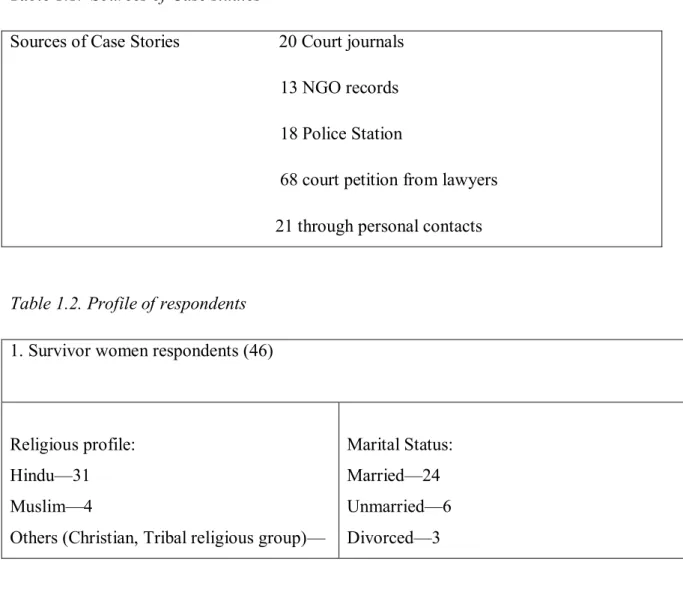
- Data sources and profile of respondents
All lawyers were selected for interview because they deal with domestic violence cases. Chapter III, titled “Nature and Forms of Domestic Violence in Assam”, deals with the analysis of the data collected for the study.
Domestic Violence against Women
Introduction
Definition of Domestic Violence
Therefore, feminists have described "the victimization of women as a major component of domestic violence" (Merchant: 2000: 250). A range of coercive, intimidating and controlling behaviors are used when perpetrating domestic violence.
Forms of Domestic Violence
- Physical violence
- Sexual violence
- Psychological violence
- Forms of domestic violence across the world: Within physical, sexual and psychological categories mentioned above, domestic violence takes various forms across
Incest or sexual abuse of children and adolescents within the family is one of the invisible forms of violence. The girl's family meets the dowry demands made by the matrimonial home to save their daughter's marriage.
Historical Understanding of Domestic Violence 1. Domestic violence in the western context
- Domestic violence in the context of India
Below is a brief description of the history of women's rights movements and their involvement in the issue of domestic violence. The battered women's movement and shelter movement of the 1970s brought about significant changes in the recognition of the problem of domestic violence and its legal intervention.
Theories of Domestic Violence
- Family violence perspective
The continued efforts of women's groups made lawmakers realize that domestic violence takes many forms other than dowry. They consider domestic violence as the ultimate expression of male dominance and exploitation of women (Jackson: 2007).
Introduction
Nature of Domestic Violence
- Domestic violence found across all stages of life
- Respondent’s perceptions about domestic violence
- Forms of wife-battering
- Physical violence
- Psychological violence
- Sexual violence
- Economic violence
- Witch-hunting
- Accusation and Identification process of a ‘witch’
- Branded as a witch: Reasons that turn witchcraft accusation into domestic violence
The data collected reveals the presence of domestic violence across the lifespan of women in Assam. Domestic violence is therefore a clear act of abuse of power and violation of women's rights. Nitu, a survivor respondent, said: Domestic violence is a clear abuse of power and a violation of women's rights.
In the above cases, the women had been subjected to forced abortions as part of domestic violence. The above cases show that verbal abuse has been a common and most frequent form of domestic violence. Sexual violence is one of the most difficult aspects of domestic violence for its victims to talk about (Felson and Pare: 2005).
Data thus show the negative impact of domestic violence on women's work and economic self-sufficiency.
Causes of Domestic Violence
- Alcohol and domestic violence
- Suspicion about the wife’s character
- Dowry
- Son preference
- Second marriage
One of the important findings in cases of domestic violence against wives due to husbands' extramarital affairs is that extramarital affairs are seen as They find that the wife's refusal and protest against the husband's secret second marriage causes torture in the name of dowry. With this purpose, he tried to push her out of the house in the name of "not meeting the demands for money".
The data show that dowry deaths occurred mainly in the first years of marriage. The Tiwa used to be a matrilineal group but are now in the process of transforming into a patrilineal group (Krishna: 2005).
Early marriage
I had to do all the housework and had no time to feed my child. I did not allow such a thing and he abused me and threw me out of the house. In my data, economic hardship is found to be one of the most unfavorable consequences of second marriages.
Sometimes the discovery of a second marriage and the questions that follow also lead to a violent situation. It has been confirmed that early marriage is one of the causes of domestic violence, as the police receive frequent complaints from young women.
Conclusion
The consequences of domestic violence included numerous hardships related to women's health, economic status and social position, including child victimization. These reasons could easily initiate violent episodes due to the inherent patriarchal nature of society, which provides a base for violence through its rules, norms and values that support discrimination against women. Thus, domestic violence in Assam is seen to be widespread, affecting women from different angles with different consequences and being indirectly supported by the social system.
In the next chapter, women's reactions to domestic violence, coping strategies and help-seeking experiences are discussed.
Introduction
Women’s Reactions to Domestic Violence
Also, depending on the nature, structure, power, and inherent ideological orientation of the agencies, women have different experiences in their attempts to seek help. Seeking help is an important step and shows that women are not just victims, but also survivors.
Factors influencing Women’s Reactions
Another factor related to women's decision to tolerate violence and continue a violent marriage is the choice of life partners. Concern for children's safety plays an important role in women's lives as they deal with domestic violence. In the context of domestic violence that occurs following dowry demands, women's silent suffering can be linked to parental economic weakness.
The data reveal that increased violence often motivates women to decide to seek outside help. Thus, the factors described above should influence women's responses to the violence they face.
Coping with Domestic Violence
- Coping strategies adopted by women
- Help-seeking from informal agencies
- Help-seeking from the natal family
- Help-seeking from relatives, friends and marital family members
- Nari-adalat: Help-seeking from nari-adalats
- Formation and authority structure
- Connecting and mobilising women
- Working procedure
- Techniques of resolving cases
- Reasons for approaching nari-adalats: women’s experiences with nari- adalats
- Collaborating with the police and helping women to approach formal agencies
- Weaknesses of nari-adalats
- Help-seeking from formal agencies
- Reason for not approaching the formal system: women’s experiences with the police and the legal system
Seeking help has been found to be one of the ways women respond to domestic violence. The birth family was found to be one of the primary informal sources of help-seeking. Rita, a member of nari-adalat, stated: We are trying to find a solution according to the wishes of women.
On the other hand, transfer of cases to the nari-adalats actually reflects the reluctance of the police to treat domestic violence as a criminal act. Therefore, the importance of the formal bodies in cases of help for domestic violence over the informal bodies can easily be assumed.
Conclusion
It has also been established that most victims use this law to obtain alimony or economic support from their husbands or sons. Some changes and reforms on the implementation side of the Act and upgradation of infrastructure may prove beneficial for the effective implementation of this Act in favor of women. The Nari-adalats challenged this traditional practice and allowed women to speak openly in public.
However, despite the important role played by the informal agencies, the formal agencies are found to be stronger as they have constitutional legitimacy. Nor is the reaction of society and the legal system free from its influence.
Conclusion
Abstract
My study therefore tried to show domestic violence as the result of a patriarchal system - a system that influences, shapes, controls women's lives from all sides and places women in a subordinate position. My study supports the feminist debate against the domestic violence perspective, which considered domestic violence as the result of individual pathological suffering and a gender-neutral act. As described above, my study also confirms that through these institutions, mechanisms, norms and values, men's authority in patriarchy is maintained and the perpetuation of domestic violence is normalized.
The issue of domestic violence has been one of the major campaigns of feminists in India. Using feminist and sociological methodology, this study intends to contribute to the understanding of the issue of women's lives in Assam in general and domestic violence as a manifestation of women's status and gender relations in particular.
Chapter summary
Studies claim that domestic violence is closely related to caste system, economic status and class discrimination. Feminist theory explains the actual nature of domestic violence, which is rooted in patriarchal power inequality. This chapter shows the acute presence of domestic violence, which affects women's lives in countless ways.
Gendered social norms and values are taken into account in the explanation of persistent domestic violence in its myriad forms. The description and explanation of various types, forms and causes of domestic violence is made in relation to the position of women in the patriarchal social set-up of Assam.
Findings of the Study
All these factors are described in connection with patriarchal values and practices that lead to the perpetuation of domestic violence. Several factors, including family, marriage, parental reputation, child safety, financial dependence and lack of awareness, have been found to influence women's decision to tolerate or resist violence. Apart from this, some other factors including husbands' extramarital affairs, alcoholism, dowry, son preference and polygamous marriage are found to initiate episodes of domestic violence.
The formal system, including the police and the legal system, is the ultimate source for seeking help with domestic violence issues. This study supports the feminist argument that gender and power hierarchy are the ultimate root of domestic violence (Dobash and Dobash: 1979; Bogard: 1990; Karlekar: 1998).
Limitations of the Study
Future Scope
Policy Recommendations
Prevalence of intimate partner violence: findings from the WHO multi-country study on women's health and domestic violence', The Lancet. Acceptability of domestic violence against women in the European Union: a multilevel analysis, J Epidemiol Community Health. Domestic Violence Against Women: Statistical Analysis of Crimes Across India', Journal of Comparative Family Studies.
The cause and effect of domestic violence against pregnant women in India', Journal of Obstetrics and Gynecology. A Difficult Match: Women's Actions and Legal Institutions in the Face of Domestic Violence', economic and political weekly.
