Point-of-Care-Testing Devices for Sensing and Diagnostics
A thesis submitted
in partial fulfillment of the requirements for the degree of
Doctor of Philosophy
by
Nilanjan Mandal
Centre for Nanotechnology
Indian Institute of Technology Guwahati
December 2019
C E R T I F I C A T E
It is certified that the works contained in this thesis entitled “Point-of-Care-Testing Devices for Sensing and Diagnostics”, by Mr. Nilanjan Mandal, have been carried out under our supervision and have not been submitted as a thesis elsewhere for a Ph.D degree.
Thesis supervisors
Prof. Dipankar Bandyopadhyay
Professor & HOC
Department of Chemical Engineering &
Centre for Nanotechnology
Indian Institute of Technology Guwahati
Prof. Arun Chattopadhyay
Professor
Department of Chemistry &
Centre for Nanotechnology
Indian Institute of Technology Guwahati
December 2019
ACKNOWLEDGEMENT
The journey undertaken for the completion of this thesis has been one of the most amazing experiences of my life, which would have been impossible without these people.
First and foremost, I would like to thank my thesis supervisors Prof. Dipankar Bandyopadhyay and Prof. Arun Chattopadhyay for giving me the opportunity to work in a very interesting area of research. I am very grateful to them for their continuous guidance, important advices and stimulating discussions. In spite of their busy schedule, they were always happy to dedicate their time to analyze the problems and give necessary suggestions for the betterment of my work. I am certain that the experience of working under their supervision will have far-reaching influences on my life. Their devotion towards their work, their untiring zeal to achieve perfection, and their patience in guiding novice researchers, will always inspire me. I consider it an honor to have been guided by them. I wish to thank my doctoral committee members, Prof. Harshal B. Nemade, Department of Electronics and Electrical Engineering, Prof. Tapas K. Mandal, and Dr.
Ashok K. Dasmahapatra, Department of Chemical Engineering, for their valuable suggestions and efforts during my thesis work.
My sincere thanks to Dr. A. Ananth Praveen Kumar and Dr. Kartick Mondal, alumni from our research group, and Dr. Nayanmani Das and Dr. Dhrubajyoti Roy, Institute Post-Doctoral Fellows, for their unhesitating assistance and continuous encouragement throughout my PhD tenure. I wish to express my deepest gratitude to Prof.
Sarmishtha Banerjee, Department of Design for her insightful suggestions regarding the design and aesthetics of the prototypes developed. I also wish to extend my gratitude to Dr. Sandip Patil from E-SPIN Nanotech Pvt. Ltd., Kanpur and Mr. Sahil Jagnani from Primary Healthtech Pvt. Ltd., New Delhi for their help in developing commercial prototypes. In addition, I am particularly grateful to Dr. Amit Kumar Singh, Mrs.
Aanchal Gupta, Dr. Seim Timung, Mr. Shirsendu Mitra, Ms. Satarupa Dutta, Dr.
Madhumita Das and Dr. Mitradip Bhattacharjee, for their support in experiments and computations.
I am also thankful to all the members of our research group, Ms. Abhijna Das, Mr. Abhinav Sharma, Dr. Abir Ghosh, Dr. Amit Kumar Singh, Mr. Aniruddha Deb,
Mrs. Anchal Gupta, Mr. Ankur Pandey, Mr. Anvesh Dixit, Mr. Ankit Chowdhury, Ms. Anuja Tripathi, Dr. Anushree Dutta, Mr. Bhaskarjyoti Sharma, Mrs. Binita Nath, Dr. Bolleddu Ravi, Mr. Chintak K. Parashar, Mr. Debdatta Ghosh, Mr.
Debendra Nath Sarkar, Mr. Divesh Ranjan, Mr. Harsha Lankipalli, Mr. Himanshu Raturi, Mr. Jayant Borana, Mr. Joydip Chaudhuri, Mr. Kaniska Murmu, Mr.
Manash Pratim Borthakur, Ms. Mitali Basak, Dr. Mitradip Bhattacharjee, Mr.
Nayanjyoti Kakati, Mr. Nirmal Roy, Ms. Prasfutita Paul, Mr. Prathu Raja Parmar, Ms. Prerona Gogoi, Mr. Pritam Roy, Md. Rashid Ali Faridi, Mr. Rupam Sinha, Mr.
Ravula Rajasekhar, Mr. Sagnik Midda, Mr. Saikat Biswas, Dr. Saptak Rarotra, Ms.
Satarupa Dutta, Dr. Seim Timung, Mr. Shaon Sutradhar, Ms. Snigdha Chakraborty, Ms. Shreya Mukherjee, Mr. Shrikant Kashyap, Mr. Shirsendu Mitra, Mr. Siddharth Thakur, Dr. Sunny Kumar, Mr. Sunil Kumar Singh, Mr. Surjendu Maity, Mr.
Subhradip Ghosh, Dr. Shrestha Basu, Mrs. Tamanna Bhuyan, Ms. Tanusree Ghoshal, Mr. Vinod Vanarse and last but not the least Mr. Viswanath Pasumarthi. I cannot forget to thank my friends and colleagues Mr. Abhik Bhattacharjee, Mr.
Ardhendu Sekhar Chaudhury, Mr. Biplab Ghosh, Dr. Jitendra Kumar, Dr.
Manishekhar Kumar, Dr. Shyam Trivedi, Dr. Shamim Rahman, Mr. Saptarshi Gupta, Mr. Siddhanta Roy, Mrs. Soumi Sarkar, Mr. Arunabha Banerjee, Dr.
Upashi Goswami, Dr. Madhumita Das, Dr. Sandipan Mukherjee, Mr. Somorjit Singh, Ms. Larionette Mawlong, Dr. Anamika Dey, Dr. Anamika Kalita, Dr. Ashish Singh, Dr. Dipjyoti Das, Ms. Nilanjana Nandi, Ms. Anwesha Chowdhury, Mr. Ritesh Kant Gupta, Mr. Rahul Narasimhan, Mr. Rabindranath Garai, Mrs. Namami Goswami, and last but not the least Dr. Rimi Das Mandal for their role in making my stay at IIT Guwahati memorable.
My special thanks goes to all the faculty and staff members of Centre for Nanotechnology, and Central Instruments Facility, IIT Guwahati, for their co- operation and to MeitY grant no. 5(9)/2012-NANO for financial support and to DST- SERB, grant no. SR/S3/CE/0079/2010 for the facilities provided.
Above all, I wish to thank my parents, friends, and family members for their love and support throughout everything, as always.
I dedicate this thesis to
My Family.
SYNOPSIS
Point-of-Care Testing Devices for Sensing and Diagnostics
1. Introduction
The society in this fast moving contemporary world is prone to diseases and health problems. Therefore, the support of various health monitoring sensors and systems for staying healthy may be necessary. As a result, there is a revolution in the field of innovation in monitoring sensors and devices to make the human life healthier and disease free. In this regard, the researchers and innovators throughout the world are trying to make effective, economical, biodegradable, fast sensors and devices. However, since this task is not a very simple one, there are various existing challenges associated with the portability, sensitivity, selectivity, response time, robustness, miniaturization, reusability, or user- friendliness, among many others. The researchers are thus encouraged to work in multifarious dimensions for finding the solution to each of these important problems.
Recently, the focus has also been made upon the use of functionalized nanomaterials, conducting polymers, paper-substrates, open source electronics and their application in the Point-of-Care (POC) testing devices. The advantages of such kind of POC devices are, availability of higher surface to volume ratio, reduction in the amount of the fabricating material as well as in the amount of the sample required for testing, economic and biodegradable sensor substrate, and the emergence of exquisite physical, chemical, optical, electronic, or electrochemical properties at the nanoscale. In a way, expressing the specialties of the nanomaterials inside the microscale devices have paved new directions in the fields of sensor development, healthcare, and environmental monitoring, among others. The present thesis focusses on developing sensors and electronic devices targeting
As mentioned earlier the topics selected in the thesis are in context with the increasing health problems due to the rapid industrialization and subsequent changes in the healthcare and environment of the contemporary world. There are many lifestyle related diseases from which humans suffer in this modern era, which go undiagnosed at an early stage, for reasons such as lack of awareness as well as due to the absence of facilities at patients’ location. Thus, the doctors in general encounter the diseased patients at the advanced stages. In this current situation, the need of the hour are devices that may detect diseases at the early stage, thus increasing the consciousness about human health on a regular basis. As per World Health Organization (WHO) guidelines, the mandate is to develop devices with ASSURED features – affordable, sensitive, specific, user-friendly, rapid and robust, equipment free, and deliverable. These are envisioned devices which can diagnose the otherwise common diseases in the patient’s location such that they can be treated at their early stages. The innovators at well-established commercial organizations are even trying to integrate healthcare devices, which can be integrated to an existing device such as mobile phone or wristwatch, or a glass to obtain the various health parameters, such as blood pressure and temperature, body-mass-index, heartbeat, or pulse, that exclusively help in deciding the current status of health condition of a human being.
Moreover, integration of sensors with clothes, spectacles, and directly to different body parts have also been demonstrated by these organizations. Further, flexible and wearable electronics-based sensors are also found extensively in the prior arts.
In view of this background, the present thesis focusses on the use of smart nanomaterials such as the metal nanoparticles, biomaterials or conducting polymers in the paper based microfluidic devices to develop proof-of-concept prototypes targeting biomedical applications and environmental monitoring. The thesis comprises four
of α-amylase activity in human blood serum, (ii) paper-based α-amylase detector for point- of-care diagnostics, (iii) paper-based sensor for point-of-care kidney function monitoring, and (iv) paper-based sensors for point-of-care water quality testing. The technical chapters in the thesis are preceded by an introductory chapter while at the end of the thesis a chapter containing the summary and future scopes have been included. A brief detail of outcomes of this thesis in terms of publications, patents, conferences, and awards has been provided as an APPENDIX.
2. Chapter 1: Point-of-Care-Testing of α-Amylase Activity in Human Blood Serum
Figure 1: Images (a) and (b) schematically show the coating of a PANI-EB film on a glass substrate. Image (c) shows the FESEM images of surface textures of PANI-EB film.
Image (d) shows the formation of SAuNPs on the surface of the film and conversion of PANI-EB to PANI-ES. Image (e) shows the FESEM image of surface textures of the conducting PANI-ES film coated with SAuNPs, marked on the image with arrow. Image (f)
In this chapter, Activity of α-amylase enzyme in human serum indicates the onset of pancreatitis, mumps, cancer, stress, and depression. Herein we design and develop a biosensor for the point-of-care-testing (POCT) of α-amylase concentration in serum. The biosensor is composed of a glass substrate coated with an electrically conducting poly- aniline-emeraldine-salt (PANI-ES) film covered with starch-coated gold nanoparticles (SAuNPs), as shown in the Figure 1. Addition of different dosage of α-amylase on the biosensor selectively depletes starch stabilized on the SAuNPs, which changes the electrical resistance of the sensor. The change in electrical resistance show a nearly linear correlation with the concentration of α-amylase in buffer, which helps the detection of unknown α-amylase activity in the blood serum. The biosensor responds in a specific manner owing to the use of selective enzymatic chemical reaction between α-amylase and starch. The pathways to SAuNP formation on PANI-ES, time-dependent starch digestion with α-amylase, and the subsequent variation in electrical response was characterized to uncover the sensing mechanism. The chloride ions and the AuNPs present catalyse the starch-amylase reaction on the PANI surface to enable a sensitive detection of α-amylase in serum (10 – 90 U/l) at a quick response time of ~60 s. Integration of the biosensor with the built-in sourcemeter and a real time display help an immediate presentation of α- amylase level in the serum, comparable to the clinically approved methodologies.
3. Chapter 2: Paper-Based α-Amylase Detector for Point-of-Care Diagnostics
In this chapter, fabrication of a paper-sensor for quantitative detection of α- amylase activity in human blood serum. Pieces of filter papers were coated with starch- iodine solution leading to an intense blue coloration on the surface, as shown in the Figure
of the color because of starch-hydrolysis catalyzed by amylase, as shown in the Figure 2.
The variation in the intensity of the color with the concentration of amylase was estimated in three stages: (i) initially, the paper-surface was illuminated with a light emitting diode,
Figure 2: (I) Schematic illustrations of the steps to fabricate paper-sensor. (II) Reflection mode – images (a) and (b) show the experimental setup and corresponding circuit diagram for resistance measurement. (III) Transmitted mode – images (a) and (b) show the experimental setup and the corresponding circuit diagram for resistance measurement. The notation LDR (LED) represents photoresistor or photodetector (light emitting diode).
(ii) then, the transmitted (reflected) rays emitted through (from) the paper was collected on a photoresistor, and (iii) the variations in the electrical resistance of the photoresistor were correlated with the amylase concentration in analyte. The resistance of photoresistor decreased monotonically with an increase in amylase concentration because the intensity of the reflected (transmitted) rays collected from (through) the paper increased with reduction in the color intensity on the paper surface. Since a specific bio-reaction was employed to detect the activity of amylase, the sensor was found to be equally efficient in detecting unknown quantities of amylase in human blood serum. The reported sensor has shown the potential to graduate into a point-of-care detection tool for α-amylase.
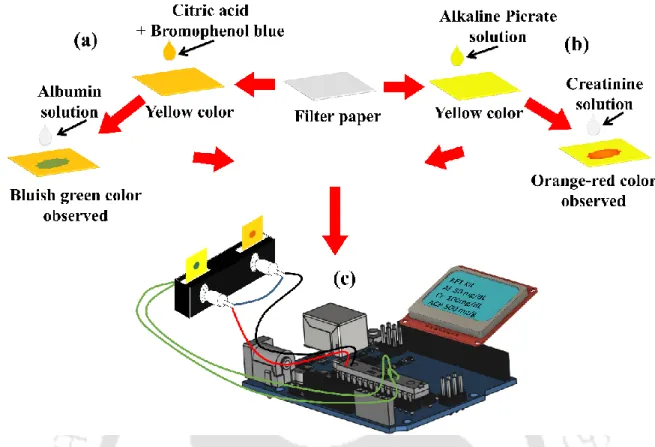
4. Chapter 3: Paper-Based Sensor for Point-of-Care Kidney Function Monitoring In this chapter, development of a paper-based colorimetric sensor for monitoring of kidney function is discussed, as shown in the Figure 3. The ratio of albumin to creatinine (ACR) in urine is a measure of human kidney-health. In this study, we report the development of a paper-based point-of-care (POC) kidney function test (KFT) kit, which is composed of paper-based ACR sensors, opto-electrochemical measurement unit, a display, and facility to transfer data to a smartphone. For the albumin sensor, the pieces of filter papers were coated with a mixture of alcoholic bromophenol blue and citric buffer leading to a chrome-yellow coloration while for the creatinine sensor the papers were coated with alkaline picrate solution leading to a lemon-yellow coloration of the surface.
Dispensing albumin solution of known concentration on the albumin-sensor led to the conversion of chrome-yellow coloration to bluish-green while dispensing the creatinine solution on the creatinine-sensor led to the conversion of lemon-yellow to orange coloration of the surface.
Figure 3: This schematic shows the fabrication process and illustration of working of the sensors. Image (a)-(b) show the different steps of fabricating the albumin and creatinine sensors. Image (c) illustrates the working of the sensors in determining the albumin and creatinine concentration in human blood.
For both the albumin or creatinine sensors, the intensity of the bluish-green or orange coloration varied with the concentration of the analytes in the solutions. The variations in the intensities of colors with albumin and creatinine loadings in the analytes were quantified by integrating a light emitting diode (LED) at one side of each sensor and a light dependent resistor (LDR) on the other side. The intensity of the transmitted rays from the source LED, passing through the sensors, was found to vary the electrical resistance of the LDR monotonically with the loading of the albumin or creatinine in the analyte, which helped in obtaining the calibration plots for the ACR sensors. The portable and fast proof-of-concept POC prototype was employed for the on-spot detection of the unknown ACR in the real human urine samples.
5. Chapter 4: Paper-based Sensors for Point-of-Care Water Quality Testing
In this chapter, multiple paper-based sensors for monitoring of water quality is developed and demonstrated, as shown in the Figure 4. Contamination of water bodies due to the disposal of natural and anthropogenic pollutants is one of the major global concerns in the recent times. Regular on-spot monitoring of water quality has become mandatory wherein diverse classes of materials such as organic, inorganic, heavy metals, or biological wastes are detected employing standard protocols. However, most of the existing laboratory techniques are either costly and/or time consuming owing to the process involving the expert driven sophisticated analysis techniques.
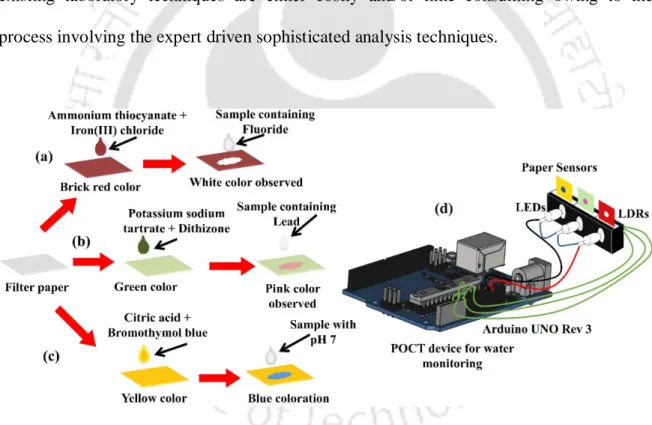
Figure 4: Images (a)-(c) schematically illustrate the steps of colorimetric sensor fabrication for F−, Pb2+ and pH, respectively, and their color change. Image (d) shows the integration of LED and LDR with the sensor and subsequent measurement of the change in resistance using Arduino based POCT device for the display of water quality.
Herein, we report the development of three paper based colorimetric sensors for the on-spot quantitative detection of the levels of fluoride (F−), lead (Pb2+), and pH in
variation in the concentration of F−, Pb2+, and pH were converted into electronic signals to enable the development of a point-of-care-testing (POCT) device. For this purpose, initially, the sensors were characterized and calibrated with known concentrations of contaminates before successful validations with real samples. Thereafter, the sensors were illuminated with a light emitting diode from one side while the transmitted rays passing through the sensor was captured by a light dependent resistor (LDR) from the other side.
The variation in the color intensity of the paper-sensor with the contaminant loading was found linearly varying with the resistance of the LDR. The sensor was then translated into a specific, stable and user friendly POCT device, which enabled inexpensive spot detection of pollutants in drinking water.
List of Figures
Figure 2.1: Images (a) and (b) schematically show the coating of a PANI-EB film on a glass substrate. Image (c) shows the FESEM images of surface textures of PANI-EB film. Image (d) shows the formation of SAuNPs on the surface of the film and conversion of PANI-EB to PANI-ES. Image (e) shows the FESEM image of surface textures of the conducting PANI-ES film coated with SAuNPs, marked on the image with arrow. Image (f) illustrates the scheme for measurement of sensor resistance by sourcemeter. 23 Figure 2.2: Image (a) shows starch consisting of glucose units. Image (b) shows the
reduction of the HAuCl4 by glucose to form AuNPs. Image (c) shows formation of SAuNPs and image (d) shows the conversion of PANI-EB to PANI-ES by HCl alongside having Cl− on the film matrix. 26 Figure 2.3:The XRD plots in the image (a) correspond to the PANI-EB (darker – black)
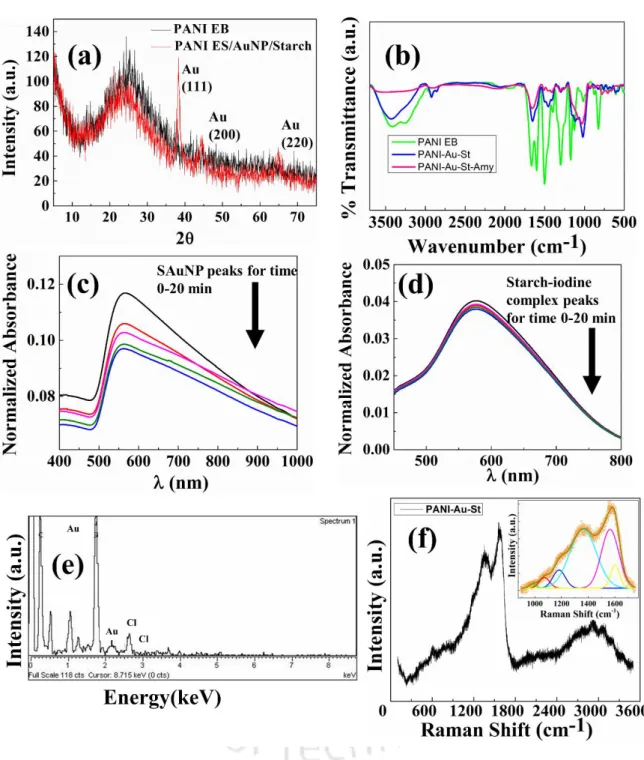
and PANI-ES coated with SAuNPs (lighter – red). The plot (b) shows the IR spectra of the sensor. The image (c) shows the UV-Vis spectroscopy of α- amylase treated SAuNP composite at different time intervals, 0 min, 5 min, 10 min, 15 min, and 20 min, of starch digestion. The image (d) shows the UV-Vis spectra of starch-iodine complex at the same time intervals of digestion of bare starch. Image (e) shows the EDXS plot of the sensor surface depicting the elemental composition. Image (f) shows the Raman spectra of the sensor surface whereas the inset shows the peak fitting for 900 – 1760 cm-
1. 29
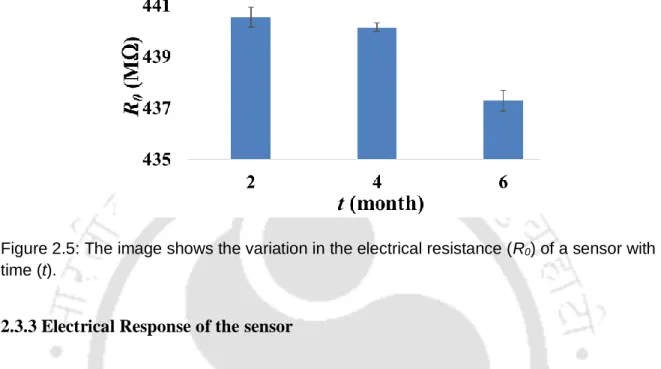
Figure 2.4: (a) shows the UV-Vis spectroscopy of interaction of α-amylase with AuNPs at different time intervals, 0 min, 5 min, 10 min, 15 min, and 20 min. The image (b) shows the UV-Vis spectroscopy of interaction of α-amylase with only iodine at the same time intervals. The image (c) shows the UV-Vis spectroscopy of α-amylase treated SAuNPs composite in absence of Cl− ion. 30 Figure 2.5: The image shows the variation in the electrical resistance (R0) of a sensor
with time (t). 33
Figure 2.6: The image (a) shows the commercial sourcemeter for resistance measurement and the image (b) shows the silver paste electrical contacts on the sensor, which is magnified in image (c). The image (d) shows the variation in the normalized resistance (R/R0) with α-amylase concentration in the analyte (C).
The image shows the calibration plot using the commercially available sourcemeter (circular symbols) using α-amylase solution prepared in the laboratory, the same data reproduced by the POCT device (square symbols), and the test data measured by the POCT device using human serum of unknown level of α-amylase (triangular symbols). Image (e) shows the photograph of the POCT device composed of a sensor, a sample stage, a signal processing unit (SPU) with a built-in sourcemeter, and a liquid-crystal- real-time-display (LC-RTD). The image (f) illustrates the circuit diagram of the POCT device where, (i) corresponds to microcontroller board, (ii) LC-
RTD, and (iii) voltage divider circuit with the built-in sourcemeter. 35 Figure 2.7: The variation in normalized resistance (R/R0) with volume fraction (ϕ) of the
starch layer. The value of ϕ was obtained by evaluating the ratio of the area occupied solely by starch film to the total area occupied by the starch and AuNPs. The inset shows the schematic diagram with the dimensions of the sensor employed for the simulation in which Va = 10 mV was the input
voltage. 37
Figure 3.1: (I) Schematic illustrations of the steps to fabricate paper-sensor. (II) Reflection mode – images (a) and (b) show the experimental setup and corresponding circuit diagram for resistance measurement. (III) Transmitted mode – images (a) and (b) show the experimental setup and the corresponding circuit diagram for resistance measurement. The notation LDR (LED) represents photoresistor or photodetector (light emitting diode). 54 Figure 3.2: Top views of the paper-sensors in which the numbers indicate the
concentration of α-amylase in units/litre (U/L) in the analyte. The first image corresponds to the SI coated paper-sensor before amylase was added while the other images were taken after the addition of different concentration of α-
amylase solution. 56
Figure 3.3: (a) Top views of the paper-sensors in which the numbers indicate temperatures in °C. (b) Variations in the normalized resistance differences (∆𝑹𝑵𝑻) with temperature (T) for the transmission mode. Equal amount of α amylase (80 U/L) has been dispensed on the sensors. 57 Figure 3.4: (I) The light (dark) colored curve shows the FTIR spectra (%Transmittance
(T) to wavenumber (κ)) of SI complex before (after) the addition of α-amylase solution on the paper-sensor coated with SI complex. Images (a) – (c) show
the magnified regions of the image (I). 58
Figure 3.5: Images (a) and (b) show the FESEM micrographs of the paper-surface having the SI coating before and after the addition of α-amylase while images (c) and
(d) show the corresponding EDX data. 59
Figure 3.6: Variations in, (a) the normalized change in resistance (∆𝑹𝑵𝑹) with concentration of α-amylase (C) for the reflectance mode, and (b) normalized change in resistance (∆𝑹𝑵𝑻) with C for the transmission mode. (c) The images of the paper-sensors show the colorimetric change when blood serums of different α-amylase loading were dispensed. The first (second) row shows the results without (with) the pre-treatment of KIO3. (d) The variation in ∆𝑹𝑵𝑻 with C in transmission mode when the initial analyte was composed of a mixture of ascorbic acid and α-amylase and then were pre-treated with KIO3
before dispensing on the paper-sensor. The square (triangular) symbols show the plot with known (unknown) amylase concentration in the analyte (human
serum). 63
Figure 3.7: UV-Vis spectra showing the variations in % absorbance (A) with wavelength (λ). Image (a) shows the same of pure ascorbic acid (2 mg/dl) while image (b) is of pure KIO3 (5 mg/ml). Image (c) represents mixture of ascorbic acid - KIO3 solutions in which the curves 1 and 9 represent pure ascorbic acid (2 mg/dl) and KIO3 (5 mg/ml) respectively. Curves 2 – 8 represent mixtures (v/v) of ascorbic acid and KIO3 as mentioned in the line legend. Image (d)
shows the magnified regions of image (c). 64
Figure 3.8: Schematic illustration of the proposed device for simple, fast, reliable, economic, and point-of-care detection of amylase level in human blood
serum. 66
Figure 4.1: Images (a) and (b) are schematic illustrations of the steps involved in the fabrication of the paper-sensors for quantitative detection of albumin and creatinine. Images (c) illustrates the electronic setup for the measurement of
the albumin, creatinine and ACR. 79
Figure 4.2: (a) shows the UV-Vis spectra for the albumin detection reaction. Image (b) illustrates the reaction mechanism of the albumin detection. 85 Figure 4.3: Plots (a) – (c) illustrate the 1H NMR spectra of picric acid, creatinine, and
mixture of alkaline picrate and creatinine, respectively. The 13C NMR of picric acid, creatinine, and mixture of alkaline picrate and creatinine are illustrated in the images (d) – (f ). The reaction mechanism is illustrated in
image (g). 87
Figure 4.4: The image shows the variation in the electrical resistance of an albumin sensor (green bar, 𝑹𝟎𝒂) and a creatinine sensor (yellow bar, 𝑹𝟎𝒄) with time (t).The image shows the variation in the electrical resistance (R0) of a sensor
with time (t). 88
Figure 4.5: Variations in the, (a) normalized resistance (𝑹𝒂/𝑹𝟎𝒂) with concentration of albumin (𝑪𝒂) and (b) normalized resistance (𝑹𝒄/𝑹𝟎𝒄) with concentration of creatinine (𝑪𝒄).The points (square and triangle) represents the mean value and the error bar signifies the range in which it varies (standard deviation from the mean). The image set (c) shows the colorimetric change of the paper- sensors when solution different loadings of albumin were dispensed. The image set (d) Illustrates the colorimetric change on the surface of the paper- sensors when sample solution containing different creatinine concentrations
were dispensed. 89
Figure 4.6:Image (a) illustrates the working prototype of the proposed device for simple, fast, reliable, economic, and point-of-care detection of albumin, creatinine, and ACR in the human urine. Image (b) illustrates the smartphone
application, which can be used for remote monitoring of kidney health. Image (c) illustrates the different part of the POCT device circuit. 92 Figure 5.1: Images (a)-(c) schematically illustrate the steps of colorimetric sensor
fabrication for F−, Pb2+ and pH, respectively, and their color change. Image (d) shows the integration of LED and LDR with the sensor and subsequent measurement of the change in resistance using Arduino based POCT device
for the display of water quality. 108
Figure 5.2: The images (a) and (b) illustrates the UV-Vis spectra and mechanism of the interaction between iron (iii) thiocyanate and fluoride. Images (c) and (d) shows the UV Visible spectra and mechanism interaction between dithizone and lead. Images (e) and (d) illustrates the UV-Vis spectra and mechanism of interaction of bromothymol blue with different pH. 109 Figure 5.3: Plots (a) – (c) show the variation in the normalized resistance change (𝑹𝒊𝟎/𝑹𝒊)
with the fluoride concentration (𝑪𝑭) in water, lead concentration (𝑪𝑷𝒃) in water and pH of water, respectively. The squares (black) denotes the calibration points and the triangles (red) denotes the unknown samples.
Images (d)-(f ) illustrate the color change of the F−, Pb2+ and pH sensors, respectively, due to the change in concentrations as written at the bottom. The numbers below the images (d)-(e) denotes concentration in ppm, and pH in
image (f). 113
Figure 5.4: Image shows a POCT device for monitoring of F−, Pb2+ and pH of water. 114
List of Tables
Table 2.1: Comparison table between the existing methods and the proposed method. 18 Table 2.2: Assignment of the FTIR spectra of PANI-EB and PANI-ES (Dhivya et al.
2015). 28
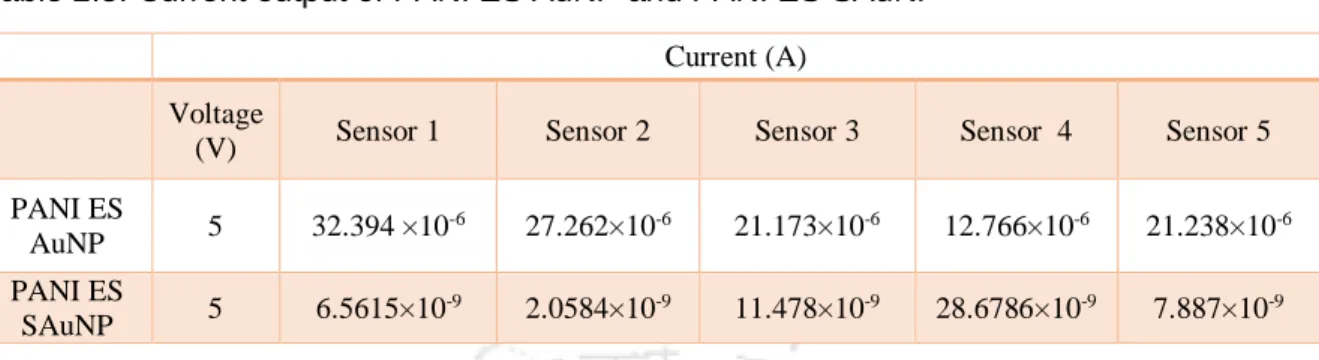
Table 2.3: Current output of PANI ES AuNP and PANI ES SAuNP. 32 Table 2.4: Current output using different conc. of starch in PANI ES SAuNP. 32 Table 2.5:Amylase in Serum using POCT and Commercial Devices. 36 Table 3.1: Amylase in Serum using POCT and Commercial Devices. 65 Table 4.1: Quantitative measurement of urine albumin and creatinine using the proposed
KFT kit and the clinically approved commercial devices. 90 Table 4.2: Existing and proposed methods for the albumin detection in urine (Kumar and
Banerjee 2017). 91
Table 4.3: Existing methods and proposed methods for detection of urine creatinine
(Pundir et al. 2013). 91
Table 5.1: Comparison table between the existing methods and the proposed method for the Pb2+ detection in water (Deibler and Basu 2013; Ding et al. 2010; Huang
et al. 2003; Saito et al. 2006). 110
Table 5.2: Comparison table between the existing methods and the proposed method for
the F- detection in water. 111
Table 5.3: Comparison table between the existing methods and the proposed method for
the pH detection in water. 111
Table 5.4: Comparison of the contaminates in water using POCT and Commercial
Devices. 114
Table 5.5. Comparison of cost and expertise in water quality monitoring using
POCT and Commercial Devices. 115
Contents
Topic Page No.
CHAPTER 1 ... 1 1.1. Overview ... 3 1.2. Classification of POCT devices ... 5 1.2.1 Conducting polymer based POCT devices... 5 1.2.2 Paper-based POCT devices ... 6 1.3 Objectives of the Thesis... 7 References... 8 CHAPTER 2 ... 13 ABSTRACT... 15 2.1. Introduction ... 16 2.2. Experimental Section ... 20 2.2.1. Materials ... 20 2.2.2. Synthesis... 20 2.2.3. Methods ... 22 2.3. Results and Discussion ... 26 2.3.1 Reaction mechanism ... 26 2.3.2 Characterization of the sensor material and function ... 27 2.3.3 Electrical Response of the sensor ... 33 2.3.4 Computational Simulations to Estimate the Change in Resistance ... 37 2.4. Conclusions ... 38 References... 39 CHAPTER 3 ... 45 ABSTRACT... 47 3.1. Introduction ... 48 3.2. Experimental Section ... 51 3.2.1. Materials ... 51 3.2.2. Preparation of solutions... 51 3.2.3. Methods ... 53
3.3.1 Reaction mechanism... 55 3.3.2 Characterization of the sensor material and function ... 58 3.3.3 Electrical Response of the sensor ... 60 3.4. Conclusions ... 66 References ... 67 CHAPTER 4 ... 73 ABSTRACT ... 75 4.1. Introduction ... 76 4.2. Experimental Section ... 80 4.2.1. Materials ... 80 4.2.2. Sensor fabrication and optimization ... 81 4.2.3. Methods ... 82 4.3. Results and Discussion ... 83 4.3.1 Reaction mechanism characterization ... 83 4.3.2 Electrical Response of the sensor ... 88 4.4. Conclusions ... 94 References ... 95 CHAPTER 5 ... 101 ABSTRACT ... 103 5.1. Introduction ... 104 5.2. Experimental Section ... 107 5.2.1. Materials ... 107 5.2.2. Methods ... 107 5.3. Results and Discussion ... 109 5.3.1 Characterization of the sensor material and mechanism of detection ... 109 5.3.2 Response of the sensor ... 112 5.4. Conclusions ... 115 References ... 116 CHAPTER 6 ... 119 6.1. Summary ... 121 6.2. Future Scope ... 125 Appendix-1: Publications, Patents, and Conferences 127
CHAPTER 1
Introduction
Contents
CHAPTER 1 ... 1 1.1. Overview ... 3 1.2. Classification of POCT devices ... 5 1.2.1 Conducting (sensing material) polymer based POCT devices ... 5 1.2.2 Paper (substrate)-based POCT devices ... 6 1.3 Objectives of the Thesis ... 7 References ... 8
2 Chapter 1
Introduction 3
1.1. Overview
In the modern human life, personal care practices have become indispensable to maintain a minimum quality of health. The point-of-care testing (POCT) devices, are miniaturized, user friendly, rapid, economical, uses low power and help in such round-the-clock health monitoring and diagnostics. In a way, the POCT devices can minimize medical expenses by operating with minute amount of complex biological and chemical samples; such as blood, urine and water, rapidly analysing those samples and allowing prompt treatment before the onset of the infection or disease. Broadly, POCT devices are also used for primary health care in prevention and control of disease as well as monitoring of health conditions in remote areas lacking sophisticated laboratory arrangements and trained medical laboratory technicians.
Recently, there have been significant advancements in the area of design and development of the POCT devices by implementing advanced technologies like, bio-process reaction engineering, nanotechnology, micro or nanoelectronics, microfluidics, smart soft materials, data analytics, and connectivity (Bhattacharjee et al. 2016; Bhattacharya et al. 2007; Gogoi et al. 2011; Gogoi et al. 2012; Kricka 2001; Kricka et al. 1993; Manz et al. 1990; Saliterman 2006; Singh et al. 2014; Vo-Dinh and Cullum 2000; Whitesides 2006; Wu et al. 2012). In particular, micro and nanoscale objects such as the nanoparticles, nanofibers, nanodots, nanopores, and microfluidic devices have shown the potential to improve the efficiency of various highly selective detection techniques by enhancing the accuracy, sensitivity and response time (Ahn et al. 2004; Bashir 2004; Grieshaber et al. 2008; Homola 2008; Nguyen 2007; Vo-Dinh and Cullum 2000) and resulting in immediate detection of diverse ailments.
4 Chapter 1 The guidelines as laid by World Health Organization (WHO) for developing efficient POCT devices are known as ASSURED, in which the abbreviation ASSURED stands for affordable, sensitive, specific, user-friendly, rapid/robust, equipment-free or minimal, and delivered at time of need (Jenkins and Goldberger 2002; Luppa et al. 2016; Peeling and Mabey 2010).
The present thesis aims at the design and development of a host of specialty sensors and portable POCT devices targeting a set of healthcare applications, and environmental monitoring. The background of the aforementioned topics is associated with increasing health hazards that are directly related to the pollutions in the ambient air, water, and soil (Conrad and Hilchey 2011; Spengler and Sexton 1983; Yu et al. 2011). Importantly, due to the lack of awareness and absence of facilities at the patients’ site, the early detection of these ailments are not available. Consequently, most of the patients are at advanced stage of disease when they consult the doctors. Considering the current situation, recently, people are trying to develop POCT devices that are capable of an early stage disease detection and increasing the awareness by monitoring their health status regularly.
Globally, the recent research thrust has been directed to obtaining the varied health-related parameters, such as body weight (Fader et al. 2009; Meza and Carrillo 2016; Must et al.
1999), body-mass index (van der Pals et al. 2014), blood sugar or pressure, lipid profiles (Bruen et al. 2017; Flynn et al. 2017), T3-T4-TSH (Christ and Burger 2015; Dayan 2001), hemoglobin (Brown et al. 2003), sodium and potassium (Metheny 1981; Stenvinkel and Alvestrand 2002) body temperature, heartbeat or pulse, which help in deciding the qualitative and quantitative profiling of individual health. Further, flexible and wearable electronics-based sensors, integrated with objects of regular usage such as clothes, or
Introduction 5 directly into the patients’ affected body part, also have been found in extensive use (Appelboom et al. 2014; McGrath et al. 2014; Schneegass and Amft 2017). Apart from the developing POCT devices for medical purposes, development of POCT devices for environmental monitoring has made a rapid progress in recent times. Development of sensors to detect various toxic chemicals, pH, in the water bodies gained serious interest due to their importance in environmental monitoring and relation with various disease (Clement et al. 1999; Fung and Mykhaylova 2014). In particular, the use of various electronic as well as optoelectronic phenomena have been utilized to develop proof-of-concept prototypes targeting medical as well as environmental applications.
1.2. Classification of POCT devices
In recent past, there have been extensive research and development in the field of POCT devices. Varied applications ranging from healthcare to environmental testing have been developed and demonstrated by integrating different attributes of micro and nano domain to different technological fields such as optoelectronics, electrochemistry, etc. In the following section, an overview of different POCT devices employed in this thesis has been depicted.
1.2.1 Conducting (sensing material) polymer based POCT devices
Conducting polymers based POCT devices have also been developed to monitor the environment and health parameters. Conducting polymers are low cost, fabrication convenient, user-friendly, biodegradable materials, which are used for the sensors design in POCT devices. Conducting polymers have been used on various platforms such as catalytic and affinity biosensors as immobilization matrices, signal transduction systems, and even analyte recognizing components.
6 Chapter 1 Further, Sensor fabrication for POCT devices exploits numerous exciting properties of conducting polymers such as (Yoon and Jang 2009):
Easily produced using electrochemical or chemical processes.
Sensitive to an array of analytes at different conditions (i.e. temperature, humidity)
Response depends on the intrinsic property of the conducting polymer.
Polymer structure can be readily modified for selective responses toward specific target.
Sensitivity can also be customized by the fabrication conditions.
Miniaturization and mass production of sensor array can be easily achieved by using various electrochemical fabrication procedures.
Nanomaterials fabricated from conducting polymer is largely used to detect multifarious analytes for environmental and health monitoring. There are sensors based on conducting polymer nanomaterials, consisting of polypyrrole (PPy), polyaniline (PANI), poly-(3,4- ethylenodioxythiophene) (PEDOT) (Li et al. 2015; Yoon and Jang 2009).
1.2.2 Paper (substrate)-based POCT devices
Paper is the most abundantly available, biodegradable, user-friendly and economic materials used for various purposes ranging from writing to packaging and many more. Recently paper has been used in great deal in POCT devices for its aforementioned qualities (Russo et al. 2011; Yetisen et al. 2013). The varied intrinsic properties of the paper such as thickness, porosity, color, texture etc. can be easily tuned during its manufacturing process.
The fiber networks of cellulose in paper helps in fluid flow without any external force making it the most suitable candidate for low cost POCT device in environment as well as in health care applications (Madou et al. 2001; Martinez et al. 2010). Further, paper being
Introduction 7 flexible substrate is suitable for use in portable and wearable sensors (Yang and Hsu 2010).
In addition, due to their background color paper substrates are widely used in colorimetric based sensor for achieving instantaneous results in POCT based devices. There has been a major gobal development in paper-basd colorimetric sensors in recent times (Segev-Bar and Haick 2013; Sriram et al. 2017; Windmiller and Wang 2013). Lately, numerous paper-based colorimetric sensors for sensing broad range of materials such as, toxic vapor and gases, clinically important analytes (Cheng et al. 2010; Li et al. 2014; Li et al. 2008) have been developed. The paper sensors can be easily fabricated just by soaking them or drop casting the reagent upon their surface which helps in detecting specific target analytes, chemical or biological in nature, quantitatively or qualitatively by variation in colorimetric due to the reaction. However, there is never ending requirements to develop paper-based POCT devices to cater the needs of large section people in its requirement.
1.3 Objectives of the Thesis
The objectives of the thesis are the development of diverse POCT devices for health care and environmental applications. For developing such POCT devices, different principles have been explored such as electrical, electrochemical, optoelectronic, among others.
Furthermore, it is also the need of the hour to make people aware about their health and its relation to the environment, which is only possible by giving them easy access to the hassle free testing and diagnosis facility at their location, with the help of POCT devices. With this background survey, the thesis presented demonstrates varied principles and fabrication techniques to develop proof-of-concept prototypes for healthcare and environmental monitoring.
8 Chapter 1 The thesis is broadly divided into six chapters. The first chapter provides the introduction, overview and objectives of this thesis. Following this, four technical chapters are presented such as, (ii) point-of-care-testing of α-amylase activity in human blood serum, (iii) paper- based α-amylase detector for point-of-care diagnostics, (iv) paper-based sensors for point- of-care kidney function monitoring, (v) paper-sensors for point-of-care monitoring of drinking water quality. The sixth chapter containing the summary and future scope of this thesis succeeds the technical chapters. A brief detail of contributions from this thesis in terms of patents, publications, conferences, and awards has also been provided in the respective appendices after the conclusion of the thesis.
References
Ahn, C.H., Jin-Woo, C., Beaucage, G., Nevin, J.H., Jeong-Bong, L., Puntambekar, A., Lee, J.Y., 2004. Proc. IEEE 92(1), 154-173.
Appelboom, G., Camacho, E., Abraham, M.E., Bruce, S.S., Dumont, E.L.P., Zacharia, B.E., D’Amico, R., Slomian, J., Reginster, J.Y., Bruyère, O., Connolly, E.S., 2014. Arch. Belg.
72(1), 28.
Bashir, R., 2004. BioMEMS: state-of-the-art in detection, opportunities and prospects. Adv.
Drug Delivery Rev. 56(11), 1565-1586.
Bhattacharjee, M., Pasumarthi, V., Chaudhuri, J., Singh, A.K., Nemade, H., Bandyopadhyay, D., 2016. Nanoscale 8(11), 6118-6128.
Bhattacharya, S., Jang, J., Yang, L., Akin, D., Bashir, R., 2007. BioMEMS and Nanotechnology-Based Approaches for Rapid Detection of Biological Entities. J. Rapid Methods Autom. Microbiol. 15(1), 1-32.
Brown, W.W., Peters, R.M., Ohmit, S.E., Keane, W.F., Collins, A., Chen, S.-C., King, K.,
Introduction 9 Bruen, D., Delaney, C., Florea, L., Diamond, D., 2017. Sensors 17(8), 1866.
Cheng, C.-M., Martinez, A.W., Gong, J., Mace, C.R., Phillips, S.T., Carrilho, E., Mirica, K.A., Whitesides, G.M., 2010. Angew. Chem., Int. Ed. 49(28), 4771-4774.
Christ, E.R., Burger, A.G., 2015. Thyroid Function Tests. In: Huhtaniemi, I., Martini, L.
(Eds.), Encyclopedia of Endocrine Diseases (Second Edition), pp. 477-485. Academic Press, Oxford.
Clement, R.E., Yang, P.W., Koester, C.J., 1999. Environmental Analysis. Anal. Chem.
71(12), 257-292.
Conrad, C.C., Hilchey, K.G., 2011. Environ. Monit. Assess. 176(1), 273-291.
Dayan, C.M., 2001. Lancet 357(9256), 619-624.
Fader, A.N., Arriba, L.N., Frasure, H.E., von Gruenigen, V.E., 2009. Gynecol. Oncol.
114(1), 121-127.
Flynn, J.T., Kaelber, D.C., Baker-Smith, C.M., Blowey, D., Carroll, A.E., Daniels, S.R., De Ferranti, S.D., Dionne, J.M., Falkner, B., Flinn, S.K., 2017. Pediatr. 140(3), e20171904.
Fung, A.O., Mykhaylova, N., 2014. J. Lab. Autom. 19(3), 225-247.
Gogoi, S.K., Borah, S.M., Dey, K.K., Paul, A., Chattopadhyay, A., 2011. Langmuir 27(20), 12263-12269.
Gogoi, S.K., Paul, A., Chattopadhyay, A., 2012. RSC Adv. 2(9), 3642-3646.
Grieshaber, D., MacKenzie, R., Vörös, J., Reimhult, E., 2008. Sensors 8(3), 1400-1458.
Homola, J., 2008. Chem. Rev. 108(2), 462-493.
Jenkins, A.J., Goldberger, B.A., 2002. On-Site Drug Testing. Humana Press.
Kricka, L.J., 2001. Clin. Chim. Acta 307(1–2), 219-223.
Kricka, L.J., Nozaki, O., Heyner, S., Garside, W.T., Wilding, P., 1993. Clin. Chem. 39(9),
10 Chapter 1 Li, B., Fu, L., Zhang, W., Feng, W., Chen, L., 2014. Electrophoresis 35(8), 1152-1159.
Li, C., Thostenson, E.T., Chou, T.-W., 2008. Compos. Sci. Technol. 68(6), 1227-1249.
Li, L., Shi, Y., Pan, L., Shi, Y., Yu, G., 2015. J. Mater. Chem. B 3(15), 2920-2930.
Luppa, P.B., Bietenbeck, A., Beaudoin, C., Giannetti, A., 2016. Biotechnol. Adv. 34(3), 139-160.
Madou, M.J., Lee, L.J., Daunert, S., Lai, S., Shih, C.-H., 2001. Biomed. Microdevices 3(3), 245-254.
Manz, A., Graber, N., Widmer, H.M., 1990. Sens. Actuators, B 1(1–6), 244-248.
Martinez, A.W., Phillips, S.T., Whitesides, G.M., Carrilho, E., 2010. Anal. Chem. 82(1), 3- 10.
McGrath, M.J., Scanaill, C.N., Nafus, D., 2014. Sensor Technologies: Healthcare, Wellness and Environmental Applications. Apress.
Metheny, N., 1981. J. Infus. Nurs. 4(1), 38-44.
Meza, M.N., Carrillo, J.A.B., 2016. Biomarkers, Obesity, and Cardiovascular Diseases. In:
Wang, Mu., Witzmann, F. (Eds.), Role of Biomarkers in Medicine, Intechopen. pp. 119- 147.
Must, A., Spadano, J., Coakley, E.H., Field, A.E., Colditz, G., Dietz, W.H., 1999. J. Am.
Med. Assoc. 282(16), 1523-1529.
Nguyen, N.-T., 2007. Fabrication Issues of Biomedical Micro Devices. In: Ferrari, M., Bashir, R., Wereley, S. (Eds.), BioMEMS and Biomedical Nanotechnology, Springer. pp.
93-115.
Peeling, R.W., Mabey, D., 2010. Clin. Microbiol. Infect. 16(8), 1062-1069.
Russo, A., Ahn, B.Y., Adams, J.J., Duoss, E.B., Bernhard, J.T., Lewis, J.A., 2011. Adv.
Mater. 23(30), 3426-3430.
Introduction 11 Saliterman, S., 2006. Emerging BioMEMS Technology. Fundamentals of BioMEMS and Medical Microdevices, First ed. Wiley. pp. 413-448.
Schneegass, S., Amft, O., 2017. Smart Textiles: Fundamentals, Design, and Interaction.
Springer. pp. 161-164.
Segev-Bar, M., Haick, H., 2013. ACS Nano 7(10), 8366-8378.
Singh, A.K., Dey, K.K., Chattopadhyay, A., Mandal, T.K., Bandyopadhyay, D., 2014.
Nanoscale 6(3), 1398-1405.
Spengler, J.D., Sexton, K., 1983. Science 221(4605), 9.
Sriram, G., Bhat, M.P., Patil, P., Uthappa, U.T., Jung, H.-Y., Altalhi, T., Kumeria, T., Aminabhavi, T.M., Pai, R.K., Madhuprasad, Kurkuri, M.D., 2017. TrAC, Trends Anal.
Chem. 93, 212-227.
Stenvinkel, P., Alvestrand, A., 2002. Semin. Dial. 15(5), 329-337.
van der Pals, M., Myléus, A., Norström, F., Hammarroth, S., Högberg, L., Rosén, A., Ivarsson, A., Carlsson, A., 2014. BMC Pediatr. 14(1), 165.
Vo-Dinh, T., Cullum, B., 2000. Fresenius' J. Anal. Chem. 366(6-7), 540-551.
Whitesides, G.M., 2006. Nature 442(7101), 368-373.
Windmiller, J.R., Wang, J., 2013. Electroanalysis 25(1), 29-46.
Wu, C., Brunelle, F., Harnois, M., Follet, J., Senez, V., 2012. Micro Electro Mechanical Systems (MEMS), 2012 IEEE 25th International Conference on, pp. 777-780.
Yang, C.-C., Hsu, Y.-L., 2010. Sensors 10(8), 7772.
Yetisen, A.K., Akram, M.S., Lowe, C.R., 2013. Lab Chip 13(12), 2210-2251.
Yoon, H., Jang, J., 2009. Adv. Funct. Mater. 19(10), 1567-1576.
Yu, M.H., Tsunoda, H., Tsunoda, M., 2011. Environmental Toxicology: Biological and
12 Chapter 1
CHAPTER 2
Point-of-Care-Testing of α-Amylase Activity in Human Blood Serum
Contents
CHAPTER 2 ... 13 ABSTRACT ... 15 2.1. Introduction ... 16 2.2. Experimental Section ... 20 2.2.1. Materials ... 20 2.2.2. Synthesis ... 20 2.2.3. Methods ... 22 2.3. Results and Discussion ... 26 2.3.1 Reaction mechanism ... 26 2.3.2 Characterization of the sensor material and function ... 27 2.3.3 Electrical Response of the sensor ... 33 2.3.4 Computational Simulations to Estimate the Change in Resistance ... 37 2.4. Conclusions ... 38 References ... 39
14 Chapter 2
15
ABSTRACT
Activity of α-amylase enzyme in human serum indicates the onset of pancreatitis, mumps, cancer, stress, and depression. Herein we design and develop a biosensor for the point-of- care-testing (POCT) of α-amylase concentration in serum. The biosensor is composed of a glass substrate coated with an electrically conducting polyaniline-emeraldine-salt (PANI- ES) film covered with starch-coated gold nanoparticles (SAuNPs). Addition of different dosage of α-amylase on the surface of the biosensor selectively depletes starch stabilized on the SAuNPs, which changes the electrical resistance of the sensor. The change in electrical resistance show a nearly linear correlation with the concentration of α-amylase in buffer, which helps in the detection of unknown α-amylase activity in the blood serum. The biosensor responds in a specific manner owing to the use of selective enzymatic chemical reaction between α-amylase and starch. The pathways to SAuNP formation on PANI-ES, time-dependent starch digestion with α-amylase, and the subsequent variation in electrical response was characterized to uncover the sensing mechanism. The chloride ions and the AuNPs present catalyse the starch-amylase reaction on the PANI surface to enable a sensitive detection of α-amylase in serum (25 – 90 U/L) at a quick response time of ~60 s.
Integration of the biosensor with the built-in sourcemeter and a real time display help an immediate presentation of α-amylase level in the serum, comparable to the clinically approved methodologies.
This chapter is published in Biosensors and Bioelectronics. 124-125, 75-81 (2019).
16 Chapter 2 2.1. Introduction
Integrating the specialities of bio-processes, reaction engineering, and nanotechology in micro or nanoelectronic devices have opened up new avenues in the design and the development of the next generation micro-electro-mechanical-systems (MEMS) targeting biomedical applications (Bhattacharjee et al. 2016; Bhattacharya et al. 2007; Gogoi et al.
2011; Gogoi et al. 2012; Kricka 2001; Kricka et al. 1993; Manz et al. 1990; Saliterman 2006; Singh et al. 2014; Vo-Dinh and Cullum 2000; Whitesides 2006; Wu et al. 2012). In particular, the highly selective bio-reactions on the surface of nanoscale objects such as nanoparticles have shown the potential to improve the efficiency of various detection techniques by enhancing the sensitivity and response time (Ahn et al. 2004; Bashir 2004;
Grieshaber et al. 2008; Homola 2008; Nguyen 2007; Vo-Dinh and Cullum 2000). In near future, the sensors empowered with the special features of the nano- and bio-technology are expected to produce rapid, reliable, portable, and easy to use point-of-care-testing (POCT) tools for the immediate detection of multifarious ailments (Ahn et al. 2004; Bhattacharjee et al. 2017; Chin et al. 2007; Kricka 2001; Sia and Kricka 2008; Vo-Dinh and Cullum 2000;
Yager et al. 2008; Yager et al. 2006).
For example, it is well known that the concentration of the α-amylase in different body fluids such as blood, saliva or urine is an important indicator of a number of common ailments (Wilkins 2009). The rise or fall of this enzyme indicates the onset of pancreatitis, pancreatic cancer, mumps, stress or depression, toxaemia in pregnancy, and liver cirrhosis.(Anderson 2002; González et al. 2002; He et al. 2000; Janowitz and Dreiling 1959; Nater et al. 2005;
Swaroop et al. 2004; Warshaw and Fuller 1975; Wilkins 2009) However, the presently available methodologies to evaluate the amount of this enzyme from different biological
17 sources involve time-consuming and expensive multi-step processes.(Cosnier 1999; Foo and Bais 1998; van Staden and Mulaudzi 2000) Furthermore, expert view is also necessary for the detection and analysis. In this direction, the point-of-care diagnostic tools detecting the concentration of α-amylase with immediate electrical or optical response are perhaps the need of the hour.(Robles et al. 2011)
The enzyme α-amylase (endo-1,4-α-d-glucan glucanohydrolase, EC 3.2.1.1) is produced in pancreas and salivary glands to hydrolyse starch into simple sugars. The quantification of the enzyme in blood serum facilitates the detection of many important health disorders (Zajoncová et al. 2004). Thus far, the spectrophotometric techniques are the most reliable and accurate pathways to detect the activity of α-amylase in blood serum (Chavez et al.
1990). However, the involvement of costly UV-Vis spectrophotometry for analysis restricts the applicability of this process in the POCT devices (Chavez et al. 1990; Dutta et al. 2016;
Shetty et al. 2011). Alternatively, the electrochemical methods (Mahosenaho et al. 2010;
Yamaguchi et al. 2005; Zajoncová et al. 2004), fluorometry (Murayama et al. 2006; Zhang et al. 1990), isoelectric focusing (Takeuchi et al. 1975), electrokinetic processes (Watanabe et al. 1998), chromatography (Battershell and Henry 1990), weight based detections (Gibbs et al. 2015; Sasaki et al. 2008), and immunological methods (Svens et al. 1989), have also been employed for α-amylase estimation. A recent study has disclosed the development of a device suitable for the POC detection of α-amylase employing a paper substrate where the differential colorimetric signal generated with the variation in the α-amylase loading has been converted into electrical signal using light dependent resistor (Bandyopadhyay et al.
2016; Dutta et al. 2016). A brief discussion and comparison about the methodologies to estimate α-amylase in the diverse body fluids has been summarized in the Table 2.1.
18 Chapter 2 Table 2.1. Comparison table between the existing methods and the proposed method.
No. Principle Analyte Volume
(µL) Range Ref.
1 Electrochemical Salivary 100 0-30 U/ml (Yamaguchi et al. 2003) 2 Electrochemical Salivary 35 0.1-3 mM (Zajoncová et al. 2004)
3 Optical Salivary 5 0-200 U/ml (Yamaguchi et al. 2004)
4 Optical Salivary 30 10-140 U/ml (Yamaguchi et al. 2006)
5 Optical Salivary 25 10-230 U/ml (Shetty et al. 2011)
6 Electrochemical Salivary 50 0-90 U/ml (Yamaguchi et al. 2005)
7 Immuno-
electrochemical Salivary - 0.003-0.0016 ng/ml (Aluoch et al. 2005) 8 Electrochemical Salivary - 60-840 U/ml (Zou et al. 2008) 9 Electrochemical Salivary - 5-250 U/ml (Mahosenaho et al. 2010)
10 Impedance Blood - < 1 U/ml (Gibbs et al. 2015)
11 Optical Blood 5 10-110 U/ml (Dutta et al. 2016)
12. Electrical Blood 5 10-90 U/L Present Method
The table highlights that indeed there are a very few methods available for the detection of blood serum α-amylase concentration. Among these methodologies, the method described in (Dutta et al. 2016) is a two-step process wherein the first step involves the dispensing of the serum on the starch-iodine coated paper surface and the second one involves the integration of the paper with the device after drying to detect the level of amylase. Further, the blood serum needs to be pre-treated before dispensing it on the sensor in order to reduce the influence of ascorbic acid. In the present method, we need the pre-treatment of the blood serum with potassium iodate to remove the influence of ascorbic acid as described in the study by Dutta et al. 2016. However, after that the present method is one-step process because the sensor is capable of detecting the amylase level in the blood serum electrochemically with the help of the built-in source meter integrated to the device. Thus, the present process is expected to be faster in generating results. Herein we report the development of an electrochemical biosensor and a proof-of-concept prototype for the detection of α-amylase in human blood serum.
19 The biosensor is composed of an electrically conducting polymer poly-aniline emeraldine salt (PANI-ES) thin film (Malhotra 2001; Singh et al. 2006; Tahir et al. 2005; Trojanowicz and Krawczyński vel Krawczyk 1995; Wang and Mu 1999), which is sparsely populated with starch-coated gold nanoparticles (SAuNPs) on the surface. The PANI-ES film acts as a base material for the electrical signal transport apart from acting as an immobilization matrix for the SAuNPs (Mallick et al. 2006; Pandey and Mishra 1988; Tamer et al. 2011).
It is well known that α-amylase selectively catalyses the hydrolysis of starch into simple sugars. Thus, dispensing the solutions of α-amylase of different concentrations on the sensor depletes dissimilar amounts of the starch molecules coated the gold nanoparticles (AuNPs), which leads to the variation in the electrical resistance of the sensor. The change in the electrical resistance vary almost linearly with the concentration of α-amylase in phosphate buffer, which helps in the development of the calibration curve.
The pathway to SAuNP formation on the PANI-ES substrate, the time-dependent starch digestion with α-amylase, and the variation in the subsequent electrical response have also been characterized to uncover the details of the sensing mechanism. Involvement of chloride ions and AuNPs on the PANI-ES film offers a fast response time with a superior stability during the signal processing. A calibrated proof-of-concept prototype has also been developed for the fast (~60 s) detection of α-amylase level in human serum, which promises to be superior to the available clinically approved methodologies. The reported prototype has shown the potential evolve into a portable, easy-to-use, fast, reliable, economic, and biocompatible POCT diagnostic tool for the immediate detection of pancreatitis, cancer, stress, and depression.
20 Chapter 2 2.2. Experimental Section
2.2.1. Materials
Aniline (C6H5NH2), hydrochloric acid (HCl), ammonium peroxodisulphate ((NH4)2S2O8), ammonium hydroxide (NH4OH), starch, 125 mm filter paper (grade 1), were obtained from Merck (India). The gold (III) chloride (HAuCl4) solution, α-amylase enzyme and potassium bromide powder (KBr) were procured from Sigma-Aldrich (India). Phosphate buffer (10X) was procured from SRL (India). Conductive silver paste was obtained from Siltech Corporation (India). The chemicals above were of analytical grade and used without further purification. The Milli-Q grade water was used in all the experiments unless stated otherwise. The Arduino Uno R3 development board, Liquid crystal display (LCD), resistors (1mega ohm and 10 mega ohm) were procured from Rhydo Labz (India).
2.2.2. Synthesis
Poly-aniline emeraldine base (PANI-EB) synthesis: PANI-EB was prepared following a standard protocol.(Li and Kaner 2005) In the beginning, the liquid aniline monomer (0.3 ml) and ammonium peroxodisulphate (0.18 g) were dissolved in two separate vials containing 1.0 M HCL (10 ml). The freshly prepared solutions were mixed inside a 30 ml glass vial in equal proportion and vigorously shaken for ~30 s before settling down for ~2 h. The product obtained was collected and thoroughly washed with water and left as is for
~6 h after the addition of excess 30% aqueous NH4OH. Thereafter, the product was thoroughly washed with water until there was no trace NH4OH and dried in vacuum oven at 60°Cfor ~12 h to obtain a dark blue PANI-EB powder. PANI-EB solution (3%) was prepared by dissolving the blue powder (0.6 g) in n-methyl-2-pyrrolidone (20 mL). The
21 any suspended particle and stored in room temperature. The shape and size of PANI molecules was modulated by tuning the process parameters during synthesis to infuse required physical and electrical properties for sensing.
Preparation of gold (III) chloride (HAuCl4)/starch solution: The HAuCl4/starch solution was prepared by mixing 500 µl of 0.001 M HAuCl4 solution with 500 µl of 0.01% starch solution. The solution was stored at 2-8°C.
Fabrication of biosensors: Glass substrates were cut into the size of 1 cm × 1 cm with the help of diamond cutters. The substrates were washed thoroughly and dried by blowing pure argon gas. Following this, 40 µl PANI-EB solution was drop casted on the substrates and dried in vacuum oven for ~24 h at 45°C.Thereafter, 100 µl solution of HAuCl4/starch was poured on the dried PANI-EB films and kept in vacuum oven at 45°C for ~12 h. The sensors were kept in vacuum desiccator at room temperature untilfurther use. The composition (%
w/w) of SAuNPs and PANI-ES in the nanocomposite was found to be ~4.75 and ~95.25, respectively. The thickness of the films was of order of ~260 µm while the size of the nanoparticles was ranging from 20 nm to 300 nm. The stability of the nanocomposite deposited on the sensors was confirmed by 10 cycles of cyclic voltammetry (CV) analysis using a two-electrode system in a range of -5 to 5 V. The deviation (hysteresis) of the current density between the first scan and the tenth scan is negligible. A negligible hysteresis helped in inferring that the nanocomposite was stable.
Preparation of the α-amylase solution: A number of solutions of varying concentration from 10 – 90 U/L of α-amylase were prepared by dissolving the required amount of enzyme in 1X phosphate buffer solution of pH 7.0. The solutions were freshly prepared for each
22 Chapter 2
2.2.3. Methods
The schematic illustration in the Figure 2.1 shows the steps to fabricate the α-amylase biosensor. The non-conducting PANI-EB was synthesized following a standard protocol, as described in the experimental section. Thereafter, the film was coated on a glass substrate by drop-casting the PANI-EB solution, as shown in the Figures 2.1(a) and 2.1(b). Solubility of the non-conducting PANI-EB in the organic solvents helped in the drop-casting of the film. Since the conducting PANI-ES was sparingly soluble in most of the organic and inorganic solvents, we chose to cast the non-conducting PANI-EB film on the glass substrate. The FESEM image in the Figure 2.1(c) shows the surface textures of the non- conducting PANI-EB thin film. After coating the PANI-EB film, a specified amount of the mixture of HAuCl4 and starch was dispensed on the PANI-EB surface, as shown in the Figure 2.1(d). Consequently, reduction of gold (Au) present in HAuCl4/starch solution on PANI-EB film formed AuNPs on the film surface. The FESEM image in the Figure 2.1(e) shows the surface textures of the conducting PANI-ES thin film coated with SAuNPs in which a few of them are marked on the image with an arrow. The starch in the solution mixture acted as the stabilizing agent before bonding on the AuNPs to form SAuNPs.
Furthermore, the addition of the acidic solution (pH of 5.2 at 25°C) of HAuCl4/starch mixture on the surface of the non-conducting PANI-EB (low conductivity) infused the conductivity to the film because of the formation of the conducting PANI-ES (high conductivity) (Han et al. 2010;Wang et al. 2001). The change from PANI-EB to the conducting PANI-ES was indicated by the change of dark blue color of the film into dark green.