
It can therefore be expected to show many of the reactions characteristic of alkenes and alkynes. Spectroscopic methods have shown that the benzene ring is flat, and all the bonds are of the same length (1.397 Ǻ). Visualizing benzene as a resonance hybrid of two Kekule structures cannot explain the unusual stability of the aromatic ring.
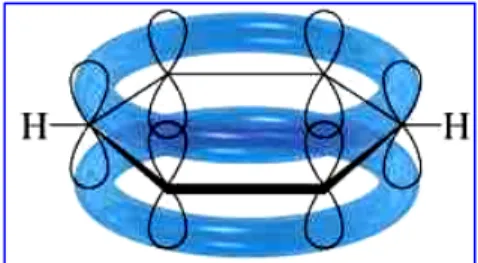
All carbon-carbon bond angles are 1200, all six carbons are sp2 hybridized, and each carbon has a p orbital perpendicular to the plane of the six-membered ring. Delocalization of pi electrons across the ring should result in a decrease in electronic energy. An anti-aromatic compound is one that meets the first three criteria, but delocalization of the pi electrons across the ring results in an increase in electronic energy.
In contrast to the easy formation of tropylium ion, the preparation of the corresponding anion is difficult because it is antiaromatic. In pyridine, nitrogen is sp2 hybridized, and its lone pair of electrons occupies an sp2 orbital in the plane of the ring and perpendicular to the 2p orbitals of the pi system; so it is not part of the pi system.
One nitrogen atom (the one bonded to hydrogen) uses its third sp2 orbital to bond to hydrogen, and its lone pair is part of the aromatic sextet. The other nitrogen has its lone pair in an sp2 orbital that is not involved in the aromatic system; this lone pair is basic. The true structure of naphthalene is a hybrid of the three resonance forms and the number of pi electrons corresponds to the Huckel no 10.
Naphthalene and other polycyclic aromatic hydrocarbons show many of the chemical properties associated with aromaticity. Naphthalene has a cyclic, conjugated pi system, with overlapping p-orbital bonds around the ten-carbon periphery of the molecule and along the central bond. Electrophilic Aromatic Substitution Reactions: Like an alkene, benzene has clouds of pi electrons above and below its sigma bond structure.
If the sigma complex were attacked by a nucleophile, the resulting addition product would not regain the aromatic stability of the star stitch material. The overall reaction is thus the replacement of an electrophile by a proton on the aromatic ring, i.e.
HNO3/H2SO4
Generation of an electrophile
Attack on an electrophile to the aromatic ring
Removal of proton
Attack of an electrophile
NUCLEUS SUBSTITUTED AMINES OR ARYL AMINES (a). Primary amines
SIDE CHAIN SUBSTITUTED AMINES OR ARYLALKYL AMINES
Structure and Basicity: Factors that increase the ability of nitrogen in an amine to share its electron pair increase the basicity of the amine, and vice versa. a) Simple arylamine: Arylamines are less basic than alkylamines because the nitrogen lone pair of electrons is delocalized by interaction with the aromatic ring pi electron system and is less available for binding to H+. Electron-donating substituent, which increases the reactivity of an aromatic ring after electrophilic substitution, also increases the basicity of the corresponding arylamines. 2.Alkylation: Primary aromatic amines, undergo reaction with alkyl halide to successively give secondary, tertiary amines and quaternary ammonium salts.
The acid chloride is more reactive than a ketone or an aldehyde because the electronegative chlorine atom pulls electron density away from the carbonyl carbon, making it more nucleophilic. Reaction with nitric acid: Primary (not secondary and tertiary) arylamines react with nitric acid at low temperatures and in the presence of a strong mineral acid, to give relatively stable, water-soluble compounds known as diazonium salts. This reaction, known as diazotization, is an extremely important reaction for several organic compounds.
Arenediazoin salts are extremely useful because the diazonio group (N2) can be replaced by a nucleophile in a radical substitution reaction. Replacement of the diazonium group by hydroxide: Aromatic amines can be converted to phenols by first forming the arenediazonium salt in aqueous sulfuric acid and then heating the solution. Replacement of the diazonium group by chloride, bromide and cyanide: Treatment of primary aromatic amine with nitrous acid followed by heating with HCl/CuCl, HBr/CuBr or KCN/CuCN results in replacement of the diazonium group by –Cl, -Br or –CN, respectively , and is known as the Sandmeyer reaction.
Replacement of the diazonium group with fluoride and iodide: When the primary aromatic amine is treated with sodium nitrite in aqueous HCl followed by the addition of HBF4 or NaBF4, the diazonium tetraborate salt is precipitated, which is collected and dried. Replacement of the diazonium group by hydrogen: Treatment of arenediazonium salts with hypophosphoric acid results in the reduction of the diazonium group and its replacement by hydrogen. Electrophilic Aromatic Substitution: The amino group is an ortho, para-directing and powerful activating substituent, so that arylamines undergo typical electrophilic substitution reactions very quickly.
If only monohalogenation is desired, the free amino group is acetylated prior to halogenation. Treatment of an amine with acid anhydride yields an N-acetylated product that is less strongly activating and less basic than amino groups because their lone nitrogen pair electrons are delocalized by the neighboring carbonyl group. As a result, the bromination of an N-arylamide occurs purely, yielding monobromine product, and hydrolysis with an aqueous base then yields the free amine.
COO -
As a result, bromination of an N-aryl amide occurs cleanly to give mono bromo product, and hydrolysis with aqueous base then gives the free amine. ii) Nitration: - The amino group is protected by acetylation before nitration so that the reaction proceeds according to the known principles of orientation and reactivity. It occurs widely throughout nature and also serves as intermediates in the industrial synthesis of products as diverse as adhesives and antiseptics. From Sulfonic Acid: In the laboratory, simple phenols can be prepared from aromatic sulfonic acids by melting with NaOH at high temperature.
Hydrolysis of aryl halide: This method is very useful for the hydrolysis of aryl halide containing electron withdrawing substituents such as NO2 group in ortho and para position. General Physical Properties: Pure phenols are generally colorless solids or liquids, but they turn reddish due to atmospheric oxidation. Due to resonance, the oxygen atom of –OH gets a positive charge and thus a proton is easily released.
It can be seen that more energy is required to separate the positive and negative charges in phenol; hence phenol has higher energy than phenoxide ion. Phenols with an electron-withdrawing substituent are generally more acidic because their substituents stabilize the phenoxide ion by delocalizing the negative charge. The acidifying effect of an electron-withdrawing substituent is particularly noticeable for phenols with a nitro group in the ortho or para position.
Electrophilic aromatic substitution: The hydroxy group is a highly activating ortho- and para-directing substituent in the electrophilic aromatic substitution reaction. The relatively low yields of products are due to losses by oxidation of reactive phenols. Use of concentrated HNO3 leads to the formation of picric acid. iii) Sulfonation: Low temperature favors ortho-isomer while high temperature favors para-isomers.
Reimer-Tiemann reaction: When phenol is treated with chloroform and sodium hydroxide solution, an aldehyde group is introduced into the aromatic ring. Kolbe reaction: When sodium phenoxide is treated with carbon dioxide gas under pressure, a carbonyl group is introduced, preferably in the ortho position to the –OH group. Reaction with formaldehyde: When phenol is treated with formaldehyde in the presence of acids or alkalis, a phenolic resin (Bakelite.
HCHO H
Fast
- KOH 2. H 3 O +
Due to the acidic nature of the methylene hydrogens, the malonic ester forms the sodium salt of the malonic ester when treated with a strong base such as sodium ethoxide. Synthesis of α,β-unsaturated acid: -When a malonic ester is treated with an aldehyde or ketone in the presence of a base such as pyridine or diethylamine, α,β-unsaturated esters are formed. Mechanism:- The most widely accepted mechanism for the Claisen condensation involves the formation of a carbanion which attacks the electropositive carbonyl carbon to form ethyl acetoacetate.
Keto-Enol Tautomerisim in ethyl acetoacetate: A carbonyl compound with a hydrogen atom on its α-carbon quickly equilibrates with its corresponding enol (en + ol). Acidic Nature: The methylene group of ethyl acetoacetate is flanked on either side by electron-withdrawing carbonyl groups. Ketonic hydrolysis: When ethyl acetoacetate is treated with dilute aqueous alkali followed by acidification, it splits into acetone, and the reaction is known as ketonic hydrolysis.
Acidic hydrolysis: When ethyl acetoacetate is heated with concentrated alcoholic alkali solution, it gives two molecules of acetic acid. Reduction: the keto form of ethyl acetoacetate is reduced with sodium amalgam to form β-hydroxy compounds. Ethyl acetoacetate Ethyl-β-hydroxybutyrate Similarly it reacts with sodium hydrogensulphate to give bisulphate compounds.
Monoalkyl ethyl acetoacetate still contains an acidic hydrogen and can therefore re-form the sodium salt when treated with a base. Then, the alkyl derivatives of ethyl acetoacetate can undergo ketone and acid hydrolysis to form alkyl substituted ketones and alkyl substituted acids. Synthesis of dicarboxylic acids: The sodium salt of ethyl acetoacetate is treated with the corresponding halo ester followed by acid hydrolysis.
Synthesis of 1,3-dicarboxylic acid: Sodium salt of ethyl acetoacetate reacts with acetyl chloride followed by ketonic hydrolysis to give 1,3-diketone. Synthesis of 1,4-diketone: When sodium salt of ethyl acetoacetate is treated with iodine, followed by ketonic hydrolysis, 1,4-diketone is formed. Synthesis of α,β-unsaturated acid: Ethyl acetoacetate condenses with aldehyde or ketone in the presence of a base such as pyridine to form a product which on acid hydrolysis gives α,β- unsaturated acids.
Synthesis of Alicyclic Compounds: Sodium salts of ethyl acetoacetate react with dihalogen compounds to form alicyclic compounds. Synthesis of Heterocyclic Compounds: Ethyl acetoacetate condenses with compounds such as urea, hydroxylamine, hydrazine, phenylhydrazine etc. to form heterocyclic compounds.
COOK
Non-classical ions in organic chemistry are a special type of carbonium ions that show delocalization of sigma bonds in 3-center-2-electron bonds of bridged systems. The compounds exo-norbornylbrosylate and its endoisomer undergo solvolysis or acylation with the potassium salt of acetic acid in acetic acid.
