Indian Anthropology
Racial, Ethnic, Religious and Linguistic Elements in Indian Population M. K. Bhasin
B-2 (GF), South City II, Gurgaon 122 002, Haryana, India CONTENTS
Racial groups
Caucasoid (Europoid) Negroid
Australoid Mongoloid Negrito Element
Proto-Australoid Element Mongoloid Element Other Racial Elements Classifications on Peoples of India Ethnic groups
Castes Religious groups Linguistic groups
The populations of India and other South Asian countries offer great opportunities to study socio-cultural and genetic variability. Perhaps, nowhere in the world people in a small geographic area are distributed as such a large number of ethnic, castes, religious and linguistic groups as in India and other South Asian countries. All these groups are not entirely independent; people belong concurrently to two or more of these groups. People of different groups living side by side for hundreds or even thousands of year try to retain their separate entities by practicing endogamy.
India is a multicultural country. Anthropologists are committed to grasping the dynamics of communities and populations. As anthropology combines the premises of a biological as well as well as socio-cultural study, it looks at the diverse sections of human beings with dual perspective, one derived from its branch called biological anthropology, and the other from social/cultural anthropology. How communities and populations continue to retain their identity, in social and cultural terms on one hand and biological on the other, and how they acquire the characteristics of the others because of cultural borrowing or interbreeding are the questions anthropologists systematically investigate.
India with about 1000 million people has the second largest population in the world and it is one of the world’s top twelve mega diversity countries and has vast diversity of human
beings, fauna, flora and environmental regimes. Its present population includes stone-age food-gatherers, hunters, fisher-folk, shifting cultivators, peasant communities, subsistence agriculturists, nomadic herders, entertainers, as well as those engaged in mechanized and chemicalised agriculture, mechanized fishing, tapping offshore oil and natural gas, running atomic power plants and producing computer software. India has been peopled by human groups carrying a diversity of genes and cultural traits. We have almost all the primary ethnic strains Proto-Australoid (skin colour-dark brown), Mediterranean (skin colour-light brown), Mongoloid (skin colour-yellow), Negrito (skin colour-black) and a number of composite strains. It is homeland of over 4000 Mendelian populations, of which 3700 endogamous groups are structured in the Hindu caste system as ‘jatis’.
Outside the preview of caste system there are a thousand odd Mendelian populations which are tribal autochthones and religious communities (Bhasin et al., 1994; Bhasin and Walter, 2001).
Like any other plural society, India offers a cauldron where the processes of unification as well as of fragmentalisation are unceasingly taking place. This presents a situation of cultural, biological and environmental richness and diversity, and one where the constant interactions between communities are aiding the formation of bridges, thus creating a sense of unity. It is in these terms that India offers an ideal case for examining unity in diversity both biological and socio-cultural perspectives.
In the present chapter an attempt has been made to give an outline of racial, ethnic, religious and linguistic groups of India.
Racial groups
Anthropologists distinguish groups of people on the basis of common origin, living, or having lived, in certain defined regions and possessing differing characteristic features in their appearance. But one should remember that there are no strict lines of demarcation between races. All these groups blend imperceptibly into one another with intermediate types possessing various combinations of physical characteristics. Modern man is biologically uniform in basic features (for example upright posture, well-developed hand and feet, prominent chin, absence of bony eye brow, an intricately structured brain encased in a big skull with a straight high forehead and 46 number of chromosomes) and polymorphous as regards many secondary features. Scientists consider all human beings as belonging to a single species, Homo sapiens. The variations found in groups living in different geographical areas reflect only a differentiation within the single species due to host of biological, social and other factors. In anthropology there are two schools of thought on the origins of man and the major races—the polycentric and the monocentric schools. The polycentric theory (Franz Weidenreich, U.S.A.) claims that modern man evolved in several regions relatively independent of one another and that peoples developed at different rates. This theory claims that modern man evolved from the
“oldest” and “old” people in each region and that this gave rise to the formation of the major races-
Caucasoid (Europoid)
Morphological Features: (Skin Colour-White; Head Hair Colour - Lighter Shades; Hair Texture - Medium to Fine; Head Form - Broad (Brachycephalic) to Long (Dolichocephalic); Nose Form- Medium to Long; Face-Jaw is not projecting forward, Pragnathism is usually absent; Forehead - High; Lip: Thin to Medium; Eye Colour- Lighter Shades; Height- Medium to Tall
Inhabitants of Europe, America (White) Australia (White), New Zealand (White), South Africa (White)
Negroid
Morphological Features: Skin Colour - Dark Brown to Black; Head Hair Colour-Black;
Head Hair Form - Woolly or Frizzly; Head Form- Predominantly (Dolichocephalic) with protruding Occiput and rounded Head; Nose Form- Broad and Flat, Bridge and Root of the Nose are usually Low and Broad; Face Form - Prognathism is often marked; Brow Ridges-Small; Lip Form – Thick and Everted; Eye Colour – Dark Brown to Black, Height-Very Short to Tall.
Inhabitants of Africa, Blacks of America Australoid
Morphological Features: Skin Colour - Medium to Dark Chocolate Brown; Head Hair Colour - Medium Brown to Black, Head Hair Form - Curly sometimes Wavy; Head Form - Usually narrow Long (Dolichocephalic); Vault to Gable shaped; Nose Form- very Broad, Nasal Root is markedly depressed and Tip is very Thick; Face Form- Short showing medium to pronounced Prognathism and Chin is usually receding; Lip-Full;
Eye Colour - Medium to Dark Brown; Brow ridges - Extremely Large; Height-Short to Medium.
Inhabitants of India (South and Central), Australia, Sri Lanka, Malay Peninsula Mongoloid
Morphological Features: (Skin Colour - Yellow or Yellow-Brown); Head Hair Colour - Brown to Brown Black, Hair Form-Straight and Coarse; Head Form - Predominantly Broad (Brachycephalic) Nose Form – Medium to Broad, usually Bridge is low to medium; Face Form – Medium Broad to very Broad; Cheekbones are high and flat; Lips- Thin; Eye - Brown to Dark Brown in Colour, Oblique Eye with narrow slit-like opening and internal Epicanthic Fold or Total Mongoloid Fold; Height - Short to Medium.
Inhabitants of China Mongolia, Tibet, North America, Siberia, Greenland, Burma, Thailand, Malay Peninsula, Philippines, Japan, North-East India.
On the other hand monocentrists (for example Henri-Victor Vallois and G. Olivier in France, Francis Howell in the U.S.A., Kenneth Oakley in Britain, Vsevolod P. Yakimov, U.S.S.R.) consider modern man to have evolved in a single region. The ancient Homo sapiens who evolved there did not possess clearly distinguished traits of any of the modern races. It was only when human groups spread geographically and settled in definite territories that racial types evolved. That is why the races of modern mankind resemble one another so closely. This resemblance is a sign of their common origin, of their emergence in a single region. Darwin more than 100 years ago, ventured to predict that one day it would be found that man had originated in Africa (Bhasin et al., 1994;
Bhasin and Walter, 2001).
Mourant (1983) in his book “Blood Relations” stated that it is almost certain that man evolved from his pre-human ancestors and emerged as a unique tool-making animal somewhere in tropical Africa and that we are therefore, in a sense, all of African origin.
Using five polymorphic restriction sites on beta gene cluster, Long et al. (1990) worked out, the evolutionary histories and relationships among Africans, Eskimos and Pacific Island populations and reported an African origin for modern Homo sapiens and a phyletic structuring in the major geographical regions. It is probably rather over a million years ago that man entered Asia from Africa; bones of the early human species, Homo erectus have been found in China as well as in Java, which could have reached only through Asia. Moreover, to reach Europe, which he probably very soon did, he must have passed through south-west Asia. It probably was in Asia that Eurasian man, by now of the modern Homo sapiens species, diverged from African man, and then became differentiated into Caucasoid and Mongoloid types. Another differentiation, which probably took place in Asia, is that of the Australoids, perhaps from a common type before the separation of the Mongoloids. The Caucasiods and the Mongoloids almost certainly became differentiated from one another somewhere in Asia and Caucasoids subsequently spread to the whole western part of the continent and thence to Europe and North Africa (Mourant, 1983). The divergence lines among the three major races—
Negroid, Caucasoid and Mongoloid—estimated by Nei and Roychoudhury (1982) by using a number of genetic markers, reported the divergence between the Negroid and the Caucasoid-Mongoloid groups seem to have occurred about 110,000 ± 34,000 years ago.
On the other hand the divergence between the Caucasoid group and the Mongoloid group seems to have occurred about 41,000 ± 5,000 years ago. This corresponds to the time when classic Neanderthals were living. These estimates of divergence lines are much earlier than Cavalli-Sforza and Bodmer’s (1971) (20,000-50,000 years ago), but they are not unreasonable in view of the fossil records available (Birdsell, 1972).
The Mongoloids are the most numerous of the three major races of mankind and China in the centre of the Mongoloid area has the largest population of these than any country in the world, so the Chinese must be taken as the typical Mongoloids. The ancestors of Japanese passed through Korea to reach Japanese Islands, where they found ancestors of the present Ainu. Through an area to the south of China, extending from the Vietnamese border to the tip of Malaya peninsula, through this there must have passed Homo erectus very long ago on his way to Java [“Sundashelf, a dry land as the route from Asian
of the paleoanthropology of Pleistocene island Southeast Asia see it as the route to Java from the Asian mainland for all migrating land mammals” (p. 186) cited from Tumer II (1990)] than perhaps (some forty thousand years ago) the ancestors of the Australian aborigines. After that came the Indonesians, and finally the Mongoloids in narrower sense, represented by the Mons and the Khmers, the Tibeto-Burmans and the Thais, all of whom probably entered the region before 1000 B.C. (Mourant, 1983).
The populations of Siberia are important in supplying evidence regarding the original peopling of the American continent. This took place perhaps about thirty thousand years ago; it was through the Bering Strait which was then dry land owing to the recession of sea level accompanied by last glaciations. Perhaps about thirty thousand years ago, populations of Mongoloid physical type moved into north eastern Siberia and thence into America (Mourant, 1983).
The differences between Mongoloids and Caucasoids appear rather sharp as one crosses the mountains in the northern boundary of the Indian sub-continent. The passage from India to Burma is somewhat more gradual, probably because contact here has been present for a long time and some mixing has taken places, whereas the Mongoloids north of the mountains were probably fully differentiated in the Far East before the retreat of the ice allowed them to enter Tibet (Mourant, 1983).
In Asia, Australoid if people now live in South of India, the deep ocean between India and Australia means that the direct ancestors of the Australians could not have set out from there. We must picture both India and south-east Asia as being at one time inhabited largely by Australoids who were driven by technologically more advanced people from the north, in the one instance into southern India and Sri Lanka and in other, across Burma and Malaysia and so ultimately through Indonesia and New Guinea to Australia (Mourant, 1983).
A number of racial classifications of human populations have been reported in the literature, but there seems to be no agreement about these classifications among anthropologists. However the human populations are broadly divided into three major races: Caucasoid, Negroid and Mongoloid. Many anthropologists have considered two more major groups i.e., Amerind [Morphological Features: Skin Colour - Yellow Brown to Red Brown; Head Hair - Black rarely Dark Brown hair colour, which is Coarse, Straight and sometimes slightly Wavy in form; Head Form - Long-Medium and Round Shape; Face - Broad with typical Mongoloid Cheekbones; Chin - More prominent than in typical Mongoloid, Lip - Thinner; Brow-Ridges and Glabellar portions are strongly developed, Eye - Dark Brown to Black Colour, Complete Mongoloid Fold is almost absent, Internal Epicanthic Fold is frequently present in women and children but rare in males, External Epicanthic Fold is common; Nose – Prominently Medium, it is very Long, Bridge is usually high and convex, Tip is of medium thickness. Height - Variable.
Inhabitants of America] and Australoid or Oceanian (Boyd, 1963). These schemes of classification of human populations were largely based on morphological and anthropometric characters. In the last few decades, however, new methods with elaborate
statistics and biometry along with the latest concepts on human genetics have added fresh dimension to the study of human population groups.
To the Indian subcontinent came several waves of immigrants at different periods of history and entered into the ethnic composition of the population at different levels from a very early phase of human civilization. The intrusions of these people with several racial elements have left the strains of various developed races together with their ethnic and cultural substrata in the land, thus representing the elements of all the main divisions of mankind.
In India the range of somatic variations in different physical traits of its people is remarkably wide. To account for the heterogeneity and to highlight the underlying pattern of the observed variations, earlier European anthropologists, like Charles de Ujfalvy (1881-82) and Captain Drake-Brockman, Sir T.H. Holland (1902) and Waddell (1899) measured groups from various parts of India and attempted various taxonomic classification of the Indian peoples. During the early part of the last century the schemes of classification of Indian people were largely based on morphological and anthropometric characters. The list of various classifications that have been given on the people of India by different authors is as follows:
1. Risley’s Classification (1915)
2. Giuffrida-Ruggari’s Classification (1921) 3. Haddon’s Classification (1924)
4. v. Eickstedt’s Classification (1934, 1952) 5. Guha’s Classification (1935, 1937) 6. Roy’s Classification (1934-38) 7. Sarkar’s Classification (1958, 1961) 8. Biasutti’s Classification (1959)
9. Roginskij and Levin’s Classification (1963) 10. Büchi’s Classification (1968)
11. Bowles’s Classification (1977)
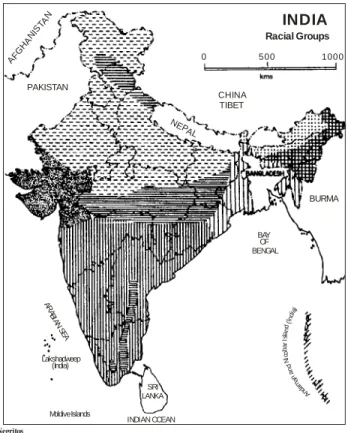
So many classifications on the people of India have been reported and almost all seem to make some sense. An attempt has been made to evaluate the distribution of various racial strains/elements present in the peoples of India and this is represented in figure 1 (This
figure has been drawn while taking into consideration the classifications reported by Guha and others).
INDIA
PAKISTAN AFGHANISTA
N
CHINA TIBET NEPAL
BURMA
da An anm andNicobar Island(India) Lakshadweep
(India)
SRI LANKA ARAB
IAN SEA
INDIAN OCEAN Moldive Islands
Racial Groups
BAYOF BENGAL
0 500 1000
Negritos
Proto-Austroloids & Negritos
Paleo-Mediterrneons, Proto-Austroloids & Alpo-Dinarics Alpo-Dinarics, Orientos and Mediterraneons Paleo-Mediterraneons, Mediterraneons and Alpo-Dinaric Mediterraneons, Orientos & Proto-Nordics Orientos and Tibeto-Mongoloids Tibeto-Mongoloids and Paleo-Mongoloids Paleo-Mongoloids
Fig. 1. Distribution of various racial strains present in the peoples of India
Negrito Element
It is generally admitted that the Negrito represents the oldest surviving type of man and it is possible even that they preceded Neanderthal man by whom, according to Grifth- Taylor, they were displaced and disposed. In any case Negrito seems to have been first inhabitants of South East Asia. The traces of the stock are still to be seen in some of the forest tribes of the higher hills of the extreme south of India and similar traces appear in the inaccessible areas of Assam and Bengal, Burma, where dwarf stature is combined with frizzly hair which appears to have resulted from recent admixture of pure Negrito stock of the Andamans with blood from the main land of India or Burma.
If Negrito was the earliest inhabitants of Southern Asia, they must have been displaced or supplanted by the Proto-Australoid. This dolichocephalic type appears to have its own origin in the west. The view that the Australian is connected with the Neanderthal man, though repeatedly rejected by authorities, seems to die hard since Hrdlicka apparently regards the Neanderthal as having contributed to existing human types, while Sewell appears to revert to the theory of Australian origin and in his account of Mohenjodaro skulls he definitely associates Indian Proto-Australoid type with Australian aborigines on the one hand and with Rhodesian skull on the other.
So many views on the Negrito problem in Indian ethnology have been reported in the literature. Guha (1928, 1929) observed the presence of Negrito racial strain from the solitary character of hair form (frizzly type) which he found among the Kadars who live in the interior of the chain of hills running from the Anamalais to Travancore. Guha (1961) wrote to Sharma (personal communication) that frizzly type of hair occurs not only among Kadars but among Irulas and the Pulayans also. Guha (1961) disagree with the hypothesis that there had been admixture of African slaves with the Malabar people;
giving the reason that if it has occurred in that case it should have been in the coastal areas, where Zamorins of Calicut imported African slaves but not in the interior of the hills 100 miles away. He further added that there is no sign of any African culture among the Kadars. However v. Eickstedt (1939) stated that genuine Negro frizzly hair never has been found in South India. The problem probably arose because the distinguishing words, spiral, woolly or frizzly, have been applied in a vague manner. Sarkar stated that the sporadic cases of frizzly hair may not be Negritoid at all. They may be independent mutations. Whether they are genetically related to Negro or Melanesian frizzly hair group, further genetic researches can disclose.
Banerjee (1959) reported the presence of intermediate or mixed types of hair among the Kadar and accounted its origin as due to admixture with Negroid elements.
Rakshit (1965) suggested that the alleged Negrito Dravidian tribes of south India viz., the Kadar, Irula, and Pulayan etc. are in all probability, the foetalized derivatives of Australian basic type.
From the genetic structure of Kadar of Kerala, Saha et al. (1974) evaluated their findings with the other (Sarkar et al., 1959) and observed that there is a little to support that a proportion of Kadar show Negritoid traits. However they added that there is slender evidence which supports the possibility of past African Negro admixture on a small scale.
The postulated genetic reconstruction of ancestral Kadar population by them suggested that they may have been similar to Melanesian and Australian aboriginal populations, but their original genetic structure has been modified through incorporating genetic elements not only from Black Africans but from surrounding Dravidian populations.
Sarkar (1954) has discussed the Negritos of the Andaman in the light of the process of pygmy formation. Steatopygia, infantilism and dwarfism are probably the effect of endocrine derangements and the reproductive physiology of the Andamanese appears to
before they came in contact with civilization. The Andamanese were probably peopled in the quaternary times during a glacial period when the fall of sea-level brought lower Burma in direct contact with the Islands.
Negrito populations occupy parts of the Philippines, Northern Malay Peninsula, Andaman Islands and New Guinea has a number of morphological characters similar to those of Pygmies and Bushmen of Africa. Because of this similarity, some anthropologists have hypothesized a common origin of the Negrito populations.
However, Nei and Roychoudhury (1982) analysed the genetic relationship and reported that despite some morphological similarity between the Negritos of Southeast Asia and the Pygmies and Bushman of Africa the genetic distance analysis shows them to be genetically different. This result supports Coon’s (1965) thesis that the Pygmies and Asian Negritos developed their phenotypic similarity by adapting to similar environmental conditions independently rather than by common descent.
Proto-Australoid Element
The earliest stratum of Indian populations was a long-headed, dark skinned, broad nosed people. Their physical features are closely akin to modern aborigines of Chota Nagpur, Central India and the primitive tribes of South India. They are original inhabitants, the so called ‘Adi-basis’ of India. In the hymns of Rigveda the oldest sacred texts of the Hindus, they are mainly addressed as ‘Dasa’ (Barbarians) or ‘Dasyu’ (ugly, sub-human) described as ‘Anas’ (‘a-nas’ = noseless or ‘an-as’ = without a mouth), Krishnagarba (Dark skinned), ‘Mridhravak’ (Hostile speech) not worshiping Vedic gods with whom Aryan speaking tribes fought during their advent into India from Transcapia.
They have been classified by various authors and so far there has been no agreement on this. Lapicque (1920) was probably responsible for the term Pre-Dravidian. Ruggeri (Chakladar, 1921) named it‘Australoid-Veddaic’, while Chanda (1916) favoured the term
‘Nishada’. v. Eickstedt used the term Weddid for those having closer affinity with the Veddas of Ceylon. Sewell and Guha (1929) in trying to find out the physical affinities of the Nal race have described Tamils and the Veddas as descendants of the original Proto- Australoid and Proto-Negroid blend. They have also found the Proto-Australoid type occurring among the Mohenjodaro skeletal remains. Hutton (1933) used the term Proto- Australoid exclusively in his census reports. He even put Veddas under Proto-Australoid.
The term Proto-Australoid owes its origin to Dixon (1923). Hooton (1930) introduced changes in Dixon’s terminology and replaced term Proto-Australoid as Pseudo- Australoid while he similarly renamed Proto-Negroid as Pseudo-Negroid.
The Papuas of New Guinea and the Australian aborigines of Oceania are often called Australoids. Guha (1937) used the term ‘Proto-Australoid’ to designate the indigenous people of India presumed to have racial affinities with Australian Aboriginals. It was observed in the morphological traits that there seems to be a regular gradation, the shortest and smallest being the Indian tribes, then come Veddas of Ceylon (Sri Lanka) and lastly the Australians. The Indian tribes retaining the more basic characters and the two extra Indian groups having developed some of the features in a more marked manner.
The most appropriate term to apply to them therefore is Proto-Australoid which shows best the genetic relationships between the three. Sarkar (1954) pointed that so long the Australoid is regarded as one of the basic stems of mankind and its prototype is unknown, the use of the term Proto-Australoid seems to be unjustified.
Sanghvi (1976) compared allelic variability observed among tribal populations in India and Australia to study the postulated ancestral relations between Indian and Australian Aboriginal people. He concluded that the search for appropriate weights for individual alleles to be considered in genetic distance analysis of problems for racial origins has not so far been rewarding.
Simmons (1976) reported on the basis of the blood group genetic data, presently available, that the Veddoids, and other aboriginal peoples of South India relate most closely to the Indian populations, and neither they nor the Veddhas relate in any obvious blood groups genetic make-up to the distant Ainu, or to the even more distant Australian Aboriginals.
Kirk (1976) reported his investigations 15 years ago as he was searching for specific markers which might link Australian Aboriginals with the Veddahs of Ceylon and the
“Veddoid” populations of South India and stated that so far no specific markers common to any of these sets of populations have been found. By contrast, the Veddahs of Ceylon do have some genetic markers in common with groups of Southeast Asia, particularly TF CHI (Serum Transferrin CHI) and the abnormal haemoglobin HB*E (Haemoglobin E).
The ‘Veddoids’ of South India, however, have neither of these markers that possess the abnormal haemoglobin HB*S (Haemoglobin S) and having no transferrin variants in the populations which he studied. It is only in the north east of India that transferrin allele TF*CHIi is found while HB*E is not uncommon among tribal populations such as Oraons, Konda Reddis and Koya Dora.
Roychoudhury (1984) studied genetic relations between Indian Tribes (Toda, Irula, Kurumba of South India); Veddah of Sri Lanka with the Aboriginals of Malay, New Guinea and Australia by genetic distance analysis and found the tribes of South India and Sri Lanka genetically closer to each other than to the Aboriginals of Southeast Asia and Oceania. He concluded that despite their morphological similarity there is no genetic evidence to suggest that the Indian tribes and Australian Aboriginals are biologically related.
Pietrusewsky (1990) reported from the craniofacial variation that Australians represent a biologically distinct population, sharing ancestral ties with Melanesians but not with the recent populations of Asia and the rest of the Pacific. The latter represent a second major population complex.
Mongoloid Element
The Mongoloids are mainly present in the northern and north eastern zones of the
Hutton is of the view, that it may be said to fringe upon the area to Indo-European languages. There is very considerable overlap in the places. In all the overlapping areas the Indo-European languages are definitely intrusive and the Mongoloid element in the population is strong enough to retain its own languages. It is possible that the extension of Mongoloid physical elements has gone a good deal further than the present range of their language would suggest. One of the Mohenjodaro skulls has been identified as definitely Mongoloid and from the lowest stratum of the excavation have been recovered terracotta figurines with unmistakable Mongoloid features having the typical sloping narrow eyes of caricatures of that type.
On the other hand, Eastern Bengal is strongly suggestive of mixed Mongoloid and Proto- Australoid strain. Buxton suggests that the Pareoean element extends to southern India.
Burma, of course, is almost completely Mongoloid and though the existence of other strains is not doubted, they are no longer easy to isolate. There are Proto-Australoid elements too. In some of the hill tribes and on the Assam side a Melanesian strain is to be expected.
Mongolian features have been observed among the tribes of Central and Eastern India, the tribes occupying such States as Bihar, Orissa, Madhya Pradesh and Andhra Pradesh, in the latter state in areas adjoining Orissa and Madhya Pradesh. The list includes almost important Mundari speaking (Munda Group of Austro-Asiatic Family) tribes like the Munda, Santal, Ho, Juang, Saora, Gadaba etc. and number of Central Indian Dravidian speaking tribes like the Maria, Muria, Kondh, and Oraon etc. The occasional presence of Mongolian features among the central and eastern Indian tribal groups foetalised derivative’s of Australian types as suggested by Rakshit (1965).
Other Racial Elements
Amongst the earliest arrivals into Indian sub-continent were long-headed people of Palaeo-Mediterranean stock, who came in successive waves. They were closely related with the Proto- Mediterranean or Proto-Egyptian Brown Race and were long, narrow- headed people, having medium to tall stature, possessed relatively long, narrow faces, low orbit, and vertical forehead with protruding occiput and mesorrhine nose. Later waves of this race belonged to the more basic stock of the Mediterranean race. Their skeletal remains have been recovered from the Chalcolithic sites of the Indus Valley (Harappa, 1963, Mohenjo-daro, 1931) etc. and further west from the Aeneolithic sites of Iran and Mesopotamia. They now form a dominant element among the populations of North India and the upper classes.
The next wave was allied to the so-called Oriental Race of Eugen Fischer (1923). They were relatively broad-headed, medium in stature, and broad faced, thus closely related to the Brachycephalic Alpine and Armenoid racial type of Europe. Their major concentration was in Asia Minor, Pamirs or the Iranian plateau, from where they are supposed to have infiltrated into India during the third to second millennium B.C.
The early evidence of these elements was found among a few of Chalcolithic crania from Indus Valley sites and later among Iron Age crania from Adittanallur in the Tinnevally District of South India (1963). The origin of the broad-headed strain allied to Alpine and Armenoid lies primarily among the brachycephalic hordes of prehistoric Homo alpinus stock of Central Asia. However, the original source of brachycephaly in Western India appears to have come from Scytho-Iranians who had infiltrated from the ethnic intrusion of the Sakas, Huns, Kushans and Abhiras. Today the stronghold of this type is in Bengal, Rajasthan and Gujarat.
The Dinaric type (medium to light pigmented, hook nosed, acrocephalic, round heads) finds expression among the population of Bengal and Orissa and got mixed with varying degrees of the Mediterranean element. It is also to be seen in Kathiwar, Kannanda and Tamil areas. The latest great racial movement into India was associated with a long- headed, tall, delicate-nosed, fair-skinned people having a long face with well-marked chin, possessing blue eyes more akin to the so-called Nordic Race (pure blond or near blond, long heads) of Europe. During the close of the third or at the beginning of the second millennium B.C. they were supposed to have entered India across the northwestern frontier from the Eurasiatic steppes between southwestern Russia and Siberia. On the basis of linguistic and cultural evidence, they have been described as Indo-European, Indo-Iranian, or Aryan people, who were Proto-Nordics. The area of their civilization was said to be in the Aralo-Caspian Basin.
If the millions of population of India are members of some great branch of humanity, yet strange to say, all or nearly all, who have sought to explain the differentiation of population of India into racial types, have sought the solution of this problem, outside the peninsula. They have never attempted to ascertain how far India has bred her own races.
They have proceeded on the assumption that evolution has taken place long ago, far too away but not in India, the great anthropological paradise (Keith, 1936). No doubt India has been invaded time and again but it is a fact that 85 per cent of the blood in India is native in the soil. It is necessary that our eyes should be more directly focused on the possibility of India being an evolutionary field both now and in former times.
Classifications on Peoples of India
The outline of various classifications that have been reported on the composition of the Indian Region population is as follows:
Risley’s Classification (1915)
In India the schematic classification of races was first attempted by Sir H.H. Risley in 1886-88. On the basis of physical characters based on nine anthropometric measurements of 5784 individuals, he envisaged a seven-fold division of the peoples of India:
1. The Turko-Iranian Type
Morphological Features: Skin Colour-Fair Complexion; Head Hair-Medium Brown to Black Colour, Wavy to Curly hair form; Head Form – Broad (Brachycephalic); Eyes Colour - Generally Dark, Grey; Nose Form-Fine to Medium; Stature-Tall.
Represented by the Baluchis, Brahuis, Afghans and North-Western Frontier Province.
2. The Indo-Aryan Type
Morphological Features: Skin Colour-Fair Complexion; Head Hair-Brown to Black Colour and Hair Form-Wavy to Curly; Head Form – Long (Dolichocephalic); Eyes-Dark Colour; Nose Form -Long, Narrow and prominent; Stature-Tall.
Inhabitants of Rajasthan, Punjab, Kashmir predominantly represented by the Rajputs, Khattris and Jats.
3. The Scytho-Dravidian Type
Morphological Features: Skin Colour - Fair Complexion; Head Hair-Dark Brown to Black Colour; Wavy to Curly Hair form; Head Form – Medium (Mesocephalic) to Broad (Brachycephalic); Eyes – Dark in Colour; Nose Form - Medium; Stature - Medium height.
Represented from Western India, including the Maharashtrian Brahmins, Kunbis and Coorgs probably formed by a mixture of Scythian and Dravidian elements.
4. The Aryo-Dravidian Type
Morphological Features: Skin Colour - It is variable, varies form light brown to dark;
Hair - Dark Brown to Black colour, Wavy to Curly form; Head Form-Long (Dolichocephalic) with tendency towards Medium; Eyes - Dark Colour; Nose Form - Medium to Broad; Stature - Short to Medium height.
Represented by the peoples of Uttar Pradesh and some parts of Rajputana, Behar and Sri Lanka (Ceylon) as well as higher caste and lower caste people. This type is a result of admixture between Aryan males and Dravidian females.
5. The Mongolo-Dravidian Type
Morphological Features: Skin Colour - Dark; Hair - Black in Colour, Wavy Hair form;
Head Form - Broad (Brachycephalic) to Medium (Mesocephalic) Eyes – Dark in Colour;
Nose Form - Medium to Broad; Stature - Short to Medium height.
This type is represented by the people of lower Bengal and Orissa, particularly the Bengali Brahmins and Kayasthas, Mohammedans, possessing a strain of Indo-Aryan blood and a blend of Dravidian and Mongoloid elements.
6. The Mongoloid Type
Morphological Features: Skin Colour - Dark with Yellowish tinge; Hair - Dark Colour and Straight form; Head Form - Generally Broad (Brachycephalic); Eyes-Oblique eye showing Epicanthic Fold; Face - Broad Mongolian face; Nose Form- Fine to Broad;
Stature-Short to Below Medium height.
Inhabitants of the people of Himalayas, Nepal, Assam and Burma represented by the Kannets of Lahul, Kulu, Lepchas, Limbus, Murmis and Gurangs of Nepal and Bodos of Assam and Burmese.
7. The Dravidian Type
Morphological Features: Skin Colour – Very Dark; Hair - Dark in Colour and form is generally Curly; Head Form – Long (Dolichocephalic); Eyes - Dark in Colour; Nose Form - Very Broad and sometimes a Depression is seen at the Root of the Nose; Stature- Short height.
Represented by the people from the valley of the Ganges to Sri Lanka (Ceylon) including the whole of Madras, Hyderabad, Central Province and Chota Nagpur. Paniyans of South India, the Santals of Chota Nagpur are the best examples of this type.
The results of Risley’s study were published in 1891 and 1901 in a volume of Ethnographic Appendices of the Census Report. Later his classifications were criticized, particularly his techniques of measurements, his statements of brachycephaly in Western India as due to Scytho-Iranian and Scythian invasion and his hypothesis of the Mongolo- Dravidian origin of the Bengalis.
Guha’s Classification (1935)
Later, the reliability and standardization of measurements were emphasized by the authorities. In 1931 the task was then under taken by Dr. B.S. Guha of the Zoological Survey of India. His work was published in the Census of India (1931, Pt. III) based on an analysis of 29 characters and 63 crude coefficients of racial likeness of different measurements of 2511 persons belonging to 34 groups. His survey was claimed to have the great advantage of standardization of the anthropometric techniques of the International Agreements of 1906 and 1912. This was regarded as a very important landmark in the racial history of Indian Anthropology. His extensive applications of Karl Pearson’s coefficient of racial like-ness proved very useful for biological relationships among the different populations of India.
According to Guha (1931), the classification of racial groups determined 6 main races with 9 subtypes:
1. The Negritos
Morphological Features: Skin Colour – Dark Brown to Dark Black; Hair - Woolly in form; Head Form - Small, Round, Medium or Long; Forehead is Bulbous; Supraorbital Ridges - Smooth; Eyes - Dark in Colour, Nose Form - Straight, Flat and Broad; Stature- Very Short height or Pygmy.
Represented by the Kadars, Pulayans (Cochin and Travancore, Irular and Primitive tribes of Wynad. They are considered to be autochthones of India.
2. The Proto-Australoids
Morphological Features: Skin Colour - Dark Brown; Hair - Dark in Colour; Wavy and Curly Hair form; Head - Long (Dolichocephalic); Forehead - Less Developed and Slightly retreating; Supraorbital Ridges - Prominent; Eyes - Dark in Colour; Nose – Broad, Depressed at the Root; Stature - Short, Limbs are delicate.
This type is represented by Urali (Travancore), Baiga (Rewa), the tribal groups - Chenchu, Kannikar, Kondh, Bhil, Santal, Oron belong to this group. Their morphological features wavy hair is different form the Negritos who are having frizzly or woolly hair.
3. The Mongoloids
This group is characterised by straight hair, obliquely set eyes showing Epicanthic fold;
scanty hair on body and face, flat face with prominent cheek bones.
They are represented by two groups - (i) Palaeo - Mongoloids who are categorized into (a) Long - headed and (b) Broad - headed and (ii) Tibeto - Mongoloids:
(i) Palaeo – Mongoloids (a) Long - headed:
Morphological Features: Skin Colour - Dark to Light Brown; Hair - Dark Colour Straight form; Head Form – Long (Dolichocephalic), Face - Short and Flat; Surpraorbital Regions - Faintly developed, Cheekbones - Prominent; Nose Form - Medium; Stature – Medium height.
The peoples of sub - Himalayan Region represented by the tribal groups of Assam (Sema Nagas); Nepal (Limbus)
(b) Broad - headed
Morphological Features: Skin Colour - Dark; Hair - Dark Colour, Straight form; Head Form – Broad (Brachcephalic); Eyes - Obliquely set eyes which show marked Epicanthic fold; Nose - Medium; Stature – Medium height.
They are represented by Lepchas of Kalimpong; Hill Tribes - Chakmas, Maghs of Chittagong.
(ii) Tibeto - Mongoloids:
Morphological Features: Skin Colour - Light Brown; Hair - Dark and Straight form;
Head Form – Broad (Brachycephalic) and Massive; Face - Long and Flat; Eyes - Oblique having marked Epicanthic fold; Nose - Long to Medium; Stature – Tall Height.
The Tibetans of Bhutan and Sikkim are representing this type.
4. The Mediterranean: They have been categorized in three different racial types:
(i) Palaeo - Mediterranean: They are considered like more ancient people.
Morphological Features: Skin Colour - Dark; Hair - Dark Colour, Wavy to Curly hair form; Head Form - Long (Dolichocephalic) and narrow with bulbous Forehead;
Projecting Occiput and high vault; Face – Narrow; Chin – Pointed; Eyes - Dark in Colour; Nose Form - Small and Broad; Stature – Medium height.
The Tamil Brahmans of Madura, Nairs of Cochin, and Telegus Brahmans are representing this type. The Dravidian speaking people of South India show the preponderance of this type.
(ii) Mediterranean
Morphological Features: Skin Colour - Light; Hair - Dark Colour; Head Form - Long (Dolichocephalic), Head with Arched Forehead; Face - Long; Chin - Well Developed;
Eyes - Dark Brownish to Dark Colour; Nose Form - Narrow and Prominent; Stature - Medium to Tall and slender body built.
The Numbudiri Brahmans of Cochin, Brahmins of Allahabad, Bengali Brahmans, and Marathas are representing this type. The people of this group are inhabitants of Uttar Pradesh, Bombay, Bengal, and Malabar.
(iii) The so - called Oriental sub - type of the Mediterranean
Morphological Features: The Oriental type has been described by Fischer and the people represent all most all the characteristics of the Mediterranean type except the nose
Punjabi Chettris and the Pathans is representative of the group. The people of Punjab, Sind, and Rajputhana etc. are representative of this group.
5. The western broad headed people of Brachycephals consisting of three types:
(i) The Alpinoids
Morphological Features: Skin Colour - Light; Hair - Dark Brownish to Dark Colour and Form - Wavy; Head Form - Broad (Brachycephalic) with rounded occiput; Face - Round; Eye – Dark Brown in Colour; Nose - Prominent; Stature - Medium and body is thickly set.
The representatives of this group are Bania of Gujarat, Kathi of Kathiawar, and the Kayasthas of Bengal among others.
(ii) The Dinarics
Morphological Features: Skin Colour - Darker; Hair - Dark in Colour; Head Form - Broad (Brachycephalic) with rounded occiput and high vault; Face - Long; Eyes - Dark in Colour; Forehead - Receding; Nose Form - Very long and often convex, Stature – Tall height.
This type is represented among Brahmans of Bengal; Kanarese Brahmans of Mysore and the inhabitants of Bengal, Orissa, and Coorg. The Alpino - Dinaric people are considered to enter India through Baluchistan, Sind, Gujarat, and Maharashtra into Kannade and than Sri Lanka (Ceylon). This type has been observed in the Indus Valley site, Tinnevally, Hyderabad.
(iii) The Armenoids
Morphological Features: The Armenoids are having most of the morphological features similar to Dinaric. They are having more prominent, narrow and aquiline nose and occiput is more marked.
The best representative of this group is the Parsis of Bombay.
6. The Nordics
Morphological Features: Skin Colour - Fair Complexion; Hair - Brown to Dark in Colour Wavy hair form; Head Form – Long (Dolichocephalic), protruding Occiput and arched Forehead; Jaw - Strong; Eyes - Mostly Bluish Tinge; Nose - Fine, Narrow; Face - Long and Straight; Stature - Tall with powerfully built body.
Inhabitants of Northern India, mainly the people of Punjab, Rajputana are representative of this group. Kaffirs, Kathash belong to this group.
Guha considered that the Negritos are the earliest racial element in India and believed that the Kadars, Irulas and the Pulayans of South India have a Negrito strain.
v. Eickstedt’s Classification (1934, 1952)
The next large - scale attempt at racial classification was made by Egon von Eickstedt who classified the people of India into 3 main races and 18 subraces:
1. Weddide (Ancient Indians) (a) Gondide (Proto - Australoid)
Morphological Features: Skin Colour - Dark brown.
The representative of are tribal groups - Juangs, Bhils, Oraons, Gonds etc. form Central India.
(b) Malide
Morphological Features: Skin Colour - Dark Brown; Hair – Curly form; Stature – Short.
This group is represented by Kurumber, Weddah etc. tribal groups from South India.
2. Melanide (Black Indians) (a) Melanide
Morphological Features: Skin Colour - Black, Yanadis group is the representative of this group.
(b) Kolide
Morphological Features: Skin Colour - Black Brown, Hair - Dark Colour and Curly form; Stature - Short;
The peoples of the group are found in North Deccan Forests. The representatives are Munda, Ho, Santal etc.
3. Indide (New Indians) (a) Gracile (Graceful) Indid
Morphological Features: Skin Colour - Brown; They have gracile in appearance.
(b) Coarser - Mediterranean
Morphological Features: Skin Colour - Light Brown.
Representatives are Rajputs of North India.
According to v. Eickstedt the Melanide race is the oldest and descended from the Indo - Negroid or the Eastern branch of the Negro Race. His monumental work, Rassenkunde und Rassengeschichte der Menschheit (1934) and his scheme of classification is based partly on physical traits and partly on geographical localities.
Haddon’s Classification (1924)
Among the other notable works regarding the racial classifications of the peoples of India mention must be made of Haddon (1924) who found 15 major races all over the world and classified Indians into three basic regional types:
I. The Himalayan Region:
The dominating characteristics are Mongoloid morphological features among people of Nepal, Bhutan, Sikkim, Assam etc. In Assam the following racial elements were observed which is classified on the bases of head and nose form.
(i) Dolichocephalic - Platyrrhine type (Pre - Dravidian) (Long Head - Broad Nose) Khasi, Kuki, Manipuri, Kachari etc are representative of the group
(ii) Dolichocephalic - Mesorrhine (Long Head - Broad Nose) This type is observed among Naga tribal and Hill tribes etc.
(iii) Mesocephalic - Platyrrhine (Medium Head - Broad Nose) Reported among Khasis group
(iv) Brachycephalic - Leptorrhine (Round Head – Long Nose) They moved form north and related to the Eurasiatic group.
(v) Mesocephalic - Mesorrhine (Medium Head – Medium Nose) (vi) Brachycephalic - Platyrrhine (Round Head – Broad Nose)
They are a variety of Parecoean (Skin Colour – Olive Brown to Coppery Brown; Hair - Coarse and Lank texture; Head Form - Broad (Brachycephalic); Face - Broad; Nose -
Short and flat, Eyes - Narrow, Oblique; Epicanthic Fold is present; Stature - Short and body is thick set.
(vii) Dolichocephalic - Leptorrhine (Long Head - Long Nose) This form is from India.
II. Hindustan Region or the Northern Plains:
(i) Indo - Afghan
Morphological Features: Skin Colour - Light Brown complexion; Hair – Black in colour and Wavy form; Head – Long (Dolichocephalic); Face - Long; Eyes - Dark; Nose - Finely cut straight or convex, prominent; Stature - Medium to Tall height.
Representative of this groups are Jats, Rajputs etc.
III. Deccan Region or Southern Plateau:
(i) Negrito
Negrito racial characteristics were suspected among some people like Kadars of south India
(ii) Pre - Dravidian
Morphological Features: Skin Colour - Dark Brown to Black; Hair – Dark in colour, Curly form; Head – Long (Dolichocephalic); Eye - Dark in Colour; Nose Form – Broad;
Stature – Short height.
The representatives of these groups are Bhil, Gond, and Oraon Santal etc.
(iii) Dravidian
Morphological Features: Skin Colour - Brownish Black; Hair - Dark in Colour, Curly in form; Head – Long (Dolichocephalic); Eye – Dark in colour; Nose Form - Medium;
Stature – Medium height.
The representatives are Malayams, Telegu, Tamil, Cancrease, speaking people.
(iv) Southern Brachycephals
Morphological Features: Skin Colour - Brown Complexion; Head Form – Medium (Mesocephalic) to Broad (Brachycephalic); Nose Form - Medium.
The representatives of these groups are Panyan in Tamil Nadu, Pavara of Tinnevelly coast.
(v) Western Brachycephals
Morphological Features: Skin Colour - Light Brown Complexion; Head Form- Broad (Brachycephalic); Nose Form - Long; Stature – Tall height.
The representatives are Nagar Brahmans of Gujarat; Prabhu. The people from Gujarat to Coorg along with western coast are representing these groups.
Giuffrida - Ruggeri’s Classification (1921)
Another anthropologist, Giuffrida - Ruggeri (1921), classified Asiatic peoples as Homo europeaus asiaticus into:
1. Dolicho: Indo - Afghan, Indo - Iranian and Irano - Mediterranean 2. Brachy: Armeno - Pamirensis and Georgianus
He classified the people of India as under:
1. Negrito
Negrito element is suspected among some tribal groups of South India for example Kadars.
2. Pre - Dravidian or Australoid - Veddaic It is represented by Santal, Ho, Munda etc. groups.
3. Dravidians
It is represented by Tamil and Telegu speaking people 4. Tall Dolichocephalic Elements
Among Todo group
5. Dolichocephalic Aryans (Homo dolichomorphus) Indo - Europeaus
6. Brachycephalic Leucoderms (Homo brachymorphous)
Sarkar Classification (1958/1961)
Sarkar classified the people of India into six racial types as follow:
1. Australoids
Morphological Features: Skin Colour - Dark Complexion; Hair - Dark colour and Wavy in form; Head Form - Long (Dolichocephalic); Eye - Dark in Colour; Nose Form - Broad;
Stature – Short height.
The Australoids are referred also as Proto - Australoid, Pre - Dravidian, Nisada and Veddid. The representatives of this group are some tribes of South India, namely - Urali, Kannikar, Malapantarram, Paniyan, Kadar etc.
2. Indo - Aryan
Morphological Features: Skin Colour – Light; Hair - Brownish Dark; Head Form - Long (Dolichocephalic) and massive; Eye Colour - Not Dark; Stature – Tall height, the physique is most robustly built.
The Baltis is of Hindukush are the best representative of this group. They inhabit Indus Valley to Gangetic Valley of Western India and also spread to Bihar among higher caste groups.
3. Irano –Scythian
Morphological Features: Skin Colour- Light Brown Complexion; Head Form- Medium (Mesocephalic)
Irano-Scythian entered India form north-west and they moved south word along the Indus Valley to reach Gujarat, Maharashtra and towards, Mysore and Deccan. From western side the Irano-Scythian move towards eastern India following the rivers Narmada and Son.
4. Mundari Speakers
Morphological Features: Skin Colour - Lighter; Hair-Dark in Colour and Thick Straight Hair Form; Head Form – Long (Dolichocephalic); Stature - Short with Robust constitution.
They are inhabitants of Chota Nagpur, Orissa Hills and Madhya Pradesh. They show some Mongoloid affinities. The people are Santhal, Juang, and Savara etc.
5. Far Eastern
Sarkar reported that some amount of Malaya Polynesian element [Darker Skin colour;
Broad (brachycephalic) head, short stature with tendency to obesity] is observed in certain populations particularly along the Tuticorin-Tinnevally coast in the extreme south and along the coast of Chittagong hill tracts.
6. Mongolian
Morphological Features: Skin Colour- Yellowish; Eye-Mongolian Eye fold.
They inhabit North-eastern India and Foothills of Himalaya. They can be easily distinguished form the other due to their eyes and face form
In addition to this Roy (1934 - 38), Biasutti (1959), Roginskij and Levin (1963), Büchi (1968) and Bowles (1977) have also classified the peoples of India into different racial groups taking racial elements and/or geographical areas into consideration.
Abe and Tamura (1983) and Abe (1985) used multivariate analysis to classify the people of India (South) and Sri Lanka. On the basis of morphological types, Malhotra (1978) stated that Negrito, Australoids, Mongoloids and Caucasoids have contributed to the biological composition of the people of India.
Mourant (1983) classified the peoples of the Indian region broadly into three zones - tribal peoples of Australoid type, living in pockets chiefly in the south, the Caucasoids of slender type and with rather dark skin mostly speaking Dravidian languages occupying the main southern part of the region and more robust Caucasoids, with paler skins and speaking Indo - European languages, in the north.
The people of the Himalayan regions are partly or wholly Mongoloid (Mourant, 1983).
The various classifications given above were initially based on geographical regions, linguistic families, caste group and/or religious groups and were followed by scientifically oriented somatometry and somatoscopy. Finally few genetic markers, like blood groups, were also taken into account. The picture that emerged was complicated and incomprehensive as India from the fourth century B.C. for 2000 years, particularly in north received wave after wave of immigrants [(Indo - Aryans, Greeks, Parthians and Sakas (Scythians), Kushans, Huns, Arabs, Turko - Afghans, Mongols (from north and north west directions), Shan (from eastern side)] from different directions and thus took on the character of a miniature museum of races commingling in all sorts of permutation and combinations (Fig.1).
From the section of Indian population milieu of this chapter it may be evaluated that migration from different places formed the Caucasoid (Dravidian, Aryan) and Mongoloid components of India’s populations, whereas the original inhabitants who have been classified as Negrito and/or Proto - Australoids may be referred as Nishada (Pre -
Dravidians). It is worthwhile to mention here that the racial classifications are currently only of academic interest and are seldom used for categorizing populations, as the population composition at any time is influenced by mating patterns, migrations, genetic drift, mutation and selection under different environments. It should not forget that racial categories are artificial constructs, which have not been able to withstand the test of time.
Populations have always intermixed, with the consequence that the pure type (‘race’) was nothing but a figment of imagination. We dissociate ourselves from the old race concepts.
Ethnic groups
The aggregation of biological and socio-cultural characteristics constitutes an ethnic group. Within the category of Ethnic Group, we include Castes, Scheduled Castes, Scheduled Tribes and Communities (for details see Ghurye, 1969; Hutton, 1981).
Biological Anthropological studies of such ethnic groups as well as “Communities” have been reported in India. Community is generally referred to a group of people who may have occupational, linguistic, religious or regional characteristics (Bhasin et al., 1994;
Bhasin and Walter, 2001).
Castes
The Indian society is highly stratified and is divided into castes, scheduled castes, scheduled tribes etc. It should be understood at the outset that our intention is not to give the detailed account of individual castes, their ceremonies, and their machinery for regulating their relation with other castes, nor of their own internal conduct, but to examine caste in terms of Mendelian population groups.
Hindu caste system is a highly complex institution, though social institutions resembling caste in one respect or another are not difficult to find elsewhere, but caste as we know it in India, is an exclusively Indian phenomenon. The word ‘caste’ comes from the Portuguese word ‘casta’, signifying breed, race or kind. Risley (1915) defines it as “a collection of families or groups of families bearing a common name; claiming a common descent from a mythical ancestor, human or divine; professing to follow the same hereditary calling; and regarded by those who are competent to give an opinion as forming a single homogeneous community’ is generally associated with a specific occupation and that a caste is invariably endogamous, but is further divided as a rule, into a smaller of smaller circles each of which is endogamous (this is called Jati), so that a Brahman is not only restricted to marrying another Brahman, but to marrying a women of the same subdivision of Brahmans.” The internal exogamous division of the endogamous caste is ‘Gotra’. There are several stages of groups and the word ‘caste’ is applied to groups at any stage. The word ‘caste’ and ‘sub-caste’ are not absolute but comparative in significance. The larger group will be called a caste while the smaller group will be called a sub-caste. These divisions and subdivisions are introduced on different principles. At theoretical level, Gotra or Got is derived either from the Gotrakara rishis of early Vedic time or from Gotra of some Brahman priests who ministered to a non-Brahman caste. In reality, Gotras are exogamous units of various kinds, territorial, occupational, totemistic
At organization level considerable variation is found, caste mobility in few castes and in certain areas is a common factor. Theoretically, the caste definition seems to serve the purpose but the word caste, for example, “translates two vernacular terms with different meanings”. In Northern India, the word ‘Jat’ (breed) and ‘Qaum’ (tribe) are synonymously used. The other word used is ‘Biradari’ or ‘Bhaiband’ (brotherhood). The
‘Jat’ is the caste as a whole, while ‘Biradari’ is the group of caste, who lives in a particular neighbourhood and act collectively for caste purposes. Quantitatively the
‘Biradari’ can be conceived as a fraction of caste, but qualitatively it can be conceived as a ‘Jat’ in action.
The Features of the Castes
The feature of the castes are: hierarchy; endogamy and hypergamy (male of higher caste marrying a female of lower caste) occupational association; consciousness of caste membership and restriction on food, drink and smoking; distinction in dress and speech and confirmation to peculiar customs of particular caste; ritual and other privileges and disabilities; caste organization and caste mobility.
The essence of the caste is the arrangement of socio-economic hereditary groups than hierarchy. The popular impression of the hierarchy is derived from the idea of Varna with Brahman at the top and scheduled caste at the bottom. Only the two opposite ends of the hierarchy are relatively fixed, in between and especially in the middle regions, there is considerable room for debate regarding mutual positions. In a dispute over rank each caste would cite as evidence of its superiority the items of its diet, the other caste groups from which it accepted or refused to accept food and water, the ritual it performed and the custom it observed, its traditional privileges and disabilities and the myth of its origin.
This fact of mutual position and arguments regarding it permit social mobility in certain areas. Mobility is not a recent phenomenon, but is restricted. All Hindus regard scheduled castes as being at the bottom of the ladder, but the category of scheduled castes is not homogeneous. In each linguistic area there are a few scheduled castes which form a hierarchy.
It cannot be said for certain when and in what circumstances the caste system originated.
However, many theories have been put forward, which are as follows:
(1) Based on Colour
It is generally believed that in the early Vedic period there were no castes in Punjab. Only the fair skinned invaders called themselves Aryans and they called the dark skinned aborigines as Dasyus, Dasas or Asuras.
The term Varna (colour) is often confused with caste (Jati, Jat), though it is far from having the same meaning. The Rigvedic society was divided into four classes on the basis of Varna, three categories of twice-born (Dvija)—Brahman, Kshatriya and Vaishya, and fourthly the Sudra below whom were the outcastes.
(2) Based on Purushukta
In the Purushukta of the Rig-Veda, there is a mantra interpreted by scholars as such:
“The Brahmans were born from the mouth of God, the Kshatriyas from his arms, and the Vaishyas from the thighs and Sudras from his feet.” Some people regard this Mantra as the basis of the caste system.
(3) Based on Division of Occupation
After the Aryan invasion into Ganges valley, the stratification in the Indian society began. Social mechanisms were built up in order to carry on the organization of production and supply of services. One such well known mechanism was caste. Caste was not wholly an economic structure. Yet undeniably, it was built up on the basis of monopolistic guilds which were endogamous, each of these guilds grew up into separate caste. Exchange of goods and services was a highly stratified affair and each caste specialized in certain type of industry or delivery of goods. So each unit in the economic structure was virtually a monopoly of one caste and every tribe if possible was brought into more than one caste according to their specialization. Each caste or tribe was allowed to preserve its diverse socio-cultural pattern as long as it did not give rise to conflicts with Brahmanical priesthood. Brahmans were trying for the uniformity of the rites and practices at a community level, local communities were allowed to carry on their modified version at family level.
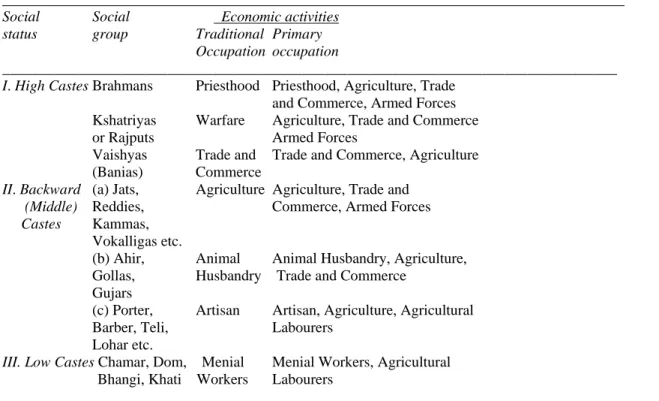
Traditionally, each caste was associated with hereditary occupation and had a limited monopoly over it e.g. Brahmans (priestly and learning); Kshatriyas (warrior and aristocracy); Vaishyas (land owners and traders); and Sudras (crafts and service). It is not true to say that every member of the caste practiced the associated occupation exclusively. It can only be said true of castes like Dhobi (washerman) and Kumhar (potter). However, generally speaking most practiced agriculture along with their traditional occupation. Even agriculture as a single occupation cannot be associated with castes, as agriculture also means number of things: land ownership, tenancy and labour.
Often the artisans and servicing castes do not earn enough from traditional occupation, so they augment their income by working as casual labourers or tenants on land.
An analysis of the occupational statistics for 84 selected castes in 1931 showed that only 45 per cent of their members were following the traditional occupation (Census of India, 1931, Vol. 1, Part 2, pp. 416-19).
Occupations practiced by high and low castes are considered high and low, respectively.
Manual labour is looked down and certain occupations like swine-herding and butchery are considered to be polluting and low.
Castes are governed by their own organization of authority. A greater uniformity has been retained at the economic level of caste than perhaps in relation to customs regulating marriage in particular. Though, there is a wide prevalence of the above model in all parts
in regional moulds. The Saryuparis of Avadh (Uttar Pradesh), Namboodaris of Kerala, Chitpavans of Maharashtra, Chattopadhayas of Bengal and Iyengars of Tamil Nadu are all Brahman, but these categories are essentially regional. In the same way, the Jats of Haryana, the Bhumiyars of Bihar, the Reddys of Andhra and Vakilagas of Karnataka are cultivating castes, but the regional structure imposes boundaries which are generally recognised especially for inter-marriages. The Chamars of Uttar Pradesh, the Balais of Bengal, the Magirs of Gujarat, the Mahars of Maharashtra, the Malls of Andhra or the Adi-Dravidas of Tamil Nadu are all toiling scheduled castes but they are all highly concentrated in specific regions. It is, therefore, clear that, in spite of its wide prevalence, the caste system is, in many ways, also a regional phenomenon. The status and position of every caste group may be determined on an All India scale of social hierarchy, but the caste group itself, in many important respects is also a regional category.
Scheduled Castes and Scheduled Tribes
In the Indian censuses prior to 1931, information was collected and published for each caste or tribe separately. In the 1931 census, data for individual communities was limited to (i) Exterior Castes (ii) Primitive Castes and (iii) all other castes with the exception of (a) those whose members fall short of four thousand of the total population and (b) those for which separate figures were deemed to be unnecessary by the local government.
In the 1941 census, ‘group totals’ were tabulated for scheduled castes, tribes and Anglo- Indians. For selected individual tribes separate tables were furnished. By 1951 census, community distinctions based on caste were being discouraged. It was decided to enumerate population on the basis of race, caste or tribe only to the extent necessary for providing information relating to certain special groups of the people who are referred to in the Constitution of India. The Scheduled Castes and Scheduled Tribes were enumerated from 1951 census onwards. The President by a special order scheduled particular castes among Hindus and Sikhs in particular areas for special treatment that also applies to tribes irrespective of their religious persuasion. The Scheduled Castes and Scheduled Tribes have been specified by 15 Presidential Orders issued under the provisions of Articles 341 and 342 of the Constitution. They are listed in Scheduled Castes and Scheduled Tribes Orders (Amendment) Act 1976.
The constitution prescribes protection and safeguards for the Scheduled Castes and Scheduled Tribes, and other weaker sections either specially or by way of insisting on their general rights as citizens with the object of promoting their educational and economic interests and of removing the social disabilities. However, in spite of all Governmental efforts, even when following the same profession as their neighbours, the Scheduled Castes and Tribes often have an inferior social status and are ruthlessly exploited by their employers and by money lenders.
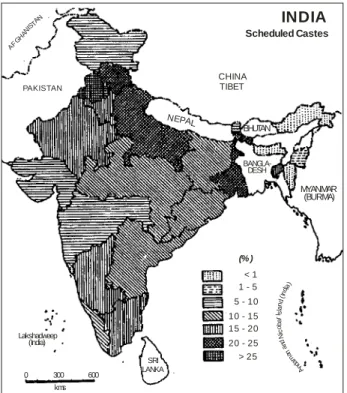
In the Census of India 2001, 16.2 per cent of the population was enumerated as belonging to ‘Scheduled Castes’ or another 8.2 per cent as belonging to ‘Scheduled Tribes’ (Table 1). Thus roughly one in every four persons in India belongs to Scheduled Castes or
Scheduled Tribes. There are, however, vast differences in the concentration pattern of Scheduled Castes in the different regions of the country. The fact that these castes are associated with agriculture explains their main concentration in the alluvial and the coastal plains of the country (Fig. 2). The hilly and the forested tracts of the tribal belt of the central and north-eastern India have only a sparse population of the Scheduled Castes.
INDIA
PAKISTAN AFGHANISTAN
CHINA TIBET
NEPAL
MYANMAR (BURMA)
da An anm
andNicobar
I sland(Ind ia)
Lakshadweep (India)
SRI LANKA
Scheduled Castes
BHUTAN
BANGLA- DESH
0 300 600
kms
(% )
< 1 1 - 5 5 - 10 10 - 15 15 - 20 20 - 25
> 25
Fig. 2. India-Scheduled Castes in per cent to the Total Population
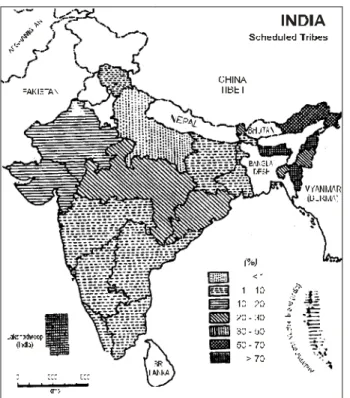
The total population of the Scheduled Tribes in the states of Madhya Pradesh, Orissa, Bihar, Gujarat, Rajasthan, Maharashtra and West Bengal together accounts for about 80 per cent of the entire tribal population of the country (Fig. 3). On the contrary, the States and Union Territories with high tribal percentages have a far lesser share in the country’s total tribal population. The tribal population of Mizoram, Lakshadweep, Arunachal Pradesh, Nagaland and Meghalaya accounts only one twentieth part of the total population of India.
Fig. 3. India-Scheduled Tribes in per cent to the Total Population
Ninety per cent of the Scheduled Castes are rural based and provide substantial support to Indian agriculture which is significantly more than that provided by Scheduled Tribes.
The occupational structure of the Scheduled Caste work force is, by and large, made up of the following components:
(1) Landless agricultural labourers, (2) Cultivators with small holdings,
(3) Small commodity producers or artisans, (4) Services particularly of ‘polluting’ kind, and
(5) Industrial workers, mainly in industries related with their traditional crafts—leather tanning, shoe making etc.
Among the ethnic groups of India, the Scheduled Tribes hold a significant position. They belong to different ethnic, linguistic and religious groups having different economic organisation and socio-cultural characteristics.
In the census of 1951 the Scheduled Tribes were 5.35 per cent of the population of India.