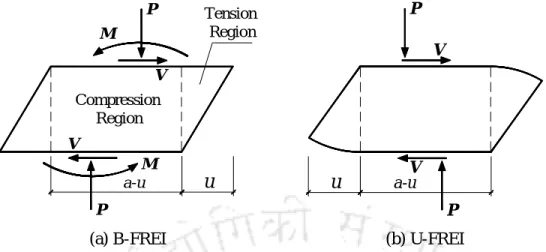
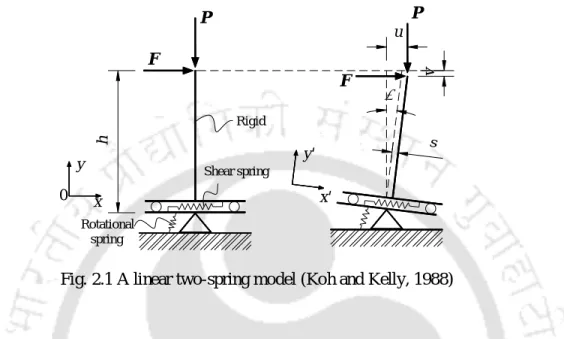
A comparison of the horizontal behavior of bonded and unbonded U-FREI shows that the horizontal stiffness of U-FREI is significantly lower than that of B-FREI at larger displacements. As can be seen from the literature review, researchers have proposed some analytical methods to evaluate the secant horizontal stiffness of U-FREI.
B ACKGROUND
Therefore, the development of cheaper and lightweight laminated elastomeric isolators that are easy to install would play an important role in reducing the seismic vulnerability of low-rise masonry buildings. The following section briefly describes the different types of structural control systems used to reduce the response of structures during earthquakes.
O VERVIEW OF S TRUCTURAL C ONTROL S YSTEMS
- Passive Control System
- Active Controlled System
- Hybrid Control System
- Semi Active Controlled System
Passive control systems are permanently incorporated into the structural system and generally do not require attention. Active control systems are built into the structural system after the construction of the buildings is completed.

B ASE I SOLATION
Basic Concept and Advantages of Base Isolation System
Bracing the structure can reduce drift between floors, but lead to amplification of the floor accelerations. The basic characteristics of a base isolated system consist of the horizontal flexibility and energy absorption capacity.
Classification of Base Isolation
The weight of the insulator is heavy mainly due to the weight of these steel plates and two thick steel end plates at the top and bottom. Fiber reinforced elastomeric insulator (FREI) is a result of the effort to reduce the weight and cost of insulator, which is expected to be used in low buildings.

A PPLICATION OF B ASE I SOLATION
The use of base isolation technology has so far been very limited in developing countries such as India. In India, research activities were carried out for the development and production of systems for the insulation of foundations and the construction of insulated buildings.
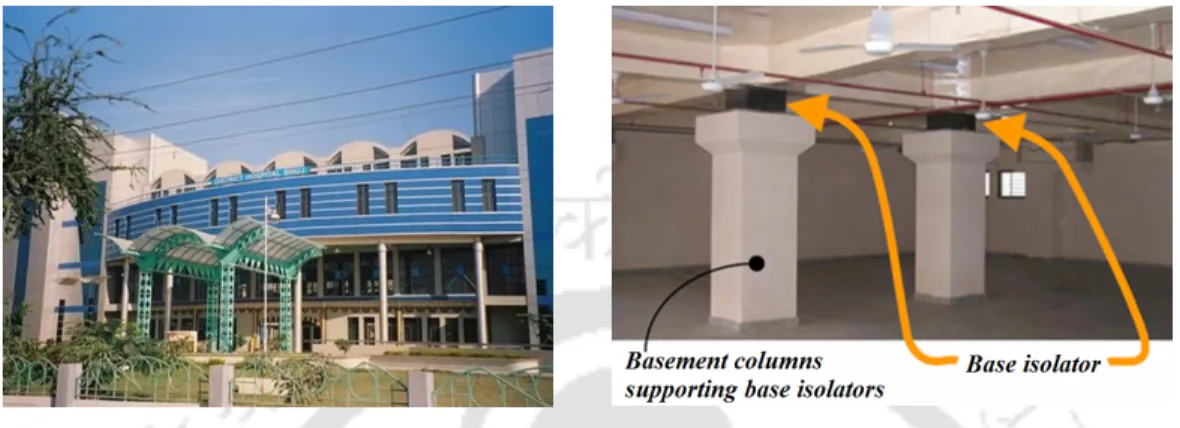
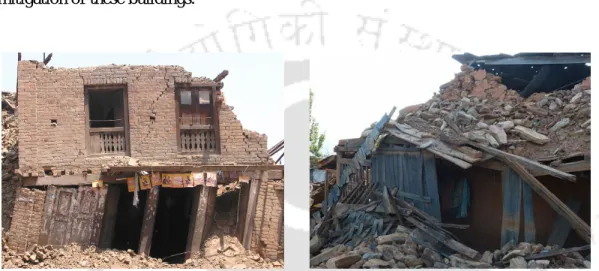
Mitigation of seismic vulnerability in low-rise buildings is an important area of research in recent times. However, little effort has been made to assess the seismic vulnerability of low masonry isolated by U-FREIs.
P ROBLEM I DENTIFICATION
R ESEARCH O BJECTIVES
To carry out experimental and numerical studies for the evaluation of the effect of different directions of horizontal loading on the behavior of square U-FREIs. To develop step-by-step procedure for designing prototype U-FREIs for seismic isolation of low-rise buildings.
S COPE OF S TUDY
Experimental Study
Numerical Study
O UTLINE OF THE T HESIS
The effect of shear modulus, shape factor, and horizontal loading direction on the horizontal FREI response is also reported. A polynomial hysteresis loop fitting method is used to predict insulator stability.
LITERATURE REVIEW ........................................................... 23-64
B ASE I SOLATION B EARING
Kelly [2009] presented the emergence and development of the base isolation system in different parts of the world. In this subsection, an overview of the origin and development of basic insulating bearings in different parts of the world and their operating principles was presented.
E XPERIMENTAL S TUDY OF I SOLATORS
Experiments showed that the performance of carbon FREI was even better than SREI in terms of vertical stiffness and effective damping. Comparison of numerical and experimental results showed that the seismic response of the building supported on U-FREIs could be evaluated numerically with quite reasonable accuracy.
F INITE E LEMENT A NALYSIS OF I SOLATORS
Chang [1988] investigated three commercially available software ABAQUS, B- RUBBER and MARC for FE analysis of rubber material. The test data were used to calibrate the constitutive model and the FE analysis results were compared with the test result. The results of the FE analysis were compared with the predicted values obtained using the pressure solution and the pressure approach methods.
A NALYSIS OF I SOLATORS USING A NALYTICAL S OLUTION
The influences of fiber flexibility on the mechanical properties of the FREI subjected to pure bending moment were studied. In addition, the boundary conditions at the ends of the fiber-reinforced bearings can also influence the compressive stiffness. The theoretical solutions for the compression stiffness of the bearings were very close to the result obtained with the FE method.
S TABILITY A NALYSIS OF I SOLATORS
It was found that the critical load capacity of the bearings decreased with increasing horizontal displacement. It was shown that the critical load capacity decreased with increasing lateral displacement. A method based on fitting a polynomial to experimental force-displacement hysteresis data was proposed to predict the critical bearing capacity of an insulator.
V ULNERABILITY A SSESSMENT OF S TRUCTURES
Many studies have been conducted on the development of analytical fragility curves to evaluate the seismic vulnerability of reinforced concrete structures. Lagomarsino and Giovinazzi [2006] proposed two models (marco‐seismic and mechanical models) to develop analytical fragility curves for vulnerability assessment of European towns and regions. Most of the studies have reported seismic vulnerability assessment using analytical fragility curves for reinforced concrete buildings and highway bridges with and without conventional SREIs.
C ONCLUDING R EMARKS
Unlike a bonded isolator, the horizontal response of a square U-FREI is affected by the direction of loading due to the change in the effective area of the isolator in contact with the support surfaces. The effect of shear modulus change on FREI horizontal stiffness at large horizontal displacement has not been considered in most previous studies. However, most of the literature studies on critical load evaluation of insulators have been performed on scale models of bonded conventional insulators.
EXPERIMENTAL STUDY ON HORIZONTAL FORCE-
- D ETAILS OF P ROTOTYPE FREI S
- T EST FOR E VALUATION OF H ORIZONTAL F ORCE -D ISPLACEMENT B EHAVIOUR
- Experimental Set-up
- Details of Input Displacement History
- Experimental Results ans Discussion
- E FFECT OF S HEAR M ODULUS ON H ORIZONTAL R ESPONSE OF U-FREI S
- T EST FOR E VALUATION OF E FFECT OF L OADING D IRECTION ON H ORIZONTAL
- Experimental Set-up and Input Loads
- Experimental Results ans Discussion
- C ONCLUDING R EMARKS
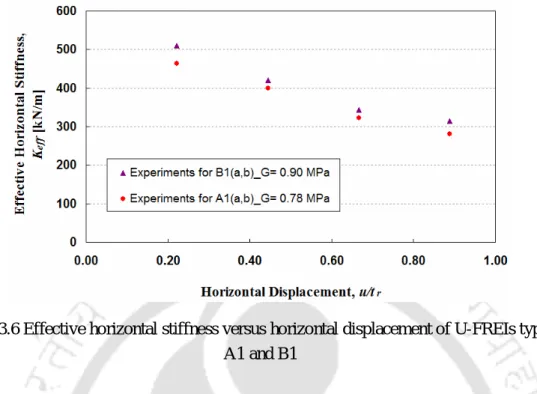
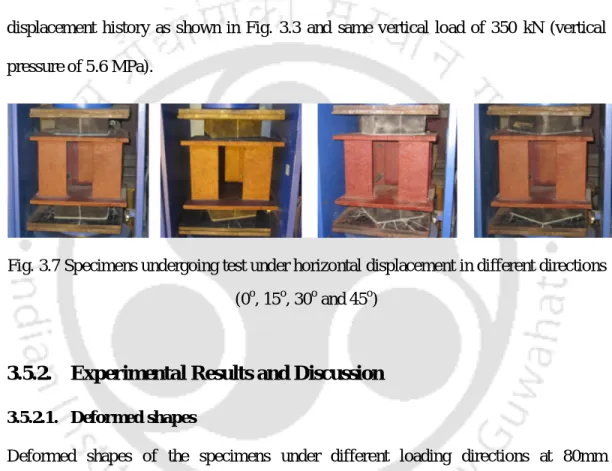
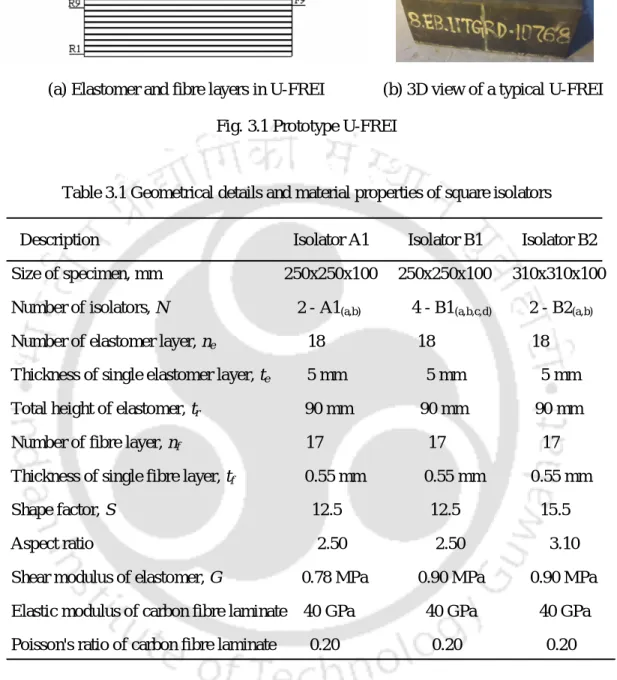
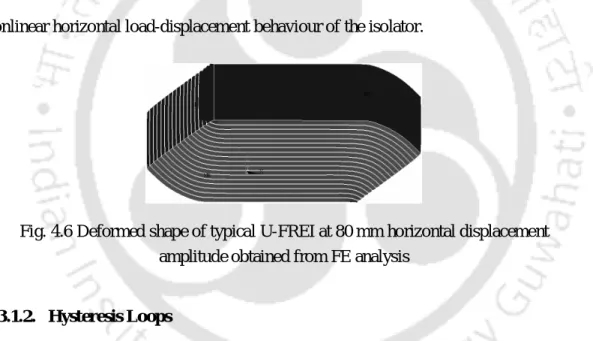
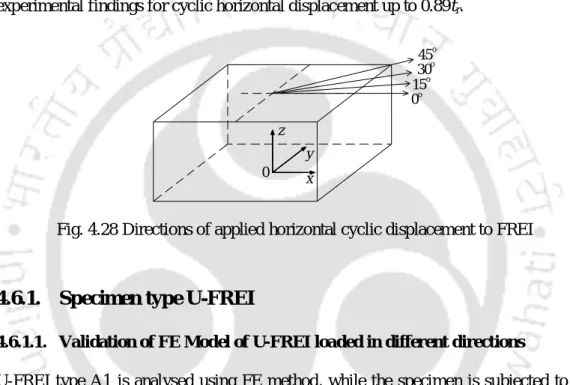
Reduction in effective horizontal stiffness with increasing horizontal displacement of U- FREIs with different values of shear modulus is shown in Fig. Deformed shapes of the specimens under different loading directions at 80mm amplitude of horizontal displacement shown in Fig. Effective horizontal stiffness of U-FREI decreases and equivalent viscous damping increases with increase in horizontal displacement due to rollover deformation.
FINITE ELEMENT ANALYSIS OF FREI.............................. 79-130
F INITE E LEMENT M ODELLING
- Element Type for Finite Element Model
- Element Type of Elastomer layer
- Element Type of Fibre reinforment layer
- Contact and Target Elements
- Material Model
- Details of Input Loads
- Solution Method
- Effect of Mesh Size on FE Analysis Result
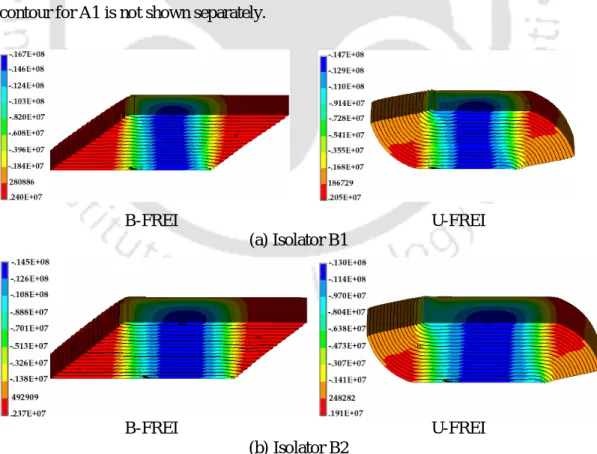
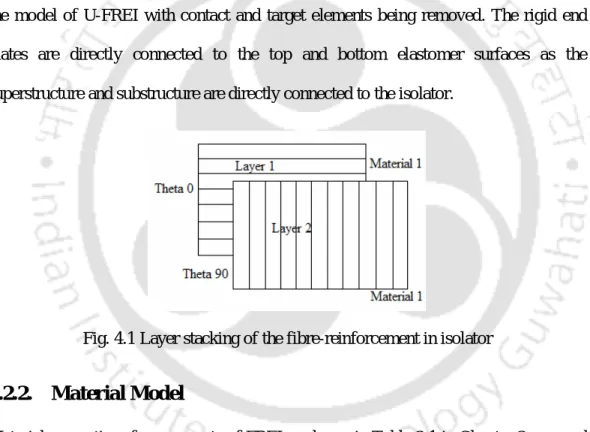
In the numerical simulation, two horizontal rigid plates are considered at the top and bottom of the isolator to represent the superstructure and substructure. Normalized stress distribution S33/p (p is the vertical pressure due to the vertical load applied to the top of the insulator, the 3-axis is parallel to the Z-axis) plotted along the width of the 9th elastomer layer placed adjacent with the middle height and the 9th fiber layer placed in the middle of the height of the U-FREI, type B1 with a horizontal displacement of 135 mm are shown in Fig. The connections of the rigid supports to the top and bottom surfaces of the isolators are appropriately addressed for simulating the bonded and unbonded cases.
P ERFORMANCE OF P ROTOTYPE FREI UNDER C YCLIC H ORIZONTAL
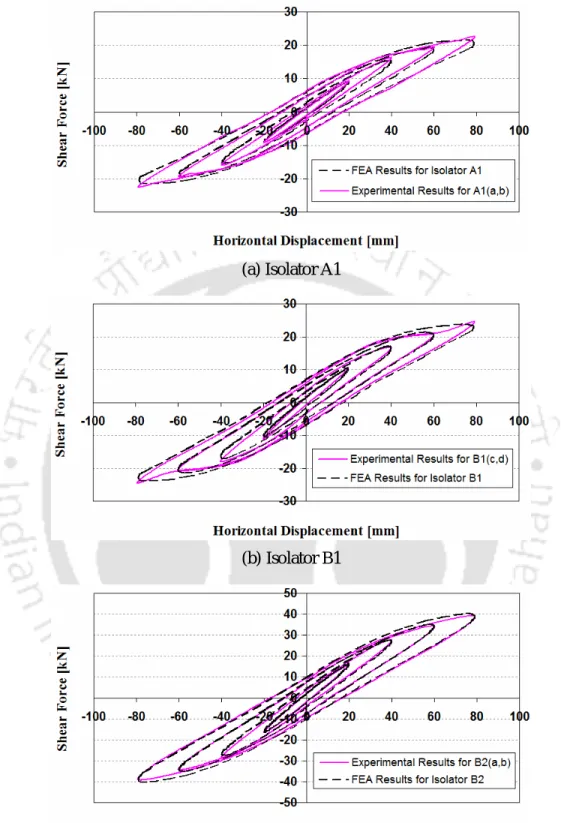
- Validation of Finite Element Model of U-FREI
- Deformed Shapes
- Hysteresis Loops
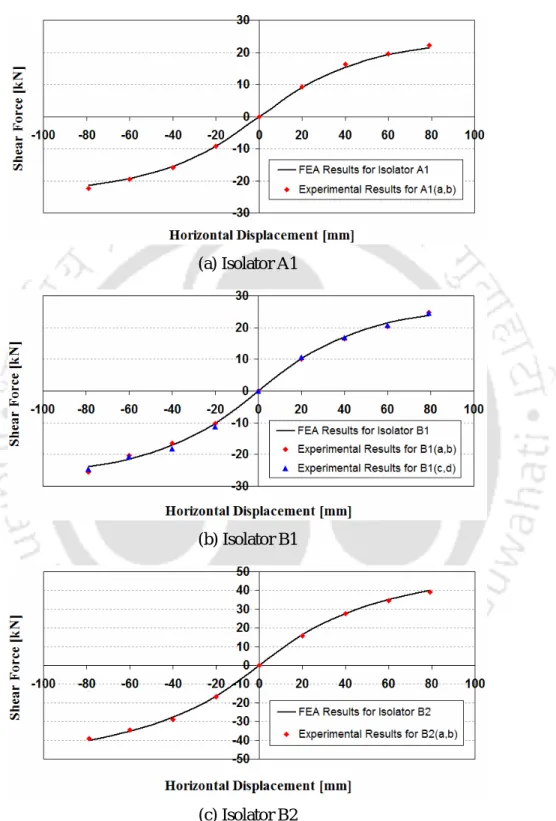
- Horizontal Load-Displacement Relationships
- Deformed Shapes of Bonded and Un-bonded FREI
- Mechanical Properties of FREI
- Horizontal Load-Displacement Relationship of B-FREI and U-FREI
- Stress and Strain in Elastomer Layer
- Stress in Fibre Reinforcement Layer
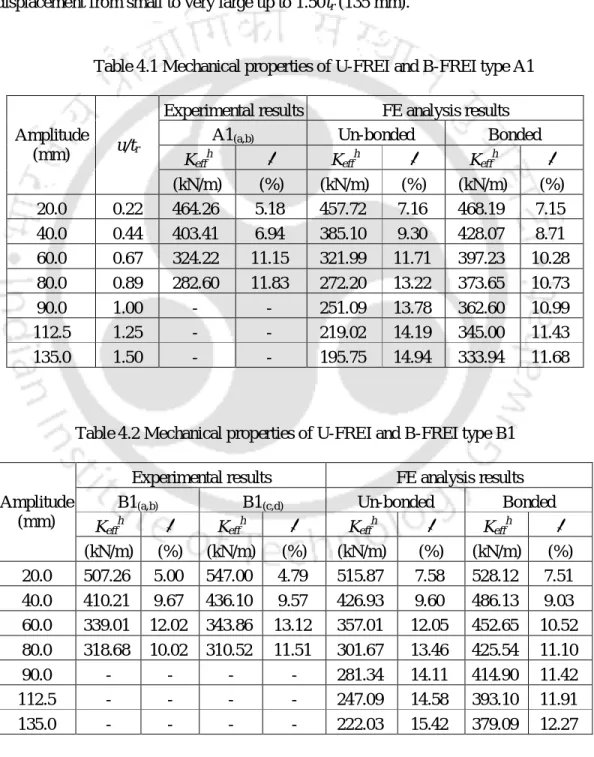
It can be observed from Tables 4.1-4.3 that the effective horizontal stiffness of B-FREI and U-FREI obtained from FE analysis decreases with the increase in horizontal displacement. Contours of normal stress S11 in the 9th elastomer layer (adjacent to mid-height of the insulator) of both B-FREI and U-FREI corresponding to the maximum applied horizontal displacement of 135 mm are shown in Fig. However, the middle elastomer layer shown at mid-height of B-FREI outside overlap region is under tension.
E FFECT OF S HEAR M ODULUS ON H ORIZONTAL R ESPONSE OF FREI
- Specimen Type B-FREI
- Specimen Type U-FREI
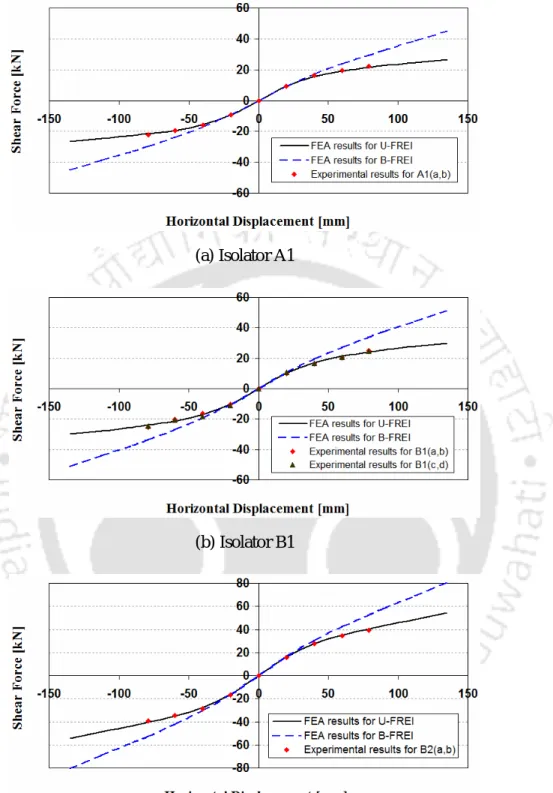
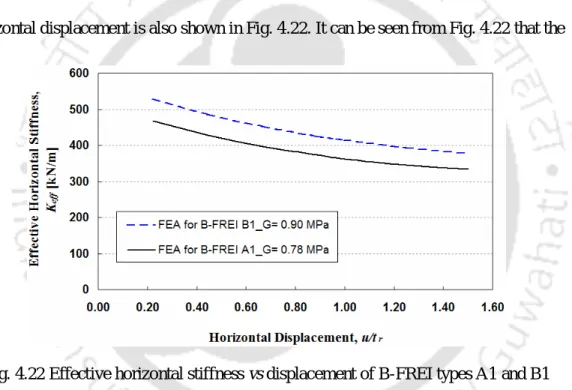
The decrease in effective horizontal stiffness of B-FREI types A1 and B1 with increasing horizontal offset is also shown in the figure. In addition, a comparison of the effective stiffness of B-FREI types A1 and B1 shows that the effective stiffness of B-FREI depends on the shear modulus of the elastomer. The decrease in effective horizontal stiffness of U-FREI types A1 and B1 with increasing horizontal displacement, as obtained from both experiments and FE analyses, is shown in Fig.
E FFECT OF S HAPE F ACTOR ON H ORIZONTAL R ESPONSE OF U-FREI
- Effective Horizontal Stiffness
- Stress in Elastomer Layer
- Stress in Fibre Reinforment Layer
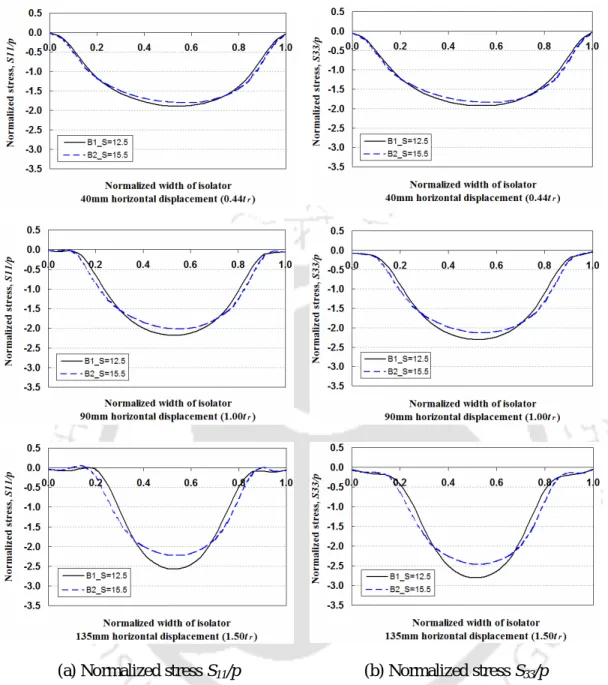
Comparison of shear stress plotted along the width of the 9th elastomer layer located along the center height of U-FREI types B1 and B2 at different horizontal displacements is shown in Fig. Comparison of normalized stresses S11/p and S22/p plotted along the width of the 9th fiber reinforcement layer located at the mid-height of U-FREI types B1 and B2 at different horizontal displacements is shown in Fig. Similar to the comparison of compressive stress in middle elastomer layer of U-FREI in Fig.
E FFECT OF L OADING D IRECTION ON H ORIZONTAL L OAD -D ISPLACEMENT
- Specimen Type U-FREI
- Validation of FE Model of U-FREI Loaded in Different Directions
- Deformed Shapes
- Horizontal Load - Displacement Relationship
- Mechanical Properties
- Stress and Strain in Elastomer Layer
- Specimen Type B-FREI
- Horizontal Load - Displacement Relationship
- Stress and Strain in Elastomer Layer
The horizontal load-displacement curves of U-FREI loaded in four directions obtained by FE analysis are shown in the figure. Horizontal response of U-FREI under different load directions with increasing horizontal displacement up to 2.00 tr as shown in the figure. Furthermore, the horizontal response of B-FREI and U-FREI loaded in different directions is also compared.
C ONCLUDING R EMARKS
The effective horizontal stiffness decreases and the equivalent viscous damping increases as the horizontal displacement of the U-FREI increases due to overturning deformation. In general, as the loading direction changes from 0o to 45o, the effective horizontal stiffness of the U-FREI square increases with a given horizontal displacement (u < . 1.70tr), while that of the B-FREI remains more or less unchanged. The effective horizontal stiffness of the U-FREI begins to increase with large horizontal displacement in the range of 1.70tr to 2.00tr.
I NTRODUCTION
Thus, further efforts are needed to improve the analytical approach for predicting the behavior of U-FREIs. This chapter presents a proposed method for evaluating the horizontal secant stiffness of FREI in both bonded and unbonded applications. An analytical approach that includes the effect of both shear modulus nonlinearity and effective shear area with increase in displacement is proposed as a basic analysis tool for predicting the horizontal secant stiffness of U-FREIs.
P ROPOSED A NALYTICAL A PPROACH FOR D ETERMINATION OF S ECANT
Calculated U-FREI horizontal stiffness values using Eq. 5.6) also showed somewhat good agreement with the experimental results. The reduction of the shear surface due to overturning deformation was taken into account by Nezhad [2014] for the calculation of the effective horizontal stiffness of U-FREI as. However, as discussed, the decrease in the secant horizontal stiffness of the U-FREI with increasing horizontal displacements depends not only on the isolator's effective planar area due to overturning deformation, but also on the isolator's effective shear modulus.
![Fig. 5.1 Deformed configuration of U-FREI According to Nezhad [2014], d is evaluated as](https://thumb-ap.123doks.com/thumbv2/azpdfnet/10530792.0/166.918.132.744.282.864/fig-deformed-configuration-frei-according-nezhad-2014-evaluated.webp)
P ERFORMANCE E VALUATION OF P ROPOSED A NALYTICAL A PPROACH FOR
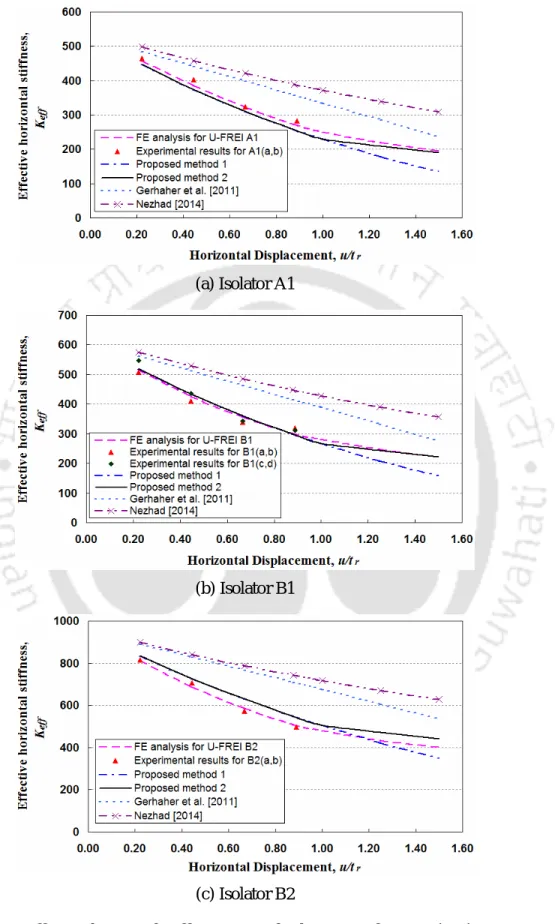
As can be seen from Fig. 5.3, the effective horizontal stiffness of the B-FREI obtained from the FE analysis decreases with increasing horizontal displacement. It can be seen from Fig. 5.3 that the effective horizontal stiffness of the B-FREI as obtained from the FE analysis decreases with increasing horizontal displacements. 5.2) and (5.12) can be considered as a basic analytical tool for predicting the effective horizontal stiffness of B-FREI and U-FREI respectively.
C ONCLUDING R EMARKS
Thus, based on the observations from fig. 5.2) and (5.12) can be considered a basic analytical tool for predicting the effective horizontal stiffness of B-FREI and U-FREI, respectively. The effective horizontal stiffness of the B-FREI is affected by the reduction in the effective shear modulus with displacement, while the U-FREI is affected by the reduction in the shear modulus as well as the reduction in the contact area of the isolator undergoing overturning deformation. It was further found to be in good agreement with the experimental and numerical results when the shear modulus reduction estimation is done using Eq.
STABILITY ANALYSIS OF A PROTOTYPE U-FREI ....... 145-160
- P ROCEDURE FOR D ETERMINATION THE C RITICAL L OAD C ARRYING C APACITY
- D ETAILS OF I NPUT L OADS
- FE A NALYSIS R ESULTS AND D ISCUSSION
- Critical Buckling Load Carrying Capacity
- Effect of Vertical Load on Dynamic Properties of the U-FREI
- Rollout Instability of the U-FREI under Design Vertical Load
- C ONCLUDING R EMARKS
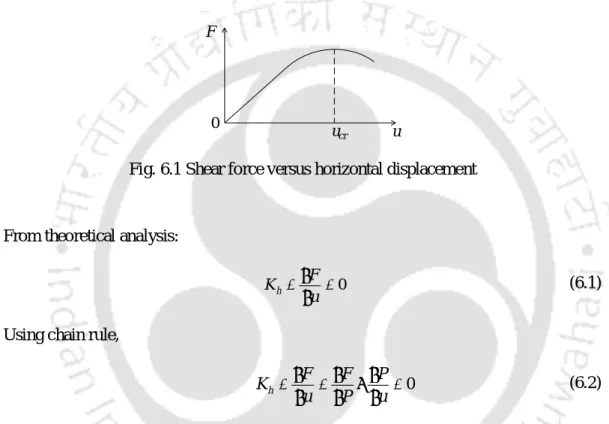
In the dynamic method, the U-FREI is simultaneously subjected to a vertical load change and horizontal cyclic displacement. The vertical load-transverse stiffness relationships of the U-FREI at different horizontal displacement amplitudes are shown in Figs. The critical buckling load of the isolator decreases with increasing horizontal displacement amplitude.
VULNERABILITY ASSESSMENT OF A PROTOTYPE LOW-
- D ESCRIPTION OF B ASE -I SOLATED M ASONRY B UILDING
- N UMERICAL M ODELLING OF M ASONRY B UILDING
- Uniaxial Compressive and Tensile Behaviour of Masonry Prism
- Stress-Strain Behaviour of Masonry Prism in Shear
- Loads and Boundary Conditions
- Verification of 3D Nonlinear Model
- I DENTIFICATON OF D AMAGE S TATES
- V ULNERABILITY A SSESSMENT OF M ASONRY B UILDING
- Pushover Analysis
- Analytical Fragility Assessment
- D YNAMIC R ESPONSE OF M ASONRY B UILDING UNDER G ROUND M OTION
- C ONCLUDING R EMARKS
A two-story stone masonry building with an isolated base is constructed in Tawang, India, supported by U-FREI for seismic isolation. A stone masonry structure is considered as similar structures are prevalent in the north-eastern region of India. To evaluate the seismic vulnerability of a masonry structure, both thrust and dynamic analysis are performed.

STEP-BY-STEP DESIGN PROCEDURE OF U-FREI ......... 187-194
M ECHANICAL P ROPERTIES OF U-FREI S
- Shape Factors
- Horizontal Stiffness
- Vertical Stiffness
S TEP - BY -S TEP P ROCEDURE FOR THE D ESIGN OF U-FREI S
D ESIGN E XAMPLE
C ONCLUSION
SUMMARY AND CONCLUSIONS....................................... 195-200
M AJOR F INDINGS
R ECOMMENDATIONS FOR F UTURE W ORK