The first two chapters focus on the copper(II)-based synthesis of 2-arylbenzoxazoles and 2-aryl-N-benzylbenzimidazoles from bisaryloxime ethers and N-benzylbisarylhydrazones via C-H functionalization/C-N/C-O bonds. The last two chapters discuss the copper(II)-catalyzed aerobic oxidative synthesis of substituted 1,2,3- and 1,2,4-triazoles from bisarylhydrazones via C–H functionalization/C–C/N–N/C– Formation of N-bonds.
Synthesis of 2-Arylbenzoxazoles from Bisaryloxime Ethers via C–H Functionalization/C–N/C–O Bonds Formation
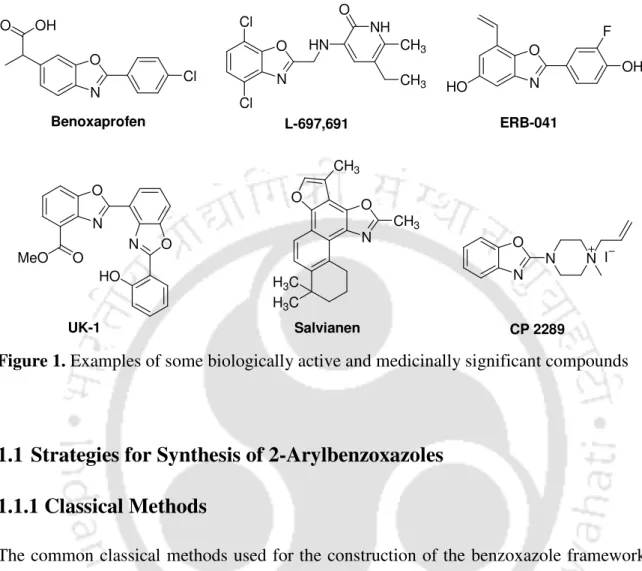
Strategies for Synthesis of 2-Arylbenzoxazoles .1 Classical Methods
- Cross-Coupling Reactions
As for example, copper-catalyzed intermolecular domino C-N/C-O cross-coupling reaction was incorporated for the synthesis of 2-arylbenzoxazoles from 1,2-dihaloarene and primary amides (Figure 2b). At a later stage, copper-catalyzed intramolecular C–O cross-coupling reaction of o- halobenzanilides (Figure 2c) was developed using ligand and base under reflux condition (Scheme 2).15b-c.

Copper-Catalyzed Intramolecular Cross-Coupling
Copper-Catalyzed Synthesis of Benzoxazoles in Water
- C–H functionalization Reactions
Palladium-Catalyzed C–H Functionalization of Heteroarenes
Iron-Catalyzed Synthesis of 2-Arylbenzoxazoles NO 2
- Present Study
Synthesis of Bisaryloxime Ethers
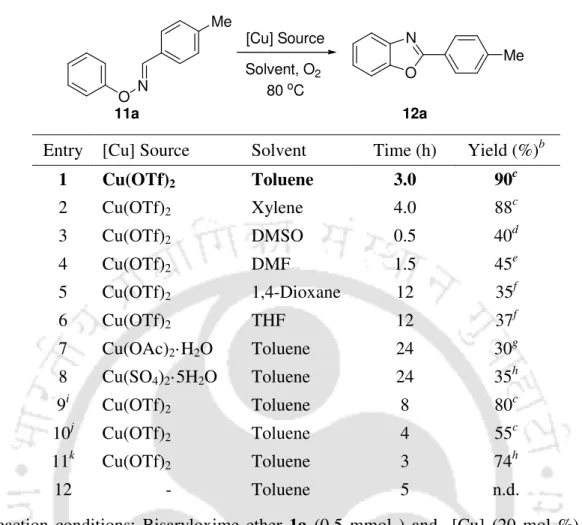
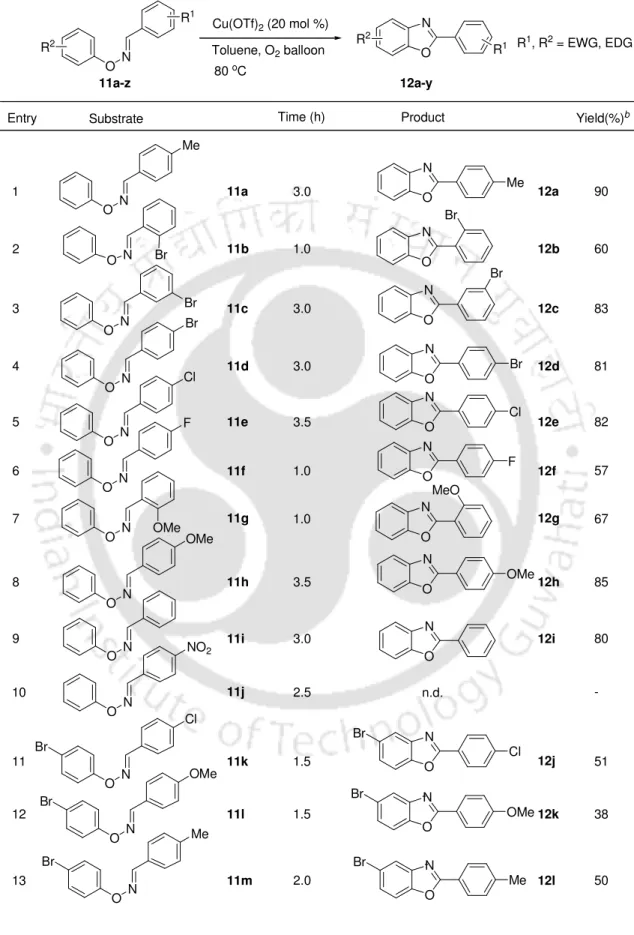
With the optimized conditions, the extent of the reaction with various bisaryloxime ethers 11b-z was then investigated (Table 2). Similar results were obtained with alkyl aryl oximether 13 and allyl aryl oximether 14 , giving a 1:1 mixture of the respective phenol and nitrile in quantitative yields ( Scheme 10 ).
Reaction of Alkyl Phenyloxime and Allyl Phenyloxime Ethers
Reaction of Bisaryloxime Ether without Imine C–H Bond
Cross-Over Experiment for Intramolecular Cyclization
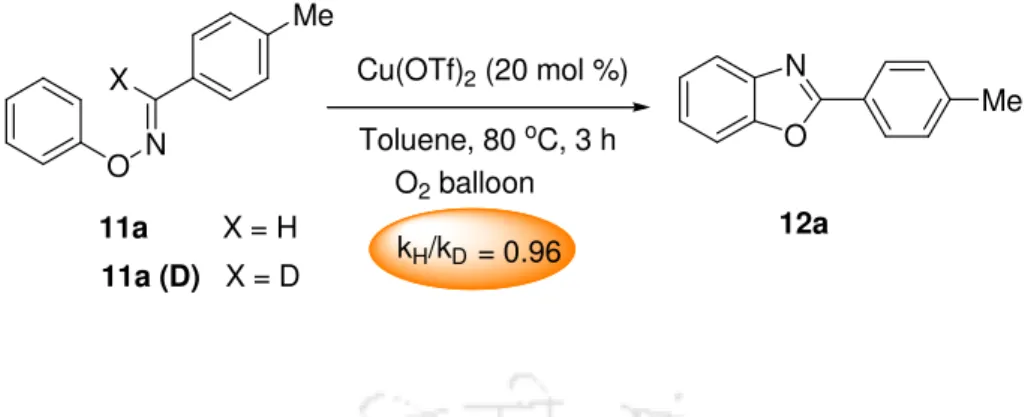
Kinetic Isotope Effect
Intermediate c could provide the target heterocycles 12a-y by reductive elimination of metal (pathway A).6a Alternatively, c can be oxidized with another equivalent of Cu(OTf)2, forming a copper(III) intermediate d that can undergo reductivity elimination to give the target products 12a-y (path B).23 The reduced copper species can be oxidized by molecular oxygen to complete the catalytic cycle.6a,23.
Proposed Catalytic Cycle for Synthesis of 2-Arylbenzoxazoles
Bulk Scale Synthesis of 2-Arylbenzoxazole
- References
- Strategies for Synthesis of Substituted Benzimidazoles .1 Classical Methods
The progress of the reactions was monitored at 0.25 hour intervals by taking a portion of the reaction mixture and passing it through a short pad of silica gel using ethyl acetate and hexane as eluent. In this chapter, we aim to provide a detailed investigation into the scope of the synthesis of 2-aryl-N-benzylbenzimidazoles from N-benzylbisarylhydrazones via intramolecular C–H functionalization/C–N bond formation.
Common Route to Benzimidazoles
- Cross-Coupling Reactions
- Copper Catalysts
Due to its less toxic nature and low cost, copper catalysts have been widely used for the synthesis of various substituted benzimidazoles via C–N cross-coupling reactions. 1,2-Dihaloarenes via cross-coupling reactions with amidines in the presence of copper salts could form substituted benzimidazoles.
Copper-Catalyzed Amination of 1,2-Dihaloarenes
Copper-Catalyzed Synthesis of Benzimidazoles in Water
CuO Nanoparticle Catalyzed Cross-Coupling Reaction
By changing the precursors to o-haloarylcarbodiimides and N-nucleophiles, N-substituted benzimidazoles have been synthesized by the intermolecular cascade addition/copper(I)-catalyzed C–N coupling reaction (Scheme 5).17d.
Cascade Synthesis of N-Substituted Benzimidazoles
Copper-Catalyzed Three-Component Synthesis of Benzimidazoles NH 2
- Palladium Catalysts
Palladium-Catalyzed C–N Cross-Coupling of 2-Haloarylamidines
Synthesis of Substituted Benzimidazoles under Microwave Conditions
Palladium-Catalyzed Twofold Amination of 1,2 Dihaloarenes
- Cobalt Catalysts
- C – H Functionalization Reactions
- Copper Catalysts
Copper-catalyzed C-H functionalization is an excellent strategy for the construction of heterocyclic compounds through intramolecular carbon-heteroatom bond formation. Enormous efforts have been made to develop a novel Cu(II)-catalyzed synthesis of substituted benzimidazoles via C–H functionalization/C–N bond-forming protocol from arylamidines using oxygen as the readily available oxidant (Scheme 11).20.
Copper-Catalyzed C–H Functionalization of Arylamidines
- Palladium Catalysts
The formation of C–N bonds at the expense of C–H bonds during chemical transformations can be considered the most spectacular examples of C–H functionalization reactions, which are essentially carried out by transition elements.
Palladium-Catalyzed C–H Amination of Bis(aryl)amidines
As a replacement for aldehydes or carboxylic acids, tertiary amines could be useful for the synthesis of benzimidazoles. Dehydrogenative amine activation in the presence of heterogeneous palladium catalyst under microwaves has also been reported for the direct transformation of tertiary amines to benzimidazoles (Scheme 13).21b.
Dehydrogenative Amine Activation of Tertiary Amines
- Cobalt-Catalysts
Cobalt-Catalyzed Synthesis of Benzimidazoles
- Co-catalysts
Intramolecular Aromatic C–H Amination
- Present Study
We have studied the synthesis of 2-aryl-N-benzylbenzimidazoles from N-benzyl bisarylhydrazones via copper(II)-mediated C-H functionalization strategy. Reaction of anilines A with NaNO2/HCl gave the corresponding aryl diazonium salts that could be easily converted to aryl hydrazines B in the presence of SnCl2·2H2O and HCl at 0 °C under air.24 Condensation of B with aryl aldehydes provided arylhydrazones25, which can be alkylated with benzyl bromide in the presence of NaH to provide the desired N-benzyl bisarylhydrazones D in high yields (Scheme 17).
Synthesis of N-Benzyl Bisarylhydrazones
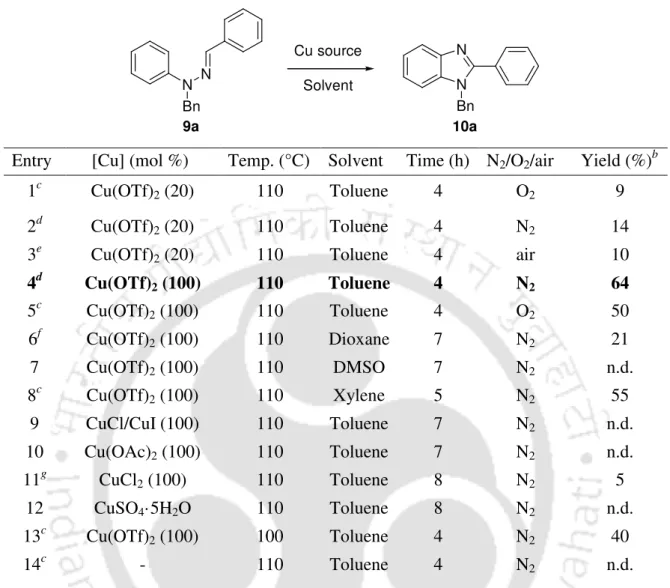
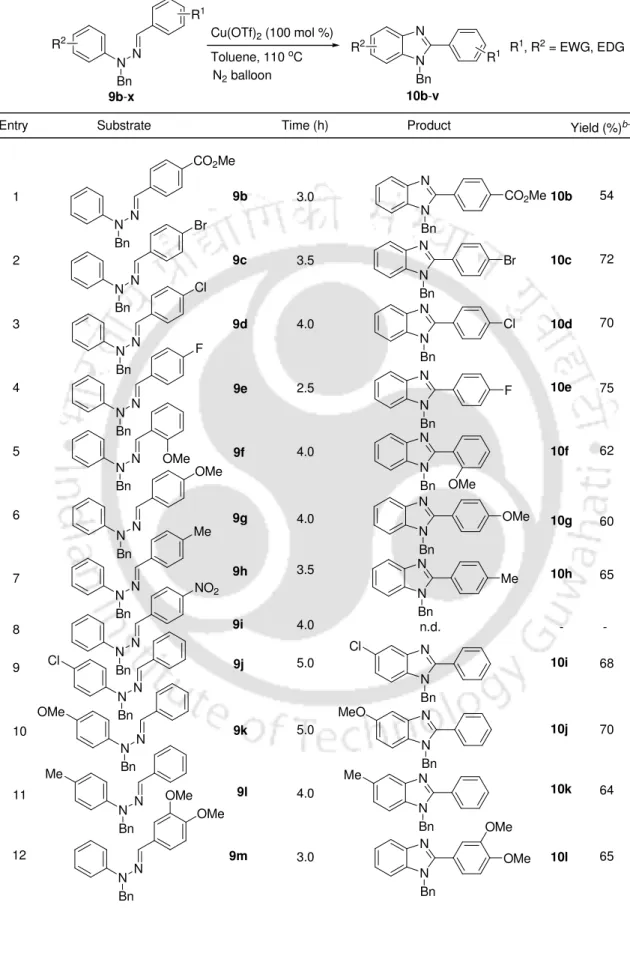
Reactions of substrates having substituents on both the aryl rings and one of the rings were studied. In the case of N -benzyl bisarylhydrazone 9y containing the 3-Me substituent, the cyclization proceeded to give a 1:2 mixture of regioisomers 10w and 10x in 37% yield ( Scheme 18 ).
Reaction of meta Substituted N-Benzyl Bisarylhydrazone
Additionally, N -benzylarylfuranylhydrazone 9t , N -benzylarylthiophenylhydrazone 9u , and N -benzylarylnaphthylhydrazones 9w–x were cyclized to afford the benzimidazoles 10s–v in <6.0 h in 36–78% yield. Under these conditions, N -benzylbisarylhydrazone 9i with 4-NO 2 group and N -benzylarylpyridylhydrazone 9v did not exhibit desired cyclization, undergoing C=N cleavage to give the corresponding aldehydes in quantitative yields. Copper(II) triflate can undergo coordination with the imine nitrogen of substrates 9a-x to give the intermediate a.
Intermediate b can further rearrange to form six-membered metallocycle c and subsequent reductive elimination of elemental copper28 can give the target heterocycle 10a-v.
Plausible Mechanistic Path
- References
- Strategies for Synthesis of N-1 Substituted 1,2,3-Triazoles .1 Azide-Alkyne Cycloaddition (AAC) Reaction
- CuAAC Reactions
The organic layer was washed with water (2 x 15 ml), dried (Na2SO4) and evaporated under reduced pressure to give a residue which was purified by column chromatography on silica gel using ethyl acetate and hexane as eluent to give the title compounds 9a-y yielded. used for the cyclization reactions. The progress of the reaction was monitored by TLC using ethyl acetate and hexane as eluent. Drying (Na2SO4) and evaporation of the solvent yielded a residue which was purified by silica gel column chromatography using ethyl acetate and hexane as eluent to provide the desired N-benzyl-2-arylbenzimidazoles 10a-x in analytically pure form.
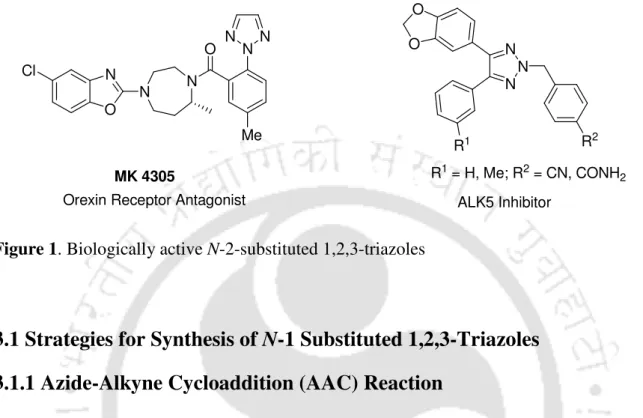
Aerobic Oxidative Synthesis of Substituted 1,2,3-Triazoles from Bisarylhydrazones via C–H Functionalization/C–C/N–N from Bisarylhydrazones via C–H Functionalization/C–C/N–N Bond Formation. In this chapter, we describe an unprecedented route for the regioselective synthesis of 2,4,5-triaryl-1,2,3-triazoles from bisarylhydrazones via a cascade copper(II)-catalyzed aerobic oxidative C–H functionalization/C– Formation of C/N–N bonds. Due to limitations of the traditional Huisgen azide-alkyne dipolar cycloaddition (AAC) processes, 12 metal-catalyzed AAC reactions13 have enabled the assembly of diverse N-1-substituted 1,2,3-triazoles under relatively mild reaction conditions.
Solid Phase Synthesis of Substituted 1,2,3-Triazoles
To date, the most powerful click reaction is the copper-catalyzed azide-alkyne cycloaddition (CuAAC) which has enabled the synthesis of disubstituted 1,4- or 1,5-1,2,3-triazoles from a range of never seen more excellent substrates. selectivity. A novel copper(I)-catalyzed 1,3-dipolar cycloaddition of terminal alkynes to azides in the solid phase is reported for the synthesis of N-1-substituted 1,2,3-triazoles, where alkyl azides, aryl azides and an azido sugar were used (Scheme 1).13a. Copper(I)-catalyzed regiospecific synthesis of 1,4-disubstituted 1,2,3-triazoles has also been developed from organic azides and terminal acetylenes at room temperature (Scheme 2).13b New copper(I) catalyst made from 5 mol % sodium ascorbate and 1 mol % copper(II) sulfate in a 2:1 mixture of water and tert-butyl alcohol give the desired products without any attempt to exclude oxygen.
- RuAAC Reactions
Ruthenium-Catalyzed Synthesis of Trisubstituted 1,2,3-Triazoles
- Strategies for Synthesis of N-2 Substituted 1,2,3-Triazoles .1 Three-Component Coupling (TCC) Reactions
Bimetal-Catalyzed Formation of Triazole
CuO Promoted Azide-Chalcone Oxidative Cycloaddition
One-Pot Synthesis of N-Hydroxymethyl-1,2,3-Triazoles
- Regioselective Post-Triazole Arylation or Alkylation
For derivatization after the triazole, the higher electron density on the two terminal nitrogens of the triazole heterocore allows to give only N-1 substituted products. Therefore endless efforts have been devoted to selective N-2 post-triazole arylation or alkylation in recent years. Regioselective N-2 alkylation of 4,5-dibromo- and 4-bromo-5-trimethylsilyl-1,2,3-triazoles has been demonstrated via base-mediated posttriazole alkylation (Scheme 9).15a These building blocks can is readily converted to 2-mono-, 2,4-di-, and 2,4,5-substituted triazoles, providing a general method for the synthesis of N-2-substituted triazoles.
Post-Triazole Alkylation of 1,2,3-Triazoles
Post-Triazole N-2-Arylation of 1,2,3-Triazoles
Considering that C-4 and C-5 substituents on the 1,2,3-triazoles could provide the necessary steric hindrance to prevent the nucleophilic substitution on the terminal nitrogens of heteroarenes, N-2 selective post -triazole alkylation and -allylation has been done with C-4 and C-5 overcrowded 1,2,3-triazoles in the presence of K2CO3 (Scheme 11).15c Scheme 11. Efficient regioselective post-triazole N-2 arylation has also been developed on based on C-4,C-5 disubstituted-1,2,3-NH-triazoles via copper-catalyzed cross-coupling reactions with aryl halides or arylboronic acids (Scheme 12).15d.
Copper-Catalyzed Post-Triazole Arylation
Post-Triazole Arylation using Bulky Ligand
- Present Study
In polar solvents such as dioxane, DMSO and THF, product 2a was obtained with Table 1. In contrast, the yield of the target compound 2a under nitrogen atmosphere was reduced to 30% (entry 12).
C–H Functionalization of Bisarylhydrazones
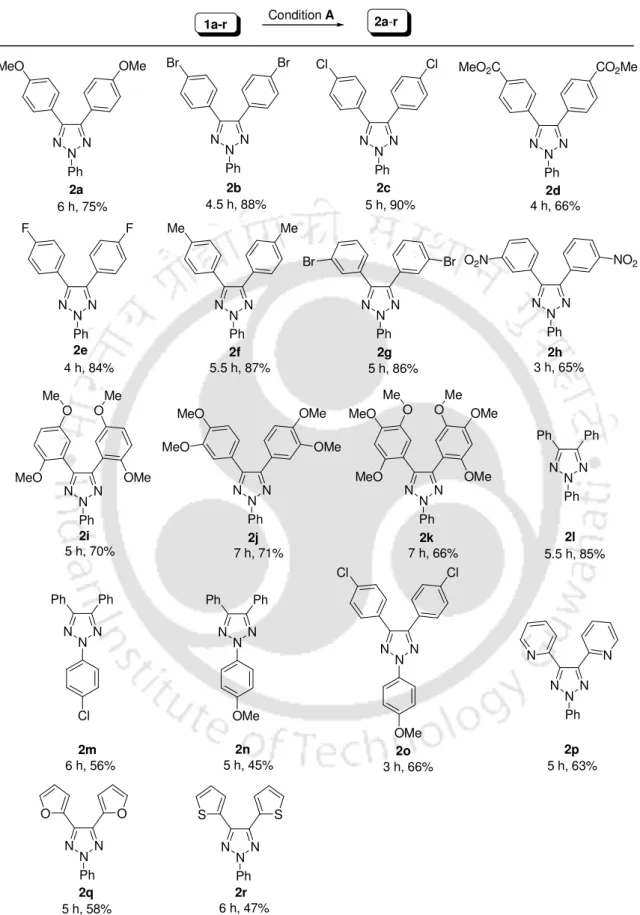
A similar result was observed when either the reaction temperature (40 °C) or the amount of copper source (10 mol %) was reduced (Entries 10 and 13). For example, bisarylhydrazones 1a and 1c readily proceeded to react to give unsymmetrical 2,4,5-triaryl-1,2,3-triazole 2s in 70% yield along with substituted 1,2,3-triazoles 2a and 2c symmetrically. as small products (Scheme 15).
Synthesis of Unsymmetrically Substituted 1,2,3-Triazole
Proposed Catalytic Cycle for the Synthesis of Substituted 1,2,3-Triazoles
- References
Based on the above experimental observations and literature reports,18 a plausible route for the synthesis of substituted 1,2,3-triazoles has been proposed (Scheme 16). In summary, copper(II)-promoted oxidative CH functionalization of bisarylhydrazones for regioselective synthesis of 2,4,5-triaryl-1,2,3-triazoles has been achieved through CH functionalization/C–C/N –N bond formation strategy. After stirring for an appropriate time, the reaction mixture was cooled to room temperature and passed through a short pad of silica gel using hexane followed by a mixture of ethyl acetate and hexane as eluent to obtain the target 2,4,5-triaryl-1,2,3- triazoles 2a-r in analytically pure form.
After cooling to room temperature, the reaction mixture was passed through a short pad of silica gel using hexane, followed by a mixture of ethyl acetate and hexane as eluent to give the target 2,4,5-tripenyl-1,2,3-triazole 2l in 75 % (1.11 g) of the gain.

Aerobic Oxidative Synthesis of Substituted 1,2,4-Triazoles from Bisarylhydrazones via C–H Functionalization/C–N Bond
Chelation of Iron with Deferasirox
- Strategies for Synthesis of Trisubstituted 1,2,4-Triazoles
- Synthesis of 1,2,4-Triazoles under Metal-Free Conditions
There are a number of precursors (chloromethylene amides, imidates, thioamides, thioimidates, imidoylbenzotriazoles, amidrazones, oxadiazoles, N-nitrosoamidines, and orarylphosphazoanilides) that can produce N-acylamidrazones. In the presence of oxalyl chloride, N-alkyl substituted acetamides and aryl or alkyl hydrazides can produce 3,4,5-trisubstituted 1,2,4-triazoles via N-acylamidrazone intermediates (Scheme 2).11a The reaction can to be carried out in a -pot without isolation of intermediates.
Synthesis of Triazoles from Activated Amide Derivatives
Synthesis of Triazoles from Imidate Precursosrs
Synthesis of Triazoles from Amidrazones
- Synthesis of 1,2,4-Triazoles under Metal Based Conditions
Palladium-Catalyzed Carbonylative Access of Acyl Amidines
Here, primary amidines with carboxylic acids, eliminating the need for carbon monoxide, can produce the target tri-substituted 1,2,4-triazoles via the same intermediate in the presence of a coupling reagent at room temperature (Scheme 7).12b.
Noncarbonylative Access to Acyl Amidines
Synthesis of Triazoles via Triazenes
Copper-Catalyzed Tandem Addition - Oxidative Cyclization
- Synthesis of Trisubstituted 1,2,4-Triazoles by Other Methods
But solid-phase synthesis of trisubstituted 1,2,4-triazoles has also been established from triazole-functionalized solid supports in the presence of alkyl halides (Scheme 10).13a.
Solid Phase Synthesis of Trisubstituted 1,2,4-Triazoles
- Present Study
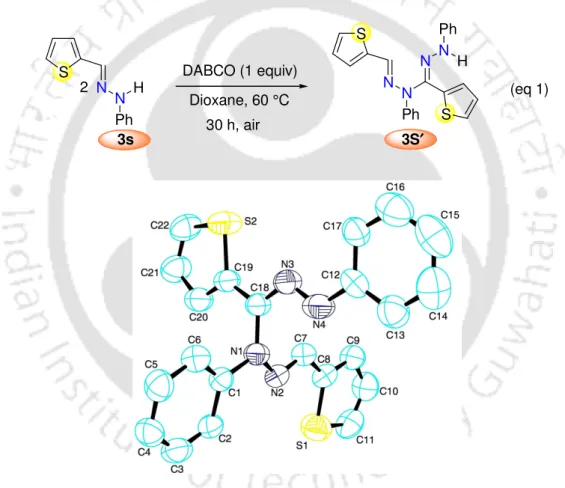
Investigating the reaction conditions, we found intriguingly that bisarylhydrazone 3a could easily react with an organic base such as Et3N in toluene at 60 °C for 30 h under air to give an intermediate that could continue the reaction further with 10 mol% Cu (OAc) 2·H2O at room temperature to give 1,3,5-triaryl-1,2,4-triazole 4a in 55% yield (Table 1, entry 1). The catalytic activity of the other copper sources such as Cu(OAc)2, CuCl2, Cu(OTf)2, CuCl and CuI was investigated and Cu(II) salts were found to be superior to Cu(I) salts for to give the product 4a in high yields (entries 14-18). When the amount of the copper source (5 mol %) or the amount of the base (0.5 equiv) was reduced, the yield of 4a decreased significantly (entries 19 and 20).
Control experiment revealed that in the absence of the copper source, no cyclization was observed to give the target heterocycle 4a.
Copper-Catalyzed Oxidative C – H Functionalization
The reaction condition B could also be easily applied for the synthesis of asymmetric 1,3,5-triaryl-1,2,4-triazoles. For example, a 1:1 mixture of hydrazones 3a and 3c reacted to give the corresponding asymmetric 1,2,4-triazole 4t in 68% yield, along with the symmetric 1,2,4-triazole 4a and 4c as secondary products (Scheme 13).

Synthesis of Unsymmetrically Substituted 1,2,4-Triazole
- References
The literature reports on copper-catalyzed aerobic oxidative transformations developed by Chiba8 and Stahl14 facilitate the unraveling of the mechanistic pathway for the synthesis of substituted 1,2,4-triazoles. In summary, the exciting chemistry of copper(II)-catalyzed oxidative CH functionalization of bisarylhydrazones for the regioselective synthesis of 1,3,5-triaryl-1,2,4-triazoles has been exploited under aerobic conditions. The pioneering feature of this protocol involves the synthesis of 1,3,5-triaryl-1,2,4-triazoles by copper(II)-catalyzed CH functionalization at room temperature using aerobic oxygen as the oxidant.
The solvent was concentrated under reduced pressure and the residue was purified by column chromatography on silica gel.
List of Publications
Conferences
![Figure 3. ORTEP diagram of the single-crystal X-ray structure of 5-chloro-2-(4- 5-chloro-2-(4-methoxyphenyl)benzo[d]oxazole 12q](https://thumb-ap.123doks.com/thumbv2/azpdfnet/10490542.0/18.892.105.737.662.1068/figure-ortep-diagram-single-crystal-structure-methoxyphenyl-oxazole.webp)
![Figure 2. ORTEP diagram of 1-benzyl-5-chloro-2-phenyl-1H-benzo[d]imidazole 10i. H- H-Atoms have been omitted for clarity](https://thumb-ap.123doks.com/thumbv2/azpdfnet/10490542.0/54.892.131.761.100.1034/figure-ortep-diagram-benzyl-chloro-imidazole-omitted-clarity.webp)