Q1Dp The language of one-gap primitive participles that is not del-robust. Q1Dp (n) The language of non-del-robust one-gap primitive participles of length n.
Introduction
Explore the location of the language of primitive participles in the conventional Chomsky hierarchy. Prove that the language of θ-unbounded participles is a disjunctive language, where θ is a morphic involution.
Thesis Outline
The set of θ-unbounded partial words is shown to be a regular language under the assumption that θ is an antimorphic involution. A word w is said to be bordered if there is a non-empty regular prefix w that is also a suffix.
Partial Words
A dot (local dot) k of a partial word is said to be minimal if all other periods (local . dots) are larger. The set of all strong periods of the partial word w is denoted by P(w), and the smallest strong period by p(w).
Results on Words
Results on Partial Words
The above result does not hold in the case of partial words with two or more holes. The above proposition does not hold in the case of partial words with two or more holes.
Hierarchy of Partial Words
Properties of Primitive Partial Words
Remember that a partial word w is bounded if there are words x, y and z such that w⊂xy and w⊂yz. By Proposition 2.42, if u is a primitive subword with at most one hole and uu↑xuy, then either x= ε or y=ε. In our next result, we prove that forn≥2, un−1 is not compatible with a central factor ofun, where u is a primitive partword with one hole.
Then u is primitive if and only if un−1 is incompatible with a central factor of un for all n≥2.
Partial Primitivity and Density
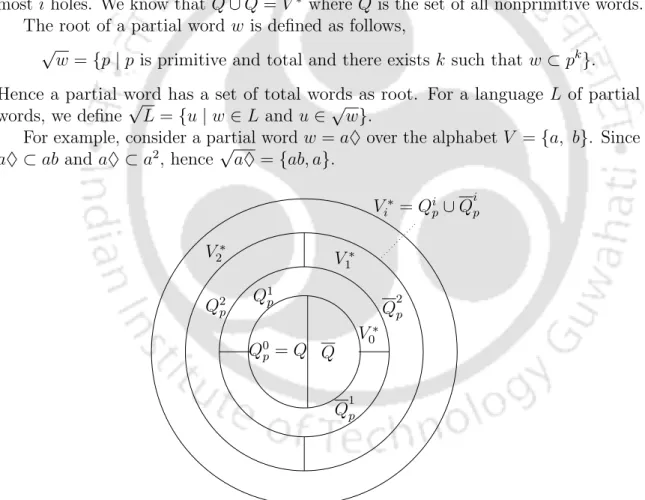
The language Q1p is dense over an alphabet V in V1∗. Consider a partial word w with at most one hole. There are two different cases depending on whether it is a primitive partial word or non-primitive partial word. Here we consider two possibilities, depending on whether w is contained in power of a symbol from the alphabet or power of a word with two or more separate letters.
So Q1p is closely above the alphabet V in V1∗. Let L be a minimal right 1-dense language of primitive subwords with at most one gap over an alphabet V. Then the following statement holds:.
The Language Q p in Chomsky Hierarchy
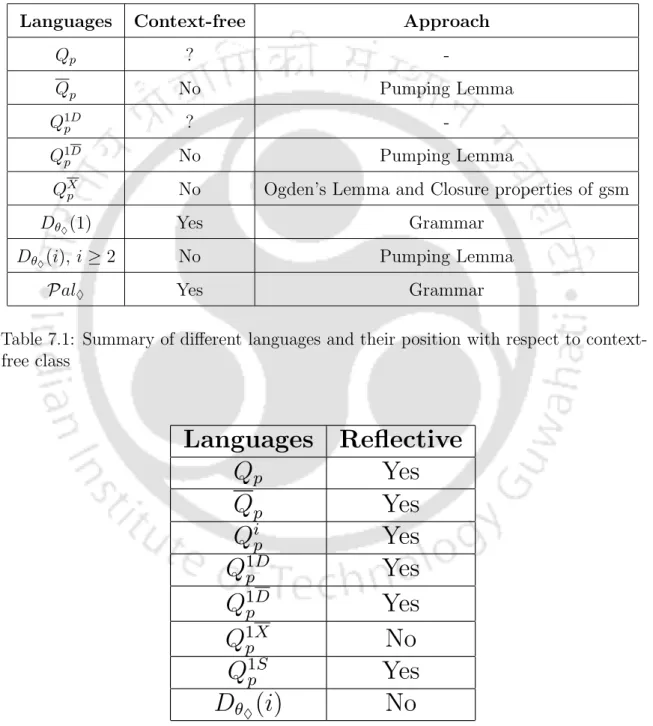
In our next result we show that the language of primitive participles is not a deterministic context-free language and we use the closure properties of DCFL. In this section, we prove that the language of one-hole primitive participlesQ1p is accepted by a two-way pushdown automaton (2DPDA). We then show that the language of primitive participles Qp over an alphabet V is accepted by a Random Access Machine (RAM) computational model in linear time.
The language Qp of primitive partial words over a non-trivial alphabet V is accepted by a RAM in linear time.
Indexed Grammar for Z
In the second case, f is consumed when the index production of f is applied. We then prove that the grammar indexed above generates the language of non-primitive words. Depending on the primitive word x, we apply the production rules and index production rules to generate the word x.
Then the production rules A → Ag or A → Ah are repeatedly applied to generate the corresponding indices of wordx.
Conclusions
31] to partial words with a hole and studied the notion of preserving primitiveness in partial words. In Section 4.2, we discuss the primitiveness preservation of one-hole partial words with respect to the deletion operation. We call the set of primitive partial words with one hole, which are robust to the deletion function, asdel-robust primitive partial words.
We prove that the language of invariantly robust primitive participles is not context-free over the alphabet in Section 4.4.
Del-Robust Primitive Partial Words
In this section we investigate the relationship between the language of non-del-robust one-gap primitive participles Q1Dp and the language classes in the Chomsky hierarchy. There are several possibilities, which we discuss below, depending on whether the substrings v and y contain more than one symbol or hole. There will be different cases depending on whether v contains combinations of a's and b's and y contains only one type of symbol, or whether v contains one type of symbol and y contains the combination of symbols, or whetherx contains combinations of a's and b's.
Since all the above examples result in a contradiction, the assumption that the language of non-persistent primitive participles with one hole Q1Dp is context-free does not hold.
Exchange-Robust Primitive Partial Words
Clearly, the set of all exchange-robust primitive subwords with a gap is a subset of Q1p. We call this set of subwords as non-exchange-robust primitive single-hole subwords. We denote the set of non-exchange-robust primitive subwords with one gap over an alphabet V asQ1Xp.
Next, we show that the language of exchange-robust primitive partwords with one hole is not dense.
It is sufficient to find one part-word for which we cannot find any word satisfying the condition. For example, takew= aaba♦aaba /∈ Q1Xp, and if we concatenate or b at the right end of w, we get a non-primitive part word. Since we know that a CFL is closed under the gsm mapping and then using a sequential transducer (a gsm), the language QXp ∩R can be translated into a new language.
Knowing that the family of context-free languages is closed under sequential converters and the intersection with regular languages, we conclude that QXp is also not context-free.
Subst-Robust Primitive Partial Words
Let us assume that w = xay is a non-substantive primitive participle with one hole. Next, we show that the language of substative primitive participles is one-hole closed under cyclic permutation. Therefore, the language of sub-robust primitive participles Q1Sp is closed under conjugation relation.
It is easy to see that whether a primitive participle with one hole of length n is del-robust can be tested in O(n2).
Conclusions
Motivated by the work of Peter Leupold in [66], and the generalization of the classical notion of (un)bounded1 words to that of θ-(un)bounded2 words, [58], we generalize the notion of (un)bounded participles to θ- (un)framed participles. In Section 5.3 we prove several combinatorial properties of θ-(un)bounded participles, including closure properties and characterization of the set of θ-unbounded participles for antimorphic involution θ. In section 5.5 we prove that the set of all θ-unbounded participles Dθ♦(1) is a disjunctive language.
In Section 5.7, we define θ-primitive partial words for (anti)morphic involution3 and discuss some basic properties of it.
Basics of θ-bordered Partial Words
Properties of θ-bordered Partial Words
Let be either a morphic or antimorphic involution over an alphabet V♦. a) A partial word bounded by θ u∈V♦+ has length greater than or equal to 2. If θ is a morphic involution then it is an iw limit, and if θ is an antimorphic involution then u <θd♦ w. If θ is an antimorphic involution, then either v < p u or u < p v . Lemma 5.15 need not hold for partial words as shown in the following example.
The following lemma provides a characterization of θ bounded partial words in the case of antimorphic involution θ.
Catenation of θ-bordered Partial Words
However, the minimal θ-bound of a θ-bounded partial word under a morphic involution need not be an unbounded θ-word. Since all cases lead to contradictions, we have that uv is an unbounded partial word θ. If x1x2 is an unbounded partial word θ, then for every k >1, xk1x2 is also an unbounded partial word.
Therefore, it is not necessary that a θ-unbounded participle can be parsed as a concatenation of two θ-unbounded participles.
More specifically, a partial word w∈V♦+ is said to be contained in the pseudo-power of a non-empty word u with respect to θ if w⊂u{u, θ(u)}∗. However, in the case of participles, the primitive root of a participle need not be unique, [8]. Similarly, the θ-primitive root of a part word need not be unique as shown in the following example.
Since θ-primitive participles are primitive, Lemma 3.7 also applies to θ-primitive participles.
This result does not hold in the case of partial words, as shown in the following example. In particular, we prove that if xandy are two θ-unbounded partial words such that x6↑y, then xandy do not θ-commute each other, where θ is a morphic involution. The result from Theorem 2.36 provides a characterization of the partial words u and v that commute with each other.
Similarly, in the next result we provide a characterization for participles u and v such that u θ-commutes with v for (anti)morphic involution θ.
Conclusions
In this chapter we study the concept of palindromes and pseudo-palindromes in part words, which are extensions of palindromes in whole words. We begin with section 6.2 by defining the palindromes in part words and studying some properties in relation to primitive part words. The limit on the number of palindromes in the conjugation class for a primitive part word which is also a palindrome is examined in section 6.3.
We define θ-palindromes for part words and establish a connection between θ-bounded and θ-palindromic part words in Section 6.4.
Palindromes in Partial Words
We provide a necessary and sufficient condition for the conjunction of a partial word and its opposite to be a non-primitive partial word. We give a lower bound for the number of bounds θ of a power of a primitive θ-palindromic partial word with arbitrary number of holes. We then define the perfect mixture of two words of the same length and give a necessary and sufficient condition for a partial word to be a palindrome of equal length.
The following result gives a necessary and sufficient condition for the concatenation of a partial word and its inverse to be non-primitive.
Conjugates and Density of Palindromes
Let w=a♦♦b♦a be a primitive partial word of even length that is also a two-hole palindrome. However, this is not true in the case of partial words, and there may be more than one palindrome in the conjugation class of a primitive palindromic partial word of odd length. In the following result, we prove that if the catenation of a partial word and its inverse is contained in a nontrivial power of a word, then the word is a palindrome.
Next, we show that if an integer power of a subword is a palindrome, then the subword itself is a palindrome.
We have the following result for counting the number of θ-boundaries of some power of a partial word with one hole when θ is a morphic involution. In our next result, we give a necessary and sufficient condition for a partial word to be a θ-palindrome under an antimorphic involution θ. In Theorem 6.31, we count the number of θ-boundaries of some integer power of a θ-palindromic primitive participle with one hole.
Next, we count the number of θ-bounds of some power of a θ-palindromic primitive participle with an arbitrary number of holes and provide a lower bound.
Conclusions
But whether the language of primitive participles is context-free or not is still open. We presented a 2DPDA automaton for recognizing the language of primitive part words with a gap. We also proved that the language of θ-bounded subwords is not a context-free language when θ is a morphic involution.
We proved that the language of palindromes in partial words is a context-free language as well as a dense language.