I am sending her thesis entitled "Synthesis of Nitrogen and Oxygen Heterocyclic Compounds" which is for the Ph. Science is submitted). Section 2A describes regioselective synthesis of dihydropyran derivatives via oxonium-ene cyclization reaction catalyzed by bismuth(III) trifluoromethane sulfate (Bi(OTf)3).
Section B: TMSOTf catalyzed diastereoselective synthesis of pyranopyrans using β-allenols and aldehydes
Stereo- and regio-selective synthesis of 4-vinylpyrrolidine from N- tethered alkyne-alkenol
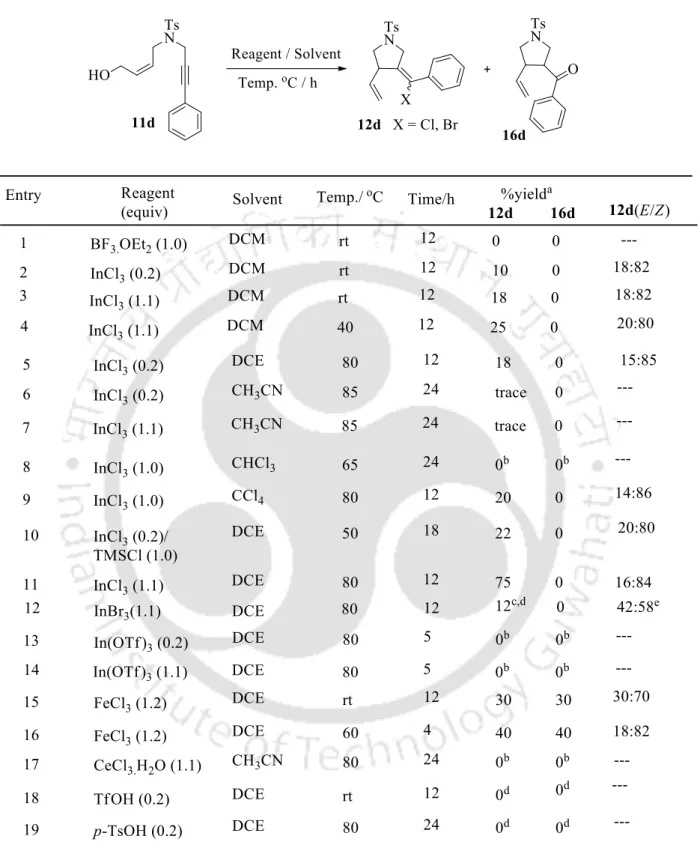
The stereochemistry of the pyrrolidine products was confirmed by none of the compounds E and Z 3-(1-chloroethylidene)-1-tosyl-4-vinylpyrrolidine (Figure 3). One of the important aspects of the reaction is the dual role that indium(III) chloride exhibits as a Lewis acid as well as a source of chloride.
Index
Chapter 3: Stereo- and Regio-selective Synthesis of 4-Vinylpyrrolidine from N-Tethered Alkyne-Alkenol
- Background
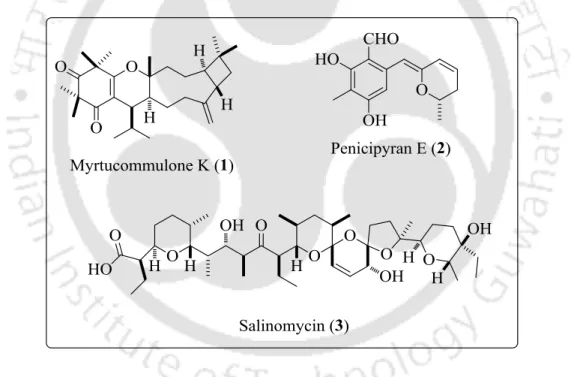
- Importance and applications of O-hetercycles
- Dihydropyrans
- Pyranopyrans
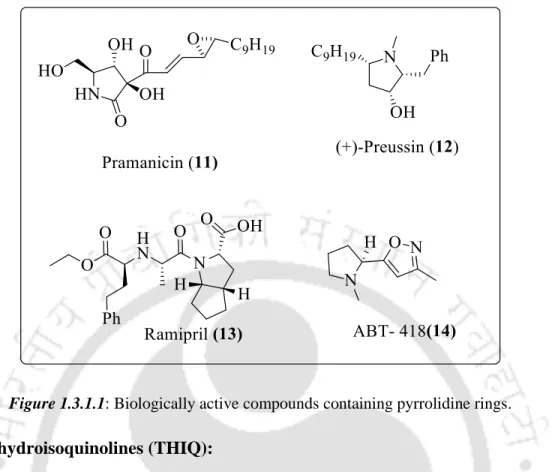
- Importance and applications of N-heterocycles
- Pyrrolidines
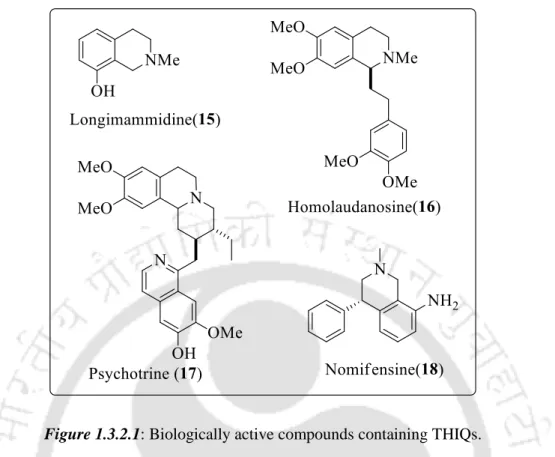
- Tetrahydroisoquinolines (THIQ)
- A brief reviews and discussions on the synthesis of nitrogen and oxygen containing heterocyclic compounds
- Prins cyclization
- Oxa-Pictet-Spengler reaction
- Oxonium-ene reaction
- Hetero Diels-Alder (HDA) reaction
- Metal salts catalyzed cyclization reaction
- References
Therefore, it is considered one of the versatile methods for the synthesis of heterocyclic compounds (Figure 1.4.3.1)32. The synthetic utility of the strategy was further extended towards the synthesis of the natural product (±)-angusturein.
Section A
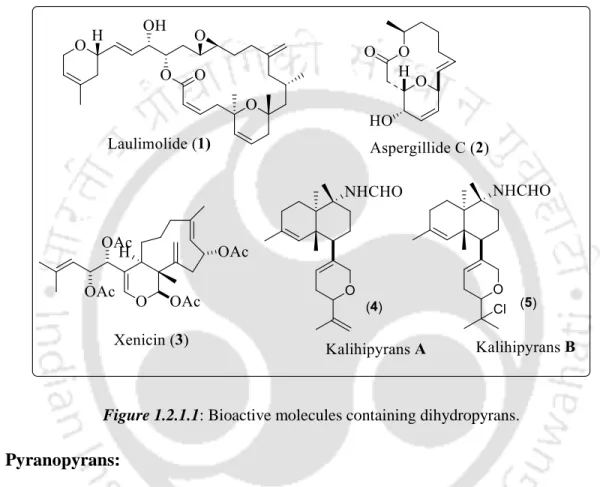
2A.1. Importance and applications
2A.2. Literature Methods
2A.3. Present strategy and objective
2A.4. Results and Discussions
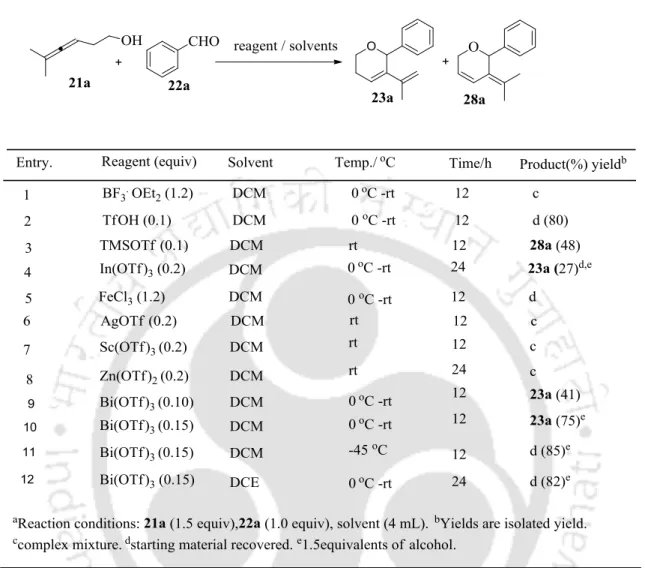
After completion of the reaction, the reaction mixture was concentrated and further purified by column chromatography (Hexane:EtOAc:: 9:1) to give the allene ester 27. Further screening of the reaction with other reagents such as TMSOTf (10 mol%) in dichloromethane at room temperature afforded 28a in 48% yield.
2A.5. Conclusion
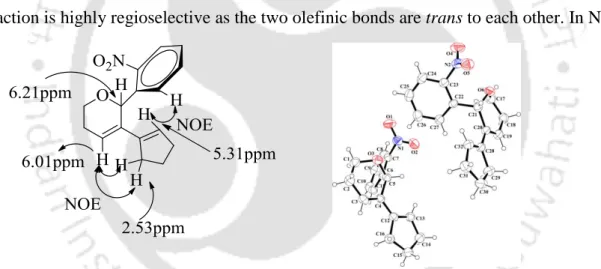
From these perspectives, it can be seen that the two olefinic bonds are mutually displaced and that the reaction is highly regioselective. The Lewis acid activates the carbonyl group of aldehyde 22 for nucleophilic attack by alcohol 21 to form acetal A .
2A.6. Experimental Section
2A.7. Charactererization Data
2A.8. Representative Spectra
2A.9. References
Section B
2B.1. Introduction and applications
2B.2. An Overview of Relevant Synthetic Methods
In 2008, Willies and co-workers synthesized a transfused pyranopyranones 7 from methyl (4E,7R)-7-hydroxyoctanoate (5) via intramolecular Prins cyclization with various aldehydes 6. Subba Reddy and co-workers described a method for oxidative Prins cyclization reaction for the synthesis of trans- and cis-fused hexahydro-2H-furo[3,2-c]pyrans and octahydropyrano[4,3-b]pyrans 9 in good yields with an excellent stereoselectivity mediated by DDQ and In(OTf )3 (Scheme 2B. 2.2). Develops cyclization in the presence of stoichiometric amounts of DDQ and SnCl4 via benzylic C-H bond activation to give the corresponding trans- and cis-fused hexahydro-1H-benzo[f]isochromenes 11 in good yields with complete stereoselectivity.7.
The reaction was catalyzed by TMSOTf and the minor cis-condensed isomer can be readily separated by column chromatography.8. Liu and co-workers reported the asymmetric synthesis of bicyclic O,O-acetals (19 and 20) from racemic lactols 16 and nitroenine 17 via asymmetric organocatalysis and gold catalysis in a sequential process as shown in Scheme 2B.2.4.9.
2B.3. Present Objective and Strategy
2B.4. Results and Discussions
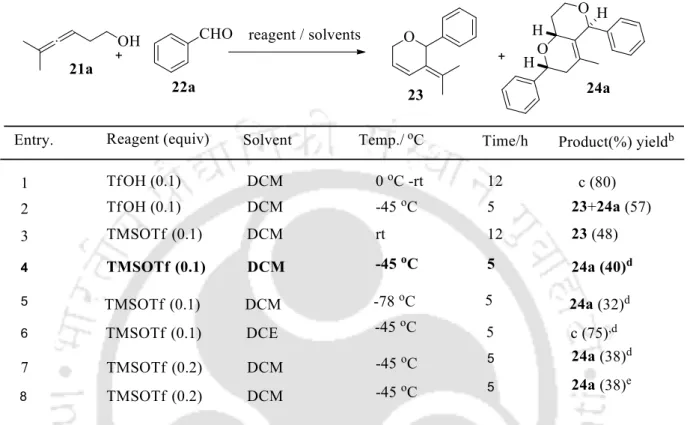
With the optimized condition in hand, the extent of the reaction was investigated using different types of aldehydes and β-allenols as summarized in Table 2B.4.3.1. Reaction of 4-cyclohexylidenebut-3-en-1-ol (21c) with aldehydes with electron-withdrawing groups and electron-donating group on the aromatic ring afforded the corresponding pyranopyrans in moderate yields. It was observed that substrates with strong electron-withdrawing groups on the aromatic ring of the aldehydes gave better yields than moderately electron-withdrawing and electron-donating groups on the aldehyde ring.
Further reaction of alcohol 21d with both electron donating and withdrawing groups on the aldehyde ring also yielded the desired products. The reaction of β-allenol 22b with aldehyde 22d gave an isomer mixture of 25b and 25b' with a corresponding ratio of 2:1 in an overall yield of 68%. The substrate 22b does not appear to be a good substrate for the synthesis of a tricyclic compound, as shown by the reaction of 22b with 22c, which yields 25c in 58% yield (Scheme 2B.4.3.1).
This unusual behavior of 22b may be due to the presence of a five-membered ring in the tricyclic ring, which destabilizes the overall configuration of the molecule.
2B.5. Mechanism of the reaction
Similarly, the five-membered cyclic β-allenol (22b) was also not found to be a good substrate for the formation of. To prove the formation of compound 24 from compound 25 via intermediate 25', compound 25 (preparation and analysis see previous section A) was reacted with another aldehyde under similar conditions and it was observed to obtain pyranopyrans 24 in moderate yields (Scheme 2B.5.2).
2B.6. Structure and stereochemistry of the pyranopyrans
Therefore, the HOMO of the diene interacts with the LUMO of the dienophile to give the desired regioisomers.10. The observed diastereoselectivity of the reaction is due to the formation of a more stable transition state A, where there is less steric repulsion between the cyclohexenyl group of the dihydropyran and the hydrogen of the aldehyde group, compared to transition state B, which experiences strong steric repulsion between the cyclohexenyl ring of the dihydropyran and the aryl group of the aldehyde (Scheme 2B.6.1.1). Therefore, the desired products under these conditions could be 24 or 27, with protons at C-9H, C-10H, and C-17H being entirely in cis configuration.
The diastereomer 27 is not stable due to the presence of steric repulsion between the cyclohexyl ring and the aryl group at the C-20 position.
2B.7. Conclusion
2B.8. Experimental section
2B.9. Charaterization Data
2B.10. Representative Spectra and crystal parameters
2B.11. References
Stereo- and Regio-selective Synthesis of 4-Vinylpyrrolidine from N-Tethered Alkyne-Alkenol
Importance and applications
Literature Methods
Lewis acids such as FeCl39 and InCl310 are used for the cyclization of N-linked alkyne-alkenol and C-linked alkyne-allyl bromide, respectively. In 2006, Cook and co-workers reported indium(III) chloride as an efficient catalyst for the cyclization of C-bonded allylic halides and alkynes in 1,6 positions 5 . Mechanistic evidence supports a cationic reaction pathway with Lewis acid activation of the allylic halogen and concomitant nucleophilic attack by the alkyne and trapping with halide led to atom transfer cyclization products 6 (Scheme 3.2.1).10.
Yeh and co-workers reported a gold(I)-catalyzed cycloisomerization reaction of N-linked alkynalkenol 7 to afford alkenylpyrrolidines 8 in good yields as shown in Scheme 3.2.2.12. In 2012, Yeh and co-workers also described a mild and efficient FeCl3-mediated synthesis of azaspiro[4.5]cycles 10 from cyclic N-linked enynols 9 (Scheme.3.2.3). In this reaction, FeCl3 acts as both the Lewis acid and the chloride nucleophile for the cyclization/chlorination reaction.
The method is highly diastereoselective and produces only (Z)-4-(arylchloromethylene)-substituted azaspirocycles in good to excellent yields.9.
Present strategy and objective
Results and discussions
- Preparation of N-tethered alkyne alkenol
- Optimization studies
- Substrate scope of the reaction
- Stereochemistry of the N-vinyl pyrrolidines
- Plausible mechanism of the reaction
Addition of an external chloride source, TMSCl, did not affect the yield but decreased the Z-selectivity of the reaction. Therefore, 1.1 equivalents of InCl3 in DCE at 80 oC stand out as the optimal condition for the reaction. With these optimized conditions, we further investigated the extent of the reaction and limitations with different substrates (Table 3.4.3.1).
The reaction works well for both alkyl and aryl groups on the alkyne side chain and affords cyclized products in good yields. Substrates with electron-donating and moderately electron-withdrawing groups on the aromatic ring of the alkyne side chain gave desired products in good yields. Steric effects play a significant role in the yield of the reaction as reflected in substrates 11i and 11j which gave low yields compared to other substrates.
This may be due to the lower stability of the carbocation intermediate D (where R = H, Scheme 3.4.5.1) formed during the reaction.
Conclusion
Experimental Section
- General Information
- Representative procedure for the synthesis of vinyl pyrrolidines (12a-j)
Characterization Data
Representative Spectra
1H NMR and HRMS spectra of compounds 12d-Cl and 12d-Br (reaction performed with InBr3 in ClCH2CH2Cl).
Synthesis of 4-vinyl-1,2,3,4-tetrahydroisoquinoline from N-linked benzyl-alkenol catalyzed by indium(III) chloride: Formal synthesis of (±)-isocyclocellabenzine.
Importance and Applications
An overview of literature methods
Over the year, several synthetic strategies have been developed for the synthesis of tetrahydroisoquinoline derivatives. The reaction followed a simple series of five steps and then an intramolecular Heck cyclization reaction took place.10 (Scheme 4.2.1). In 2009, Bandini and co-workers reported a FeCl3-catalyzed cyclization reaction of electron-deficient arenes with π-activated alcohols 7 and it provided access to the synthesis of a series of tetrahydronaphthalenes, tetrahydroisoquinolines and tetrahydrobenzo[d]azepines with tertiary benzylic stereocenters in excellent yields (up to 92% ).11 (Scheme 4.2.2).
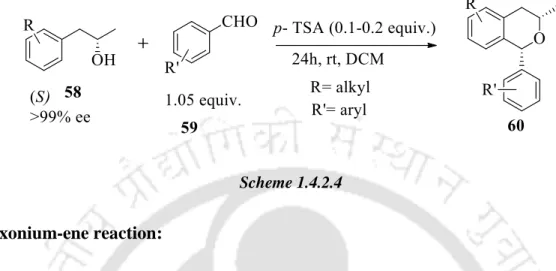
In 2014, Perumal and co-workers reported a palladium-catalyzed, highly regio- and stereoselective 6-exo-digger and 7-endo-digger cyclization of functionalized alkynes (9 and 11) to give (E) -4-(isobenzofuran-1 (3H)-ylidene)-1,2,3,4-tetrahydroisoquinolines 10 and aze/oxepinindoles 12 respectively (Scheme 4.2.3).12. An efficient method for the synthesis of tetrahydroisoquinoline derivatives 15 was reported by Menéndez and co-workers via a one-pot reaction of amide-type compounds 13 (including carbamates, amides, ureas and diketopiperazines), aldehydes 14 and p -toluenesulfonic acid 1 . (Scheme 4.2.4).
Present strategy and objective
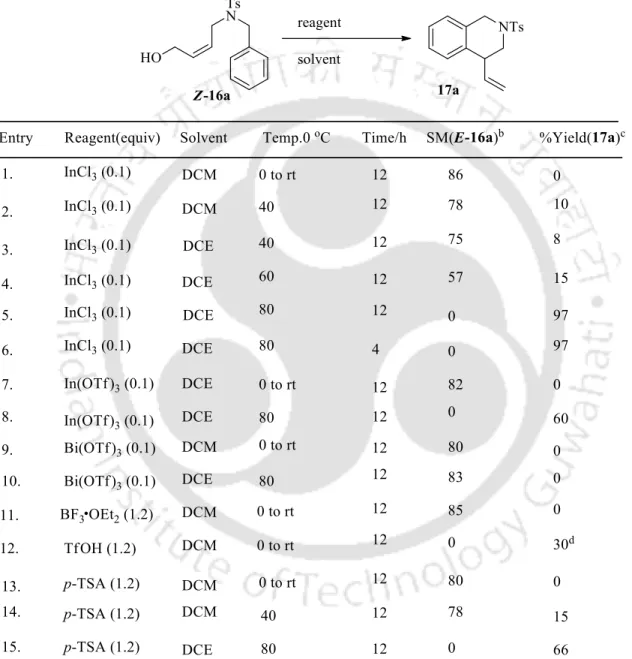
Based on these literature methods and previous reports from our group, we predicted that the N-linked benzyl-alkenol cyclization reaction could afford tetrahydroisoquinoline derivatives functionalized with the exocyclic vinyl group in high regioselectivity. Thus, in this chapter, the synthesis of vinyl-substituted tetrahydroisoquinoline derivatives via InCl3-mediated Friedel-Crafts reactions using N-linked benzyl-alkenol is described. The vinyl functionality is further used for the synthesis of tetrahydroisoquinolin-4-yl)ethanol. , a precursor for the synthesis of an alkaloid, (±)-isocyclocellabenzine. (Scheme 4.3.1).
Results and Discussions
- Preparation of benzyl alkenols
- Optimization studies
- Substrate scope of the reaction
- Stereochemistry of the vinyl tetrahydroisoquinoline
- Mechanism of the reaction
- Formal Synthesis of (±)-Isocyclocelabenzine
We examined the substrate size and limitations of the reaction (Table 4.4.2.1) with the above reaction condition (Scheme 4.3.1). However, with the variation of the electronic effect in the aromatic ring, the yields of the reaction also varied. This may be due to the interaction of the Lewis acid with the oxygen of –NO2 and -OMe, respectively.15 On the other hand, a substrate with a strongly electron-withdrawing –CF3 group in the benzene ring gave an 80% yield.
But we got two isomeric products in the case of meta-substituted benzene ring due to the availability of two sites for C-alkylation. In NMR spectroscopy of compound 17a, there is a peculiar peak of the exocyclic vinyl protons ppm (m, 2 H ppm (m, 1 H)), which determined that the obtained compound is different from the starting material 16a and the formation of vinylisoquinolines. The tosyl group of the amine was detosylated using Mg/CH3OH to give the precursor 22, which can be further used for the synthesis of (±)-isocyclocelabenzine 23.18 The formation of the precursor 22 can be explained from both proton and carbon NMR spectra .
In the proton NMR spectrum, the singlet peak at 3.11 ppm for the –CH3 group of the toluenesulfonamide disappeared and a broad singlet of two protons at 3.91 ppm for both –OH and –NH groups appeared.
Conclusion
We started with compound 16a, oxidizing its vinyl functionality using hydroboration and oxidation techniques, giving the primary alcohol 21 80%.17 The proton NMR spectrum of compound 21 shows the disappearance of three vinyl protons at 5 ,0-6.0 ppm and the appearance of a broad singlet peak at 1.34 ppm confirms the hydroxyl group. In the 13C spectroscopy, the disappearance of four peaks of the toluene sulfonamide group from the aromatic region also concluded the formation of detosylated product.
Experimental Section
- Instrumentation and characterization
Charactererization Data
Representative Spectra and Crystal Parameters
![Figure 2. NOE and X-ray crystallographic structure of Dimethyl 4,4'-((1S*,4aR*,6R*,6aS*)- 4,4'-((1S*,4aR*,6R*,6aS*)-1,3,4,4a,6,6a,7,8,9,10-decahydropyrano[4,3-c]isochromene-1,6-diyl)dibenzoate](https://thumb-ap.123doks.com/thumbv2/azpdfnet/10554592.0/11.892.146.738.368.521/figure-noe-crystallographic-structure-dimethyl-decahydropyrano-isochromene-dibenzoate.webp)