THE GLOBAL THEME PARK INDUSTRY
b) Futuroscope, c) SeaWorld Orlando, d) Coney Island
THE GLOBAL THEME PARK INDUSTRY
Salvador Anton Clave
www.cabi.org
CABI Head Office CABI North American Office Nosworthy Way 875 Massachusetts Avenue Wallingford 7th Floor Oxfordshire OX10 8DE Cambridge, MA 02139 UK USA Tel: +44 (0)1491 832111 Tel: +1 617 395 4056 Fax: +44 (0)1491 833508 Fax: +1 617 354 6875 E-mail: [email protected] E-mail: [email protected] Website: www.cabi.org
© S. Anton Clave 2007. All rights reserved. No part of this publication may be reproduced in any form or by any means, electronically, mechanically, by photocopying, recording or otherwise, without the prior permission of the copyright owners.
A catalogue record for this book is available from the British Library, London, UK.
A catalogue record for this book is available from the Library of Congress, Washington, DC.
ISBN-13: 978 1 84593208 4
Translated by Andrew Clarke
Typeset by AMA DataSet Ltd, Preston, UK
Printed and bound in the UK by Biddies, Kings Lynn.
Contents
Acknowledgements xi Introduction xiii I. The Development of Theme Parks 1 1. The Social Origins of the Theme Park Concept 3 1.1. The Heritage of the European Garden Design 5 1.2. Lessons from the Universal Expositions 8 1.3. Amusement Parks'Entertainment Background 12 1.4. The Language of the Cinema 16 Case 1. The New World in Singapore, an Early 20th-century
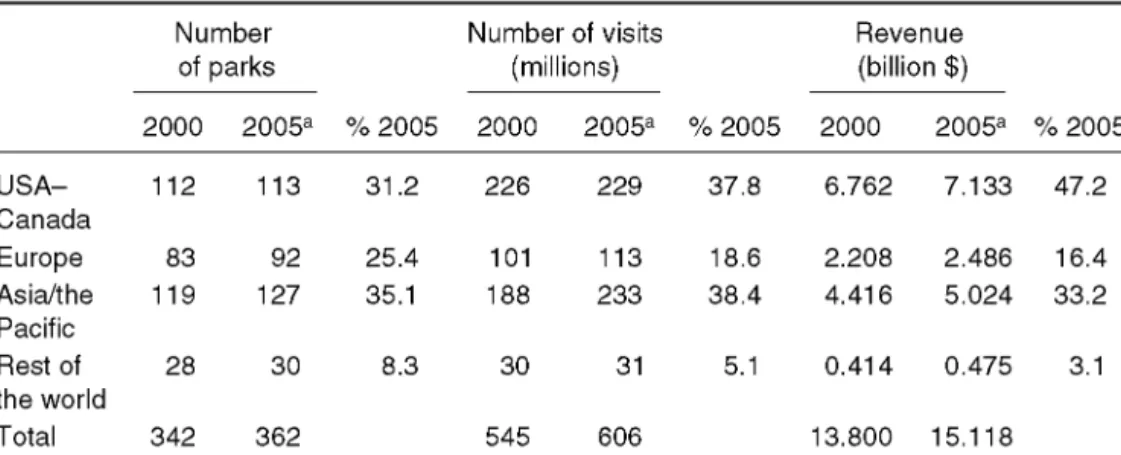
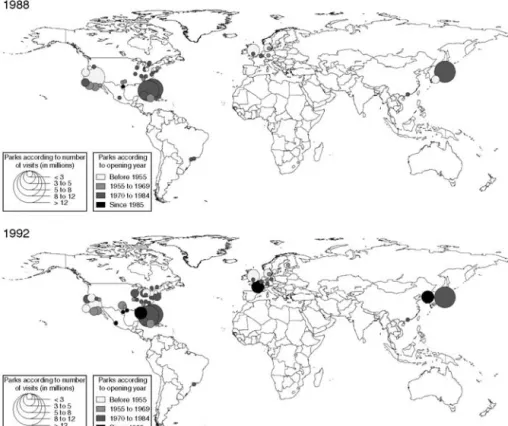
Amusement Park in Asia 18 2. Development and Categorization 21 2.1. The Invention of Theme Parks 22 2.2. The Nature of Theme Parks 2 7 2.2.1. Definition and types 28 2.2.2. The concept and the utilities of the themes 32 2.3. The Social Bases of Success 37 2.4. Synergies with the Media Entertainment Industry 41 Case 2. Efteling, the Best Childhood Memories for Everyone 43 Case 3. Huis ten Bosch, a Replica of the Dutch World in Japan 44 Case 4. Cedar Point, the Roller Coaster Capital of the World 45 3. Globalization of the Theme Park Industry 48 3.1. Location Tendencies of Theme Parks in the World 49 3.2. The Diversification of the Industry in the USA 56
v
3.3. The Transformation of the Amusement Park
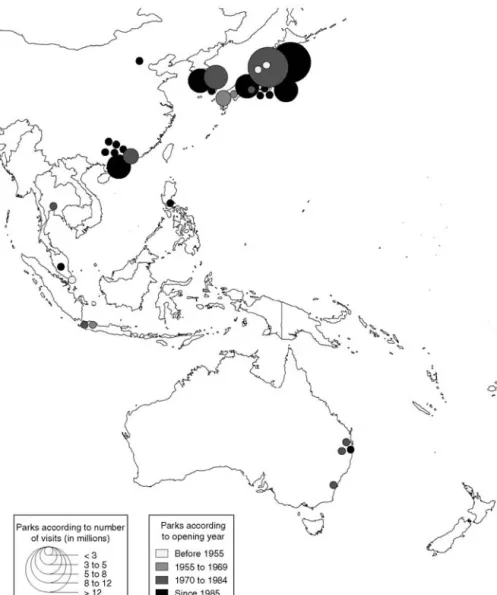
Model in Europe 64 3.4. The Growth of the Markets in Asia/the Pacific 72 3.5. The Proliferation of Initiatives in the Rest of
the World 85 Case 5. The Recent Growth of the Theme Park Industry
in Brazil 90 4. A Profile of Major Theme Park Operators 93 4.1. The Role of the Large Operators in the USA 94 4.1.1. Disney's integral strategy 98 4.1.2. Six Flag's orientation to regional markets 106 4.1.3. The positioning of Universal as an operator of
destination parks 112 4.1.4. The consolidation of Cedar Fair as an operator
of regional parks 121 4.1.5. Anheuser Busch's corporate strategy 124 4.2. The Emergence of Regional Operators in the
Rest of the World 128 4.2.1. The development of transnational groups
in Europe 129 (A) The Tussauds Group 130 (B) Merlin Entertainment 131 (C) GrevinetCie 133 (D) Parques Reunidos 136 4.2.2. The diversity of operators in Asia/the Pacific 137 (A) Oriental Land 138 (B) Samsung Everland 139 (C) China Travel International Investment 142 (D) Village Roadshow Ltd 145 (E) Sanrio Company Ltd 146 4.2.3. The uniqueness of the CIE in Latin America 147 Case 6. The Family-run Europa Park 149 Case 7. A Chocolate-related Entertainment Destination in
Hershey, Pennsylvania 151 Case 8. Suncity, Entertainment and Property Development in
Malaysia 153 II. Theme Parks in the Entertainment Society 155 5. Theme Parks and the Commercialization of Leisure 157 5.1. Commercial Access to Entertainment 160
5.1.1. Consumption as a distinguishing factor of
contemporary leisure 161 5.1.2. The multiplication of themed leisure
environments 166 5.2. The McDonaldization Paradox 170
5.3. Disneyization as a Model 177 5.3.1. The components of Disneyization 180 5.3.2. Interpretations from postmodernity 183 Case 9. The Ecohistorical Parks of Grupo Xcaret 187 Case 10. The Globalization of Leisure and the
Sesame Street Characters 189 6. The Urbanism of Theme Parks and Spatial Innovation 191 6.1. The Urban Singularity of Parks 192 6.1.1. The spatialization of the imagination 193 6.1.2. Technology at the service of creation 195 6.2. The Corporative Urbanism of Leisure Complexes 198 6.3. Parks as a Referent for Planning 201 6.4. The Scope of Spatial Innovation 209
6.4.1. The privatization of development and the
challenge of the public use of space 210 6.4.2. The invention of the landscape and the
challenge of the identity of the territory 215 Case 11. The Creation of a Leisure Destination in Dubai 221 7. The Impact of Theme Parks 224 7.1. Parks in Regional and Urban Planning 225 7.2. The Effects on the Local and Regional Economy 233 7.2.1. The economic impact of theme parks 235 7.2.2. Parks and regional development 238
(A) Busch Gardens Europe
(Virginia, USA) 240 (B) Futuroscope (France, Europe) 243 7.2.3. Parks and tourist development 246 7.3. The Environmental Impact of Theme Parks 250 7.4. The Social and Cultural Effects of Parks on
Local Communities 257 7.4.1. Theme parks and social cohesion 258 7.4.2. The effects of parks on local culture 261 Case 12. Environmental Protection Measures in the
Redevelopment of Ocean Park 264 Case 13. The Grand Pare du Puy du Fou and the
Valorization of the Local Heritage 268 Case 14. The Enhancement of the Urban Landscape at
International Drive, Orlando 270 8. The Development of Theme Park Destinations 272 8.1. Theme Parks and Economic Development in Orlando 273 8.1.1. The role of Walt Disney World as a catalyst 275 8.1.2. Orlando besides the parks 283 8.2. Disneyland Paris and the Planning of Marne-la-Vallee 285
8.2.1. The creation of Disneyland Paris in
Marne-la-Vallee 291 8.2.2. The role of Disney in Val d'Europe 293 8.2.3. The economic impact of Disneyland Paris 297 8.3. The Emerging Entertainment Economy of the
Greater Pearl River Delta 299 8.3.1. Hong Kong's tourism and leisure project 303 8.3.2. Park development in the Shenzhen Special
Economic Zone 306 8.3.3. The role of Macau in the tourism system of
the Pearl Delta 309 Case 15. The Transformation of PortAventura into a
Tourist Destination 310 III. Fundamentals of Theme Park Development
and Management 315 9. Factors Influencing the Development Process 317 9.1. The Nature of a Theme Park as a Recreational Product 318 9.2. The Locational Factors in Theme Park Development 321 9.2.1. The size of the market 322 9.2.2. The characteristics of the place 329 9.2.3. The support of the public sector 334 9.3. The Business Environment as a Factor of Success 337 Case 16. Effects on Attendance of the Addition of a
New Gate in a Multipark Destination 341 10. Basic Principles of Theme Park Planning 343
10.1. Project Development 344 10.1.1. The design of the master plan 345 10.1.2. The management of the development process 348 10.2. Project Viability 351 10.2.1. The planning of services and operations 352 10.2.2. The forecasting of operating measures 355 Case 17. Access for the Disabled at Disneyland Paris 363 11. The Architectonic Design of a Theme Park 365 11.1. The Form 366 11.2. Size and Capacity 369 11.3. Flows and Transport Systems 370 11.4. Components 374 11.4.1. The attractions and the shows 375 11.4.2. The services (food and beverages and shops) 381 Case 18. A Flow Management Model to Optimize
Retail Profits at Universal Studios Hollywood 383
12. Management Strategies 12.1.
12.2.
12.3.
12.4.
Case Case
Operations Management
12.1.1. The logistics of operations (A) Production
(B) Procurement and distribution (C) Maintenance
(D) Safety
12.1.2. The documentation of processes 12.1.3. Quality assurance
Human Resources Management 12.2.1. The hiring process
12.2.2. Employee loyalty strategies Marketing Strategies
12.3.1. Marketing plans (A) Product (B) Price (C) Promotion (D) Place
12.3.2. The role of new techonologies Operators' Corporate Social Responsibility
19. The Safety of the Attractions at Six Flags Parks 20. The International Association of
Amusement Parks and Attractions
385 389 391 391 392 393 395 396 398 400 403 407 409 411 412 414 415 417 417 419 424 426 Bibliography 429 Index 448
About the Author
Salvador Anton Clave (PhD) is Senior Lecturer in Tourism Geography at the University Rovira i Virgili in Catalonia, Spain. His research interests have focused on leisure and tourism planning and development. He has authored and co-authored a number of books and many academic papers in this field. Currently, he is a director of the Tourism and Leisure University School and of the Science Park of Tourism and Leisure at the University Rovira i Virgili.
Acknowledgements
Writing this book would not have been possible without the collaboration and support of a great many people and organizations. First of all I would like to thank those anonymous referees of programmes for research at the Direccio General de Recerca de la Generalitat de Catalunya - Department of Research of the Autonomous Government of Catalonia — who have on three occasions awarded me with funds to carry out research periods in the USA in order to study the dynamics, evolution and impacts of theme parks. Without grants 1998BEAI400248, 1999BEAI00193 and 2001BEAI400048 from the Generalitat de Catalunya and my warm wel- come by Briavel Holcomb at the Bloustein School of Planning and Public Policy at Rutgers, the State University of New Jersey in New Brunswick and, on several occasions, by Donald E. Hawkins and Kristin Lamoreaux at the International Institute of Tourism Studies at the George Washington University in Washington, DC, the research leading up to the writing of this book would never have materialized. I also wish to thank Nacima Baron-Yelles for providing me with perfect working facilities at the Institut Francilien d'Ingenierie des Services at the Universite de Marne- la-Vallee, in France.
Some of the numerous people with whom I have come into contact when writing this book have played a determining role. Here I would spe- cifically mention Michael D. Beyard, who, from his office in Georgetown provided me with access to some of the main corporations that operate theme parks in the USA and throughout the world. Similarly, without the collaboration of Frank P. Stanek, from Los Angeles, and of Richard M.
Jackson, in Orlando, my ability to comprehend the phenomena associated with the development of theme parks would have been greatly limited.
I also convey my thanks to the International Association of Amusement Parks and Attractions seated in Alexandria for having put all of their avail- able resources at their documentation centre at my disposal. A great many
xi
others - management staff from parks, local and regional government pro- fessionals, and researchers - have received me at some time or another while devoting my time to the writing of this book. I thank all of you for responding to my needs for information, comment or guidance.
Thanks also to my colleagues of the Research Group into Territorial Analysis and Tourism Studies at the Department of Geography at the Rovira i Virgili University in Tarragona. I would like to make a special mention of Josep Oliveras - from whom I have received continuous sup- port during the elaboration of this work - and of Jordi Blay - who has pro- vided me with everything during fieldwork stays. I would also like to thank Xavier Culebras for preparing the figures I have incorporated into the text. Neither can I overlook the innumerable comments that have been made to me over the years I have devoted to the study of theme parks by the pupils and colleagues of the different universities at which I have had the chance to present the results of my research and from the profession- als of the sector who have given me the possibility to debate my break- throughs and appraisals concerning the social reality of theme parks with them. In this sense, I want to thank specifically the staff and management of PortAventura - particularly Lluis Rullan and Mercedes de Pablo - for their support and interest.
Although the structure and contents differ, this book has its precedent in a previous work I have written, which was published in Spanish by Ariel publishers of Barcelona, entitled Parques temdticos. Mas alia del ocio (Theme Parks. Beyond Leisure) in 2005.1 thank them for allowing me to use the previously published work as a basis for the drafting of this new book. Thanks also to Greg Richards and Julie Wilson because, aware of my work on theme parks, it was they who encouraged me to prepare this new work in the English language. Finally, I would like to thank most espe- cially Andrew Clarke for his painstaking labour in preparing the transla- tion of the new original manuscript into English. Logically, the final work has greatly benefited from the suggestions made by the reviewers. A task such as this requires time and dedication. This is why, in finishing, I would like to thank my friends, my family and, in particular, my wife Maria Angel, for their enthusiastic support and encouragement throughout the time I spent preparing the original.
Vila-seca, June 2006
Introduction
This book sets out to achieve three basic aims. In the first place it deals with defining and explaining the development and characteristics of the theme park industry on a global level and, from this point of view, offers the ele- ments necessary for the understanding of their nature and functioning as spaces for entertainment with specific meanings. It is, above all, an explan- atory book, containing real data as to the characteristics, the growth and the effects of the theme park phenomenon. Thus, it is a book whose primary aim is to try to understand why, as Tuan (1998) stated, theme parks are seen by their visitors as places through which to temporarily 'escape' from the conditions and worries of their everyday lives. In the second place, this book takes an analytical approach to the role played by theme parks in the social construction of space. Hence, on the basis of the analysis of its terri- torial effects, it deals with cultural trends, the dynamics of social change and local and regional development. It also presents the interests put into play by the agents participating in the development process of parks, the competitive instinct of the corporations that promote them and the strate- gic use they make of their resources and possibilities. Therefore, the book presents a debate as to the role of parks in the commodification of leisure and the social scope of their models of the creation of experiences. Finally, the third aim of this book is to look at the main conceptual, strategic and operative aspects which must be known about for the development and management of a theme park. An explanation is given as to the specificities that need to be taken into account during the planning stage, the condition- ing factors that may affect their development, the characteristics and com- ponents of their layout as well as the main key aspects that contribute to the successful management and operation of a theme park.
This is a book which aims to arouse reflection and debate. Bearing their complexity and diversity in mind, it tackles the reality of theme parks.
Its contents are set out along three principal axes: on the one hand, the
xiii
theoretical reflection inherent in the academic work; secondly, the analysis of the reality on the basis of specific case studies; and finally, operative information, that is to say, the explanatory and informative elements, data, maps, tables and graphs that allow one to comprehend the reality of the activity rather than a mere interpretation thereof. This has in fact been a challenge, given the common practice in the study of theme parks of writ- ing and interpreting while presenting hardly any data - very little empirical substance, that is to say.
Before moving on, I cannot fail to mention right from the outset that it has not been an easy task to deal with such matters taking theme parks as the 'object' of study. There are three reasons why this has been so. The first is that this book refers to a reality which - normally - in a great many parts of the world many people usually assimilate only in terms of 'I like it' or 'I don't like it'. Needless to say, in this sense, many people have their opinion of parks in their capacity as users - based, in addition, on something as dif- ficult to argue with as their 'emotions' or their 'perception' - and that the interpretations made in this book may clash head-on with their most imme- diate intuition. Secondly, difficulties increase when, undervaluing their real territorial, economic, social and personal effects, it may be stated that a certain intellectual aversion exists to the scientific treatment of a subject, that of theme parks, and of consumerist leisure in general, which many aca- demics tend to consider as either 'superficial' or 'little engaged'. Finally, a third difficulty is due to the fact that, in the same way as there are pro-park approaches, anti-park approaches also exist. To this end, we cannot forget that the academic contributions themselves to the analysis of theme parks made by French social theory and North American cultural studies have normally been highly critical of theme parks as artefacts of mass consump- tion, especially critical of Disney. However, the question that must be asked, as Marcus (1997) maintains, is whether the critical discourse that underlies the arguments put forward in academic books and journals (even in some semiological works with so much predication that they are cited in this book, such as Eco and Baudrillard) really goes beyond what an every- day conversation may provide.
Why Write a Book on Theme Parks?
Theme parks are liked by many people and this in itself is reason enough to try to understand why and to learn from them and interpret their effects.
Their success defies the social scientists to assume a positive attitude and accept their existence, leaving aside merely ideological standpoints.
Conversely, one must ask oneself what it is that leads our society to seek elements of escapism by means of parks and why they have become promi- nent elements of what Lefebvre denominates 'the second circuit of capital', that is to say, investment in real estate, urban development and the shaping of new social and economic elites (Gottdiener et al, 1999). Similarly, one must also ask oneself why parks have managed to be, in fact, more meddlesome
and subtle in their capacity for ideological penetration than any Marx or Mao could ever have conceived (Barber, 1996, 129). Understanding this requires serious study.
Posing a scientific discourse about theme parks therefore means try- ing to understand their meaning and function in the society of today and of the future. From this perspective, this book is an attempt at participat- ing in the incipient tendency which Holt and Schor (2000, x) detect among academics of being increasingly attentive to the questions con- cerning the nature of society and consumption and of transferring such content to the channels pertaining to academic debate.
I agree with Lynch when he states that the field of the study of leisure and its practice cannot allow itself to bury its head in the sand and shun the kingdom of global, commercial and consumer leisure. To do so would, according to his standpoint, avoid most of what a huge number of people do in and for their leisure. There exists the need to be committed to the com- mercial and consumerism, to study them, understand them, influence and legislate them, and to make the most of the advantages they may offer (Lynch, 2001, 201). On the other hand, it cannot be forgotten that, in the same way as for Venturi et al. (1972), understanding the content of Pop mes- sages in the Strip of Las Vegas and their means of projection 'does not mean that one need agree with, approve of, or reproduce that content', understand- ing the keys to a park's functioning, which are creations that appeal intelli- gently to our deepest emotions through elementary proposals, does not mean that their analysis should be the equivalent of predicating the universal exemplariness of the model of the creation of leisure experiences they pose.
The basic point which arises from this work is that theme parks cannot be only considered as mere spaces for entertainment and recreation or mere tour- ist attractions. Regardless of the size and scope of theme parks, they represent and give shape and sense to the societies in which they exist. By selectively interpreting the reality, transferring emotions and feelings from the personal to the commercial sphere and generating specific spaces of control and transgres- sion, parks, in their capacity as organizations visited by millions of people each year, say a lot about us, about our cultural needs and imperatives, about our collective resignations and, of course, about our ideals and our frus- trations. Now, as Barber (1996, 129) suggests, it should not be forgotten that theme parks as a metaphor are seated on theme parks as a material and spatial reality. It is in this sense, therefore, that studying the role of parks in the social construction of space acquires relevance. As Minca (1996, 2) says, space 'is acquiring unprecedented importance' in the evolution of social thought. This is so because it is the environment in which social groups - with their con- flicts, tensions and dominations - materialize their preferences.
What is Known about Theme Parks?
Davis (1997) notes a variety of emphases, some contradictory, in the aca- demic analysis of theme parks as of the mid-1970s in the USA. Initially,
academic studies - largely focusing on Disney - were critical of theme parks as a characteristic result of North American economic policy.
Intensely influenced by the popular radicalism of the end of the 1960s, Schiller (1973) was probably the first analyst to criticize the supposed stance of innocence and neutrality of Disney entertainment products.
However, this approach is abandoned and, as of the 1980s forks into two currents. On the one hand, the social historians begin to tackle theme parks from the angle of the analysis of changes in consumer tendencies during society's leisure time and they take an interest, from this stand- point, in the history of theme parks (Adams, 1991). On the other hand, the interpretation of theme parks as narrative and textual scenarios becomes generalized. In this way, anthropologists and semiologists treat theme parks as supposedly paradigmatic spaces of the postmodern era (Eco, 1989).
The acceleration of consumption and its pre-eminence as an economic motor as of the 1980s, together with the manifestation of the crudest aspects of the structural crisis facing North American cities, arouses architects, urban planners, geographers and sociologists to take an interest - now as of the 1990s - in theme parks from the perspective of the relationships between social life and the production of space. From this point of view, theme parks are more than just leisure spaces. They become the physical expression of society's desires as to its preferences for the city and offer alternatives to the conventional processes of urban construction, which is moving towards the corporate privatization of spaces and, in short, the redefinition of social space. However, this approach has led to diametri- cally opposed results. Thus, whereas Rebori (1995a, 5-6) maintains that the study of Disney presents numerous ideas and examples of applica- tions in the fields of planning, design, development and flow manage- ment, authors like Sorkin (1992a) use this same basis to criticize, by means of a journey through the principal scenarios of contemporary urban geography in North America (the 'analogical' cities of Atlanta, Calgary and Montreal, the West Edmonton Mall commercial area, the exopolis of Los Angeles or the utopia of Disneyland), the loss of public space or, at least, the confusion between the public and the private (Donaire, 1999).
In fact, one should not overlook the fact that the most relevant part of the bibliography existing to date on theme parks has mainly concentrated on Disney. This is logical when considering that authors with such pres- tige as Baudrillard (1998, 55) are capable of stating that 'if we believe that the whole of the Western world is hypostatized in America, the whole of America in California, and California in MGM and Disneyland, then this is the microcosm of the West'. In any case, Disney's dominance of the theme park industry brings about additional difficulties in the study of theme parks. As a symbol corporation of the process of the 'Americaniza- tion of the world', instigator of the expansion of consumer society and initiation rite of totalitarian capitalism (Aries, 2002, 8-9), Disney has generated a multitude of critical interpretations (among the most signifi- cant those of Klugman, Kuenz, Waldrep and Willis in 1995 under the
collective name of The Project on Disney, 1995), which have led to an impairment of the ability to interpret the theme park phenomenon beyond Disney. Thus, to cite one of the most recent in fierce argument against Disney's presence in France, Aries (2002, 24) justifies such pre-eminence when he said that 'it has turned along with McDonald's, IBM, Microsoft and Monsanto into one of the most important symbols of the capitalist globalization taking place'.
Now, in the same way as Disney parks have been characterized as 'stupid' and 'plastic' and, in the beginning, Disneyland was dubbed a 'national monument to vulgarity' opposed to any manifestation of art and architecture, other professionals have validated its achievements to the extent that they give lessons to both planners and to architects who have crossed the frontiers of parks and have been useful in the design of public spaces (Rebori, 1995b). Without a doubt, the success of parks as regards visitor numbers, their corporate achievements in such diverse fields as the media, technological innovation, creativity of entertainment or the setting of urban standards and, of course, their particular narrative con- structions and visions of society in themes such as gender, ethnicity and (local and global) history have made the Disney corporate conglomerate the favourite target of academics interested in the issue of theme parks.
However, without denying Disney's role, neither can it be overlooked that the analysis of theme parks only on the basis of the Disney experience gives rise to considerable bias.
In short, therefore, the question of theme parks is approached taking into consideration the fact that, as Donaire (1999) maintains, these kinds of hyperreal spaces are 'the quintessence of post-industrial society and its tensions'. From this standpoint, Rebori (1995a), for example, upholds the view that theme parks are a feast for interdisciplinary studies. As for Davis (1997, 3), she bases her magnificent study on SeaWorld in San Diego from the perspective that parks can be considered emblematic of urban spatial problems. Likewise, in an article on the opposition to cer- tain Disney projects in the USA, Warren (1996, 546) argues that theme parks are 'in fact a richly diverse landscape full of cultural contradiction not accounted for in theories of postmodern cities'. Parks, therefore, are seen to be significant from the point of view of the analysis of the relation- ship between society and space (Tuan and Hoelscher, 1997).
In any case, the growing literature on mass consumption and the development of recreational and tourist activities globally is giving rise to increased interest in the study of the social and urban implications of theme parks. So, for example, in Europe and from the angle of geography, Gazes (1988) even defined his study as the development of a new field of research. Nevertheless, it is also true that, besides a few excellent mono- graphs on specific parks such as the one by Davis (1997) on SeaWorld or detailed analytical work on Disney's effect on the urban development of Orlando (Foglesong, 1999) among others, there is still a long way to go as regards the knowledge of theme parks as spaces of mass consumption.
Issues such as their characteristics as a business, their effects on the
strategies of the creation of corporate spaces for public use, the transfor- mation of the local heritage and of the places themselves into standard- ized recreational products or the effect of their development on regional economies remain to be dealt with in depth.
How Was This Book Written?
Emulating landscapist Anne Whiston Spim (1998, 4) I can say that the parks themselves and their immediate surroundings are the primary data for the drafting of this book. Photographs, sketches and field books contain- ing notes written about sights, sounds, smells and thoughts are the first material source of the content of this work. Thus, still with the aim of offer- ing a global overview of the reality of theme parks as places for entertain- ment with a great capacity to catalyse economic and territorial processes in their immediate surroundings, what is true is that the considerations I make are based on fieldwork periods in the USA, fundamentally in Califor- nia, Florida and Virginia, and in Europe, in France, Germany and Spain.
The effect caused on the territory by PortAventura, which was inaugurated in 1995, precisely the same year in which I finished my doctoral thesis on the tourist urbanization of the Costa Daurada (Gold Coast of Spain) (Anton Clave, 1997), is without a doubt, in this context of references, what initially got me interested in the subject.
Therefore, the deliberations regarding theme parks that contribute to this book are as much based on the use of classic research techniques such as theoretical reflection and the analysis of indicators as that of personal document research concerning the principal places to which reference is made. As always, when the areas of theory and fieldwork are brought together and reality adopted as a laboratory, the number of questions is multiplied. In consequence, as is to be expected, it has proved more com- plicated to write this book than I could have imagined at first. Lanquar (1991, 4) neatly sums up some of the difficulties that derive from the very 'object' of writing. On the one hand, there is the peculiarity of scientific, technical and even commercial literature on this matter (with a great deal of knowledge amassed with the years of experience being kept as the property of the operating companies themselves and of design and plan- ning consultants and therefore outside the circuit of dissemination of knowledge and know-how). On the other hand, there is the futility of much of the promotional and journalistic material, which, due to the rapid changes that affect the sector, is rendered quickly obsolete. Finally, as Spirn (1998) also maintains, given that the in-depth interpretation of a landscape requires local knowledge, there is the difficulty involved in the appreciation of complex and distant territorial realities.
On the other hand, despite inevitably having the Anglo-Saxon, and especially North American, reality as points of reference, it cannot be overlooked that this book on parks is written from a perspective of a peripheral academic tradition - in this case European geography. To this
end it cannot be forgotten that studying theme parks from Europe means performing - as Keil (1994) shrewdly notes with regard to the differences that exist between the two urban realities - much reflection since the European and American social models, though similar, are not exactly the same. It may be timely to quote Baudrillard (1998, 123) at his most exqui- site when he states that:
[Europeans,] fanatics of aesthetics and meaning, of culture, of flavour and seduction, we who see only what is profoundly moral as beautiful and for whom only the heroic distinction of nature and culture is exciting, we who are unfailingly attached to the wonders of critical sense and transcendence, [find North America] a mental shock and a unique release to discover the fascination of nonsense and of this vertiginous disconnection.
It is as a result of these considerations that this book was construed with a unique structure. It consists of three parts. The first tackles the development process of theme parks. It reviews their background, it describes the process of their emergence in the USA as well as their orga- nization as a leisure product, it analyses their international expansion from the 1950s to the present and it introduces the main operators. The second part deals with the role of parks in the social development of space and their importance from the viewpoint of the analysis of social reality. Thus, some of the main debates are concentrated on transversally covering the concern held by authorities, international organizations, eco- nomic agents and citizens' groups. Issues are scrutinized such as the nature of parks' productive systems in the context of post-Fordism and postmodernism, parks' effects on thought, contemporary urban practice and their impact on local and regional and tourist development and the role enjoyed by some park complexes in the creation of specific tourist destinations. The book is rounded off with a third part devoted to the question of the fundamentals of planning and management that are to be borne in mind for the development and establishment of a park. Further- more, the book contains a bibliography and includes several brief analy- tical cases whose purpose is to illustrate, through the provision of solutions, how some specific theme parks have gone about achieving their own strategic and operative challenges.
Who Is This Book Written For?
To debate as to the role and social function of theme parks may help to facilitate the understanding of social and urban processes that are charac- teristic of both North America and Europe, Asia and, more incipiently, Latin America, such as the boom of shopping malls, the reconversion of heritage as leisure spaces, the gentrification of urban centres, the theming of consumption, the fragmentation of travel supply or the creation of gated communities - architectural spaces, all of them - which emulate the principles of design and operation of theme parks (Ritzer, 1999, 115).
On the other hand, it may also facilitate the proper interpretation of the future role of such spaces in a context in which, according to Holt and Schor (2000, vii-x), there are three factors that disquiet the current emer- gence of the consumer society. The first and most obvious is social inequality on any scale. Second is the growing transformation into a com- modity of an increasingly large part of life and social relations, even of those aspects which until recently had been kept outside the market, pre- cisely such as entertainment. In this sense, Aries is quite to the point when he says that we are heading towards the 'commodification of the lived experience: the sale of affection, sensations and feelings' (Aries, 2002, 218).
Finally, the third is the rapid globalization of the world economy.
It should not be forgotten that criticism of today's entertainment society even involves actions of protest that find mechanisms of expression in popu- lar anti-consumerism manifestos in the style of Naomi Klein's (1999) No Logo and which suggest the need to seek means to minimize inequality, escape from commodification and radically transform the meaning of global- ization. Hence the need to render the knowledge of the patterns and mecha- nisms of consumption in a 'research schedule' and, especially, in this schedule to consider the demands, options and behaviour of developed soci- ety with regard to leisure. The problem according to Veal (1998, 260) lies in how to carry out more than purely descriptive investigation and develop a satisfactory theory that is linked to broader theoretical ideas. In any case, applicable to the subject of theme parks is Britton's (1991, 452) appraisal of the geographical study of tourism when he states that 'it requires a more rig- orous core of theory in order to conceptualise fully its role in capitalist accu- mulation, its economic dynamics, and its role in creating the materiality and social meaning of places'. Only in this way is it possible to integrate his study into the front line of debate of the social disciplines.
Be that as it may, I believe, therefore, that it may be stated that through this book it is possible openly to comprehend the reach of the theme park phenomenon. I am of the understanding that through its study it is possible to learn about the pleasures and needs of today's soci- ety in developed countries and about leisure corporations' strategies as they strive to consolidate commercial access to emotions and feelings.
Tarkophilic' readers may discover, in short, that theme parks are, in addition to being a unique place for entertainment, a source of meaning and a suitable framework for the study of culture, space and technology.
Opponents to parks in their capacity as privileged spaces of the repro- duction of the capitalist system and paradigmatic examples of the renewed capitalist society, in which, as Debord (1967) announced, the spectacle is the great instrument of domination, may find this book helps their effort to understand the workings, dynamics and structures of the culture of global corporations and, therefore, a way to discover new use- ful tools to fight against them. All in all, paraphrasing Venturi et al.
(1972), it should be acknowledged that, as humans, we can learn 'from Rome and Las Vegas and from looking around us wherever we happen to be'. When all is said and done, defenders and detractors compete in the
market of ideas, attitudes and behaviours, and one as much as the other usually has valuable statements to make.
Lastly, I cannot help thinking that there is a wealth of information, knowledge and creativity that remains to be developed on the basis of the study of theme parks; important questions and approaches that have only been dealt with in brief. Therefore, new lines of research and study may open up both from within and from outside parks. At the end of the day, perhaps the most interesting thing about parks is that they convey to us the cultural, social and economic context of their development. In fact, this time paraphrasing Rifkin (2000, 298), while the wealthier are con- cerned with entertainment and creativity, millions of people live in pov- erty. My only hope is that the book will provide something different for those who are more knowledgeable of the subject and the odd novelty too - at least from an intellectual point of view - for those for whom the social and territorial implications of theme parks are quite unknown.
Likewise, if the book inspires others to join in and contribute to the study of this kind of leisure space, I shall consider the time I have dedicated to this pursuit well spent. For all of the above it is my desire, just as for Garcia Canclini (1995, 53), that this book should be read as if it were the start of a conversation between urban planners, geographers, anthropolo- gists, psychologists, sociologists, economists and the citizens themselves, precisely as to 'what it means to be citizens and consumers'.
I The Development of
Theme Parks
I fear that the productions of democratic poets may often be surcharged with immense and incoherent imagery, with exaggerated descriptions and strange creations; and that the fantastic beings of their brain may sometimes make us regret the world of reality.
(Alexis de Tocqueville, 1835) The concept of theme park cannot be detached, nowadays, from the idea materialized by Walt Disney when on 17 July 1955 Disneyland opened its doors in California. In fact, as Lanquar holds (1991, 11), with Disney came the birth of 'supermarkets of leisure, places for the production and con- sumption of free time, a flat-rate price, integrating technology and modern management and the arts and spectacles'. In any case, there is a whole world of theme parks beyond Disney. Because of that, this first part of the book analyses the dimensions and processes that have shaped the present system of theme parks throughout the world. Chapter 1 deals with the his- torical, cultural and social foundations on which today's reality of theme parks is built since the pre-modern fairs. Chapter 2 characterizes the emergence of theme parks as specific leisure spaces and their fundamen- tal features are set out. Chapter 3 tackles the question of the progressive worldwide expansion of the phenomenon since the 1950s to the present, especially regarding the intensification of their growth dynamics in Europe and in Asia as of the end of the 1980s and the early 1990s, just when in the USA the development of the industry saturated the market.
Finally, Chapter 4 explains the role played in this process of internation- alization and generalization on a global scale by the main operators, the large corporations - led by Disney - and other, smaller-sized operators.
Both the one and the other are shaping the industry in the USA as well as in Europe and in Asia/the Pacific.
©S. Anton Clave 2007. The Global Theme Park Industry (S. Anton Clave) 1
The Social Origins of the
Theme Park Concept
The great European garden is an idealized world separated from both nature and the city . . . Human beings have always been tempted to envisage a world better than the one they know. The literature on Eden, paradise, or utopia is vast. . . After all, Heaven itself had its gate, guarded by Saint Peter, and only a small proportion of souls could enter.
(Yi-Fu Tuan and Steven D. Hoelscher, 1997) Beyond their present role as pure manifestations of commercial leisure and despite the consideration by some in intellectual discourses - with no empirical foundation, however - that they are 'second class leisure facilities' due to their mass, artificial and consumerist nature (Lynch, 2001), theme parks are a cultural creation. The starting date of the theme park industry is usually put at 1955, the year in which Disneyland opened in Anaheim, California. This consideration, generally accepted in spite of being arbitrary (for example, Efteling, the Dutch theme park based on popu- lar children's tales, opened its doors in 1952), is based on the fact that Dis- ney was configured from the beginning as a recreational model and was enthusiastically emulated, imitated and envied by a great number of agents and corporations. Theme parks are necessarily associated, therefore, on the basis of the above, with the entertainment and leisure of the masses, consumption and, as of the 1970s, the stimulation of the tourist activity.
However, notwithstanding their date of foundation, as regards being a cultural manifestation, theme parks have explicit precedents in another type of phenomena of popular culture. In fact, their origins can be traced back to European fairs of medieval origin. Along the way, theme parks have incorporated conceptual and operational breakthroughs that have been successively innovated in other kinds of leisure facilities and activities.
As can be seen in Table 1.1, for Botterill (1997, 146) theme parks as areas for recreation correspond to the very characteristics of contemporary
©S. Anton Clave 2007. The Global Theme Park Industry (S. Anton Clave) 3
1
society, which he denominates late-modern, in the same way as fairs and amusement parks were the recreational responses to the leisure needs and the relations of dominant power in pre-modern and modern societies.
Thus, according to Botterill,
across time and space, people have created a place within which they gath- ered in large numbers to participate in ritual, entertainment, amusements and spectacles, while consuming and exchanging foods, goods, and services.
The theme park is the contemporary manifestation of fairs, carnivals, and amusement parks - a class of cultural phenomena which I will refer to as the amusementscape.
(Botterill 1997, 1) Table 1.1. Social evolution of the amusement-scape (from Botterill, 1997).
Social characteristics Dominant place Production base Orchestration State formation Bridging voice Relations Identity Market
Communication Group
Self Power
Characteristics of the Form
Primary case Place Boundary Time Motivation Purpose Audience Orchestration Transport Mode Product Mocks
Animal symbol Chronology
Pre-modern
Rural Agrarian
Church/monarchy Colonial
Tradition/church Communal Birth/craft Local Oral Family/guild Animistic Force
recreational scenario Fair
Saint Bartholomew's Fair, London Street Open
Religious calendar Religious festival/
exchange of goods Expression Pilgrim/peasant Community Foot/horses Allegory Made by
Church/monarchy
Pig
1500-1850
Modern
Town Industrial Company/state Nation
Reformer/sponsor Impersonal Production National Mass-mediated Class
Individual Alienation
Amusement park Coney Island, New York Seaside Semi-open Seasonal Profit/civilizing/
amusement Education/culture Working class Monopoly Trolleybus Fact Made for Genteel culture Elephant 1850-1960
Late-modern
City
Service/symbolic Corporation/media Transnational Advertiser
Corporation with face Consumption/pleasure Global
Promotional culture Fragment/other Cultural subject Hegemony
Theme park Walt Disney World Resort, Florida Suburb Enclosed Year-round
Dividends/jobs/pleasure Entertainment
Middle class Oligopoly Car/plane
Hyperreality/simulacra Consumer/promotion Everyday/technology Mouse
As of 1 960
The amusement parks that have sprung up both in Europe and the USA as of the 19th century reconstruct the fragments of the old fairs' 'manufacturing', by means of their rides, places for the entertainment of the masses of workers. In parallel, the coming of universal expositions showed how it was possible to create simulated geographies as stages for mechani- cal rides that were more in keeping with amusement parks. Finally, the appearance of the cinema and the mass media offer new perspectives of entertainment, new languages of communication and new ways (scenic and dramatic) of grasping reality.
Parks contain formulas for the creation of stages and landscapes that evoke the tradition concerning gardening and the domestication of nature, which is so characteristic of Western culture. Not in vain, as Capel claims (2000, 66), 'a garden is a refined construction . . . an image of para- dise on earth [which] is progressively made accessible to aristocratic and bourgeois groups and then to the population in general'. In short, parks feed from the formally urban concept of universal expositions, from the ability to satisfy humans' leisure needs through 'manufactured' systems fitting of amusement parks, from fragmented language, scenes, character- istic of cinematography and of the effect of representing the world that has inherited the most classic garden tradition. Furthermore, theme parks are not just a complicated system of escape from the daily routine but are also places with a didactic vocation and signification. This is why they incorporate modern buildings, sanitized surroundings, advanced technology and purpose-planned and built areas - like gardens since the classic epoch - to create spectacle, pleasure and coercion (Sorkin, 1992b, 208).
In any case, Sudjic's (1992) statement could be applied to theme parks, when he referred to universal expositions saying that parks would be to the town 'the same as fast food outlets to a restaurant': an instant of massive doses of popular culture, congestion and spectacle that leaves the client hungry for more; a superficial mixture of the mundane and the fantastic allowing one to lose sight of the banality of the modern town; a place to sit down and drink, attend shows and shop, be entertained and work, see and be seen; in short, a microcosm in expansion.
1.1. The Heritage of the European Garden Design
Ouset (1986a, 67) states that 'most contemporary works devoted to the history of parks and gardens do not really evoke the conditions of the appearance of recreation parks'. In this respect, Samuelson and Yegoiants (2001) in their book on American amusement parks are explicit when stat- ing that 'the roots of the modern inception of the American amusement park began in sixteenth century Europe' when, in French public gardens, sports activities started to be pursued and, progressively, places for refreshment and entertainment were incorporated and later when, with the industrial revolution at the end of the 18th century in Great Britain,
the gardens of inns and hostels appeared and were developed in the form of complex landscapes where theatre plays were held, concerts, fireworks and, later, illuminations and balloon rides.
Mitrasinovic (1996, 3) shares this view, due to not only a genealogical criterion as in the case of the aforementioned authors but also a concep- tual one. For him, a park, like a garden, is a complex symbolic space from a social and cultural point of view. There, the treatment of the landscape serves to construct, in an idealized way, an unreal space. In this sense, says Mitrasinovic, in the same way as the structures of Versailles or Chantilly 'reflect Descartes's Meditations, Pascal's Pensees, the power of Louis XIV, contemporary theme parks are like 'mirrors of infinity' show- ing images of collectivity that allows the reconstruction/reassumption of each one's place in the universe. Of the same opinion are the contribu- tions by Young and Riley made at a Colloquium on the History of the Architecture of the Landscape of Dumbarton Oaks (Young and Riley, 2002), in which they review, among other things, the background to and variations of today's theme parks compared with the gardens of the 18th century.
Robillard (cited by Lusignan, 1993) is likewise explicit when stating that amusement parks, though they owe many of their characteristics to fairs, have their roots in the characteristic 18th-century English pleasure gardens. 'Amusement parks', says Robillard:
owe to 'pleasure gardens', their concerts, balls, picnics, the spirit of baroque festivity transported from the great European courts to a public park offering a unified atmosphere with their dreamy montage, their engine rooms, their fabulous gardens, their theatrical spirit, their masquerades, their illumina- tions, their fireworks and a decorative style often inherited from the rococo.
Mangels (1952) is of the same understanding in his classic history of the outdoor entertainment industry when, in the middle of the 20th century, he states:
the modern American amusement park is of comparatively recent develop- ment, but for more than three hundred years elaborate outdoor amusement centres have existed in several European countries. Known usually as 'pleasure gardens' they were remarkably similar to those of today in their general layout and variety of entertainment.
In their beginnings, the concept of a 'park' was applied to spaces that the European kings and aristocracy recreated and redesigned for the enjoy- ment of their leisure time. Lanquar (1991, 9) cites, along these lines, the Tuileries or Versailles in Paris. Lusignan (1993) goes even further back in time and cites the park of Hesdin in the 14th century in the domains of the Duke of Bourgogne in France, a place where wild animals roamed free but also an area in which a variety of attractions were located, ranging from a maze to a supposed predecessor of today's chamber of horrors. In the 18th century, these royal gardens and parks were opened up to the public. One of the categories of park that take part in this process is the aforementioned
'pleasure gardens'. These are places for leisure and attractions that sprung up in most European towns as of the 18th century and during the 19th century where - paying for them - one could enjoy a series of attrac- tions that were a direct derivation of those that were common in the royal gardens.
The first European 'pleasure gardens' located in the outskirts of towns date from the 17th century. The most characteristic are Vauxhall Gardens (initially called New Spring Garden when created in 1661, and renamed Vauxhall Gardens in 1728, with an entry fee from 1730 and until 1859, the year in which it closed with a firework display) and Ranelagh Gardens (1690) in London. A century later, Ruggieri (1776) and Tivoli (1795) gar- dens were designed, later moved to Copenhagen (1843), and the Prater in Vienna (1766). Some of them are still kept today as gardens, while the Prater, as we shall see later on, has become one of the most characteristic amusement parks in Europe and Denmark's Tivoli has been turned into a theme park. These parks symbolize the democratization of the aristocracy's ludic pursuits. It was in 1793 that the first public zoo opened in France, on the lands of the old Jardin du Roi in Paris (Coltier, 1985). Around them the spirit of courtesan parties was adapted to the growing European bourgeoisie's need for leisure.
Concerning this, Capel (2000, 71) affirms that the very theatrical and scenographic nature of the courtesan and aristocratic garden of the 18th century gives rise to an intimate relationship between space and festivity:
On the one hand, the theatre as a garden, that is to say, theatrical action per- formed in a garden . . . On the other hand, the garden as a theatre in which the action of the privileged owners and visitors is carried out.
Moreover, from the ludic point of view and according to Botterill (1997), during the 19th century, gardens, a legacy of aristocratic and bourgeois constructions and a manifestation of domesticated nature, were consid- ered as being curative, educative, a source of artistic inspiration and a manifestation of the power of humanity over nature.
Linked to colonial and industrial lifestyles, these parks continuously observed the world and transplanted within their domains the flora and the fauna of the most varied regions of Europe and, in particular, from the Orient. They simulated the landscapes from other regions in one specific place. At the same time they evolved in the direction of zoological gardens, centres open to the public that performed the functions of the display, acclimatization and study of wild animals. This discourse, in fact, is well dissected by Davis in her study on the SeaWorld parks, which not only implicitly link their design to the concept of a park but also have, as a theme, nature itself, in this case, marine life. 'Seaworld's spectacular nature' says Davis, 'is a medium that connects customers to nature and, in the ordered theme park world, to each other and to themselves. In this way, it both continues and revises the quasi religious nineteenth-century tradition of nature as a self-discovery and gives domination of nature a gentle, civilized face' (Davis, 1997, 35).
Even so, it cannot be forgotten that, with industrialization, the creation of parks and gardens became a reaction to urbanization. Nature, whether in its pure state or domesticated, becomes an urban phenomenon and soci- ety tries to get closer to it either by preserving it, incorporating it into the cities or through its recreational use. Linked to the ideals of Romanticism, nature is observed as something curative and educative, 'God's visible smile on mankind', in the words of William Cullen Bryant (cited by Nye, 1981, 63). Outside towns and cities, Yellowstone (1872) symbolizes the bid to preserve natural areas and open them up for public enjoyment. At the same time, in the towns themselves the opening up of empty areas for the enjoyment of the emerging middle classes was under way:
In 1812 Philadelphia landscaped five acres of the east bank of the Schuykill River. In this same century, Central Park was designed by F.L. Olmsted and Calbert Vaux in 1858 to furnish New Yorkers with a 'harmonizing influence' and 'to cultivate among the community loftier and more refined desires'.
(Nye, 1981, 63-64) This, however, is another tradition. Finally, authors like Samuelson and Yegoiants (2001) also affirm that the roots of North American amusement parks are in the characteristic 'picnic groves' of Atlantic coast holiday 'resorts'.
For Burns (1988), 'picnic groves' are the American equivalent of the European 'pleasure gardens'. Based on the American tradition of land- scapes, 'picnic groves' changed as of the early 19th century from recre- ational meeting places to veritable beach resorts. In 1859, 12,000 people met at the Martha's Vineyard Camp Meeting one Sunday in August. Current resorts like Newport on Rhode Island, Long Branch in New Jersey or Saratoga Springs in New York were developed as the train made them more accessible in the 1830s. They were places that were initially reserved for the elite and little by little became frequented by the masses.
On their premises, adult-oriented entertainment took place, animals were exhibited and games for children were promoted. Rather than a classic reference of amusement parks, Coney Island itself was, in the 1850-1860 period, a bathing resort with areas that more closely resembled European 'pleasure gardens' than the later amusement parks.
1.2. Lessons from the Universal Expositions
According to Canogar (1992, 19) 'carnival, fairs and markets fused in the 19th century arriving at the new formula of industrial exhibitions. Such precedents served as conceptual models that were to enjoy an undeniable major role in the later development of universal expositions'. Universal expositions appeared, from the mid-19th century, as areas for the repre- sentation of modernity and progress (see in Table 1.2, for the purposes of illustration, the official name of the expositions prior to the Second World War). Unlike conventional fairs, whose main function was to exchange goods,
Table 1 Year 1851
1855 1862 1867 1873 1876 1878 1879 1880 1888 1889 1893 1900 1904 1906 1910 1911 1913 1915 1929 1933 1935 1937
1939
.2. Universal expositions prior to the Second World War (from Canogar, 1 992).
Venue London
Paris London Paris Vienna Philadelphia Paris Sydney Melbourne Barcelona Paris Chicago Paris St. Louis Milan Brussels Turin Ghent San Francisco Barcelona Chicago Brussels Paris
New York
Name Dimensions (ha) Great Exhibition of the
Works of Industry of All Nations
Exposition Universelle des Produits de I' Industrie International Exhibition of 1862
Exposition Universelle Weltausstellung Wien Centennial Exposition Exposition Universelle International Exhibition Sydney
International Exhibition Exposicion Universal de Barcelona
Exposition Universelle World's Columbian Exposition
Exposition Universelle Louisiana Purchase Exposition
Esposizione Internazionale Exposition Universelle et Internationale
Esposizione Internazionale d' Industrie e de Laboro Exposition Universelle et Industrielle
Panama-Pacific Exposition Exposicion Internacional de Barcelona
A Century of Progress - International Exhibition Exposition Universelle et Internationale de Bruxelles Exposition Internationale des Arts et Techniques dans la Vie Moderne
New York's World Fair
10.4
13.6 10 50 250 175 70 6 19.2 N/A 90 278 69.2 508 100 88 98.8 123.6 254 120 169.6 125 100
486.4
Visitors (millions) 6
5.1 6.2 11
7.2 10.1 16
1.1 1.3 N/A 32.2 27.3 6.1 19.6 5.5 13
4 11 18 n/a 48.7 20 34
44.9
universal expositions were aimed at encouraging consumption, ideologi- cal persuasion based on the idea of progress and the dissemination of technological breakthroughs.
According to Adams (1991, 21), the 1893 universal exposition of Chicago is fundamental in understanding the step from amusement to theme parks. In fact, according to Zukin (1995, 56), together with the one held in 1939 in Flushing Meadows, the Chicago exposition shaped Walt Disney's idea of creating 'a place for people to find happiness and knowledge'.
Chicago's was a magnificent event (covering 2 78 ha, it occupied three times as much space as its predecessor, Paris in 1889) which pro- jected - avant la lettre - the future development of illusory areas as theme parks. The extraordinary landscape of a macro-city - White City - was created with over 400 buildings, which, made of perishable materials, for the first time ephemerally represented a function instead of just housing it (in the fifth month of the exposition and before its closure, the buildings started to crumble). Canogar (1992) says that:
the uniformity of the neo-classic style bestowed an image of authority and order to the architectural group which dramatically contrasted with the chaos of the city of Chicago. More importance had been given to the superfi- cial effect of the buildings than to the exhibitional content of the different galleries.
On the other hand, at the universal exposition of Chicago, hygiene and sanitary systems were established - for the first time at an event of such characteristics - and, as in today's parks - with the dual function of trans- port and a ride - internal transport systems were developed within the exposition itself. These include mechanical walkways that moved at a constant speed allowing the masses to move in disciplined fashion, for example, and the public access by tram to the exposition. In fact, the expo- sition was a laboratory for experimentation with new forms of transport.
Finally, Chicago's was, according to Botterill (1997), the first universal exposition that implemented a large-scale international advertising cam- paign. In conceptual terms, the universal exposition of Chicago did not rep- resent an escape from the city but, fundamentally, like theme parks of today, an idealization and amplification of it. The themes behind the expo- sition were enlightenment, national pride and progress. The exposition was pure movement and mechanical technology. The urban aspect of the exposition was ideal for the creation of a meeting place that was conducive to art, inspiration, education, social participation, trade and good living.
According to Nye (1981, 65), the basis of the success of the universal exposition of Chicago was the Midway Plaisance, a kilometre-and-a- half-long walk full of shops, shows and games run by private enterprises, which can be considered the seed of the availability of these elements at today's parks (Nye, 1981, 64-65). The Midway Plaisance, with representa- tions of a street in Cairo, a Persian palace, a Turkish village, a Japanese bazaar, Kilauea volcano, a Viennese cafe or, among other things, a scale model of the Eiffel Tower, was a concession to popular taste in contrast to
the grandiosity and refinement of White City (Adams, 1991, 68). Canogar (1992) says, referring to this, that 'the proletariat of Chicago, intimidated by the grand ideological messages of the rest of the exposition, felt far more relaxed in the Midway Plaisance'. In fact, its takings were the principal cause of the positive economic result of the Chicago exposition.
The Midway Plaisance housed, furthermore, the Ferris wheel, the exposition's fundamental icon: a wheel that reached the height of 18 floors with a structure weighing 10801, on which during the exposition 1,453,611 people rode in exchange for 50 cents for a 20-min thrill. It was the first great machine exclusively for ludic and commercial purposes. It was the first recreational icon that fully captured the imagination of North Americans. The Midway Plaisance offered, therefore, a new set of sensa- tions for the emerging middle-class North Americans who had witnessed, through fantasy, the illusory possibility of discovering the whole world.
For the first time, as Zukin (1995) points out, the architecture and repre- sentations reduced the realizations of the universal culture to a few tour- ist signs. Its success made it, furthermore, a fundamental model for future leisure precincts. At each successive universal exposition, the spectacles were more mechanized. Canogar (1992) says that 'the mechanical attrac- tions were favoured by the proletariat classes, the social group with great- est contact with machines in factories'.
The success of the universal exposition of Chicago proved the existence in the USA already since the end of the 19th century of millions of people willing to pay to be entertained and, if necessary, even travel. Railway and tram companies, breweries, local entrepreneurs and a wide variety of corporations entered, as of the early years of the 20th century, what one observer of the time denominated fairground/amusement park hysteria.
As for the universal exposition of New York of 1939, it used the future as its main thread. The organizers decided to create a futuristic landscape.
The creation of atmosphere and space is this exposition's great contribu- tion to today's concept of a theme park. As Canogar (1992, 73) says, 'the exposition was conceived as a total experiment where the tiniest detail would contribute to creating the fantasy of the future'. To achieve this, it was most important for the buildings 'to look' modern rather than being really novel. What was most relevant was the general orientation rather than the architectonic details. The buildings were aerodynamic, sculp- tural, capable of captivating at a mere glimpse. Canogar (1992, 74) states that, in fact, the exposition was 'a Las Vegas at an embryonic stage . . . A place where the pavilions did not exist so much to shelter as to communi- cate . . . A new architecture of mass communication was being formalised within the precinct of the New York exposition.'
A white sphere, Perisphere, together with a 183-m-high needle- shaped tower, Trylon, anticipated the future which the exposition evoked.
The sphere symbolized the values of democracy, capitalism and inter- national trade. Inside it there was a complex diorama called 'Democracy', which transported the spectator to a day in a city in the year 2039. But the most frequented spectacle was Futurama, a gigantic mobile diorama that