
3) ∗Thermogeometric description of the van der Waals phase transition in AdS black holes. A thermogeometric description of the van der Waals phase transition in black holes AdS, Talk, IAGRG IIT Guwahati, India.
General background
The proof of the zeroth law and the first law of black hole thermodynamics mainly depends on the killing horizon and the killing symmetry. In the second part, we will discuss the van der Waals phase transition of black hole thermodynamics.
Chapter-wise overview: Outline of the thesis
Therefore, in this chapter we revisit the thermodynamic aspects of the scalar tensor theory of gravity in the Jordan and Einstein frames. Moreover, we show that the conserved ADT current (for arbitrary diffeomorphism vector) can be written as the derivative of the antisymmetric two-level ADT potential.
Two major unsolved puzzles in scalar-tensor the- ory for decades
Although the expressions of entropy and temperature are accepted to some extent, but there is a controversy in the expression of energy that can be used for the thermodynamic description in this theory. Most of the existing energy (or mass) expressions as described in the literature are not conformationally invariant [99–.
Objectives of the chapter
There are some unresolved issues such as, what are the explicit covariant expressions of the physical quantities (energy, entropy, temperature) and how they are connected in the two frames. For that, the Noether current and the potential of the two frames must be found as they are directly linked to the thermodynamic quantities.
Comparison of the two frames at the Lagrangian level
- Actions in the two frames from bird’s eye view
- Decomposition of the action as bulk term and surface term
- Equation of motion from the bulk term
- Connection of the surface and the bulk terms of the action: The holographic relation
- Generalized Bianchi identity in scalar-tensor theory of gravity
The gravitational action of the scalar tensor theory in the Jordan frame is given as A=. 2.1). Let us now take a deeper look at scalar tensor theory in both frameworks.
Entropy from Noether Current and the Noether Potential in the Two Frames
Noether current and charge
Thus we obtain the conserved off-shell Noether current and the Noether potential in the two frames. In the next section, we use these expressions of the Noether currents and the Noether potentials of the two frames to obtain the entropy using the Virasoro algebra technique.
Virasoro Algebra and the Entropy
Thus, using the Virasoro algebra, we find that the entropy of the two frames is equivalent. The equivalence of the entropy in the two frames is used later in this chapter to obtain the equivalence of the other thermodynamic quantities (the energy and the temperature) in the two frames.
Comparison at the thermodynamic level
Action as the free energy of spacetime
As was done earlier, the action can also be treated here as the free energy of spacetime. Therefore, from the discussion above, we get that the actions in the two frames can be written as the free energy of the spacetime.
Holographic relation at the thermodynamic level
In addition, we also obtain that the thermodynamic parameters are conformally equivalent in both frames. So, at the thermodynamic level, the holographic relation in the Jordan frame is not obtained as was the case at the action level before.
Relation between different thermodynamic entities from the GHY term
This implies that for any value of α the entropy is equivalent in the two frames. Based on the analysis we have done in this chapter, we found that the energy in the two frames should be conformally invariant.
Summary and Discussions
We were able to prove that the entropies in the two frames are indeed equivalent. The GHY surface term of the action in the Einstein frame is defined in (2.7), which can be further written as.
Overview of the chapter
With all this in mind, we consider redefining the Lagrangian in the Jordan framework in this chapter. We also show the entropy increase theorem (or the second law of black hole mechanics) which will be shown to require a modified zero-energy condition in the Jordan frame.
Defining a proper Lagrangian in the Jordan frame and removing the earlier in-equivalences
Defining the Lagrangian
Thus, in the classical regime, fixing both φ and its first-order derivative simultaneously at the boundary is not admissible. Another method is to add a judiciously chosen boundary term that cancels out the unwanted terms that appear in the variation of the original action.
Removing the earlier in-equivalences
3.3) This gives us the holographic relation in the Jordan frame, which is given as This is another motivation why we should change the Lagrangian in the Jordan frame and not in the Einstein frame (we could change ˜L to make it equivalent to L, but in that case the holographic principle will be violated in both frames).
Modified off-shell Noether current and the potential in the Jordan frame and equivalence of the conserved
While the equivalence of the conserved charges is generally absent if we consider the Lagrangian in the Jordan frame as L instead of L0. By changing the Lagrangian in the Jordan frame we also solve these inequalities.
Thermodynamic quantities by Iyer-Wald formal- ism and their conformal invariance
- Jordan frame
- Einstein frame
- Comparison of the thermodynamic quantities
- Connection of the derived mass with the Brown-York mass term
We consider the Killing vector in the Einstein frame (˜ξa) to be the same as in the Jordan frame, that is, ˜ξa = ξa. From the transformation relations of the quantities, the same conclusion can also be drawn in the Jordaan frame.
Off-shell ADT current and potential in scalar- tensor theory
Jordan frame
Since JADTij is an anti-symmetric tensor, ∇iJADTi = 0 even in the off-shell, which means that the off-shell ADT current is also a conserved quantity. We now find out the conserved ADT current and potential in the Einstein frame in the following section.
Einstein frame
Following the earlier arguments, we remark that also in the Einstein frame the off-shell ADT current, ie J˜ADTi, is a conserved quantity.
Connection between conserved off-shell ADT and Noether potentials
Now we want to show how the ADT potentials are conformally connected in the two frames. Thus, our result implies that the ADT potentials in the two frames are connected in the same way as we obtain in the case of Noether potentials.
Entropy increase theorem and the modified null energy condition in Jordan frame
Here we show an interesting fact that the obtained comparable energy state in the Jordan frame is proportional to the zero energy condition defined in the Einstein frame. We can therefore conclude that the energy condition in the Jordan frame (3.41) corresponds to the zero energy condition in the Einstein frame.
Summary and Discussions
We hope that this work will be important in the thermodynamic description of the scalar tensor theory. A variation of the GHY surface term in the Jordan framework (2.8)) will provide a term with coefficient δφ.
A “realistic” black hole
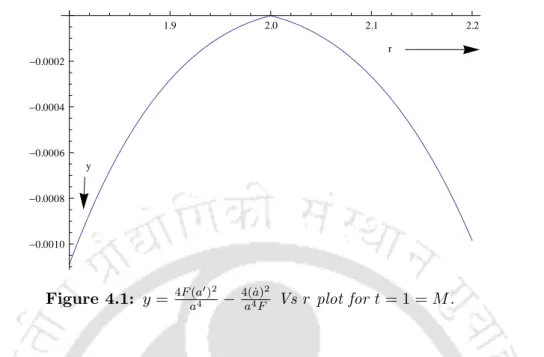
The basic motivation for working in SD spacetime is that the SD metric corresponds to a real cosmological scenario for the following reasons. In this chapter, the entire thermodynamics of the SD black hole will be developed in a consistent manner.
Objectives of the chapter
The striking feature in this case is that SD black holes evolve over time and, therefore, there is no time-like kill vector to describe the energy of a particle. After obtaining the temperature expression from the tunneling formalism, the next goal will be to discover the first law of thermodynamics for the SD black hole.
SD metric: a brief review
In this context, another problem of poor behavior of the sources can be pointed out here. Moreover, despite these limitations, one cannot deny that the spacetime metric of the SD black hole is one of the most realistic solutions of a cosmological black hole to date and fits nicely with the theory of the expanding universe.
Tunneling and Hawking temperature
In this case, the temperature expression is obtained by comparing the tunneling probability with the Boltzmann factor. It has been shown in [182] that if one starts with the bulk Klein–Gordon equation in four dimensions, it effectively reduces to an equation governed by the (r−t) sector of the full metric in the near-horizon limit.
First law of thermodynamics from Einstein’s equa- tion
The Misner-Sharp energy gradient, manipulated using the Einstein equation when projected onto the horizon, leads to a unified first law in differential form. In this process, we have shown that the obtained temperature value agrees nicely with the entropy expression and the Misner-Sharp energy from the literature, which gives the first law.
Summary and Discussions
There are two main approaches to developing a thermodynamic description of a black hole from conserved charges. In addition, in the previous chapter (Chapter 4) we obtained a thermodynamic description for the SD black hole, which has a time-dependent conformal Killing horizon.
Objectives of the chapter
In addition, the diffeomorphism vector can be chosen according to the type of horizon surface. First, we obtain a general expression for the conserved current and potential for Lanczos-Lovelock gravity.
Conserved quantities for a horizon defining dif- feomorphism vector
However, we will note that the expression of the current is not the same for both cases. Then, we get the change of the Noether current due to the change of the metric tensor.
Special form of diffeomorphism
Since the development of the thermodynamics in a conformal Death Horizon requires further investigation, we have taken the assumption in chapter 3 to obtain the thermodynamics in both frames. Apart from these examples, there are many non-Death horizons in gravity as we mentioned earlier.
Explicit evaluation of the conserved charges for a black hole spacetime
In this case we choose ra as the conformal Killing vector ξa of spacetime and ta is constructed as the auxiliary zero vector la, so that l.ξ = −1. Currently we cannot say what the additional terms appearing before the conformal Killing vectors contribute.
Summary and outlook
However, we currently cannot determine (using any first principles) what macroscopic black hole quantities (such as mass, angular momentum, entropy, etc.) these charges represent. For the Killing vector case, the overall result reduces to the original ADT currents and the potential defined for the Killing vectors.
Prologue
Therefore, roughly speaking, some of the original degrees of freedom gauge (which could have been eliminated if we had allowed the entire set of diffeomorphisms) can now be considered as improved physical degrees of freedom (since we only allowed the subset of diffeomorphisms), which attribute entropy. This is the generalization of previous work [157] on the Killing horizon in Rindler space.
Objectives of the chapter
Furthermore, since zero surface is a local concept, the present analysis will illuminate the "emergent nature of gravity" for the following reasons. Therefore, one would be interested to examine the null surface in this context to see the generality of these concepts.
Near horizon symmetry, charges, brackets and the algebra
Null metric in Gaussian null coordinates (GNC)
With this set of zero vectors, one can give a covariant definition of the elementary surface area of the zero (d−2) hypersurface (with the dimension of the entire spacetime) asdΣab. For the present case, one can check that the explicit form of the elementary surface area can be determined as dΣur.
Set-up: null surface preserving diffeomorphisms and charges
Other components of the metric (eg grA) may vary along the diffeomorphism, but this does not affect the null features or the location of the null surface (which is r= 0). The precise meaning of such a condition is – it is the minimum criterion for the unchanged location of the zero surface.
Algebra of the charges
Therefore, the validity of the previous result [157] in the case of GNCs needs to be investigated. In this case, the algebra of charges along these directions can be derived from (6.22).
Conclusions and outlook
Moreover, our algebra sheds more light on the quantum nature of the surface since it is noncommutative. In our analysis, we have taken α and µ to be independent of the coordinate only on the null surface, since the leading order contribution of these quantities is considered to be independent of u.
Phase transitions in black hole thermodynamics
In this and the following chapter, we will present a general framework for studying all these types of van der Waals phase transitions in black hole thermodynamics. We then apply the geometrothermodynamics (GTD) formalism to provide the thermogeometric description of all van der Waals-type phase transitions present in black hole thermodynamics.
Extended phase space and thermodynamic first law using Wald’s formalism
Later we will show that the entropy and energy of the black hole system are directly related to the Noether potential. Thus, the role of the black hole mass is also changed in the description of black hole thermodynamics in the extended phase space.
Thermodynamic geometry in a Legendre invari- ant way: a brief review
In the following, we mention the method for obtaining the Legendre-invariant thermogeometric metric. To formulate a thermo-geometric metric in a Legendre-invariant way, one must first define a thermodynamic phase space T.
P -V criticality in thermogeometric picture
FT YidT dYi], (7.34), where in the above we use the fact that the conjugate variables are the functions of the thermodynamic variables ˜Xa. This can be observed from the explicit expression of the Ricci scalar for a single charged metric.
