We have considered Comptonization of the bremsstrahlung as the future cooling mechanism in the flow. Properties of magnetically assisted dissipative accretion flows around black holes”, Biplob Sarkar, Santabrata Das and Samir Mandal, in 29th meeting of the Indian Association for General Relativity and Gravitation (IARGG), May organized by the Department of Physics, IIT Guwahati, Assam , India.
Models of Accretion Discs
- Standard Disc (Shakura-Sunyaev)
- SLE
- Slim Disc
- ADAF
Meanwhile, the temperature in the disk varies with the radius axis (Shakura and Sunyaev 1973, Frank, King and Raine 2002). This hot post-shock region inversely compresses the soft photons from the disc and results in the emission of hard spectrum.
Importance of the Magnetic Fields
In the region around the horizon, rotation of the black hole pulls the space-time geometry. The Maxwell stress due to the turbulent magnetic fields transports sufficient angular momentum, allowing disc material to fall towards the black hole.
Treatment of gravitational field around a Black Hole
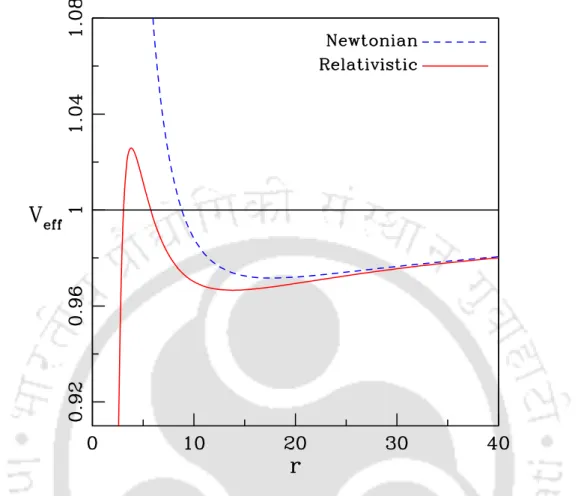
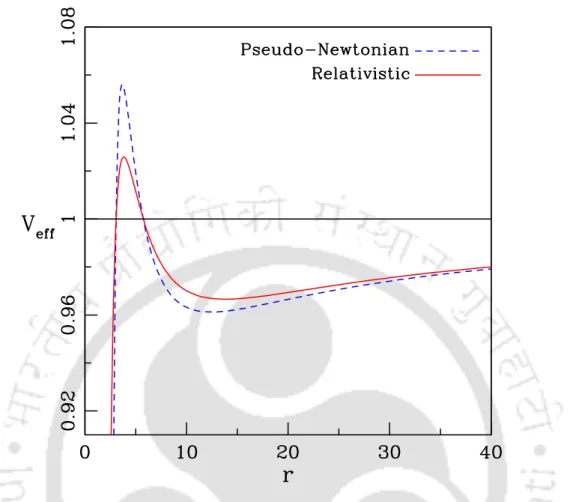
Pseudo-Newtonian Potential
We noted earlier that the rms is the location of the Keplerian minimum. In chapters 2 and 3 of the thesis, we will use ΨPN to take care of general relativistic effects.
Pseudo-Kerr Potential
Second, numerical simulations become more feasible and time-dependent properties can be easily investigated by simply replacing the Newtonian potential with the pseudo-Kerr one. Consequently, the above potential was adopted in Chapter 4 to simulate the spacetime geometry around a rotating black hole.
Radiative processes
The total amount of energy emitted by relativistic electrons rotating around magnetic field lines per cm3 per SEC. is given by (Shapiro and Teukolsky 1983). whereTe is the electron temperature in the plasma. For complete ionization of hydrogen gas, fe = 1 and we have, . iii) Inverse Compton emission: Another important mechanism by which high-energy photons can be created is the scattering of photons by hot electrons, which are highly relativistic.
Concept of Optical Depth
Based on the ratio between the Kepler disk accretion rate (˙Md) and the sub-Keplerian halo velocity (˙Mh), the electrons in the Compton cloud can lose energy (inverse Compton scattering) or gain energy (Compton scattering). Therefore, according to the power law, a hard photon component is a characteristic of the hard state of the black hole candidate.
Shocks in Accretion Flow
For an adiabatic, steady-state shock, we obtain from equation (1.31) that (E+pgas)v is the same on both sides of the shock, and we have at the front of the shock. We know from equation (1.25) that ρv is constant along the stroke, and ψeff is a continuous function on the stroke.
Over view of the work
Governing Equations
The magnetic pressure is given by pmag =< Bφ2 > /8π, where < Bφ2 > is the azimuth mean of the square of the toroidal component of the magnetic field. Based on the seminal work of Shakura and Sunyaev (1973), we consider αB as a parameter in the present study. However, for the sake of simplicity, in this chapter we assume the comptonization of the bremsstrahlung as the active cooling mechanism in the flow (see section 1.4 for discussion).
To describe the advection rate of the toroidal magnetic flux, we consider the induction equation given by Assuming the steady state, the subsequent equation is then vertically averaged, taking into account that the azimuthally averaged toroidal magnetic fields vanish at the surface of the disk. In the accretion disks, the conservation of ˙Φ cannot hold in general because ˙Φ can change radially due to the existence of the magnetic diffusion term and the dynamo term in equation (2.10).
Sonic Point Analysis
At the same time, numerical simulation results by Machida, Nakamura and Matsumoto (2006) showed that the relation, ˙Φ∝x−1, holds in the disc in the quasi-steady state. For ζ > 0, however, the magnetic flux increases as the accreting matter continues towards the black hole's horizon. Matter starts accreting towards the black hole from the outer edge of the disk at almost negligible speed and subsequently crosses the black hole's horizon at a speed equal to the speed of light.
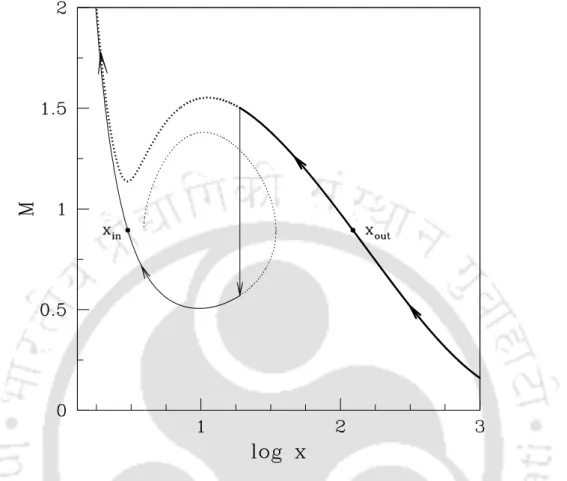
However, equation (2.13b) suggests that there may be some points between the outer edge of the disc and the horizon where the denominator (D) vanishes. Setting D = 0 gives an expression for the Mach number (M =v/a) at the sonic point, which is calculated as,. Setting N = 0 gives a quartic equation for the speed of sound at xc and is given by,.
Global Accretion Solution
- Shock free global accretion solution
- Shock induced global accretion solution
- Shock dynamics and properties
- Accretion disc luminosity
- Parameter space for shock
- Critical viscosity parameter
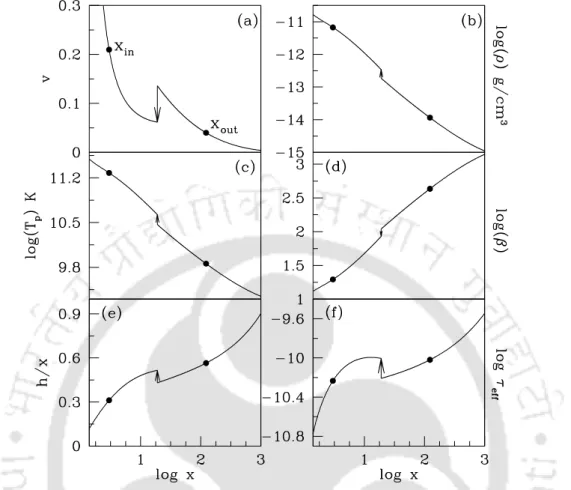
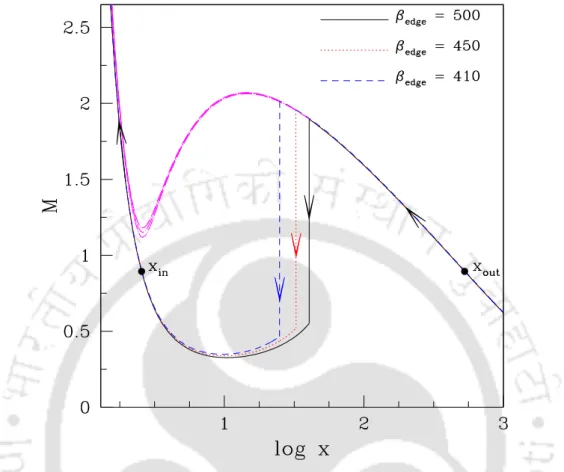
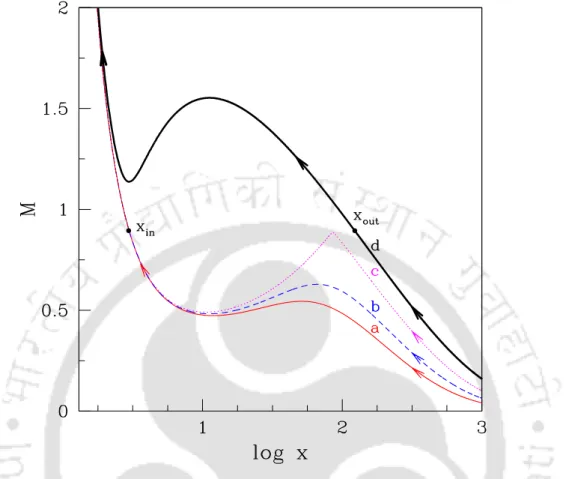
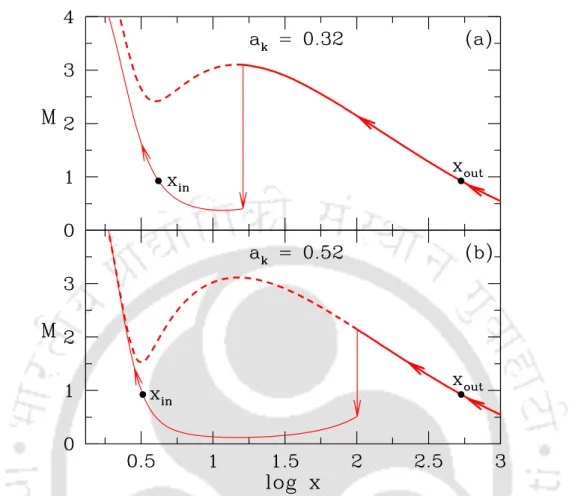
In the figure, the locations of the inner sonic point (xin) and the outer sonic point (xout) are marked, and arrows indicate the direction of the flow toward the black hole. 2.3(a), we demonstrate the variation in the radial velocity (v) of the accreting flow, where the shock transition is observed at xs = 19.03 indicated by the vertical arrow. 2.3(b), we show the density profile of the flow where the catastrophic jump of density at the impact site is observed.
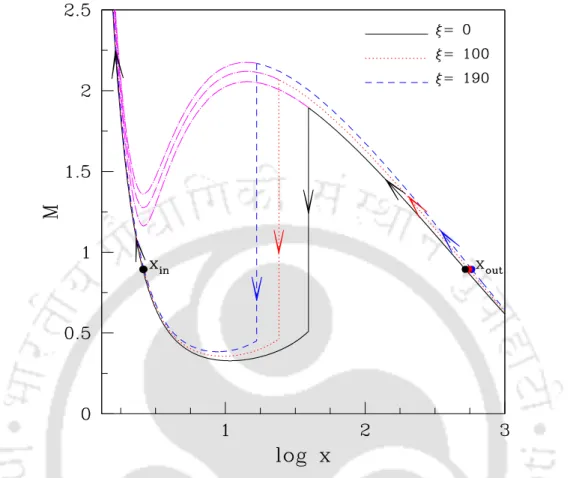
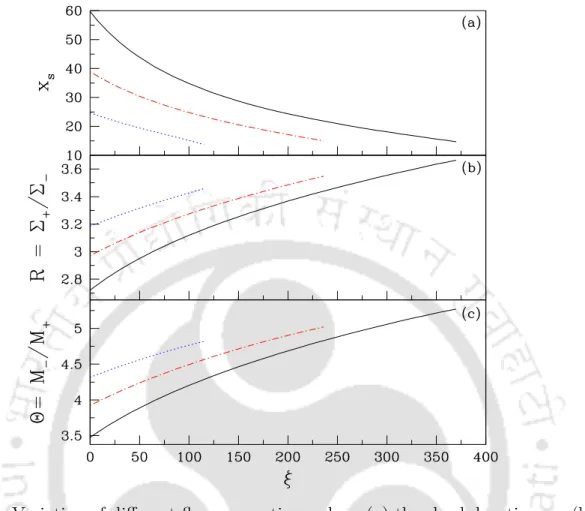
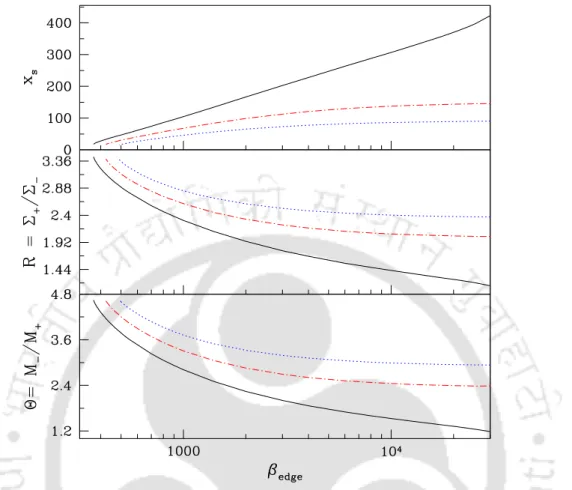
As the cooling factor ξ gradually increases, the shock front approaches the BH horizon. The dynamics of the shock location is controlled over time by the combined effect of cooling and the magnetic field. For a given edge λ, the shock front moves toward the horizon with an increase in the cooling factor (ξ), as shown in Fig. 1b.
Astrophysical Applications
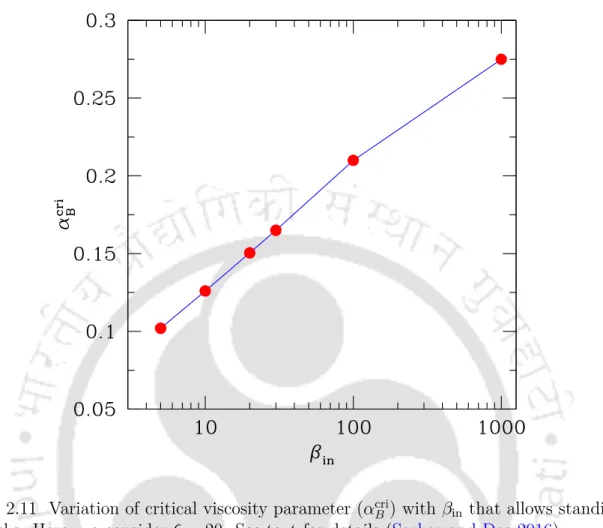
We continue our study of parameter space to investigate the role of viscous dissipation in the shock parameter space. After this we obtain the value of the critical viscosity parameterαBcri based on the criteria whether a standing shock is formed or not. Usually, the energy dissipation mechanism at the shock is regulated by the thermal comptonization process (Chakrabarti and Titarchuk 1995) and therefore the thermal dissipation in the PSC is reduced.
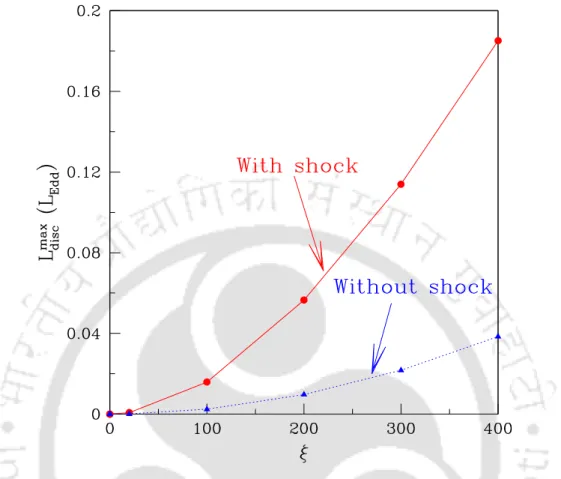
For a weakly rotating black hole, Das, Chakrabarti & Mondal (2010) calculated the maximum energy dissipation upon impact and is estimated as. In this scenario, the available energy on the PSC is equal to the available energy dissipated on impact. Following the above approach, we estimate the maximum luminosity of the shock (Lmaxshock), which corresponds to the maximum energy dissipation during the shock.
Chapter Conclusion
Sonic Point Analysis
In the process of accretion to the black hole, infalling matter starts its journey from the outer edge of the disk with a negligible radial velocity and then crosses the black hole horizon with a velocity comparable to the speed of light. These findings apparently require that infalling matter during accretion must smoothly change its sonic character from subsonic to supersonic before falling into the black hole. The radial coordinate where accreting matter encounters such a sonic transition is known as the sonic point.
Using N = 0, we obtain an algebraic equation of the sound speed at xc given by,. Solving equation (3.8) for a set of input parameters of the flow, we calculate the sound speed at xc and then find the radial velocity of the flow using equation (3.7). As before, in this Chapter we are interested in studying the properties of the global accretion flow around the black holes and so the wind solutions are left aside for future study.
Results
Global accretion solution
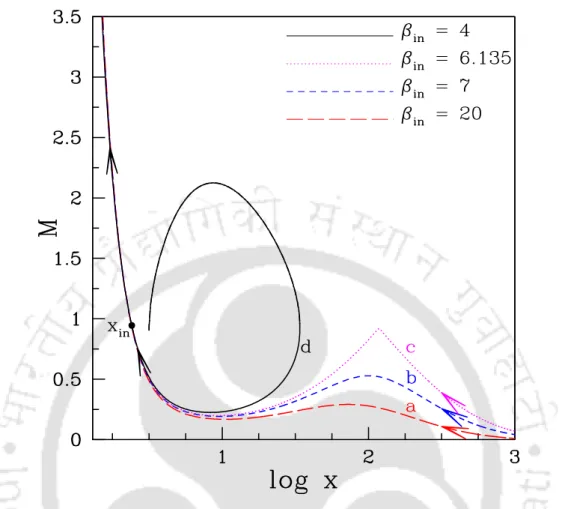
When βin < βincri, the transonic accretion solution fails to extend to the outer edge of the disk and does not represent a complete global accretion solution. The rotating subsonic accretion flow at the outer edge of the disk slowly gains its radial velocity due to the pull of gravity. Arrows indicate the direction of flow movement and the vertical arrow represents the shock transition.
The validity of the thin-disk approximation is consistently observed from the outer edge to the horizon, even in the presence of shock transition. It has already been pointed out that the density and temperature of the PSC are increased due to the effect of shock compression. This essentially causes the reduction of the overall specific energy profile in the PSC region (Singh and Chakrabarti 2011).
Chapter Conclusion
Analysis of transonic conditions
During the course of accretion, matter moves from the outer edge of the disk (xedge) to the black hole under the influence of gravity. In reality, inflowing matter possesses negligible radial velocity at xedge in contrast to the local sound speed and enters the black hole with a velocity equal to c. The radial coordinate where the accretion flow smoothly changes its sonic character from subsonic to supersonic condition is commonly called a critical point.
Now, using the accretion flow parameters, we solve equation (4.16) to obtain the speed of sound (ac) at xc and then calculate vc using equation (4.15). Using the values of vc and ac in Eq. 4.11), we examine the characteristics of critical points. As before, in this chapter, since our motivation is to investigate the flow structure of magnetized clumps, we focus on clump solutions only in the subsequent analysis.
Results and Discussions
- Transonic Global Solutions
- Global Accretion Solutions with Shock
- Properties of Standing Shocks
- Parameter Space for Shock
- Energy Extraction from PSC
In general, the flow is dominated by cooling on the left side of the peak, while viscous heating dominates on the other side. We see that the effective area of the parameter space for shock decreases gradually with the decrease of βin. We further carry out the analysis to calculate the critical accretion rate (˙mcri) of the flow as a function of βin, yielding global accretion solutions containing standing shock.
In fact, when βin <1, the inner part of the disc is magnetically dominated and a small amount of accretion rate is sufficient to cool the flow. On the other hand, as βin is gradually increased, the strength of magnetic fields becomes weak and therefore an increased accretion rate is required for the cooling of the flow. In the context of the formation of standing shock in a magnetized accretion flow, we now illustrate the dependence of the critical accretion rate (˙mcri) on the spin of the black hole (ak) in Fig.
Chapter Conclusion
We demonstrate the existence of shocks in global accretion solutions and investigate the properties of the post-shock corona (PSC). We find that PSC dynamics are controlled by flow parameters, namely viscosity, cooling efficiency factor (ξ) and magnetic field strength. We obtained global solutions of transonic accretion with shocks and showed that black hole rotation significantly affects shock properties and PSC dynamics.
We also calculate the maximum energy that can be extracted from the PSC and study its variation with magnetic parameter β and spin of the black hole. Due to the general nature of the content presented in the thesis, the work can be used in the future to address many important issues. In the thesis, the parameter ζ parametrizes the radial variation of the toroidal magnetic flux advection rate (˙Φ).