G
ENETICALLYM
ODIFIEDO
RGANISMSVolume 4. Challenges and Opportunities
with Bt Cotton in Vietnam
G
ENETICALLYM
ODIFIEDO
RGANISMSS
ERIESTitles available
Volume 1. A Case Study of Bt Maize in Kenya
Edited by A. Hilbeck and D.A. Andow
Volume 2. Methodologies for Assessing Bt Cotton in Brazil
Edited by A. Hilbeck, D.A. Andow and E.M.G. Fontes
Volume 3. Methodologies for Transgenic Fish
Edited by A.R. Kapuscinski, S. Li, K.R. Hayes and G. Dana
Volume 4. Challenges and Opportunities with Bt Cotton in Vietnam
Edited by D.A. Andow, A. Hilbeck and Nguye˜ˆn Va¸˘n Tuaˆ´t
E NVIRONMENTAL R ISK A SSESSMENT OF
G ENETICALLY M ODIFIED O RGANISMS
Volume 4. Challenges and Opportunities with Bt Cotton in Vietnam
Edited by
David A. Andow
Department of Entomology University of Minnesota Saint Paul, Minnesota, USA
Angelika Hilbeck
Institute for Integrative Biology Swiss Federal Institute of Technology Zurich, Switzerland
Nguye˜ˆn Va¸˘n Tuaˆ´t
National Institute for Plant Protection
Hanoi, Vietnam
Series Editors
Anne R. Kapuscinski
Department of Fisheries, Wildlife and Conservation Biology
University of Minnesota St Paul, Minnesota, USA and
Peter J. Schei
Fridtjof Nansens Institute Lysaker, Norway
CABI Head Office CABI North American Office
Nosworthy Way 875 Massachusetts Avenue
Wallingford 7th Floor
Oxfordshire OX10 8DE Cambridge, MA 02139
UK USA
Tel: +44 (0)1491 832111 Tel: +1 617 395 4056
Fax: +44 (0)1491 833508 Fax: +1 617 354 6875
E-mail: [email protected] E-mail: [email protected]
Website: www.cabi.org
©CAB International 2008. All rights reserved. No part of this publication may be reproduced in any form or by any means, electronically, mechanically, by photocopying, recording or otherwise, without the prior permission of the copyright owners.
A catalogue record for this book is available from the British Library, London, UK.
Library of Congress Cataloging-in-Publication Data Environmental risk assessment of genetically modifi ed organism / edited by A. Hilbeck and D. Andow.
p. cm.
Includes bibliographical references and index.
ISBN 0-85199-861-5 (alk. paper)
1. Crops--Genetic engineering--Environmental aspects. 2. Transgenic plants--Risk assessment. 3. Corn--Genetic engineering--Kenya--Case studies.
I. Hilback, A. (Angelika) II. Andow, David Alan. III. Title.
SB123.57.E59 2004 631.5'23--dc22
2004007981 ISBN-13: 978 1 84593 390 6
Typeset by SPi, Pondicherry, India.
Printed and bound in the UK by Biddles Ltd, King’s Lynn.
v
Contributors ix
Editors’ Preface xv
Series Foreword xix
Foreword by Bùi Bá Bô
¸
ng, Vice Minister, Ministry xxi of Agriculture and Rural Development, Vietnam
1. Challenges and Opportunities with GM Crops 1 in Vietnam: the Case of Bt Cotton
Nguyê˜n Va˘n Tuâ´t, David A. Andow, Gary P. Fitt, Edison R. Sujii, Eliana Fontes, David R. Just and Lê Quang Quyê´n
2. Cotton Production in Vietnam 24
Lê Quang Quyê´n, Nguyê˜n Thi. Hai, Trâ`n Anh Hào, Mai Va˘n Hào, Nguyê˜n Thi. Thanh Bình, Ðàng Na˘ng Bu’u, Du’o’ng Xuân Diêu and Evelyn Underwood
3. Consideration of Problem Formulation and 64 Option Assessment (PFOA) for Environmental
Risk Assessment: Bt Cotton in Vietnam
Nguyê˜n Va˘n Uyeˆn, Phan Va˘n Chi, Nguyê˜n Va˘n Bo·ˆ
Hoàng Thanh Nhàn, Leˆ Quang Quyê´n, Nguyê˜n Xuân Hoˆ`ng, Leˆ Minh Saˇ´t, Arjen Wals, Deise M.F. Capalbo and
Kristen C. Nelson
4. Transgene Locus Structure and Expression 79 Trâ`n Thi. Cúc Hoà, Anna Depicker, Kakoli Ghosh,
Nelson Amugune, Phan Ðình Pháp, Tru’o’ng Nam Ha¸ i and David A. Andow
5. Non-target and Biological Diversity Risk Assessment 115 Angelika Hilbeck, Salvatore Arpaia, A. Nicholas E. Birch,
Yolanda Chen, Eliana M.G. Fontes, Andreas Lang, Lê Thi. Thu Hô`ng, Gabor L. Lövei, Barbara Manachini, Nguyê˜n Thi. Thu Cúc, Nguyê˜n Va˘n Huy`nh, Nguyê˜n Va˘n Tuâ´t, Pha.m Va˘n Lâ`m, Pham Van Toan, Carmen S.S. Pires, Edison R. Sujii, Trác Khu’o’ng Lai, Evelyn Underwood, Ron E. Wheatley, Lewis J. Wilson, Claudia Zwahlen and David A. Andow
6. Potential Effect of Transgenic Cotton on Non-target 138 Herbivores in Vietnam
Nguyê˜n Thi. Thu Cúc, Edison R. Sujii, Lewis J. Wilson, Evelyn Underwood, David A. Andow, Mai Va˘n Hào, Baoping Zhai and Hô` Va˘n Chiê´n
7. Invertebrate Predators in Bt Cotton in Vietnam: 176 Techniques for Prioritizing Species and Developing
Risk Hypotheses for Risk Assessment
Pha·m Va˘n Laˆ`m, La˜ Pha·m Laˆn, Angelika Hilbeck, Nguyê˜n Va˘n Tuaˆ´t and Andreas Lang
8. Potential Effects of Transgenic Cotton on Non-target 212 Insect Parasitoids in Vietnam
Nguyê˜n Va˘n Huy`nh, A. Nicholas E. Birch, Josephine Songa, Nguyê˜n Va˘n Ði˜nh and Trâ`n Thê´ Lâm
9. Potential Effects of Transgenic Cotton on Flower 236 Visitors in Vietnam
Lê Thi. Thu Hô`ng, Ðinh Quyê´t Tâm, Hoàng Anh Tuâ´n, Trác Khu’o’ng Lai, Gabor L. Lövei, Carmen S.S. Pires, Fang-Hao Wan, Jian-Ying Guo and David A. Andow
10. Potential Effects of Transgenic Cotton on Soil Ecosystem 258 Processes in Vietnam
Pha.m Van Toan, Hoa`ng Ngo.c Bình, Beatrice Anyango, Claudia Zwahlen, Barbara Manachini, David A. Andow and Ron E. Wheatley
11. Environmental Risks Associated with Gene Flow from 274 Transgenic Cotton in Vietnam
Jill Johnston West, Vu˜ Ðu´’c Quang, Marc Giband, Bao Rong Lu, David A. Andow, Nguyeˆ˜n Hu˜’u Hoˆ, Vu’o’ng Thi. Phaˆ´n and Leˆ Quang Quyeˆ`n
12. Resistance Risk Assessment and Management for 296 Bt Cotton in Vietnam
Gary P. Fitt, David A. Andow, Nguyê˜n Hu˜’u Huân,
Mike Caprio, Celso Omoto, Nguyê˜n Tho’, Nguyê˜n Hô`ng So’n and Bùi Cách Tuyê´n
13. Challenges and Opportunities with Bt Cotton 330 in Vietnam: Synthesis and Recommendations
David A. Andow, Nguyê˜n Va˘n Tuâ´t, Angelika Hilbeck, Evelyn Underwood, A. Nicholas E. Birch, Ðinh Quyê´t Tâm, Gary P. Fitt, Marc Giband, Jill Johnston West, Andreas Lang, Lê Quang Quyê´n, Lê Thi. Thu Hô`ng, Gabor L. Lövei,
Kristen C. Nelson, Nguyê˜n Hô`ng So’n, Nguyê˜n Hu˜’u Huân, Nguyê˜n Thi. Hai, Nguyê˜n Thi. Thu Cúc, Nguyê˜n Va˘n Huy`nh, Nguyê˜n Va˘n Uyê˜n, Pha˘m Vâ´n La.m, Pha.m Van Toan, Edison R. Sujii, Trâ`n Anh Hào, Trâ`n Thi. Cúc Hoà, Vu˜ Ðu´’c Quang, Ron E. Wheatley and Lewis J. Wilson
Index 345
The colour plate section can be found following p. 43.
ix Important note: All of the Vietnamese names in this book are stated in the standard format in Vietnamese, with the family name first, followed by the given name. Vietnamese typically address each other by the given name, in part because there are relatively few family names. Following international citation standards, Vietnamese references are called using only the family name. However, to facilitate identification of the actual author the entire given name is included in the references for each chapter.
Amugune, Nelson Onzere, Lecturer, School of Biological Sciences, University of Nairobi, PO Box 30197, Riverside Drive, Chiromo Campus, Nairobi, Kenya. [email protected]
Andow, David A., Professor of Insect Ecology, Department of Entomology, University of Minnesota, 219 Hodson Hall, 1980 Folwell Avenue, St Paul, Minnesota 55108, USA. [email protected]
Anyango, Beatrice, Senior Lecturer, School of Biological Sciences, University of Nairobi, PO Box 30197, Riverside Drive, Chironomo Campus, Nairobi, GPO 00100, Kenya. [email protected]
Arpaia, Salvatore, Researcher, Department of Biotechnology / Health and Environment Protection, ENEA – Italian National Agency for New Technologies, Energy and Environment, Research Centre Trisaia, S.S. 106 Ionica km 419+500, Rotondella, Montana I-75026, Italy. salvatore.arpaia@
trisaia.enea.it
Birch, A.N.E., LEAF Coordinator, SCRI, Invergowrie, Dundee DD2 5DA, Scotland, UK. [email protected]
Bùi Cách Tuyê´n, Rector, Ho Chi Minh Agriculture and Forestry University (HCM AFU), Thu Duc, Ho Chi Minh City, Vietnam. [email protected]
Capalbo, Deise, Embrapa Environment (CNPMA), Rodovia SP 340, Km 127.5, CP 69, Tanquinho Velho, Jaguariúna, SP, CEP 13820-000, Brazil.
Caprio, Michael, Professor of Insect Genetics, Entomology and Plant Pathology, Mississippi State University, Box 9775, Mississippi 39762, USA. [email protected]
Chen, Yolanda H., Entomologist, Crop and Environmental Sciences Division, International Rice Research Institute (IRRI), DAPA Box 7777, Metro Manila, Philippines. [email protected]
Ðàng Na˘ng Bu’u, Nhaho Research Institute for Cotton and Agricultural Development, Nha Ho, Ninh Son, Ninh Thuan, Vietnam. [email protected] Depicker, Anna, Professor, Plant Systems Biology, Plant Gene Regulation, Ghent University, VIB, Technologie Park 927, Gent B-9052, Belgium.
Ðinh Quyeˆ´t Tâm, Bee Research Centre, MARD, Hanoi, Vietnam. dinhqtam@
hn.vnn.vn
Du’o’ng Xuân Diêu, Nhaho Research Institute for Cotton and Agricultural Development, Nha Ho, Ninh Son, Ninh Thuan, Vietnam. [email protected] Fitt, Gary P., Deputy Chief, CSIRO Entomology, Long Pocket Laboratories, 120 Meiers Road, Indooroopilly, Brisbane, Queensland, QLD 4068, Australia. [email protected]
Fontes, Eliana, Research Group Leader, Biosafety, Biological Control Unit, Embrapa Genetic Resources and Biotechnology, Parque Estacão Biológica, Caixa Postal 02372, Av. W5 Norte – Final, Brasília, DF 70770-900, Brazil.
Ghosh, Kakoli, Agriculture Officer (Capacity Building), Plant Production and Protection Division (AGP), Seed and Plant Genetic Resources Service (AGPS), Food and Agriculture Organization (FAO), Viale Delle Terme di Caracalla, Rome, Lazio I-00100, Italy. [email protected]
Giband, Marc, CIRAD, Embrapa Algodão, Rua Osvaldo Cruz 1143 – Centenário, Campina Grande, PB 58 107-720, Brazil. [email protected] Guo, Jian-Ying, State Key Laboratory for Biology of Plant Diseases and Insect Pests, Institute of Plant Protection, Chinese Academy of Agricultural Sciences (CAAS), 12, Zhong-Guan-Cun, Nan-Da-Jie, Beijing 100081, China (P.R.). [email protected]
Hilbeck, Angelika, Institute of Integrative Biology, Swiss Federal Institute of Technology ETHZ, Universitätsstrasse 16, Zürich CH-8092, Switzerland.
Hô` Va˘n Chiê´n, Director, Southern Regional Department, Vietnam Plant Protection Department (PPD), Long Dinh, Chau Thanh, Tien Giang prov- ince, Vietnam. [email protected]
Hoàng Anh Tuâ´ n, Nhaho Research Institute for Cotton and Agricultural Development, Nha Ho, Ninh Son, Ninh Thuan, Vietnam. [email protected] Hoang Ngoc Binh, Deputy Head of Planning and Investment Department, Vietnam Cotton Company (VCC), Lot 1 15–17 D2 Street, Northern Van Thanh Ward 25, Binh Thanh District, Ho Chi Minh City, Vietnam.
Hoàng Thanh Nhàn, BCH National Focal Point, Nature Conservation Division, Vietnam Environment Protection Agency (VEPA), Vietnam Ministry of Natural Resources and the Environment (MONRE), 67 Nguyen Du, Hanoi, Vietnam. [email protected]
Johnston West, Jill, Utah Division of Wildlife Resources, 1594 W North Temple, Suite 2110, Salt Lake City, Utah 84114, USA. [email protected] Just, David R., Assistant Professor, Applied Economics and Management, Cornell University, 254 Warren Hall, Ithaca, New York 14853, USA. drj3@
cornell.edu
Lã Pha.m Lân, Plant Protection Division, Institute of Agricultural Sciences of Southern Vietnam (IAS), MARD, 121 Nguyen Binh Khiem, District 1, Ho Chi Minh City, Vietnam. [email protected]
Lang, Andreas, Institute of Environmental Geosciences, University of Basel, Bernoullistr. 30, CH-4056 Basel, Switzerland. [email protected] Lê Minh Sa˘´t, Deputy Director, Department of Science and Technology, Vietnam Ministry of Science and Technology (MOST), 39 Tran Hung Dao, Hoan Kiem District, Hanoi, Vietnam. [email protected]
Lê Quang Quyê´ n, Director, Nhaho Research Institute for Cotton and Agri- cultural Development, Nha Ho, Ninh Son, Ninh Thuan, Vietnam. quyen@
nhahocotton.org.vn
Lê Thi. Thu Hô`ng, Head of Division of Science and International Cooperation, Southern Fruit Research Institute (SOFRI), Box 203, My Tho, Long Dinh, Chau Thanh, Tien Giang, Vietnam. [email protected]
Lövei, Gabor L., Senior Scientist, Faculty of Agriculture, Department of Integrated Pest Management, University of Arhus, Flakkebjerg Research Centre, Slagelse DK-4200, Denmark. [email protected]
Lu, Bao-Rong, Deputy Director, Institute of Biodiversity Science, Fudan University, Handan Road 220, Shanghai, P.R. 200433, China (P.R.). brlu@
fudan.edu.cn
Mai Vaˇn Hào, Nhaho Research Institute for Cotton and Agricultural Development, Nha Ho, Ninh Son, Ninh Thuan, Vietnam. maivanhao@
yahoo.com
Manachini, Barbara, Professor Researcher, Department of Animal Biology, University of Palermo, Via Archirafi 18, 2, 90123 Palermo, Italy.
Nelson, Kristen C., Associate Professor, Department of Forest Resources and Department of Fisheries, Wildlife and Conservation Biology, University of Minnesota, 115 Green Hall, 1530 Cleveland Avenue North, St Paul, Minnesota 55108, USA. [email protected]
Nguyê˜n Hô`ng So’n, Deputy Director, Plant Protection Research Institute (PPRI), MARD, Dong Ngac, Tu Liem, Hanoi, Vietnam. [email protected] Nguyê˜n Hu˜’’u Hoˆ, Institute of Tropical Biology – Vietnamese Academy of Science and Technology, 1 Mac Dinh Chi Street, 1st District, Ho Chi Minh City, Vietnam. [email protected]
Nguyê˜n Hu˜’’u Huân, Vice Director General, Vietnam Plant Protection Department (PPD), MARD, 28 Mac Dinh Chi Street, 1st District, Ho Chi Minh City, Vietnam. [email protected]
Nguyê˜n Thi. Hai, Head of VCC Liaison Office in Ho Chi Minh City, Nhaho Research Institute for Cotton and Agricultural Development, Nha Ho, Ninh Son, Ninh Thuan, Vietnam. [email protected]
Nguyê˜n Thi. Thanh Bình, Nhaho Research Institute for Cotton and Agricultural Development, Nha Ho, Ninh Son, Ninh Thuan, Vietnam. binhcot- [email protected]
Nguyê˜n Thi. Thu Cúc, Associate Professor, College of Agriculture, Plant Protection Department, Can Tho University, Campus II, 3 Thang 2 Street, Can Tho, Vietnam. [email protected]
Nguyê˜n Tho’, Consultant, Vietnam Institute of Agricultural Engineering &
Postharvest Technology, 29/2G, D2 Ward, Van Thanh Bac, P25, Binh Thanh District, Ho Chi Minh City, Vietnam. [email protected] Nguyê˜n Va˘n Bô., Director, Vietnamese Academy of Agricultural Sciences (VAAS), Vinh Quynh, Thanh Tri, Hanoi, Vietnam. [email protected]
Nguyê˜n Va˘n Ðı˜nh, Dean of Faculty, Associate Professor, Faculty of Agronomy, Hanoi Agricultural University Number 1, Trau Quy, Gia Lam, Hanoi, Vietnam. [email protected]
Nguyê˜n Va˘n Huýnh, Associate Professor, College of Agriculture, Department of Plant Protection, Can Tho University, Staff Housing, 30 Thang Tu Street, Can Tho, Vietnam. [email protected]
Nguyê˜n Va˘n Tuâ´ t, Director General, Food Crops Research Institute (FCRI), MARD, Gia Loc, Hai Duong, Vietnam. [email protected]
Nguyê˜n Va˘n Uyeˆn, Professor, Yersin University, 27/25 Hau Giang Street, Ward No. 4, Tan Binh District, Ho Chi Minh City, Vietnam. nguyen- [email protected]
Nguyê˜n Xuân Hoˆ`ng, President, Vietnam Labour Union, 6 Nguyen Cong Tru Street, Hai Ba Trung District, Hanoi, Vietnam. [email protected]
Omoto, Celso, Associate Professor, Arthropod Resistance to Control Tactics Laboratory, Universidade de São Paulo (USP), Escola Superior de Agricultura ‘Luiz de Queiroz’ (ESALQ), Avenida Pádua Dias 11, C.P. 9, Piracicaba SP 13418-900, Brazil. [email protected]
Pha.m Va˘n Laˆ`m, Head of Pest Diagnostics & Identification Division, Plant Protection Research Institute (PPRI), MARD, Dong Ngac, Tu Liem, Hanoi, Vietnam. [email protected]
Pham Van Toan, Head of Biotechnology Office, Office of Agricultural Biotechnology Programme, Vietnam Ministry of Agriculture and Rural Development (MARD), 2 Ngoc Ha, Ba Dinh, Hanoi, Vietnam. pvtoan@hn.
vnn.vn
Phan Ðình Pháp, School of Biotechnology, International University, Vietnam National University – HCMC, Quarter 6, Linh Trung Ward, Thu Duc District, Ho Chi Minh City, Vietnam. [email protected]
Phan Va˘n Chi, Deputy Director, Protein Biochemistry Laboratory, Vietnam Institute of Biotechnology (IBT), Vietnamese Academy of Science and Technology (VAST), 18 Hoang Quoc Viet Road, Cau Giay District, Hanoi, Vietnam. [email protected]
Pires, Carmen Silvia Soares, Researcher, Laboratory of Bioecology and Semiochemicals of Insects, Embrapa Genetic Resources and Biotechnology, Parque Estacão Biológica, Av. W5 Norte – Final, Brasília DF 70770-900, Brazil. [email protected]
Songa, Josephine M., Crop Protection Coordinator, Kenya Agricultural Research Institute (KARI), PO Box 14733, Nairobi 00800, Kenya. jmsonga@
africaonline.co.ke
Sujii, Edison Ryoiti, Researcher Biological Control, Embrapa Genetic Resources and Biotechnology, Parque Estacão Biológica, Av. W5 Norte – Final, Brasília DF 70770-900, Brazil. [email protected]
Trác Khu’o’ng Lai, Head of Division of Biological Control and IPM on Fruit and Vegetables, Southern Fruit Research Institute (SOFRI), PO Box 203, My Tho, Tien Giang, Vietnam. [email protected]
Trâ`n Anh Hào, Deputy Director General, Vietnam Cotton Company (VCC), Lot 1 15–17, D2 Street, Ward 25, Binh Thanh District, Ho Chi Minh City, Vietnam. [email protected]
Trâ`n Thê´ Lâm, Head of Binh Thuan Province Office, Vietnam Cotton Company (VCC), Binh Thuan, Vietnam. [email protected]
Trâ`n Thi. Cúc Hoà, Head of Department of Biotechnology, Cuu Long Delta Rice Research Institute (CLRRI), MARD, Thoi Thanh, O Mon, Can Tho, Vietnam. [email protected]
Tru’o’ng Nam Hai, Deputy Director, Vietnam Institute of Biotechnology (IBT), Vietnamese Academy of Science and Technology (VAST), 18 Hoang Quoc Viet Road, Cau Giay, Hanoi, Vietnam. [email protected]
Underwood, Evelyn, Institute of Integrative Biology, Swiss Federal Institute of Science and Technology ETHZ, Universitätsstrasse 16, Zurich CH-8092, Switzerland. [email protected]
Vu˜ Ðu´’c Quang, Head, Department of Molecular Biology, Institute of Agricultural Genetics (IAG), MARD, Co Nhue, Tu Liem, Hanoi, Vietnam.
Vu’o’ng Thi. Phâ´n, Biotechnology, Western Highlands Agroforestry Science and Technical Research Institute (WASI), MARD, Road 27, Hoa Thang, Buon Ma Thuot, Dac Lac, Vietnam. [email protected]
Wals, Arjen, Associate Professor, Education & Competence Studies Group, Social Science Department, Wageningen University, PO Box 8130, Wageningen NL-6700 EW, Netherlands. [email protected]
Wan, Fang-Hao, Senior Principal Research Scientist, State Key Laboratory for Biology of Plant Diseases and Insect Pests, Institute of Plant Protection, Chinese Academy of Agricultural Sciences (CAAS), 12, Zhong-Guan-Cun, South Street, Nan-Da-Jie, Beijing CN-100081, China (P.R.). wanfangh@
public3.bta.net.cn
Wheatley, Ron E., Research Leader, Environment-Plant Interaction Programme, SCRI, Invergowrie, Dundee DD2 5DA, Scotland, UK. R.
Wilson, Lewis J., Senior Principal Research Scientist, CSIRO Plant Industry and Programme Leader, ‘The Farm’, Cotton Catchment Communities CRC, Locked Bag 59, Narrabri, New South Wales, NSW 2390, Australia.
Zhai, Baoping, Department of Entomology, Nanjing Agricultural University, Weigang 1, Nanjing 210095, China (P.R.). [email protected]
Zwahlen, Claudia, Research Associate, Institute of Biology, University of Neuchâtel, Case postale 2, Rue Emile Argand 11, Neuchâtel CH-2009, Switzerland. [email protected]
xv The Cartagena Protocol on Biosafety (Biosafety Protocol) under the Convention on Biodiversity (CBD) identifies a need in both developing and developed coun- tries for comprehensive, transparent, scientific methods for pre-release testing and post-release monitoring of transgenic plants to ensure their environmental safety and sustainable use. Most importantly, Article 22 of the Biosafety Protocol requires that Parties shall cooperate in the development and/or strengthening of human resources and institutional capacities in biosafety, especially in developing countries. Vietnam is a signatory to the Cartagena Protocol and committed to implementing a clear system for biosafety risk assessment, management and monitoring. Vietnam has made considerable progress towards this goal in the past few years (see Chapter 1, this volume).
At the same time, the country is investing strongly in the development of agri- cultural biotechnology.
This Vietnam case study is a product of the GMO ERA Project, ‘International Project on GMO Environmental Risk Assessment Methodologies’. This project is a continuation of the GMO Guidelines Project, which was launched by scien- tists of the International Organization for Biological Control (IOBC) Global Working Group on ‘Transgenic Organisms in Integrated Pest Management and Biological Control’. It is funded by the Swiss Agency for Development and Cooperation (SDC) as a part of the Swiss government’s commitment to the Biosafety Protocol. The project is advised by an advisory board representing a wide array of organizations from around the world. The board members func- tion both as scientific advisors and as international mediators to the policy environment and relevant decision making processes. The project is governed by a steering committee, which is responsible for all significant decisions taken by the project.
The project addresses the environmental and agricultural effects of trans- genic crops, but does not evaluate human health impacts or ethical implica- tions. It has focused on the transgenic crop plants already available because
there is more information on this class of transgenic crop than any other, plus it is possible to mobilize considerable expertise in this area. One of the aims of the project is to improve the capacity of scientists in developing countries to support environmental risk assessment of transgenic crop plants. To accom- plish this, the project concentrates on scientist-to-scientist exchange, because these personal connections are likely to persist over time. To leverage these efforts, the project has focused on a few developing countries with sufficient scientific infrastructures, a desire to develop the scientific basis to support envi- ronmental risk assessment and a need to do so. By strengthening the scientific capacities for risk assessment in these countries, expertise should be able to diffuse more readily to neighbouring countries. Kenya and Brazil were the first two focal countries of the project (Hilbeck and Andow, 2004; Hilbeck et al., 2006), with Vietnam being the third. The work conducted in Vietnam forms the basis of this book. Several of the South-east Asian countries have well- developed scientific infrastructures, but the project selected Vietnam as a part- ner based on its need and desire to develop the scientific basis to support environmental risk assessment.
This book is the result of a series of workshops held in Vietnam in 2004, 2006 and 2007 that involved the participation of more than 65 Vietnamese scientists and many public sector scientists from other countries, including Brazil, China, the Philippines, Kenya, Australia, the USA and a number of European countries. During 1–5 April, we convened a workshop in Ho Chi Minh City focusing on the environmental risk assessment of Bt cotton, which framed the analysis and provided the major results in this book. After complet- ing drafts of nearly all the chapters, we convened a workshop during 22–25 May 2006 in Hanoi, which focused on insect resistance management (IRM) of Bt crops. This workshop finalized the content for Chapter 12 (this volume) and provided IRM plans for Bt maize and Bt rice. Finally, during 21–26 May 2007, we convened a workshop in Nha Trang on non-target risk assessment method- ologies. This workshop finalized the methodologies and results in Chapters 5–10 (this volume) and also structured approaches to non-target risk assess- ment for Bt maize and Bt rice. This book is the final product from the case study of Bt cotton in Vietnam. An earlier draft of these results was printed in Vietnamese in 2004 (Nguyen, 2004).
We would first like to thank Dr Bùi Bá Bô
¸
ng, the Vice Minister of Research in the Vietnam Ministry of Agriculture and Rural Development (MARD) and Dr K.L. Heong, International Rice Research Institute for providing the spark and guidance for the work we have accomplished in Vietnam.
We are indebted to Dr Nguyê˜n Va˘n Tuâ´t, Dr Nguyê˜n Hô`ng So’n, Mrs Pha.m Thi. Hô`ng Ha.nh and their team from the Plant Protection Research Institute of MARD, who organized all of the project activities in Vietnam, supported by the other members of the Vietnam Steering Committee of the GMO ERA Project (most of whom are co-authors on this book). We thank them for their foresight and leadership: Professor Nguyê˜n Va˘n Uyê¸
n (Yersin University), Dr Lê Minh Saˇ´t (Ministry of Science and Technology), Dr Lê Thanh Binh (Ministry of Natural Resources and Environment), Drs Lê Quang Quyê´n (Nhaho Research Institute for Cotton and Agricultural Development, MARD), Vu˜ Ðu´c Quang
(Vietnam Institute of Agricultural Genetics, MARD) and Dr Trâ`n Thi. Cúc Hoà (Cuu Long Delta Rice Research Institute, MARD). We also thank Dr Nguyê˜n Va˘n Bô. (Vietnamese Academy of Agricultural Sciences), Dr Phan Va˘n Chi (Institute of Biotechnology), Dr Nguyê˜n Tho’ (Vietnam Cotton Company) and Dr Bu`i Cách Tuyeˆ´n (Ho Chi Minh Agriculture and Forestry University) for their support. The project activities in Vietnam were made possible by the support and endorsement of Dr Lê Trâ`n Binh (Director, Vietnam Institute of Biotechnology), member of the Advisory Board to the GMO ERA Project. We would also like to thank all the members of the Advisory Board for their contin- ued support: Dr Katharina Jenny (Swiss Agency for Development Cooperation), Dr José Geraldo Eugênio de França (Embrapa, Brazil), Dr Marcus Vinicius Segurado Coelho (Brazil Ministry of Agriculture), Dr Paulo Jose Peret de Sant’Ana (Brazil Ministry of Science and Technology), Dr Stefano Colazza (Secretary General, International Organization of Biological Control), Dr Chris Briggs (Director, UNEP GEF Biosafety Programme), Dr Helmut Gaugitsch (Austrian Federal Environment Agency), Dr Julian Smith (Central Science Laboratories, UK), Dr Ahmed Djoghlaf (Executive Secretary, Secretariat of the CBD) and Dr Christian Borgemeister (Director General, ICIPE, Kenya). We also acknowledge the considerable efforts of the Steering Committee of the Project, without whom the project could not exist. In addition to the editors, these members are Drs Tri.nh Kha˘´c Quang (MARD), Pham Van Toan (Biotechnology Office, MARD), Gary Fitt (CSIRO Entomology), Kristen C.
Nelson (Forest Resources, University of Minnesota), Deise Capalbo (Embrapa Meio Ambiente), Eliana Fontes (Embrapa Recursos Genéticos Biotecnologia), Celso Omoto (Entomology, University of São Paolo ESALQ), K.L. Heong (International Rice Research Institute), Nick Birch (Scottish Crop Research Institute), Gabor Lövei (Integrated Pest Management, Aarhus University), Salvatore Arpaia (ENEA – Italian National Agency for New Technologies, Energy and Environment, Research Centre Trisaia), Richard Edema (Faculty of Agriculture, Makerere University, Uganda), Josephine Songa (Kenya Agricultural Research Institute) and Fang-Hao Wan (Institute for Biological Control, Chinese Academy of Agricultural Science). Most importantly, we acknowledge Evelyn Underwood and Areca Treon, without whose help and enthusiasm the Vietnam activities and this book would not have been possible.
We thank the chapter reviewers for their careful anonymous reviews. These were: Salvatore Arpaia (ENEA Research Centre Trisaia), Julio Bernal (Texas A&M University), Jim Bever (Indiana University), Michael Cohen (Canadian Food Inspection Agency), Stefano Colazza (University of Palermo), Les Ehler (University of California, Davis), Cesar V. Galvan (Food and Agriculture Organization), Marc Giband (CIRAD), Bryan Griffiths (Scottish Crop Research Institute), Julia S. Guivant (University of Santa Catarina), Jack Heinemann (University of Canterbury), Jean-Luc Hofs (CIRAD), Claudia Jacobi (University of Minas Gerias), Lim Li Ching (Third Word Network), Danny Llewellyn (CSIRO), Jon Lundgren (USDA-ARS), Carol Mallory-Smith (Oregon State University), Louise A. Malone (Horticulture and Food Research Institute of New Zealand), Melodie A. McGeoch (University of Stellenbosch), Kristin Mercer (Ohio State University), Panos Milonas (Benaki Phytopathological Institute),
John Obrycki (University of Kentucky), Angelo Pallini (University of Viçosa), Débora Pires Paula (Embrapa), Alan Raybould (Syngenta), John Ruberson (University of Georgia), Nancy Schellhorn (CSIRO), Herbert Siqueira (University of Pernambuco), David Somers (Monsanto), Doreen Stabinsky (Greenpeace), Doug Sumerford (USDA-ARS), Maurice Vaissayre (CIRAD) and Mary Whitehouse (CSIRO). We also thank the Series Editors, Dr Anne Kapuscinski (University of Minnesota) and Dr Peter Schei (Fridjof Nansen Institute) and the three additional anonymous reviewers who reviewed the book on behalf of the Series Editors. Their comments were all extremely useful and greatly improved the contents of the book.
We thank the IOBC Global Working Group on Transgenic Crops for their continued intellectual support of our work. We also thank the MARD, the UNEP GEF Project of MONRE and the SDC for their financial and in-kind sup- port of the work on which this book is based. Finally, all of the authors thank partners and families for their support and understanding when meeting the many tight deadlines.
David A. Andow St Paul, Minnesota Angelika Hilbeck Zurich, Switzerland Nguyê˜n Va˘n Tuâ´t Hanoi, Vietnam 26 November 2007
References
Hilbeck, A. and Andow, D.A. (eds) (2004) Environmental Risk Assessment of Transgenic Organisms, Volume 1: A Case Study of Bt Maize in Kenya. CAB International, Wallingford, UK.
Hilbeck, A., Andow, D.A. and Fontes, E.M.G. (eds) (2006) Environmental Risk Assessment of Genetically Modified Organisms, Volume 2: Methodologies for Assessing Bt Cotton in Brazil. CAB International, Wallingford, UK.
Nguyen Van Tuat (2004) Report on the results of the GMO Guidelines Project Workshop in Ho Chi Minh City, April 2004. Unpublished.
xix The advent of genetically modified organisms (GMOs) offers new options for meeting food, agriculture and aquaculture needs in developing countries, but some of these uses of GMOs can also affect biodiversity and natural ecosys- tems. These potential environmental risks and benefits need to be taken into account when making decisions about the use of GMOs. International trade and the unintentional trans-boundary spread of GMOs can also pose environ- mental risks depending on the national and regional contexts.
The complex interactions that can occur between GMOs and the environ- ment heighten the need to strengthen worldwide scientific and technical capacity1 for assessing and managing environmental risks of GMOs.
Global environmental management of GMOs and the strengthening of sci- entific and technical capacity for biosafety will require building policy and legis- lative biosafety frameworks. The latter is especially urgent for developing countries, as the Cartagena Protocol on Biosafety of the Convention on Biological Diversity makes clear. And the World Summit on Sustainable Development also identified the importance of improved knowledge transfer to developing countries on biotechnology. This point was also stressed in recent international fora such as the Norway/UN Conference on Technology Transfer and Capacity Building, and the capacity building decisions of the first meeting of the parties to the Cartagena Protocol on Biosafety.
The Scientific and Technical Advisory Panel (STAP) of the Global Environment Facility (GEF), in collaboration with a number of international sci- entific networks, initiated this book series and supported production of the first three volumes. The mandate of the STAP covers inter alia providing a forum
1 By ‘scientific and technical capacity’ we mean “the ability to generate, procure and apply science and technology to identify and solve a problem or problems” including “the generation and use of new knowledge and information as well as techniques to solve problems.” (Mugabe, J. 2000. Capacity Development Initiative, Scientific and Technical Capacity Development, Needs and Priorities. GEF-UNDP Strategic Partnership, October 2000.)
for integrating expertise on science and technology, and synthesizing, promot- ing and galvanizing state of the art contributions from the scientific community in a number of focal areas, including biodiversity. The book series comple- ments the projects undertaken by the United Nations Environment Programme and the GEF to help developing countries design and implement national biosafety frameworks.
The purpose of this series is to provide scientifically peer-reviewed tools that can help developing countries strengthen their own scientific and technical capacity in biosafety of GMOs. Each book in the series examines a different kind of GMO. The workshops and writing teams used to produce each book are also capacity building activities in themselves because they bring together scientists from developing countries and developed countries to analyse and integrate the relevant science and technology into the book. This fourth book, on assessing Bt cotton in Vietnam was written by more than 70 contributors from 13 countries. The first book, a case study of Bt maize in Kenya, was pub- lished in 2004; a second book, on methodologies for assessing Bt cotton in Brazil, was published in 2006; and a third book, on methodologies for risk assessment and management of transgenic fish, was published in 2007. Each book underwent independent, international and anonymous peer review led by the series editors. Each book provides methods and relevant scientific informa- tion for environmental risk assessment, rather than drawing conclusions.
Relevant organisations in each country will therefore need to conduct their own scientific risk assessments in order to inform their own biosafety decisions.
We hope that this book will help governments, scientists, potential users of GMOs and civil society organizations in Vietnam, other countries in the region and in the rest of the world to strengthen their understanding of the scientific knowledge and methods that are available for conducting environmental risk assessments of GMOs. We encourage readers to draw their own insights in order to help them devise and conduct robust environmental risk assessments for their own countries.
Anne R. Kapuscinski University of Minnesota St. Paul, Minnesota, U.S.A.
Peter J. Schei Fritdjof Nansen Institute Lysajer, Norway June 5, 2008
xxi There is no doubt that biotechnology provides immense opportunities for increasing agricultural production, particularly in developing countries where agriculture is still a major economic sector and supports a major part of society.
However, to harvest the benefits of biotechnological advances in agriculture, developing countries must build capacity in science and, at the same time, develop regimes for biosafety regulations and controls and the protection of intellectual property rights. The delayed or incomplete establishment of such regulations and practices will hamper the adoption of biotechnology advances in agriculture and will, as a consequence, adversely affect the desired pace of agricultural modernization and transformation of the rural economy.
From this viewpoint, the GMO ERA Project funded by the Swiss Agency for Development Cooperation has been highly successful. The project has been implemented for the past 5 years in Kenya, Brazil and Vietnam to help develop their national capacity for sound environmental risk assessment (ERA) and management of genetically modified (GM) crops. It has succeeded in develop- ing scientific methods, in raising the awareness of scientists and policy makers and in building expert training teams who can train their countries’ regulators.
This peer-reviewed volume ‘Environmental Risk Assessment of Genetically Modified Organisms: Challenges and Opportunities with Bt Cotton in Vietnam’ has been compiled by international and Vietnamese scientists as a result of their cooperation and partnership under the direction of the GMO ERA Project. It will be a very good reference for Vietnam and for other developing countries also. I am honoured to introduce this book to its readers and congratu- late the authors wholeheartedly on their excellent achievement.
Dr Bùi Bá Bô¸ ng Vice Minister, Vietnam Ministry of Agriculture and Rural Development
©CAB International 2008. Environmental Risk Assessment of Genetically Modified Organisms:
Vol. 4. Challenges and Opportunities with Bt Cotton in Vietnam (eds D.A. Andow et al.) 1 The Vietnamese economy still relies heavily on agriculture and is being inte- grated into the global economy. The study of GM organisms in general, and GM plants in particular, together with their management and oversight, is very important to the country (Resolution 18/CP, 1994;1 Vietnam Agenda 21,2 2004). According to Nguyen Van Uyen (Biotechnology Institute, 2003a), the organization of government agencies to manage GM organisms is urgent because: (i) the government has committed to make biotechnology a leading industry, with GM technology and GM products at the centre of biotechnology activities; (ii) when implementing global economic policies, GM organisms will be introduced into agricultural production and health and environment protec- tion is essential – this requires the government to develop effective risk assess- ment and management of GM organisms in advance; (iii) it is necessary to provide the public with sufficient information about GM organisms because, in Vietnam, biotechnology and GM technologies are in the initial period of devel- opment and the government should keep the public informed.
Despite persistent controversies, countries have agreed on the Cartagena Protocol on Biosafety as a framework for the management, implementation and trade of GM plants and products. Vietnam is a signatory to the Cartagena Protocol and thus must participate in developing policies and regulations on biological safety and must control the import and export of GM plants and products, which currently are uncontrolled. An active approach and appropri- ate management of biotechnology will be essential to promote the safe use of
1 Challenges and Opportunities with GM Crops in Vietnam:
the Case of Bt Cotton
N
GUYʘ
NV
A˘
NT
U´
T, D
AVIDA. A
NDOW, G
ARYP. F
ITT, E
DISONR. S
UJII, E
LIANAF
ONTES, D
AVIDR. J
UST ANDL
ÊQ
UANGQ
UYÊ´
N1 Resolution 18/CP on Development of Biotechnology in Vietnam to 2010, signed 11 March 1994.
2 Decision No. 153/2004/QD-TTg issuing the Strategic Orientation for Sustainable Development in Vietnam (Vietnam Agenda 21), signed by the Prime Minister of Vietnam on 17 August 2004 (http://www.va21.org/eng/va21/va21_de.htm).
GM plants and products for both human health and the environment (Biotechnology Institute, 2003a).
1.1. Biosafety Regulations for Agricultural Biotechnology in Vietnam
In 2005, the Vietnamese Prime Minister signed Decision No. 212/2005/
QD-TTg3 on the management of the biological safety of genetically modified organisms, and products and goods originating from genetically modified organisms, which implemented the requirements of the Cartagena Protocol on Biosafety. This Decision made the Ministry of Natural Resources and Environment (MONRE) the focal point for the management of the biosafety of GMOs in Vietnam and gave it the task of assisting the Vietnamese government in performing unified state management of GMOs, in collaboration with all the relevant Ministries. MONRE, with the assistance of experts from relevant agen- cies, has produced a National Action Plan for Biosafety to 20104 and has com- menced a project for the implementation of the national biosafety framework in Vietnam, funded by UNEP GEF.
Vietnam is developing biosafety regulations to implement the Biosafety Decision, so that production and trading of GM products are carried out in a regular and orderly way, as required by the Decision of July 2007.5 All the industrialized and developed countries have biosafety regulations and oversight of commercial GM products, as well as laboratories to assess the impacts on human health and the environment. Some newly developed and less developed countries have also issued biosafety regulations or guidelines (BIOTEC, 1992a,b; DOAP, 2002; SADA, 2004). The Vietnamese Ministry of Agriculture and Rural Development (MARD) is responsible for managing and regulating agricultural biotechnology (crops and trees), including the management of field trials.6 MARD is currently drafting regulations that require environmental risk assessments of GMOs covering: transgene flow, stability of transgene locus and trait, the effects on target organisms and on biodiversity, including non-target organisms, soil organisms and effects through food chains. Other regulations that are relevant to the management of GM crops are: the Ordinance on Plant
3 Decision No. 212/2005/QD-TTg promulgating the Regulation on Management of Biological Safety of Genetically Modified Organisms, Products and Goods Originating from Genetically Modified Organisms, signed by Prime Minister Phan Van Khai, effective date 26 August 2005.
4 Decision No. 79/2007/QD-TTg approving the National Action Plan on Biodiversity up to 2010 and Orientations towards 2020 for Implementation of the Convention on Biological Diversity and the Cartagena Protocol on Biosafety, signed by Prime Minister Nguyen Tan Dzung, effec- tive date 31 May 2007.
5 Decision No. 102/2007/QD-TTg promulgating the Comprehensive Plan to Strengthen Management Capacity in Biosafety of GMOs, Goods and Products Originating from GMOs until 2010, as well as Implementation of the Cartagena Protocol on Biosafety, signed by Prime Minister Nguyen Tan Dzung, effective date 11 July 2007.
6 With the recent reorganization of the Ministries, MARD also has responsibility for fisheries.
Protection and Quarantine (2001),7 which implements the WTO SPS agree- ment in Vietnam; the Ordinance on Plant Varieties (2004),8 which implements the UPOV convention in Vietnam; and the Law on Environmental Protection (2005).
According to the 2005 and 2007 Biosafety Regulations and the Decree on Labelling (2006), GM products that are being circulated, or soon will be circu- lated, in Vietnam should be labelled. Initially, this may cause import and export losses to some businesses, but it will heighten the responsibility and competi- tiveness of Vietnamese scientists and businesses thereafter. Initial development strategies are expected to minimize this potential adverse effect (Biotechnology Institute, 2003b).
1.2. Status of GM Plants and Products in Vietnam
The use of biotechnology is considered key for agricultural development in Vietnam. Some crops in Vietnam that might benefit from transgenesis include:
industrial crops, forest trees, flowers and agricultural crops. Useful traits include:
pest resistance, fungal resistance, slow-ripening and yield quality enhancement (Biotechnology Institute, 2003a). Research on GM plants in Vietnam has been carried out mainly at the Biotechnology Institute, Agricultural Genetics Institute, Cuu Long Delta Rice Research Institute, Institute for Tropical Biology and sev- eral other organizations. Recently, substantial investments have been made in high-tech biotechnology centres in Ho Chi Minh City9 and Hanoi (the Hanoi Biotech Park, HaBiotech). Herbicide tolerance, pest resistance and pro-vitamin A genes have been transferred into rice, cabbage, maize, papaya and flowers on an experimental basis, but they have not yet been applied to production.
During 2006, Vietnam developed a long-term plan extending to the year 2020 for implementing GM crops.10 The programme is being implemented by the Ministry of Agriculture and Rural Development. Up to the year 2013, MARD will focus its efforts to commercialize GM crops of cotton, soybean and maize. The main traits desired are transgenic insect resistance traits, targeted against lepidopteran leaf- and boll-feeders in cotton, pod-borers in soybean and stem-borers and ear-feeders in maize. These three crops are emphasized because they are not exported from Vietnam and efforts to improve production and productivity could offset the need to spend hard currency on imports or
7 Socialist Republic of Vietnam (2001) Ordinance on Plant Protection and Quarantine No. 36/2001/PL-UBTVQH10. 25 July 2001. Standing Committee of the National Assembly.
8 Socialist Republic of Vietnam (2004) Ordinance on Plant Varieties. Order No. 03/2004/
L-CTN of 5 April 2004. Standing Committee of the National Assembly. Official Gazette No. 16 (24-4-2004), pp. 3–20.
9 Biotechnology Centre of Ho Chi Minh City, run by the People’s Committee of Ho Chi Minh City (http://www.hcmbiotech.com.vn/ – accessed 10 November 2007).
10 Decision No. 11/2006/QD-TTg approving the key programme on development and application of biotechnology in the domain of agriculture and rural development up to 2020, signed by Prime Minister Phan Van Khai, effective date 12 January 2006.
insecticides. The policy also indicates that genetically engineered export crops (e.g. rice, coffee and pepper) will not be considered for commercialization.
After 2013, Vietnam will re-evaluate its strategy and possibly include export crops in its GMO development strategy. Partly as a consequence of this policy, and because the need is lacking, Vietnam is unlikely to commercialize pro- vitamin A rice anytime in the near future.
The plan for implementing GM crops in Vietnam focuses on Bt cotton as the first crop for commercialization. Because cottonseed oil is the only cotton product that is used for human food in Vietnam, the food safety assessment of cotton will be relatively restricted in scope, allowing more thorough and mea- sured consideration of the environmental risks. Vietnam will use the experience gained from the environmental risk assessment and commercialization of this crop for the development of other GM crops.
In this book, we identify the issues that should be addressed in an environ- mental risk assessment of Bt cotton in Vietnam and propose methods and pro- tocols for how some of the challenges can be met. Specifically, we provide a scope and framework for environmental risk assessment of Bt cotton in Vietnam, identifying potentially significant adverse effects of Bt cotton that may need to be characterized and, in some cases, characterizing these effects and associated management alternatives.
1.3. Cotton Production in Vietnam
Cotton is an important fibre crop and has high economic value in Vietnam, primarily because of the large number of textile products produced in the coun- try (see Chapter 2, this volume, for a more thorough discussion of cotton in Vietnam). Currently, locally produced cotton fibre meets only about 10% of the Vietnamese textile industry’s real demand, even under favourable weather, land and labour conditions. In principle, it should be possible to increase local pro- duction in Vietnam to supply the demand of the Vietnamese textile industry fully and defray the costs of importing raw cotton fibre. Based on this under- standing, the Vietnamese government pursued a strategy to increase cotton production rapidly during 2001–2010,11 aimed to provide sufficient fibre inputs for the textile industry, not only to reduce State use of foreign currency to pur- chase imported cotton, but also to facilitate changes in the structure of agricul- tural cultivation and to improve the production of goods and increase people’s incomes, thereby ensuring socio-economic stability. However, since 2004, the national economy has performed increasingly better and the worldwide cotton price has declined, such that the profitability of domestic cotton production is threatened. Bt cotton is being evaluated in the hope that it will improve the profitability of cotton in Vietnam.
11 Decision No. 17/2002/QD-TTg on the orientations and solutions for the development of industrial cotton plant in the 2001–2010 period, signed by Prime Minister Phan Van Khai, effec- tive date 31 January 2002.
Cotton cultivation in Vietnam originated at least 700 years ago, when Gossypium arboreum, which is called Co cotton, was introduced from India (Vu˜, 1962). During the late 19th and early 20th centuries, G. hirsutum, which is called Luoi cotton, was introduced from Cambodia and China (Vu˜, 1962, 1971) and gradually replaced Co cotton, except for subsistence production in some locations, such as the northern mountainous regions of Vietnam (Tran and Nguyen, 1995). G. barbadense (Hai Dao cotton) was also introduced around the same time, but is no longer grown commercially, instead being used primarily in breeding programmes (Vu˜, 1971).
Vietnam grows about 15,000–20,000 ha of cotton, most of which (~80%) is improved G. hirsutum cotton hybrids with high yield potential, high quality fibre and good resistance to leafhopper Amrasca devastans Distant (Homoptera: Cicadellidae) and bollworm Helicoverpa armigera Hübner (Lepidoptera: Noctuidae). In addition, a series of advanced technolo- gies, such as integrated pest management (IPM) measures to reduce pesticide costs, cultivation methods like crop rotation, intercropping and cover crop- ping, and using crop growth regulators, have raised cotton productivity and quality and created economic value (Nguyen, 1994a,b), doubling yields from the mid-1990s to over 1 t/ha and reducing pesticide use during the rainy sea- son to 3–4 sprays plus seed treatment (Chapter 2, this volume). Nearly all cotton (~90%) is grown during the rainy season, but hybrid cotton can be grown during the dry season when irrigated. During the dry season, cotton can yield higher quantity and quality of fibre than during the rainy season, and receives a higher price. Average yields from dry season production have been increasing steadily since 2000 to over 2 t/ha.
Most of the cotton in Vietnam is intercropped with other annual or peren- nial crops. Intercropping is preferred over cotton monoculture because of the higher economic value per land area and lower risk to producers than the cot- ton crop by itself. Cotton can add net income for a farmer as a supplementary crop (Nhaho RICOTAD, 2004). Rainfed cotton production costs may range between VND 1–3 million/ha,12 depending on fertilizer use. With average yields of 1.1 t seed cotton/ha and an average cotton area of 0.6 ha, a grower could obtain total revenue of VND 4.6 million, resulting in a net revenue of VND 1.6–3.6 million.
Despite these potentially favourable conditions for cotton production, the cotton area in Vietnam has decreased by half since 2002. Some factors that may have contributed to this decrease, despite the government policy to increase cotton area, include insufficient capital investment, high production risk and low returns per land area. For example, material investments in irriga- tion systems may fail to meet farmers’ needs. Rice irrigation systems are not adapted readily for furrow irrigation, which is generally preferred for cotton
12 The seed is offered fully on credit at 650,000 VND/ha (at a seeding rate of 5 kg/ha); pesti- cides are offered fully on credit at 200,000–500,000 VND/ha, depending on pest control recom- mendations for the region. The full recommended amount of fertilizer costs VND 2 million/ha but farmers normally use much less and are not offered credit for the full amount.
during the dry season. In addition, even though cotton can attain higher net income than rice on a per crop basis, overall annual net income is usually higher in a rice triple-crop system than a cotton double-crop system. Cotton generally requires 5–6 months per crop cycle, while rice generally requires only 4–5 months per crop cycle, allowing two rice crops and one other short-season crop (Minot and Goletti, 2000).
In addition, there are significant production risks that farmers need to learn to manage (Biotechnology Institute, 2003b). Most cotton producers do not know how to use appropriate crop management and the cotton plant may fail to attain acceptable quantity and quality of yield. Another important risk is losses to pest arthropods, diseases and weeds. Cotton blue disease (CBD) is a problem in all production regions, causing crop losses in both rainy and dry season cotton. To control CBD, farmers spray insecticides against aphids once or twice during the first 30 days of crop growth, despite a low density of aphids. These sprays can lead to outbreaks of H. armigera in the midseason period, because natural enemies are killed. Varieties resistant to CBD and H. armigera are needed (Nguyen, 1999). Without effective resistance to the disease, more pesticides will need to be used and pesticide-resistant aphids may occur. Varieties resistant to H. armigera could help to reduce the risk of losses to pesticide-induced outbreaks of this lepidopteran pest.
1.4. Genetically Modified Cotton Worldwide
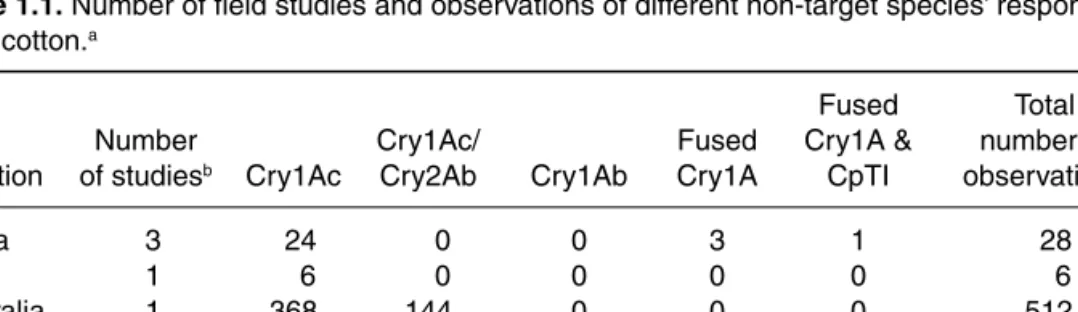
Genetically modified (GM) cotton was grown commercially for the first time in the USA and Australia in 1996 and, within 5 years, more than 5 million ha were grown worldwide. There are three kinds of genetically modified cotton that have been commercialized: cotton with resistance against herbicides, resistant against lepidopteran pests and resistant against both herbicides and lepidopteran pests. In 2006, GM cotton was grown in at least 11 countries, with the largest amounts grown in the USA, India, China, Australia, Brazil, Argentina, Mexico, Colombia and South Africa (Falck-Zepeda et al., 2007). In this book, we focus on GM cotton that is resistant to lepidopteran pests based on protein toxins from Bacillus thuringiensis. These include both crystal pro- tein (Cry) toxins and vegetative insecticidal protein (VIP) toxins. In the following section, we review the experiences of some of the countries that already use Bt cotton and draw conclusions to identify possible opportunities and challenges with Bt cotton for Vietnam.
USA
The first Bt cotton commercialized in the USA was Cry1Ac (Bollgard®) cotton, which provided excellent control of Heliothis virescens (cotton budworm) and Pectinophora gossypiella (pink bollworm) and some control of other impor- tant lepidopteran pests (US EPA, 2001). Currently, several additional Bt trans- genes have been commercialized and the total area planted to Bt cotton in
2006 was 3.45 million ha (NASS, 2006). Most of the published information on the benefits and risks of growing Bt cotton is on Cry1Ac cotton, although several others, such as Cry1Ac/Cry2Ab and Cry1Fa/Cry1Ac cottons, are used widely.
Yield studies have demonstrated that Bt cotton has higher average lint yields than non-Bt cotton in the large-scale commercial production systems in the USA (Marra et al., 2002; Cattaneo et al., 2006). This yield benefit, how- ever, is variable and depends on the level of budworm pressure, other pests and environmental conditions. When the target pest pressure is low, the yield ben- efit is lower, and when other pests are common or environmental conditions are poor, the yield benefit again is lower. Average yield benefits (Bt yield minus non-Bt yield) ranged from 83.2 to 130 kg lint/ha when examined in 47 studies throughout the USA; however, particular yield trials varied from a 330 kg lint/
ha loss to a 1030 kg lint/ha gain. In other words, Bt cotton did not always result in higher yields. Bt cotton received fewer applications of insecticides than non-Bt cotton, ranging from 1.1 to 2.5 fewer applications (Marra et al., 2002;
Head et al., 2005; Cattaneo et al., 2006). In the south-east and mid-south, there were 2.3 applications on non-Bt cotton and only 1.2 applications on Bt cotton. These low rates of insecticide application on both Bt and non-Bt cotton have been possible because of the (unrelated) successful eradication of boll weevil. In the south-west (Arizona), there were 6.7 applications on non-Bt cotton and 4.3 applications on Bt cotton.
Many potential adverse environmental effects of Bt cotton have been investigated in the USA, including reductions in pollinators, potential gene flow to crop relatives, resistance evolution in the target pests and disruption of natural pest population regulation by the reduction in parasitoids and preda- tors. For Bt cotton in the USA, resistance risks are assessed and considered serious enough to require management using non-Bt refuges (Chapter 12, this volume). Compliance with this requirement has been high (Carrière et al., 2005). To minimize risks arising from gene flow, planting is not allowed in locations where there are wild relatives with which cotton can interbreed.
These restrictions have had no commercial consequence because the restricted areas are not suitable for cotton production. Some non-target herbivores have become significant pests in Bt cotton. These include stink bugs in the south- east (Greene et al., 2001, 2006), Lygus bugs in the mid-south (Hardee and Bryan, 1997) and Lygus bugs and tobacco whitefly in the south-west (Wilson et al., 1992, 1994) of the USA.
More recently, risks associated with seed industry practices have surfaced (NRC, 2002). Commercial companies do not want to maintain inventories of large numbers of varieties. In the USA, Bt cotton is most often available with a herbicide tolerance (HT) gene. This has resulted in overuse of the Bt trait because many growers require only the HT trait, but cannot obtain sufficient high quality seed with this trait only. In addition, while the base genetics of the transgenic varieties continue to improve, the base genetics of the non- transgenic varieties are lagging behind. This is expected to affect the eco- nomics of resistance management by increasing the opportunity costs of planting a refuge.
Australia
INGARD® (= Bollgard®) was the first commercialized Bt cotton in Australia. It provided economic control against H. armigera and significant reductions in pesticide requirement (~50%) but, because Cry1Ac concentrations declined during the season, control efficacy also declined (Fitt et al., 1994, 1998). There were also significant concerns about resistance risk. Consequently, in 2004/05, INGARD® varieties were removed from the market once two-gene Bollgard II® varieties were available. Bollgard II® contains both Cry1Ac and Cry2Ab, which provide season-long control of H. armigera. In 2006, approximately 80% of cotton grown in Australia was Bt varieties, although the total area was sup- pressed dramatically by drought. Most of the published literature from Australia is on INGARD® cotton, but newer work on Bollgard II® and VIP3A cotton is emerging (Llewellyn et al., 2007).
The major benefit of Bt cotton in Australia has been a reduction in insecticide use. The average number of insecticide applications for the control of H. armigera was 9.7 sprays/season for conventional cotton and only 4.2 sprays/season for Bt cotton (INGARD®), a 57% reduction (Fitt, 2004). During the first several years of use, Bt cotton required 40–60%
fewer insecticide applications than conventional, non-Bt cotton (Fitt, 2004). With Bollgard II varieties, pesticide reductions of 85% have been achieved and, in situations of high pest pressure, economically significant yield increases have been realized (Gary Fitt, Brisbane, 2007, personal communication).
The potential environmental risks of Bt cotton have been examined care- fully in Australia (Fitt and Wilson, 2002; Whitehouse et al., 2005). Resistance evolution in H. armigera is considered the most serious risk and Australia has implemented a comprehensive resistance management strategy to delay it (Fitt, 2004). This includes a requirement for refuges, which include non-Bt cotton and alternative host plants such as pigeon pea, sorghum and maize. Growers pay a significant fee to use the technology and are audited several times during the growing season to document compliance with the management strategy.
Compliance is very high. Initially, growers received monetary rebates in recog- nition of compliance, although now, with Bollgard II varieties, the pricing struc- ture no longer includes rewards per se. Bt cotton production is also now approved in Northern Australia after initial concerns about the risk of gene flow to native Australian cottons and about potential weediness were demon- strated to be negligible risks (OGTR, 2006). Although recognized as a potential issue (Ward, 2005), no sucking pests have become secondary pests of Bt cot- ton in Australia, although higher populations of two-spotted spider mites have been observed associated with Bt cotton production systems (L. Wilson, Narrabri, 2007, personal communication). No effects on natural enemies have been observed (Whitehouse et al., 2005). On balance, Bt cotton has been accepted widely by Australian growers, who have benefited from reduced insec- ticide use and from the positive community recognition of reduced environ- mental impact.
China
China has grown Bt cotton since 1997, based on three different transforma- tion events – cry1Ac,cry1A (a fusion of cry1Ab and cry1Ac) and CpTI (cow- pea trypsin inhibitor), an inhibitor of protein digestion. CpTI often occurs in commercial varieties with one of the other genes. These Bt cottons provide control against H. armigera,P. gossypiella and Anomis flava (cotton looper) (Cui and Xia, 2000; Wan et al., 2004, 2005). The Chinese Agricultural Yearbook reports 3.7 million ha of Bt cotton were grown in 2004. A third of Chinese cotton is produced from large, subsidized state-run farms of irrigated cotton in north-western China, but millions of smallholder farmers in the Yellow River and Yangtze River cotton growing regions also produce a large amount of cotton (Wu and Guo, 2005).
Early work demonstrated that Chinese smallholder farmers benefited from Bt cotton. Farm budget analysis based on surveys of 300–400 farmers in five provinces during 1999–2001 showed a complex pattern of adjustments of pesticide use and yield associated with Bt cotton (Huang et al., 2002; Pray et al., 2002). In the Shandong Province during 1999, yields of Bt cotton were 9% higher and the amount of insecticide applied was 71% lower. In the Henan Province, yields were 17.7% higher during 2000 and 6.7% higher during 2001, and insecticide use was 63% lower during 2000 and 55% lower during 2001. In the other provinces in 2001, yields were 6.0–7.2% higher and insec- ticide was 14–47% lower. Surprisingly, labour expenditures did not parallel insecticide use patterns, even though insecticide application was one of the main labour costs of cotton production. In all 3 years, use of Bt cotton resulted in increased yield and reduced amounts of insecticide, although this reduction in insecticide use appeared to decline over time. The studies conclude that farmers had a positive net income from Bt cotton, mainly through reduced input and labour costs (Huang et al., 2003).
A follow-up study of > 400 farmers in five provinces during 2004 showed a striking change to the economics of Bt cotton (Wang et al., 2006). Using an econometric model, the authors confirmed that farmers benefited substantially from Bt cotton during 1999–2001, having a higher net revenue of US$121/
ha. In 2004, this was reversed and farmers using Bt cotton had a net revenue 8% lower than non-Bt cotton growers (approximately –US$250/ha). They showed that farmers had slightly higher insecticide expenditures than non-Bt farmers, probably for the control of secondary pests, such as mirid bugs (Wu et al., 2002a). It is possible that 2004 was an atypical year, but it illustrates that Bt cotton may not always be beneficial to the farmers who use it.
It is not certain if Chinese Bt cotton farmers will be able to maintain its benefits without institutional support to guarantee the quality of Bt cottonseed, discourage pesticide use and provide IPM training (Huang et al., 2003; Yang et al., 2005a,b; Pemsl and Waibel, 2007). Efficacy of Bt cotton has been variable. In 2002, < 15% of farmers in Shandong purchased official certified Bt seed and most of the rest used saved seed or unofficial, inexpensive Bt seed from informal sources (Pemsl, 2006; Pemsl and Waibel, 2007). Efficacy of the
official Bt cotton had high variability and the variability of the saved and unoffi- cial seed was even higher. Pesticide use on both Bt and non-Bt cotton exceeded the economically optimal level greatly (by 10–40 kg active ingredient/ha) and farmers probably could reduce pesticide use without affecting yields of either Bt or non-Bt cotton (Huang et al., 2002; Pemsl et al., 2005; Yang et al., 2005a). Farmers in the Shandong Province sprayed Bt cotton 10–12 times (Pemslet al., 2005; Yang et al., 2005a) and farmers in five other provinces sprayed Bt cotton 18 times (Wang et al., 2006). IPM training may be essential to reduce pesticide use in both Bt and non-Bt cotton (Yang et al., 2005b).
Farmers without IPM training used three times more pesticide and sprayed twice as frequently on their Bt cotton plots as the farmers with IPM training.
Thus, institutional support is needed to ensure that smallholder farmers in China obtain the benefits Bt cotton offers.
Resistance risk is the main risk of Bt cotton that is managed in China.
Resistance risk management relies on the combined use of the fused Cry1A toxin and CpTI in the same varieties to delay resistance evolution in H. armigera and P. gossypiella. Refuges are unstructured and rely on maize and other crops for H. armigera (Wu et al., 2002b, 2004; Wu and Guo, 2005). No refuge is availa- ble for P. gossypiella. If Bt maize is commercialized, there will be a need for structured refuges for Bt cotton (Wan et al., 2005, Wu and Guo, 2005; Wu, 2007). Several non-target pests have emerged, including mirids (Wu et al., 2002a; Wang et al., 2006) and possibly aphids (Wu and Guo, 2003) and leaf- hoppers (Men et al., 2005). Gene flow risks are considered unlikely in China (Zhanget al., 2002).
Argentina
Bt cotton was commercialized in Argentina by Monsanto in 1998 and, in 2005/06, it was planted on 61,000 ha, about 20% of the cotton area in Argentina (Falck-Zepeda et al., 2007). Two varieties containing a cry1Ac gene are planted and have good resistance against the two major pests, tobacco budworm (H. virescens) and the cotton bollworm (H. gelotopoeon (Dyar) ), and also provide protection against the cotton leafworm (Alabama argillacea), the pink bollworm (P. gossypiella) and, to a lesser extent, the armyworms (Spodoptera spp.) (Qaim and de Janvry, 2003).
Field surveys of 89 large-scale farmers (Qaim and de Janvry, 2003; Qaim et al., 2003) showed that, over two cropping seasons, farmers applied 55%
and 43% less insecticide (kg a.i./ha) to their Bt cotton compared to their non-Bt cotton and had significantly higher yields (32%) from the Bt cotton (Qaim et al., 2003). Yield of Bt cotton was predicted to be higher for smallholder farmers (~42%), and total gross benefit/ha was also expected to be higher (17%) than for large-scale producers. The authors attribute this prediction to insufficient control of pests by smallholders, who apply little to no insecticide