Downloaded by [New York University] at 00:18 07 August 2016
Archaeology of Psychotherapy in Korea
This is the first book in English dedicated solely to the historical development of psychotherapy in Korea. It is an archaeological research of literature relating to the care and treatment of mind in Korean history in dialogue with spiritual, philosophical, cultural, social, and medical perspectives. It reviews the evolution of different approaches on mental illnesses covering autochthonous practices, psychiatry, clinical psychology, counselling, Western psychotherapy, and Korean psychotherapy. Archaeology of Psychotherapy in Korea inspects:
• Folk treatment
• First psychiatry
• Influence from clinical psychology
• Counselling development
• Implementation of Western psychotherapy
• Shaping of Korean psychotherapy.
Its discussion engages firmly with the Korean culture and perspective while acknowledging various extrinsic influences and the fact that Korean psychotherapy continues to evolve in its own unique manner. It aims to refine the understanding of psychotherapy development in Korea in connection with its historical and social backgrounds, and to interpret a way to highlight the culturally relevant psychotherapy that is more suitable as a Korean psychotherapy better attuned to the distinct cultural and societal expectation of Korea.
Haeyoung Jeong is a psychotherapist and art therapist. She received her doctorate in Psychotherapy Sciences from the Sigmund Freud University, Vienna.
Downloaded by [New York University] at 00:18 07 August 2016
Routledge Studies in Asian Behavioural Sciences Series Editor: Lo Tit Wing, City University of Hong Kong
Archaeology of Psychotherapy in Korea
A study of Korean therapeutic work and professional growth Haeyoung Jeong
Downloaded by [New York University] at 00:18 07 August 2016
Archaeology of Psychotherapy in Korea
A study of Korean therapeutic work and professional growth
Haeyoung Jeong
Downloaded by [New York University] at 00:18 07 August 2016
First published 2015 by Routledge
2 Park Square, Milton Park, Abingdon, Oxon OX14 4RN and by Routledge
711 Third Avenue, New York, NY 10017
Routledge is an imprint of the Taylor & Francis Group, an informa business
© 2015 Haeyoung Jeong
The right of Haeyoung Jeong to be identified as author of this work has been asserted by her in accordance with sections 77 and 78 of the Copyright, Designs and Patents Act 1988.
All rights reserved. No part of this book may be reprinted or reproduced or utilised in any form or by any electronic, mechanical, or other means, now known or hereafter invented, including photocopying and recording, or in any information storage or retrieval system, without permission in writing from the publishers.
Trademark notice: Product or corporate names may be trademarks or registered trademarks, and are used only for identification and explanation without intent to infringe.
British Library Cataloguing in Publication Data
A catalogue record for this book is available from the British Library Library of Congress Cataloging in Publication Data
Jeong, Haeyoung, author.
Archaeology of psychotherapy in Korea: a study of Korean therapeutic work
& professional growth / by Haeyoung Jeong.
p. ; cm.
I. Title.
[DNLM: 1. Mental Disorders—therapy—Korea. 2. Psychotherapy—
history—Korea. 3. History, 20th Century—Korea. 4. History, 21st Century—
Korea. WM 11 JK6]
RC480.5
616.89′1409519—dc23 2014021399
ISBN: 978-1-138-79380-4 (hbk) ISBN: 978-1-315-76085-8 (ebk) Typeset in Times
by Book Now Ltd, London
Downloaded by [New York University] at 00:18 07 August 2016
Dedicated to the people on the Sewol ferry and to families and friends affected by the incident
Downloaded by [New York University] at 00:18 07 August 2016
This page intentionally left blank
Downloaded by [New York University] at 00:18 07 August 2016
Contents
List of illustrations ix
Foreword xi
Chronology of events xv
Introduction 1
1 Korean mental geography 4
Korean ethos 4 Korean pensées 11
2 Korean philosophy 25
Cheon-Ji-In 25 Pungryu 28
3 Folk treatment 39
Autochthonous practices 39 Mudang and Kut 42
Folk-psychical approach 47
4 First psychiatry 56
Introduction of Western psychiatry 56 First Korean psychiatrists 61
Reconstruction of Korean psychiatry 63
5 Influence from clinical psychology 71
Introduction of psychology: 1910s–1945 71
Early development of clinical psychology: 1946–1970s 73 Expansion of clinical psychology: 1980s– 79
Downloaded by [New York University] at 00:18 07 August 2016
viii Contents
6 Counselling development 82
Early counselling psychology: 1950s–1970s 83 Counselling development: 1980s– 84
School counselling 87 Pastoral counselling 91
7 Implementation of Western psychotherapy 95 Psychoanalytic psychotherapy 96
Humanistic psychotherapy 106 Cognitive behavioural therapy 109 Expressive arts therapy 111
8 Shaping of Korean psychotherapy 115
Taopsychotherapy 116 Seon psychotherapy 124
Conclusion 134
Glossary 142
Index 144
Downloaded by [New York University] at 00:18 07 August 2016
Illustrations
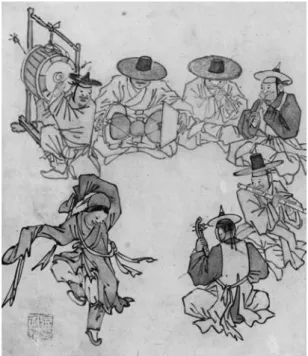
1.1 Pungmul, at Naju, 1976 10
1.2 Danwon Kim Hong-Do ‘Mudong’, around 1789 11
1.3 Bojo-Jinul 보조 지눌 (1158–1210) 14
1.4 Rock-carved Bodhisattva in half lotus position (신선암마애보살반가상) at Sinseonam Hermitage in
Gyeongju, around the eighth century © 2011 Eggmoon 15
1.5 Jesa © 2006 pcamp 17
1.6 Jandaehyun Church, at Pyungyang, 1900 21
2.1 Cheon-Bu-Kyung: an example found in the posthumous collections of Nongeun Jo Won-Kil, a scholar of the
late Goryeo Dynasty (around 1328–1392) 25
2.2 Choe Chi-Won 29
2.3 Choi Si-Hyung 33
2.4 Ham Seok-Heon (left), his teacher Yu Young-Mo (right)
© 2008 Ssialsori 35
2.5 Ham Seok-Heon 36
3.1 Tal-nori 41
3.2 Tal-nori at Andong © 2008 Koreanet Korean
Culture and Information Service 41
3.3 Mudang and Kut © 2010 Splashman 43
3.4 Hyewon Shin Youn-Bok ‘Munyeo-shinmu’, around 1805 45
3.5 Heo Jun 50
3.6 Dongui-Bogam 51
3.7 Lee Jei-Ma 52
4.1 Jejung-won, 1885–1904 57
4.2 The Severance Hospital and Medical School;
students and staff at the Severance, 1904 59
4.3 Kim Sung-Hi 66
4.4 Rhee Dong-Shick 67
4.5 Yu Seok-Jin 68
4.6 Lee Jung-Seob 이중섭 (1916–1956) ‘Ox 소’ 69 5.1 Lower grade girls, Ewha Haktang, 1908/1922 © 2014
University of Southern California 71
Downloaded by [New York University] at 00:18 07 August 2016
x Illustrations
5.2 Im Seok-Jae, Han Chi-Jin, Lee Jin-Sook 73
5.3 Seoul National Mental Hospital (est. 1962) © 2008
Voice of People 77
6.1 SNU Student Guidance Centre © 1962 SNU 85
6.2 D-middle school, mid-term exam © 2009 Samuel Orchard:
according to the Korean Statistical Information Service (KOSIS), the suicide rate of 8.9 per cent per 100,000 population was observed in the age group of 15–19 (in 2011). 39.2 per cent of respondents identified the stress about school records or exams as major causes
of the impulse to commit suicide (in 2012) 90
6.3 Lee Whan-Shin 91
7.1 Rhi Bou-Yong 101
7.2 Lee Zuk-Nae 103
7.3 Cho Doo-Young 105
7.4 Gestalt therapy group workshop © November 2008 Author 108 7.5 Art therapy workshop © September 2010 Author 113 8.1 Kyungbong Sunim with Lee Keun-Hu, Rhee Dong-Shick,
Yun Ho-Kyun (circled, from the left): Tongdo-sa, Yangsan
© September 1974 The Korean Academy of Psychotherapists 116
8.2 Ten Ox-herding pictures 121
8.3 Inkyung Sunim 126
8.4 Yeom-Ji-Gwan meditation therapy (Awareness–Stay–Observation Meditation); workshop held in Beobryun-sa © July 2012
The Korean Meditation Counselling Association 127
Downloaded by [New York University] at 00:18 07 August 2016
Foreword
This book by Haeyoung Jeong is a remarkable one as it is presumably the first book about psychotherapy in Korea which describes both ‘worlds’: the Western worldview of psychotherapy and the Korean view on psychotherapy, both from an historic perspective.
For me as a Western-trained psychoanalytic psychotherapist, it is very informative to discover what a rich tradition has existed in Korea since ancient times about the nature of the human soul and its treatment. With the spreading of Western psychotherapy all over the world and also in Korea, the author turns to national history, seeking its roots and looking for the integration of the past with the future and the West with the East.
The author is in good company with Sigmund Freud who described psy- choanalysis as a method of ‘archaeology of the soul’. Haeyoung Jeong is the archaeologist and psychoanalyst of the understanding of the collective soul, its theories and practices of Korea.
She does not deal with political circumstances but has chosen a more spiritual and philosophical way of looking beyond everyday life to excavate the real trunk of understanding the soul in Korea from former times to now. She stays in a line of Henri Ellenberger’s book on the Discovery of the Unconscious (1970) but also of Michel Foucault’s efforts to look behind the curtain of normal conventions and she looks for the drives and forces which constitute modern consciousness in the mirror of its history.
With this book, the global understanding of the soul makes a step forward and it enriches the scientific but also the cultural understanding of Korea and its capacities, as well as its problems. This is also shown through the illustrations of the book which gives me one more dimension of the topic.
Dr Alfred Pritz President of the Sigmund Freud University Vienna, May 2014
Downloaded by [New York University] at 00:18 07 August 2016
Ship-Jangsaeng 십장생
To enjoy a long healthy life in harmony with nature is a prime ideal throughout Korean culture. It is the main goal of Korea’s indigenous Shin-shun (Spirit- Immortal) Ideology that permeates and colours its Shamanism, Buddhism, Confucianism, other traditions and folk-culture. One motif from this tradition that is still most commonly used and considered meaningful is the Ship-Jangsaeng 십장생 that is the Ten Symbols of Longevity: Rock, Tortoise, Sun, Crane, Deer, Mountains, Reishi mushroom, Water, Pine trees and Cloud. These are the ten items that represent immortality.
Downloaded by [New York University] at 00:18 07 August 2016
Downloaded by [New York University] at 00:18 07 August 2016
This page intentionally left blank
Downloaded by [New York University] at 00:18 07 August 2016
Chr onology of events
Three UnitedGoryeoJoseonJapan 1st Rep.KoreanYushinDemocratic Asian KingdomsSillaColonialS. KoreaWarGovernmentMovements Financila Crisis GovernmentPark Jung-Hi BC57676936139219481950-531961-7919871997 BC700060080014001600180019101945195019601970198019902000 FOLK TREATMENT: Suhn, Arts, Kut, Folk-psychical PSYCHOANLYSISPERSON-CENTREDCBTMEDITATION PHILOSOPHY1962SNU Student Guidance Center 617-6861489-15461894-1909-1989Seoul National Mental Hospital Cheon-Ji-.InIl-shimGiDonghakSsial1963School Counselling Education Act 1964Society of Clinical Psychology FOLK TREATMENT1968Analytical Psychology:Rhi Bou-Yong 82216131894 KutTal.noriFolk-psychical ApproachDongui Sasang1973First certified counselling psychologists Jieon.Goron TherapyBogam Typology1974Korean Academy of Psychotherapists PSYCHIATRYKorean Assoc. of Psychoanalysis: Cho Doo-Young1980 Jejung.won1885Clinical Art Association1982 Joseon-Chongdokbu.Uiwon: Shim Ho-Seop1913Voluntary Counselling Service for Students1985 Severance Hospital: Lee Jung-Chul1923Korea Counselling Centre: Kim In-Ja1986 Kyungseong Imperial Univ. Hospital:Myung Ju-Wan1924Gestalt Therapy:Kim Jung-Kyu1988 PSYCHOLOGYSeoul Cognitive Therapy Centre1993 The Korean Psychological AssociationArt Therapy Consultation Services for Problem ChildrenDance-Movement Therapy Psychiatric clinic in the Seoul Juvenile Court1946Drama Therapy Music Therapy Psyhological Assessment Tools1950Mental Heath Act1997 Pastrol Counselling: Lee Whan-Shin1951 Art Remedies Program: Yu Seok-Jin1952Buddhist Counselling: Lee Keun-Hu2000 Children’s Advisory Board1958Buddhist Psychotherapy Seon Counselling:Inkyung2002Downloaded by [New York University] at 00:18 07 August 2016
This page intentionally left blank
Downloaded by [New York University] at 00:18 07 August 2016
Introduction
Historically, in Korea, mental illness and its treatment were largely a matter for spiritual healers, such as shamans, Buddhist monks and Taoist priests, and even Confucian scholars. In fact, shamanistic healing, Buddhist and Tao philosophy and practice of meditation, the Confucian cultivation of mind, together with folk-psychical methods of traditional Korean medicine have all been preserved throughout Korea’s history. The first documented record of individual psycho- therapy in Korean history may be the case of treating the ‘depressed’ Chungkong in 822. A Confucian scholar named Nokjin who recognised the nature of his illness effected the cure by ‘proper words and high discourse’, a method also mentioned in traditional Eastern medicine, that is similar to modern didactic psychotherapy.
In the 1930s, the theories of modern Western psychotherapy were introduced into Korea, and some Korean psychiatrists attempted to apply the concepts of Freudian psychoanalysis or methods of hypnosis and persuasion in their treat- ment. However, due to the extreme discrimination against Koreans’ access to training and profession by the colonial Japanese government, their activities were limited; before liberation in 1945, psychotherapy in Korea barely existed. During the Korean War, the Koreans came in contact with American dynamic psychiatry, psychological tests, clinical psychology and the Western modes of counselling.
From the 1950s, many mental health professionals emerged from various disci- plines, allowing psychotherapy in Korea to grow and evolve.
In the last two decades, while Western psychotherapy has continued to develop and swell the number and types of therapy, the psychotherapy in Korea has also suffered from an internal struggle. Professional psychotherapists who have been trained in Western modes of therapy have commonly faced difficul- ties because of the particular nature of Korean patients’ expectations, relation formation and responsiveness. Questioning the default application of Western modes of psychotherapy without validating their suitability in the Korean set- ting, a number of dedicated mental health professionals have promoted the integration of traditional Korean values and practices with the Western methods of psychotherapy. The main effort taken by these professionals has been to combine locally familiar notions of the Tao and Buddhist philosophy and meth- ods of meditation. Another related accomplishment comes from the field of
Downloaded by [New York University] at 00:18 07 August 2016
2 Introduction
expressive arts therapy, incorporating traditional Korean artistic activities such as tal-nori (mask play), samul-nori (percussion music play) or madang-nori (open yard arts play).
To refine the understanding of psychotherapy development in Korea, this book traces the treatment of mental issues throughout its recorded history. It explores traditional Korean thoughts, beliefs and values as the backbone of therapy and reviews the development of different attitudes, approaches and methods for addressing mental illness in relation to their historical and social contexts. The book begins by revealing the important cultural-specific concepts considered vital to understanding Korean ethno-psychology, Korean ways of thinking and feeling. Four core concepts are introduced and they are Haan (deep grief or resentment), Jeong (strong feeling of affection or attachment), Noonchi (intuitive perception) and Heung (intrinsic sense of joy). It is followed by the four main streams of religious and ethical experience (i.e., Shamanism, Buddhism, Confu- cianism and Christianity), which played a definite role in forming the Korean mentality or consciousness. The notions of Cheon-Ji-In (the connected ‘oneness’
of heaven, earth and humans) and Pungryu (aspiring toward nature and harmony;
a natural lifestyle usually associated with creativity and spontaneity) are also explored. The subsequent text examines the significant practice of arts play as a primordial treatment, followed by the contributions of shamans and shamanic rites and traditional Korean medicine.
These first three chapters really provide the horizontal overview on the Korean mental geography and the practices served to soothe its rifts and fissures. In the following three chapters, the developments of first psychiatry, clinical psychology and counselling are explained focusing on the growth of each professional domain.
Outlining the achievement of expressive arts therapy, the Western methods of psychotherapy, classified into the three categories of psychoanalytic, humanistic and cognitive behavioural psychotherapy are then investigated. Finally, the devel- opments of Taopsychotherapy and psychotherapy through Buddhist teaching or practice of meditation are highlighted, and thereby completing the holistic knowledge-base of how present day, Korean psychotherapy has been shaped.
Drawn upon the understanding of psychological, spiritual, ethical, cultural and medical characteristics in the historical development of mental treatment in Korea, this book attempts to highlight the importance of knowledge about its cultural and philosophical history and the historical conditions obscured behind system or custom, in order to appreciate the true nature and challenges of Korean psychotherapy. It takes the view that such knowledge is essential to identify a psychotherapeutic approach that is better attuned to the specific needs of Koreans within their cultural milieu. The book shines from the perspective of a Korean psychotherapist inquiring not ‘what is Korean psychotherapy?’, but ‘how is Korean psychotherapy patterned; how has Korean knowledge of mind cure historically developed and changed?’.
The idea of the archaeology of psychotherapy comes from Foucault’s archae- ology of knowledge. While the book tracks his methodology of archaeological
Downloaded by [New York University] at 00:18 07 August 2016
Introduction 3 analysis only loosely, it treads its path by unearthing and distinguishing the strata of ideas that constitute the approaches for mental cure over the past centuries. It reveals layers of diverse practices for the treatment of the mind, and attempts to produce a form of knowledge pertaining to the distinctive character of Korean psychotherapy today and thereby establish the foundations for more suitable and effective practices.
The word ‘psychotherapy’ has two Korean terms; one is Simli-Chiryo 심리치 료 (心理治療) and the other is Jungshin-Chiryo 정신치료 (精神治療). Both Simli-Chiryo and Jungshin-Chiryo are Sino-Koreans words.1 The latter has a more psychiatric connotation of ‘mental’ treatment and is used amongst psychia- trists. On the other hand, Simli-Chiryo originated from the Chinese for psychol- ogy (Simli, 心理) (心 literally meaning ‘mind or heart’ and 理 meaning ‘logic or reason’) and Chiryo (治療) meaning treatment. This is more generally used by other mental health professionals. Naedam-ja 내담자 is a Sino-Korean word to refer to a counsellee. Nae (來) meaning ‘to come’, dam (談) ‘to talk’ and Ja (者)
‘a person’, Naedam-ja thus literally means ‘a person who comes to talk’.2 Simli- Chiryo can be then paraphrased as dealing with the logic of mind of a person who comes to talk. This book is about the history, evolution and context of Simli-Chiryo 심리치료 in Korea.
Notes
1 Today, in South Korea, the core of the Korean vocabulary is made up of Hangeul 한 글, the native phonetic alphabet of the Korean language, while a significant proportion of the words especially that denote abstract ideas, are Sino-Korean words called Hanja 漢字; Hangeul 한글 was created in 1443 but only came into widespread use in the late nineteenth century replacing Chinese characters. Hanja is words that originated from Chinese, or were heavily influenced by Chinese words and coined in the Korean lan- guage. In North Korea, officially, Hanja has not been used since June 1949 and many words borrowed from Chinese have been replaced with native Korean words.
2 The Korean word for counselling is Sangdam 상담, a coined Sino-Korean word. Sang (相) means ‘one another’ and dam (談) means ‘talk’. The character 相 can be split again into 木 (tree) and 目 (eye). 談 can be split into 言 (word) and 炎 (flame). 상담 (相談), then, can be read as ‘to talk looking at one another around a fire’, exquisitely evoking the idea of ‘a calm, gentle, willing and glad dialogue’.
Downloaded by [New York University] at 00:18 07 August 2016
1 Korean mental geography
Korean ethos
Two approaches to the pursuit of Korean psychology are manifest today. One approach deals with Shamanism, Buddhism and Confucianism to find the elements which may be understood and reinterpreted from the viewpoints of modern psychology. Another approach is from folk psychology, espousing social constructivist philosophy.1 Psychologists in this line derive important cultural-specific concepts from Koreans’ spoken words and analyse the rela- tionships of the concepts. Holding on to these Korean terms, they enquire into characteristic phenomena of Korean life and present them as psychological concepts. Notably Choi Sang-Chin 최상진 (1940–2011)2 has pioneered such research on the psychology of Koreans since the 1980s in the dominant aca- demic milieu of studying it through using the terms and theories of Western psychology. He devoted himself to developing a Korean indigenous psychology and the psychological conceptualisation of many indigenous phenomena.
Today, concepts such as Haan 한, Jeong 정, Noonchi 눈치 and Heung 흥, that reflect the essence of Korean psychology in both cultural characteristics and interpersonal relations, are culture-specific concepts considered vital to under- standing Korean ethno-psychology – Korean ways of thinking and feeling.
Haan 한
Haan is a key word to the understanding of Korean people and culture. It has a very complex cultural, psychological structure and has a highly subtle in-depth psychological dynamic, running on many levels from the highest historical national consciousness extent to the innermost feelings of an individual. Histori- cally, Haan has been regarded as a Korean person’s historical, cultural, social and collective emotional state of repressed and accumulated anger, resulting from an appalling national history of invasions and wars, as well as from a painful per- sonal life of poverty, exploitation and losses. Its geographical positioning exposed the country to frequent invasion and occupation by neighbouring foreign forces – a repeated experience of being trampled and destroyed. Koreans have experienced an abundance of loss and pain in their lives. In the twentieth century, Korea was
Downloaded by [New York University] at 00:18 07 August 2016
Korean mental geography 5 occupied by Japan for 35 years (1910–1945) and endured the Korean War that killed millions of people, ending with the tragic division of the Korean Peninsula.
Warfare together with deep political upheavals caused Koreans grievous destruc- tion, personal loss, unbearable pain and suffering. In addition, the social injustice of the traditional Confucian system in particular generated its own degree of personal misery and victimisation for the ruled. The poor, the powerless, as well as women, had to be subservient and cope with much maltreatment and injustice.
Within this history and culture, few have escaped the experience of loss, suffering or resentment. For their own survival and with the overall inclination to live in harmony, however, they have mostly suppressed their real emotions, thereby fostering deep feelings of Haan.
Haan is generally understood as the psychological state that usually appears as one is overcome by the anger arising from suffering injustice or anything that is unfairly inflicted upon an innocent person or a group, for a prolonged period.
Not only invading foreign forces, an unequal society or abusive parents-in-laws, but even fate or natural calamity can generate the Haan feeling of indignation.
While the original Chinese character of Haan 恨 means ‘to get even with’ or ‘to revenge’, and thus has a more action-oriented vengeful sense, the Korean use of Haan 한 (恨) stresses a suppressed feeling of anger. Of this suppressed anger, the grief and agitation for one’s appalling condition is repeatedly aroused and subdued in one’s mind. When suffering reaches an extreme, one collapses into a compressed feeling of sadness, despair and bitterness. This accumulated feeling of chagrin, resentment and rancour that occurs as a result of prolonged deficiency, mistreatment, unfairness or injustice for a long period of time defines Haan.
Choi Sang-Chin described the process of Haan in four phases. The first phase is the experiencing of anger, resentment, hatred or desire for vengeance for an injustice or mistreatment. Given the other Korean cultural tendency not to risk social relationships, the pressure is to suppress this anger. Being prohibited from expressing the experienced anger outwardly, from unknotting or acting out the anger, one turns to self-blame, surrendering to fate, nihilism or some rationalisa- tion that could reduce the intensity of the anger. In the second phase, anger turns into sadness, frustrated desire into feelings of helplessness and desire for revenge into self-hatred; depression and pessimism become pervasive. The third phase is the period when one keeps re-thinking and questioning the situation. Feelings of sadness or agitation are aroused and subdued repetitively. A Korean theologian, Ahn Suk-Mo 안석모 (1953–2013) noted that Haan of this phase carried the image of ‘wounded-ness’, the shattered and split self and life almost akin to mourning. This phase may last a long time. It is usually while experiencing this phase of Haan that Koreans come to discuss it. In the fourth phase, one begins to detach and objectify the Haan feeling by putting emotional distance between Haan experiences, and can talk about it more calmly. The melancholic sentimen- tality of Haan of this last stage has been typically expressed in a sublimated way in singing, writing and other art forms.
Downloaded by [New York University] at 00:18 07 August 2016
6 Korean mental geography
Korean psychiatrists assert that Haan is deeply imprinted in the collective subconscious of the Korean people, and that is a symbol of the Korean psyche and the Korean version of victimisation syndrome. From a psychiatric viewpoint, Haan is regarded as a ‘causative factor’ in the development of a Korean culture- bound syndrome called Hwabyung. It literally means ‘fire’ (hwa 화; 火) and
‘disease’ (byung 병; 病) translated as ‘anger disease’. Hwabyung, known for a long time in Korea as a folk-medical term, is now registered as one of the culture- bound syndromes in the appendix of the Revised Diagnostic and Statistical Manual of Mental Disorders (DSM IV), published by the American Psychiatric Association. It notes Hwabyung as a folk syndrome specific to Koreans, as an anger syndrome attributed to the prolonged suppression of anger. The related symptoms are fatigue, indigestion, discomfort in the abdomen, anorexia, fear of impending doom, panic, dysphoria, generalised aches and pains, palpitations and insomnia.
Haan-puri 한풀이
While generally understood as a provenance for fulminating anger, Haan is also regarded as a motor force for accelerating Korea’s remarkable economic success and modernisation, and as a principal source of Koreans’ fervour for education.
Another outcome often attributed to Haan is the strong motivation and will to persevere and fight on until an objective is achieved. Haan of poverty and oppres- sion became a drive for Koreans to work hard to excel and be successful. Haan of socio-political oppression was sometimes expressed as in violent social revolu- tion and anti-government demonstrations often including chants and dances – ritualistic expressions of their Haan and Haan-rage.
Haan has also been understood as a source for creation. Haan that underlies repressed emotions or unrequited yearnings, thereby inordinate frustration and anger, was often sublimated into arts. Haan-related stories derived from their daily life experiences were the most common and popular themes for Korean folklores and literature. Many cultural heritages, including tal-nori (mask play), madang-nori (open yard arts play), pan-sori (epic chant), folk paintings and ceramic arts have been related to people’s Haan and widely practised to over- come one’s Haan. Koreans sought to release their Haan by means of dance, music, drama and painting. Naturally Haan has formed a nucleus of traditional Korean arts and culture. In this respect, the creativity in Korean people is, without doubt, partially ascribed to Haan as a major source of energy. Korean Shamanism was another area in which traditionally Koreans sought to deal with their Haan.
For instance, shamanic rituals called ‘Kut 굿’ are thought to release one’s Haan by resolving the Haan of the spirits of the dead. Kut is akin to a symbolic drama with plenty of singing and dancing in which people are often invited to join in. It has played an important part in Korean life.
Historically and culturally, Koreans have developed various ways to deal with Haan. Haan has been transformed, sublimated or fermented into energy for
Downloaded by [New York University] at 00:18 07 August 2016
Korean mental geography 7 life, for creation, or for the production of socially meaningful results including arts and social reformation. The action and process of unknotting and letting out Haan is called Haan-puri. It usually denotes ‘wish-fulfilment’. Today, these traditional dynamic, expressive and artistic methods of releasing Haan are, how- ever, fading away.
Jeong 정
Jeong is another Korean term of cultural-specific affect. The related Chinese character 情 is also used in Japan. However, there is a subtle distinction in its meaning for each country. The Chinese emphasise the aspects of ‘loyalty and reciprocity’ when using their Jeong character, whereas the Japanese equivalent, pronounced ‘jyo’, means rather sentimental feelings usually used with another word ‘nin (human)’ as ‘nin jyo 人情’. Jeong in Korean culture has a much more ambiguous and subtle meaning in its use. It refers to a psychological sense of bonding or relational tie with a person, extending to a place, an object or anything that one has constructed a lasting sentimental relationship with over time. Jeong occurs through direct or indirect contact, or mutual experiences and it is aroused autonomously, spontaneously and unconsciously.
Jeong is a central concept in describing the quality of relationship in any dimension. It represents a more primitive way of relating, of being more fused and less separated. The interactions among family members that emphasise one- ness, sameness, mutual support and even sacrifice manifest the prototype of Jeong-based relationships. It is this Jeong that makes Koreans say ‘we’ rather than ‘I’, ‘our mother, our house’ rather than ‘my mother, my house’; it links to
‘Uri 우리 (we)’ culture of Koreans. Such psychology of ‘we-ness’ or Jeong rela- tionship is frequently extended to relationships with non-family members. Once the ‘other’ enters a sort of ‘we-ness’ connection, a Jeong relationship operates instantly. As such, Koreans emphasise the aspect of Jeong in the evolution of interpersonal and emotional relationships between people, developing long-term relations through bonding. A common thought system which underlies Jeong and solidifies we-ness is a so-called ‘Han 한 (韓)’ philosophy. Here, Han means
‘one’, ‘big’, ‘whole’ or ‘brightness’.3 This philosophy of Han represents a Korean ideal to become one, reunited and harmonised with others. Naturally, the Han philosophy appeared in Korean history each time the nation suffered troubles from within or outside, in order to overcome the pressing difficulties. In human relationships, a Han mindset is typically expressed collectively in we-ness and Jeong. Consequently, the manifestation of Jeong in social frames is primarily through fidelity and devotion, often without overt reasoning or assessment. Inter- actions between Koreans, whether formal or informal, carry the assumption of engagement and interdependency, and such values as independence and auton- omy are estimated or assumed to be less important.
While Koreans consider Jeong an essential element in human life, promoting the depth, meaningfulness and richness of personal relations, life and environment,
Downloaded by [New York University] at 00:18 07 August 2016
8 Korean mental geography
Jeong-ridden behaviours can easily cause tensions, conflict, dissatisfaction and rage. Jeong tends to impose one’s own expectation and demand for the other party to respond accordingly, or one decides to live by the expectation of people in Jeong relationship against one’s desire. Consequently, a personal boundary is easily vio- lated and the personal needs can be constantly disregarded by Jeong-related people.
Once arisen, Jeong rarely dissipates and it results in having a strong attachment that hinders living freely and independently. A Jeong relationship devoid of mutual affection or closeness can also provoke Haan. Jeong can also endanger social rela- tions by siding with insiders while segregating outsiders, thereby splitting in-group and out-group. Nepotism and favouritism are indeed common practice in Korea.
Koreans are likely to go to someone they count on, with whom they are usu- ally Jeong-bonded, for counselling or advice. In such a relationship, they readily talk, share, understand and exchange thoughts. Hence, it can be challenging for a Korean to open up to an unfamiliar mental health professional without develop- ing any degree of Jeong trust between the two. However, it is also to say that once a relation of Jeong is developed with the therapist, psychological and emotional interactions can be very rich, intense and insightful.
Noonchi 눈치
The abundance of Jeong exchange in social relations demands Koreans to be highly sensitive to others and to maintaining good interpersonal relationships.
Thus, they make greater efforts to ensure a relationship remains unbroken, under any circumstances. The Korean word, Noonchi, literally meaning ‘measuring with eyes’, is a concept that characterises a special interpersonal relationship. It is used in various contexts with subtle differences in nuance. If one has Noonchi, it means one has an intuitive capacity to read the mind of another person and react accordingly and appropriately. Here, Noonchi refers to a sense that is able to understand the needs or mood of others, or the states of a social situation instantly, based not on what is being said, but on appreciating an underlying communication.
This then enables unspoken expectations or feelings to be accommodated. Some- one who has fast Noonchi will quickly grasp and handle the situation, while a person who has too much Noonchi would continuously study other people’s countenance, voices, body languages and other cues, and try to adapt to their feel- ings as much as possible. Someone who shows no sign of Noonchi is commonly regarded as being ignorant, negligent, insensitive or immature. If someone gives you Noonchi, it means being shown a sign or gesture of representing internal thought; someone without Noonchi would not easily capture this cue and message. ‘Give Noonchi’ can also have the additional connotation of an unwelcome look. Noonchi exchanged between people refers to delivering a message through indirect and non-verbal communication.
While the terms Haan and Jeong have become increasingly dated, the term Noonchi is still very popular. Having an acute sense of Noonchi is regarded as being indispensable to interpersonal relationships, especially any relationship
Downloaded by [New York University] at 00:18 07 August 2016
Korean mental geography 9 with seniors in the workplace. The proper Noonchi helps to avoid or prevent any incident which may cause embarrassment and to keep harmonious relationships.
Koreans have the tendency not to explicitly express anything that has the poten- tial to make people or the social atmosphere feel awkward or unpleasant. Thus, the intended meaning of the messages is often not directly verbalised. A person may say ‘yes’ while the real meaning is ‘no’, and it is up to one’s Noonchi to capture the hidden meaning – often relying on the context of interaction for guid- ance. Not surprisingly, misled Noonchi can breed misunderstanding and conflict.
On the other hand, one who has too much Noonchi can easily harbour anger and disrespect. Excessive Noonchi that keeps one on constant alert, can make one extremely nervous, tense, insecure, anxious and fearful. It can generate clinical manifestations of social phobia and paranoia. Anthropophobia, ‘Taein-Kongpo 대 인공포 (TK4)’ in Korean, is considered among Korean psychiatrists to be related to excessive cultural emphasis on Noonchi. TK Syndrome is categorised as
‘culture-bound’ in DSM IV nomenclature, and defined as ‘an intense fear that the body, its parts or its functions, displease, embarrass, or are offensive to other people in appearance, odour, facial expressions, or movements’. It is distinguished from social anxiety disorder in terms of these culturally prescribed systems of interdependence. The morbid fear of offending or bringing shame upon others, which results in avoidance behaviour, is typically seen in TK Syndrome.
Heung 흥
Heung5 is best described as an intrinsic sense of joy. Korean linguistic application of Heung has penetrated deep into the daily lives of people as the sentiment of gratification, of fun, excitement and enjoyment. Heung plays an essential role in the rise of an intensive emotional experience that includes expressive and radiat- ing behaviours, contributing to the purification of negative emotions. The concept of Heung and its related cultural phenomena are already found in religious rites in years bc. The first reference to the Korean Peninsula was made in a Chinese document called ‘Weizhi 魏志’. Written in the third century bc as a sort of geographic and travel narrative, it describes the characteristics of Koreans (then- called ‘the people of the Three Hans; 삼한족’) as people who are optimistic, like to dance, sing and drink; in May and October they hold memorial ceremonies. All tribes gather together and play day and night. They sing and dance beating a rhythm to their hands and feet.6 One of the important purposes of the singing and dancing was to attain mental transcendence and to communicate or unite with deities. Korean culture is indeed often referred to as the culture of ‘Umju-Ga-Mu (음주가무; drinking, singing and dancing)’. In times of hardship, as well as of ease, it is not unusual for Korean people to break out into singing or dancing. Kut (shamanic rite) always includes singing and dancing. Pungmul (percussion) is played in the countryside to accompany agricultural labour, making working together in groups easier and more enjoyable. For instance, many of the most famous folk songs (minyo) were conceived by farm labourers singing while they
Downloaded by [New York University] at 00:18 07 August 2016
10 Korean mental geography
completed their hard day of work. Even traditional funeral services in Korea include singing. Mourners sing requiems as they carry the coffins to the grave- yard. Heung, as the fundamental phenomenon of communication in traditional culture products, was generally evoked within the context of group interaction, through sharing dynamic activities and emotions.
From the viewpoint of Korean cultural psychology, Heung is a culture- specific concept that generates and recovers Jeong, and settles and resolves Haan. Generally, when Haan is resolved, and Jeong is recovered, Heung shows itself. Heung is often stimulated by collective activity. One’s Heung easily boosts the Heung of another, especially within the group in sharing joyful or funny events. As Heung and action by Heung react with each other, the cheerful emotions of joy, happiness and the demonstration of reciprocal empathy enhance self-expression, sense of unity and self-awareness. It is also Heung that instils spontaneity and improvisation into the nature of Korean people, promoting a style of ‘here and now’ interaction and communication. Koreans are often described as people who, once they get into the mood, usually show no hesitation or shyness in allowing their feelings to explode into jubilation and cheerfulness, through which they experience much comfort. This process of unknotting Heung is called Heung-puri. It essentially contains three curative factors of spontaneity, improvisation and engagement, and is usually found in emotion-driven activities such as free forms of singing, dancing or playing. Heung accelerates Heung-puri and is also induced by it. Any sense of sadness and frustration seems easily forgotten during the moments of joy found in such activities. Once Heung is boosted, everything will be done voluntarily and with flexibility.
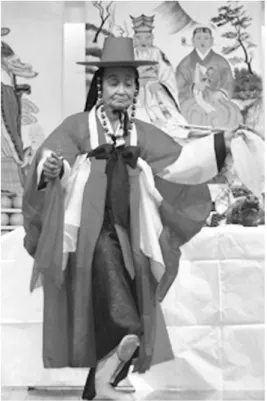
Heung has been seen as a major factor in Koreans surviving their various hard- ships, helping to turn the darkness of their minds towards brightness, even in the Figure 1.1 Pungmul, at Naju, 1976
Downloaded by [New York University] at 00:18 07 August 2016
Korean mental geography 11
toughest times. In times of suffering, Koreans usually seek consolation in song and dance, and in collective activities containing a lot of humour and laughter.
Heung has served not only as the coping mechanism for Koreans but also as the impetus to their rich culture in everyday life and a fundamental source of their potentials. Korean people need Heung to work productively and Heung is also what makes them work proactively. In the presence of Heung, Koreans most spontaneously move into action and have a good communication by exchanging Heung.
The traditional cultural artefacts such as samul-nori (percussion music play) which remains very popular with Koreans today, are intrinsically Heung. The Korean mindset and culture of Heung has also produced an enthusiasm for crea- tive therapy such as music, art, drama and dance-movement therapy. Because of this notion of Heung that is uninhibited and contagious, Korean people usually work better together: Heung has been, perhaps, the main reason for Koreans responding so warmly to group therapy rather than to individual therapy.
Korean pensées
Korean thinking has been strongly influenced by four main streams of religious and ethical experience: Shamanism; Buddhism; Confucianism; and Christianity.
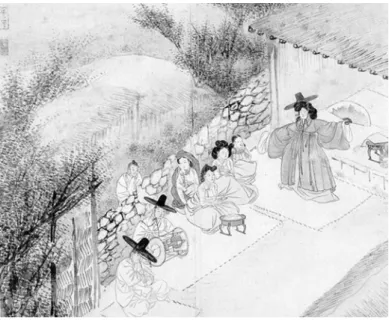
Figure 1.2 Danwon Kim Hong-Do ‘Mudong’, around 1789
Downloaded by [New York University] at 00:18 07 August 2016
12 Korean mental geography
These have developed and co-existed in harmony reinforcing one another: Sha- manism has built beliefs that human beings are an indispensable part of nature, and need to learn to live in harmony with the ways of nature; Buddhism has influenced Koreans’ attitudes and practices of benevolence and compassion towards all living creatures; Confucianism has imbued the codes of ethics for proper thoughts and behaviours; Christianity has catalysed the modernisation of knowledge and of social systems.
Today in Korea, there is neither an official, nor a dominant religion and Koreans enjoy freedom of choice in beliefs. The birthdays of both Buddha and Jesus are equally celebrated as national holidays. A sophisticated mixture of Shamanism, Buddhism, Confucianism, Christianity and other religious elements lives in the Korean subconscious and consciousness and continues to influence the distinc- tive nature of the Korean mentality. In Korea, Jong-Kyo 종교, the term for religion, started being used in the 1900s. Before the terms Mu-Kyo (Shamanism), Yu-Kyo (Confucianism) and Bu-Kyo (Buddhism) became popular, they were called instead Mu-Do, Yu-Do and Bul-Do, terms which stressed the aspect of Do (도; Tao 道) – a ‘Way’ that one needs to learn and practise. Hence, it may be more appropriate to understand each pensée not solely from a religious viewpoint but rather from each spiritual, ethical and social-cultural perspective, considering the factors concerned with the ways of thinking and consciousness.
Shamanism 무교
As the earliest and indigenous religion, Shamanism has been a profound force in Korean culture. It embodies thousands of years of their life, thoughts and experi- ences. Korean shamanism has experienced extended and comprehensive interaction with Buddhism, Confucianism and Christianity and has still survived, successfully integrating with other religions. The influence of Shamanism over the lives of Korean people was so deep that newly introduced beliefs had to comply with cer- tain elements of Shamanism for Koreans to accept them readily.
Belief and ethics
The fundamental belief of Korean Shamanism is that human beings are the essen- tial part of nature and closely interrelated with the ways of nature. In this sense, every human life is best sustained when it adheres to the rhythm and balance of nature. Conversely, if one lives against the flow of the rhythm of nature, life becomes a struggle. As Korean Shamanism is grounded on poly-demonism or polytheism, it does not acknowledge a dualism of human being and god. Since there is no dichotomy between good and evil, human beings are free of dualistic obsessions in their thoughts, more significantly of a hierarchy of human condi- tions. Dualism is also denied in shamanistic ethics. A wrong in one situation is not necessarily wrong in another; every deed is evaluated within its particular context considering circumstances. Korean Shamanism also recognises no salvation
Downloaded by [New York University] at 00:18 07 August 2016
Korean mental geography 13 or punishment in the afterlife. By the flow of nature, every human being goes to another place after death by ‘turning the corner’ and simply lives another life.
Hence, there is no notion of a transcendent state of human existence. Naturally, Korean Shamanism facilitates a life in the present life – a worldly existence. This emphasis on the life led here and now is a remarkable feature. The beliefs and ethics of Korean Shamanism, essentially open and relative, concentrating on links with nature and existence in the present, have become impregnated into the basic thinking of all the subsequent Korean pensées.
Interpersonal relations
The preoccupation with a worldly life can lead to a tendency to focus on attaining one’s desires now, by any means. Although it may contribute to making Koreans swift, flexible and better adapted to survive, it also provokes a purpose-oriented disposition, egoism and nepotism. Nepotism well defines Korean shamanistic interpersonal relationships. Within the category of family, relative or friend, there is no clear distinction between oneself and another, and their lives are closely intertwined. In such interpersonal relations, one’s perceptions and feelings continuously overlap with those of other people. Cohesion and emotional involvement are the essential elements of such a phenomenon, while imprudent intrusion into the affairs of others or a strong display of emotion is considered natural, even ethical. Consequently, the emotional reaction usually felt after the withdrawal of one’s affection or exclusion from one’s regard, is a particularly strong and prevailing emotion among Koreans. Such shamanic spirit in interpersonal relations naturally corresponds to the notions of Jeong. As Korean Shamanism is preoccupied with one’s present life and with immediate surroundings, the downside is to have little consideration for public morality and a feeble sense of consciousness for metaphysical values such as ideologies, ethics or philosophies.
Today, belief in Korean Shamanism is not as widespread as it once was, and it is now more a symbol of indigenous culture and a valuable folk tradition.
Nevertheless, shamanistic views are still very much part of Korean traits and impact on their thoughts and behaviours, as well as their cultural practices.
When traditionally minded Koreans are inexplicably sick, worried about certain things, have a run of bad luck in business, or have mental illness in the family, many of them, whether Christian or Buddhist, still flock to consult a shaman for ways of solving their problems. The expansion of mental health treatment facilities since the late 1980s has not replaced Shamanism. Many contemporary Koreans exhibit shamanic-based inclination towards a human nature that is generally relative, flexible, free, emotional, impetuous and presocentric.
Buddhism 불교
Buddhism arrived in Korea around 372 when a Chinese monk brought Buddhist statues and texts. It was readily assimilated into the indigenous Shamanism
Downloaded by [New York University] at 00:18 07 August 2016
14 Korean mental geography
producing a unique form of Korean Buddhism. Today, the peaceful co-existence and co-prosperity of Shamanism and Buddhism can be observed in Korean Buddhist temples that set aside a shrine sacred to the high sprits of Shamanism.
The shamanistic view of worldly life has influenced Korean Buddhism, while the dualistic idea of paradise and hell, as well as the notion of punishment, was partly absorbed into the shamanistic beliefs through Buddhism. Beyond its religious stance, Korean Buddhism flourished and grew into a major cultural, social, intel- lectual and spiritual force producing numerous Buddhist books and cultural artefacts and, above all, became actively engaged in social activities. It has played an integral part in the moral and spiritual life of Korean people.
Three distinct features: Hoguk, Tong, Bosal
From early in its history, Korean Buddhism has been drawn to secular elements and earthly prosperity, reflecting the pressing needs of the people of a peninsula Figure 1.3 Bojo-Jinul 보조 지눌 (1158–1210): Seon master in the twelfth century introduced three profound gates as the methods to cure the diseases: the first gate is to understand the highest scriptural teaching, thus ‘theory’ as conceptual knowledge; the second gate is to forget the theory, focusing on ‘here and now’ through Seon dialogue, i.e., the perception of ‘outer reality’; the third and most profound gate is complete silence. This aims at the perception of ‘inner reality’
Downloaded by [New York University] at 00:18 07 August 2016
Korean mental geography 15 repeatedly threatened by invaders and natural calamities. Historically, Korean Buddhism took a prime role in guarding the country. This produced the concept of ‘Hoguk Bulkyo 호국불교 (State-Protection Buddhism)’, a special aspect in the development of Korean Buddhism. Whenever there was a national danger, Buddhist monks were always the first to rise and fight to protect the country. They were always actively involved in social issues and political movements. With this conviction, Korean Buddhism has been a force that brought Koreans together – to create Korean solidarity. Concepts of peace, harmony and unity of all sentient beings, which Korean Buddhism also strives for, became foundations of patriotism.
The second distinct characteristic of Korean Buddhism is the concept of ‘Tong Bulkyo 통불교 (Buddhism of Interpenetration)’. Korean Buddhism successfully overcomes ideological division or conflict by embracing all Buddhist doctrines without predilection for any school or sect. The underlying position is that all different doctrines have the same origin and destination and, regardless of schools, Buddhist thoughts or ways of ascetic practice can remain united or in harmony without strife. Likewise, all beings co-originate and are bound to co- exist through interpenetration. Korean people who mostly prefer to emphasise similarities rather than discrepancies should be indebted to this feature of Korean Buddhism. The spirit of Tong Bulkyo has certainly served as an instrument to develop tolerance for different religions or spiritual practices, allowing harmoni- ous co-existence and flexible cooperation. It may also be true that the same holis- tic and universal approach facilitated an overflowing of varied beliefs and the hovering between religions.
The third central trait of Korean Buddhism is the practice of the spirit of Bodhisattva. A Bodhisattva is an ordinary human being who directs their attention and behaviours to practising the way of life of Buddha. Benevolence is considered
Figure 1.4 Rock-carved Bodhisattva in half lotus position (신선암마애보살반가상) at Sinseonam Hermitage in Gyeongju, around the eighth century ⓒ 2011 Eggmoon
Downloaded by [New York University] at 00:18 07 August 2016
16 Korean mental geography
the most important quality on the spiritual path to becoming a Bodhisattva. A truthful Bodhisattva is someone who helps all other beings with vigour and patience in perfect benevolence, compassion and wisdom. This status of Bodhisat- tva can be obtained by anybody irrespective of social status – it is entirely free from discrimination. The spirit and way of being a Bodhisattva certainly influ- enced Koreans towards an egalitarian and humanitarian orientation. Practically, any Korean who practises Buddhism is now called a Bodhisattva, a ‘Bosal 보살’ in Korean.
Today, Korean Buddhism is mostly represented by Seon 선 (禪 Zen; medita- tive state) – known for its stress on meditation, monasticism and asceticism. At the same time, Korean Buddhism has a strong link with communities and society, having always had a clear social responsibility, caring for the suffering and prob- lems of others prior to pursuing personal salvation or enlightenment. It remains a dynamic and influential voice in Korean culture and society today, actively expressing its opinions on issues ranging from human rights, democratisation and social welfare, to environmental protection and political reunification. More and more contemporary Koreans striving for freedom and equality are inspired by its guidance and leadership in fighting against political and social autocracy and injustice.
Confucianism 유교
Critical of both Shamanism and Buddhism, Confucianism became the leading spirit and instrument of a social, political and ethical ideology of the new king- dom of the Joseon Dynasty (1392–1897). Differing from the other traditional styles of thought, Korean Confucianism adhered to very clear and strict moral precepts and codes of conduct thoroughly observed by each individual. Its ideal man was a moral being who lived by the Confucian codes of ethics and behav- iours in accordance with a prescribed place in society. On the other hand, Korean Confucianism embraced traditional practices of worshipping spirits of the dead by holding memorial rites for family ancestors, usually on the anniversary of their death. These ancestral rites still remain an important part of Korean life, faithfully observed.
From the viewpoint of Korean Confucianism, a life is simply the course of diligently following through a number of roles. Filial piety (Hyo) and loyalty (Choung) are the most basic duties one must fulfil. Propriety (Ye) means to carry out a role with respect and modesty acknowledging the difference between the self and another, and thereby maintaining interpersonal relation- ships in harmony and keeping social order intact. Benevolence (In) is the essential virtue of guiding the conduct of Confucian interpersonal relationship.
It is cultivated within oneself through constant study, along with the display of Hyo, Choung and Ye to other people. A true and genuine man, according to Confucian thought, is thus someone who achieves ‘In’ within family, and then also for the community and country.
Downloaded by [New York University] at 00:18 07 August 2016
Korean mental geography 17 Vertical relationship: Hyo
효
, Choung충
In Confucian society, the value of an individual’s life is secondary to the achievement of ‘In 인 (仁; benevolence)’. The Confucian belief is that the relationship between a parent and a child is the absolute, most important relationship and so a virtue of
‘Hyo 효 (孝; filial piety)’ forms the foundation of In. It is a child’s duty to remain always respectful and totally obedient to their parents and grandparents. This pattern of deference is extended to govern relationships between elder and younger, between ruler and ruled and between husband and wife. Hyo also has to be shown towards the dead, as well as the living. The same respect and obedience is expected to be paid to anyone with authority in whatever social circle, whether teacher, boss or leader. Another word for this is ‘Choung 충 (忠; loyalty)’ defined as a virtue of one’s moral commitments to surroundings and communities as a whole. The social and political dimension of Korea is commonly based on the virtue of Hyo, and their leaders hold de facto parental authority over the individual.
Since the values of Hyo and Choung are central in finding the true meaning of one’s existence, personal will usually defers to the will of the family or commu- nity; personal decision-making and goal-focus are mostly guided, adjusted and achieved within the expectations of family or community prosperity. Such con- vention has often undermined relationships through the principal stress on obedi- ence rather than affection, loyalty instead of righteousness. Moreover, it has worked to hinder Koreans from developing the concept of self as an autonomous and independent being; instead, promoting the tendency of constantly seeking recognition or approval and assessing one’s place and position in relation to other
Figure 1.5 Jesa ⓒ 2006 pcamp: Jesa is a ceremony commonly practised in Korea – a memorial to the ancestors. It is usually held on the anniversary of the ancestor’s death. In most families, this ancestor ritual still remains an important part of their lives and they are faithfully observed
Downloaded by [New York University] at 00:18 07 August 2016
18 Korean mental geography
authorities. Nevertheless, the Confucian-adhering individual may not necessarily feel deprived of personal identity, rights or interests, but instead feel supported, stable and secure.
It is still easy to perceive the influence of Confucianism on Koreans today.
Younger people are expected to serve and respect older people and not to oppose parents’ wishes or the community’s will. Despite considerable transformation through the process of modernisation, it is still not hard to observe Koreans’
emotional attachment to kindred and family cohesion, which remain as central instruments of a secure life. It is unquestionable that the virtues of Hyo and Choung have helped to deter family breakdowns in the individualistic climate of modern society. The greatest influence of Korean Confucianism is that human beings depend on others for their existence and one’s life cannot exist in isolation.
Education and formality: Ye 예
Another important way to attain ‘In 인’ is through constant study and perfor- mance of ‘Ye 예 (禮)’. Originally meaning ‘sacrifice’, the term ‘Ye 禮’ was used for any ceremony or courtesy performed at court, and then extended to mean what is ethical and morally right. ‘Ye 예’ is now translated as ‘propriety’ or ‘rules of proper behaviour’ and embodies the entire range of interaction. Ye is comprised of detailed codes of thoughts and behaviours assigned to each person according to one’s place in community. Confucius considered proper behaviour, albeit artificial, to be an assurance that everything is seen to be right in its proper place, contributing to preserving morals and trust within the community, and engendering social harmony.
As a code of ethical discipline, Ye is learnt and practised through education and study – something also viewed as being part of Ye. Learning and studying is regarded as the ultimate conduit through which one could become a fully respect- able person. In Confucian belief, one has to be educated to become a righteous person who then serves their community. In Confucian understanding, a more educated person is, almost literally, a better person. Confucian institutions like Hyanggyo and Seodang and the ‘Kwakeo 과거 (National Civil Service Examina- tions)’ systems were designed to regulate social mobility, and to foster ethical people, who would work to improve society and the nation. Throughout their history, Koreans have attached great significance to education and it became the highest priority for a Korean family and a norm in society. While it places heavy emphasis on self-cultivation as both the object and process of Confucian life through education, Korean Confucianism, however, failed to apply such princi- ples to all people. Being only applicable to aristocratic men, it excluded both women and lower classes. It built a strictly authoritarian bureaucratic society dominated by Confucian political elites. While it raised Korean academic standards, Korean Confucianism cannot avoid the criticism of it promoting intellectual enhancement in favour of ethics and ideology. It firmly excluded foreign knowl- edge and civilisation. Moreover, it hindered the development of a genuine sense
Downloaded by [New York University] at 00:18 07 August 2016
Korean mental geography 19 of self by excessive, empty formality, thereby creating a façade of unity, and above all making inequality in Korean society a permanent social ill.
Under the broad spectrum of Ye, acts and routines of daily life carried out knowingly or unknowingly are today composed of Ye naturally exerted by inter- nalised modes of ‘proper’ behaviours. The fundamental frame of Korean people, especially for their moral and interpersonal behaviours, is still bound by Confu- cian concepts. Certainly, the study and performance of Ye has produced hierarchical structures while at the same time promoting conflict-avoidant relationships. One who fails to maintain the complex Confucian codes in every relationship is threatened by a fear of shame and loss of face.
Face saving: Chemyeon 체면
Chemyeon 체면 (體面; Social face) literally means presenting a decent counte- nance to other people. It is a social face closely attached to shame feeling. Excessive consciousness and alertness to the possibility of shame produce a face saving culture. In Confucian belief, you are defined according to your place and position in relation to other people and how they perceive and esteem you. Behaviour, thus, depends on how others perceive it rather than how it is perceived by oneself.
Inexhaustibly, a person tries to measure how their acts and thoughts might be viewed through other people’s eyes. One who succeeds in keeping Chemyeon up is able to consistently behave in accordance with the codes of Ye. Chemyeon certainly contributes to making Korean people extremely self-conscious and a reason why they are so concerned with appearance over substance, justification over benefit, reputation over condition. It often results in fostering empty for- malities and vanity. As one always tries to save Chemyeon, external behaviour often does not correspond to the inner mind. The natural expression of emotion is usually hindered under artificial norms and one progressively becomes indif- ferent to true emotion. The notion of Chemyeon has pervaded all aspects of inter- personal relationship. Korean people’s awareness of each other’s Chemyeon is typically so strong that it often results in behaviour that is contrary to people’s true self and authentic mind.
Gender and sexuality
Confucianism understands the relationship between man and woman as the foun- dation of any human relationship and the beginning of all creation. Ye between them is considered the most important. Nonetheless, in the name of mutual respect and harmony, Korean Confucianism, openly displays differentiation and discrimination in favour of men. Women who enjoyed a great deal of social and economic freedom during the pre-Confucian period, were reduced to an existence to serve and obey in every aspect of interpersonal relationships. Korean Confu- cianism holds the feudalistic convention of regarding men as superior to women.
A woman is bound to obey the father in childhood, the husband during marriage