Hakimeh Razeghi mansor1 & Ran Zhang 2 & Bagher Soljo3 & Binbin Chen4 &Guangyao Wang5 (107-133)
Abstract
As an important type of ancient artwork, the Chinese blue and white porcelain entered Iran through the artists and merchants during the Safavid era (1501–1736 AD), and it strongly influenced the Islamic ceramic industry at that time. Chinese blue and white porcelain wares can be considered as the most decorative ceramic art. Bowls and plates with a floral rim and teacups were exported from China to the overseas markets. The influence of this art and its motifs can be seen in the examples obtained from the excavations at Jahan Nama Palace in the old city of Farahabad. Not only the Chinese ceramic finds from this excavation show the long-distance trade from China, the artistic imitation in the porcelain manufacturing and porcelain also can be seen in different areas of Iran. According to the historical sources and accounts, the Farahabad historical complex is a part of the city with the same name, which was built on Tahan village by the order of Shah Abbas I, and the early history of this city dates to 1612 AD in an area of about 40 hectares along the Tajan River and close to the littoral area of the Caspian Sea. The purpose of this research is to study and discuss the blue and white porcelain of Jahan Nama Palace and the extensive trade and port status of the important city of Farahabad in the Safavid era.
Keywords: Mazandaran, Farahabad, Jahan Nama, blue and white porcelain.
1. Corresponding Author: Expert of Farahabad Sari historical city research base, Ministry of Cultural Heritage, Handicrafts and Tourism of Iran.
2. Expert Archaeological Department Durham University, UK.
3. Expert of Farahabad Sari historical city research base, Ministry of Cultural Heritage, Handicrafts and Tourism of Iran
4 . Department of Chinese , Language Literature Peking University 5. Expert of the Palace Museum Archaeological Institute
10.22059/jarcs.2021.323643.143019
Print ISSN: 2676-4288-Online ISSN: 2251-9297
https://jarcs.ut.ac.ir
Received: 30 December, 2020; Accepted: 10 March, 2021
directly influenced by the ceramic imports from the Ming China (1368–1644 AD). This is known well that Chinese ceramics was imported in large quantities from the Far East, and the Iranian potters imitated Chinese ceramics and produced similar Irani local pottery (Mohammadifar, 2008: 95).
While the art of Ming China was featured by the fine porcelains and the high-quality decorative calligraphic paintings, this was also the golden age of Islamic blue and white ceramics. During the Qing period (1644–1912), a political continuation of the Ming period, the ceramic industry still flourished. The visual features of Islamic blue and white ceramics continued to develop until the early Eighteenth century AD (Nafisi, 2005: 11),
and was as influential as the art of pottery in the Safavid period.
Shah Abbas (1571-1629 AD), the fifth Safavid Shah of Iran, gathered art masters in his great empire, settled them around Isfahan, established numerous royal industrial workshops and aided small craftsmen and private industries. When he heard from the merchants and representatives of the Dutch East India Company (the VOC), which had a fortress on Hormuz island in the Persian Gulf where they were busy trading Chinese porcelain, he invited Chinese merchants to send their beautiful porcelain to Iran by land for re-exporting to Europe. Therefore, there was strong competition in ceramic trade between Iranian ceramic industries and the Dutch East India company.
Shah Abbas invited some 300 Chinese potters to Iran to train the local potters in the porcelain industry (Woolf, 1993: 134). He played an important role in promoting ceramic industries of Iran. With his ingenuity and tact, he created a great change in the Iranian art and pottery industry, and generated economic growth in this period. Since the reign of Shah Abbas, namely the period of the Ming China, blue and white porcelain had become the most important type of trade ceramics in the commercial market (Sarmadi &
Masoumeh, 2010: 114; Zhang, 2016: 295-297). With important cities such as Ashraf, Sari, Amol, Natel, Barforosh and the newly built city of Farahabad of the Caspian Sea, Mazandaran also became an important centre in commercial, artistic and cultural exchanges. Palatial buildings were built in this city, and their inhabitants were the major consumers of the luxurious commodities and artworks.
chronological development of Persian blue and white ceramics, it only hoped that the well-dated Chinese ceramic finds could enhance the understanding of all artefacts unearthed from the site, and give some parallelled evidence for supporting the further investigations of the Persian blue and white ceramics.
In 2007 and 2011, due to the importance of the old city of Farahabad, surface surveys and excavations were carried out and, as a result, parts of architecture and related decorations, including bedding and tiling, as well as beautiful pottery and porcelain from the Safavid period were found. It appears that the artistic style of the Isfahan school was quite evident in these works (Razeghi and Solhjoo, 1399: 8). The evidence unearthed from the archaeological excavations of Jahan Nama Palace in Farahabad clearly shows the cultural exchange between Iran and China. On one hand, porcelain finds and Irani local pottery yielded from surface surveys and excavations of the Jahan Nama Palace show the decorative and ceramic firing technical influences from Chinese ceramics; on the other hand, the Irani local made pottery utensils surpassed Chinese ceramics in terms of ceramic shapes, patterns, variety of functions, colours and decorations. They had therefore been exported to other countries in a large quantity.
This intensified the artistic independence of artists and potters in the ceramic centres of Iran during the Safavi period. In the excavations of the old city of Farahabad and Jahan Nama Palace, a large number of pieces of blue and white porcelain and Irani local pottery were found. Selected examples of these are introduced in this article, and they are categorised as remarkable pottery and top findings. By examining the historical accounts, the authors will attempt to outline and analyse the role of the motifs used in this porcelain, and discuss their roles in the cultural exchange between Iran and China.
2. A brief history of Jahan Nama Palace
A number of European tourists and businessmen have seen the Jahan Nama Palace up close and described it in their travelogues. In his travelogue, Stoddart describes this palace in the period of prosperity as follows:
It was a great and pleasant place, the gate is very simple and has nothing interesting
(Figure 1). After going through a yard full of greenery that was planted with trees on both sides of the road, we reached another gate that was as simple as the first one. After passing through it, we reached a very pleasant garden full of orange and orange trees.
some of which are categorized. This categorization shows the main purpose of this palace, which is for different people, as inhabitants say, this special palace has been for women in the harem. All these rooms are decorated with different types of arts. Not only painting such as flower, bush and imaginary decorations had been seen, but also the calligraphic arts including contrary to Muslims’ belief, pillars and ledges in form of sculptures. But they have been damaged so much by the wind and rain that they can be hardly discerned. From what I could see, I came to a conclusion that these subjects or painters must have been Chinese because instead of stiff drawing seen in Iranian paintings, these paintings were very soft and fluid (Sotoudeh, 1985: J4, 583).
Jahan Nama Palace has become famous for its architectural grandeur and integration of Eastern and Western art, which is in the form of paintings on walls.
Figure 1: Remains of Jahan Nama Palace from Nasreddin Shah’s album (Archival source of historical city, Farahabad)
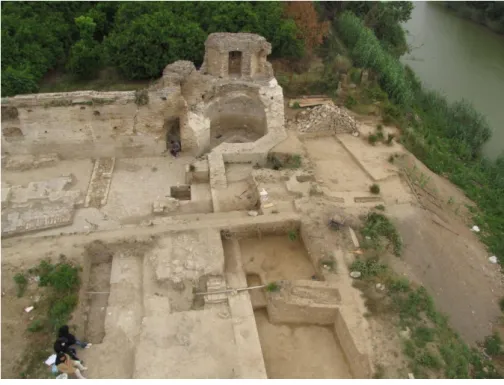
Figure 2: An Overview of the Site of Jahan Nama
Figure 3: A Part of the Survived Wall Remains of the Jahan Nama Palace
Several insights are gained from the post-archaeological processes of the auger-holes survey. A significant number of the broken sherds consisting of varied types of glazed potteries, such as plain pottery, polychrome pottery and blue and white pottery tiles with geometric pattern, are obtained. This preliminary discovery delivers some key clues to re-construct the details of these buildings of the site, including the architectural decorations, potteries for display, the plasterwork and colourful tiles. All of these details can be well identified to the arts that were created by Safavid artists. It is also interesting to see that the pottery findings and tiles from the survey were all in the imitations of the contemporary Chinese and Ottoman ceramics.
It can be seen that this survey is against the well-known historical backdrop of the Old City of Farahabad, which describes that the site of Jahan Nama Palace is with a historical and cultural greatness of the architectural remains, including bridges, mosques, bathrooms and so forth (Figure 4).
Figure 4: Location of the Site of Jahan Nama in Farahabad
Therefore this survey can suggest that the economic and cultural exchange activities of the City of Farahabad are well demonstrated by the survey findings including these Safavid period dated ceramic imports, the local potteries and decorations from the gardens and buildings of the Jahan Nama Palace. The economic and cultural environment of the city was clearly comparable to the other cities at Safavid period.
4. Excavation of Jahan Nama Palace in 2011
In order to further explore the Jahan Nama Palace’s history, culture and art, excavations are conducted to reveal different areas of the site. The architectural style, decorative arts of the palace are therefore being able to be confirmed to the Safavid period, by recording and identifying the arrangements of the palace architectural structures.
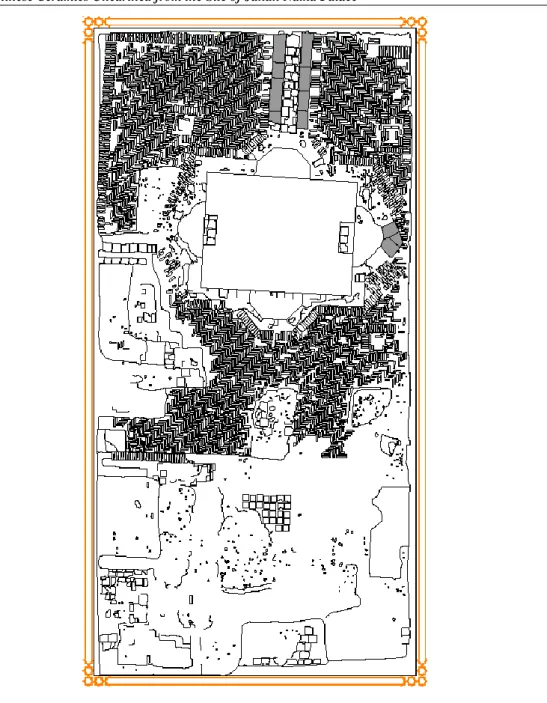
According to the results of the excavation, brick-floors, a prey-niche, and an unidentified structure are yielded (Figure X4).
Figure 5: Plan of the Excavated Area of the Jahan Nama site
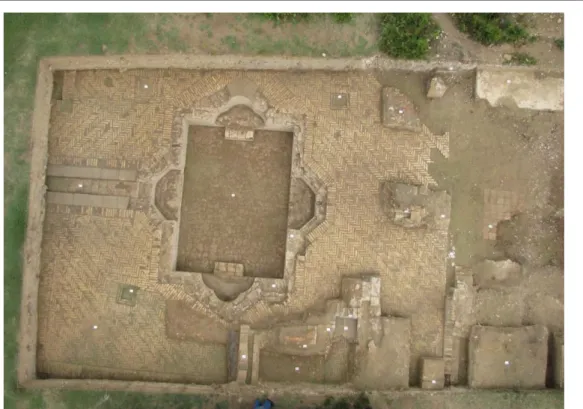
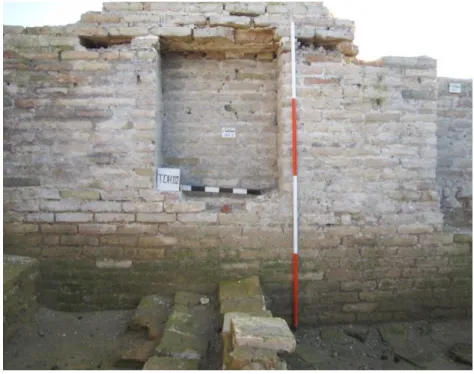
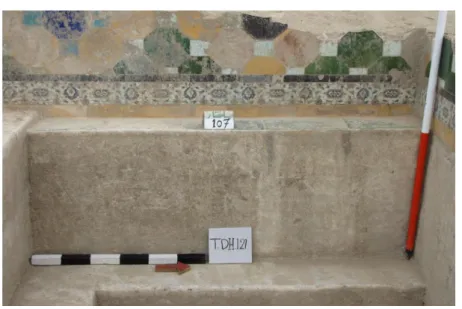
A summarised description of the excavated structures is outlined below: (1) one of the key featured patterns of floor arrangement is the herringbone pattern that laid out in the middle and was outlined by the running bond pattern (Figure 6); (2) the most complete prey niche is excavated. It was built with bricks and bonded by sandy lime mortar [25 height × 25 width × 5 depth] (Figure 7); (3) an important but unidentified platform structure with a height of 46 cm is discovered, and on which the blue and white pottery tiles dated to the Safavid period are decorated (Figures 8 & 9).
Figure 6: Floor Brick Arrangement Pattern of the Site Jahan Nama
Figure 7: A Well Preserved and Completed Prey Niche
Figure 8: Platform with Tile Decorations
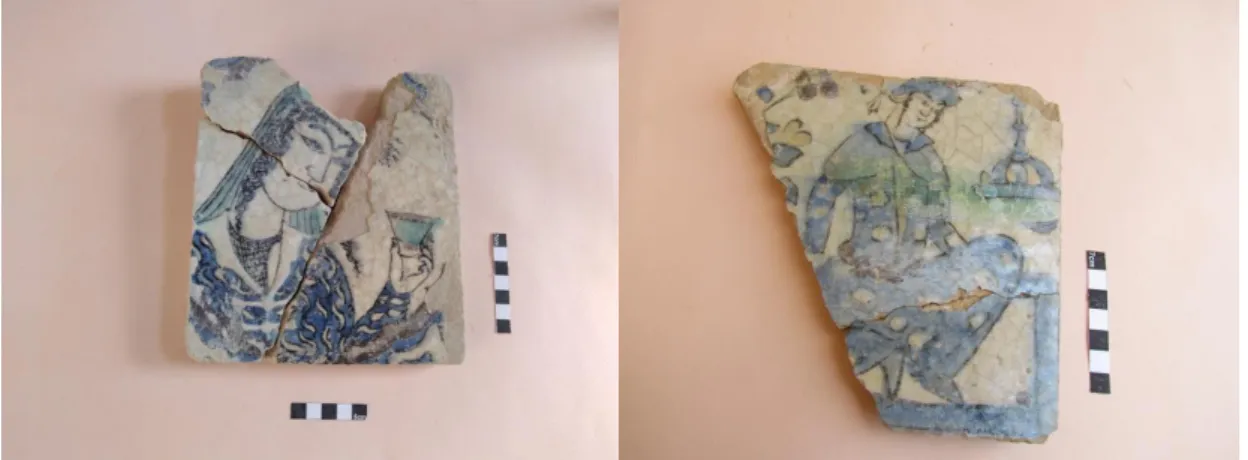
Figure 9: Glazed Pottery Tiles
More importantly, the purpose of this archaeological excavation is to investigate the cultural and historical artifacts in the past, because a great number of archaeological findings are obtained, including local produced glazed potteries, imported ceramics from China and so forth (Figure 10 and see below). The Chinese ceramic imports will be introduced and discussed in the following sections.
Figure 10: Local produced pottery wares
5. Chinese porcelain unearthed from Jahan Nama Palace
With the economic and diplomatic development between Ming China and the Safavid Iran, especially during the reign of Shah Abbas, large quantities of blue and white porcelain earthenware entered Iran and were traded in a number of newly built small and large cities. Based on the archaeological evidence, one of cities dated to this period, Farahabad in Sari, was involved in the contact with Ming and Qing China regarding ceramic imports. Following the surveys and excavations carried out at the site of Jahan Nama Palace, many finds of blue and white porcelain are yielded. The Irani local pottery that were strongly influenced by Chinese art were found as well. The trade, art and economy of the city developed considerably.
Seven assemblages of broken Chinese porcelain wares from the excavation of the site of Jahan Nama are classified into four groups. They are listed below with an introductory description and archaeological dating evidence. The description aims to introduce the bodies, glazes, shapes, decorations or patterns and marks of these wares, and the archaeological dating evidence is used in the discussion of the possible dating ranges:
A. Group 1
Name: Blue and white porcelain bowls
Possible dating: From the mid-sixteenth century to the early seventeenth century AD
Place of manufacture: Jingdezhen, Jiangxi Province, China Shape: Plates
Description
In the grounds of Jahan Nama Palace, a very thin and fine blue and white porcelain sherd was discovered. This sherd has a pure white, fully fused porcelain body with a smooth shiny glaze with a fine surface (Figure 11). It has a floral rim and on the thin and flattened edge, the square-shaped panels, called kaiguang (开光) in Chinese, can be seen. The inside of the panels is decorated with repeating geometric patterns and a
southern China became the capital of Chinese porcelain production (cf. Jiang, 1991: 47;
BJDXKGWBXY et al., 2009; Chen, 1973; GGBWY et al., 2007). It has been found that the Kraak style was manufactured at kiln sites in the Guanyin Ge and Luoma Qiao site of Jingdezhen (BJDXKGWBXY et al., 2009: 57, Qin, Gao & Weng, 2020: 90-92).
Van der Pijl-Ketel discussed the porcelain found in the Witte Leeuw shipwreck (dated to 1613 AD) and stated that the panel patterns first occurred in around 1595 AD and were popular until at least 1613 AD ((McElney, 1979, p. 50; Van Der Pijl-Ketel, 1982).
Similar dating can be confirmed by the kiln sites of Luoma Qiao, and it is suggested that a small amount of the Kraak type was produced between the 1620s and 1644 AD, namely the late Ming dynasty (Qin, Gao & Weng, 2020). A very similar type can be observed within the Bennebroek shipwreck assemblage dated to 1713 (Klose, 2000), and it is suggested that this type lasted until the early eighteenth century.
The ceramic technique exchange between Iran and China can be seen in the gradual integration of designs on porcelain pottery in Iranian production centres. The pottery found in the grounds of Jahan Nama Palace is similar to the ware discovered in the excavations of Abbas Abad Garden in Behshahr (Figure 12). By covering the pottery interior with patterns, the Iranian potter has attempted to avoid from the influence of Chinese art. The application of the Chinese herbal and geometric designs became less popular. In general, according to the surface surveys and excavations carried out in Jahan Nama Palace, we encounter an abundance of porcelain and Irani local pottery. By using the pattern and theme of Chinese motifs on Chinese ceramic imports, and trying to represent designs and decorations, the Iranian potters of this period gradually formed their own different styles on ceramic making and decorations. Some of these Iranian porcelain dishes were manufactured so carefully and delicately. By naked-eye examination it is hard to distinguish the Irani made and Chinese porcelains. However, the technique of Irani local pottery shows a clear difference from the Chinese porcelain wares, in terms of the clay, the form of wares and the designs. Iranian local pottery was manufactured in important kilns of Mashhad, Kerman and Tabriz and exported to different parts of the Safavid territory.
Figure 11: Pottery piece No.14 (Archival source of historical city, Farahabad)
Figure 12: Blue and white pottery in Behshahr and Abbas Abad (Archival source of Abbas Abad Garden)
B. Group 2
Name: Blue and white porcelain bowls
Possible dating: From the mid-seventeenth century to the early eighteenth century AD
Place of manufacture: Jingdezhen, Jiangxi Province, China Shape: Bowl
Description
In this group, there are two types of Chinese blue and white porcelain ware. The first type consists of a couple of blue and white porcelain sherds, which can be reconstructed into a bowl. They have a fine body fabric: white, dense, hard and thin. No inclusion can be on the body. The glaze is transparent with a very slight bluish-white tone. The glaze
The second type is a small assemblage of blue and white porcelain sherds. It can be reconstructed into a bowl, and the fabric and firing techniques are very similar to the former type. On the inside of the bowl, a pattern of an immortal is outlined with a double circle. This immortal has small almond-shaped eyes, a beard and a headband. In his right hand, there is a gourd-shaped container that is probably used to carry liquids.
He is dressed in a billowing robe and is in a cloud . The main motif on the outside of the ware has been lost, and there is only the remains of an incomplete sea wave pattern, on which some incomplete figures can be seen. This could indicate that the outside motif is probably linked to the theme of the immortals crossing the sea. On the base, a Chinese mark is positioned within a double-lined rectangular frame. The content is written in cobalt blue, showing six Chinese characters of Daming Chenghua Nian Zhi, the same as the mark on the other type (Figure 15).
7. Dating evidence and discussion
This decorative motif of ‘Eight Immortals Crossing the Sea’ is a simplified version of the similar sense on the imperial porcelain wares dated to the early Qing dynasty, although its first application on Chinese ceramics was dated from the fourteenth century (Harrison-Hall & Krahl, 2009) and, like the cobalt blue decoration, might start from the late Ming dynasty (late sixteenth century to early seventeenth century AD) (Xiong, 2003:
68). Developed from the Taoist tales dated around the middle of the seventeenth century, this Taoist tale was finally formed and developed into the sense of the eight immortals attending the Peach Festival of the Queen Mother of the West. Similar bowls with the imperial qualities testify to the great developments of this story on porcelain products during the reigns of Kangxi and Yongzheng (1661–1735 AD). As one of the earliest examples, a bowl with a similar but exquisitely painted motif housed in the Art Museum of Tsinghua University, Beijing, is dated to the Kangxi period. Moreover, a very similar but also exquisitely painted motif on an imperial blue and white porcelain bowl housed in the Gardiner Museum in Canada (object number: G99.19.18) is dated to the Yongzheng period (Figure 16).
eighteenth century AD.
Figure 13: Pottery piece No.1 (Archival source of historical city, Farahabad)
Figure 14: Pottery piece No.1 (Archival source of historical city, Farahabad)
Figure 16: An imperial blue and white porcelain bowl with the exquisitely painted motif of ‘Eight Immortals Crossing the Sea’, Gardiner Museum, Canada (object number: G99.19.18) (Do we need to consider the copyright? If so we should delete this figure).
C. Group 3
Name: The Batavia porcelain wares
Possible dating: From the mid-seventeenth century to the early eighteenth century AD
Place of manufacture: Jingdezhen, Jiangxi Province, China Shape: Cups and bowls
Description
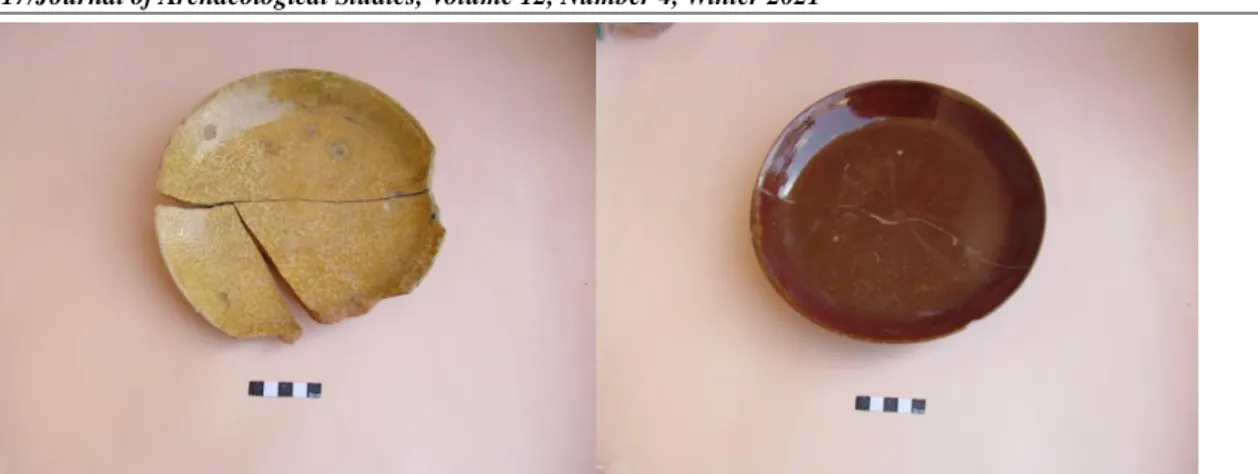
In this group, there are two types of the so-called Batavia porcelain, which are featured with a brown glaze coated on the outside of wares. The first type refers to a cup that was discovered on the site of Farahabad. It has a very fine, white, dense, thin and hard body fabric. The brown glaze on the outside is not evenly applied. This cup has a straight rim, a round body and a short, thin foot ring. On the base, there is a mark with four Chinese characters of Cheng Hua Nian Zhi, meaning ‘Manufactured in the reign of Chenghua’
(Figure 17). The second type is a bowl unearthed from the excavation of Jahan Nama Palace. It has the same glaze and fabric as the other type, but on the brown glaze, there is a white-colour decoration in the form of a tree-like pattern (Figure 18).
examples with reserved panels in white on the exterior combined with an underglaze painted cobalt blue on white or polychrome enamel painted decoration. This is because that the Batavia porcelain appears to have been produced particularly for the export market to Europe and is especially associated with the Dutch East India Company operating via Batavia (Jakarta). There are many finds also coming from the middle-eighteenth century examples, such as the Cà Mau wreck (1723–1735) (Chien, 2002), the Gotheborg wreck (1745) ((Wästfelt, Gyllensvärd, & Weibull, 1991) and the Geldermalsen wreck (1752) (Jörg, 1986). Further examples are known from the Gulf area from al-Ain (Power, 2015: 12–14, 19 ‘BATAVIA’), Al-Hamara of Ras al-Khaimah in the UAE (Priestman and Zhang, 2021, forthcoming), Freiha in Qatar (Bystron, 2015:
106–07, Fig. 8.21), and six coastal sites in southern Iran (Priestman, 2005: 313, pl. 268).
Furthermore, similar to the marks of group one, this group has the mark read as Cheng Hua Nian Zhi. However, according to its writing, this mark is dated from the late seventeenth century to the mid-eighteenthcentury rather than the reign of Chenghua Emperor of the Ming dynasty.
The use of the porcelain motifs and the pottery transparency on both interior and exterior surfaces imitates the images on wares with slight changes in the production technique. The use of these materials to make Iranian porcelain vessels and Irani local pottery started in centres such as Kerman, Mashhad and Tabriz. Imitation of human, animal, plant and abstract motifs and natural elements was gradually found on Iranian porcelain products and Irani local pottery. It should be noted that the form and shapes of pottery produced in these centres are varied, including hollow plates, plates with smooth edges, cups, porcelain bowls and wares with a floral rim.
Figure 18: Pottery piece No.6 (Archival source of historical city, Farahabad).
Picture 19: The famous Batavia bowl (Li, 2012: 29)
monochrome cobalt blue. The white and tree-like overglaze decoration can also be seen.
On the bases of these two bowls, there are two similar marks within a square frame. The content of the marks is fu, meaning auspicious luck (Figure 20).
Figure 20: Pottery pieces No. 4 and No. 5 (Archival source of historical city, Farahabad)
11. Dating evidence and discussion
The class appears to be closely related stylistically and in terms of the dating of production to Batavia ware (group 3, see above). Most vessels are small cups and bowls that can be monochrome cobalt blue on the exterior or have reserved panels of white and further decoration added with enamel or gilding. Similar examples have been recovered from the middle-eighteenth century Umm Lajj wreck in the central northern Red Sea off the coast of Saudi Arabia (Visconti, 2018: 105, Fig. 6). On the Griffin shipwreck, monochrome blue porcelain vases had been found (Goddio et al., 1999:
266-69, pls XLI and XLII).
12. Discussion: economic and cultural exchanges of ceramics in the Safavid era Iran and Ming-Qing China
The large-scale economic, cultural and technical exchanges between ancient Iran and China could trace back to Abbasid Caliphate /China’s Tang dynasty (c.f. Lin and Zhang 2018; Northedge and Kennet 1994; Qin 2013; Wen 2018; Zhang 2013). During the
Anatolia and pottery from Europe dated to the middle and late eighteenth century, were traded to the Near East in a large quantity. The coarse quality Irani local pottery trade was therefore in decline during the Zand dynasty and the Qajar dynasty (Fehérvári, 1973: 135). Among the pottery products in Kerman and Mashhad, so-called blue and white pottery with the imitation patterns of Chinese motifs could be seen in abundance.
More importantly, however, it should be noted that during the Safavid period these Irani local potteries were not merely the imitations of Chinese ceramic imports, because they had a richer, finer, and more diversified decorations and patterns than the high-fired Chinese imports (Frieh, 1374: 267).
In the study of blue and white pottery in the Safavid period, some differences can be seen between Mashhad and Kerman, two ceramic industrial centres. In particular the Mashhad’s potteries were more influenced by Chinese motifs, and two shades of blue colour were used in their patterns. Plates, bowls and dishes were copied from similar Chinese ceramic imports. In their decorations, Chinese landscape motifs and Buddhist symbols were vastly imitated (Fahuri, 1388: 75). Conversely, it is believed that the result of this Iranian artists’ experiment in the Safavid period led to the production of blue and white pottery and it can be well distinguished from Chinese blue and white porcelain. This is known well that many Chinese porcelain items were imported into Iran during the Safavid period. It is very clear that the Iranian potters were familiar with Chinese designs and decorations, and they adapted some decorative designs from Chinese porcelains. However, the firing techniques of Iranian blue and white porcelain were very different from Chinese ceramics (Karimi & Mohammad, 1986: 63). The pottery kilns of Kerman and Mashhad in the seventeenth century AD did have the design of porcelain on dishes that was impacted by the transitional period dated Ming Chinese ceramics, and in many cases, the six Chinese characters as the marks on wares were replaced by some un-readable signs (Figure 21). Otherwise, at Kerman and Mashhad kilns they also produced new types of pottery with Iranian motifs (Salehi et al., 2013: 8).
Figure 21: Iranni pottery sherds with un-readable signs on the base to imitate Chinese marks (The Williamson Collection of the Survey in south Iran, housed at Durham University, UK)
The evidence gained from archaeological excavations at Jahan Nama Palace in Farahabad clearly shows the cultural exchange in this city during the Safavid period. In particular, the Chinese porcelain wares, including the Chinese ceramics dated to the late Ming dynasty and early Qing dynasty, are parallel to the Timurid and Safavid periods in Iran. All these wares were made at the kiln sites of Jingdezhen in China, and the Dutch East India Company based in Indonesia had the monopoly for exporting them from China. This shows that Iran had extensive trade with the Far East and that Farahabad was involved in these extensive relations in Safavid.
Otherwise, these Irani local pottery discovered from the site of Jahan Nama was highly likely manufactured in the important Iranian pottery centres in Safavid period, such as Mashhad, Kerman, Tabriz, and even Farahabad. It can be found out that not only did some of these potteries entirely imitate Chinese ceramics, and are strongly impacted by Chinese art and designs, but also in many cases they could surpass the Chinese ceramic imports in terms of appearance, pattern designs, vessel shapes, colours and decorations.
Sometimes, it is very difficult to distinguish the local Irani potteries from Chinese ceramic imports. This may show the artistic independence of Safavid artists in these ceramic production centres. Otherwise, the coarse quality local potteries also had been found from the site. By retaining the basis of making blue and white pottery, the Irani local artists also tried to include creativity, innovation and motifs in the utensils in a traditional way.
the archaeological education to public.
References
BJDXKGWBXY. JXSWWKGYJS. & JDZSTCKGYJS. 2009. Brief Report of the Excavation of the Guanyinge Kiln at Jingdezhen of Jiangxi [江西景德镇观音阁明代窑址发掘简报]. Wenwu [文物], 12, 39-58.
Blair. S. S. & Bloom. J. M. 1995. The art and architecture of Islam 1250-1800: Yale University Press.
Bystron. A. M. 2015. Qatar Islamic Archaeology and Heritage Project: University of Copenhagen and Qatar Museums.
Chen. Q. 1973. Jiangxi Leping Mingdai QInghua Yaozhi Diaocha [江西乐平明代青花窑址调 查]. Wenwu [文物], 3, 46-48.
Chien. N. D. 2002. Tau Co Ca Mau. The Ca Mau Shipwreck 1723–1735. Ha Noi: The National Museum of Vietnamese History.
Crown. Y. 2003. Persia and China: Safavid Blue and White Ceramics in the V&A Museum 1501-1738:Thames & Hudson.
Fahruri. G. 2009. Pottery of the Islamic World in the Tariq Rajab Museum in Kuwait, translated by Mahnaz Shayestehfar, Tehran : Institute of Islamic Art Studies, First Edition.
Frieh. R.W. 1995. Iranian Arts. Translated by Parviz Marzban. Tehran: Bright Day Research Publishing House.
Fehérvári. G. 1973. Islamic pottery: A comprehensive study based on the Barlow collection:
Faber and Faber.
GGBWY. JXSWWKGYJS. & JDZSTCKGYJS. 2007. 江西景德镇丽阳碓臼山元代窑址发掘 简 报 A Brief Excavation Report on the Kiln of the Yuan Dynasty Located in Duijiushan,Jingdezhen City,Jiangxi Province. Wenwu, 3, 9-16.
Goddio. F. de Saint Michel. E. J. G. & Juncqua-Naveau, D. 1999. Griffin: on the route of an Indiaman: Periplus Publ.
Harrison-Hall. J. & Krahl. R. 2009. Chinese Ceramics: Highlights of the Sir Percival David
off the coast of southern Africa; the Oosterland (1697), Bennebroek (1713) and Brederode (1785). Transactions of the Oriental Ceramic Society (1999-2000), 64, 63-81.
Lane, A. (1957). later Islamic pottery: Faber and Faber, London.
Li. B. 2012. Batavia’ Style Chinese Export Porcelain: Origins, Recent Finds, and Historic Significance. In S. A. Buslig, N. D. Chién, & B. Li (Eds.), The Cà Mau Shipwreck Porcelain (1723–1735) (Vol. 2, pp. 23-30). Budapest: Magyar Indokína Társaság Kft.
Lin. M. & Zhang. R. 2018. The Silk Road: Intercontinental Trade and the Tang Empire. In L. C.
Niziolek (Ed.), China: Visions through the Ages. Chicago: Chicago University Press.
McElney. B. S. 1979. The Blue and White Wares (post 15th century). South East Asian and Chinese Trade Pottery.
Mohammadifar. Y. & Belmaki. B. 2008. The Art of Pottery in the Safavid Period, A Study of Art Techniques and Patterns. Fine Arts, Architecture and Urban Planning, 35, 93-102.
Nafisi. N. D. 2005. The Presence of Nature in the Blue and White Porcelain Collection of Sheikh Safiuddin Astana in Ardabil. Tehran: Academy of Arts, First Edition.
Northedge. A. & Kennet. D. 1994. The Samarra Horizon. Cobalt and Lustre: The first centuries of Islamic pottery. The Nasser D. Khalili Collection of Islamic Art, 9, 21-35.
Power. T. 2015. A Ceramic Chronology for Late Islamic al-Ain, UAE. Journal of Islamic Material Culture, 2(1): 1-33.
Priestman. S. 2005. Settlement & ceramics in Southern Iran: An analysis of the Sasanian &
Islamic periods in the Williamson collection. Durham University,
Priestman. S. & Zhang. R. 2021. East Asian Ceramic Imports from the Site of Jazirat al-Hamra, Internal Report of Jazirat al-Hamra Project, Ras al-Khaimah, UAE, 2018-2020. Retrieved from forthcoming.
Qin. D. 2013. China's First Ceramic Export Trade Peak-Focus on the Volume and Charactics of Ancient Chinese Ceramics Foreign Trade in the 9th and 10th Century [中国古代陶瓷外销的第 一个高峰—9~ 10 世纪陶瓷外销的规模和特点]. Journal of the Palace Museum [故宫博物院 院刊](5), 32-49.
Qin. D. Gao. X. & Weng. Y. 2020. Research Outcomes and Relative Questions of the Remains of Luoma Qiao Kiln Site of Ming and Qing Dynasty [落马桥窑址明清遗存发掘的收获及相关 问题]. Wenwu [文物], 11: 48, 79-96.
Rezeghi. M. H. & Solhjoo. B. 2020. The Effect of Isfahan School Painting on Human Designs of Tiles of Jahand Nama Farahabad Palace. Quarterly Journal of Mazandaran History and
Visconti. C. 2018. A Cargo of Chinese Porcelain from a Shipwreck in the Red Sea.
Wästfelt, B., Gyllensvärd, B., & Weibull, J. (1991). Porcelain from the East Indiaman Götheborg: Wiken.
Wen. W. 2018. Chinese Ceramics in the Islamic World from the 8th to 10th Centuries CE. PhD thesis, University of Oxford, Unpublished Thesis.
Woolf. H. A. 1993. Ancient Iranian Handicrafts, Translated by Sirus Ebrahimzadeh. In: Tehran.
Xiong. L. & Xiong. H. 2003. Canon of Porcelain Decoration Through the Ages of China [中国 历代瓷器装饰大典]. Shanghai: Shanghai Wenhua Chubanshe.
Zhang. B. 2008. Complete Collection of Ceramic art Unearthed in China-Vol. of Fujian [中国出 土瓷器全集-福建卷]. Beijing: Kexue Chubanshe.
Zhang. R. (2013). 唐末印度洋大规模陶瓷贸易的兴盛——兼论邢窑与越窑在陶瓷贸易中的
地位 A Sudden Rise of Chinese Ceramic Trade in the Late Tang Period. In ZGGTCYJH (Ed.), 中国古陶瓷研究 Zhongguo Gutaoci Yanjiu (pp. 409-422). Beijing: Gugong Chubanshe.
Zhang. R. 2016. An Exploratory Quantitative Archaeological Analysis and the Classification of Chinese Ceramics Trade in the Western Indian Ocean, AD c. 800- 1500. PhD Thesis, Durham University.
یرگشدرگ
ناریا .
نار گنیز گ
سانشراک هورگ
ناتساب یسانش ، هاگشناد ماهرود ، ناتسلگنا
لص رقاب وج ح
سانشراک
هاگیاپ یتاقیقحت
رهش یخیرات حرف دابآ یراس ، ترازو ثاریم یگنهرف ، عیانص یتسد و
یرگشدرگ
ناریا .
یب نیچ نین
سانشراک هورگ
نابز و تایبدا ینیچ هاگشناد نکپ
گناو ویژ ناوگ
سانشراک هسسوم
ناتساب یسانش هزوم رصق
هدیکچ (لوا سابع هاش 1587
- 1628 لاس هب ناردنزام رب طلست زا سپ )یدلایم یاه
1596 هاگتحارتسا ناونع هب ار هقطنم نیا هراومه یدلایم
رظن رد یتنطلس لاس رد هقطنم نیا .تشاد
1599 هب ینامرف اب یدلایم تلایا
هصاخ رظن تحت هاش یصخش کلم ناونع هب و هدش لدب تموكح
یزكرم .دمآرد روتسد اب لاس هب سابع هاش 1612
نجت هناخدور یقلات هطقن رد ناهاط هدكهد یدلایم
گرزب یرهش هب ناردنزام یایرد و
حرف و هدش لدب مهم یهاگردنب و رهش زا هرود نیا رد هك یجراخ ناحایس هلمج زا .تفرگ مان دابآ
ییایلاتیا هلاولاد ورتیپ ،دندرك ندید
اهج خاك هطوحم ن
شخب نیا زا یكی امن رد هك دوب دابآ حرف یخیرات هعومجم مهم یاه
لاس یاه 2007 و 2011 و هعلاطم دروم
نامگ یط و تفرگ رارق یسررب شخب ،نآ رد شواك و ینز ه
ییاه زا یرامعم و تانییزت هتسباو هب نآ لماش چگ یرب و یشاك ؛یراك
نینچمه فورظ یلافس و ینیچ هب تسد
1 دمآ یرادربوگلا هك
م یرنه کبس زا دهاوش .تسا دوهشم ًلاماك نآ رد ناهفصا بتك
هب تسد شواك رد هدمآ ناتساب یاه
تروص یسانش ناهج خاك رد هتفرگ
امن حرف ی ناشن یبوخ هب دابآ .تسا یگنهرف ییایوپ نیا هدنهد
دش دیلوت اجك رد امن ناهج خاك هطوحم رد هدمآ تسد هب فورظ هك دوب نیا قیقحت نیا یلصا شسرپ یگژیو هچ یاراد و دنا ه
؟دنتسه مرف و گنر ،حرط رظن هطقن زا ییاه هب ینیچ راثآ هك داد ناشن قیقحت نیا جیاتن تسد
اك زا هدمآ یم میسقت یلك هورگ ود هب امن ناهج خ لوا هورگ :دنوش
دیلوت فورظ
.داد ناشن ار رود قرش اب ناریا هدرتسگ تراجت هدمآ تسد هب راثآ .دنتسه ایواتاب هب فورعم فورظ ای و »نژد گنیج« رهش هدش ینیچ لدب و ینیچ فورظ لماش مود هورگ رد هك تسا ییاه
زیربت و نامرك ،دهشم نوچمه یوفص هرود ناریا یرگلافس مهم زكارم
هتخاس هدش ارگلافس .تسا تسد و وگلا اب هرود نیا یناریا ن
شقن ندادرارق هیام هیام
هاگراك رد ینیچ یاه اب و لافس یدیلوت یاه
حرط ییامنزاب رد ششوك بتكم ،تانییزت و اه
رق دوخ هحولرس و قشمرس ار یدایز یرنه یاه .دنداد را
شسرپ :زا دنترابع شهوژپ نیا یاه
1 زا و تساهدرکن هئارا نونکات ار 1390لاس رد شواک لصف نیمود زا یشرازگ امنناهج خاک شواک تئیه تسرپرس - هب یایشا و راثآ طبض و تبث یگنوگچ
تسد رد یتاعلاطا هدمآ .تسین نارگشهوژپ سرتسد
.دوب هدنام