Getting Better Bite by Bite
A survival kit for sufferers of bulimia nervosa and binge eating disorders
Ulrike Schmidt, Janet Treasure
and June Alexander
Getting Better Bite by Bite
Getting Better Bite by Bite is an essential, authoritative and evidence-based self- help programme that has been used by bulimia sufferers for over 20 years. This new edition maintains the essence of the original book, while updating its content for today’s readers, drawing on the latest knowledge of the biology and psychology of bulimia and its treatment.
The book provides step-by-step guidance for change based on solid research.
The use of everyday language, stimulating contemporary case study story-telling and evocative illustrations in Bite by Bite provide encouragement, hope and new perspectives for all readers.
This handy-sized book fills a need for easy-to-understand information about bulimia nervosa, a serious and prevalent eating disorder. Ulrike Schmidt and Janet Treasure are world-renowned researchers and authorities on eating disorders, and June Alexander, a former sufferer of anorexia and bulimia, is a respected writer and internationally-known eating disorder awareness advocate. Getting Better Bite by Bite is a valuable resource – for sufferers, for their families, and for the health professionals and carers treating them.
Ulrike Schmidt is Professor of Eating Disorders at King’s College London and a consultant psychiatrist in the Eating Disorders Unit at the Maudsley Hospital, London, UK. Her research covers all aspects of eating disorders, from causes to treatments. She has a particular interest in developing novel treatments, especially brief interventions that can be widely disseminated. She is the author of several popular self-help books and award-winning online therapy programmes.
Janet Treasure, OBE, PhD, FRCP, FRCPsych, is a professor and a psy- chiatrist who works in research and teaching at King’s College London and as a clinician at the South London and Maudsley NHS Foundation Trust (www. thenewmaudsleyapproach.co.uk). Professor Treasure’s research interests include conjoint working with patients and carers using translational research to develop new forms of treatment.
June Alexander developed anorexia nervosa at age 11, an illness that challenged and shaped her life. A love of words became a survival tool. She kept a diary
ence and literary skills to write about eating disorders. A PhD candidate, June serves on Australian and international organisations, including AED, F.E.A.S.T.
and NEDC. Her website: www.junealexander.com.
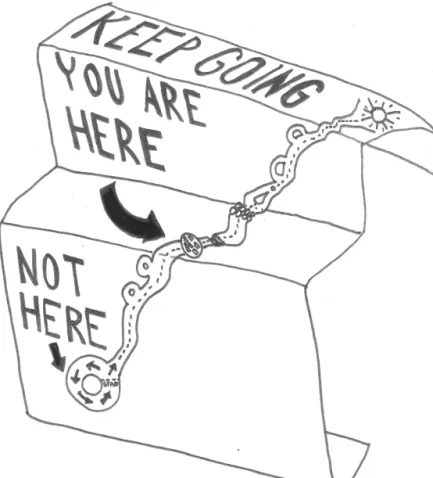
Getting Better Bite by Bite illustrator, Elise Pacquette, who also has experienced an eating disorder, hopes her works will help the reader to personalise their jour- ney and to see that although obstacles may appear, when the decision to start the journey has been made, every step is one closer to freedom.
original self-help manual, one of the first written after the description of these disorders. The new edition retains the appeal of the original through a friendly style, moving case-vignettes and ingenious illustrations. Some additions enable the inclusion of new research on the body image disturbance and on refined treat- ment techniques, while an extra chapter facilitates access to sources of help in different parts of the world. I recommend this book with full enthusiasm.”
– Gerald Russell, Emeritus Professor of Psychiatry, Institute of Psychiatry, King’s College London
“Ulrike Schmidt, Janet Treasure and June Alexander make an outstanding team in this second edition of one of the foremost self-help manuals for sufferers with bulimic disorders. Drs Schmidt and Treasure are at the cutting edge in their clini- cal and research work in this domain, and adding June Alexander to this team provides this edition with an eloquent voice that represents sufferers and carers.
This book is a great practical guide for those who are unwell, and also for those of you who are there to guide these individuals through their struggles toward recovery – professionals, families and friends alike.”
– Daniel Le Grange, PhD, Benioff UCSF Professor in Children’s Health, University of California, San Francisco, USA
“Getting Better Bite by Bite is a beautifully illustrated step-by-step guide for eat- ing disorders recovery. Through rich storytelling and concrete practical exercises reflecting decades of collective clinical experience, this book accompanies the reader across the stepping stones to recovery. Warmth, compassion, and deep under- standing flow from every page integrating perspectives of two of the most respected eating disorder clinicians in the world and a survivor/advocate. This guide avoids jargon and provides solid advice for anyone with an eating disorder. A rich resource for every library and a comforting companion for anyone contemplating recovery.”
– Cynthia Bulik, PhD, FAED, Professor, Karolinska Institutet and the University of North Carolina at Chapel Hill, author of Midlife Eating Disorders and Binge Control
Getting Better Bite by Bite
A survival kit for sufferers of bulimia nervosa and binge eating disorders
Ulrike Schmidt,
Janet Treasure
and June Alexander
Second edition
by Routledge
2 Park Square, Milton Park, Abingdon, Oxon, OX14 4RN And by Routledge
711 Third Avenue, New York, NY 10017 First edition published 1993
Routledge is an imprint of the Taylor & Francis Group, an informa business
© 2016 Ulrike Schmidt, Janet Treasure and June Alexander
The right of Ulrike Schmidt, Janet Treasure and June Alexander to be identified as authors of this work has been asserted by them in accordance with sections 77 and 78 of the Copyright, Designs and Patents Act 1988.
All rights reserved. No part of this book may be reprinted or reproduced or utilised in any form or by any electronic, mechanical, or other means, now known or hereafter invented, including photocopying and recording, or in any information storage or retrieval system, without permission in writing from the publishers.
Trademark notice: Product or corporate names may be trademarks or registered trademarks, and are used only for identification and explanation without intent to infringe.
British Library Cataloguing-in-Publication Data
A catalogue record for this book is available from the British Library Library of Congress Cataloging-in-Publication Data
Schmidt, Ulrike, 1955-
[Clinician’s guide to Getting better bit(e) by bit(e)]
Getting better bite by bite : a survival kit for sufferers of bulimia nervosa and binge eating disorders / Ulrike Schmidt, Janet Treasure, and June Alexander. —Second edition.
pages cm
Revision of: Clinician’s guide to Getting better bit(e) by bit(e). c1997.
1. Bulimia. I. Treasure, Janet. II. Alexander, June, 1950- III. Title.
RC552.B84S36 2016 616.85’263—dc23 2015012752
ISBN: 978-1-138-79740-6 (hbk) ISBN: 978-1-138-79737-6 (pbk) ISBN: 978-1-315-75401-7 (ebk) Typeset in Times New Roman by Apex CoVantage, LLC
developing this book.
Contents
About the authors xiii
Introduction 1
A few words of caution 3
What this book can and can’t do 4
1 The way forward 6
Do I suffer from bulimia? 6 How to use this book 7 First steps 9
Back to the future 11
Making your decision to go 13 How to stage your journey 15
2 Tools for the journey 18
How to facilitate change by keeping a therapeutic diary 18 New skills to cope with old difficulties 22
3 Dieting: A health warning 28
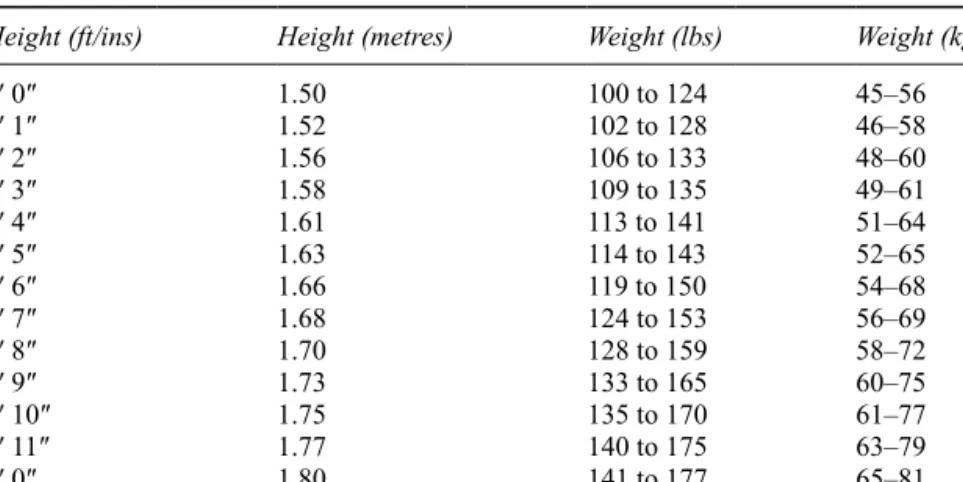
Beauty is in the eye of the beholder 28 In the healthy weight range 29 Health hazards of dieting 33 How much do I need to eat? 34 Achieving optimal weight and shape 34 Regaining eating control 37
4 The black hole of the insatiable stomach 41
Why can’t I control my eating? 43 How to stop binges 43
Lapses 49
5 Having your cake and eating it, too 51 Facing the facts 52
Why you are right to worry 52
What type of weight controller are you? 53 How to stop vomiting 54
How to stop abusing laxatives, diuretics, medications 57
6 Learning to feel good about your body 59
How body image problems are caused and maintained 61 Getting to know your body 63
Looking after your body 64 Other helpful strategies 64 Living with your body 65
7 Being fatter may be better 67
Health risks in being overweight 68 Nothing beautiful about dieting 68 Avoiding the lonely trap 70 Shake, shake, shake your body 70
8 Relapse: Walking in circles – or not 77
Preventing slips 77
What to do if a slip occurs 78 Add pleasure to your day 78
9 Childhood wounds 82
Sexual abuse 85
Trying to make sense of it 86
Grappling with guilt and self-blame 91 After-effects of abuse 92
Get a toehold on trust 92 Coming to terms 93
10 Food for thought 94
Feeling like you don’t fit in 95 The gloom-and-doom scenario 96 When life is dreadful 96
Wracked by guilt 99 Please, please them 99
When control gets out of control 103 Defusing self-defeating thoughts 108 Shoo away shame 110
11 Finding your voice 112 Learning to stand your ground 114
Anything for a quiet life 115
Ground rules for assertive behaviour 115 Putting assertiveness into practice 116
12 The seduction of self-destruction 119
The slippery slope of alcohol and drugs 120 When to worry about alcohol intake 122 Living dangerously 126
Spending what you don’t have 127
13 Web of life: Parents, partners, children and friends 129 At home with the family 129
Friends 132
Sexual relationships 134 Children 138
14 Working to live, living to work 143
Common work problems 144
15 The end of your journey – or not 151
If you are still stuck 152 Time to get real about you 152
Recovery: An adventure in self-discovery 153
16 Where to get help and support 155
Worldwide eating disorder advocacy organizations 156 Books and other resources 160
Further reading 161
Appendix 167
About the authors
Ulrike Schmidt is professor of eating disorders at the Institute of Psychiatry, Psychology and Neurosciences at King’s College London. She is also a con- sultant psychiatrist in the Eating Disorders Unit at the Maudsley Hospital. She was a member of the NICE Eating Disorders Guidelines Development Group, chair of the Section of Eating Disorders at the Royal College of Psychiatrists and a board member of the Academy for Eating Disorders (AED). She is a Council member of Beat, the UK’s main eating disorders charity. She is the recipient of a 2005 NHS Award for Innovative Service Delivery, the 2009 AED Leadership Award for Clinical, Educational and Administrative Services, the 2013 KCL Supervisory Excellence Award and the 2014 Hilde Bruch Award for Outstanding Achievements in Eating Disorders Research and Treatment.
Professor Schmidt has published some 300 peer-reviewed papers and 90 other publications on eating disorders, including text books, chapters, patient manu- als, and web-based treatment or training packages. A key focus of her research has been on development of brief scalable psychological treatments for eating disorders.
Janet Treasure, OBE, is a psychiatrist who has worked professionally with peo- ple with eating disorders for over 33 years at the Eating Disorder Unit at the South London and Maudsley Hospital NHS Trust, which is a leading centre in clinical management and training of eating disorders. She was chairman of the physical treatment section of the UK NICE guideline committee. She is the chief medical advisor for Beat (the main UK eating disorder charity).
She was awarded with a leadership for research with the Academy of Eating Disorders in 2007 and was also awarded a lifetime achievement award from the Academy of Eating Disorders and from Beat in 2014. She is trustee of the charities Student Minds, Charlotte's Helix, Diabetics with Eating Disorders and the Psychiatry Research Trust and is on the scientific board of the charities SUCCEED, MAED – Mothers Against Eating Disorders and FEAST.
June Alexander is a writer and PhD candidate. At age 11, June developed ano- rexia nervosa and this challenge, together with a love of writing, shaped her life. Upon recovering from her illness at age 55 in 2006, June departed a jour- nalism career to write books about eating disorders – combining life experience
and professionals skills to disseminate evidence-based research for health practitioners and mainstream readers. June serves on national and international mental health and advocacy organisations, including Academy of Eating Dis- orders, F.E.A.S.T. and the National Eating Disorders Collaboration (Australia).
Her website and blog supports this advocacy work. She speaks publicly on the theme “Hope at Every Age” and presents workshops on writing as a ther- apy. June is a PhD candidate in creative writing at CQUniversity, Australia, exploring how diary writing can be therapeutically applied in the treatment of eating disorders, and is a diary-writing mentor with inpatients in a hospital eat- ing disorders unit. June has a website at www. junealexander.com.
Elise Pacquette, illustrator, gains inspiration for her work from her experience of recovery from anorexia nervosa. She understands many of the battles along the journey towards recovery, including the reluctant start, the hurdles, the temptations and the slip-ups. Having made this journey, she appreciates that it not only took her towards recovery but also was rewarding in itself, gathering along the way many insights and an understanding of herself that have been invaluable. Elise is now married with children and, inspired by her eating dis- order experience, has developed a course for 11–12 year olds to attend with their parents/carers about growing up and becoming independent; run as an after-school club, this course helps parents and children to explore together what it means to grow up in today’s culture. Elise wishes all those who journey through this book the strength to keep going, step by step, bite by bite.
Introduction
The important message throughout every page of Getting Better Bite by Bite is that recovery is possible, at every age. This book does not pretend that recovery from an eating disorder is easy. What this book does do is arm you with skills and knowledge to make your recovery journey as smooth and rewarding as possible.
Getting Better Bite by Bite portrays what life is really like, living with bulimia nervosa or binge eating disorder. (Hereafter, we will usually just use the term bulimia). Until directly affected by an eating disorder, most people’s perception of these illnesses is obtained from the media. The perception is almost always noth- ing like reality. There is nothing glamorous or desirable about bulimia or binge eating. Much mystique remains. Misconceptions and misinformation abound about the causes, the health risks and the treatment. Access to treatment is dif- ficult for many sufferers, and friends and relatives often have no idea how to help.
Also, some doctors are not sympathetic or understanding, and make the person feel their problem is self-inflicted and trivial and thereby compound the illness characteristics of guilt, shame and loneliness.
This book was originally written for the patients with bulimia attending the Eating Disorders Clinic at the Maudsley Hospital, London. Our patients wanted
information about their illness and practical advice on how to overcome their problems. This book contains in condensed form what we know to be the essential ingredients of cognitive-behavioural therapy (CBT), a form of therapy endorsed by the UK’s National Institute of Health and Care Excellence1 as the most effective treatment for bulimia. In addition, it incorporates evidence-based strate- gies for successfully changing problem behaviours as outlined in the NICE guide- lines for Behaviour Change2.
Getting Better Bite by Bite is unique in several respects. It strongly focuses on enhancing readers’ motivation and belief in their ability to change, includes strategies for dealing with common accompanying problems and has an easy-to-read conversational style3. The first edition of Getting Better Bite by Bite, released in 1993, has helped many eating disorder sufferers, not only at the Maudsley but around the world. We know this because many people wrote to us after working through the book to tell us their personal recovery story and give us feedback.
Many people, on reading this book, have felt empowered to tackle their eating problem and, beyond that, to address other difficulties in their lives, too. Some people – often those feeling less sure about what they want – found the book help- ful in understanding their problem and gaining tools to make an informed decision about whether or not to enter treatment.
Clinical trials using this book have shown that a significant proportion of peo- ple working through this book by themselves make a full and lasting recovery from their eating disorder, and when this book is used with a few sessions of sup- port and guidance from a therapist, it is as effective and more sustainable than a much longer face-to-face CBT treatment4.
CBT delivered by a therapist typically includes a case formulation in the form of a diagram or map showing how a person’s difficulties all “hang together”. This can be very helpful, especially if it is really tailored to an individual. However, this approach does not always “hit the spot” for the person if, for example, the map is too complicated or too simple, or makes the person feel forced into an unhelpful structure. The available research evidence suggests that therapists like these diagrams, but it is not clear how helpful or necessary such diagrams actually are for people in overcoming their difficulties5. We therefore decided not to put such a diagram into this book. Instead, we have taken a problem-led approach, with each chapter tackling an area relevant to most or particular subgroups of people with bulimia or binge eating.
This updated Second Edition can help you, too, on your journey to recovery. You must undertake this journey of change yourself, but we can be like your support crew, ready to help you plan and prepare and to be beside you as you travel towards your destination. We can provide maps and point out the dangers and pitfalls along the route. Importantly, we can help you find a way to overcome the inevitable obstacles. No matter how big the obstacle, we can help you find a way around it and work with you to achieve recovery. Remember, there is always a solution.
You may have mixed feelings about leaving the sense of security that accom- panies the familiar territory of bulimia. You know that there are severe dangers on all sides, and you may have constructed ways of ignoring or suppressing those
dangers. You will feel frightened about entering the new territory without the backup of your bulimia or binge eating behaviours. This book is filled with the travellers’ tales of people like yourself who have made the journey before you.
They are here to travel with you, to keep you company and help to decrease your sense of isolation.
This book is full of clues on how to avoid the traps of self-defeating thought patterns. It contains the tools you need to travel safely along the road to recov- ery. It shines a light on changes that you can make to replace the short-lived and doomed-to-fail rewards that you get from your illness. Getting Better Bite by Bite offers safe, reliable, long-lasting alternatives.
Getting Better Bite by Bite also will help you to anticipate, and prepare for, obstacles and detours on the way. You may experience initial discomfort (just like we get aches when we start a new exercise or dance routine, as latent muscle groups are brought into use), but persevere because eventually you will get past this stage and start to recognize and enjoy the many benefits of your new skills and new-found strengths.
Not everyone is successful at first. Setbacks and lapses commonly occur. How- ever, always remain hopeful because you can learn from these experiences. For some sufferers, the change process is slow and laborious, requiring many attempts before achieving freedom of self; others find the way is easier.
The time taken to recover from bulimia or binge eating disorder is three months on average, but differs for each person. Vigilance and a high level of self-awareness is often necessary for years afterwards to ensure your life remains unshackled by the eating disorder.
You may feel, “I can’t help myself. I have tried. My problem is too severe for this. I need someone else to take over.” However, any form of treatment can work only when you are actively involved. The more you put in, the more you will strengthen and empower your true sense of self. So you might as well start now. We don’t expect that reading Getting Better Bite by Bite will make you sud- denly “snap out” of your problem. However, deciding to do what it takes to stop your chaotic eating pattern is the important first step on a journey that leads to increased freedom and self-esteem.
A few words of caution
Some people are persuaded by their families or partners to work on their prob- lems. This book can help only if you really want to get better for yourself. Get- ting Better Bite by Bite can’t help if you are not ready to change, or if you just want to change to please somebody else. To assess your readiness for undertaking the recovery journey, go to Chapter 1; fill in your own balance sheet, and keep it close by (in your bag or pocket) for regular consultation wherever you go.
You will be asked to do a lot of hard work over the next few weeks. Even when you are determined to get better, there are bound to be ups and downs. The best way to cope is to take each day as it comes and focus on living in the moment, rather than the past.
You may feel tempted to “binge” on this book, that is, read it quickly and throw it in a corner, telling yourself, “this is nothing new”; “I knew all this, already”.
This is certainly what the eating disorder bully wants you to think. Strive to be honest with, and listen to, your own true self. Take time to absorb and digest each chapter slowly.
What this book can and can’t do
Getting Better Bite by Bite can’t cure you but can help you acquire new coping skills, so that the eating disorder no longer rules your life. This book is not aimed primarily at helping you to understand why you developed an eating problem.
Understanding the underlying causes is often difficult and happens only gradually, if at all. To know what caused the eating problem is important, but rarely helps to change distressing eating symptoms. Getting Better Bite by Bite aims to help you develop new skills to ease these symptoms and to help you gain control over your life. Once eating symptoms are addressed, underlying causes often become clearer and a decision will be easier regarding whether you need treatment in your own right.
Notes and references
1 National Institute of Health and Care Excellence, 2004. Eating Disorders: Core Inter- ventions in the Treatment and management of anorexia nervosa, bulimia nervosa and related disorders. http://guidance.nice.org.uk/CG9
2 National Institute of Health and Care Excellence, 2014. Behaviour Change: Individual Approaches (PH49). http://guidance.nice.org.uk/PH49
3 We compared six widely available CBT self-help interventions for bulimia and found that GBBB was by far the most easy and straight forward read (Musiat, P. & Schmidt, U., 2010. Chapter in Agras, W.S. (Ed.), The Oxford Handbook of Eating Disorders.
Oxford Library of Psychology).
4 Getting Better Bite by Bite (GBBB) has been tested in seven clinical trials in the UK and internationally. These trials show that working through the book by yourself is bet- ter than doing nothing and waiting for treatment with a therapist. GBBB with guidance from a therapist (8 sessions) is as good as individual CBT (16–20 sessions) (Thiels, C., et al. American Journal of Psychiatry, 1998;155:947–953; Treasure, J., et al. British Journal of Psychiatry, 1996;168:94–98; Treasure, J., et al. British Medical Journal, 1994;308(6930):686–689). GBBB with guidance also has advantages over group CBT (Bailer, U., et al. International Journal of Eating Disorders, 2004;35:522–537) and family-based treatment in bulimic adolescents (Schmidt, U., et al. American Journal of Psychiatry, 2007;164:591–598). A large trial from Austria has shown that GBBB works as well as Internet-based CBT (Wagner, G., et al. British Journal of Psychiatry, 2013;202:135–141). Other researchers using a different self-help book have found that if you start treatment using self-help for bulimia but with the option of adding other treatments (CBT from a therapist and antidepressant medication) if necessary, you do better in the longer term than if you have “Rolls Royce” CBT with a therapist straight away (Mitchell, J.E., et al. British Journal of Psychiatry, 2011;198:391–397).
We can only speculate why this might be, but it is likely that if you mobilise your inner
resources and think about what you can do yourself, this is more helpful than waiting for someone else (a therapist) to provide the answers for you.
Finally, we and others have found that working through the book and actually doing the suggested between-session tasks leads to much better outcomes than simply skim reading it (Beintner, I., et al. Clinical Psychology Review, 2014;34(2):158–176). This may sound obvious but is crucial.
5 Wilson, G.T. Behaviour Research and Therapy, 1996 Apr;34(4):295–314. Moorey, S.
Journal of Cognitive and Behavioral Psychotherapies, 2010 Mar;38(2):173–184.
1 The way forward
Do I suffer from bulimia?
A mountainous pile of labels has emerged to describe a person who overeats and feels distressed about it. The labels include: compulsive overeating, bulimia nervosa, bulimia, binge eating disorder, bulimarexia, night eating syndrome and
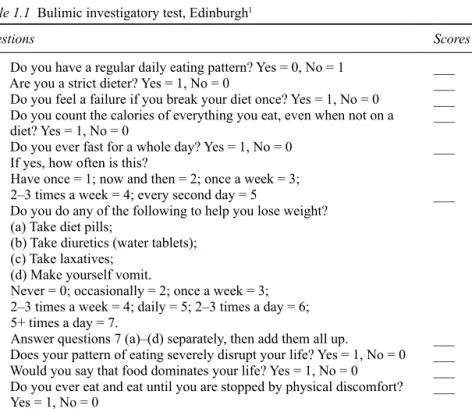
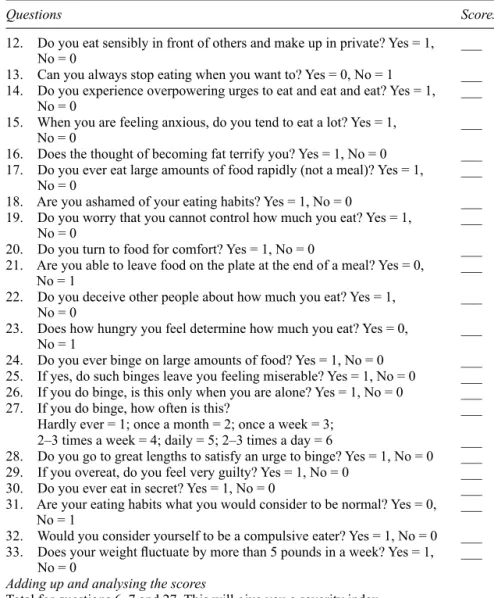
loss-of-control eating. They overlap and have an awful lot in common with each other. Problems with overeating can occur in people of any body weight (under- weight, average, and overweight). This book has been written for people who fall into any of these categories. If feeling unsure whether any of this fits you, fill in and score the test in Table 1.1.
If your severity index score is 5 points or above, you are likely to have a signifi- cant eating disorder at present.
If your symptom score is 15 points or above, you have a lot of the thoughts and attitudes that go with an eating disorder and are clearly distressed by it.
How to use this book
Like many people, you may have the habit of starting to read a book at the end or in the middle, perhaps flicking through the pages until a chapter title grabs your interest. In principle, you can do that with this book, but let us explain a few things first: Chapters 1 to 6 are the core chapters that teach all the steps you need for solving unhealthy eating habits. We suggest you read Chapters 1 to 6 together, but in whatever order you like. These chapters will help you decide whether you are correct in deciding that you want to get over your bulimia and are ready to start the journey.
Table 1.1 Bulimic investigatory test, Edinburgh1
Questions Scores
1. Do you have a regular daily eating pattern? Yes = 0, No = 1 ___
2. Are you a strict dieter? Yes = 1, No = 0 ___
3. Do you feel a failure if you break your diet once? Yes = 1, No = 0 ___
4. Do you count the calories of everything you eat, even when not on a
diet? Yes = 1, No = 0 ___
5. Do you ever fast for a whole day? Yes = 1, No = 0 ___
6. If yes, how often is this?
Have once = 1; now and then = 2; once a week = 3;
2–3 times a week = 4; every second day = 5 ___
7. Do you do any of the following to help you lose weight?
(a) Take diet pills;
(b) Take diuretics (water tablets);
(c) Take laxatives;
(d) Make yourself vomit.
Never = 0; occasionally = 2; once a week = 3;
2–3 times a week = 4; daily = 5; 2–3 times a day = 6;
5+ times a day = 7.
Answer questions 7 (a)–(d) separately, then add them all up. ___
8. Does your pattern of eating severely disrupt your life? Yes = 1, No = 0 ___
9. Would you say that food dominates your life? Yes = 1, No = 0 ___
10. Do you ever eat and eat until you are stopped by physical discomfort?
Yes = 1, No = 0 ___
11. Are there times when all you think about is food? Yes = 1, No = 0 ___
(Continued)
Questions Scores 12. Do you eat sensibly in front of others and make up in private? Yes = 1,
No = 0 ___
13. Can you always stop eating when you want to? Yes = 0, No = 1 ___
14. Do you experience overpowering urges to eat and eat and eat? Yes = 1,
No = 0 ___
15. When you are feeling anxious, do you tend to eat a lot? Yes = 1,
No = 0 ___
16. Does the thought of becoming fat terrify you? Yes = 1, No = 0 ___
17. Do you ever eat large amounts of food rapidly (not a meal)? Yes = 1,
No = 0 ___
18. Are you ashamed of your eating habits? Yes = 1, No = 0 ___
19. Do you worry that you cannot control how much you eat? Yes = 1,
No = 0 ___
20. Do you turn to food for comfort? Yes = 1, No = 0 ___
21. Are you able to leave food on the plate at the end of a meal? Yes = 0,
No = 1 ___
22. Do you deceive other people about how much you eat? Yes = 1,
No = 0 ___
23. Does how hungry you feel determine how much you eat? Yes = 0,
No = 1 ___
24. Do you ever binge on large amounts of food? Yes = 1, No = 0 ___
25. If yes, do such binges leave you feeling miserable? Yes = 1, No = 0 ___
26. If you do binge, is this only when you are alone? Yes = 1, No = 0 ___
27. If you do binge, how often is this? ___
Hardly ever = 1; once a month = 2; once a week = 3;
2–3 times a week = 4; daily = 5; 2–3 times a day = 6 ___
28. Do you go to great lengths to satisfy an urge to binge? Yes = 1, No = 0 ___
29. If you overeat, do you feel very guilty? Yes = 1, No = 0 ___
30. Do you ever eat in secret? Yes = 1, No = 0 ___
31. Are your eating habits what you would consider to be normal? Yes = 0,
No = 1 ___
32. Would you consider yourself to be a compulsive eater? Yes = 1, No = 0 ___
33. Does your weight fluctuate by more than 5 pounds in a week? Yes = 1,
No = 0 ___
Adding up and analysing the scores
Total for questions 6, 7 and 27. This will give you a severity index. ___
Total for all other questions. This will give you a symptom score. ___
Table 1.1 Continued
If in addition to a problem with your eating habits you are also overweight, we suggest you include Chapter 7 in your initial reading.
Chapters 8 to 14 focus on the links between your eating disorder and the rest of your life. You can read them at a leisurely pace over the next few weeks, in whatever order you like. The aim of these additional chapters is to help you spot problems in different areas of your life, and see connections with factors that may have contributed to your eating problem or are obstacles in overcoming it.
If you drink heavily or regularly take drugs, we encourage you to look at Chap- ter 12 early on. Drug and alcohol problems make eating difficulties much harder to control and therefore need to be tackled early on. Chapter 12 will help you to (a) assess the seriousness of your alcohol/drug problem, and (b) decide what to do about it.
First steps
Are you ready to undertake the journey?
Read core Chapters 2, 3, 4, 5 and 6. Now. Don’t try to follow any suggestions and instructions given there; skip over these for now. Re-read each chapter until you feel sure that you have been able to take the information on board. Are you ready to undertake the journey?
• Now, when you have a quiet hour, start writing your bulimia balance sheet.
First, take a large sheet of paper and divide it length-wise into two main columns. At the top of one column, write “Reasons for giving up bulimia”, and on the other, write “Reasons for not giving up bulimia”. You may have important reasons to fear change from familiar behaviour, and yet part of you feels desperate to escape the vicious circle that is keeping your bulimia nervosa going. Keeping all these thoughts and ideas together in your head at one time is impossible, as our memory has its limits, and so there is a tendency to swing from one side of an argument to the other.
Writing a balance sheet will help you to manage your thoughts system- atically. Plan to work on this for a week – keep going back to it each day.
To focus your thoughts, make four divisions across the sheet, and at the start of each row, write:
1. Practical gains and losses for self
2. Practical gains and losses for others
3. Emotional gains and losses for self
4. Emotional gains and losses for others
Here, others share examples from their balance sheets to get you started. You may agree with some of the comments and want to add them to your list. But reflect and give yourself time to find your own reasons, and try to be specific.
Keep this balance sheet in mind all week, as new ideas can pop up unexpectedly while you are doing something else.
Reasons to give up bulimia 1. Practical gains for self
“I won’t be tired and unwell all the time.”
“My teeth won’t continue to be destroyed.”
“I will look healthier.”
“My guts will work normally without unnatural practices.”
“My body will begin to repair the damage I have caused.”
2. Practical gains for others
“I will be able to be with my family and friends more and will not have to make excuses to avoid eating with them.”
“My flatmates won’t find the food cupboards empty.”
“I will be more romantically/sexually responsive.”
“My partner will be able to kiss me if I no longer vomit.”
“I will be less irritable and snappy.”
“I will be able to concentrate and do a better job at work.”
3. Emotional gains for self
“I won’t have to lie about food and how much I eat.”
“I won’t have to deceive people about vomiting and taking laxatives.”
“I will have achieved something positive.”
4. Emotional gains for others
“My parents will stop worrying that I will die.”
“My friends won’t have to see me destroying my life.”
“At work, I will appear healthy and competent.”
“I will be able to join in all social activities without excuses.”
Disadvantages of change and recovery 1. Practical losses for self
“I will find meal-times very frightening.”
“I will feel bloated, stuffed, too full.”
“My stomach may ‘blow out’ after eating small amounts.”
“I may get swelling around my eyes and ankles.”
“I will become extremely anxious about my weight.”
2. Practical losses for others
“I will need more active help and support from my parents/partner/friend.”
“My mood may swing more.”
3. Emotional losses for self
“Letting go of my eating disorder will be so difficult that I’m bound to fail and then I will feel worse than ever.”
“I will feel out of control over everything.”
“I will have to face up to my responsibilities.”
“I will feel uncomfortable, miserable and frightened.”
“I will hate myself and my body.”
4. Emotional losses for others
“I may become more assertive and dominant when relieved of the burden of my eating disorder, which may upset the dynamics in my relationships.”
Don’t worry if distinguishing between these four categories is difficult, as there is some overlap and their role is simply to help focus your thoughts. It doesn’t really matter in which category you insert your reasons, as long as they are in the correct column, that is, positive or negative.
When your balance sheet is finished, go over the list and rate each gain and loss for importance on a 1–10 scale (10 = a very important reason; 1 = only slightly important reason). Next, rate each gain and loss on a 1–10 scale for likelihood.
What have you learnt from this? What are the things that might be holding you back? How likely are they to happen? What are the things that really matter to you and that might help you to start the journey?
Back to the future
We now suggest that you do the following exercise. Having your balance sheet in front of you will be helpful.
Imagine you have decided that the challenge of overcoming your eating disorder is too difficult and risky. Five years have gone by. You continue to have bulimia. Everything has gone wrong. All the negative consequences that you considered in your balance sheet have come true. You feel alone, powerless and at the end of your tether. You decide to write to your one close friend, whom you haven’t seen for a while, as she (assuming your friend is a woman) has been abroad. You know that she cares about you and will not be deceived by superficial news, and that when you meet her on her return, she will see it all anyway. You have found in the past that she has been able to provide emotional and practical support when you have needed help. You know you can trust her, and must be completely open in describing your present difficulties.
Here are a few guidelines to consider in writing to your friend:
• What weight will you be?
• What medical complications will you have?
• What career/job will you be pursuing?
• Where and with whom will you be living?
• Who will be your friends?
• Will you be in a relationship? Married? Have children?
Now be as realistic as possible, and talk in the present tense. Here is an example of a letter from another sufferer from bulimia nervosa, who is preparing herself to undertake the journey of recovery:
Dear Susan,
I look forward to catching up when you return home in June. I thought I would tell you all about my current situation so that we can pick up where we left off when you departed five years ago. I’m afraid my story is rather sad, but I know I can trust you, and have faith that something good will come out of sharing hon- estly with you, as happened in the past.
My bulimia has continued, which means I have been battling it for 15 years now. My weight has fluctuated greatly, like a yo-yo, up and down, up and down.
At the moment, I am on the lower end of the ideal body weight scale. I should be happy but I’m not.
I continue to vomit, although this doesn’t seem as effective as it once did, and I now severely restrict my food. Preparing my food consumes my day. I keep a semblance of control by wrapping small bites in dried seaweed. In the morning, I sometimes wake to find that I have eaten at night but cannot remember it. The illness has taken a severe toll on my health. I now have six caps on my teeth, and the others remain very sensitive to temperature changes. Last summer, I was in hospital in agonizing pain with kidney stones. I had special vibration treatment to disperse them. I passed blood and gravel in my urine for weeks afterwards.
I have become more dependent on laxatives and spend all day walking to chem- ists’ shops to buy them. I have a fixed routine and visit different shops on different days of the week. More than half my social security money goes on laxatives. The amount I need has been increasing gradually. Without them, I become so bloated and bunged up that I am terrified, and yet with them, I bleed and leak and am up all night on the toilet.
I have not worked for two years. I rent a room in a house with six others. Since David finished with me four years ago, my social life has shrunk. I only remain in contact with Sophie and Paul. They keep in touch on the phone and regularly pick me up for a visit at their house. At times, I feel so low and full of despair that I con- template ending my suffering. I hold back as I am a coward and also because I couldn’t bear to think of people seeing my room or belongings after I am dead.
I would be ashamed for them to see my hoards of food (I have three freezers filled with food) and trinkets, which I have stolen from shops and never used. The com- pulsion to collect and clean is exhausting and overwhelming.
Despite all of this, I cling to a glimmer of hope. I remember that moment, five years ago, when you offered to help me overcome my illness. Back then, the chal- lenge to change seemed too difficult and risky. However, I now clearly see that there is no other way forward, and I want to accept that offer of help that you so generously made before.
I know that you will be pleased that I have made this first step and have mus- tered the courage to write to you.
With love from Penny
Making your decision to go
Only you can decide to work at change now or to continue with bulimia ner- vosa or binge eating. Probably this will not be simply one decision but numer- ous smaller decisions that you will make over the following days, months and years. Strong forces will try to suck you back. Expect, like others venturing on this journey, to make many mistakes. However, don’t feel disheartened because Getting Better Bite by Bite will help you acquire skills to turn any mistake into a helpful lesson.
Asking someone to help
Trying to get better on your own is a hard and lonely task. Asking for help from family, partner or friends can be useful. Sometimes, your family, partner or friends may be more enthusiastic about helping you than you are to have them help you. If you feel unsure, read Chapter 13, as this will help you clarify whether the involvement of family members or friends in your treatment will be a positive step for you. Chapter 13 also offers guidance on how to involve others in the most helpful way, and to ascertain whether you are seeking their support for the right reasons. You will need to decide whom you will ask to give you support. Will you ask people you feel closest to or those with whom you spend the most time?
The questions outlined in Table 1.2 may help you make these important decisions.
• Now write your own letter to your own friend. Read it through carefully. Don’t kid yourself. Be honest and open. Do you really want spend another five years shackled to your eating disorder while your friends are out having fun and getting on with life?
• Refer back to the guidelines at the start of this section. Now write a second letter. Imagine your situation in five years. This time, you have successfully overcome your bulimia because you are starting recovery work right now. Casting your mind back to the present, what steps have helped you to get well? Whose support has been invaluable? How have you managed to build momentum? What obstacles have you overcome and how? What does your future without bulimia look like? Is this the sort of future you want to aim for? That is, a future where you are the choreographer of what you do and say?
Asking for support will be difficult. Being direct and specific about what you want your potential supporter to do is important. To help explain, we suggest you give them this book to read.
Helping someone with an eating problem is like taking on a major challenge.
Some people may foresee these problems and decline to help early on. Such responses are not based on a rejection of you but the reality of their own com- mitments. Others may start the journey with you, wishing to please and help you without knowledge of the implications and then find it too difficult – again, expect this and know this is realism. The secondary effects of eating disorder habits lead to confusing signals to others. Sadly, there are also some people who just “don’t get” bulimia and are critical and judgmental about it.
Table 1.2 Support questionnaire
Could person X be your support? Answer the following questions: Score 1. How easy is it to talk to X about your problem?
Very easy (5 points); quite easy (4 points); not sure (3 points); quite
difficult (2 points); very difficult (1 point) ___
2. Is X critical or easily upset about your eating?
Always (1 point); often (2 points); sometimes (3 points); rarely
(4 points); never (5 points) ___
3. Could you talk to X even if you are not making progress?
Definitely (3 points); not sure (2 points); definitely not (1 point) ___
4. Can you trust X to always be there when you need someone – with no expectations or strings attached?
Definitely (5 points); probably (4 points); maybe (3 points); probably
not (2 points); definitely not (1 point) ___
5. When you overcome your bulimia, what is X’s response likely to be?
X will feel threatened by my achievement and feel redundant (0 points)
X will feel jealous of me becoming more independent and successful with my life (0 points)
I haven’t a clue (1 point)
X will be happy for me (2 points) ___
6. How often are you in contact with X?
At least once a week (3 points)
At least once every two weeks (2 points) At least once a month (1 point)
Less than once a month (0 points) ___
Total number of points Analysing your score
19 to 23 points: You are fortunate to have a perfect supporter near you. Definitely ask person X to help you in your efforts to overcome your eating disorder.
12 to 18 points: It is uncertain whether X should be your supporter. Maybe you don’t know them well enough yet to be able to predict their response. Perhaps your best bet is to keep X in mind as a potential support, but not to rush into anything.
However, if you do know X very well, your score may simply reflect that X is rather lukewarm about their commitment to you, and you may be better off thinking about someone else.
4 to 11 points: Look for someone else, or go it alone.
You may be fortunate to have one of those rare people around you who will be able to help and stay beside you throughout the recovery journey. The road will be difficult and treacherous for both of you, but the rewards are great. You will need to define the amount of support that will be helpful. Spend at least 15 minutes each week reviewing progress and setting new goals with your guide. You may want to show or share with your recovery guide some of the exercises we suggest in Getting Better Bite by Bite.
Trust is a difficult issue. The secret life of a person with an eating disorder may lead to suspiciousness in others. Discuss this with your guide. Tell them that if they become suspicious or anxious, to talk to you about their concern. Encourage them to describe the behaviour that is worrying them. They must try to be direct and present the facts, rather than be judgmental or withdraw help because of this
“hump” or obstacle that appears to be blocking progress. For example, they may need to say, “You’ve been working hard not to binge, and you have been able to join me for the evening meal several times this week. However, you ate very little at supper last night, appeared tense and rushed off early. I’m wondering if you’ve started to binge and vomit again.”
You may work with your recovery guide to think of ways to alter your behav- iour when you get an urge to eat. For example, you may come home from a dif- ficult day at work feeling tense and hopeless, with thoughts such as “I never do anything right” spinning in your head. Instead of bingeing, which would tempo- rarily suppress these thoughts, you could go for a walk with your guide, discuss together your thoughts and feelings, and return home with a fresh perspective.
Another form of support that may work for you is a self-help group, either in your neighbourhood or online. Concerned others (such as parents, partners and friends) often find these groups helpful, too. In addition, there are now resources (books2 and DVDs3) for concerned others giving them unbiased information about eating disorders, helping them to manage their concerns and anxieties, and teach- ing them how to be supportive without being intrusive.4
Even if you decide to travel solo on this recovery journey, we encourage you to set aside 30 minutes each week, or more frequently, for review. Try to use your diary as a friend and confidante. Perhaps use this time to write a letter as if to a recovery guide, or draw or paint a picture or create a collage to summarise your week. End by marking goals into your diary for the coming week and evaluating what you have learned from the week before.
How to stage your journey
Before starting on Getting Better Bite by Bite (after browsing through it and com- pleting the introductory exercises), you must decide – perhaps with the help of your recovery guide – to set yourself realistic and manageable goals. For instance, to state, “I am never going to binge again in my life” will be overwhelming and unachievable. Such an over-keen, black-and-white, unrealistic goal can make things worse instead of better by triggering more binges. Refining and breaking down your overall goals into more manageable steps is a wise way to prepare for travel. Chapters 2 to 6 provide an idea of what goals might be realistic starting
points in overcoming various problematic aspects of your eating disorder. In try- ing to reach a goal, having an exact description of what you want to achieve is important. Describe each goal in terms of:
1. Something that you can plan and do yourself. Be specific.
2. Something that is measurable (not something that is impossible to measure, such as happiness).
3. Something that challenges you slightly, so that you will feel pleased when you accomplish it, but not so difficult that even Superwoman would fail.
4. Something defined within a realistic time frame. Having no time limit leads to procrastination. Having a goal in which you state, “I will not do X for the rest of my life” is unrealistic and equally unhelpful.
Get smart
The acronym SMART (specific, measurable, achievable, realistic, timeframe) summarises the features of helpful goal setting. Clear goals are the first step towards successful behaviour change.
Once you have identified your SMART goals, four other things are important:
1. Prioritise: If you have identified several goals, you will need to think how best to prioritise them. Sometimes, people want to tackle all several goals at once, but as a rule of thumb, it is better to decide on one or two and really follow through with them than to do too much. Also, it might be important to start with a relatively small goal at first and try to achieve that, rather than something that is more ambitious.
2. Plan action: In order to translate your goals into action, you will need to plan what will happen in what situation or at what time:
how often it will happen, for how long and where it will take place (e.g. I will add a mid-morning snack consisting of my favourite full-fat yoghurt to my diet. I will eat this around 11 a.m. after I have checked my emails at work).
3. Identify obstacles: Before starting to work on your goal(s), it will be important to identify any obstacles that could get in the way of your goal. A useful way to do this is in the form of “if (x happens), then (I will do . . .)” statements. Really try to visualize what could happen and then complete your if . . . then statements. It will be helpful to
Notes and references
1 Adapted from Henderson, M. & Freeman, C.P.L. British Journal of Psychiatry, 1987;150:18–24. Reproduced with permission.
2 Treasure, J., Smith, G., & Crane, A., 2007. Skills-based learning for caregivers of a loved one with an eating disorder: The new Maudsley method. Hove: Routledge.
3 The Succeed Foundation: http://www.succeedfoundation.org
4 Most importantly, people whose families have worked through these resources find that it makes their relationship with their family members much easier, less stressful and more supportive.
repeat this out loud several times so that it becomes wired-in as an automatic helpful habit.
4. Review and monitor progress towards your goal(s): In the next chapter, you will learn about diary keeping. This can be helpful in reviewing and monitoring progress towards your goal(s).
2 Tools for the journey
How to facilitate change by keeping a therapeutic diary
Take a look at the sample diary page at the back of this book. We suggest you make some copies of this page. You can then carry a single diary sheet around with you every day, and collect all the daily sheets in a folder, or you could create the page online if this is more convenient. There are also a number of commercially available eating disorder diary apps that may suit your purposes.
Alternatively, you can draw up your own diary based on the form, and in some ways, this adds to the therapeutic benefit.1 Buy a booklet small enough to fit into your pockets or a bag. The ground rules for keeping a diary are simple:
• The diary’s role is to help and support you like a best friend. Developing a friendship and trust with your diary as a safe, non-judgmental place to offload and share your thoughts is important preparation towards trusting your own self.
• For every day, write down what you eat and drink. Try to be as accurate as you can.
• Write down those occasions when you were scheduled to eat or drink, but did not do so.
• Always keep your diary with you. Take it with you even to the loo. Record even things you find shameful and embarrassing. There can be no holding back on the road to recovery.
• Record things when they are happening. In this way, you give the clearest idea of what is going on at the time.
• Do not write a novel: try to find an efficient “short-hand” way of describing what is happening at the time. Your diary is your log book on a very important journey.
• Do not leave writing your diary until you are tired and ready for bed – for greatest accuracy and benefit, note your progress several times throughout each day.
At the end of each week, look over your diary entries for the whole week.
What have you learnt?
What went well and why? How can you build on this?
What did not go so well and why? How can you reduce or prevent this from happening again?
What are the next steps for you to take over the week to come?
Try to be fair and compassionate to yourself in your review of the week.
Until you get into the habit of diary-keeping, you may want to break it down into stages. Get used to scribbling down and noting what you eat for a week or two; thereafter, move on to the ABC approach that we proceed to describe here.
The detective work will follow.
“A” is for antecedents (triggers). Describe in your diary:
• Where you were at the time of eating, and what was going on (that is, were you on your own or in company, at home or at work, or elsewhere?)
• Your thoughts beforehand. Who said what?
• Your feelings beforehand.
“B” is for behaviour. Note:
• Whether you thought what you ate was a binge (see Chapter 4 for a definition of this).
• Whether you made yourself sick and how often.
• Whether you used laxatives or diuretics, and in what amounts.
“C” is for consequences. Describe:
• The consequences – both positive and negative – in both the short and long term on your thoughts, feelings and behaviour.
By answering these questions, you can create a behaviour chain:
The most difficult aspect of the detective work will be to become aware of your triggering thoughts and feelings. Chapter 10, “Food for Thought”, describes the thinking traps that commonly occur with eating disorders. Most triggering thoughts and feelings are unpleasant, and you may prefer not to deal with them, but the energy you use to blot them out takes a long-term toll on your well-being.
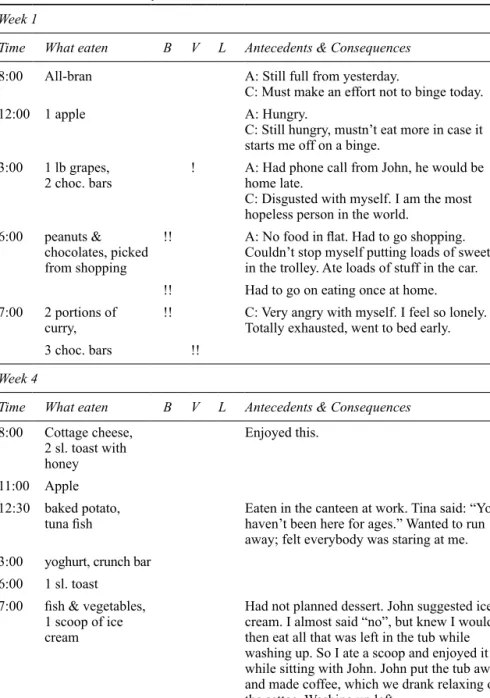
Although these thoughts and feelings are not enjoyable, they are necessary and important signals that indicate you may need to change some aspects of your life. In Table 2.1, we include excerpts from a diary sheet completed by Anna, one of our patients, as an example.
Although this diary should only take a few minutes a day to complete, you are bound to find keeping it on a daily basis inconvenient at times, if not irritating.
Start your diary during a week when you are not so busy that you are bound to fail to keep it.
Understanding Behavioral Chain: ABC
AntecedentA
(What came before)
BehaviourB
C Consequences
(results)
Short term Long term
Thought Behaviour Feelings Sensaon
We find that people vary greatly in their response to keeping this diary. You may love writing and immediately bond with your diary, able to treat it like a trusted, reliable friend in whom you love to confide. Good. You will not have any difficulties with this approach.
Table 2.1 Anna’s food diary, week 1 and week 4 Week 1
Time What eaten B V L Antecedents & Consequences
8:00 All-bran A: Still full from yesterday.
C: Must make an effort not to binge today.
12:00 1 apple A: Hungry.
C: Still hungry, mustn’t eat more in case it starts me off on a binge.
3:00 1 lb grapes,
2 choc. bars ! A: Had phone call from John, he would be home late.
C: Disgusted with myself. I am the most hopeless person in the world.
6:00 peanuts &
chocolates, picked from shopping
!! A: No food in flat. Had to go shopping.
Couldn’t stop myself putting loads of sweets in the trolley. Ate loads of stuff in the car.
!! Had to go on eating once at home.
7:00 2 portions of
curry, !! C: Very angry with myself. I feel so lonely.
Totally exhausted, went to bed early.
3 choc. bars !!
Week 4
Time What eaten B V L Antecedents & Consequences 8:00 Cottage cheese,
2 sl. toast with honey
Enjoyed this.
11:00 Apple 12:30 baked potato,
tuna fish Eaten in the canteen at work. Tina said: “You haven’t been here for ages.” Wanted to run away; felt everybody was staring at me.
3:00 yoghurt, crunch bar 6:00 1 sl. toast
7:00 fish & vegetables, 1 scoop of ice cream
Had not planned dessert. John suggested ice cream. I almost said “no”, but knew I would then eat all that was left in the tub while washing up. So I ate a scoop and enjoyed it while sitting with John. John put the tub away and made coffee, which we drank relaxing on the settee. Washing up left.
B = Binge, V = Vomited, L = Laxatives
On the other hand, for a variety of reasons, you may find keeping a diary too difficult. You may simply find it boring. Or you may find the process of self-reflection and recording frightening and shameful and find it extremely hard to face up to what you are doing to yourself. You may be worried that someone will read your diary. Or perhaps you worry that the focus on recording all the food you eat might make you binge more instead of less. You may feel tempted to stop writing your diary every time you have had a binge. Try to be as honest as you can. Getting over this problem involves facing up to frightening feelings, thoughts and behaviour. Attempting to suppress and deny them will impede and hinder your journey to recovery.
Some people find that simply keeping a diary helps them to regularise their eat- ing habits and facilitate progress. For others, the recovery road may not be that easy.
Shula
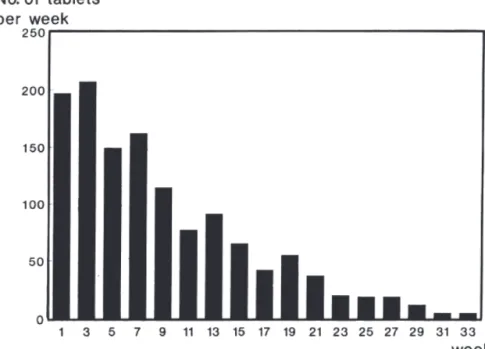
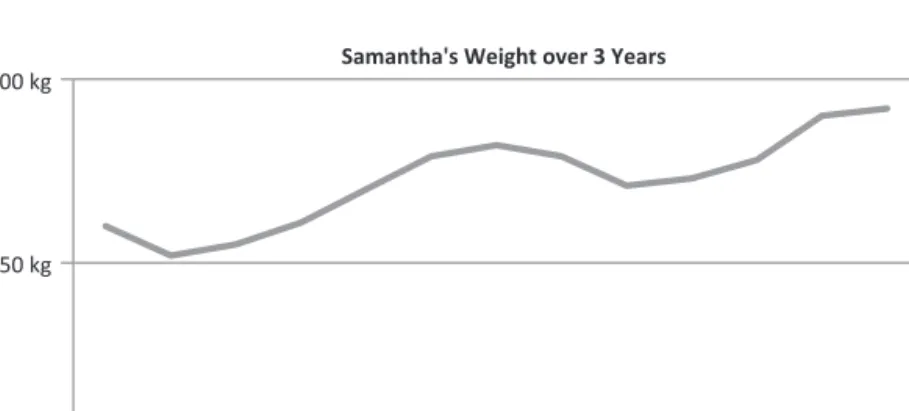
Shula had severe anorexia nervosa. She spent a long time in the hospital, and her weight increased to the level it had been before her illness began. However, after discharge, she began to have painful, prolonged binges. These happened every day. She induced vomiting several times a day and took about 150 laxative pills daily. She kept her food diary religiously, as she felt it provided some sense of being in control amid all her chaos. After three or four months of keeping a diary (and trying to work on her eating problem), she felt that little had changed, so why continue keeping it? Shula was asked to go over her diary again and to draw up a chart of the number of binges, episodes of vomiting, and number of laxatives taken per week (Figure 2.1).
To her surprise, she discovered that she had actually decreased all features of her eating problem, most remarkably the laxatives, but that bingeing and vomiting were also reducing gradually. You may say, “How could she have failed to notice such a dramatic improvement?” Well, change can be difficult to notice when drawn out over a long period of time, and especially on a bad day, when everything looks gloomy to you. Shula decided to put up the weekly chart in her bedroom to give her strength at those times when she felt she wasn’t progressing.
New skills to cope with old difficulties
You will find that, in gradually learning to give up retreating into the patterns of bulimia to cope with life’s difficulties, you need to develop new skills.
Learning to solve problems in seven steps
Making decisions and solving problems, small or large, is a definite skill. People vary in the ways they reach solutions for problems. Some do it just intuitively; it has to feel right emotionally or agree with certain “rules” that they live by. Others manage mainly by trying to find the most rational solution. There is no right or wrong way and we all use mixtures of these two approaches.
Here are seven steps that will help you find a way to take care of life’s demands and stresses without defaulting to bulimia:
Step 1: What is the problem? This step may sound trivial, but you need to define your problem carefully. Write one succinct sentence to describe your problem.
Step 2: Many people get stuck because in trying to find a solution, they limit the field of possibilities. Put all constraints aside and list as many solutions as you can. Give your imagination free rein.
Do not exclude anything just because it seems selfish, crazy, unrealistic or far-fetched. Jot down every solution that comes to mind.
Step 3: Look at each option in detail. List the pros and cons for each one, even for those solutions that seem silly.
Step 4: Choose a solution that fits you. Step 3 will help clarify what solu- tion is right or wrong for you. If you still feel unsure about the best option, you may need to return to Step 2 and create more solutions, or perhaps you are not ready to address the problem you have defined. Can you shelve it for a while? What are the pros and cons of doing that?
Figure 2.1 Laxative chart.