Harlene Hayne is a professor of psychology at the University of Otago in Dunedin, New Zealand. Masha Komolova (MSc, 2007, University of Utah) is a doctoral student in Developmental Psychology at the University of Utah.
Contributors
Monisha Pasupathi Department of Psychology, University of Utah, Salt Lake City, UT, USA, [email protected]. Weeks Department of Psychology, University of Utah, Salt Lake City, UT, USA, [email protected].
Introduction
Where Have You Been, Where Are You Going? Narrative Identity in Adolescence
What Does Identity Have to Do with Positive Youth Development?
Further, identity development is a lifelong process; that is, once constructed, identities are reconstructed, altered, maintained, or discarded in response to changing life circumstances (Kroger, 2007; McAdams, 1993; McLean, 2008). Narrative approaches, we believe, offer the best available way to address questions about the process of identity development.
Why a Narrative Approach to Identity Development?
Identity development researchers have focused extensively on classifying individuals along the dimensions of exploration, commitment, complexity, and coherence. More generally, researchers interested in narrative identity development ask questions about the elaboration, complexity, and coherence of people's narratives, captured in various ways, and the characteristics of the meanings people construct in the narrative, including their positivity and negativity.
What We Know: Narrative Identity in Early Childhood and Across Adulthood
This means that the study of narratives allows and even requires an understanding of multiple levels of influence on the narrative reconstruction of the personal past. One is descriptive, in the sense of attempting to capture individual differences in narrative construction and relate them to other personality-relevant person characteristics such as traits and motives (e.g., McAdams et al., 2004; Woike, 1995). .
Why We Need to Better Understand Narrative Identity in Adolescence
Contributors to the current volume work from a more psychological point of view, drawing on one or both of the personality and cognitive developmental memory traditions described above. Doing so is important to our understanding of narrative identity development as researchers and is also important to many of the more practical issues with which we opened this chapter.
The Present Volume
Methodologically, these chapters point to the value of certain features of narrative identity – specific types of meanings, for example – in capturing the developmental progression of narrative identity. Although work remains to be done to further explore these connections, this book demonstrates the potential importance of narrative identity.
Self creates stories that create self: A process model for narrative self-development. Personality and Social Psychology Review. The role of motives in the content and structure of autobiographical memory. Journal of Personality and Social Psychology.
Self-Continuity Across Developmental Change in and of Repeated Life Narratives
Changes and discontinuities in life can even be considered a prerequisite for life narratives. Before turning to an exploratory analysis of some recurring narratives, we sketch the narrative means of mediating personal change through personal continuity in life narratives, briefly touch on related developmental aspects, and finally delineate our expectations regarding the representation of continuity and change in life. narratives.
Continuity and Change as Represented in Life Narratives
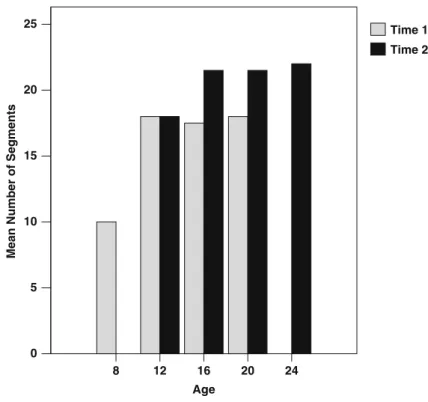
While the development of the narrative devices to create continuity can be studied cross-sectionally, the continuity and change of life stories themselves must be studied longitudinally. Studying retold life stories of the same person provides a special opportunity to observe the subsequent reinterpretation (time 2) of the first reinterpretations (time 1) of an original experience as part of the lived life.
The Development of the Self-Concept and Narrative Development
Self-continuity through developmental change in and from repeated life stories 5 introduced above and which link continuity and change to identity, the 8-year-olds' life stories failed to be globally coherent. The progression of the ability to create globally coherent life stories during adolescence relies on the social-cognitive and narrative developments outlined above.
Continuity and Change of Life Narratives
Moreover, adolescence also provides the motivation to create personal continuity in the form of globally coherent life stories, because it is a time of major changes beyond the adolescent's control and brought about by sexual maturation and social demands. to become a responsible member of society. Western societies also provide the cultural form of biography that allows for the construction of the life story, offering written biographies, novels, diaries, and public discussions of life stories.
Exploring Eight Adolescents’ Life Narratives
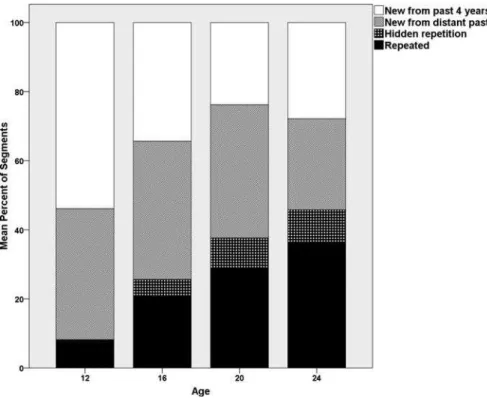
Self-Continuity Across Developmental Change in and of Repetitive Life Stories 9 McAdams and colleagues (2006) studied the stability of various aspects of ten memory stories, with length, complexity, and evaluative tone being most stable over 3 years (correlations of 0.6 and above), while the motivational themes of agency, community, and personal growth were less stable. Self-continuity across developmental changes in and of repeated life stories 15 what we have called hidden re-narratives, the narrator chooses a different aspect of the same episode or theme that he or she had already talked about in the narrative the first of life.
Conclusion
Self-continuity across developmental changes in and of repeated life narratives 21 Habermas, T., & de Silveira, C. The development of global coherence in life narratives across adolescence: Temporal, causal, and thematic aspects. Developmental Psychology.
Emerging Identities: Narrative and Self from Early Childhood to Early Adolescence
Habermas and de Silveira's (in press) data provide important new evidence on the development of life history from middle childhood to adulthood. It is clear that life history develops in both quantitative and qualitative ways across these ages.
The Development of Personal Narratives from Early Childhood
In these dyads, the child's level of evaluative recall was not a function of the mother's level of evaluation. Rather, parents who were more secure and coherent about their own early childhood talked more openly and extensively with their children about the child's early experiences.
Personal Narratives and Self-Concept in Childhood
A Subjective Perspective in Adolescence as a Function of Mother–Child Reminiscing in Early Childhood
We then conducted Pearson correlations between mothers' references to children's emotions and adolescents' references to their own emotions, both positive and negative. However, we did not anticipate that mothers' references to children's negative emotions would be such a strong predictor of adolescents' positive emotions.
The Emerging Life Story and Well-Being in Early Adolescence
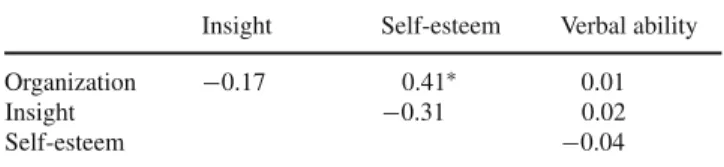
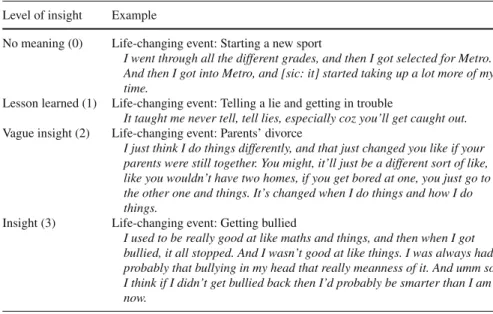
Indeed, our prediction of a positive association between life story and well-being was only confirmed for life story organization. Contrary to what was predicted, adolescents' life story organization during the chapter task was not correlated with the level of insight achieved.
Patterns of Family Narrative Co-construction in Relation to Adolescent Identity and Well-Being
In essence, personal narratives provide the structure of our self-understanding, combining our experiences with our evaluations to produce a story of our lives in relation to others. Recent research has begun to examine the emergence of life narratives in adolescence, a time when cognitive and socioemotional skills mature, allowing children to begin to reflect on their own and others' perspectives, values, and goals, and to question previously accepted interpretations. and meanings (Erikson Kroger, 2000).
Narratives and Identity
We focus on family sharing a negative event, a time that was stressful for the family, because stressful events have a critical relationship with well-being. There is increasing evidence that the ability to create more coherent and emotionally integrated stories about stressful events is associated with better physical and psychological well-being (Pennebaker, 1997).
Early Parent–Child Reminiscing
Patterns of Co-Construction of Family Narratives In the preschool years, children of mothers who are more elaborate have a more differentiated and coherent sense of self (Bird & Reese, 2006; Welch-Ross, a more advanced theory of mind (Reese & Reese, 2006). Cleveland, 2006; Welch-Ross, 1997), have a more sophisticated understanding of their own emotions and those of others, and exhibit higher levels of emotional well-being (Laible, 2004a, 2004b, 2006) than children of less verbose mothers. who engage in highly elaborated and evaluative memories gain richer memories of their own past and a better understanding of themselves and emotions.
The Family Narratives Project
Examining the family as the unit of analysis therefore allowed us to explore how the family as a system co-constructs the past. We investigated both the process of narrative interaction, i.e. how the family constructs the narrative together, and the content of narratives, focusing specifically on the emotional content.
The Family as a Unit Family Reminiscing Style
More interestingly, families who engaged in more elaboration and repetition when reminiscing about the emotional aspects of negative events had preadolescents with concurrently higher levels of internalization (r=0.29,p<0.10 for elaboration andr=0.34,p <0.05 for Table 3.1 Means (and standard values). Deviations) for recall of style and emotional content variables for the family, mothers and fathers. Families who expressed and explained more specific negative emotions (but not general affective terms) when reminiscing about negative events had adolescents who demonstrated higher self-awareness two years later. appreciation (r=0.31,p<0.12 for expressions andr=0.33,p<0.12 for explanations) and higher levels of social competence (r=0.44,p<0.05 for expressions andr =0.41,p<0.05 for explanations) and academic competence (r=0.35,p<0.05 for expressions andr=0.36,p<0.10 for explanations.
Family Reminiscing as a Gendered Activity
However, the finding that fathers who elaborate and evaluate the emotional aspects of events are associated with lower well-being was puzzling. Most interestingly, the longitudinal relationships between parental narrative style and adolescent well-being were clearly related to gender.
Summary of Family Narratives
In this context, it is thus possible that maternal scaffolding of highly emotional accounts of family relationships may be related to children's development of a more emotionally coherent sense of family and self. Based on developmental theory, we would argue that it is only during this transition to an adult gender identity that daughters may have problems with emotionally expressive fathers.
Conclusions and Implications
Haden (Eds.) Autobiographical memory and the construction of the narrative self: Developmental and cultural perspectives (pp. 149–168). Haden (Eds.), Autobiographical memory and the construction of the narrative self: Developmental and cultural perspectives (pp. 187–207).
Autonomy, Identity, and Narrative Construction with Parents and Friends
Choosing Classes
In the class selection exchange above, the daughter explains in detail which classes she chose and why. Note that issues of identity are also involved in this conversation, as the mother reminds her daughter that she "always made clothes for dolls anyway." The mother contributes to the daughter's understanding of who she is by revealing her enduring preferences in ways that complement and expand the daughter's exploration of her identity through her interests.
Processes of Identity and Autonomy Formation Are Linked in Adolescence
We begin by looking at theories of the interrelated developmental concerns of identity and autonomy in adolescence. He categorized some individuals as having achieved a state of identity achievement or a fully formed identity.
Identity and Autonomy in Conversational Storytelling
Identity and Conversational Remembering
In this way, all four quadrants of the model can be activated in conversation (Fivush, 2002). However, his mother rejects this interpretation of the event and asserts her own interpretation (as immature and wrong).
The Artist
First, the mother's tone in this conversation is one of disgust and annoyance: she is not cordial. The mother is not at all concerned with the son's desired interpretation of this event and what that may mean for his identity.
Trying Alcohol
Pay particular attention to the daughter's phrase "I am, for example," which the mother does not include as a subject. In fact, the mother suppresses this daughter's concern regarding the alcohol event.
College Choice
The daughter's desired interpretations are not incompatible with the mother's interpretations, as was the case in The Artist. In the latter, the mother wants to direct the conversation to a particular feature of the event, but she does not imply that her daughter's issues are unacceptable, just not important to her.
What About with Friends?
And the experience that's not, you know, it's "not me" is, you know, when I went to (inaudible)'s house. That is, the discussion about spirituality and exemplary status does not undermine the prudence and moral concerns raised in the conversation with the mother.
The Angry Young Man
In this case, the fact that the young person thinks about the meaning of his temper swings and that he pursues an opportunity to talk about it suggests a certain self- and other-silence at work in his interaction with his friends. Autonomy, identity and narrative construction with parents and friends 85 to engage in these projects with his friends.
Summary and Conclusions
In the college choice conversations, we see how a young man silences himself twice - once with his mother and once with his friend. Individuation in family relationships: A perspective on individual differences in the development of identity and role-taking skills in adolescence.
What He Said to Me Stuck: Adolescents’
Narratives of Grandparents and Their Identity Development in Emerging Adulthood
We then describe our previous research on adolescent stories about their grandparents as socializers of family values. Finally, we report some new longitudinal analyzes of adolescent stories about their grandparents and predictions from aspects of these stories to identity development for a sample of adolescents moving from adolescence to emerging adulthood.
Grandparenting and Storytelling in the Three-Generational Family
Older adults seem motivated to find similarities between themselves and younger family members. Traditionally, grandparents are believed to be important transmitters of personal and family values to younger members of the family (e.g., Kandell, 1996).
Stories of Grandparent Value Teaching by Adolescents
This was similar to the inclusion of parental voices in narratives about parents as socializers of values, which occurred approximately 31% of the time in the current sample (Pratt et al., 2007). Further analysis also showed that parents' actual words were also quoted more directly in the stories told about generative adults (Pratt et al., 2007).
Grandparenting and Adolescent Identity Formation
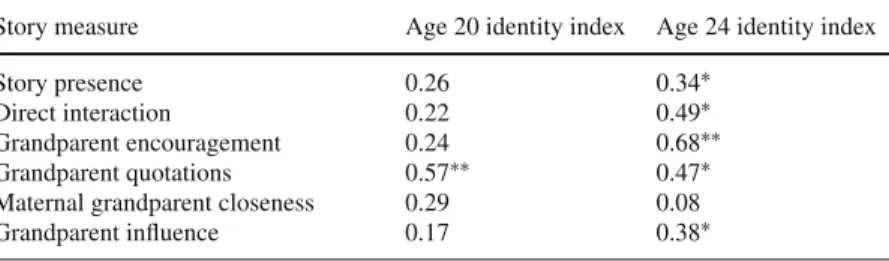
Grandparents' use of direct voice quoting and grandparent encouragement, however, were not related to time (rvalues = 0.09 and −0.10 by age). In particular, grandparent encouragement, direct interaction, and the use of a grandparent's actual voice were all positively associated with advanced identity status at age 24, as shown in Table 5.2.

Interpretations and Conclusions
The work of Mueller et al. 2002), mentioned above, involved a cluster analysis of questionnaire data from a large sample of US grandparents and suggested patterns also reminiscent of Baumrind's (1991) parenting typology. As mediators of the grandparent relationship, parents are likely to moderate its impact on the child in many ways.
Life Stories of Troubled Youth: Meanings for a Mentor and a Scholarly Stranger
She is personally and professionally involved with the authors and sees more in the stories than the authors say. Like many narrative researchers, her only knowledge of the informants was the stories they produced and the clues that led to those stories.
Suzanne’s Story: “Transformation”
Suzanne's adventurous voice comes through most clearly in the episode in which she abandons her comfortable life at Annie's house to run away to Las Vegas. I think that Susan's mother's voice (perhaps channeling that of their guidance counselors) is also evident in Susan's reflections on the cause of her troubles: acting out because she missed her mother.
Jeff’s Story: “Welcome to My Life”
Jane views the wariness in Jeff's story as symptomatic of his general wariness, which is consistent with her own experience of Jeff as withdrawn and taciturn. Life Stories of Troubled Youth 125 in Jeff's story indicating that he has some positive attachments to others.
Near and Distant Views of Life Stories
Avril, like many narrative researchers, has a myopic perspective; she only sees the stories and can only imagine the authors. We have interpreted the stories in a way that we hope is consistent, personal and ethical, with empathy for the unusual predicament the story writers face.
Postscript
Eds.) (2001). Turns in the road: Narrative studies of lives in transition. Washington, DC: American Psychological Association. The social construction of the personal past and its implications for adult development. Psychological Bulletin Adolescent worlds: Negotiating family, peers, and school. NY: Teacher's College Press.
Re-storying the Lives of At-Risk Youth: A Case Study Approach
To begin, we provide a select overview of the relevant literature on at-risk youth and narrative self as context. After the review, we introduce Amy and Amber, and use traditional qualitative methodologies to analyze their stories to present some of the emerging theme.
At-Risk Youth
In this chapter, we focus on the construction and reconstruction of the life stories of two at-risk female youth, Amy and Amber (not their real names). Many of the early childhood traumas they experienced contribute to their current criminal activities and/or substance abuse, which then lead to challenges in later life.
At-Risk Youth and the Self
Self and the Life Story
Although adolescence may be the time when people have the cognitive and psychosocial capacities to construct a life story, it is in childhood when early life experiences occur that shape the later emerging story. For example, a hopeful, optimistic narrative tone can be set as a result of a secure attachment to the parental figure with trusting stories emerging in the narrative.
Life Stories of At-Risk Youth
Therefore, early life experiences and people are believed to play a decisive role in the shape the life story will take. In the first phase, the therapist helps the youth reflect on past and present experiences in an attempt to contextualize past events, deconstruct painful memories, distance the youth from their troubled identities, and emphasize the events and characteristics that conflict with the oppressive narrative, what Ungar refers to as the narrative of "vulnerability". In the second phase, the therapist challenges the young person's story of vulnerability by constructing a convincing invulnerable, resilient story.
Case Studies
She started dating her high school "sweetheart" who was her "lifesaver." She also gained popularity at school and had fun at weekend parties and used drugs recreationally. At the time of the first interview, Amy was at a crossroads in her life.
Applying Latent Semantic Analysis to Changing Stories
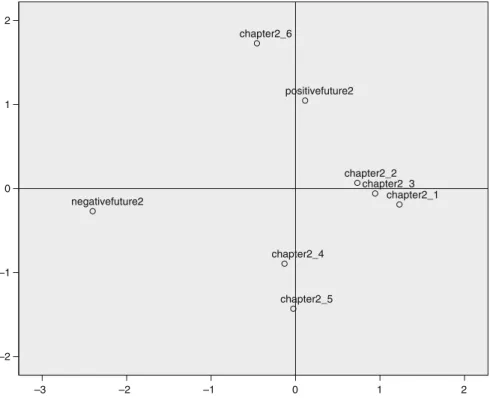
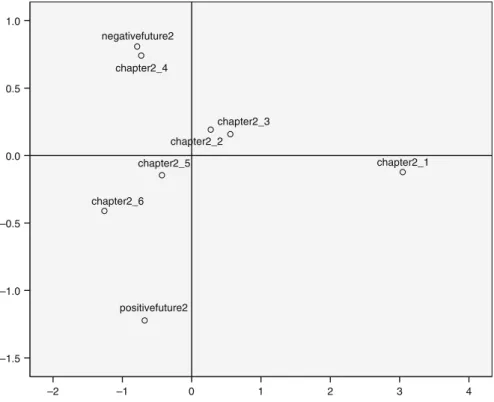
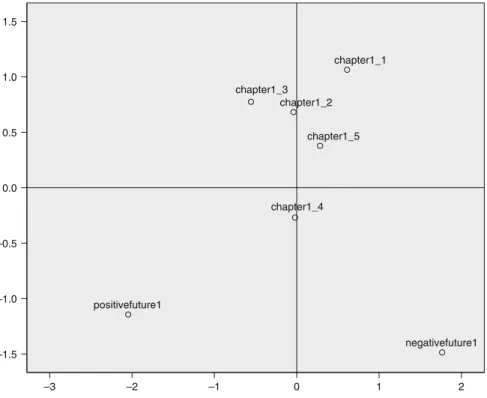
In our study, we chose future goals as our semantic reference point because we believe that those chapters that contain future goal-related words are more likely to be part of the new story of resilience. Vectors are positioned in semantic space based on the presence of related words in the TASA knowledge cache.
Discussion and Conclusion
Mental disorders, comorbidity, and postrunaway arrests among homeless and runaway youth. Journal of Research of Adolescence. A prospective longitudinal study of high school dropout: Examining multiple predictors across development. Journal of School Psychology.
Constructing Resilience: Adolescent Motherhood and the Process
Furthermore, to our knowledge, researchers have not yet examined the process of positive change in adolescent mothers with histories of severe antisocial behavior. Next, we turn to the interviews with two young women to illustrate the process of personal transformation as it unfolds.
Self-Identity and Resilience in Adolescence
Indeed, Erikson (1980) recognized motherhood as an important transitional stage in the life course that offers new opportunities for the development of identity. This connection between meaning making and behavior is essential to the development of one's self as an individual capable of acting in the world in accordance with her own values, beliefs, goals and desires for the self (Moshman, 2005).
Exploring Personal Narratives of Young Mothers with Histories of Antisocial Behavior
While she suggests that her daughter motivates her, her connection of her own experiences of birth to the self is focused on action-oriented, external aspects of. Near the end of the interview, however, Jasmine describes an important event in her life story and it becomes clear that the process of transformation is much more complex than Jasmine's story initially suggests.
Implications for the Study of Narrative Identity in Adolescence
Impacts of teenage childbearing on mothers and the implications of these impacts for government. Washington, DC: American Psychological Association. 1985). Power, intimacy, and life history: Personological inquiries into identity.
Negotiating the Meanings of Adolescent
Motherhood Through the Medium of Identity Collages
Negotiating the Meanings of Adolescent Motherhood
Low-income minority populations are typically the focus of teen pregnancy research, perhaps because demographic research finds elevated risk for teen pregnancy among African American and Hispanic populations compared to white populations (U.S. Census Bureau, 2006). We set out with the express purpose of recognizing and exploring the complexity of the identities of adolescents living in poverty—a complexity that is often overlooked in both public opinion about teen mothers and in teen pregnancy research (Shultz, 2001).
The Art Project
During the project, the teenagers addressed issues of sexuality, family, fathers and marriage, as well as education and career. Participants were recruited from a school-based teenage pregnancy program called Project ELECT/TAPP (Education Leading to Career and Employment Training, and Teenage Pregnancy and Parenting), which was introduced in response to the extraordinarily high teenage birth rate in the community.
Creating Collages
Portraits
While Mandisa is vague and says very little about the "medical field," she is lively and detailed in her plans to open a hair salon with her sister and cousins (who are like sisters). She is Puerto Rican, lives with her mother, stepfather and siblings and is the first child on her mother's side of the family to have a child.