Drug Therapy for the Elderly
Martin Wehling
Editor
Drug Therapy for the
Elderly
Institute of Experimental
and Clinical Pharmacology and Toxicology Director Clinical Pharmacology Mannheim Medical Faculty Mannheim
University of Heidelberg Mannheim
Germany
ISBN 978-3-7091-0911-3 ISBN 978-3-7091-0912-0 (eBook) DOI 10.1007/978-3-7091-0912-0
Springer Wien Heidelberg New York Dordrecht London
Library of Congress Control Number: 2012945526
#Springer-Verlag Wien 2013
This work is subject to copyright. All rights are reserved by the Publisher, whether the whole or part of the material is concerned, specifically the rights of translation, reprinting, reuse of illustrations, recitation, broadcasting, reproduction on microfilms or in any other physical way, and transmission or information storage and retrieval, electronic adaptation, computer software, or by similar or dissimilar methodology now known or hereafter developed. Exempted from this legal reservation are brief excerpts in connection with reviews or scholarly analysis or material supplied specifically for the purpose of being entered and executed on a computer system, for exclusive use by the purchaser of the work. Duplication of this publication or parts thereof is permitted only under the provisions of the Copyright Law of the Publisher’s location, in its current version, and permission for use must always be obtained from Springer. Permissions for use may be obtained through RightsLink at the Copyright Clearance Center. Violations are liable to prosecution under the respective Copyright Law.
The use of general descriptive names, registered names, trademarks, service marks, etc. in this publication does not imply, even in the absence of a specific statement, that such names are exempt from the relevant protective laws and regulations and therefore free for general use.
While the advice and information in this book are believed to be true and accurate at the date of publication, neither the authors nor the editors nor the publisher can accept any legal responsibility for any errors or omissions that may be made. The publisher makes no warranty, express or implied, with respect to the material contained herein.
Disclaimer: Not all indications mentioned in this book are FDA labeled.
Statements and particular dosages have been formulated with care; however, users cannot rely on them and have to check all statements including dosages against standard literature and official labels including those by the FDA. While the advice and information in this book are believed to be true and accurate at the date of going to press, neither the authors nor the editor nor the publisher can accept any legal responsibility for any errors or omissions that may be made. The publisher makes no warranty, expressed or implied, with respect to material contained herein.
Printed on acid-free paper
Springer is part of Springer Science+Business Media (www.springer.com)
Foreword
It is much easier to write upon a disease than upon a remedy.
The former is in the hands of nature and a faithful observer
with an eye of tolerable judgment cannot fail to delin- eate a likeness.
The latter will ever be subject to the whim, the inaccuracies, and the blunder of mankind.
William Withering (1741–1799) When William Withering wrote these words, he never could have imag- ined that they would still be relevant to the practice of medicine into the next millennium. However, there remains a lingering truth to Withering’s words that should humble all those who prescribe medications to older patients. There are many reasons that make geriatric pharmacotherapy especially challenging. Geriatric patients often have multiple coexisting illnesses, leading to the use of complex drug regimens. An increased burden of morbidity often results in polypharmacy; polypharmacy can lead to redundant drug effects and is the most important risk factor for serious drug-drug interactions and adverse drug events. Adverse drug events are often nonspecific and can go unrecognized in older patients.
Sometimes, drug side effects lead to the prescription of additional medi- cations, creating a prescribing cascade, and potentially increasing the risk of drug-related problems in older patients even more. Complicating these challenges are the many pharmacologic and physiologic changes that occur with aging, posing additional risks of drug-related injury for geriatric patients. Last but not least, errors in management are extraordi- narily common in medication prescribing and monitoring in the elderly, resulting in dangerous near-misses, close calls, and preventable drug- related injuries. All of these challenges are even further complicated by the dearth of evidence that exists around the benefits, risks, and compara- tive effectiveness of the multitude of drug treatments that are commonly used in older patients.
v
There is universal recognition of the need to optimize and rationalize the medication regimens of older patients. The editor of this important contribu- tion to the medical literature, Martin Wehling, is an eminent pharmacologist, and he has assembled a distinguished group of experts to create a textbook that should serve as an important reference for health care professionals across the disciplines who wish to provide the very best care to our growing geriatric population.
February 2012 Jerry H. Gurwitz M.D.
Chief, Division of Geriatric Medicine, Executive Director Meyers Primary Care Institute The Dr. John Meyers Professor of Primary Care Medicine University of Massachusetts Medical School, Worcester, MA, USA
Preface
Drug therapy is the most important therapeutic intervention by any physi- cian. Even surgeons prescribe numerically more drugs than making decisions on individual operations. The number of diagnoses increases with the age of patients, and so does the number of drugs: Men aged 80+ have 3.24, women of the same age have 3.57 diagnoses in average. As a guideline dealing with one of those diagnoses recommends three drugs on average, it is not difficult to understand why elderly patients often receive ten and more drugs. A U.S.
study showed that patients aged 65+ consume five and more drugs in over 50 % of cases, and 10 % of elderly patients even used ten and more. This phenomenon of so-called polypharmacy has grave consequences: For the United States alone, it is estimated that each year about 100,000 patients die of serious adverse drug reactions. The potential of drug-drug interactions increases exponentially with the number of drugs; however, this is not the biggest problem of polypharmacy. Not mentioning costs, which in the light of the demographic revolution is a yet-increasing threat to all health care insurance systems, it reflects the generally insufficient quality of treatment in the elderly. This results—among other reasons—from the fact that most drug therapies have never been tested in the elderly; guidelines often simply extrapolate findings from younger to elder patients if the latter patient group is mentioned at all.
The lack of evidence is one of the major sources of suboptimal treatment in the elderly, and no drug has ever been tested in position 8 or 10 of a list of potentially outcome-relevant drugs. In clinical trials, patient selection aims at those without relevant concomitant diseases and thus medications; this almost automatically excludes most elderly patients from studies, and no drug will be tested on a background of more than four or five drugs. Poly- pharmacy thus results from extrapolations and simple additions of drugs—a process that often leads to a deadly cocktail. As a consequence, we need not only the systematic generation of data on drug efficacy and safety in the elderly but also an answer to the burning question of how to reduce poly- pharmacy rationally and consistently in the realm of non-evidence-based drug therapies in the elderly.
In this context, the book has two major aims: to compile the available knowledge on gerontopharmacology and to guide physicians to a rationalistic
vii
approach for successful drug therapy in the elderly. This includes the wide application of a novel classification of drugs relating to theirFitness for the Aged (FORTA; see chapter “Critical Extrapolation of Guidelines and Study Results: Risk-Benefit Assessment for Patients with Reduced Life Expectancy and a New Classification of Drugs According to Their Fitness for the Aged”), which not only assesses negative drug aspects such as the Beers’ list, but also adds the emerging positive experiences in important therapeutic situations. It should be mentioned beforehand that the paucity of data and the yet-early days of an international discussion lead to limitations of this classification, which is only meant as proposal and inspirational attempt; in many instances, it still reflects author opinions only. It applies to chronic therapies for which data in the elderly are more prevalent than for those on acute interventions (e.g., in intensive care situations). This explains that, for example, for stroke as one of the most prevalent diseases in the elderly, only risk factors and preventive measures are addressed, but not the acute treatment, which is mainly done by specialists. In situations in which special knowledge and treatment modalities do not exist for the elderly in comparison to younger patients, we refer to standard books and training; thus, it is conceivable that chapters on gastrointestinal diseases or antibiotics are lacking. This book should concentrate on age-specific problems and not become diluted by the repetition of age-independent standard knowledge that can be found in reference works. Ideally, it should be received as a book supplementing those not devoted to the elderly; thus, the book volume could be restricted to less than 350 pages. Referencing is also very limited and by far not complete. Along this line, basic drug data contained in the Physician’s Desk Referenceor similar national drug listings (e.g., Rote Liste® in Ger- many) are not repeated unless they are important for age-related issues.
Therefore, some chapters appear inadequately small compared to the impor- tance of the clinical entities addressed. This results from the lack of data and reflection thereof in the book, but slim or lacking chapters should also inspire and encourage researchers to generate the data in clinical trials.
An important task for the authors was the thorough reflection of geriatric syndromes directly relating to drug therapy in the elderly, such as dementia, fall risk, and frailty. This includes both the induction of these syndromes by drugs and their treatment by drugs. In addition, more generic aspects of drug therapy in the elderly are addressed, including altered pharmacokinetics or compliance/adherence issues. These topics underlie the disease-oriented chapters (including the “missing” ones), and not notoriously repeated there;
for example, it does not need to be reiterated in all chapters that kidney function is essential to the excretion of many drugs. To ease orientation, study acronyms are explained within and at the end some chapters.
The authors hope that this book may positively contribute to one of the most important therapeutic areas of the future: drug therapy in the elderly.
Mannheim Martin Wehling
February 2012
Contents
General Aspects
Heterogeneity and Vulnerability of Older Patients. . . 3 Heinrich Burkhardt
Epidemiologic Aspects. . . 11 Heinrich Burkhardt
Age-Associated General Pharmacological Aspects. . . 21 Martin Wehling
Critical Extrapolation of Guidelines and Study Results:
Risk-Benefit Assessment for Patients with Reduced Life Expectancy and a New Classification of Drugs According
to Their Fitness for the Aged. . . 35 Martin Wehling
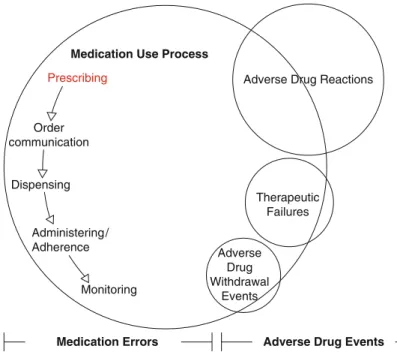
Inappropriate Medication Use and Medication Errors
in the Elderly. . . 43 Zachary A. Marcum and Joseph T. Hanlon
Special Aspects with Respect to Organ Systems Based on Geriatric Clinical Importance
Arterial Hypertension. . . 53 Martin Wehling
Heart Failure. . . 69 Martin Wehling and Robert Lee Page 2nd
Coronary Heart Disease and Stroke. . . 85 Martin Wehling
Atrial Fibrillation. . . 105 Martin Wehling
Diabetes Mellitus. . . 119 Heinrich Burkhardt
ix
Obstructive Lung Diseases. . . 135 Martin Wehling
Osteoporosis. . . 143 Martin Wehling
Parkinson’s Disease. . . 151 Heinrich Burkhardt
Therapy of Chronic Pain. . . 161 Heinrich Burkhardt
Dementia. . . 179 Stefan Schwarz and Lutz Fr€olich
Depression. . . 197 Stefan Schwarz and Lutz Fr€olich
Sleep Disorders. . . 215 Stefan Schwarz and Lutz Fr€olich
Treatment Decisions and Medical Treatment of Cancer
in Elderly Patients. . . 229 Ulrich Wedding and Stuart M. Lichtman
Pharmacotherapy and Geriatric Syndromes
Fall Risk and Pharmacotherapy. . . 251 Heinrich Burkhardt
Central Nervous System (CNS) Medications and Delirium. . . 259 Donna M. Fick
Pharmacotherapy and Special Aspects of Cognitive Disorders
in the Elderly. . . 279 Heinrich Burkhardt
Pharmacotherapy and Incontinence. . . 285 Heinrich Burkhardt and John Mark Ruscin
Immobility and Pharmacotherapy. . . 295 Heinrich Burkhardt
Pharmacotherapy and the Frailty Syndrome. . . 303 Heinrich Burkhardt
Further Problem Areas in Gerontopharmacotherapy and Pragmatic Recommendations
Adherence to Pharmacotherapy in the Elderly. . . 313 Heinrich Burkhardt
Polypharmacy. . . 319 Heinrich Burkhardt
Inappropriate Prescribing in the Hospitalized Elderly Patient. . . . 331 Robert Lee Page 2nd and John Mark Ruscin
Index. . . 341
About the Editor
Martin Wehlingis full professor of clinical pharmacology at the Uni- versity of Heidelberg. He is also an internist (cardiologist) and has long-standing experiences in basic science (cell physiology, steroid pharmacology, nongenomic steroid actions); clinical trials (translating basic science into human studies);
and clinical medicine (invasive cardiology, endocrinology, geria- trics). In 2004, he was appointed by AstraZeneca as director of dis- covery (¼ translational) medicine.
In 2007, he returned to his academic
position. In 2000, he founded the Center of Gerontopharmacology (together with the head of the department of geriatric medicine, R. Gladisch), which supports the development of drug therapy in the elderly both scientifically and in daily practice. He has the only outpatient service for gerontopharma- cology in Germany.
Potential Conflicts of Interest of the Editor
Martin Wehling was employed by AstraZeneca R&D, M€olndal, as director of discovery medicine (¼translational medicine) from 2004 to 2006 while on sabbatical leave from his professorship at the University of Heidelberg. After return to this position in January 2007, he received lecturing and consulting fees from Sanofi-Aventis, Novartis, Takeda, Roche, Pfizer, Bristol-Myers, Daichii-Sankyo, Lilly, and Novo-Nordisk.
xiii
List of Contributors
Martin Wehling Medical Faculty Mannheim, University of Heidelberg, Mannheim, Germany
Heinrich Burkhardt IV. Medical Clinic, Geriatrics, University Clinics Mannheim, Mannheim, Germany
Donna M. Fick School of Nursing, Pennsylvania State University, University Park, PA, USA
Lutz Fr€olich Central Institute for Mental Health J 5, Mannheim, Germany
Joseph T. Hanlon University of Pittsburgh, Division of Geriatric Medicine, Pittsburgh, PA, USA
Stuart M. Lichtman 65+ Clinical Geriatric Program, Memorial Sloan-Kettering Cancer Center, Commack, NY, USA
Zachary A. Marcum University of Pittsburgh, Division of Geriatric Medicine, Pittsburgh, PA
Robert Lee Page 2nd School of Pharmacy, University of Colorado, Aurora, CO, USA
John Mark Ruscin Department of Internal Medicine, SIU School of Medicine, Springfield, IL, USA
Stefan Schwarz Central Institute for Mental Health J 5, Mannheim, Germany
Ulrich Wedding Division of Palliative Care, University Clinics Jena, Clinic for Internal Medicine II, Jena, Germany
xv
General Aspects
of Older Patients
Heinrich Burkhardt
Pharmacotherapy Between
Individualization and Standardization
Modern pharmacotherapy has to meet high-quality standards for the optimized treatment of every patient. On the one hand, standardization is indis- pensable for the determination of stable dosages and effect prediction and hereby is one of the major prerequisites for prescription safety and treatment efficacy. On the other hand, individuali- zation of pharmacotherapy is mandatory because both patient-related and environmental factors lead to a wide variability of clinical phenotypes with critical relevance to drug treatment. Despite all standardization procedures and recommendations, pharmacotherapy is still characterized best as an individual experiment in daily practice; factors influencing the therapeutic response are never entirely known a priori, and the effect size cannot be securely calculated in advance. To minimize risks and maximize benefits, a careful estimation process for the risk-benefit ratio should take place at the beginning of every pharmacotherapeutic intervention. Today, information concerning the potential, and thus expected benefit, of a drug relies mainly on clinical studies in accordance with the principles of “evidence-based medicine” (EBM).
Randomized controlled trials (RCTs) represent the data source with the highest quality, and general validity is claimed for results derived from such studies. However, significant limitations of RCTs are often overlooked; RCTs are preferably per- formed in populations that are artificially homoge- neous by virtue of narrow inclusion and wide exclusion criteria. They thus do not actually repre- sent the entire population with a given disease but may even only be typical for a minority of patients within this population. This strict patient selection mainly reflects methodological considerations and limitations in that clear drug effects may become diluted by confounders such as concomitant diseases or relevant conditions (e.g., kidney impairment). As the selected study population does not represent all patients with the disease, results should not be automatically generalized to the treatment of all patients with a given disease.
Serious concerns about the so-called external valid- ity of trial data should be triggered when important subgroups are severely underrepresented, as is still true for most trials almost systematically excluding the elderly (Bugeja et al.1997; Lee et al. 2001;
Dodd et al.2011; Witham and McMurdo2007).
Evidence-derived recommendations on phar- macotherapy should never be rigorously applied without assessing a patient’s individual clinical situation; a “cookbook-medicine”-type approach is strictly discouraged in the elderly. Modern phar- macotherapy has to be based on a compreh- ensive and differential process considering both standardized recommendations and individual arguments from the clinical situation to H. Burkhardt (*)
IVth Department of Medicine, Geriatrics, University Medical Centre Mannheim, Theodor-Kutzer-Ufer 1-3, Mannheim 68167, Germany
e-mail: [email protected]
M. Wehling (ed.),Drug Therapy for the Elderly,
DOI 10.1007/978-3-7091-0912-0_1,#Springer-Verlag Wien 2013
3
eventually deviate from recommendations or guidelines.
A differential pharmacotherapy in the elderly has to be based on clear and applicable arguments to realize a comprehensive individ- ualization of the therapeutic approach.
In this context, the chronological age is cer- tainly an insufficient argument, although still widely used. Rather than using the chronological age, clinical parameters like multimorbidity or frailty have been proposed to better describe the relevant biological vulnerability; these para- meters meet the following demands:
– Sufficiently operationalized and applicable in the clinical setting
– Suitable to identify more vulnerable sub- groups who are theoretically more likely to show a deviant risk-benefit ratio
Hereby, a reproducible input on comprehen- sive decision processes may be documented and discussed, thereby improving the transparency of individualized treatment decisions.
However, it should be discussed beforehand whether all elderly patients should be regarded as a special population in total for which particular issues and routines should be developed and applied, whether this is reasonable only for cer- tain subgroups among the elderly, or finally, whether both options apply to this population.
To answer this, the following points need to be addressed:
– How significant is the heterogeneity in the elderly in this context?
– How is this heterogeneity described?
– Which clinical consequences result from this heterogeneity?
Important Aspects of Differential Pharmacotherapy in the Elderly
From a clinical point of view, there is no doubt that elderly form a heterogeneous group com- pared with the relatively homogeneous groups of younger adults or adolescents. The heterogeneity of the elderly reflects both life-related and physio- logical aspects. Obviously, this not only results from genetic factors but also is mainly caused by
accumulated risks and incidents during a long personal history. These influences reduce the physiological and psychological resources in a wide range of individual variation, so that some elderly stay fit or resilient and others become frail or vulnerable. Therefore, the remaining personal resources are central players in a concept to describe the age-related heterogeneity. Two major aspects are often stated to be important in this context that may describe this heterogeneity range in a practical way: multimorbidity and functionality. However, conceptual shortcomings still exist for both aspects (see the following discussion). Moreover, the features of heterog- eneity are not static, and dynamic developments, including both improvement (recovering or com- pensation) and worsening (acceleration of impairment), may complicate the picture (Bengt- son and Schaie1999).
In this theoretical framework, two different approaches toward a differential pharmaco- therapy in the elderly may be described. The first approach (“pharmacological approach”) emphasizes age-related alterations of pharmaco- logical aspects like pharmacokinetics and phar- macodynamics. The second approach is more clinically or geriatric oriented (“geriatric approach”) and reflects changes in the risk- benefit ratio caused by impaired resources and increased and special geriatric risks and barriers.
Both approaches may help to identify more vul- nerable elderly patients for whom evidence for a defined pharmacotherapeutic approach may not simply be extrapolated from evidence obtained in younger adults.
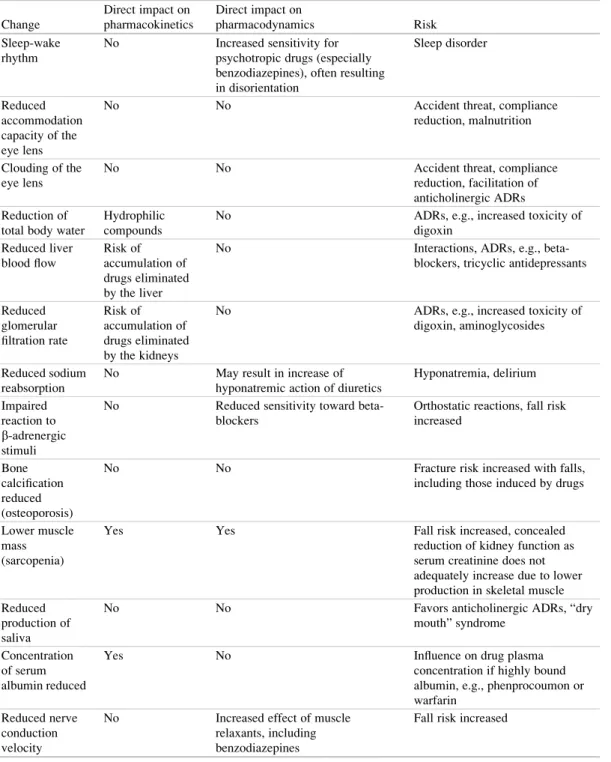
Age-associated changes in pharmacokinetics and pharmacodynamics are generally outlined in chapter “Age-Associated General Pharmaco- logical Aspects” and discussed for disease- related medication schemes in greater detail in part “Special Aspects with Respect to Organ Systems Based on Geriatric Clinical Impor- tance.” It has to be kept in mind that most of these changes are described as median changes for the entire elderly population, and a given patient may widely deviate from these medians.
Therefore, the pattern of age-related changes and their significance for pharmacotherapy
have to be examined and evaluated in every individual patient. Only by this can the individual risks and benefits of drug therapy be assessed.
Nevertheless, median changes or risks found at a high prevalence in the elderly may support gener- alization and may render certain drugs as being critical or even inappropriate for the elderly.
Such evaluations are the basis for labeling defined drugs according to the FORTA (Fit for the Aged) criteria (see chapter “Critical Extrapo- lation of Guidelines and Study Results: Risk- Benefit Assessment for Patients with Reduced Life Expectancy and a New Classification of Drugs According to Their Fitness for the Aged”).
Age-related alterations are highly interactive and form a complex framework of interdepen- dencies that determines the success of pharma- cotherapy in the end (Fig. 1). Adverse drug reactions (ADRs), for example, may be deter- mined by both changes in the patient’s resources and changes in pharmacokinetics. Changes in an organ system (e.g., skeletal muscles) may influ- ence both the patient’s resources (locomotion, postural stability) and pharmacokinetic aspects (misinterpretation of creatinine values in the
“normal” range).
The individual evaluation of the risk-benefit ratio prior to prescription not only allows for choosing and dosing a drug properly, but also critically defines subgroups of elderly at special risk or increased vulnerability. The most impor- tant factors involved in this regard are the fol- lowing:
– Occurrence of age-specific ADRs (falls and delirium)
– Multimorbidity and polypharmacy – Frailty
– Functional limitations – Reduced life expectancy.
Adverse Drug Reactions
In general, the elderly are more likely to experi- ence ADRs than younger adults and represent a particularly vulnerable population in this respect (Calis and Young 2001). Among the large number of ADRs are those that frequently occur in the elderly and are clinically much more seri- ous than in younger adults. These are mainly falls and the confusional state. Both are discussed in more detail in chapters “Fall Risk and Inadequate ADR
medication
Non- response
Multimorbidity polypharmacy Pharmaco-
kinetics
Pharmaco- dynamics
Self- management,
adherence
Homeostasis resources Functional
limitations Altered
Physiology Fig. 1 Framework of
interacting contributors determining efficacy and safety of pharmacotherapy in the elderly.ADRadverse drug reaction
Pharmacotherapy” and “Central Nervous System (CNS) Medications and Delirium.” An increased risk for these particular ADRs associated with a particular drug may qualify this compound as inappropriate for the elderly.
Multimorbidity
Multimorbidity is typical for a significant share of the elderly population and as such is often seen as a marker of an increased ADR vulnerability as it is closely associated with polypharmacy. Poly- pharmacy is a frequent and critical issue in the elderly and represents a major challenge for opti- mized pharmacotherapy in the chronically ill elderly patient (see chapter “Polypharmacy” for more detail). There is no exact consented crite- rion for polypharmacy, although it is frequently defined by the simultaneous application of five and more drugs.
The simultaneous long-term prescription of five and more drugs is considered critical and often termed polypharmacy (McElnay and McCallion1998).
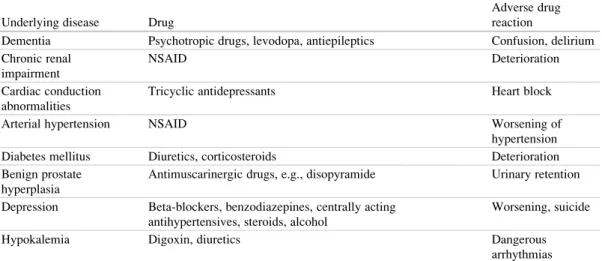
In polypharmacy situations, possible drug interactions may no longer be calculable as they exponentially increase with medication numbers, as does the risk of ADRs. Unintended and ill- indicated prescribing cascades may be estab- lished to cope with avoidable ADRs, resulting in unfavorable risk-benefit ratios.
The definition of multimorbidity does not include age-associated changes in physiology and organ function (e.g., renal impairment), which also need to be considered for tailored, individualized drug therapies. It should be men- tioned that multimorbidity may not always result in impaired functionality, although the term would suggest severe functional impairments as well. Furthermore, different patterns of multi- morbidity (variation of concomitant diseases) may be the key for an understanding of treatment strategies and the therapeutic burden. In conclu- sion, multimorbidity varies substantially and is not well described and assessed just by the counting of diagnoses.
Frailty
The frailty syndrome has been defined as the age- associated decline of functionality in close rela- tion to the aging phenotype and to the dynamics of aging processes that alter physiological responses (Fried et al.2001). The phenotype of aging clearly associates with vulnerability and integrates signif- icant physiologic aspects. The latter provide a theoretical and clinical basis of frailty. The main features of this syndrome are
– Reduced muscle mass
– Neurological or cognitive deficits
– Changes in energy metabolism (malnutrition) The frailty syndrome is described in detail in chapter “Pharmacotherapy and the Frailty Syn- drome” and is also discussed in the context of pharmacotherapy. Furthermore, frailty is a major aspect for the evaluation according to the FORTA criteria in part “Special Aspects with Respect to Organ Systems Based on Geriatric Clinical Impor- tance.” Recent developments clearly point to an increased future significance of the frailty syn- drome and the frailty concept for the identifica- tion of the vulnerable elderly.
Functionality and the Concept of Activities of Daily Living
From a geriatric point of view, functionality and everyday competence are key issues for the strat- ification of the heterogeneous elderly population regarding the expected vulnerability. Functionality may allow for the direct description of barriers and impairment. The evaluation and quantification of basic and instrumental functionality follows the framework of daily activities (activities of daily living [ADLs] and instrumental activities of daily living [IADLs]; Table 1). These activities are translated into sum scores; one of the most prom- inent scores is the Barthel Index (Mahoney and Barthel1965), which has been widely used over long periods of time. When handling such scores, their limitations and shortcomings have to be kept in mind. First, special barriers and impair- ments may not be well described as scores in
general are simplifying integrations of various domains and abilities.Second, scaling problems like ceiling and bottom effects may exist, and phy- sicians and other users may not be aware of those limitations. For example, management of medica- tion is an item of the IADL score, but a low score in this test does not necessarily indicate an impaired self-management of medication. Thus, it is still controversial how to identify vulnerable elderly best—by integral scores or the particular score items. The special items describing functional cap- abilities of importance for the self-management of pharmacotherapy are
– Reduced visual acuity – Reduced dexterity – Reduced cognition
For these functions, good predictability of future problems in the self-management of med- ication could be shown (Nikolaus et al.1996). A simple and easily applicable method checking all three items simultaneously is the “timed test of money counting” (Nikolaus et al.1995).
Reduced Life Expectancy
Another aspect important for the stratification with impact on differential pharmacotherapy is reduced life expectancy. Preventive pharmacotherapeutic strategies are clearly limited in their value if the horizon of the preventive effect is expected to exceed the remaining life expectancy. Some cate- gories in which this may be regularly found are described by the following scenarios:
– Severe and advanced diseases (e.g., cardiac failure stage IV according to the New York Heart Association [NYHA])
– When palliative approaches are the leading therapeutic principles
– In the oldest old (80+ years; note that there is no generally accepted definition concerning this term, but 80 years and over is most fre- quently used)
Like all therapeutic strategies, pharmacother- apeutic schedules have to be reconsidered near the end of life as a true benefit for the patient may then be absent (“end-of-life debate”). Rather than automatically carrying on medication schedules, an early and repeated reassessment and discus- sion of the patient’s individual wishes and needs should be sought. To guide this interactive pro- cess, criteria such as those proposed by Gillick may be helpful (1994).
Geriatric Syndromes
In many cases, the health status of the elderly is not sufficiently described if solely based on organ-oriented diagnoses as given in theInterna- tional Classification of Diseases(ICD) manual.
In addition, it is in the interest of the patient to consider and appropriately describe his or her functional status beforehand. This primarily func- tionality based assessment of the health status in the elderly frequently uncovers complex morbidity conditions not sufficiently described by organ- based diagnoses. These conditions are calledgeri- atric syndromes and may represent both a Table 1 The ADL/IADL framework of activities of daily living
ADLs (activities of daily living) IADL (instrumental activities of daily living)
Feeding Use of telephone
Grooming Shopping
Bathing Food preparation
Dressing Housekeeping activities
Use of toilet Ability to handle laundry
Fecal continence Mode of transportation
Urinary continence Self-management of medication
Transfer from bed to chair Ability to handle finances
Walking Climbing stairs
significant contribution to the morbidity burden and of paramount importance for the treatment and intervention modalities in the elderly. Typi- cally, these syndromes are caused by multiple factors and require a multidimensional therapeu- tic approach. However, even among geriatricians there is no clear consent about the systematics of geriatric syndromes; therefore, it is not surprising that these syndromes are not well represented in theICDmanual. According to Horan (1998), the geriatric syndromes that are most important and with the most consented are
– Immobility – Falls – Incontinence
– Cognitive decline and delirium.
These four are the classical geriatric syn- dromes, also termed the “geriatric giants.” How- ever, other, more symptom-oriented health problems are debated as well in this context (Inouye et al.2007); some authors add the fol- lowing syndromes to the list of geriatric syn- dromes:
– Iatrogenic health-related problems (e.g., ADRs)
– Depression – Malnutrition
– Fluid and electrolyte imbalance.
The last four items are not discussed in this chapter in greater detail. ADRs are discussed for the major diseases in part “Special Aspects with Respect to Organ Systems Based on Geriatric Clinical Importance,” and depression is dis- cussed in chapter “Depression.” Malnutrition and fluid-electrolyte imbalances are mentioned here to complete the list, but are not discussed in greater detail in this publication.
Focusing on the four accepted geriatric syn- dromes, part “Pharmacotherapy and Geriatric Syndromes” particularly considers their interre- lation with pharmacotherapy. Three questions guide this discussion:
1. How does a pharmacotherapeutic strategy have an impact on the occurrence of a geriatric syndrome?
2. Are there pharmacotherapeutic approaches to treat a geriatric syndrome?
3. Does a geriatric syndrome contribute to the prediction of the success of pharmacotherapy in that it supports the identification of vulner- able patients?
In general, the therapeutic approach to geriatric syndromes may integrate pharmacotherapy as part of a multimodal strategy also comprising nonphar- macotherapeutic measures such as physiotherapy, occupational therapy, neuropsychological treat- ment, education, and others.
Evaluation of Different Approaches to Describe Heterogeneity
and Vulnerability in the Elderly
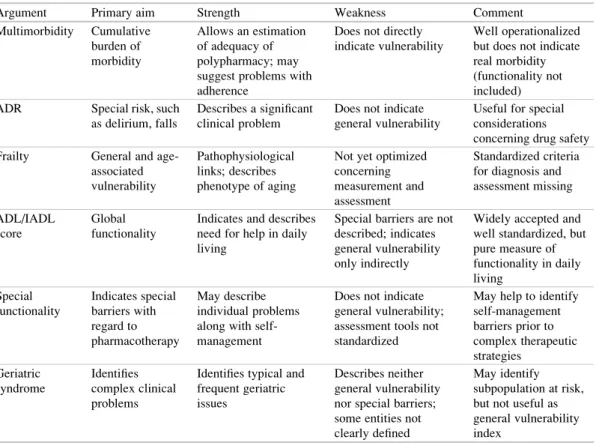
The concepts mentioned allow an identification and description of the more vulnerable elderly at special risk. They also determine a differential pharmacotherapeutic approach reflecting essen- tial patient-related aspects. These aspects are – General vulnerability (frailty, impaired ADLs,
geriatric syndromes) (Fig.2)
– Barriers impeding successful self-management (special functional limitations)
Table 2 summarizes these aspects and com- ments on strengths and weaknesses.
Fig. 2 Vulnerability as identified by different geriatric concepts.ADLactivities of daily living,IADLinstrumental activities of daily living
References
Bengtson VL, Schaie KW (eds) (1999) Handbook of theories of aging. Springer, Berlin
Bugeja G, Kumar A, Banerjee AK (1997) Exclusion of elderly people from clinical research: a descriptive study of published reports. BMJ 315:1059
Calis KA, Young LR (2001) Clinical analysis of adverse drug reactions. In: Atkinson AJ, Daniels CE, Dedrick RL, Grudzinskas CV, Markey SP (eds) Principles of clinical pharmacology. Academic, San Diego, pp 319–332
Dodd KS, Saczynski JS, Zhao Y, Goldberg RJ, Gurwitz JH (2011) Exclusion of older adults and women from recent trials of acute coronary syndromes. J Am Ger- iatr Soc 59:506–511
Fried LP, Tangen CM, Walston J, Cardiovascular Health Study Collaborative Research Group et al (2001) Frailty in older adults: evidence for a phenotype.
J Gerontol A Biol Sci Med Sci 56:M146–M156 Gillick M (1994) Choosing medical care in old age: what
kind, how much, when to stop. Harvard University Press, Cambridge
Horan MA (1998) Presentation of disease in old age.
In: Tallis R, Fillit H, Brocklehurst JC (eds) Brockle-
hurst’s textbook of geriatric medicine and gerontol- ogy. Livingstone, Edinburgh, pp 201–206
Inouye SK, Studenski S, Tinetti ME, Kuchel GA (2007) Geriatric syndromes: clinical, research, and policy implications of a core geriatric concept. J Am Geriatr Soc 55:780–791
Lee PY, Alexander KP, Hammill BG, Pasquali SK, Peter- son ED (2001) Representation of elderly persons and women in published randomized trials of acute coro- nary syndromes. JAMA 286:708–713
Mahoney FI, Barthel DW (1965) Functional evaluation.
The Barthel index. Maryland State Med J 14:61–65 McElnay JC, McCallion CR (1998) Adherence and the
elderly. In: Myers LB, Midence K (eds) Adherence to treatment in medical conditions. Harwood Academic, Amsterdam, pp 223–253
Nikolaus T, Bach M, Specht-Leible N, Oster P, Schlierf G (1995) The timed test of money counting: a short physical performance test for manual dexterity and cognitive capacity. Age Aging 24:257–258
Nikolaus T, Kruse W, Bach M, Specht-Leible N, Oster P, Schlierf G (1996) Elderly patients’ problems with medication. An inhospital and follow-up study. Eur J Clin Pharmacol 49:255–259
Witham MD, McMurdo ME (2007) How to get older people included in clinical studies. Drugs Aging 24:187–196
Table 2 Arguments determining and modifying a differential pharmacotherapeutic schedule in the elderly
Argument Primary aim Strength Weakness Comment
Multimorbidity Cumulative burden of morbidity
Allows an estimation of adequacy of polypharmacy; may suggest problems with adherence
Does not directly indicate vulnerability
Well operationalized but does not indicate real morbidity (functionality not included) ADR Special risk, such
as delirium, falls
Describes a significant clinical problem
Does not indicate general vulnerability
Useful for special considerations concerning drug safety Frailty General and age-
associated vulnerability
Pathophysiological links; describes phenotype of aging
Not yet optimized concerning measurement and assessment
Standardized criteria for diagnosis and assessment missing ADL/IADL
score
Global functionality
Indicates and describes need for help in daily living
Special barriers are not described; indicates general vulnerability only indirectly
Widely accepted and well standardized, but pure measure of functionality in daily living
Special functionality
Indicates special barriers with regard to pharmacotherapy
May describe individual problems along with self- management
Does not indicate general vulnerability;
assessment tools not standardized
May help to identify self-management barriers prior to complex therapeutic strategies
Geriatric syndrome
Identifies complex clinical problems
Identifies typical and frequent geriatric issues
Describes neither general vulnerability nor special barriers;
some entities not clearly defined
May identify subpopulation at risk, but not useful as general vulnerability index
ADRadverse drug reaction,ADLactivity of daily living,IADLinstrumental activity of daily living.
Epidemiologic Aspects
Heinrich Burkhardt
Definition of the Elderly
A common definition (World Health Organiza- tion 2011) describes elderly individuals as per- sons aged 65 and over. A previous definition given by the WHO even defined persons only 60 or more years old as elderly, but this cutoff is not generally accepted. In this context, it is necessary to discuss the definition of age. The definition of an calendarian cutoff for defined age groups merely depends on social consensus and not primarily on physiological changes that may occur even years before. Age-associated physio- logical changes in the endocrine system or in lens elasticity may start much earlier even in healthy subjects: between age 40 and age 45 for the endocrine system and during puberty for lens elasticity. A reliable and valid threshold value for significant changes in physiology cannot be calculated and applied due to a great variety of interindividual aging patterns and courses.
Within the large group of elderly individuals, persons at age 80 years and older may form a special subgroup presenting with increased prev- alence rates of typical geriatric problems; for that reason, they may be defined as belonging to a separate age group—some call them the fourth
age. Octogenarians (more so even older people) show a significant decline in key functionalities such as locomotion, continence, and cognition;
therefore, functionality and impairment are a major topic when considering health-related aspects of high age.
Methodological Aspects
Epidemiologic data comprise a variety of data sources. Global trends mainly rely on national census data and international data platforms such as U.N. organizations or the WHO. For many countries, such data provide reliable information on the age distribution of the population, life expectancies, and regional and global trends for defined age groups.
Functionality and impairment data or descrip- tions of special barriers are often not sufficiently represented in census data; health insurance orga- nizations or population-based large scale cohort studies may provide more sophisticated data sets. Remarkable regional differences due to the heterogeneity of health care systems and epidemi- ologic approaches need to be considered. There- fore, an international comparison of prevalence data has to utilize global surveys such as those by the WHO. The WHO provides data retrieved by the World Health Survey, which include entries on the prevalence of functional limitations among the elderly population in different countries. Unfortunately, not all countries are par- ticipating in this survey for a variety of reasons, H. Burkhardt (*)
IVth Department of Medicine, Geriatrics, University Medical Centre Mannheim, Theodor-Kutzer-Ufer 1-3, 68167 Mannheim, Germany
e-mail: [email protected]
M. Wehling (ed.),Drug Therapy for the Elderly,
DOI 10.1007/978-3-7091-0912-0_2,#Springer-Verlag Wien 2013
11
and not all standardized questions are suitable for all regions, rendering a global comparison diffi- cult to impossible. There is no global consensus how to measure functionality best, and frame- works developed in the United States and Euro- pean countries will not fit situations in developing countries despite their wide acceptance in the scientific literature. This may also explain the paucity of regional data published from countries outside Europe and the United States.
Identifying data on general prescription rates of drugs in the elderly is even more challenging.
In most countries, systematic drug surveys are lacking, and prescription rates can only be esti- mated from general consumption rates or total redeemed prescriptions, but the information is usually not stratified for defined age groups or individual diseases. Therefore, data on polyphar- macy are often lacking or ambiguous. In some countries, national health surveys comprise medi- cation data; however, these data are not published in an appropriate way to allow for calculation of prescription rates in the entire elderly population and are mostly restricted to subpopulations with defined diseases or health problems. For that rea- son, a global comparison of polypharmacy preva- lence and prescription rates is even more challenging. Obviously, in developing countries access to pharmacotherapy is restricted due to financial and infrastructural limitations and a global and transcultural comparison of drug pre- scription patterns cannot be made with certainty.
Finally, local and regional drug availability may be variable due to differences in licensing and adds to the complexity of drug analysis. Coding and grouping different drugs may also widely vary across different regions even if countries may be comparable for demographic, political, and socio- cultural aspects.
In the European context, the Berlin Aging Study (BASE) appears as the most thorough population-based analysis concerning drug pre- scription in the elderly (Baltes and Mayer2001).
The BASE investigators not only performed a detailed analysis of prescription rates but also analyzed over-the-counter (OTC) drugs and evaluated appropriateness of individual prescrip- tions by reevaluating the individual disease pat-
terns. Moreover, symptoms possibly associated with adverse drug reactions (ADR) were ana- lyzed for each subject.
General Aspects
In Western countries and some developing countries (e.g., Brazil), the proportion of elderly in the population steadily increased over the past decades and the age group of people 80 years and older may even represent the most rapidly expanding subpopulation (e.g., Germany). Simul- taneously, life expectancy of younger and middle- aged people is also increasing. Table1summarizes recent data from U.N. calculations and estimations.
Although the current life expectancy at birth still differs markedly between the United States and a typical European country on the one hand and Brazil and India on the other, it is noteworthy that life expectancy of 65- or 80-year-old persons becomes similar for these countries.
As mentioned, a global perspective concerning drug prescription rates is rather complex and arbi- trary. In Europe, prescription analysis consistently showed that most drugs are clearly prescribed to the elderly. In Germany, for example, a thorough analysis utilizing health insurance data found 64%
of all drugs were prescribed to patients 60 years and older (Schwabe and Paffrath 2008). Also, individual prescription rates are increasing with advanced age and do not plateau up to age 80 and over. Table 2 summarizes prescription rates for different countries, with information retrieved from population-based studies. These studies are missing for India, and hospital-based data had to be given instead for comparison. Table3pro- vides data on functionality, multimorbidity, and polypharmacy. Polypharmacy and multimorbidity prevalences are found to range from 12% to 25%
of the elderly.
Functionality, Frailty, and Multimorbidity
Functionality is a significant constituent of well- being and an essential prerequisite for activities
and participation of the individual. The WHO acknowledges this in its framework of health and disease; functionality is addressed in a sepa- rate diagnostic manual that tries to assess this complex issue, the ICF (International Classifica- tion of Functioning, Disability and Health; WHO 2001). However, this framework is rather com- plicated; in daily practice and geriatrics, func- tionality as defined by self-competence in ADLs (activities of daily living) is assessed according to the ADL/IADL (instrumental activ- ities of daily living) framework. Although rather simple, this framework is still not globally imple- mented in health surveys. Therefore, population- based data given in Table3concern several items and countries. As a common problem with the description and evaluation of complex concepts like functionality, data aggregation into a general index may mask individual and yet significant differences (Gupta2008). Nevertheless, the gen- eral ADL index is widely applied to describe the level of general functionality in the elderly
(Stone et al.1994; Sato et al.2002). This index has limitations regarding the decision of whether self-management of pharmacotherapy still is fea- sible. For example, an individual with an ADL index of 70 of 100 points may still be able to manage medications properly as functional lim- itations are restricted to locomotion, but another patient with the same score may not be capable if the ADL limitation is mainly based on forgetful- ness and low visual acuity.
Vulnerability of older persons is described not only by functional limitations or multimorbidity but also by the presence of the frailty syndrome as described in chapter “Pharmacotherapy and the Frailty Syndrome” in more detail. As the defini- tion of the frailty syndrome by Fried’s criteria (Fried et al. 2001) was published only in the early 2000s, the different aspects of this syn- drome, like hand-grip strength or walking speed, are usually not assessed in population-based surveys dating further back, especially not outside Western countries. Nevertheless, to give some Table 1 General demographic data
United
States Brazil India Germany
Persons 65 and over (percentage of all, estimation 2010)aexpected 2020 data
40.5 Mio 13.7 Mio 60.3 Mio 16.8 Mio
(13.0%) (7.0%) (4.9%) (20.4%)
54.7 Mio 20.3 Mio 87.5 Mio 18.6 Mio
(16.2%) (9.5%) (6.2%) (23.3%)
Persons 80 and over (percentage of all, estimation 2010)aexpected 2020 data
11.8 Mio 2.9 Mio 8.2 Mio 4.2 Mio
(3.8%) (1.5%) (0.7%) (5.1%)
13.0 Mio 4.4 Mio 12.6 Mio 6.0 Mio
(3.9%) (2.1%) (0.9%) (7.5%)
Current life expectancy at birthb Women:
81.1 years
Women:
82,1 years
Women:
64.2 years
Women:
18 years Men:
76.2 years
Men:
70,7 years
Men:
64.4 years
Men:
78.2 years Current remaining life expectancy of 65-year-oldsb Women:
20 years
Women:
18 years
Women:
15 years
Women:
20 years Men:
16 years
Men:
16 years
Men:
14 years
Men:
16 years Current remaining life expectancy of 80-year-oldsb Women:
10 years
Women:
10 years
Women:
7 years
Women:
9 years Men:
8 years
Men:
9 years
Men:
7 years
Men:
7 years Mio:million
aCurrent data retrieved from the U.N. population estimation database for the year 2010, and the expected data for 2020 under constant fertility scenario given initalics(UNPD World Population Prospects 2006)
bCurrent estimation of the United Nations (UNPD World Population Prospects 2006; 2010–2015 constant fertility scenario for life expectancy at birth, 2000–2005 for life expectancy at given age); data from United Nations (2011)
impressions about the prevalence in the older population data from a population-based longitu- dinal study in the United States, the Cardiovascu- lar Health Study may be cited. In this study, over 5,000 subjects older than 65 years were included.
Based on body impedance analysis, prevalence data for the presence of sarcopenia could be retrieved (Janssen et al. 2004). These data revealed that 70.7% of men and 41.9% of women disclosed moderate sarcopenia, which was even severe in 17.2 % of men and 10.7% of women. In another population-based cohort (the New Mexico Elder Health Survey), the DXA (dual energy x-ray absorptiometry) method was applied to detect sarcopenia. Although the meth- odology differed from that used in the former cohort, prevalence rates for sarcopenia increased with advanced age from 13% to 24% in subjects aged below 70 to over 50% in octogenarians and older (Baumgartner et al.1998). Applying the Fried criteria, the prevalence of the frailty syndrome was found between 15.5% and 31.3% in persons aged 85 years and over in the Cardiovascular Health
Study cohort. Some subgroups of elderly may dis- close even higher prevalence rates. Purser et al.
(2006) published 27% prevalence rates for frailty in a group of inpatients 70 years and older with coronary heart disease if assessed by Fried’s criteria and exceeding 60% when the presence of any ADL impairment was taken as a criterion.
In Lawton and Brody’s score of significant IADLs, “medication management” is listed among a total of eight items (Lawton and Brody 1969). This activity may be subdivided further:
– Recognizing the medication – Correct dosing
– Managing the handling of the medication package with respect to dosing aid
Several studies clearly disclosed that elderly patients frequently fail to manage the handling of medication packages and correct dosing correctly (Atkin et al.1994).
In another study by Nikolaus et al. (1996), 143 elderly patients without signs of cognitive decline were thoroughly analyzed concerning their ability to manage standard medication Table 2 Drug prescription in elderly
Drugs United States (%) Brazil (%) India (%)a Germany (%)
Antihypertensives 8.9b 11.3c
Digoxin 9d 31.0c
b-blockers 7d 3.8b 5.5c
ACE inhibitors 7d 12.6e 25.2f 5.3c
Ca antagonists 8d 7.3e 28.3f 22.8c
Oral antidiabetics 3d 6.2e 11.4c
Analgesics 16d, g 3.6b
NSAIDs 10d 4.3b 33.8c
Diuretics 20d 6.4–14.7b, e 28.3f 30.4c
Antipsychotics 3.9e 4.4c
Antidepressants 1d 3.3c
Corticosteroids
Lipid-lowering drugs 15d 2.4e 26.9f 7.5c
Anticoagulants 8d
Benzodiazepines 2%d 12.4c, h
NSAIDsnonsteroidal anti-inflammatory drugs
aNo population-based survey in India concerning this topic; hospital data are given instead
bPopulation-based survey in an urban region in Brazil (Filhoa et al.2004)
cData from Berlin Aging Study (BASE), a population-based survey done between 1990 and 1993 among people 70 years and older people in an urban setting (Baltes and Mayer2001)
dPopulation-based survey in the United States including over-the-counter drugs in elderly persons 65 years and older (Kaufman et al.2002)
ePopulation-based survey in a defined region in Brazil among individuals 60 years and older (de Loyola Filho et al.
2006)
fA multicenter hospital survey in India done in 2008 and 2009 (Harugeri et al.2010)
gIn this survey, acetaminophen
hLabeled in the survey as hypnotics
Functional domain United States (%) Brazil (%) India (%) Germany (%) Locomotion
Unable to use public transportation 31.2a
Unable to take a walk 20.3–30.9b 6.2c 5.6–8.4d 10.6a
Unable to climb stairs 7.0–5.7b 11.4a
Unable to perform bed-chair transfer 1.3–1.7d 2.7a
Uses walking aid 10.9–12.9b 20.9a
Bound to wheelchair 3.1a
Postural stability impaired 18.7–66.0e 44.2a
Difficulty moving aroundf 44.7–63.6g 71.9–84.6g 52.3–75.0g
Self-care
Unable to take shower/bath 2.0c 16.0a
Unable to go shoppingh 33.7a
Difficulty in household activitiesf 54.6–63.8g 78.3–85.1g
Needs help in clothingh 8.2–7.5b 5.9a
Needs help in groomingh 5.9–7.2b 1.3a
Difficulty in self-caref 16.2–39.5g 56.0–76.5g 18.8–45.8g
Needs help to use the toileth 3.2a
Needs help in eatingh 4.3–5.2b 4.5c 0.9a
Sensorium
Uses visual aid 95.6a
Visual impairment 8.8–19.2i 25.3–27.5j 26.6a
Difficulty with seeingf 34.0–59.7g 66.6–61.4g 25.5–37.5g
Uses hearing aid 15.5a
Hearing impaired 15.4–19.5j 18.6a
Cognition
Impaired cognition 2.7–27.4k 14.9l 9.8–11.0j 14.0a
Difficulty with rememberingf 58.7–86.0g 70.2–80.3g 29.3–56.2g
Polypharmacy/multimorbidity
Unable to manage medicationh 2.6–14.8m
Five or more diagnoses 5.9j,n 28.0a
Five or more drugs prescribed 12.0–16.0o 25.2p,q 37.5a
aData from Berlin Aging Study (BASE), a population based survey done between 1990 and 1993 among people 70 years or older in an urban setting (Baltes and Mayer2001)
bData from National Health and Nutrition Examination Survey (NHANES) III, a population-based survey in the United States, 1988–1994; data given as men-women (Ostchega et al.2000)
cData from population-based survey in Brazil. Pesquisa Nacional por Amostra de Domicı´lios (PNAD) 1998 (Lima- Costa et al.2003)
dPopulation survey in India, NSS 60th Round Unit level data 2004; data differ between urban and rural regions (Prasad2011)
eSame source as note b; data stratified to age and gender (Ostchega et al.2000)
fItem used to qualify functionality in the World Health Survey (WHO2011)
gData from the World Health Survey 2003; data given for 60- to 80-year-old participants
hItem listed in activities of daily living/instrumental activities of daily living (ADLs/IADLs) framework
iData from NHANES, a population-based survey in the United States, 1999–2002 (Vitale et al.2006)
jPopulation survey in India NSS data 1995–1996; data differ to ethnic groups (Rajan2007)
kData from NHANES III, a population-based survey in the United States, 1988–1994; data stratified according to different age groups, 60–85 years (Zhang et al.2001)
lSame source as note p (Tamanini et al.2011)
mPopulation-based survey. M€oglichkeiten und Grenzen einer selbstst€andigen Lebensf€uhrung hilfe- und pflegebed€urfti- ger Menschen in Privathaushalten (MUG) 1990 (Wahl and Wetzler1998)
nThree or more chronic conditions
oSame source as note b; data stratified to age 65–74 years and 75 years and over (Centers for Disease Control and Prevention2011)
pData from a population-based survey in Sao Paulo. Sau´de, Bem-estar e Envelhecimento (SABE) among people 60 years or older (Secoli et al.2010)
qIn this cohort, six and more drugs