Piercy, Professor of Marriage and Family Therapy, Virginia Tech; Editor of the Journal of Marriage and Family Therapy. Wetchler, PhD, is a professor in the Marriage and Family Therapy Program at Purdue University Calumet, Hammond, Indiana. He is a clinical fellow and approved supervisor of the American Association for Marriage and Family Therapy.
Wetchler is co-editor (with Jerry Bigner) of the Handbook of LGBT-Affirmative Couple & Family Therapy, editor of the first and second editions of the Handbook of Clinical Issues in Couple Therapy, co-editor (with Fred Piercy and Katherine) of the Handbook of the Clinical Treatment of Infinity, co-editor (with Jerry Bigner) of Same-Sex Couples Relationship Therapy, co-editor (with Volker Thomas and Terri Karis) of Clinical Issues with Interracial Couples, and co-author (with Fred Piercy and Douglas Sprenkle) of family therapy sourcebook, 2nd Edition, and co-editor (with Lorna Hecker) of the first edition of this Introduction to Marriage and Family Therapy.
ABOUT THE EDITORS
Hecker, PhD, LMFT, CHPS, is a professor in the marriage and family therapy program at Purdue University Calumet in Hammond, Indiana. She is also the director of the Purdue University Calumet Couple and Family Therapy Center. She is a Clinical Fellow of the American Association for Marriage and Family Therapy (AAMFT) and an AAMFT Approved Supervisor.
She is the author of Professional Issues in Couples and Family Therapy, author (with Sharon Deacon and colleagues) of Therapist's Notebook: Homework, Handouts, and Activities for Use in Psychotherapy, co-editor (with Catherine Ford Sori) of Therapist's Notebook II: More homework, handouts and.
CONTRIBUTORS
It has been a joy to edit the second edition of An Introduction to Marriage and Family Therapy. Finally, we would like to thank our colleagues at Purdue University Calumet for providing us with a wonderful place to develop our Marriage and Family Therapy Program and for continuing to believe in our educational and scholarly endeavors. I (JW) want to personally thank the field of family therapy for bringing me a professional life of joy and fulfillment.
I am especially fortunate to have graduated from the Doctorate Program in Marriage and Family Therapy at Purdue University and the Postgraduate MFT Training Program at the Family Institute at Northwestern University.
ACKNOWLEDGMENTS
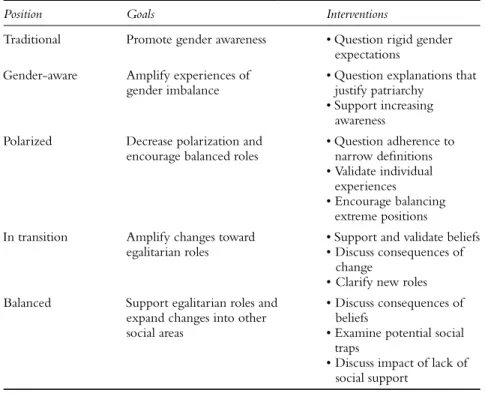
The first edition was published in the early 21st century and served as a summary of 20th century family therapy. Family therapy departs radically from traditional mental health in that it looks to the family and the context in which it is embedded to understand mental health problems, rather than looking solely at an individual as the source of mental health problems. Another shift occurred in the field in the 1980s, when feminists led a revolt, arguing that family therapy had failed to address the larger social context in which families are embedded.
In yet another revolution against the traditional psychodynamic therapy model on which psychology is based, the incorporation of spirituality issues into family therapy has occurred.
INTRODUCTION
Our view of couples and families has changed drastically since the field of marriage and family therapy was founded. We hope you enjoy this opportunity to learn about the field of marriage and family therapy. This book serves as an introduction and overview to the fastest growing branch of the mental health field: marriage and family therapy.
Marriage and family therapy is a model of mental health treatment that takes a family perspective on emotional problems and psychopathology.
THE HISTORY OF MARRIAGE AND FAMILY THERAPY
This 1956 double volume paper proved to be one of the most influential and controversial in the history of family therapy. MR has served as one of the most influential centers for family therapy worldwide. It was here that the Strategic School of Family Therapy was founded (see Chapter 5), and as of 2001, MRI has published over 60 research projects, more than 60 books, and more than 500 other publications (MRI, 2001).
Satir was one of the original members of MRI and served as the director of family therapy training. Some credit Whitaker with calling the first meeting in family therapy (Broderick & Schrader, 1991). James Framo was one of the few psychologists to figure prominently in the early days of family therapy.
GENERAL SYSTEMS THEORY, CYBERNETICS, AND FAMILY
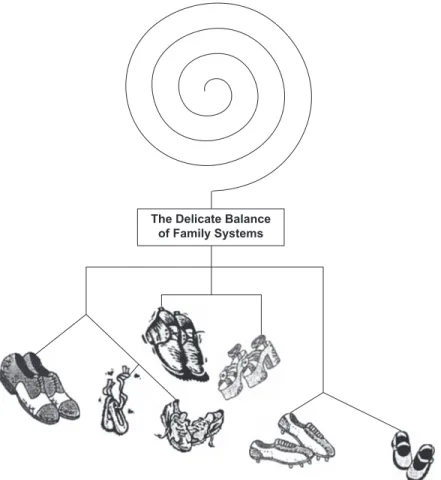
The success of the family depends on the existence and connection with other family members. The study of the family must begin with a look at the relationships and interactions between family members. A family system therefore includes the unique characteristics of the family members and the relationships between family members, as well as the family members themselves.
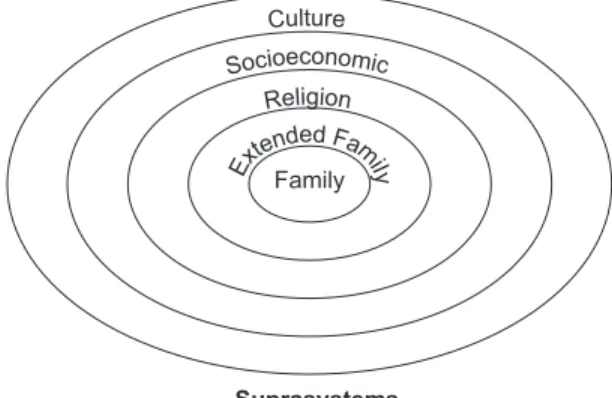
Unfortunately, until recent years, family therapy often ignored the impact of the larger system on the family. This illustrates the systems theory concept that a change in one part of the system affects all parts of the system. All the behaviors considered problematic in this case make sense in the context of the relational system.
Change in one part of the system will result in change in another part of the system. Family roles are individually prescribed patterns of behavior, reinforced by the expectations and norms of the family. If the process and the content of the message are not congruent, a double message can arise.
Because each theory emphasizes a different part of the family process or structure, unique interventions from each theory are designed to influence different aspects of the family system. Gregory Bateson, who based his work on the ideas of Norbert Wiener (1954) and Ludwig von Bertalanffy (1968), did much to bring these theories to the forefront of families and was a pioneer in understanding mental illness in the context of the family. system.
CONTEXTUAL ISSUES IN COUPLE AND FAMILY THERAPY
Scholars and practitioners have increasingly paid attention to contextual issues in the practice of couple and family therapy. Likewise, couple and family therapy theories have been guided by these messages about what is appropriate within the family. Another thorough research review (Blow, Timm, & Cox, 2008) focuses on whether gender match of the therapist and client influences the outcome of couple and family therapy.
Two recent content analyzes have focused on LGBT couple issues in the marital and family therapy literature. One of the most ignored aspects of culture in family therapy has been social class and poverty. The exploration of spirituality by couple and family therapy is a relatively recent phenomenon (Harris, 1998; Perst & Keller, 1993; Walsh, 2009).
The importance of spirituality in relationship and family therapy: a comparative study of the beliefs of therapists and educators. Coming out of the dark: Content analysis of articles related to gay, lesbian, and bisexual issues in relationship and family therapy journals.

STRUCTURAL FAMILY THERAPY
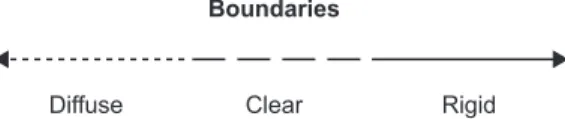
Each holon – the individual, the nuclear family, the extended family and the community – is both a whole and a part, not one more than the other, not one rejecting or in conflict with the other”. Hierarchy refers to a boundary that separates the management subsystem from the rest of the family. A family lost in the woods would be wise to let the son, who is an Eagle Scout, be responsible for getting everyone to safety rather than relying on the parents—the usual leaders—if the parents have minimal outdoor skills.
In other words, the goal of structural family therapy is to bring about second-order change in family structure that can lead to desired outcomes. The therapist's data and his diagnoses are achieved experientially in the family reunification process. When the therapist asks the family questions, family members can control what they are presenting.
The therapist assumed that the mother perceived limited strength in herself and that one or more of. the children may have almost as much power in the family hierarchy as she does. All family members came to the first session, which was also part of the treatment, to empower the mother to be the leader in the family. To further assess the family structure, the therapist asked each member of the family to describe what was going on in the family.
The younger daughter snapped at the older daughter: "Look what you've done!" The older daughter rolled her eyes and looked angry. The therapist then had the family members draw what they would like their family structure to be.
STRATEGIC FAMILY THERAPY
Why is it important to understand the client's position in relation to the problem, therapy or the therapist. Much of the success of strategic therapy depends on the therapist's ability to persuade the client to do something different. Seeing everyone involved in the problem helps the therapist understand the problem and the social situation that maintains it.
Furthermore, they do not emphasize the use or elicitation of the expression of the client's or the therapist's feelings. The therapist must establish a trusting relationship with the client in which the therapist is seen as helpful and on the side of the client (Haley, 1976). In this way, the therapist can gain an understanding of the attempted solutions that may maintain the problem.
The therapist notices the clients wording and tone in relation to the presenting problem, the treatment and the therapist. A critical determinant of the success of this intervention is the therapist's ability to offer a credible rationale for suggesting that the client walk slowly. In fact, the therapist may even encourage the client to relapse (ie, prescribe the symptom).
Generally, the therapist instructs the client to continue the ordeal until the problem is resolved. The whole family (Tom, Susan, Beth and two younger children) was invited to the first session so that the therapist could hear everyone's description of the problem and see the family in action.