de novo design of
“difficult-to-describe” all-α protein structures
December 2021
Koya Sakuma
The Graduate University for Advanced Studies, SOKENDAI
School of Physical Sciences
Department of Structural Molecular Science
Table of Contents
Chapter 01:
General Introduction ...page 2–6 Chapter 02:
Enumeration and comprehensive design of three-helix bundle structures composed of typical αα-hairpins ...page 7–72 Chapter 03 :
Limitations of the ABEGO representation: ambiguity between
αα-corner and αα-hairpin ...page 72–98 Chapter 04:
Design of complicated all-α structures ...page 97–139 Chapter 05:
A flood of folds: a de-novo designed protein library containing 294 distinct all-α topologies encoded by 7,350 amino-acid sequences
...page 140–148 Chapter 06:
De novo design of Globin-like topologies ...page 148–155 Chapter 07:
Conclusion ...page 156–159
Appendix . ..page 160
Acknowledgement ...page 161
Chapter 01:
General Introduction
Protein structure and function
Protein performs various functions in the cells and underlies most of the biological phenomena. The function of proteins ranges from catalyzing the chemical reactions to forming cytoskeletons, and their functional diversity is believed to be based on the diversity of protein structures. For example, enzymes that catalyze specific chemical reactions require complementary ligand pockets that selectively accommodate the substrate molecules. As the size and shape of pockets are defined by the structure of the enzyme, the structure of proteins has very crucial roles in determining the specificity of the reaction [1]. Therefore, protein structures have been believed to define their functions.
Protein structure and folding
When seen as a group of covalently bonded atoms, the structure of a protein is just a polymer. Chemically, a protein is just a hetero polypeptide chain composed of amide-bonded amino-acid residues. However, this is just one aspect of the protein structure. One of the most astonishing aspects of naturally occurring proteins is that the polypeptide chains spontaneously fold into specific three-dimensional structures to perform their work. This phenomenon in which polypeptide chains fold into specific conformations is called “protein folding”, which makes proteins distinct from random heteropolymers [2,3].
Anfinsen's dogma
The specific conformation the protein folds into is called the native state. The native states vary between protein species, which are specified by their amino-acid sequences. The native state of protein is believed to be the state with lowest conformational free-energy as long as the folding process obeys equilibrium thermodynamics. This is called “Thermodynamic principle of protein folding” or Anfinsen's dogma [2,4].
Structure prediction
Owing to these physico-chemical backgrounds, there has been much effort to predict the three-dimensional structure of proteins from the amino-acid sequence.
The formalism of the problem is very simple; for a given amino acid sequence, predict the native state that the sequence is most likely to fold into. In short, an amino-acid sequence is given to the solver, and the solver returns the plausible three-dimensional structure that the amino-acid sequence is likely to fold into. This
problem, structure prediction, is a very fundamental problem in protein science and also has many outcomes if practically solved [5–7]. For example, accurate computational structure prediction of drug-target proteins that are difficult to crystallize may lead to accelerated design of drug molecules.
Protein design as inverse problem of structure prediction
Protein design, the main subject of this thesis, is formalized as the inverse problem of the structure prediction problem [8]. Namely, a target backbone structure is given to the solver, and the solver returns an amino-acid sequence that is likely to fold into the target structure. This seems to be a very clear definition of protein design problem.
However, this formalism on protein design is oversimplified and too formal.
The most important question that need to be asked here is “where does the target backbone structure come from?” In other words, who determines what to design?
Structure prediction has no analogous question to this. In structure prediction, the target amino-acid sequence comes from sequence databases that store vast numbers of experimentally determined genomic DNA sequences. It is generally easier to obtain the nucleotide sequences of the genes than to solve the three-dimensional structure of the protein experimentally, and this makes protein structure prediction a well-defined problem. In contrast, it remains ambiguous where the target structures to design come from. This is the key viewpoint to understand protein design as something more than the inverse problem of protein structure prediction.
Redesign of naturally occurring protein structures
In the early history of protein design, the design was performed exactly following the formalism explained above; they took naturally occurring protein structure as inputs, removed the sidechain atoms, and then computationally designed the amino acid sequences that fold into the target structure [9,10].
However, in the modern context of protein design, such protocols depending on the naturally occurring backbone structure tend to be called “redesign” rather than just design. This is because another paradigm of design, de novo design, has been widely accepted in the field of protein design.
De novo design
De novo protein design is a more drastic concept for protein design. In de novo protein design, backbone structures are built from scratch, and not stolen from naturally occuring proteins [11]. Once the backbone structures are built by some means, designers can perform the amino-acid sequence designs as if they were taken from natural proteins. In this way, they successfully design completely new proteins. This offers higher flexibility in selection of design targets and therefore would greatly enhance the variety of designed structures. Such ability to design completely new proteins may enable the design of customized proteins such as artificial enzymes and artificial antibodies for example. However, there are limited
numbers of methods to generate de novo backbone structures [12–15], which may be bottlenecking the diversity of designed proteins. Further development of design protocols is required to unleash the potential of de novo protein design
Outline of this thesis
In this thesis, the author focused on the strategies to build the backbone structures and explore how new approaches can extend the repertoire of design protein structures.
In section 2, the author aimed to comprehensively construct three-helix bundle structures. The purpose of this section is to learn what it is like to comprehensively design small tertiary structures. The author first performed a statistical analysis of helix-loop-helix fragments, and identified αα-hairpin motifs specifically related to left- or right-handedness of helix-helix packing. Using these motifs as building blocks, the author thoroughly performed backbone-building simulation of all of the possible small three-helix bundle structures. As is expected without simulations, the length of the second α-helix plays a significant role in the compaction of three-helix bundle structure. Performing these backbone-building simulations, the author identified the combinations of the loop types and the helix-lengths that result in tight compaction of three helix-bundles required to form a hydrophobic core. The author also performed amino-acid sequence designs for those thoroughly enumerated the compact three-helix bundle structures, and found that they were highly designable. The author also made this comprehensive set of three-helix bundle structures publically available, hoping that this structural library allows other designers to skip the rebuilding of similar topologies and enable them to focus on their specialized design tasks.
In section 3, the author took two simple four-helix bundle structures as examples and critically investigated the reason why diverse all-alpha protein structures have not been designed so far in the current framework of de novo protein design. The author identified that “double-meaning” of GBB loop critically lowers the purity of fragments and leads to low efficiency of backbone building in BlurpintBDR.
The author concluded that the blueprint method is not suitable for the design of all-alpha proteins.
In section 4, the author developed new strategies for design of all-α proteins to overcome the limitation of current methods pointed out in Section 2. The author guessed that “difficult-to-describe” structures were also difficult to draft out. Therefore the author intended to skip the step of making blueprints, and directly model backbone structures which are ready for amino-acid sequence designs. First, the author started from the classification of typical helix-loop-helix fragments identified as fundamental building blocks for building backbone structures. The author generated literally all the possible combinations of these building blocks and the connecting α-helix lengths, and evaluated their compaction and clashes, and composed a myriad of globular all-α backbone decoys. Statistical analysis of these decoys clarified that the conformation generated by this strategy largely covers the conformational space that has not been sampled by previous de novo designs. Then
the author searched for the backbone topologies that attracted my attention as if the author looked over a catalog of protein backbone structures, and then picked some up for sequence design. For the five backbone topologies the author got interested in, amino-acid sequence design was performed. The author performed experimental validation of foldability of these designed proteins. For the most promising designs, the three-dimensional structures were solved in collaboration with Dr. Naohiro Kobayashi and Dr. Toshihiko Sugiki at Riken and Osaka university. The structure of a design protein Elsa was solved in collaboration with Murata group at Chiba university and they clarified the protein forms domain swapped dimer form in the crystal.
In section 5 and 6, the author seeked for the applications of the backbone building technique developed in section 4. In section 5, the author created a massive library of de-novo designed mini all-α proteins to examine the value of the structural diversity made accessible by the backbone building method. The library encodes 294 distinct topologies by 7,350 amino acid sequences, whose structural diversity would be useful to design functional proteins. In section 6, the author designed idealized versions of globin topology to show that the typical building blocks can provide sufficient structural complexity covering the most famous example of
“difficult-to-describe” topology. The author was able to design the amino-acid sequences that are predicted to fold into the target globin-like topologies. Though experimental validations for these library and globin-like designs are yet to be done, these results highlight the applicability of the structural diversity and complexity provided by the backbone building method developed in section 4.
[1] A.D. McLachlan, Protein Structure and Function, Annu. Rev. Phys.
Chem.23165–192 (1972). DOI: 10.1146/annurev.pc.23.100172.001121.
[2] K.A. Dill, S.B. Ozkan, M.S. Shell, T.R. Weikl, The protein folding problem, Annu. Rev. Biophys. 37 289–316 (2008). DOI:
10.1146/annurev.biophys.37.092707.153558.
[3] K.A. Dill, J.L. Maccallum, P. Folding, The Protein-Folding Problem , 50 Years On, 1042–1047 (2012).
[4] C.B. Anfinsen, Principles that Govern the Folding of Protein Chains, J.
Phys. A Math. Theor. 44 1689–1699 (2011). DOI:
10.1088/1751-8113/44/8/085201.
[5] J. Moult, A decade of CASP: Progress, bottlenecks and prognosis in protein structure prediction, Curr. Opin. Struct. Biol. 15 285–289 (2005).
DOI: 10.1016/j.sbi.2005.05.011.
[6] A.W. Senior, R. Evans, J. Jumper, J. Kirkpatrick, L. Sifre, T. Green, C.
Qin, A. Žídek, A.W.R. Nelson, A. Bridgland, H. Penedones, S. Petersen, K. Simonyan, S. Crossan, P. Kohli, D.T. Jones, D. Silver, K.
Kavukcuoglu, D. Hassabis, Improved protein structure prediction using potentials from deep learning, Nature. 577 706–710 (2020). DOI:
10.1038/s41586-019-1923-7.
[7] J. Jumper, R. Evans, A. Pritzel, T. Green, M. Figurnov, O. Ronneberger, K. Tunyasuvunakool, R. Bates, A. Žídek, A. Potapenko, A. Bridgland, C.
Meyer, S.A.A. Kohl, A.J. Ballard, A. Cowie, B. Romera-Paredes, S.
Nikolov, R. Jain, J. Adler, T. Back, S. Petersen, D. Reiman, E. Clancy, M.
Zielinski, M. Steinegger, M. Pacholska, T. Berghammer, S. Bodenstein, D. Silver, O. Vinyals, A.W. Senior, K. Kavukcuoglu, P. Kohli, D. Hassabis, Highly accurate protein structure prediction with AlphaFold, Nature. 596 583–589 (2021). DOI: 10.1038/s41586-021-03819-2
[8] C. Pabo, Designing Proteins And Peptides, Nature. 301200 (1983).
[9] B.I. Dahiyat, C.A. Sarisky, S.L. Mayo, De novo protein design: Towards fully automated sequence selection, J. Mol. Biol. 273 789–796 (1997).
DOI: 10.1006/jmbi.1997.1341.
[10] A.G. Street, S.L. Mayo, Computational protein design, Structure. 7 105–109 (1999). DOI: 10.1016/S0969-2126(99)80062-8.
[11] B. Kuhlman, G. Dantas, G.C. Ireton, G. Varani, B.L. Stoddard, D. Baker, Design of a Novel Globular Protein Fold with Atomic-Level Accuracy,302 1364–1369 (2003).
[12] N. Koga, R. Tatsumi-Koga, G. Liu, R. Xiao, T.B. Acton, G.T. Montelione, D. Baker, Principles for designing ideal protein structures, Nature. 491 222–227 (2012). DOI: 10.1038/nature11600.
[13] T.M. Jacobs, B. Williams, T. Williams, X. Xu, A. Eletsky, J.F. Federizon, T.
Szyperski, B. Kuhlman, Design of structurally distinct proteins using strategies inspired by evolution, Science (80-. ). 352 687–690 (2016).
DOI: 10.1126/science.aad8036.
[14] E. Marcos, B. Basanta, T.M. Chidyausiku, Y. Tang, G. Oberdorfer, G. Liu, G.V.T. Swapna, R. Guan, D.A. Silva, J. Dou, J.H. Pereira, R. Xiao, B.
Sankaran, P.H. Zwart, G.T. Montelione, D. Baker, Principles for designing proteins with cavities formed by curved b sheets, Science (80-. ). 355 201–206 (2017). DOI: 10.1126/science.aah7389.
[15] B. Basanta, M.J. Bick, A.K. Bera, C. Norn, C.M. Chow, L.P. Carter, I.
Goreshnik, F. Dimaio, D. Baker, An enumerative algorithm for de novo design of proteins with diverse pocket structures, Proc. Natl. Acad. Sci.
U. S. A. 11722135–22145 (2020). DOI: 10.1073/pnas.2005412117.
Chapter 02 :
Enumeration and comprehensive design of three-helix bundle structures composed of typical αα-hairpins
Abstract
The design of protein structures from scratch requires special attention to the combination of the types and lengths of the secondary structures and the loops required to build highly designable backbone structure models. However, it is difficult to predict the combinations that result in globular and protein-like conformations without simulations. In this study, the author used single-chain three-helix bundles as simple models of protein tertiary structures and sought to thoroughly investigate the conditions required to construct them, starting from the identification of the typical αα-hairpin motifs. First, by statistical analysis of naturally occurring protein structures, the author identified three αα-hairpins motifs that were specifically related to the left- and right-handedness of helix-helix packing. Second, specifying these αα-hairpins motifs as junctions, the author performed sequence-independent backbone-building simulations to comparatively build single-chain three-helix bundle structures and identified the promising combinations of the length of the α-helix and αα-hairpins types that results in tight packing between the first and third α-helices.
Third, using those single-chain three-helix bundle backbone structures as template structures, the author designed amino acid sequences that were predicted to fold into the target topologies, which supports that the compact single-chain three-helix bundles structures that the author sampled show sufficient quality to allow amino-acid sequence design. The enumeration of the dominant subsets of possible backbone structures for small single-chain three-helical bundle topologies revealed that the compact foldable structures are discontinuously and sparsely distributed in the conformational space. Additionally, although the designs have not been experimentally validated in the present research, the comprehensive set of computational structural models generated also offers protein designers the opportunity to skip building similar structures by themselves and enables them to quickly focus on building specialized designs using the prebuilt structure models.
The backbone and best design models in this study are publicly accessible from following URL:
https://doi.org/10.5281/zenodo.4321632 Background
Designing protein structures from scratch requires the careful selection of the length and types of the secondary structures and the loop types; further, the global structure and the local structural motifs need to be consistent. However, it is difficult to predict the combinations of building blocks that result in globular and protein-like conformations without simulations. Therefore, it would be beneficial for protein designers to limit the building blocks to the typical ones and enumerate the dominant subsets of their possible combinations in order to find promising combinations that result in highly designable backbone structures. In addition, once such conformational enumeration is performed, their results can be shared with other designers, and would enhance further design studies by allowing them to skip resampling the similar structures.
The αα-hairpin is a well-known structural motif, which consists of two adjacent α-helices and a loop region in between [1]. The loop region allows two flanking α-helices to pack into antiparallel arrangements, and the steep turn leads to tight non-local contacts between the two adjacent α-helices. Although the loop regions in general show non-repetitive structures and their conformations are more complicated than secondary structures, a few of them show clear patterns and can be classified into several subtypes, and are thus regarded as local motifs [2, 3]. Several pioneering studies have identified certain typical conformations of loops that are specifically related to αα-hairpins [1, 4, 5] and utilized them for design [6].
In this study, the author considered single-chain three-helix bundles as the simplest tertiary structures and investigated the conditions required to consistently construct them. The single-chain three-helix bundle is composed of three α-helices and two connecting loop regions that fold into hairpin conformations, causing neighboring α-helices to pack tightly into a compact antiparallel bundle configuration.
Consequently, the third α-helix can be packed parallel to the first helix. The single-chain three-helix bundle structures are frequently observed in naturally occurring proteins and also have been designed artificially as well [7, 8]. Of note, the design of the single-chain three-helix bundle was one of the earliest efforts in the de novo protein design [8]. The design of helical bundles or multiple-chain coiled-coils is nowadays one of the largest fields in the protein design study, allowing diverse α-helix arrangements [9]. It is now clear what residue-residue non-local interactions can cause tight packing between α-helices [10] and result in various helix-bundle arrangements [11], which originates from analysis and design of coiled-coil structures [12–14]. Such knowledge for helical bundle designs have recently led to design of antibody-like and interleukin-mimicking artificial proteins [15–17] and programmable heterodimers [18]. However, many of previous works focus on the interface design between α-helices and do not pay much attention to the detailed conformations of loops that optimally connect individual α-helices. Therefore, when compared to coiled-coils and peptide assemblies that are composed of several independent chains, it still remains unclear and undocumented which combinations of the α-helix lengths and loop types result in compact single-chain helical bundle structures. Understanding the dominant subsets of possible conformational spaces allowed for single-chain helical bundles will be fundamentally important and even
informative to efficiently design pharmacologically valuable artificial proteins. To this end, we aimed to understand which combinations of αα-hairpins and α-helix lengths can result in compact single-chain three-helical bundle structures, considering the αα-hairpins as the fundamental building blocks.
Results and discussion
Specific αα-hairpin loops determine the handedness of helix-helix packing To identify typical hairpin motifs, the author performed a statistical analysis of helix-loop-helix fragments and found that shorter loops are present in greater frequency (Figure S2-1). To focus on hairpins rather than general helix-loop-helix fragments, the author defined helix-orientation vectors [19] and calculated their crossing angles (Figure S2-1). On applying the condition that the helix-helix crossing angles θHHare less than 60° in the fragment dataset, the author found a decrease in the population of single-residue loops, as the short helix-loop-helix prefers corners or kinks rather than hairpins. The author focused on the more frequent short hairpin fragments and extracted 2, 3, and 4 residue length loops for subsequent analysis.
To investigate the preferable loop conformations related to the specific handedness of helix-helix packing in naturally occurring protein structures, the author assigned a 5-state coarse-grained representation for the backbone torsion angle, i.e., ABEGO representations (Figure S2-2) for each fragment and evaluated their statistical information [2]. ABEGO is a five-state coarse-grained representation of polypeptide backbone dihedral angles; Ramachandran map is divided into four sections and labelled by single letters A, B, E and G, to enable the representation of dihedral angle series by character strings. The A region roughly corresponds to the conformation of α-helix, and the B region corresponds roughly to the β-strand conformation. The G region corresponds to left-handed α-helix, and the E region represents the rest of the Ramachandran map. The O state correspondds to the cis-conformation of peptide bond, which are almost negligible in this paper. Then the author sorted the backbone torsion types specified by the ABEGO representations by their population and found that the hairpins showed limited conformations (Figure 2-1). For example, the GB and BB loops occupied more than 90% of the top five frequent populations among two-residue loops.
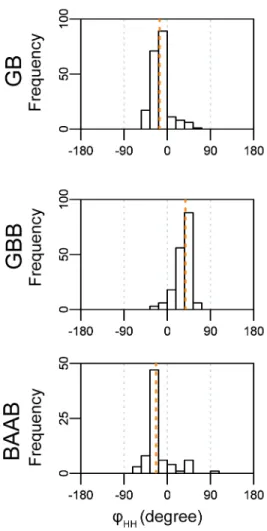
To identify hairpins that show specific handedness in helix-helix packing, the author defined helix-helix dihedral angles φHHand calculated the ratio of left- (L-) and right- (R-) types among the helix-helix dihedral angle distribution (Figure 2). The author selected the most populated loop types that showed R/L or L/R ratios higher than 5.0 in each class of loop lengths as representative hairpin species. This resulted in the selection of the GB, GBB, and BAAB loops; the author did not select BAB loop because their inter-helix dihedral angles were broadly distributed, resulting in both left- and right-handed helix-helix packing (Figure S2-3).
Figure 2-1: Identification of typical αα-hairpin motifs by the ABEGO representation for the loop conformations. The distributions of the top-10 typical hairpin conformations for two, three, and four-residue length loops that were identified by ABEGO. Several specific series of backbone torsion angles are strongly preferred in the hairpin loop region.
Figure 2-2: The handedness of helix-helix packing forced by typical αα-hairpin motifs. (A) Definition of φHH (B) Definition of packing handedness (C) The
distribution of φHH for GB, GBB, and BAAB hairpins. The horizontal axis represents the values of the helix-helix dihedral angle φHH, and the vertical axis corresponds to the number of loop fragments in the dihedral bins. The barplots are binned every 18°, and the orange dotted line indicates the median value of the distribution. (D) Representative structures for the GB, GBB, and BAAB hairpins. The structures show the GB and BAAB hairpins are related to left-handed packing, and GBB is related to right-handed packing. The α-helices are shown as cartoons and are colored in the blue-white-red gradient from the N to the C-terminus.
The author extracted the structures whose φHH was nearest to the median of the angle distribution as the class representatives. The representative structure and the distribution of φHH clarified that GB loops are closely related to the L-type handedness of helix-helix packing motifs (Figure 2-2). Similarly, the GBB loop was related to the R-type and the BAAB loop to L-type packing. The handedness of helix packing for the GB, GBB, and BAAB loops was broadly consistent with a previous report [20] and the overall tendency did not change when the author performed the same analysis for different dataset (Figure S2-4). The author also checked the clustering quality by sequence alignments for each hairpin structure, and observed typical periodic patterns of hydrophobic residues in the flanking helix regions (Figure S2-5). The author concluded that classification using the ABEGO patterns worked well to extract hairpin motifs related to the specific handedness of helix-helix packing.
Previous studies on αα-hairpins reported both L and R types of helix-helix packing can result from GB or GBB hairpins [1, 4]. However, the author observed that these loops indeed strongly bias the handedness of helix-helix packing. This does not imply that a single ABEGO-level representation can always specify the single handedness of helix-helix packing; for example, BAABB loop can result in both the L and R type packing (Figure S2-3). However, certain hairpin conformations such as GB, GBB, and BAAB can strongly determine the handedness of the packing of two flanking α-helices, and are an example of a pair of local and nonlocal structural motifs that are consistently incorporated into a single tertiary structure. As the spatial arrangements and orientation of two α-helices connected by a loop region are stereochemically determined by the backbone dihedral angles in the loop region, preference to specific handedness of helix-helix packing can be attributed to the rigid conformation of the loop region. Hydrogen bond analysis using DSSP[21] revealed that intra-loop backbone-backbone hydrogen-bond network energetically stabilizes such typical loop conformations, making the loop conformation rigid enough to relate the local conformation of loops to the specific geometry helix-loop-helix fragments (Figure S6–S8).
Sequence-independent backbone-building simulations clarify the condition for building compact single-chain three-helix bundles
The length of the second α-helix is expected to play a crucial role in the construction of compactly packed single-chain three-helical bundle structures since
extension of α-helix leads to large repositioning of the following segments. As one turn of the α-helix requires 3.6 residues, compact bundle structures may appear for every increase of 3 or 4 residues. However, it remains unclear which exact combination of loops and helix-length results in a compact single-chain three-helix bundle structure. Therefore, the author performed comparative sequence-independent fragment-assembly simulations to identify which combination of loops and helix lengths result in tight packing between the first and third α-helices.
The set of backbone dihedral angles of the fragments are roughly specified in the ABEGO representation (referred to as “blueprint” [22]) and are used in fragment-picking before the fragment-assembly simulations. Hereafter this type of fragment assembly simulation guided by the blueprints is referred to as backbone-building simulations. Using the GB, GBB, and BAAB loops identified in the previous section, the author constructed blueprint files for various types of single-chain three-helix structures and systematically scanned the length of the second α-helix. Next, 2500 trajectories of backbone-building simulations were performed for each of these blueprints [23, 24]. The author prepared ideal single-chain three-helical bundle decoys using CC-builder for the reference structures [25], and calculated the template modeling score (TM-score) of the final structure from each trajectory that was referenced by the decoys to quantify the success ratio of the backbone-building simulations [26]. Importantly, the author used two reference decoys for each blueprint-based folding simulation because single-chain three-helical bundles can take two types of helix configurations; i.e., a clockwise (CW) or counter-clockwise (CCW) arrangement of three α-helices (Figure S2-9).
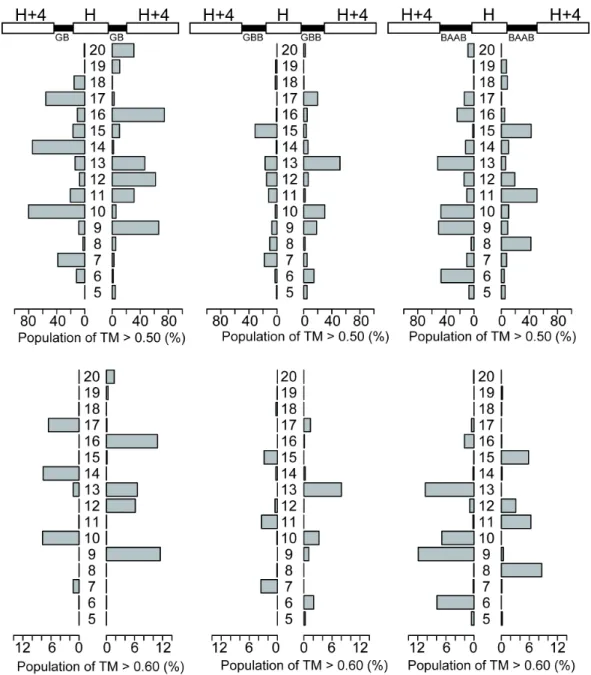
The results of the backbone-building simulations are summarized in Figure 2-3. The simulations showed three important features that are summarized here by taking the results for the helix-GB-helix-GB-helix simulations as examples. First, the length of the second alpha-helix plays a crucial role in the construction of compactly packed single-chain three-helical bundle structures; the success ratio of the
backbone-building simulations was obviously related to the periodicity of the α-helix structure. For example, CW bundles can be efficiently generated with the second α-helix with lengths of 10, 14, and 17 residues for helix-GB-helix-GB-helix blueprints.
Similarly, the second α-helix with lengths of 9, 12, 16 residues resulted in CCW bundles. Here, the peaks were separated in every three or four residues, which was consistent with the canonical α-helix structure that requires 3.6 residues per turn.
Second, certain combinations of loops and helix-lengths do not yield well-packed helix bundles. For example, the blueprint with a 15 residue helix in the middle cannot fold into a compact helical bundle. This is because the number of turns in the second α-helix is unable to pack the first and third helices closely, causing them to be apart from each other (Figure S2-10). Such a blueprint has a local conformation that is inconsistent with the global structure of compact single-chain three-helical bundles.
Third, the position of the peaks oscillates between CW and CCW bundles as the length of the second helix increases. The switch between a CW bundle to the neighboring CCW bundle is very sharp and sometimes requires an
increase/decrease of a single residue. For example, the blueprint with a 16-residue helix in the middle preferentially results in the CCW bundle structure, and an
increase of one residue results in a preference for the CW bundle. Overall, the results of the backbone-building simulations agree with the qualitative expectations that were guided by the periodicity of the α-helix structure, and provide further detailed information on the exact combination of loop types and helix-lengths that result in compact bundle conformations. These results were not affected when different threshold and reference structures were used for analysis (Figures S2-11 and S2-12).
Figure 2-3: The length of the second helix is highly responsible for the compaction of single-chain three-helix bundles. (Top) The blueprints of single-chain three-helix bundles. The white bars indicate the α-helices, and the black bars indicate the loop regions, where integer H denotes the variable length of the second α-helix. The alphabets beneath the loop represent the ABEGO of the loop region specified in the blueprint. (Bottom) Bar graphs to summarize the foldability of each blueprint with the variable length of the second α-helix, H, scanned from 5 to 20 residues.The bars represent the population of folded structures that showed a TM-score higher than 0.55 as referenced by ideal CW (left) or CCW (right) three-helical topologies. The vertical axis represents the length of the second α-helix H. The structures shown beside the bars are the representative snapshots from the
backbone-building simulations with highest TM-scores.
Taken together, these results indicate that the appropriate combination of local loop motifs and the length of the secondary structures are relatively rare among the possible combinations, especially under approximation that the loops and α-helices are semi-rigid under ABEGO constraints on backbone dihedral angles. In the author’s simple simulations for single-chain three-helix bundle structures, approximately half of the blueprints were able to generate compact bundle conformations. As the foldable combinations of building blocks are rare and sparsely distributed even for simple single-chain three-helical bundles, valid combinations for more complicated topologies are expected to become rarer and more difficult to find.
The author expects that the possibility of obtaining foldable combinations will decrease exponentially as the number of secondary structures increases, and it will be difficult to hypothesize as to which combinations may result in a compact, globular, and protein-like structure without exhaustive sampling in the conformational space.
Other types of blueprints, such as for helix-GBB-helix-GBB-helix, and helix-BAAB-helix-BAAB-helix showed results similar to the GB-blueprint.
Interestingly, the “phase” of the peak oscillation was inverted between the GBB and BAAB-blueprints, whereas the positions of the peaks were similar to each other, reflecting the local handedness of the hairpin structures. The former results in a CCW bundle when the second helix has 13 residues, and the latter yields a CW bundle in the same conditions. These observations that the local handedness of hairpins can control the global chirality of the topology may be informative for efficiently diversifying the shapes of design proteins. Additionally, the blueprints showing a mixture of hairpins with different handedness failed to pack the first and third α-helices because their crossing angles do not cancel out (Figure S2-10 and S2-13–2-17).
Amino acid sequence design suggests that the enumerated globular single-chain three-helix bundle structures may be designable.
As the backbone model generated in the previous section lacked any information on amino acid sequences, the author performed sequence designs using Rosetta [24] to check if the compact single-chain three-helix bundle structures are designable as concrete amino acid sequences. The author selected 27 backbone structures that are listed in Figure 3 and performed amino acid sequence designs for these backbone structures. The author designed ~7000–9000 sequences for each backbone structure and observed that the interfaces between the first and third α-helices recovered the sequence motifs for helix-helix packing (Figure S2-18). The results show that the relative arrangements of the first and third α-helices sampled in the sequence-independent backbone-building simulations are realistic enough to mold the typical amino acid sequences observed in helix-helix packing motifs. The optimal combinations of local properties such as the hairpin types and α-helix lengths lead to the successful recovery of non-local features. From these ensembles of
design models, the author selected the most foldable sequences for each topology using sequence-dependent fragment assembly simulations [27] (Figure 2-4 and Figure S2-19–S2-21). In most of the simulation settings, the lowest-score models agreed well with the design models and recovered local hairpin structures well (Figure S2-22–S2-27 and Table S2-1). The author also performed negative-control designs in which the loop regions of the up-down helix bundles have atypical conformations, such as EE, BEB, and BEEE. The best-effort designs for these backbone models were indistinguishable in terms of par-residue Rosetta scores from the designs with typical hairpin motifs (Table S2-2). However, they were not able to efficiently fold into the target topology in the sequence dependent fragment-assembly simulations (Figure S2-28). This result suggests that the compact up-down bundle structures with typical hairpins have higher designability than the ones composed of atypical hairpins. For these best design models, the author performed blast search using blastp against a non-redundant sequence database [28, 29] and confirmed that three were no similar sequences found in the database.
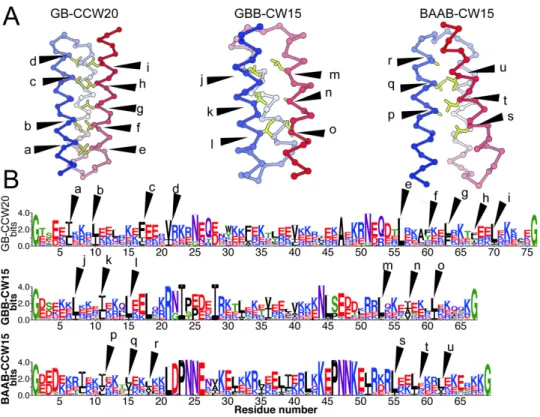
Figure 2-4: The representative structures and the results of sequence-dependent folding simulations of the designed single-chain three-helix bundles: GB-CCW9, GBB-CW11, and BAAB-CCW8.(A) The side-view and top-view of the designed structures with the α-helix shown as a cartoon and the hydrophobic side-chains represented as sticks. (B) The results of the folding and relax simulations. The vertical axis represents the Rosetta score, and the horizontal axis represents the root-mean-square deviation from the target structures. The black dots correspond to the final snapshots of the fragment-assembly folding simulations
starting from extended conformations, and the red dots correspond to the final snapshots of the relax simulations starting from the native conformations. These designs are predicted to fold into the target topologies because the trajectories of the folding simulations can reach the near-native ensembles. (C) The lowest score models in folding simulations (orange) superimposed onto the design models (white).
The predicted models and design models agree well, which suggests the designed amino acid sequences fold well into the target conformations.
To confirm the stability of designed proteins independently from the Rosetta score function and fragment assembly simulations, the author utilized molecular dynamics simulations of designed proteins models and assessed their quality [30, 31]. The author performed molecular dynamics simulations for the 27 best design models using GPU-accelerated GROMACS 2020.6 [32, 33] alongside Amber 15FB force field [34]. For each design, the author performed 10 trajectories of 100 ns molecular dynamics simulations with explicit TIP3P water models. After energy minimization and equilibration, the author performed 100 ns of the production run under the pressure of 1 bar and temperature of 300 K. The simulation showed the most of the design models can stay within 5 Å in the root-mean-square deviations (RMSD) of Cα coordinate from the designed structures for 100 ns (Figure S2-29–S2-34). The only exceptions were 7th trajectory of GB-CW7 and 3rd and 8th trajectories of GBB-CCW6 (Figure S2-29 and S2-31), which resulted in partial unfolding of the structures. These structures may be unstable probably because they have too small hydrophobic cores to maintain the designed topologies. Overall, the molecular dynamics simulations showed that the designed proteins were stable enough to keep the native conformation in the solution state. These results provided independent validation for the designability of the backbone structures we sampled by fragment assembly with the Rosetta score function.
As the author designed up-down types of helical bundles, whose substructures can be regarded as antiparallel and parallel coiled coils, the author confirmed whether the best-designed sequences can be recognized as coiled-coils by DeepCoil [35–37]. Interestingly, the predicted probability to observe coiled-coil arrangements within the designed structure increased as the length of the design proteins increased (Figure S2-35–S2-40). Approximately, when the length of the second α-helix is longer than 15 amino-acid residues, the probability to recognize the sequence as coiled-coil becomes higher than the significance threshold. This suggests that these up-down helical bundles can be regarded as coiled coils when the chain lengths are large enough. Therefore, although the author designed amino-acid sequences without considering the structures are related to coiled coils, sequence design techniques for coiled coils can be repurposed to the sequence design of large helical bundles and may result in more optimized helix-helix packing, which may lower the computational cost of design and improve the yield of successful design sequences. On the other hand, smaller helical bundles failed to be predicted as coiled coils. This does not immediately imply that such small helical bundles are not designable; such small helical bundles were designed in a previous
study [38]. Therefore, the sequence design of such small helical bundles should be performed without considering the structure as coiled-coils. This analysis suggested that optimal design methods may be able to be selected depending on the size of target helical bundles. It is also interesting whether parametrically designed multiple-chain coiled coils can be redesigned into single-chain helical bundles by designing the loops connecting the α-helices; the question is whether the designer can find appropriate loop conformations to connect the α-helices [39] without frustrations between local and nonlocal interactions [40, 41].
Finally, to detect knobs-into-holes structure in the author’s designs, the author performed structure analysis using SOCKET [42]. According to SOCKET, knob-into-holes structures were observed roughly in two-third of the author’s designs (Figure S2-41-S2-44). In addition, SOCKET detected coiled-coil structure in 4 of the author’s designs, although the author did not intend to design coiled-coil-like substructures in the author’s design scheme. This also suggests that the design of helical bundles shares many similar aspects with the design of coiled coils, and the rich and matured protocols for coiled-coil design can be imported into the design of single-chain helical bundles.
Conclusion
In this study, the author used single-chain three-helix bundles as simple models of protein tertiary structures and investigated the conditions required to construct them, and aimed to understand the mechanisms by which these local and nonlocal motifs are consistently incorporated into a single three-dimensional structure. First, the author showed that the GB- and BAAB-hairpins are related to left-handed helix-helix packing, whereas the GBB-hairpins are related to right-handed packing. Second, by enumerating the combinations of the hairpin types and the helix length, the author identified the combinations of helix-length and loop types that resulted in successful compaction of single-chain three-helix bundle structures. As the author has enumerated most of the backbone structures that are potentially obtainable for these simple topologies under the condition that the hairpins are limited to GB, GBB, or BAAB, and the lengths of the second α-helix are less than 20 residues, no other single-chain up-down three-helical bundle structures are plausible in this subspace of the structural space. Combined with the observation that the populations of loops are strongly biased towards a limited number of typical conformations, such enumeration can cover most of the possible conformational space.
The author also showed that the backbone structures composed of such short hairpin motifs may be highly designable by amino acid sequence design and sequence-dependent folding simulations, although experimental validation for these designed proteins should be done elsewhere. In addition, Molecular dynamics simulations supported that the designed proteins are stable in solution, which suggests that designed proteins do not have internal frustrations between local and nonlocal interactions. Using programs to detect coiled-coil sequences and structures, the author also found that the designed sequences and structures can be recognized
as coiled-coil when the sequences are long enough. This implies sequence design methods based on sequence periodicity of coiled coils, which is usually utilized in design of multi-chained coiled coils or peptide assemblies, can be repurposed for the design of single-chain up-down helical bundles to realize optimized helix-helix packing.
Though the author’s analyses are limited to the simplest class of tertiary structure, single-chain up-down three-helical bundles, the author has shown that the enumerative exploration into the conformational space can clarify the appropriate combinations of building blocks. The author also showed such exploration can yield transferable structural resources for protein design that can be shared with other protein designers. As such enumeration does not need to be done twice, data sharing among designers would promote advances in the protein design fields. To this end, the 27 types of backbone structure that the author enumerated and the best sequences that the author designed are now publicly available at https://doi.org/10.5281/zenodo.4321632
Method
Initial dataset preparation
A collaborator of the author composed a subset of the ECOD database (version 238) whose sequence redundancy was reduced by 40% sequence identity [43]. Next, secondary structures were assigned using DSSP [21], and a total of 39,938 helix-loop-helix substructures were extracted having loop lengths that were less than or equal to 10. The author discarded the structures whose α-helices have less than or equal to 9 residues.
The author prepared another dataset of PDB structures whose sequence redundancy was reduced by 25% sequence identity with resolution lower than 3.0 A using Pisces server[44], and obtained 29,149 helix-loop-helix structures. These structure were used to check the effect of resolution cut-off for the geometric analysis of helix-loop-helix fragments (Figure S2-4)
ABEGO-level dataset preparation
The backbone dihedral angles were translated into 5 state coarse-grained ABEGO representations (Figure S2-2). ABEGO is a coarse-grained representation of polypeptide backbone dihedral angles, where the Ramachandran map is divided into four sections and labeled by single letters A, B, E and G. The O state corresponds to the cis-conformation of the peptide bond, which is almost negligible in this paper.
The A region roughly corresponds to the conformation of α-helix, and the B region corresponds roughly to the β-strand conformation. The G region corresponds to left-handed α-helix, and the E region represents the rest of the Ramachandran map.
As it is ambiguous whether the dihedral angle of A in ABEGO representation is a loop region or α-helix termini, the author removed the loop fragments that start/end with A of ABEGO. The author only included fragments that started/ended with B, E, and G. After this data pruning, the author obtained 19,844 helix-loop-helix fragments. The author checked that the removal of fragments that started/ended with
A did not largely change the distribution of the frequent loop types (Figure S2-45). All of the date processing was performed with in-house R and python programs.
Definition of the geometrical features of helix-loop-helix fragments
For the final and first single turn on the N/C-terminal α-helices of the helix-loop-helix fragments, the vectorsvNandvCrepresenting the orientation of these α-helices were defined as per Krissinel et al. [19]. Additionally, the author defined the loop orientation vector vL as starting from the final/first Cα coordinates of the N-/C-terminal α-helices. Next, the author defined 2-geometric features using vN,vC, and vL : (1) the helix-helix crossing angle θHH, (2) the helix-helix dihedral angle φHH. θHH is the crossing angle between two N/C-terminal α-helices (Figure S1) defined by the arc-cosine of the inner-product of vN,and vC. φHHis the inter-helix dihedral angle between two α-helices defined by vN, vL, and vC(Figure 2-2). As the author focused on αα-hairpins, the author only collected fragments that satisfied the condition that θHHwas less than 60° before performing the rest of the analysis.
Sequence-independent fragment-assembly simulations: Backbone-building simulations
Sequence-independent fragment assembly simulations, which the author referred to as backbone-building simulations, were performed using Rosetta BluePrintBDR [24] similarly as in Lin et al. [23]. The blueprint files were generated manually and were used in fragment picking to specify the backbone torsion in the ABEGO representation. For each site of proteins, 200 fragments were picked from the default structure library. For each blueprint, simulations were repeated for 2500 trajectories, and the final snapshots from the trajectories were used for structural analysis. A parameter set, fldcen.wts, was used as weight parameters for BluePrintBDR simulations.
In the analysis, two ideal decoy structures of single-chain three-helical bundles were used as references to calculate the TM-scores using TM-align [26].
The author prepared two types of reference decoys, i.e., clockwise (CW) and counter-clockwise (CCW) bundles originating from the ideal decoy structures that were generated by CC-builder [25]. The parameters for CC-builder were as follows;
oligomeric state 3; radius 6.75, 8.1, 9.0, 9.9, and 11.25 for x0.75, x0.90, x1.00, x1.10, and x1.25 radius variant of helix bundles; pitch 300; interface Angle 20. Based on these decoys built by CC-builder, the author manually modified their helix-orientation to up-down-up and packing chirality by re-sorting and mirroring the Cα coordinate and superimposing ideal α-helices onto the mirrored helix arrangements (Figure S2-9). In the data analysis, the snapshots showing TM-scores higher than 0.55 were counted as folded into three-helical bundle structures [45]. To check the robustness against the change in reference structures, the author systematically modified the diameter of reference helix-bundles by the magnitude of 0.75, 0.9, 1.10, and 1.25.
The author also changed the threshold of TM-score (0.50, 0.55, and 0.60) to check the robustness of the results. These parameters were found not to largely change the results (Figure S11 and S12).
Construction of negative-control helix-bundle structures
Based on the anti-parallel part of decoy structures described above, the loop regions were modeled using Modeller [46] and six types of helix-helix hairpins that have atypical EE, BEB, and BEEE conformations were selected. Then the respective hairpin structures were repeated to form three-helix bundles composed of atypical hairpins. The severe steric clashes between alpha-helices were removed using Foldit-standalone [47].
Amino acid sequence design and sequence-dependent folding simulations Amino acid sequence design was performed using the Rosetta flxbb protocol [24] starting from the backbone structure that showed the best TM-score in the previous sequence-independent folding simulations. Score Talaris2014 was used in all designs and folding simulations including negative-control designs. In the loop region, amino acid profiles were constructed using similar loop structure fragments (RMSD < 2 Å) and used as constraints for residue types, similarly to Marcos et al [48]. In addition, the specification on the residue types was refined based on the buriedness of the backbone atoms using in-house programs. The text files, i.e. the so-called “resfiles'' specifying the final residues set were attached as supplementary files. The author performed 10,000 design trials for each backbone model and obtained ~7,000–9,000 design sequences that passed the secondary structure filter.
The author selected the best 5–10 sequences using the fragment-quality score. The author defined the fragment quality score as the average of the logarithm of the number of fragments with RMSD lower than 1.5 Å from the design model, similarly to Marcos et al [48].
The author performed sequence-dependent fragment-assembly folding simulations [27] to identify the best design sequences. Sequence dependent fragment assembly simulations, which the author denoted “folding” simulations, were performed using AbinitoRelax binary in Rosetta suite with 200 3-mer and 9-mer fragments collected by psi-blast search in the default structure library. Near-native sampling simulations, which the author denoted “relax“ simulations, were performed by relax binary in Rosetta suite to sample near-native conformation starting from the designed structure models. 20,000 trajectories of fragment-assembly folding simulations were performed for each design protein, and their ability to fold into the target structures was evaluated by the shapes of the energy landscapes.
MD simulations
All of the simulations were performed using GROMACS 2020.6 [32, 33] with Amber force field ff15FB [34]. First, the author performed the in-vacuo energy minimization by the steepest descent for 500,000 steps, and the energy-minimized protein structures were solvated by TIP3P water models. The initial box size was set to 6 nm x 6 nm x 6 nm, which was large enough for all types of designs. The Na+
and Cl- ions were introduced to the system at the concentration of 0.1 mol/L.
Depending on the total charge of the designed proteins, additional Na+ or Cl- ions
were added to the system so that the system has zero net charges. The whole system was energy-minimized again for 500,000 steps.
With the step size of 2.0 fs, the whole system was equilibrated by 100 ps of NVT and NPT simulations under harmonic constraint for heavy atoms. Then 100 ns of production runs were performed without any external constraints to the system under 1bar of pressure and 300 K of temperature. The production runs of the MD simulations were performed with LINCS constraint algorithm for the bonds between hydrogen atoms and heavy atoms. The temperature of the system was controlled to 300 K by the V-rescale algorithm (modified Berendsen thermostat) with the time constant of 0.1 ps. The pressure was controlled to 1.0 bar by Parrinello-Rahman algorithm with the time constant of 2 ps. The electrostatic part of the force field was calculated using the particle mesh Ewald scheme with the order of 4.
Availability of data and materials
The backbone models and best design models in this study are publicly accessible from following URL:https://doi.org/10.5281/zenodo.4321632
Best-effort negative control designs are available from the following URL : https://zenodo.org/record/5512549
The in-house python and R script for ABEGO analysis is disclosed in GitHub:
For ABEGO-based analysis: https://github.com/yakomaxa/ssdoublet Other scripts to reproduce the research are also disclosed in GitHub:
For backbone building:https://github.com/yakomaxa/bbdesign_template For MD simulations:https://github.com/yakomaxa/MD_gromacs_template References
1. Efimov A V. Structure of α-α-hairpins with short connections. Protein Eng Des Sel. 1991;4:245–50.
2. Wintjens RT, Rooman MJ, Wodak SJ. Automatic classification and analysis of αα-turn motifs in proteins. J Mol Biol. 1996;255:235–53.
3. Oliva B, Bates PA, Querol E, Avilés FX, Sternberg MJE. An automated classification of the structure of protein loops. J Mol Biol. 1997;266:814–30.
4. Brazhnikov E, Efîmov A. Structure of a-hairpins with short connections in globular proteins. Mol Biol. 2001;35:100–8.
5. Efimov A V. Standard structures in proteins. Prog Biophys Mol Biol.
1993;60:201–39.
6. Lahr SJ, Engel DE, Stayrook SE, Maglio O, North B, Geremia S, et al.
Analysis and design of turns in α-helical hairpins. J Mol Biol.
2005;346:1441–54.
7. Schneider JP, Lombardi A, DeGrado WF. Analysis and design of three-stranded coiled coils and three-helix bundles. Fold Des. 1998;3:29–40.
8. Walsh STR, Cheng H, Bryson JW, Roder H, Degrado WF. Solution structure and dynamics of a de novo designed three-helix bundle protein.
Proc Natl Acad Sci U S A. 1999;96:5486–91.
9. Rhys GG, Wood CW, Beesley JL, Zaccai NR, Burton AJ, Brady RL, et al.
Navigating the Structural Landscape of de Novo α-Helical Bundles. J Am Chem Soc. 2019;141:8787–97.
10. Zhang SQ, Kulp DW, Schramm CA, Mravic M, Samish I, Degrado WF.
The membrane- and soluble-protein helix-helix interactome: Similar geometry via different interactions. Structure. 2015;23:527–41.
doi:10.1016/j.str.2015.01.009.
11. Dawson WM, Martin FJ, Rhys GR, Shelley KL, Brady RL, Woolfson D.
Coiled coils 9-to-5: Rational de novo design of alpha-helical barrels with tunable oligomeric states. Chem Sci. 2021;9:4132.
12. Crick FHC. The packing of α-helices: simple coiled-coils. Acta Crystallogr.
1953;6:689–97.
13. Woolfson DN. The design of coiled-coil structures and assemblies. Adv Protein Chem. 2005;70:79–112.
14. Lupas AN, Gruber M. The structure of α-helical coiled coils. Adv Protein Chem. 2005;70:37–8.
15. Silva DA, Yu S, Ulge UY, Spangler JB, Jude KM, Labão-Almeida C, et al.
De novo design of potent and selective mimics of IL-2 and IL-15. Nature.
2019;565:186–91. doi:10.1038/s41586-018-0830-7.
16. Linsky TW, Vergara R, Codina N, Nelson JW, Walker MJ, Su W, et al. De novo design of potent and resilient hACE2 decoys to neutralize SARS-CoV-2.
Science. 2020;:eabe0075. doi:10.1126/science.abe0075.
17. Cao L, Goreshnik I, Coventry B, Case JB, Miller L, Kozodoy L, et al. De novo design of picomolar SARS-CoV-2 miniprotein inhibitors. Science.
2020;370:426–31.
18. Chen Z, Boyken SE, Jia M, Busch F, Flores-Solis D, Bick MJ, et al.
Programmable design of orthogonal protein heterodimers. Nature.
2019;565:106–11. doi:10.1038/s41586-018-0802-y.
19. Krissinel E, Henrick K. Secondary-structure matching (SSM), a new tool for fast protein structure alignment in three dimensions. Acta Crystallogr Sect D Biol Crystallogr. 2004;60 12 I:2256–68.
20. Doyle L, Hallinan J, Bolduc J, Parmeggiani F, Baker D, Stoddard BL, et al.
Rational design of α-helical tandem repeat proteins with closed architectures.
Nature. 2015;528:585–8.
21. Kabsch W, Sander C. Dictionary of protein secondary structure: Pattern recognition of hydrogen‐bonded and geometrical features. Biopolymers.
1983;22:2577–637.
22. Koga N, Tatsumi-Koga R, Liu G, Xiao R, Acton TB, Montelione GT, et al.
Principles for designing ideal protein structures. Nature. 2012;491:222–7.
doi:10.1038/nature11600.
23. Lin YR, Koga N, Tatsumi-Koga R, Liu G, Clouser AF, Montelione GT, et al.
Control over overall shape and size in de novo designed proteins. Proc Natl Acad Sci U S A. 2015;112:E5478–85.
24. Fleishman SJ, Leaver-Fay A, Corn JE, Strauch EM, Khare SD, Koga N, et al. Rosettascripts: A scripting language interface to the Rosetta
Macromolecular modeling suite. PLoS One. 2011;6:1–10.
25. Wood CW, Woolfson DN. CCBuilder 2.0: Powerful and accessible coiled-coil modeling. Protein Sci. 2018;27:103–11.
26. Zhang Y, Skolnick J. TM-align: A protein structure alignment algorithm based on the TM-score. Nucleic Acids Res. 2005;33:2302–9.
27. Bradley P, Misura KMS, Baker D. Biochemistry: Toward high-resolution de novo structure prediction for small proteins. Science. 2005;309:1868–71.
28. Altschul SF, Gish W, Miller W, Myers EW, Lipman DJ. Basic local alignment search tool. J Mol Biol. 1990;215:403–10.
29. Johnson M, Zaretskaya I, Raytselis Y, Merezhuk Y, McGinnis S, Madden TL. NCBI BLAST: a better web interface. Nucleic Acids Res. 2008;36 Web Server issue:5–9.
30. Childers MC, Daggett V. Insights from molecular dynamics simulations for computational protein design. Mol Syst Des Eng. 2017;2:9–33.
31. Ludwiczak J, Jarmula A, Dunin-Horkawicz S. Combining Rosetta with molecular dynamics (MD): A benchmark of the MD-based ensemble protein design. J Struct Biol. 2018;203:54–61. doi:10.1016/j.jsb.2018.02.004.
32. Berendsen HJC, van der Spoel D, van Drunen R. GROMACS: A message-passing parallel molecular dynamics implementation. Comput Phys Commun. 1995;91:43–56.
33. Abraham MJ, Murtola T, Schulz R, Páll S, Smith JC, Hess B, et al.
Gromacs: High performance molecular simulations through multi-level parallelism from laptops to supercomputers. SoftwareX. 2015;1–2:19–25.
34. Wang LP, McKiernan KA, Gomes J, Beauchamp KA, Head-Gordon T, Rice JE, et al. Building a More Predictive Protein Force Field: A Systematic and Reproducible Route to AMBER-FB15. J Phys Chem B. 2017;121:4023–39.
35. Ludwiczak J, Winski A, Szczepaniak K, Alva V, Dunin-Horkawicz S.
DeepCoil - A fast and accurate prediction of coiled-coil domains in protein sequences. Bioinformatics. 2019;35:2790–5.
36. Zimmermann L, Stephens A, Nam SZ, Rau D, Kübler J, Lozajic M, et al. A Completely Reimplemented MPI Bioinformatics Toolkit with a New HHpred Server at its Core. J Mol Biol. 2018;430:2237–43.
doi:10.1016/j.jmb.2017.12.007.
37. Gabler F, Nam SZ, Till S, Mirdita M, Steinegger M, Söding J, et al. Protein Sequence Analysis Using the MPI Bioinformatics Toolkit. Curr Protoc Bioinforma. 2020;72:1–30.
38. Rocklin GJ, Chidyausiku TM, Goreshnik I, Ford A, Houliston S, Lemak A, et al. Global analysis of protein folding using massively parallel design, synthesis, and testing. Science. 2017;357:168–75.
39. Mandell DJ, Coutsias EA, Kortemme T. Sub-angstrom accuracy in protein loop reconstruction by robotics-inspired conformational sampling. Nat Methods. 2009;6:551–2. doi:10.1038/nmeth0809-551.
40. Gō N. Theoretical studies of protein folding. Annu Rev Biophys Bioeng.
1983;12:183–210.
41. Onuchic JN, Luthey-Schulten Z, Wolynes PG. Theory of Protein Folding:
The Energy Landscape Perspective. Annu Rev Phys Chem.
1997;48:545–600.
42. Walshaw J, Woolfson DN. SOCKET: A program for identifying and analysing coiled-coil motifs within protein structures. J Mol Biol.
2001;307:1427–50.
43. Cheng H, Schaeffer RD, Liao Y, Kinch LN, Pei J, Shi S, et al. ECOD: An Evolutionary Classification of Protein Domains. PLoS Comput Biol. 2014;10.
44. Wang G, Dunbrack RL. PISCES: A protein sequence culling server.
Bioinformatics. 2003;19:1589–91.
45. Xu J, Zhang Y. How significant is a protein structure similarity with TM-score = 0.5? Bioinformatics. 2010;26:889–95.
46. Šali A, Blundell TL. Comparative Protein Modelling by Satisfaction of Spatial Restraints. J Mol Biol. 1993;234:779–815.
doi:https://doi.org/10.1006/jmbi.1993.1626.
47. Kleffner R, Flatten J, Leaver-Fay A, Baker D, Siegel JB, Khatib F, et al.
Foldit Standalone: a video game-derived protein structure manipulation interface using Rosetta. Bioinformatics. 2017;33:2765–7.
48. Marcos E, Basanta B, Chidyausiku TM, Tang Y, Oberdorfer G, Liu G, et al.
Principles for designing proteins with cavities formed by curved b sheets.
Science. 2017;355:201–6.
Supplementary Material for “Enumeration and comprehensive in-silico modelingof three-helix bundle structures composed of typical αα-hairpins”
Figure S2-1. The Distributions of loop lengths. (Top) The distributions of loop lengths in the general helix-loop-helix fragment (white) and αα-hairpins conditioned by θHH<
60° (cyan). Loop length is the number of residues between two flanking α-helices.
(Bottom) The definition of the helix-helix crossing angle θHH. Shorter loops were generally preferred but the population of single-residue loops diminished when θHH was less than or equal to 60°. Single-residue loops were too short to form hairpin structures.
Figure S2-2. The definition of ABEGO, a coarse-grained backbone torsion representation. ABEGO is a five-state coarse-grained representation of polypeptide backbone dihedral angles; Ramachandran map is divided into four sections and labelled by single letters A, B, E and G, to enable the representation of dihedral angle series by character strings. The A region roughly corresponds to the conformation of α-helix, and the B region corresponds roughly to the β-strand conformation. The G region corresponds to left-handed α-helix, and the E region represents the rest of the Ramachandran map. The O state correspondds to the cis-conformation of peptide bond, which are almost negligible in this paper.
Figure S2-3. The distribution of φHH for BB, BAB, and BAABB loops. BB, BAB, and BAABB loops exhibited undetermined distributions of φHH, showing broad spectra around φHH = 0. The orange dotted line indicates the median of the distributions.
These show that these BB, BAB, and BAABB hairpins cannot specify the handedness of the helix-helix packing, which the author omitted in the later analysis.
Figure S2-4: The distribution of φHH for GB, GBB, and BAAB loops using high-resolution structure dataset.
Figure S2-5. Packing between two α-helices connected by typical hairpins. (Left) The representative structure of typical hairpins. The α-helices are represented as cartoons, and loop regions are shown as sticks. (Middle) Hydrophobic residues enable tight packing between two α-helices in the representative structures. The hydrophobic residues are shown as orange sticks, and the backbones are shown as Cα-traces. (Left) The structure-based sequence alignments are shown as the sequence logo for the hairpin and the flanking ten residues of α-helices. The gray-shaded boxes indicate hairpin loop regions. There are hallmarks of hydrophobic helix-helix packing motifs in the α-helix regions, where small and hydrophobic residues periodically appear in the sequences for tight Van-der-Waals contacts.
Figure S2-6: Hydrogen bond patterns in GB-loop. The percentage indicates the ratio of hydrogen bond formation in the dataset. The energy values represent the average bonding energy for each hydrogen bond estimated by DSSP. The GB-loop typically has 3 or 4 intra-loop hydrogen bonds that stabilize the loop conformation.
Figure S2-7: Hydrogen bond patterns in GBB-loop. The percentage indicates the ratio of hydrogen bond formation in the dataset. The energy values represent the average bonding energy for each hydrogen bond estimated by DSSP. The GBB-loop typically has 3 intra-loop hydrogen bonds that stabilize the loop conformation.
Figure S2-8: Hydrogen bond patterns in BAAB-loop. The percentage indicates the ratio of hydrogen bond formation in the dataset. The mean energy values represent the average bonding energy for each hydrogen bond estimated by DSSP. The GBB-loop typically has 4 intra-loop hydrogen bonds that stabilize the loop conformation.
Figure S2-9. Two possible chiral forms of three-helix bundles and decoy structure used in the evaluation of sequence-independent folding simulations. (A) Three-helical bundles can have two types of chirality in their overall structures:
Clockwise (CW) and Counterclockwise (CCW). Please note that this is independent of the local hairpin motifs. Circles indicate the α-helix viewed from the top, and bars indicate the connecting loops. (B) There are four possible three-helical bundle structures when local handedness of αα-hairpins are also considered. The author used the right-handed decoys for GBB-bundle folding simulations, and the left-handed decoys for the GB and BAAB-bundle simulations.
Figure S2-10. Two examples of poorly packed three-helical bundle structure. (Left) When two GB-hairpins are connected by a15 residue helix in the middle, the first and third helices are placed apart and result in an extended confirmation lacking contacts between the first and third helix. This type of extended structure lacks the would-be-hydrophobic-core region and therefore is not considered designable.
(Right) An example of the structure with left- and right-handed mixed hairpins. The first and third α-helix can not pack when the hairpins with different handedness are mixed, and do not yield compact and globular three-helical bundle structures. See also Figure S15-S18, where such mixed-loop simulations are shown to be unable to generate either CW or CCW compact bundle structures.
Figure S2-11: Effect of reference structures for TM-score calculations in the analysis on backbone-building simulations. The value at the upper left of each panel represents the magnification factor for the diameter of reference helix-bundles.This figure corresponds to figure 2 in main text, and shows that the results are not severely affected by the change in reference structures for TM-score calculation.
Figure S2-12: Effect of cut-off for TM-score in the analysis on backbone-building simulations. Two different thresholds 0.50 and 0.60 are used instead of the original threshold 0.55. This figure corresponds to figure 2 in the main text, and shows that the results are not severely affected by the change in TM-score threshold..
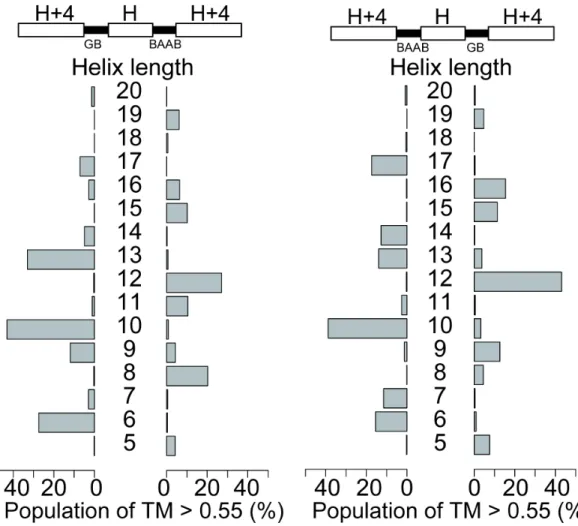
Figure S2-13. The blueprints and result of backbone-building simulation with blueprints containing two different loop types. (left) the GB-BAAB blueprint (Right) the BAAB-GB blueprints. As the GB and BAAB hairpins are both left-handed type hairpins, the helix-helix crossing angle cancels out so that the mixture of the GB and BAAB-loops can yield compact three-helix bundles in similar manners as GB-GB or BAAB-BAAB blueprints.
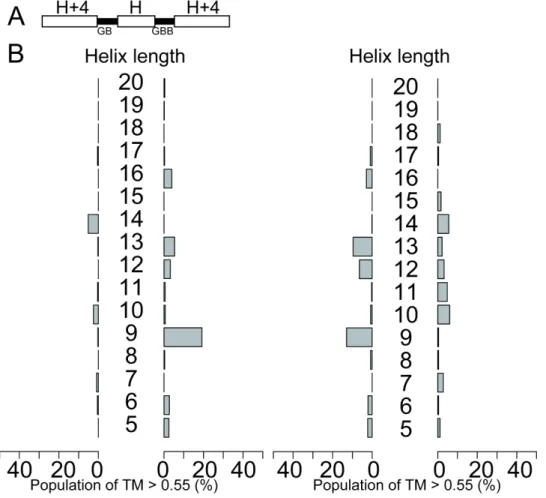
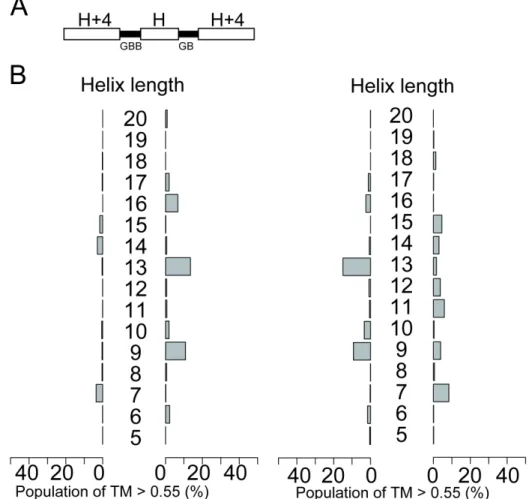
Figure S2-14. Backbone-building simulations with blueprints containing two different loop types. (A) The GB-GBB blueprint (B) Results of GB-GBB blueprint simulation referenced by CW decoy (left) GB-GBB blueprint simulation referenced by CCW decoy(right). Almost no patterns can be observed compared to the consistent blueprint such as GB-GB blueprints because combination of GB and GBB cannot cancel out the helix-helix packing angles.
Figure S2-15. Backbone-building simulations with blueprints containing two different loop types. (A) The GBB-GB blueprint (B) Results of GBB-GB blueprint simulations referenced by CW decoy (left) GBB-GB blueprint simulations referenced by CCW decoy (right). Almost no patterns can be observed compared to the consistent blueprint such as GB-BAAB blueprint because combination of GB and GBB cannot cancel out the helix-helix packing angles
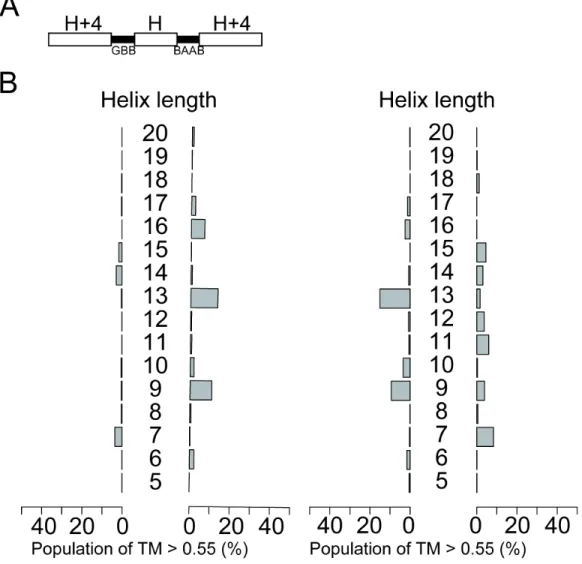
Figure S2-16. Backbone-building simulations with blueprints containing two different loop types. (A) The GBB-BAAB blueprint (B) Results of GBB-BAAB blueprint simulations referenced by CW decoy (left) GB-GBB blueprint simulation referenced by CCW decoy (right). Almost no patterns can be observed compared to the consistent blueprint such as GB-GB blueprints because combination of BAAB and GBB cannot cancel out the helix-helix packing angles.
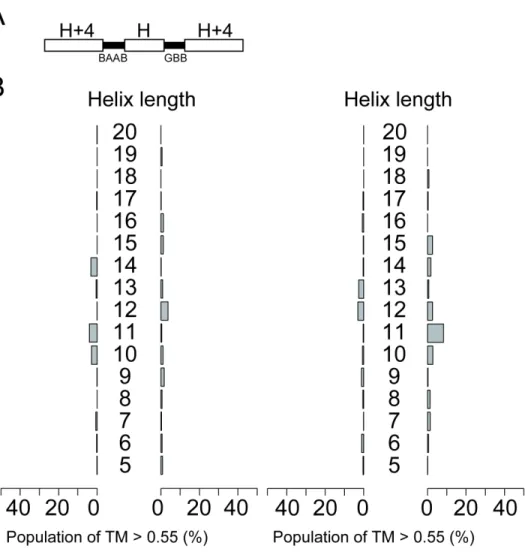
Figure S2-17. Backbone-building simulations with blueprints containing two different loop types. (A) The BAAB-GBB blueprint (B) Results of BAAB-GBB blueprint simulation referenced by CW decoy (left) BAAB-GBB blueprint simulation referenced by CCW decoy (right). Almost no patterns can be observed compared to the consistent blueprint such as GB-GB blueprints because combination of BAAB and GBB cannot cancel out the helix-helix packing angles.