2011-2012 JIIA Research Project
“P OLICIES N EEDED TO E NSURE J APAN ’ S I NTERNATIONAL
C OMPETITIVENESS ”
in part by a FY2011 Grant-in-Aid for International Affairs Research Studies and Recommendation Projects from the Ministry of Foreign Affairs, on the topic of “Policies Needed to Ensure Japan’s International Competitiveness.”
The bursting of the asset price bubble in the early 1990s sent the Japanese economy into a prolonged slump, and Japan’s competitiveness relative to the rest of the world has since been in a downtrend that has only accelerated with the remarkable catch-up achieved by emerging countries.
The devastating earthquake and tsunami that struck eastern Japan last year as well as the consequent nuclear power plant accident confronted Japanese companies with huge challenges as supply chains were severed and power shortages occurred. To make matters worse, many Japanese firms with operations in Thailand suffered losses from the flooding there. These problems were compounded by the recession in Europe and the historic appreciation of the yen, all of which contributed to poor business results among Japanese companies last year.
However, such external factors are not the only threats facing Japanese business. Emerging countries in Asia, South Korea and China in particular, have gained tremendous momentum, now standing on par with Japan and the West in terms of international competitiveness.
Japan has recently begun considering TPP participation and autumn university admissions, and the time has come for the country to actively adopt global standards and cultivate its strengths within an open global market in a bid to boost its international competitiveness.
This project benefited from the participation of leading Japanese researchers from various fields in discussing the question of how to improve Japan’s international competitiveness from the perspectives of demographics, employment, trade, investment, regulatory reform, R&D, and human resources development.
The results of this research project were presented at a February 18 open symposium that doubled as the project’s final briefing session, and the project members engaged in lively discussions with many of the symposium participants. Support from Mizuho Research Institute Ltd. was instrumental in making the symposium a grand success. Let me take this opportunity to convey my sincere gratitude to all involved.
It should be noted that the views expressed herein are entirely those of the respective authors and do not necessarily reflect the views of the Japan Institute of International Affairs. Nevertheless, I have every expectation that these research findings will prove both meaningful and useful in pondering the future of Japan’s foreign policy.
In closing, let me once again express my deep appreciation to the authors who undertook this research with such dedication and worked so hard in preparing this report, and to everyone who cooperated in these efforts.
March 2012
I
NTRODUCTIONToward Ensuring Japan's International Competitiveness ··· 1 ITŌ Takatoshi P
ART1
― S
ECURINGL
ABORR
ESOURCES ANDY
OUTHE
MPLOYMENT―
The Growing Population Onus and Manpower Issues ··· 18 KOMINE Takao Policy Responses to Youth Employment Issues ··· 47
OHTA Souichi P
ART2
― L
IBERALIZINGT
RADE ANDE
XPANDINGD
OMESTICI
NVESTMENT―
Liberalizing Trade and Investment and Ensuring Japan’s Competitiveness ··· 68 ABE Kazutomo Toward Expanding Sluggish Inward Foreign Direct Investment in Japan··· 89
URATA Shujirō P
ART3
― H
ARMONIZINGR
EGULATIONS ANDE
STABLISHINGR&D S
YSTEMS FORI
NTERNATIONALS
TANDARDS―
Regulatory/Systemic Reforms for Maintaining/Enhancing Competitiveness:
The Importance of Developing a Multi-tiered Strategy···113 NAKAGAWA Junji Developing R&D Capabilities Suited to International Standard Acquisition ···168
NAGAOKA Sadao P
ART4
― H
UMANR
ESOURCED
EVELOPMENT FORJ
APAN’
SI
NTERNATIONALC
OMPETITIVENESS―
Development of Internationally Viable Human Resources: Open Recruitment of Graduates for National Civil Service ― A Case Study of Australia···184
HATTA Tatsuo Rebuilding Japan's International Competitiveness and Developing Global Human Resources: From the Perspective of Competition with South Korea and China···206
FUKAGAWA Yukiko Profiles···249
*This research project was organized as one of the Ministry of Foreign Affairs’ FY2011 international affairs research/recommendation projects.
P
ART1
― S
ECURINGL
ABORR
ESOURCES ANDY
OUTHE
MPLOYMENT―
2011-2012 JIIA Research Project: Policies Needed to Ensure Japan’s International Competitiveness
Chapter 1
The Growing Population Onus and Manpower Issues KOMINE Takao
Introduction
This paper considers various population-related labor issues that Japan will likely face in the coming decades. Before delving into the main discussion, however, I would like to outline how this paper is related to the main theme of this symposium. The title of this symposium is “Policies Needed to Ensure Japan’s International Competitiveness,” which indicates that we should first identify what “Japan’s International Competitiveness” actually is.
Why having international competitiveness is important
Truly, signs of “Japan losing international competitiveness” can be seen everywhere. Firstly, Japan’s macro-economic performance is low compared to many other developed nations. We have been suffering from deflation for a prolonged period of time, and have been unable to grow out of it. Our growth has remained sluggish, and we are no longer the second largest economy in the world; that position is now held by China. Secondly, Japan’s visible trade balance turned to a deficit. In 2011, our visible trade balance plunged into the red for the first time in 31 years, and this condition appears likely to continue for the foreseeable future as well. Increased fuel imports after the accidents at the nuclear power plants and other extraordinary circumstances of course had some influence on this development, but it is hard to ignore the signs that the era of Japan exporting competitive products and continually holding a huge trade surplus has already ended. Thirdly, Japan is noticeably falling behind the global competition in terms of both micro industry and business aspects. We are facing an uphill battle with countries like South Korea catching up in areas that used to be our specialties, such as automobiles and digital home electric appliances. Fourthly, Japan seems to suffer from a weakening of its competitiveness in terms of the human resources that support our economy. Japan’s ranking in global comparisons of academic ability is no longer as high as before, and the number of students studying abroad has decreased sharply in recent years.
Many consider it important for Japan to regain its leading position in the global competition within these fields. However, if we focus solely on these individual fields and the building up of our competitiveness there, we might miss out on several important points.
18
The first reason for this is that an important question has not been addressed yet. Why is it important to heighten our international competitiveness to begin with? My answer to this question is as follows.
Needless to say, the ultimate purpose of any economy is to ensure a high standard of welfare for its citizens. In order to improve the standard of welfare as much as possible in a sustainable manner, it is crucially important that all citizens produce as much added value as possible, and that this value is distributed fairly. The purpose of improving our international competitiveness in individual fields is the achievement of this goal. If the international competitiveness of our industries, companies, and human resources is high, it should be possible to produce more added values than other countries using the same economic resources and labor force. Hence, we should consider improving each individual’s competitiveness as a means to improve welfare for everybody.
Secondly, there is a possibility that policies for areas not directly exposed to global competition may be neglected. For instance, it is necessary to redistribute income appropriately, design social security programs, maintain sound financial policies, and so on in order to improve our citizens’ welfare.
However, since these issues are outside the scope of international transactions, it is hard to connect them to the concept of “competitiveness.” Nonetheless, it is mandatory to take measures that compare favorably with similar initiatives in other countries.
Thirdly, many people tend to believe that the only acceptable result of improving our global competitiveness is that “we must be number one in all fields.” However, in order to take advantage of the “principle of comparative advantage” to maximize the benefit of the international division of labor, it is also necessary to concentrate our resources on our strong fields and to recognize Japan’s weaknesses and withdraw from those fields. For example, it is necessary to increase both exports and imports in order to expand free trade through the promotion of the Trans-Pacific Strategic Economic Partnership Agreement (TPP) and so on.
Global competition for affluence
I found an impressive statement in the “White Paper on the Economy and Public Finance” for 2011;
“increasing imports does not mean that we ‘lose in the global competition,’ but we ‘win in the competition for affluence’ if we increase both exports and imports.” 1 This illustrates the meaning of trading and can be considered a considerably intrinsic and important point.
At the end of the day, our goals in global competition should be all about “affluence.” If there are countries similar to Japan that are more affluent than us, Japan will have lost in the competition for
2011-2012 JIIA Research Project: Policies Needed to Ensure Japan’s International Competitiveness
affluence with those countries. In order for Japan to become a proud, leading country in the world, we must win in the competition for affluence.
Economically speaking, the best indicator for such affluence is “income per capita.” Although some may argue that “a high income does not automatically make a person happy,” it is certainly true that a high level of income broadens people’s freedom and range of possibilities.
In order to examine this point, I have compared the per capita GDP of OECD countries (Table 1) and the result shows that Japan is ranked 14th, at a level that is approximately half that of Norway. This indicates that Japan is still lagging far behind in the “competition for affluence.”
Note that we eventually reach the conclusion that—assuming other conditions remain the same—the income per capita decreases as the demographic structure of Japan changes. In order to avoid this, it becomes necessary to increase our labor force participation rate and strengthen our labor productivity further.
This is how the consideration of “labor issues in relation to population issues” leads to the awareness of issues of “securing Japan’s international competitiveness” discussed at this symposium.
Table 1 Per capita gross domestic product of OECD countries (dollars)
(Unit: 1000 dollars) Rank Country 1994 2000 2005 2008 2009 2010
1 Luxemburg 43.5 46.5 81.0 118.4 104.5 105.3
2 Norway 28.7 37.5 65.3 93.4 76.8 84.5
3 Switzerland 38.4 34.7 49.7 65.3 63.1 67.8
4 Australia 20.3 21.3 37.2 48.5 45.2 56.4
5 Denmark 29.5 30.0 47.6 62.6 56.3 56.3
6 Sweden 24.8 27.9 41.0 52.7 43.5 48.9
7 Netherlands 22.8 24.2 39.1 53.0 48.0 46.9
8 United States 26.7 35.1 42.4 46.6 45.1 46.6
9 Canada 19.5 23.6 35.2 45.1 39.7 46.2
10 Ireland 15.6 25.6 48.9 59.3 49.9 46.2
11 Austria 25.4 24.0 37.1 49.7 45.7 45.2
12 Finland 19.8 23.5 37.3 51.2 45.1 44.5
13 Belgium 23.9 22.7 36.0 47.3 43.8 43.1
14 Japan 38.8 37.3 35.8 38.0 39.4 43.0
15 Germany 26.4 23.0 33.5 44.1 40.3 40.1
(Source) Reference charts and tables in the “Annual Report on National Accounts of 2010” by the Cabinet Office
20
1. International comparison of conditions of population onus
When considering the future of the Japanese economy and society, population issues are critically important. Why are population changes important, then? It is my understanding that the key to answering this question is “population onus.” Moreover, as explained in the following, an examination of the concept of “population onus” clearly indicates that the population burden is significantly greater in Japan than in other countries.
(1) What is population onus?
No one would deny that the impact of population changes is important in the long term outlook of the future Japanese economy and society. The population changes themselves can best be described using terms such as “depopulation,” “aging population,” and “falling birthrate,” but the impact of these population changes in the future can be expressed in the single phrase “population onus.”
This term indicates the phenomenon of a declining ratio of workers to total population. “Onus”
means “burden” and formed as an expression indicating the opposite of “population bonus.” These two phenomena occur in series; a period of “population bonus” is eventually succeeded by a period of
“population onus.”
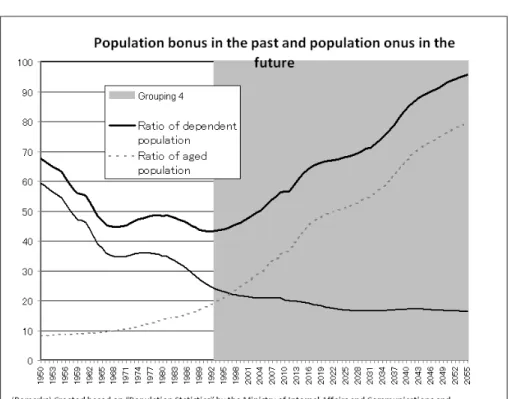
Postwar Japan went through precisely this transition. The Japanese birthrate gradually declined after the war. After some time, the people born during the era of high birthrates grew up to become a large working-age population (15 to 64 years old) while the newly born population shrunk, and as a result the overall ratio of the dependent population (sum of the child and elderly populations divided by the working-age population) dropped considerably. Assuming for the sake of simplicity that the working- age population is equal to the worker population, the ratio of the working population out of the entire population increased significantly as a consequence; this is referred to as a population bonus. The period from the 1950s to the 1970s, which coincided with a period of high growth, was a period of population bonus. This condition does not last long, however. While fewer and fewer people enter the working-age population, people born in the past period of high birthrates age year by year, increasing the ratio of the dependent population. This is referred to as a population onus. Japan entered this phase around the 1990s.
2011-2012 JIIA Research Project: Policies Needed to Ensure Japan’s International Competitiveness
Figure 1 Population bonus in the past and population onus in the future
Figure 1 shows future trends in the ratio of the dependent population in Japan based on statistics produced by the National Institute of Population and Social Security Research (2006, projections on medium-variant fertility and mortality assumptions). From this figure, it can be seen that the ratio of dependent population continues to rise in the future and that we have just entered the early stages of a period of population onus that will last for a long period of time.
(2) International comparison of population onus
Thus, Japan already faces a population onus whose severity is only going to intensify in the years to come. From an international comparison point of view, the following two points are important regarding this population onus.
The first point is that the level of population onus will become very high relative to the international standard. Table 2 lists countries with high dependent population ratios from among 50 major countries based on the 2010 Revision of the World Population Prospects by the United Nations. The ratio of the dependent population in Japan was ranked 7th in the 2010 revision, but will become the highest in the
22
world in 2050. (In 2050, the index of Japan is 96 in the projection by the UN and 93 in the projection by the National Institute of Population and Social Security Research. Since the index of number 2 on the list, Spain, is 90, Japan’s value is the highest in the world regardless of the projection used.)
Table 2 Ranking of ratio of dependent population in 50 major countries
2010 2030 2050
Rank Country Ratio Rank Country Ratio Rank Country Ratio
1 Nigeria 86 1 Nigeria 77 1 Japan 96
2 Norway 83 2 Japan 75 2 Spain 90
3 Pakistan 66 3 Germany 72 3 Italy 89
4 Philippines 64 3 Finland 72 4 Portugal 87 5 Israel 60 5 France 68 5 South Korea 85 6 Egypt 58 5 Netherlands 68 6 Germany 83 7 Japan 56 7 Belgium 67 7 Switzerland 82
8 India 55 7 Sweden 67 8 Greece 82
8 Mexico 55 9 Italy 66 9 Singapore 81 8 Argentine 55 9 Denmark 66 10 Austria 78
Reference Entire world 52 Entire world 53 Entire world 58
Developed nations
48 Developed nations
63 Developed nations
73
(Source) Based on “World Population Prospects, the 2010 Revision” by the UN. Ranking among 50 countries with a large economic scale.
2011-2012 JIIA Research Project: Policies Needed to Ensure Japan’s International Competitiveness
In other words, Japan is facing the greatest burden of population onus in the world. This means that Japan must consider population onus issues the most seriously and do whatever it possibly can to counter the problems caused by them.
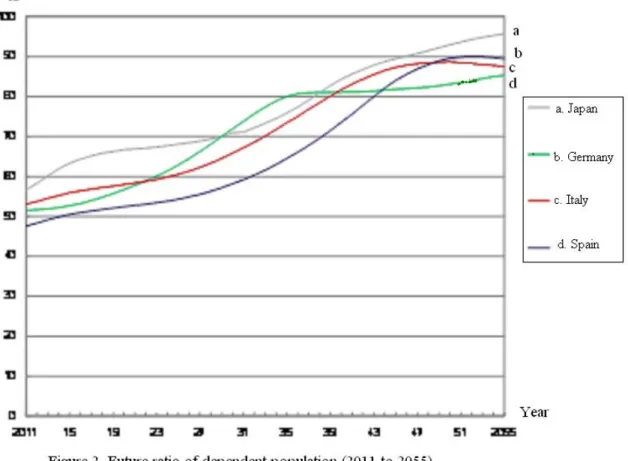
Figure 2 shows the future prospects of a number of developed countries with a high dependent population ratio. While the ratio will rise in the long term in all of these countries, the ratio in Japan stays at the highest level throughout most of the period covered in the figure.
The second point is that the population in many Asian countries, in particular, will follow the exact same trend as the Japanese population in the near future. Looking at the populations in Asia for the next 50 years or so, the population changes will follow a “flying geese” pattern. In Asia, the industrial sectors became modernized and advanced one after another, first in Japan, and then in the newly industrializing economies (NIES), followed by the Association of Southeast Asian Nations (ASEAN),
24
and now in China. This has been termed the “flying geese pattern of economic development.” In the near future, however, a population version of the flying geese pattern will develop as well (see Table 3 and Figure 3).
Again, Japan is in the lead here. In Japan, the population changes have occurred ahead of the other Asian countries, in the order of “advancement of falling birthrate,” “shift to aged society,” “decline of labor force population,” and then “decline of total population.” In the near future, the same changes will occur in the same order in the succeeding Asian countries as well.
In South Korea, Singapore, Thailand, China and other countries, birthrates have already started to decline, and the aging of these populations will set in rapidly in the future. The same trend will occur in the ASEAN countries (not including Thailand) and India, with a slight delay. In these countries, the birthrate will gradually decrease as income levels rise, and the aging of the populations will start to accelerate from 2025 to 2050.
Table 3 Development of population aspects in Asian countries
Time period
Period when total fertility rate drops below 2.1
Period when ratio of elderly population reaches 14% or higher
Period when working- age population starts to decline
Period when total population starts to decline
1950-1955 1955-1960 1960-1965 Japan 1965-1970 1970-1975
1975-1980 Singapore 1980-1985 Hong Kong 1985-1990 South Korea
1990-1995 China Japan
1995-2000 Thailand
2000-2005 Japan
2005-2010 Vietnam Japan
2010-2015 Hong Kong
2015-2020 Indonesia South Korea, Singapore
China, Hong Kong South Korea
2020-2025 Malaysia South Korea, Singapore
2025-2030 China, Thailand China
2030-2035 India
2035-2040 Philippines Vietnam Thailand, Vietnam Singapore
2040-2045 Malaysia, Indonesia Thailand, Vietnam
2045-2050
2011-2012 JIIA Research Project: Policies Needed to Ensure Japan’s International Competitiveness
(Note) The rate of change of total fertility rate and working-age population/total population was measured as 5-year average values. The ratio of the elderly population was measured in 5–year increments; for example, 1995 is classified in “1990-1995.”
(Source) “Demographic Change and the Asian Economy” by the Japan Center for Economic Research (March 2007)
In other words, all of the Asian countries will eventually face their own periods of population onus, and the periods of population bonus that have supported their growth until then will disappear. The growth environment will become more severe, and they will face serious problems in securing a stable life for their growing elderly populations.
26
2. Various effects of population onus on the economy and society
The population onus has a number of different influences on the economy and society. Indeed, virtually all the problems faced by the economy and society related to population changes are basically brought about by “population onus” (the decline of the working population ratio to the entire population).
(1) Population onus and affluence in daily life
As mentioned at the beginning, the ultimate goal of any economy is the improvement of the welfare of its citizens and it is safe to say that we are “competing for affluence.” Unfortunately, as will be shown below, population onus will invariably lead to a loss of affluence if all other conditions remain constant. Since the degree of population onus in Japan is the highest in the world, Japan will be unable to win in the competition for affluence if we leave the population onus to take its own course.
Let us assume that the national welfare is represented by income per capita, which is the per capita added value productivity. Even if the population increases, the per capita income is bound to decrease if the productivity declines. On the other hand, if the productivity rises, the income per capita increases even if the population decreases. That is, if the added value produced per person is the same (or increases), the income per person remains the same (or increases) regardless of whether the population increases or decreases.
Then, how about population bonus and population onus? Let us briefly review the determinants of income per capita once again.
Assuming that the national economic welfare is expressed by income per capita, national income per capita is by definition calculated by multiplying the ratio of the labor force population to the total population and the productivity per worker, as shown in the formula below.
Y / P = (L / P) x (Y / L)
Y: gross national product, P: total population, L: labor force population
This formula means that the national income per capita is constant if the ratio of labor force population to the total population (labor force participation rate) is constant as long as the added value productivity per worker is kept constant. In a period of population bonus, however, the labor force participation rate rises, which means that the income per capita increases even if the added value productivity per worker remains the same. In Japan’s era of high economic growth, the added value
2011-2012 JIIA Research Project: Policies Needed to Ensure Japan’s International Competitiveness
productivity increased dramatically due to improvements in labor force education and quality, implementation of new technologies, and changes in industrial structures, among others. In addition, as the labor force participation rate was growing as well, the income level rose even further.
The opposite phenomena occur in a period of population onus. Even if the added value productivity per worker remains the same, the labor force participation rate drops, leading to a decline in income per capita. In this case, in order to heighten the level of national welfare, it is necessary not only to simply increase the added value productivity, but to do so to the extent that it compensates for the declining labor force participation rate.
Table 4 shows the results of evaluating the formula using actual figures. From 2010 and onward, the factors of population onus will drag down the growth of per capita GDP by around 0.5% per year.
Table 4 Factor analysis of per capita real GDP
The population data is based on the Population Census; data from 2010 and onward is based on projections (medium-variant fertility and mortality assumptions) by the National Institute of Population and Social Security Research. GDP is expressed as percentage relative to 1990 (68SNA) for 1955 to 1970 and 1970 to 1990, and 2000 (93SNA) for 1990 to 2000. All the rates of change are annual average rates.
This point tends to be overlooked but is very important. Many claim that “because the labor force population decreases, it is necessary to raise the labor productivity even further than in the past in order to generate the same income (or to maintain the same economic growth rate).” However, correctly, it should be “because the ratio of the labor force population to the total population decreases, it is
28
necessary to raise the labor productivity even further than in the past in order to generate the same income per capita.” Essentially, the idea is to overcome the negative force of population onus by pulling up the productivity. This is the basic direction to take in economic management in a period of population onus.
(2) The economy and society under population onus
During a period of population onus, the following difficult socio-economic challenges arise.
The first challenge is a general decline in growth potential. The long-term growth potential is determined by labor force population, savings (capital), and other productive factors. In a period of population onus, owing to a drop in the ratio of the labor force population to the total population, there tends to be a lack of available labor, which in turn restricts growth. In addition, as the ratio of workers to the total population drops and the ratio of retirees increases, fewer people increase savings while more people take out savings; thus, the ratio of savings in the overall economy drops, which in turn restricts new investment.
Secondly, it becomes difficult to maintain social security programs. In particular, serious issues occur if pay-as-you-go pension and health services are established in a period of population bonus, because the ratio of workers to the total population drops and the ratio of retirees increases, meaning that the population receiving insurance money increases while there are fewer and fewer people to pay premiums.
Thirdly, issues in terms of social decision making also occur. Changes in demographic structure affect political decision making through changes in the structure of the voting population. During a population onus period, the ratio of elderly voters increases, which makes it easier for candidates who publicize policies that cater to elderly and retired voters to win in election.
The distribution of voters in Japan is already considerably slanted toward the elderly at present, and the degree is expected to increase rapidly in the near future. This development will certainly affect the future directions of social decision making. The problem here is that the bias in political decision making that manifests itself in this manner is going to pull in the exact opposite direction of what is actually required during a population onus period. That is:
[1] In a period of population onus, it is necessary to raise per capita productivity more than ever and, for that purpose, it is necessary to strengthen supply capabilities. However, if importance is placed on
2011-2012 JIIA Research Project: Policies Needed to Ensure Japan’s International Competitiveness
the retired generation, policies emphasizing the aspect of distribution, rather than supply capability, tend to be chosen first.
[2] Since the social security burden on the working population becomes increasingly heavier under a period of population onus, it becomes necessary to ask the retired generation to carry a part of the burden itself, but this becomes more difficult as a result of the voter distribution.
[3] During times of budget deficits, it is a significant fundamental problem in the current democracy that the future generations who will have to shoulder the burden later on cannot participate in the current decision making processes. Decision making centered on the retired generation makes this problem even more serious.
Thus, the skewed voter structure during the oncoming population onus period is bound to affect the various problems we are facing in such a way as to make the solution increasingly difficult.
(3) Population onus issues deeply involved in immediate problems
Population onus is not only related to the aspect of growth but also to certain immediate problems.
One of those issues is reconstruction following the recent earthquake disaster. Even before being struck by the great earthquake in 2011, the Tohoku region was already being heavily affected by population onus, as working people had steadily been migrating to urban regions causing the ratio of workers to the total population to drop significantly below the national average.
The earthquake disaster seems to have further reinforced this state of population onus. Looking at the population migration after the earthquake in the “Annual Report on the Internal Migration in Japan Derived from the Basic Resident Registers” by the Ministry of Internal Affairs and Communications, the population outflow from the Tohoku region exceeds that of previous year by a significant margin.
Fukushima prefecture, in particular, experienced a considerably large population outflow (Figures 4 and 5). Looking at this phenomenon by age, the outflow of the working-age population is particularly noticeable; these people left their home prefecture to seek employment opportunities elsewhere or to protect their children from the effects of radiation.
This means that the already severe condition of the population became even more aggravated in the afflicted areas, which may make their reconstruction, already difficult task in itself, even harder. It is often said that getting afflicted areas back into shape should be a matter of reconstruction rather than just restoration. This is true, but one cannot help thinking that even restoration alone is going to be a considerable challenge considering the current population development.
30
In order to overcome this burden of population onus and to be able to achieve reconstruction, we must create employment opportunities through fairly strong policies. Acting decisively in this manner would have the added benefit that if the Tohoku region is able to recover, Japan will have a development model for dealing with the period of population onus the entire country will go through in the coming years.
Another issue is the controversial TPP issue, which has split public opinion in two. In fact, the necessity of joining the TPP becomes even higher under the condition of population onus.
There are two main advantages in promoting free trade initiatives such as the TPP. One is that domestic resource allocation can be made more efficient by allowing us to export products we excel in and import products we are not good at producing ourselves. Another advantage is that the domestic supply framework can be made more efficient by exposing domestic production that has been protected by existing barriers to global competition.
In a period of population onus, the labor force and other productive resources become more valuable, which means that making the supply structure more efficient through globalization becomes increasingly important. Listening to discussions on the TPP, it appears that people often assume that increased exports are advantageous, while increased imports are disadvantageous, but this is wrong.
One of the significant advantages of free trade is that domestic resources are shifted toward more expansive fields due to increased imports, and this advantage only becomes greater under population onus conditions.
Figure 4 Migration of population by region after the Great East Japan Earthquake
Changes in net emigration / immigration
2011-2012 JIIA Research Project: Policies Needed to Ensure Japan’s International Competitiveness
Figure 5 Migration of population in Fukushima Prefecture after the Great East Japan Earthquake
Number of excess migration in Fukushima prefecture, year-on-year comparison
3. Employment issues under population onus conditions
Since population onus means that the ratio of labor force population to the total population declines, it is fairly obvious that a general lack of available labor force will restrict the growth under population onus conditions.
(1) Labor shortage under population onus and measures to be taken
Population onus has a significant impact on employment. Since the birthrate has already started falling in Japan, the working-age population is declining; the working-age population in 2010 was 81,730,000, but this will decrease consistently and is projected to drop to 67,400,000 in 2030 and 49,300,000 in 2050.
32
Degree of labor shortage
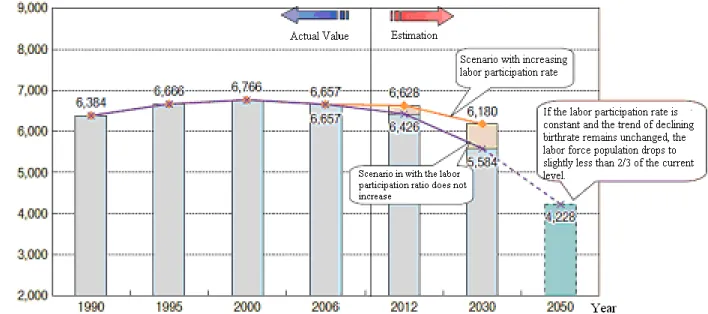
Then, how much of a reduction of the labor force population does a reduction in the working-age population bring about? It is not possible to provide an absolute answer to this question, because the labor force participation rate in each age group has different impacts on the overall issue. The Cabinet Office introduces the following estimate in its “White Paper on Birthrate-Declining Society” (2011) (Figure 6). Firstly, if we assume that the rate of participation in the labor market by gender and age remains at the current level, the labor force population is going to be dramatically reduced from 66.57 million people in 2006 to 55.84 million people in 2030, i.e., a reduction of approximately 10 million people in 25 years. On the other hand, it can be expected that an increasing number of the elderly and women will to be active in the labor market, and taking this effect into account, the labor force population in 2030 is estimated to be around 61.80 million people, meaning a reduction of only approximately 5 million people in the same period.
Figure 6 Development and prospect of labor force population
Materials: The actual values are based on the “Annual Report on the Labor Force Survey” by the Ministry of Internal Affairs and Communications. Estimations until 2030 are based on estimations by the Japan Institute for Labour Policy and Training (“Estimation of Labor
2011-2012 JIIA Research Project: Policies Needed to Ensure Japan’s International Competitiveness
Force Supply-Demand 2007 – Result of Projections using Labor Force Supply-Demand Model” in February 2008). The labor force population in 2050 is estimated by the Office of Director for Social Security of the Ministry of Health, Labour and Welfare based on the medium-variant assumption of the “Population Projection for Japan (December 2006),”
assuming that the labor force participation rate by gender and age group in 2030 and onward remains constant.
(Source) “White Paper on Birthrate-Declining Society 2011” by the Cabinet Office
In other words, by increasing the labor participation rate through policy efforts, it is possible to keep the reduction of labor force population in the coming 25 years at half the level of reduction that would bee seen if the rate were to remain at the current level. Nonetheless, a considerable decline in the labor force population cannot be avoided.
Basic measures against labor shortage
How should we cope with this foreseeable labor shortage? The following specific measures can be considered.
The first measure is to increase the labor participation rate of the elderly and women, which is explained in detail later. The second measure is to strengthen labor productivity, also known as an
“inherent growth strategy.”
First of all, it is necessary to cultivate the capabilities of each individual person. Specifically, this means maintaining high educational standards to increase the availability of human resources with acquired higher expertise. It is also necessary to assign human resources to fields with higher growth potential. Since the labor force will become more valuable from now on, wasting human resources must be avoided. The available labor force should be moved to developing fields where high productivity levels can be achieved and service fields that are truly needed by the citizens as much as possible. In order for this to happen, the labor force must be made mobile according to changes in the socio-economic environment, rather than remaining immobilized in specific fields.
Two measures against lack of capital can be considered. One is to establish a sounder public finance system. If savings become scant in the near future, wasting valuable savings to finance budget deficits is going to cause serious problems. We must reform the public finance system to separate savings from public finances in order to achieve long-term benefits. The other measure is the promotion of
34
investment from overseas. The U.S. is able to achieve a high level of domestic investment in spite of its low rate of savings because of a steady capital inflow from overseas investments. Eventually, Japan will also have no choice but to rely on a similar capital inflow. It is essential to establish an active investment climate within Japan so that capital may flow continuously in across the border.
In addition, it is necessary to boost total factor productivity by making our market frameworks more efficient and promoting technological development.
The importance of such policies is not limited to the era of depopulation. Regarding employment, for example, increasing the labor force participation rate, cultivating the capabilities of employees, and allocating resources flexibly will stimulate accelerated growth in times of population growth as well.
The same thing can be said about the improvement of capital inflow and total factor productivity as well.
In other words, during this oncoming population onus, we should adopt orthodox policies necessary in ordinary times as well more seriously, rather than special policies addressing extraordinary times.
The third measure is borrowing help from foreigners. In Japan, there is a considerably strong social resistance against this, but we cannot afford to be so haughty considering the magnitude of the population onus we are facing.
The fourth measure is to have companies relocate production bases overseas. In Japan, this is considered as hollowing out our industrial base and therefore undesirable. However, taking into account that Japan is actually facing a deficit in labor force in the near future, we should consider it a necessity that companies branch out to overseas locations in order to ensure that we have sufficient human resources available within Japan as well.
(2) Raising the labor force participation rate
Since population onus means a lowered ratio of workers to the total population (i.e., country-wide employment rate), increasing the employment rate is the quickest and most efficient method to fighting against population onus. This subject thus deserves deeper investigation.
Effects of raising labor force participation rate
First, let us review how effective raising the labor force participation rate is in coping with the oncoming population onus.
Previously, for the sake of convenience, we used the ratio of the dependent population (ratio of the working-age population to the elderly and child population) as an index of population onus. In order to
2011-2012 JIIA Research Project: Policies Needed to Ensure Japan’s International Competitiveness
discuss the labor force participation rate, however, it is more appropriate to consider the ratio of labor force population to other populations.
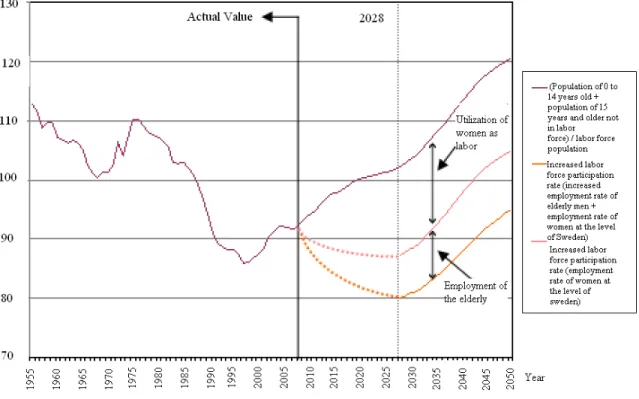
In order to calculate the ratio of the dependent population based on the labor force population, it is necessary to project the future ratio of the labor force by gender and age. This ratio is influenced by many factors such as school attendance rate, treatment by companies, views on marriage, retirement age, level of pension and pension eligibility age, as well as political initiatives. Here, we make the simplest possible estimations of the future labor force population by assuming the current employment rate by gender and age remains constant, and then we calculate the ratio of the dependent population (Figure 7). The result is 92.1 (one in 1.1 people) in 2005, 101.4 (one in 1.0 person) in 2025, and 120.6 (one in 0.8) in 2050.
Now that the labor force population is an endogenous variable, it is possible to consider changes in employment rate of women and the elderly. It is assumed that the employment rate of elderly men will grow over the coming 20 years (2028), such that the employment rate of an elderly age group becomes equal to the current employment rate of men who are 5 years younger. For example, the current (2007) employment rate is 93.1% for men in the latter half of their 50s and 74.4% for men in the first half of their 60s. The aforementioned assumption thus implies that the rate increases to 93.1% for men in the first half of their 60s and 74.4% for men in the latter half of their 60s by 2028.
Next, we assume that the employment rate of women by age rises to the level of Sweden (2006). For example, in 2007, the employment rate of Japanese women was 64.0% for women in their early 30s and 64.3% for women in their late 30s, due to the so-called M-shaped curve. Here we assume that the respective ratios go up to the level of Sweden during the coming 20 years, reaching 85.5% and 86.5%, respectively.
Taking these two assumptions into consideration, the ratio of the dependent population is estimated to be 79.5 (one in 1.3 people) in 2025 and 95.0 (one in 1.1 people) in 2050, which are not that different from the level in 2005.
From the examination above, we can conclude: firstly, raising the labor force participation rate has a considerable effect in terms of fighting against population onus; secondly, it is important to change basic mechanisms within the entire society such that women and the elderly become more useful to the labor market; and thirdly, women have greater potential in this respect than the elderly.
36
Figure 7 Ratio of dependent population relative to labor force population
Unutilized potential among women
Let us examine the impact of increasing the labor force participation rate of women. It is clear from international comparisons with other developed nations that Japan has not fully utilized the potential of its female population.
First, the overall employment rate of women is low. As can be seen in Figure 8, the employment rate of Japanese women is ranked 22nd among the 30 countries in the figure, because the so-called M- shaped curve exhibits a significant valley where the employment rate drops. Figure 9 compares the employment rate of women by age with other countries. As is clear from the figure, the Japanese employment rate drops once from the latter half of the 20s to the first half of the 30s, and then increases again from the latter half of the 30s to the first half of the 40s, exhibiting a roughly M-shaped trend.
The reason for this is that it is quite common for Japanese women to retire from work once around the
2011-2012 JIIA Research Project: Policies Needed to Ensure Japan’s International Competitiveness
time they get married and raise children, and then start working again once the first stage of child rearing is completed.
In contrast, Sweden has a well-established gender-equal society and institutions in place that make it easier for women to handle child rearing while pursuing careers at the same time; thus, there is no valley part in the corresponding employment rate curve. In fact, the valley part of the M-shaped curve indicates how difficult it is for women to satisfy both career goals and child-rearing in Japan. This is clearly a key point when it comes to increasing the employment rate of women.
Moreover, Japan is characterized by the fact that the employment rate of highly-educated women is relatively low. Looking at the women’s employment rate by educational background, the rate of junior high and high school graduates is 59.8% in Japan while the average level within the OECD countries is 66.6%, corresponding to a gap of 6.8 percentage points. Similarly, in the case of female graduates from universities and graduate schools, the rate is 68.4% in Japan, while the OECD average is 79.8%, corresponding to a gap of 11.4 percentage points (2006).
Considering that the length of academic background is a good indicator of labor quality, the participation ratio of the Japanese female labor force can be characterized as low in two aspects; in terms of overall numbers and in terms of highly educated women.
Figure 8 Employment rates of women in OECD countries
38
(Remarks) 1. Created based on OECD’s “Employment Outlook 2010”
2. The employment rate is calculated as: number of employees / population.
(Source) “White Paper on Gender Equality 2011” by the Cabinet Office
Figure 9 International comparison of employment rates of women by age
(Remarks) 1. “Labor participation rate”: Ratio of labor force population (employed workers + completely unemployed) to the population of 15 years old and over.
2. The data used for the “15 to 19 years old” age group for the U.S. is from the age group
“16 to 19 years old.”
3. The Japanese data is created based on the “Labor Force Survey (detailed statistics)”
(2010) by the Ministry of Internal Affairs and Communications, and data of other countries is created based on ILO “LABORSTA.”
4. The data for Japan are 2010 values, the data for South Korea are 2007 values, and the data for other countries are 2008 values.
(Source) “White Paper on Gender Equality 2011” by the Cabinet Office
2011-2012 JIIA Research Project: Policies Needed to Ensure Japan’s International Competitiveness
Employment rate of the elderly and employment issues of young people
Next, let us examine issues related to the elderly population. Here, fortunately, a promising feature is revealed: Japanese elderly are highly motivated to work. Comparing the employment rate of the elderly with other countries, the employment rate of men of 65 to 69 years old is 45.6% in Japan, while the same rate is only 4.1% in France and 7.2% in Germany, for instance.
Raising the employment rate of the elderly is greatly significant for the following reasons: (1) the standard of life among the elderly themselves is improved, (2) the labor shortage is alleviated as the overall employment rate of the whole nation improves, and (3) the imbalance between the generations can be evened out by increasing the working population and reducing the retired population. In addition, since employment and health conditions are deeply related, increasing the employment rate may also have the effect of suppressing healthcare expenditures of the overall society due to health improvements among the elderly.
Thus, the improvement of the employment rate of the elderly has the effect of “killing several birds with one stone” during an era of population onus. However, it must be pointed out that even if the elderly have the will to work, there may not be jobs available that match their abilities; this is an area where there is room for much improvement.
Furthermore, it is noted that the idea of increasing the employment rate of the elderly does not seem to find much support among young people. I have witnessed this sentiment first-hand; when I asked my university students about their opinions on this point in my classes, many of them responded that they cannot agree with or they doubt the importance of raising the employment rate among the elderly. The reason is clear enough: they think that if the elderly stay in jobs forever, there will be less employment opportunities for the young people themselves.
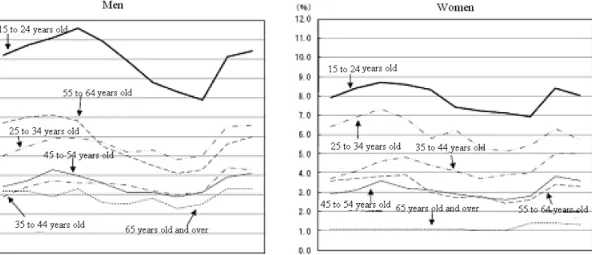
This is a justifiable concern considering the recent employment circumstances surrounding young people; in fact, young people are sacrificed for the elderly in the aspect of employment adjustment to some extent. Figure 10 shows trends in the unemployment rate by age. From this figure, we can see that (1) the unemployment rate of young people is always higher than for other age groups, and (2) the unemployment rate of young people in particular tends to rise whenever companies are forced to make employment adjustments due to recession (for example, after the Lehman Crisis in 2008).
40
Figure 10 Development of unemployment rate by age
(Source) “Annual Report on the Labor Force Survey” by the Ministry of Internal Affairs and Communications
If companies are pressed to make employment adjustments, they tend to suppress new hiring at first because that is generally the easiest approach. However, if young people are unable to be employed after graduation and start working as part-time workers or the like as a result, many of them will lose their chance to get training and thus end up remaining stuck in unstable conditions. This gives rise to the notion that the lifelong fate of young people is determined by the timing of when one was born.
Such unfairness among generations is caused by current employment practices such as long-term employment and simultaneous recruiting of new graduates.
Inevitably structural reform issues
The problems discussed above, such as the low labor force participation rate of women, the elderly being unable to find desirable employment opportunities, and young people being strained during difficult economic times are all deeply related to typical employment practices in Japan. In other words, it is essential to review our way of working in order to solve these problems.
Firstly, if long-term employment is dominant, companies will not be willing to invest in the education/training of women as core labor force, because there is a risk that they will retire early. This
2011-2012 JIIA Research Project: Policies Needed to Ensure Japan’s International Competitiveness
attitude reflects upon the women as well; they feel that companies won’t give them important jobs anyways and choose to take up homemaking instead when they get married and/or having children. In addition, under long-term employment, the degree of work required tends to be determined by work hours, rather than the number of workers. In this case, workers may be forced to work long hours in certain periods, which places women in a disadvantageous position because they are less flexible with respect to working hours.
Likewise, the practice of long-term employment inhibits the employment of the elderly in several ways. For example, if a company attempts to promote the employment of the elderly, it tends to extend retirement age in its policies to continue to employ the elderly it has already been employing; however, this does not guarantee that it can provide opportunities for jobs that are actually well suited to the elderly. If the elderly stick to their original company, they can often only get marginal assignments, which is a misfortune for both the company that keeps on employing the elderly and the elderly who are employed. We must improve the fluidity of the labor force and adjust the demand and supply of the elderly work force among a wider range of fields.
In addition, the suppression of employment of new graduates tends to be chosen as a means of employment adjustment in difficult economic times because it is difficult to adjust existing permanent employees under the practice of long-term employment as well.
Secondly, when seniority-based wages are predominant, the longer the length of service of workers, the more advantageous they become. Consequently, the wage gap between permanent employees and non-permanent employees, as well as full-time and part-time employees, becomes greater. However, it is also difficult to have a policy of equal pay for equal jobs in place as well. Women who completed childrearing by necessity aspire for shorter working hours, in which case their job options are restricted to relatively low-paying jobs.
Moreover, if a company has a strong policy of seniority-based wages in place, the wages will have to be higher for older employees, meaning that reemployment after leaving the first company once becomes difficult. Furthermore, in addition to suppressing ever-increasing wage costs, many companies have a system of compulsory retirement age. This system forces all employees to retire from their work places at a fixed age, without providing exceptions for human resources that the companies might actually benefit from maintaining longer.
Thirdly, in the traditional employment practices, the standard employment course starts with the hiring of new graduates and then proceeds with education/training via on-the-job training, which makes mid-career recruiting difficult. In cases in which workers join a company mid-career, the company
42
typically does not assign core jobs to them; they are mainly given peripheral and/or simple tasks. This practice also inhibits the re-entry of highly-educated women to the labor market after the completion of child rearing.
In addition, as long as on-the-job training aimed at new employees is the primary basis for the cultivation of human resources, new graduates that fail to be employed immediately after graduation also lose their chance to improve their value as human resources.
It is clearly necessary for Japanese businesses to review their employment practices in order to achieve a far more flexible employment environment, where equal jobs yield equal pay. The current situation demands changing old systems and practices, as well as promoting structural reforms of employment policies in such a way as to improve the labor force participation rate so that we may overcome the oncoming population onus.
4. Direction of required policies
Lastly, I would like to summarize the basic direction of policies on employment issues required under population onus conditions.
(1) Offering a model for the world by addressing population onus
Japan is becoming one of the world’s most advanced nations in terms of population onus. At the very forefront of the “flying geese” pattern of industrial structure, Japan has been an example to the countries following it, showing a model of growth through high added value by continually improving trade and industrial structures. In the future, Japan may be able to serve as a new growth model for the 21st century if it can face up to the challenges of population onus and maintain its economic and social vitality.
However, to reach that goal we must work toward integrating active measures against the population onus in all of the following policies: falling birthrate, employment, and social security. In addition, in order for them to have the desired effects, such policies must remain stable and consistent for long periods of time. It may be necessary to formulate a framework based on cross-party agreements or propose a policy system based on deliberation among independent experts.
(2) Addressing declining birthrates
Eliminating the population onus itself by raising the birthrate will lay the groundwork for addressing population onus issues. This is not impossible, considering the fact that many developed countries have
2011-2012 JIIA Research Project: Policies Needed to Ensure Japan’s International Competitiveness
indeed succeeded in raising their birthrates through policy efforts. However, it will take more than 20 years before the effect of such efforts start to appear, so this is not exactly a quick fix. Thus, we have to start taking measures as soon as possible.
As measures against falling birthrates, there are generally two types of approaches: policies appealing to the unmarried population and policies appealing to the married population who intend to have children (or already have children). Concerning the former, recent deteriorating employment conditions among younger generations has discouraged marriage among young people, which has been contributing to accelerating the decrease in the birthrate. From this viewpoint as well, it is necessary to improve the employment opportunities and human capacity of young people.
As for the latter, the important point is persuading parents to raise more than one child. It is necessary, for example, to heighten the incentive to have children through the payment of higher child allowances for second child and on, rather than providing a flat rate.
(3) Actively utilizing foreign manpower
Since one of the consequences of the population onus is the relative decline of the Japanese worker population, accepting more foreigners will prove an effective population onus countermeasure. In particular, Japan should openly accept highly-skilled human resources capable of contributing significantly to improved productivity, as well as human resources in the medical and nursing care fields, in which a future scarcity of personnel is presumed.
Note that there is still a deep-rooted resistance in the Japanese public against increasing the foreign labor force within Japan. Many are worried that it will their social stability and safety. In this respect, we should not attempt to choose between increasing the foreign labor force and social security. Rather, it is necessary to selectively accept foreigners, thereby utilizing the vitality of foreigners and maintaining social stability at the same time.
In particular, it is virtually inevitable that we must rely on a foreign labor force in the medical and nursing care fields where the demand is going to increase very significantly. Even now, we accept foreign caregivers from Indonesia, the Philippines, and so on based on economic partnership agreements, but they are not allowed to continue working unless they pass certification exams given in Japanese within 3 years. This is obviously a result of the attitude of accepting foreigners for a short period of time only. If we continue employing such a system, these human resources themselves will eventually stop coming from overseas. We need to establish new certifications for foreign nurses and
44
make other institutional improvements toward this aim (this point is based on the implications given by Mr. Takatoshi Itō in this symposium).
(4) Improving work-life balance
If we desperately attempt to increase the labor force participation rate of women without doing something about the other institutions currently surrounding women in society, the opportunity costs required by women to raise children will increase, leading to further falling birthrates, which would be the equivalent of strangling ourselves with our own hands. In order to avoid such a situation, we must raise the employment rate of women by first creating an environment that allows women to combine a career and childrearing.
As policies for allowing women to combine a career and childrearing, the utilization of childcare leave for both men and women, income security during childcare leave, and so on, can be mentioned.
Previous studies2 show that it is most effective to allow employees to switch to shorter working hours for a certain period of time while maintaining a permanent employment status.
(5) Reconsidering hiring systems and practices
As mentioned earlier, conventional business practices such as long-term employment, seniority- based wages, personnel training centered on new graduate hires, etc., hinder the employment of women and the elderly and generate disparities between younger generations. Japan’s labor market must be made more flexible for the sake of both pursuing a growth strategy and addressing population onus.
Regarding this point, it is necessary to destroy the conventional line of thinking–in which workers are employed as new graduates and work at the same company until they reach the compulsory retirement age—from the design phases of various systems. For example, the government announced a policy to mandate an extension of the retirement age to companies, in connection with an increase of the pensionable age. In addition, employment adjustment subsidies were made use of as an employment security policy after the earthquake disaster. Such policies are exactly based on the assumption that everyone follows the long-term employment model. However, there is no guarantee that employment opportunities after the earthquake disaster can be provided by the companies the afflicted workers used to work at; we must therefore aim for more flexible policies that actively incorporate the transfer of employment as well.
2011-2012 JIIA Research Project: Policies Needed to Ensure Japan’s International Competitiveness
(6) Implementing a new effective growth strategy
The tenet that a country becomes affluent if productivity is improved and the economy grows holds true regardless of the composition of the population, but in a period of population onus, this becomes an even more compelling issue. Leveraging the Japanese economy’s inherent strength to the greatest effect possible and boosting its growth potential will cancel out the negative effects of population onus through improved productivity. Japan needs once again to implement a growth strategy by pursuing more efficient resource allocation and a free trade regime.
The bases of growth are labor force, capital, and technology. It is necessary to strengthen our labor force by raising the labor force participation rate and improving the value of individuals as human resources by making more efficient educational investments. In terms of capital, we must reduce budget deficits and invite direct capital investment from overseas. Finally, we must improve our technical prowess by expanding our investments in research and development.
- Notes -
1: Page 152 of the “White Paper on the Economy and Public Finance, 2011” by the Cabinet Office
2: For example, “Human Resources that Form the Future of Japan” (February, 2008) by the Japan Center for Economic Research investigated various questions assuming pseudo-change of systems via questionnaires and drew the conclusion that “allowing the choice of shorter working hours while maintaining regular employment status” is more effective than systems of childcare leave, wages during childcare leave, and payment of childrearing costs.
46
Chapter 2
Policy Responses to Youth Employment Issues OHTA Souichi
1. Introduction
Many young people are presently having difficulty finding a place to work after graduating from university, with some of them compelled to give up hope for a regular full-time position and instead take work as a part-time employee. One’s younger years are best suited for learning how to do a job, and with the majority of young people not being accorded sufficient educational/training opportunities during their early adult years, there is cause for concern that this will have a substantially adverse impact not only on the future of the individuals involved but also on the competitiveness of the country as a whole.
Naturally, the government has worked harder than ever to promote youth employment in addressing this issue. For example, one-stop centers for young people (job cafes) have been set up in every prefecture to provide carefully tailored job-hunting support. With the assistance of NPOs, self-support programs are also being established for NEETs. In addition, a job card system is being put in place to clearly specify the skills possessed by young participants in the program as an aid in their job-hunting efforts. In that sense, the youth employment measures being pursued at present are remarkably robust.
Despite this impressive lineup of meticulous measures, there remains the impression that the grand design for the future has become somewhat difficult to discern. Since the positioning of policies taken in the economic model so far has already been studied in Ohta (2010), this paper instead focuses on key issues requiring future deliberation.
First of all, I would like to briefly touch on the youth employment issues in Japan. Following the burst of the economic bubble in the 1990s, the employment conditions surrounding young people deteriorated rapidly and a sense of crisis has been building up throughout Japanese society ever since.
The worsening situation has been manifesting itself in several indices: firstly, rising unemployment and jobless rates; secondly, increased numbers of irregular employees such as part-time employees; and thirdly, declining rates of the employment of new graduates. I will only touch briefly on the former two points, but discuss the decline of the new graduate employment rate in detail.
2011-2012 JIIA Research Project: Policies Needed to Ensure Japan’s International Competitiveness
To begin with, in the 1990s and onward, unemployment rates among young people increased rapidly, in the same way as for other generations (Figure 1). Normally, people searching for jobs are in the early part of their lives (except for people who have just reached the compulsory retirement age), and their unemployment rate tends to be at a higher level compared to other generations. During difficult economic times, that unemployment rate becomes even higher, highlighting the severity of youth unemployment issues.
One of the reasons why people lapse into a jobless situation is because they quit their job. Unlike unemployment among middle-aged and older generations, unemployment among young people is characterized by the fact that a high ratio of the young becomes jobless as a result of voluntarily quitting their jobs. If all jobless people aged 15 to 34 years of age in 2010 are classified using the
“Labor Force Survey” by the Ministry of Internal Affairs and Communications according to reason, we find that 37.3% of these subjects “Quit their job voluntarily,” while 26.1% ”Quit their job involuntarily.” The corresponding percentages among subjects aged 50 to 54 years of age were 30.8%
and 50.0%, respectively; the ratio of people who ”Quit their job involuntarily” is significantly higher than the ratio of people who ”Quit their job voluntarily.”
In addition, another characteristic of jobless young people is the frequency of “unemployed graduates”, i.e., people who graduate from school but are unable to find jobs and face unemployment.
Among unemployed people aged 15 to 34 years, the percentage of “unemployed graduates” is 10.5%
and the ratio is as high as 21.2% if the subjects are limited to 15 to 24 years old.
Figure 1 Development of unemployment rate of young people (total of both genders)
48
Source: “Labor Force Survey” by the Statistics Bureau, Ministry of Internal Affairs and Communications
The fact that the tendency of young people to become jobless in these two ways became so strong was the main reason for the dramatic increase in the unemployment rate among young people in the 1990s. Here, it must be noted that this trend is not limited to young people; the same development can be observed in the unemployment rate of middle-aged and older people. That is, the unemployment rates of all working generations—middle-aged and older people, as well as young people—are affected greatly by business fluctuations. In the past, there was speculation that, unlike the middle-aged and older generations where unemployment was considered to be caused exclusively by business fluctuations, the increase in the percentage of jobless young people was for a large part caused by the changes in young people’s attitudes toward work; however, this view is not necessarily correct.
Needless to say, jobless young people who are not in school are not necessarily unemployed.
Looking at the development of the number of so-called NEETs, defined as “non-labor force population aged 15 to 34 years of age who are neither homemakers nor students,” the number was 400,000 in 1993, but exceeded 600,000 in 2002 and has remained at that level ever since (Figure 2).
What is worth noting is that the number of NEETs increases during difficult economic times. It is highly likely that this increase reflects the number of people who actually want to work, but gave up searching for jobs and became NEETs, either because they searched for a job but could not find one easily or “there are no desirable jobs” because the employment environment is severe. Often, NEETs are regarded as “people who are not willing to work,” but this can be said to be a rather one-sided view.
As discussed above, jobless young people are greatly affected by business fluctuations, but it is considered that the growth of a certain mismatch phenomena is an additional cause of aggravation of employment problems among jobless young people. In fact, Ohta (2010), upon studying the relationship between the effective job opening to applicant ratio and unemployment rate, estimated that approximately 40% of all jobless young people in 2006 (15 to 29 years old) suffered from such mismatch phenomena. However, it is not easy to confirm the details. The details of mismatch issues in the new university graduate market are examined later.