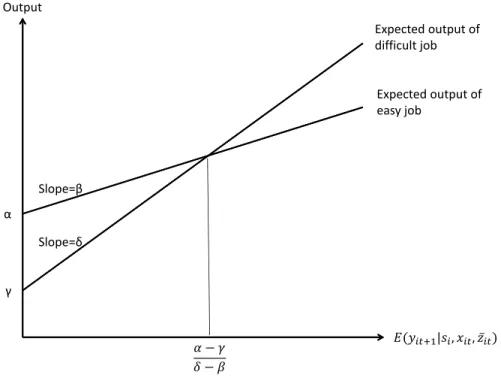
First, the absence of an employer's job performance evaluation requires that the AFQT score correlate with the employer's perceived performance. This article contributes to the literature on employer learning model estimation using workforce panel datasets, and departs from Kahn and Lange (2013) in two important directions. The second contribution is to integrate the employer learning model into the promotion decision model of Gibbons and Waldman (1999) and Gibbons and Waldman (2006) and to derive the explicit formula for promotion probabilities as a function of school prestige and performance evaluation from the past; the formula considers the result of Lazear (2004) as a special case.
All of this descriptive evidence confirms the employer learning model's prediction that employers shift the weight of the school's name to past job performance as they obtain more information. The prestige of the university from which an employee graduated helps determine the employer's prior distribution of the employee's abilities. We develop a model for the employer's promotion decision when employee competence is not perfectly observable, by integrating the employer learning model of Farber and Gibbons (1996) and Altonji and Pierret (2001) into the promotion model developed by Gibbons and.
Performance adjusted for the human capital function corresponds to the employer's assessment of the employee, which lowers the expected performance based on the employee's education and experience. The rate of convergence again depends on the relative variance of the employee's ability to noise in performance, which is ν02/σ2. Therefore, the employer raises the threshold for promotion and expects a decline in the employee after promotion due to mean reversion.
Company A
Here are some examples to give you a sense of the index: University of Tokyo's Department of Economics has 70, Kyoto University 67.5, Hitotsubashi University 65, Osaka University 62.5, Waseda 67.5 and Keio 67.5. Since national universities impose more academic subjects on candidates in the entrance exam, the result between national and private universities is not directly comparable. In order to make the results comparable, we add a score of 5 to the national universities because this achieves a good fit in the duration analysis for companies A and B.
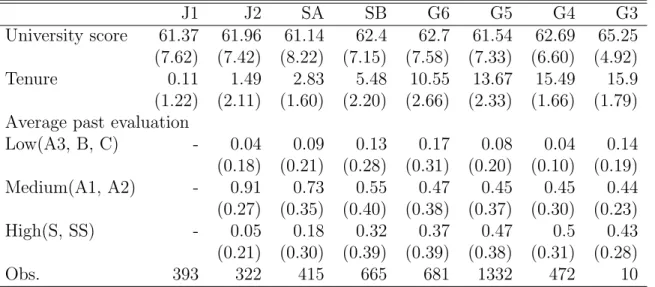
However, after being promoted to the G6, the transition probabilities to the above ranks are not significantly different from those of graduates from national first-tier universities. At the beginning of the appraisal period, an appraiser and appraisee meet face-to-face to confirm expected performance in the appraisal period. At the end of the appraisal period, the appraiser evaluates each employee's performance relative to expected performance.
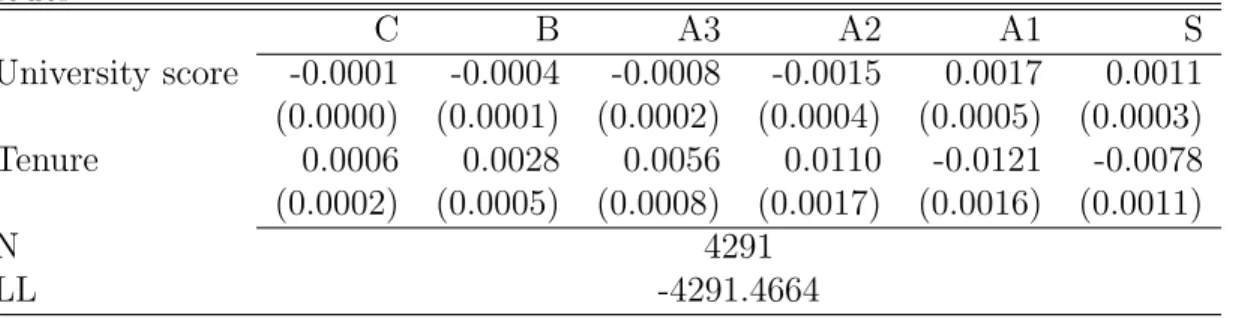
In the first phase of the career, J1, almost everyone receives A2 as her evaluation, but as workers' careers progress, some begin to receive a better evaluation, S, while others receive a worse evaluation, A3. The divergence of evaluations along the career progression shows that each worker's productivity becomes visible at the top level of the corporate hierarchy. To address this reasonable concern, we conceal the current evaluation on the university rank of the worker's alma mater and the worker's tenure, along with rank dummy variables.
This relationship is probably because those who stay in the same rank for a longer period are the ones who get promoted and are less skilled workers, on average. It is also worth noting that the consistent average school score and early promotion of elite school graduates visible in the career tree implies that elite school graduates are promoted quickly due to high performance ratings. We regress the rate of promotion from the current ability rank to the next ability rank on the school's name and average past rating to determine the relative importance of the two variables using a duration model.
The estimates decrease monotonically from -0.2671 when promoted to SA to -2.7543 when promoted to G4, implying that receiving a low evaluation has a detrimental effect on promotion and its negative impact increases on the highest level of the career ladder. Consistently receiving a high evaluation in the past increases the likelihood of promotion by 37% when promoted to G5 and by 78% when promoted to G4.
Company B
Although the effect sizes are not very pronounced, workers who graduated from more prestigious universities tend to receive higher ratings. Combined with the declining importance of university score with increasing rank, this finding is consistent with the prediction from the employer-based learning model that performance appraisals become relatively more important as one's career progresses. We consider Kahn and Lange's (2013) continuous evolution of the worker's skill at work, and thus continuous learning on the moving target, to be very realistic when we consider the long-term career developments of workers represented by wage evolution .
Through the evaluation of the structural model, we are most interested in the employer's learning speed, since faster employer learning implies that the signaling value of education is less important and the value of the human capital of education is greater. Therefore, the variance of the subjective ability distribution of each worker is reduced by half according to x∗it = (σ2/ν02); this is called the x∗it half-life period of the subjective variance of the ability distribution. We report estimates for progressions to SA, SB, G6, and G5 because estimates for G4 and above show unstable results and sometimes do not converge, most likely due to the small number of observations with yit = 1.
The role of university human capital dominates the signaling role across the employee's career because the signaling role decreases over time while the role of human capital remains constant. The size of the coefficient for the college score in the learning equation is about half the size of the college score in the human capital equation. The implied half-life of the subjective variance of the skill distribution is 4.48 for promotion to 2nd class, 3.06 for 3rd class, 1.73 for vice president, and 2.84 for supervisor.
While there are variations in the estimated half-life depending on the degrees, estimates of between 2 and 4 years imply that the signaling value of graduating from a prestigious university depreciates quickly, and its value drops by half in 2 to 4 years. Comparing the valuations of the two companies reveals a reasonable similarity of valuations between them, but the estimated role of information of. The size of the coefficients of mastery in the human capital equation is comparable to the size of the coefficients of university scores, implying that graduating from a school with a score of 1 point (0.1 standard deviation) the highest score equals accrual of one more year of ownership in terms of human capital accumulation.
The implied half-life period of the subjective variance of the ability distribution,σ2/ν02, is about 3 to 4 years across specifications, except for a few cases. This rapid learning of employees' ability by employers implies the importance of the human capital role of education relative to the signaling role.
Human capital vs. signaling roles of education
Violation of linear separability
We must bear in mind that what is estimated as the human capital role of education includes the ability effect associated with better educational attainment and continued productivity at work. The increasing effect of education on promotion contradicts the decreasing effect of education predicted by the signaling role of education. Consequently, the speed of the reducing effect of education on promotion, attributed to the signaling role of education, fades.
Therefore, the employer's learning rate estimated in the previous section should be interpreted as the lower estimate of the employer's actual rate of learning under a likely scenario where the better-educated workers acquire skills faster on the job. We model how employers learn each employee's productivity from the employee's alma mater and past performance and use their knowledge for promotion decisions. We are the first to estimate the employer learning model with the role of training based on personnel data sets.
The information about each employee's alma mater and job ranking in the datasets brings the employer's learning model to a realistic test. This finding corroborates the employer learning model, a model that incorporates employers' Bayesian learning of employee productivity. The relatively quick learning of each individual employee's productivity cannot be generalized to the entire labor market because our results are based on only two companies in a specific labor market.
We need to collect more studies on the employer learning model, based on different data sets and from different economies, to draw a definitive conclusion on the speed of employer learning. Our work does not tell whether employers in the labor market share the information about each worker's productivity or whether the current employer privately owns the information. It is important to distinguish whether the learned information is public or private, because private information about the productivity of each worker is the fundamental source of information asymmetry in the labor market, resulting in labor market friction (Gibbons and Katz (1991) ) and Hu and Taber). 2011)).
Our model considers the productivity of each worker as a scale factor, but a worker's capabilities can be multi-dimensional; a good employee in the engineering department may not be a good employee in the sales department. In this multi-dimensional skill set, the employer likely rotates its employees into different sections to learn about each employee's comparative advantage. Eight ranked dummy variables are included in the regression model, but the estimated coefficients are not reported.
The average past rating is generally not available for J1 workers because most J1 workers are promoted to J2 the following year.