저작자표시-비영리-변경금지 2.0 대한민국 이용자는 아래의 조건을 따르는 경우에 한하여 자유롭게
l 이 저작물을 복제, 배포, 전송, 전시, 공연 및 방송할 수 있습니다. 다음과 같은 조건을 따라야 합니다:
l 귀하는, 이 저작물의 재이용이나 배포의 경우, 이 저작물에 적용된 이용허락조건 을 명확하게 나타내어야 합니다.
l 저작권자로부터 별도의 허가를 받으면 이러한 조건들은 적용되지 않습니다.
저작권법에 따른 이용자의 권리는 위의 내용에 의하여 영향을 받지 않습니다. 이것은 이용허락규약(Legal Code)을 이해하기 쉽게 요약한 것입니다.
Disclaimer
저작자표시. 귀하는 원저작자를 표시하여야 합니다.
비영리. 귀하는 이 저작물을 영리 목적으로 이용할 수 없습니다.
변경금지. 귀하는 이 저작물을 개작, 변형 또는 가공할 수 없습니다.
Master’s Thesis
The Impact of Congruence between Brand and Celebrity Endorsers on Advertising Effectiveness:
An Eye-tracking Study
Eunbi Seomoon
Department of Human Factors Engineering
Graduate School of UNIST
2019
The Impact of Congruence between Brand and Celebrity Endorsers on Advertising Effectiveness:
An Eye-tracking Study
Eunbi Seomoon
Department of Human Factors Engineering
Graduate School of UNIST
ABSTRACT
Recent studies on the role of celebrity endorsers in the advertising of attractiveness-related products (e.g. cosmetics, perfumes, etc.) have demonstrated that congruence between brand and celebrity affects advertising effectiveness. According to the previous research, less congruence causes the vampire effect defined as a decrease in the brand recall due to attraction towards a celebrity endorser in advertising.
By far, studies on celebrity endorsement have only focused on congruence between brand and the physical appearance of a celebrity endorser (appearance congruence) based on the theoretical background of source attractiveness and match-up hypothesis. Today, however, meaning transfer model should be significantly considered because of the increase of a variety of communication windows between celebrity and consumers. In that sense, congruence between the brand value and celebrities’
personal image (value congruence) can influence advertising effectiveness, by making it fluent to retrieve the associative memory of advertising with celebrity based on an accessibility-diagnostic framework. Therefore, the present study investigates whether value congruence is as important as appearance congruence for improving advertising effectiveness and whether the congruences have an impact on the changed attention leading to advertising effectiveness. In this study, the main experiment was carried out with the newly recruited 24 female subjects. The stimuli for the main experiment was selected through the preliminary experiment. During the experiment, subjects were shown a series of 60 stimuli in the form of an advertisement poster, and their eye-gaze was recording. Next, subjects were requested to rank the level of appropriateness of each stimulus while their eye-gaze was tracked. After that, advertising recall and recognition tests were done, and they were also asked to evaluate value congruence as well as appearance congruence. Finally, subjects evaluated appropriateness, effectiveness, and liking of each stimulus. Results showed that both appearance congruence and value congruence were crucial for advertising effectiveness. Behavioral responses revealed that it was more appropriate for a celebrity who has both appearance congruence and value congruence to promote the brand, and especially,
value congruence was more influential than appearance congruence. The eye-tracking data also implies that the memory regarding advertising can be encoded by associative celebrity endorser faster without the longer attention. In summary, the results indicated that value congruence could play an important role for more accurate recall. These findings suggest that value congruence is as important as value congruence for improvement of the advertising effectiveness. Therefore, to establish brand identity effectively, considering value congruence may enhance print advertising effectiveness beyond the level by simply focusing on appearance congruence.
Contents
1. INTRODUCTION ... 1
1.1. Introduction to celebrity endorsement ... 3
1.1.1. Importance of celebrity endorsement ... 3
1.1.2. Factors considered for selecting celebrity endorser ... 5
1.1.3. Effectiveness of celebrity endorsement ... 7
1.2. Advertising effectiveness ... 9
1.2.1. Brand recall and recognition ... 9
1.2.2. Celebrity effectiveness ... 10
1.3. Eye-tracking methodology ... 11
1.3.1. Properties of eye-tracker ... 11
1.3.2. Human vision ... 13
1.3.3. Specific events detected by eye-tracker ... 14
1.3.4. Algorithms for event detection ... 16
1.3.5. Attention and eye movements in celebrity endorsement ... 18
1.4. Hypotheses ... 20
2. EXPERIMENTAL DESIGN ... 23
2.1. Overview of experiment ... 25
2.2. Preliminary experiment ... 25
2.2.1. Subjects ... 25
2.2.2. Stimuli ... 25
2.2.3. Experimental procedure ... 27
2.2.4. Stimuli acquisition ... 28
2.3. Main experiment ... 30
2.3.1. Subjects ... 30
2.3.2. Stimuli ... 30
2.3.3. Experimental procedure ... 30
2.3.4. Recording and data processing ... 32
3. RESULTS ... 35
3.1. Verification of stimulus classification ... 37
3.2. Behavior results ... 39
3.2.1. Evaluations on the advertisement poster ... 39
3.2.2. Recall and recognition results ... 41
3.2.3. Celebrity effectiveness ... 46
3.3. Eye-tracking results ... 49
3.3.1. Overview of eye-tracking data distribution according to conditions ... 49
3.3.2. AOI analysis ... 51
4. DISCUSSION ... 55
4.1. Hypotheses revisit ... 57
4.1.1. Effectiveness of value congruence ... 57
4.1.2. Independence of appearance congruence and value congruence... 59
4.1.3. Impact of congruence on attention change ... 60
4.2. Limitations and further works ... 62
5. CONCLUSION ... 63
APPENDIX ... 66
APPENDIX 1. Scatter plot of preliminary experiment results ... 68
List of Figures
Figure 1.1. An eye-tracker instrument. ... 11
Figure 1.2. An anatomical structure of the human eye. (from Wikipedia) ... 13
Figure 1.3. Pseudo-codes of event detection algorithm, which are for I-DT on the upper side and SMI on the lower side. ... 16
Figure 2.1. A preliminary experiment stimuli set. ... 26
Figure 2.2. An experimental procedure of preliminary experiment. ... 27
Figure 2.3. An example of computer screen during the preliminary experiment. ... 28
Figure 2.4. An example of stimulus and experimental paradigm. ... 31
Figure 2.5. An image of EyeLink 1000 Plus instrument. ... 34
Figure 3.1. Box-violin-scatter plot of verification post-questionnaire. ... 38
Figure 3.2. Verification of condition dividing. ... 38
Figure 3.3. Box-violin-scatter plot of response score evaluated during evaluation session. .... 40
Figure 3.4. Comparison of response score evaluated during evaluation session. ... 40
Figure 3.5. Histogram plot of the accuracy rate measured in recall and recognition task. ... 45
Figure 3.6. Results of recall and recognition accuracy. ... 45
Figure 3.7. Correlation matrix of post-questionnaires for measuring celebrity effectiveness. . 47 Figure 3.8. Box-violin-scatter plot of celebrity effectiveness score evaluated during post-questionnaire session. ... 48
Figure 3.9. Comparison of celebrity effectiveness score evaluated during post-questionnaire session. ... 48
Figure 3.10. An example of attention map based on raw data. ... 50
Figure 3.11. Attention map based on fixation data. ... 50
Figure 3.12. Dwell time analysis based on AOIs. ... 52
Figure 3.13. Visiting counts analysis based on AOIs. ... 54
List of Tables
Table 2.1. Experimental design for main experiment. ... 25
Table 2.2. A set of combinations separated by conditions for the main experiment. ... 29
Table 3.1. Number and rate in recall task. ... 42
Table 3.2. Number and rate in recognition task ... 43
List of Equations
(3.1) ... 49
1
1. INTRODUCTION
2
THIS PAGE INTENTIONALLY LEFT BLANK
3 1.1. Introduction to celebrity endorsement 1.1.1. Importance of celebrity endorsement
Advertising endorsement is a socially popular advertising strategy, and many marketers and companies expect various advertising effectiveness by using endorsers for brand promotions (Stout & Moon, 1990;
Martin et al, 2008). Research on advertising endorsement has identified the use of six different types of advertising endorsers, including celebrity, typical consumer, professional expert, company president, spokes-character and employees, but most studies have investigated and emphasized the effectiveness of advertising when using celebrity as an endorser (Friedman & Friedman, 1979; Friedman et al., 1976;
Freiden, 1984; Folse et al., 2013; Fleck et al., 2014; Schimmelpfenning, 2018).
Over the past few decades, celebrity endorsement has been established as one of the most popular tools for improving the quality of marketing communications (Schaefer, Parker, & Kent, 2010; Till, Stanley, & Priluck, 2008). In this context, celebrity endorsement is defined as an agreement between a publicly known individual who enjoys public recognition (a celebrity) and the companies that use a celebrity to promote their brand (McCracken, 1989; Bergkvist & Zhou, 2016). Recent reviews of the literature on this topic found that using celebrity endorsers in advertising is common worldwide (Biswas, Hussain, & O’Donnell, 2009; Carroll, 2009; Seno & Lukas, 2007; Money, Shimp, & Sakano, 2006), especially in Asian countries such as Korea, Japan and China, where the share of celebrity endorsements seems to be significantly higher (Kim, 2006; Kilburn, 1998; Praet, 2008).
As a country with an overwhelming advantage in Internet speed and penetration, Korean adults spend an average of 7 hours and 4 minutes a day on media, more than 50% of which are spent on digital media such as PCs or mobile devices, according to a report published by eMarketer in January 2018 (eMarketer, 2018). Accordingly, advertising costs in digital media are also expected to increase by about 2% from 36.2% in 2016 to 38.2% in 2017 and will reach 45.6% in 2021. In particular, as the spread of
4
smartphones and tablets made Internet accessibility easier, mobile advertising costs accounted for 68.8%
of digital advertising in 2017, which is also a significant portion (26.3%) of total media advertising costs. As the mobile industry develops due to the prevalence of 5G technology, advertisers are expected to invest more money in mobile advertising. Mobile advertisings consist of banner ads, interstitial ads, video ads, and native ads (called also as SNS ads), especially the demand for native or SNS advertising is growing rapidly so its importance is increasing. Even in this social networking environment, it has also been revealed that celebrity advertising can be an effective way to quickly make consumers aware of the brand in the emerging social media environment as well as in traditional media (e.g., television, print, etc.) (Wood & Burkhalter, 2014).Through the pictures of celebrities posted to social networking services, consumers naturally think of the brand that celebrities promote, forming a parasocial relationship which is a virtual relationship that exists only in their imagination (Chung & Cho, 2014). By taking advantage of this relationship, brand marketers create the social account for a brand and post images of a celebrity who is wearing or using the promoting products.
5 1.1.2. Factors considered for selecting celebrity endorser
Most of the research on the factors considered in order to select celebrity endorser suggested source characteristics which consist of source credibility model (Hovland & Weiss, 1951) and source attractiveness model (McGuire, 1985). Studies on source credibility model have found that credibility has a positive effect on brand evaluation (Lafferty & Goldsmith, 1999; Spry et al., 2011) as well as message persuasion (Harmon & Kenneth, 1982) by treating credibility as a single variable. On the other hand, other researchers have addressed credibility as a separate variable with trustworthiness and expertise. Research which takes both trustworthiness and expertise into consideration has shown that expertise is a more significant variable in brand evaluation than trustworthiness (Ohanian 1991; Rossiter
& Smidts 2012). Several studies also demonstrated that social attractiveness model should be considered when selecting celebrity endorser to increase the advertising effectiveness such as brand recall, brand recognition and purchase intention (Eisend & Langner 2010; Kahle & Homer 1985;
Tingchi Liu & Brock 2011). While social attractiveness model consists of similarity, familiarity, likability, and physical attractiveness, most studies on this model have highlighted the importance of physical attractiveness in the brand evaluation and little has been done on the other three elements.
Behind this limited interest is an implicit assumption that celebrities chosen by the brand are generally linked with the likability and have a good reputation by the public. Interestingly, studies of expertise and physical attractiveness that are considered important factors in the selection of celebrity endorser have revealed that the congruence between brands and celebrities plays a role of a moderator (Till &
Busler, 2000).
Recent findings regarding the concept of the congruence between brand and celebrity endorser has been established as a ‘Match-up hypothesis’, and initial research on this concept has examined that the factors affecting match-up hypothesis include physical attractiveness, expertise, and personality of celebrities (Kahle & Homer, 1985; Kamins, 1990; Lynch & Schuler, 1994). The match-up hypothesis
6
assumes that the advertising effectiveness of celebrity endorsement depends primarily on the congruence between brand and celebrity. According to many studies, using celebrities whose image or characteristics are highly congruent with brands has a more positive effect on the effectiveness of communication than using celebrities who have low congruence with the brand (Kamins & Gupta, 1994;
Till & Shimp, 1998). The physical attractiveness and expertise of a celebrity are linked to congruence between brand and celebrity, which further enhances advertising effectiveness. Athletes are perceived to have expertise in athletic products, so they can give credibility and persuasion to messages delivered through advertising. On the other hands, celebrities such as actors and actresses as well as athletes can be associated with brands based on their popularity and physical attractiveness. Both physical attractiveness and expertise of athletes were all positively related to congruence between brands and celebrities, though expertise in fitness was more strongly associated with congruence than physical attractiveness (Fink et al., 2004). Similarly, personal care products such as cosmetics or perfume advertised by celebrities such as actor/actress and supermodels, are often based on their physical attractiveness, which supports a moderating effect of congruence between brands and celebrities.
There also exists a concept considered for selecting celebrity endorser which has not received relatively much attention than either the source characteristics model or the match-up hypothesis.
According to the meaning transfer model which was introduced in the study of McCracken (1989), when celebrities are used for brand advertising, advertising effectiveness means more than brand evaluation, implying that celebrities transfer a wide range of meanings which include both evaluative and non-evaluative associations to the brand. The evaluative association between celebrity and brand refers to the improved sales or top ranking in the search engine, whereas the non-evaluative association between celebrity and brand could be revealed through the associative memory in consumer’s mind.
Until now, developments in findings regarding non-evaluative meaning transfer model demonstrated the transfer of both positively and negatively valenced personality traits from celebrities to the brand
7
(Batra & Homer, 2004; Miller & Allen, 2012). Furthermore, Campbell and Warren (2012) showed that positive characteristics of celebrity are transferred under a high congruent condition, while negative ones are transferred under a low congruent condition, and that congruence plays a role of mediator in the transition of celebrity’s traits to the brand. Despite this interest, few researchers have addressed the questions of non-evaluative meaning transfer model.
1.1.3. The effectiveness of celebrity endorsement
A growing body of literature has examined the positive effects of celebrity endorsement on both qualitative and quantitative advertising effectiveness. Not only does celebrity endorsement significantly increase sales (Elberse & Verleun, 2012; Chung, Derdenger, & Srinivasan, 2013), it is also considered a differentiated strategy to strengthen brand credibility and brand equity (Spry, Pappu, & Bettina, 2011).
In addition, several studies conducted on the potential of celebrity endorsers have shown that the physical attractiveness of celebrities has a positive effect on brand evaluation (Eisend & Langner 2010;
Kahle & Homer 1985; Tingchi Liu & Brock 2011). Furthermore, advertising featuring celebrities has been found to be effective in attracting consumers’ attention and delivering messages quickly and confidently (Simsek, 2014; Tsai, 2012). Research has examined this kind of effect as stopping power which is the ability to draw attention and interest in a media environment that is highly complex and provides a wide variety of information (Belch & Belch, 2004).
The use of celebrity advertising has been shown to be effective on raising awareness of brand and product in terms of brand perception as well as on increasing favor in the luxury brand in terms of message persuasion. Nevertheless, problems with celebrity endorsement have also been coming up persistently. Most of all, by emphasizing the physical attractiveness and stopping power of celebrity endorser, consumers’ attention could be unduly so attracted to the endorser that it would lead to fails to remember the message the product or brand is trying to convey. In other words, stopping power would
8
have unintended consequences by only drawing attention the faces of celebrities appearing in advertising. Some recent papers have defined this phenomenon as a vampire effect and tried to identify it through empirical studies using printed advertisements (Erfgen et al, 2015; Kuvita & Karlicek, 2014).
In that, it was revealed that the congruence between brand and celebrity endorser could have a significant effect on increasing of recall and recognition of the brand as well as reducing the impact of the vampire effect, while the definition of the congruence is still ambiguous (Choi & Rifon, 2012).
Kuvita and Karlicek (2014) also conducted the eye-tracking experiment in addition to the survey experiment, but only mentioned the results of the eye-tracking experiment that the subjects did not directly fixate their eyes on the brand.
9 1.2. Advertising effectiveness
1.2.1. Brand recall and recognition
The purpose of promoting a brand is to imprint the brand’s features and images into the consumer’s mind by increasing the brand equity which includes brand awareness and brand association (Keller, 1993; Aaker, 2012). Nothing is more important than creating brand awareness among consumers and leaving the presence of brands impressive in the consumer’s memory. Advertising can affect the purchasing decision of the brand by making brand awareness and interest so that consumers aware of the differences from other brands in the same product category (Cuneen & Hannan, 1993). What is known about the measurements of brand awareness are largely based on recall and recognition, which are appropriate for measuring advertising effectiveness (Pope & Voges, 2000). Typically, the recall test is performed unaided, and the recognition test is conducted with aided items presented. Recognition test requires the subjects either to choose the answer from a list of aided items or to respond whether the item presented is correct or not. There are three types of recognition test, which are yes/no choice, forced choice, and batch-testing procedures (Dodd, 1998). For forced choice, the task of having to choose one of several items presented on a screen as an answer is repeated, while for batch-testing procedures, all items including distracters are shown at once on a screen and subjects are required to choose all the brands appeared in the experiment.
10 1.2.2. Celebrity effectiveness
In the literature on celebrity endorsement, it has been widely established that the message persuasion delivered through celebrity depends on how well the celebrity’s image fits with the endorsing brand.
When consumers are exposed to advertisements featuring celebrities, they are motivated to become more involved and understand the celebrity’s image rather than the brand image. Therefore, failing to connect a celebrity with a brand has the potential to lead to poor advertising effectiveness when the brand is perceived to be inconsistent with the celebrity’s image. From this point of view, evaluating celebrity effectiveness can be accepted in the same context as measuring the advertising effectiveness.
Here, the celebrity effectiveness is defined to the extent that the celebrity is perceived as an unquestionable representative of the brand. Graeff (1996) adopted the 15 different attributes for rating the celebrity endorser’s image on a 7-point scale, and the items were rugged - delicate, excitable - calm, rational - emotional, formal - informal, complex - simple, dominating - submissive, thrifty - indulgent, pleasant - unpleasant, contemporary - noncontemporary, organized - unorganized, youthful - mature, orthodox - liberal, uncomfortable - comfortable, colorless - colorful, and modest - vain. However, these items focus only on the celebrity’s image, making it difficult to measure the impact of the congruence between the brand and the celebrity on the advertising effectiveness. A recent study of congruity effect on celebrity advertising addressed five items to measure the celebrity effectiveness by congruence between the brand and the celebrity (Harmon-Kizer, 2017). The newly addressed items were inappropriate - appropriate, ineffective - effective, poor match - good match, inauthentic – authentic, and unlikable – likable.
11 1.3. Eye-tracking methodology
1.3.1. Properties of eye-tracker
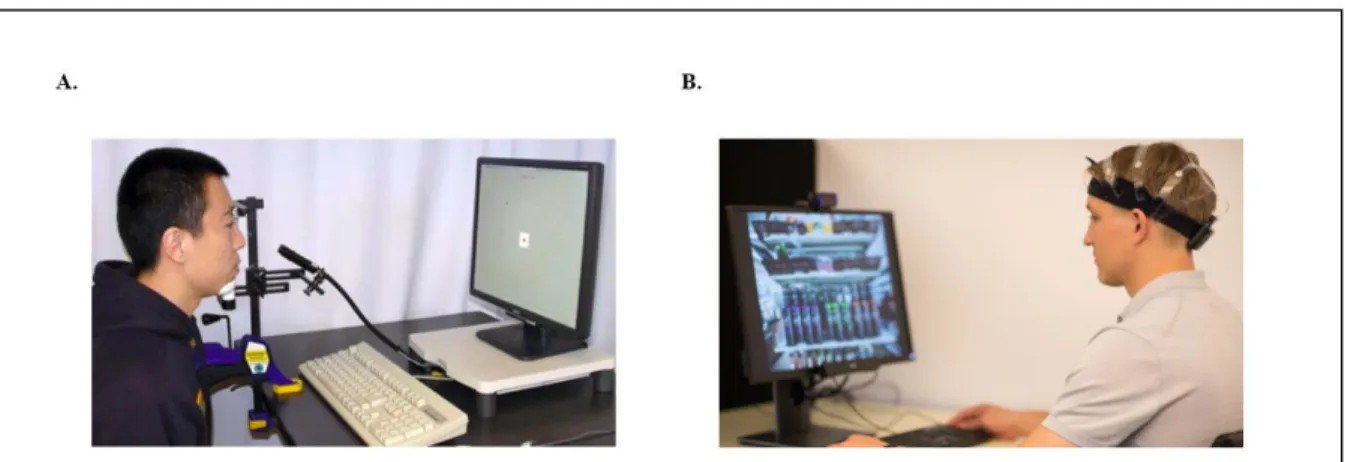
Video-based eye-tracker uses video-based pupil-to-corneal reflection measurement technology, and there exist three types of video-based eye-tracker; static eye-tracker, head-mounted eye-tracker, and head-tracker. The common set-up for these instruments needs an infrared illumination, a video camera for recording eye movements, and either a head and chin supporter for static eye-tracker or an additional scene camera for head-mounted eye-tracker. Both static and head-mounted eye-tracker are commonly used for study and the example of these instruments is in Figure 1.1 below.
Static eye-trackers can be used by restricting the subject’s head. Today, video-based eye-trackers with higher precision have a forehead and chin supporter that accurately fix up the subject’s head movements.
By placing the camera near the monitor presenting stimulus, the remote eye-trackers are able to record the subject’s eye movements from a distance, thereby enabling tracking of the eye movements within a specific radius. However, due to a significant change in the eye position by the small movements of the head or the low resolution of the camera, data from the remote eye-tracker has a somewhat low level of accuracy and precision. To solve this geometrical problem, certain remote eye-trackers place infrared reflectors on the subject’s forehead and measure exactly where he or she is. Also, this type of eye-
Figure 1.1 | An eye-tracker instrument. (A) An example of static eye-tracker with head and chin supporter.
(B) An example of head-mounted eye-tracker.
12
tracker is not only easy to operate but also allows tracking eye movements without undue interference, making it suitable for experiments targeting young children or subjects who are hard to concentrate attention on. As a systematic feature, static eye-trackers can be used with one stimulus plane and provide a data with coordinates that correspond to the coordinate system of the field of view (stimulus plane).
Overall, static eye-tracking system is operated with spatial fixation of eye camera, illuminations, and stimulus, and has the advantage of facilitating analysis by providing coordinates as data.
Head-mounted eye-trackers are equipped with eye cameras and illuminations on top of a pair of glasses, helmets, or headbands, to maximize the mobility of the subjects. Also, head-mounted systems are more versatile eye-trackers that can be used properly in a variety of situations, because eye camera angles can be shifted and adapted to individual subjects as well as the different tasks. The helmet of the head- mounted system is equipped with a scene camera with markers, and data is recorded with the coordinates of the line of sight on the scene taken by the camera. This kind of data is referred to as a gaze-overlaid video, and for the data analysis, the coordinates of the data file should refer only to the location of the scene video, not to the real position. Thus, head-mounted eye-tracking systems provide the convenience of activity to the subjects and enable challenges in a variety of tasks, while having difficulty in the processing of data for analysis.
13 1.3.2. Human vision
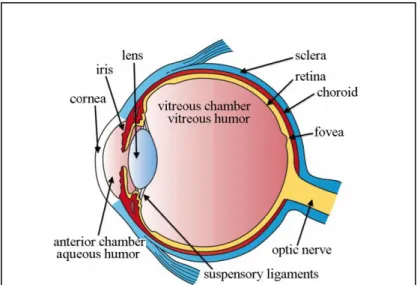
Figure 1.2 shows an anatomical structure of the human eye. Human eyes send light through the pupil and the perceived image reverses at the lens. Then the reversed image is projected onto the retina at the back of the eyeball. The retina consists of cones and rods, which convert light into electrical signals and send signals to the visual cortex to interpret information. The function of cones is to detect colors, details, and distant objects, whereas rods detect moving objects but does not give details or color information.
Also, inside the eyeball is a small area called fovea, which extends to less than 2 degrees of visual angle.
Because most cones are distributed here, it is possible to determine an object with full accuracy when the light from the object human want to see falls directly on the fovea.
Pupils are very important when using the video-based eye-tracking system. Another important element is the cornea, which covers the outside of the eye and reflects light. Reflections from someone’s eyes usually come from the cornea. Since most of the tracking of subjects’ eyes requires only one reflection, they are recorded with infrared light to avoid all natural light reflections and generally receive corneal reflection with a single infrared light source.
Figure 1.2 | An anatomical structure of the human eye. (from Wikipedia)
14 1.3.3. Specific events detected by eye-tracker
The only material to which the algorithm is applied is a stream of data samples recorded by the eye- tracker system. This data samples are stored primarily as coordinates, and the set of coordinates sometimes includes specific events that describe the certain cognitive process of subjects. The objective of event detection in eye-tracking data is to extract such events form the data sample streams according to a set of rules. In that, event extraction can be done either automatically or manually through algorithms by applying both the subjective judgments and the established event detection method. The event detection methods, especially, can be initialized with three kinds of data streams; Gaze position (𝑥, 𝑦), gaze velocity (°/s), gaze acceleration (°/𝑠2). The gaze velocity is calculated using the distance between two data samples, and the gaze acceleration is estimated from three consecutive samples.
There are some general events detected by the eye-tracking system.
Fixation
As the most commonly mentioned event in the field of eye-tracking studies, fixations are measured when eye movement status in a particular place for a short period of time. Generally, when measuring fixations, it is considered to measure the subjects’ attention to that position. The fixation is primarily detected by the maximum allowed dispersion or velocity. The fixation detected by the dispersion should temporarily place adjacent samples within a constrained area for a minimum of time, and a dispersion- based algorithm is used for analysis. On the other hand, if the fixation is detected by velocity, it is identified as a continuous portion of data samples where the velocity of the eye movements does not exceed a predefined threshold, and a velocity-based algorithm is used for analysis.
15 Saccade
The rapid movement of the eye from one point on the presented stimulus to another one point is called the saccade. The saccades are very fast and typically takes 30–80ms to complete. Also, the typical eye amplitude of saccade is 4-20° and velocity of that is 30-500°/s. The saccade is usually detected by the velocity or acceleration threshold. During most saccades, people are not aware of anything, but safety is guaranteed because it is the fastest movement human can make.
Smooth pursuit
If a bird or airplane goes across the sky, human eyes make a slow movement along the objects called smooth pursuit. Because smooth pursuit is a completely different motion generated by different parts of the brain compared to the saccade, smooth pursuit requires some moving stimuli to follow, whereas saccade is an event that can occur with only a plane to look at without a specific stimulus. There is no typical duration for smooth pursuit, but the typical velocity is 10-30°/s, which is slower than the velocity of the saccade. Smooth pursuit identification does not currently exist in any commercial software, therefore, developing a general algorithm for smooth pursuit detection is now an open research area. Few studies use information about the velocity and the direction of eye movement for smooth pursuit event detection.
Blink
Blinks are often identified by (𝑥 = 0, 𝑦 = 0) 𝑜𝑟 (𝑥 = 𝑁𝑎𝑛, 𝑦 = 𝑁𝑎𝑛) coordinates, or when the pupil diameter is zero, indicating that the eyelids are closed. However, it should be noted that this information is only roughly relevant to the coordinates recorded from eye-tracker since eyelid movements must be measured to carefully examine the blink event. In other words, identification of blink with only coordinates may result in misinterpretation of the noise or eyes being outside the plane of the stimulus, and thus the blink event cannot be accurately measured.
16 1.3.4. Algorithms for event detection
Dispersion-based algorithm
A dispersion-based algorithm is the most common type of event detection algorithm, which basically detects only fixation events and collects all other events into the same category. These algorithms identify fixated points of eye movement by finding data samples close enough to each other for the specified minimum time threshold. They do not use velocity or acceleration information when setting the thresholds for time and dispersion radius. In Salvucci and Goldberg (2000)’s study, they tested six different kinds of algorithms for measuring fixation events, taking into account the ease of implementation and speed as well as the accuracy and robustness. As a result, it was the I-DT (Identification by Dispersion Threshold) algorithm that showed the best performance in all aspects considered in the study.
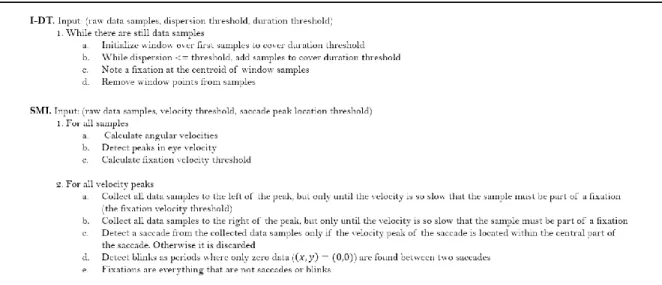
The pseudo-code for I-DT algorithm is outlined in Figure 1.3 (Holmqvist et al., 2011). In order to implement the I-DT algorithm, the dispersion threshold and the duration threshold are required as input data together with the raw data. At this point, the dispersion is defined as [𝑚𝑎𝑥(𝑥) − 𝑚𝑖𝑛(𝑥)] + [𝑚𝑎𝑥(𝑦) − 𝑚𝑖𝑛(𝑦)], where (𝑥, 𝑦) coordinates refer to the data samples within a given window. The
Figure 1.3 | Pseudo-codes of event detection algorithm, which are for I-DT on the upper side and SMI on the lower side.
17
dispersion algorithm defines the fixation by combining the duration threshold used as a temporal window and the dispersion threshold used to define the area in which the fixation lasts. When the dispersion that consists of continuous data samples in a certain area that does not exceed the dispersion threshold for a period above the duration threshold, fixation is defined. Then, if this area exceeds the dispersion threshold as the samples stacked, the window returns to its initial value and algorithm finds the next fixation event using the same process.
Velocity-based algorithm
As for dispersion-based algorithm, it uses a duration criterion to detect the fixation event, but instead, the velocity-based algorithm is applied to analysis based on eye velocity to detect the saccade event.
The velocity-based saccade detection algorithm focuses on detecting the velocity of eye movements.
There are also additional constraints, such as a clean velocity peak at the center of one saccade (Smeets
& Hooge, 2003), or that the velocity of the saccade cannot be faster than a certain velocity threshold (Nystrom & Holmqvist, 2010), to distinguish the actual saccade events from a number of possible anomalies or noises. The velocity-based algorithms have been implemented by many researchers, and one of which is applied to commercial software by SMI. This SMI algorithm is very similar to the algorithm developed by Ditchburn (1973), which is a more sophisticated version of the I-VT (Identification by Velocity Threshold) algorithm by Bahill, Brockenbrough, and Troost (1981).
As shown at the bottom of Figure 1.3, the SMI velocity-based algorithm consists of two steps that calculates the velocity at the first stage to detect the saccade and defines the onset and offset of the saccade at the second stage. The algorithm firstly finds higher velocity peaks than the threshold and accepts them as candidates for the saccade event. Then at each designated peak, the algorithm recognizes the data samples along both slopes from peak points as saccade events, and finally, the data is defined as fixation, not saccade, from the moment the velocity becomes too low.
18
1.3.5. Attention and eye movements in celebrity endorsement
Eye-tracking methods have been developed based on the “eye-mind” assumption, which means that eye movement provides the corresponding tracking of the direction of attention as well as the characteristics of basic eye movements (Just & Carpenter, 1980). Experiments on eye-tracking study have identified different types of eye movements, some of which maintain fovea on visual targets in the stimulus (e.g., saccade, smooth pursuit), while others keep the eye movement on the specific point on the stimulus (e.g., fixation) (Duchowski, 2007; Liversedge wt al., 2011). For the past decades, there has been a rapid rise in the use of the eye-tracking methodology in the field of psychology, revealing basic cognitive processes and mechanisms such as reading comprehension and visual perception. Most of the applications in these studies were related to information processing, such as reading, scene recognition, visual search, and so on (Rayner, 1998; Radach & Kennedy, 2004).
From the point of view of celebrity endorsement, consumers’ attention to celebrity endorsers can be described as an accessibility-diagnostic framework, which indicates whether consumer decisions are changed according to the accessibility and the diagnostic of the piece of information obtained from several different available (Feldman & Lynch, 1988). Because celebrities are more familiar to consumers than endorsers who are unknown, consumers will be able to more easily access and diagnose the evaluation of advertising effectiveness being promoted by celebrities than by other unknown endorsers. For example, celebrities can activate some associations in a consumers’ memory, while unknown endorsers cannot because they are not linked the cognitive schema in consumers’ memory (Bruce & Young, 1986; Misra & Beatty, 1990). Based on this theoretical reasoning, previous studies have shown that familiar stimuli tend to be more easily approached and processed faster than less accessible stimuli (Craik & Lockhart, 1972; Feldman & Lynch, 1988). In addition, one challenge on the visual search study found that subjects saw a very familiar person for longer periods of time than the less familiar person (Devue et al., 2009). Thus, in the case of advertisements featuring celebrity endorser,
19
other elements such as brand logos and products cannot rule out the possibility of less cognitive processing than celebrity endorser, and eventually, there exists a negative view of the drawback of using celebrity endorsers, such as the vampire effect.
However, an analysis of the impact of celebrity on advertising effectiveness has not taken into account in terms of visual attention to the celebrity endorser, which is the basic and important step in information processing. Although attention is a critical cognitive process in any consumer responses to advertising stimuli, no studies have so far examined how visual interest in celebrity endorsements relates to the advertising effectiveness (Aribarg et al., 2010; Milosavljevic & Cerf, 2008). Within the framework of these criteria, the research is needed from an eye-tracking perspective on the effect of visual attention on celebrity endorsements.
20 1.4. Hypotheses
By far, the research on the congruence between brand and celebrity has focused on source characteristics model and the match-up hypothesis. On the other hands, there is no active interest in meaning transfer model, which claims that celebrities can influence brand evaluations by transferring the image or characteristics to brands. The studies on congruence between brand and celebrity have commonly been studied in terms of the physical appearance of celebrity endorsers, especially for brands that feature attractiveness-related products, because physical attractiveness is a significant factor in the brand evaluation.
A major defect of these studies is a lack of an integrated model to evaluate appropriate celebrity endorser. In other words, there is a need to consider the interactive effect of all assumptions and models considered to select celebrity endorser, because consumers cannot control the factors related to the advertising effectiveness when they evaluate the advertisement. With this in mind, the aim of this research is to widen current knowledge of celebrity endorsement, by finding out whether the advertising effectiveness depends on the integrated model based on the assumptions of the research conducted so far; source characteristics model, match-up hypothesis, and meaning transfer model. The term meaning which transferred from celebrity to brand has come to refer to the personality which is seen through media or SNS rather than the personality they actually have.
So, how can a meaning transfer model be integrated with the source characteristics model and the match-up hypothesis? In terms of accessibility-diagnostic framework, if the meaning delivered by celebrity endorser to brand is similar to the specific meaning the brand originally had, the meaning would be accessible more easily and diagnosed more quickly. That is, by transferring the meaning that the brand pursues and connotates, the meaning could be associated with the brand and stored in consumers’ memory in conjunction with the celebrity endorser. Typically, brand-specific meanings are
21
expressed through brand value, which is one of the elements of brand identity that distinguishes a brand from the other brands in the same category in consumers’ mind. Because it is easy to settle the brand image by unifying expression of a brand, emphasizing the brand value is important for impressing the brand on consumers’ awareness. In that sense, congruence between the brand value and celebrity endorser’s personality would be a considerable factor in choosing the appropriate celebrity endorser.
Therefore,
H1. Congruence between brand and celebrity endorser’s personality (value congruence) is an important factor for advertising effectiveness as well as congruence between brands and celebrity endorser’s physical appearance (appearance congruence) for an attractiveness-related product.
In addition, both value congruence and appearance congruence are believed to be independent each other and they would influence advertising effectiveness individually, by being stamped on consumers’
impression differently. In other words, celebrities who have congruent appearance and characteristic with endorsing brand would have a greater impact on the advertising effectiveness than the other celebrities who have an only congruent appearance with the brand. Likewise, celebrities who have congruent appearance and characteristic with endorsing brand would also have a greater impact on the advertising effectiveness than the other celebrities who have an only congruent characteristic with the brand. Furthermore, controlling either appearance congruence or value congruence may be a constraint in measuring the advertising effectiveness. It is also important to measure two congruence factors at the same time because it cannot be ruled out that there would be a change in consumer behavior or attention that can be seen under the specific situation. Therefore, it can be assumed there would be a difference in the magnitude of the impact between appearance congruence and value congruence. Thus,
H2: Appearance congruence and value congruence are independent and individually influence on advertising effectiveness.
22
There is also the view that celebrity endorsements may focus on celebrities and reduce consumers’
awareness on other factors such as brand logos and products, resulting in a vampire effect in which consumers do not remember brands or products endorsed. However, it is not known whether the consumer shows unusually higher visual interest to celebrity endorser, which in turn makes it hard to know whether the interest in celebrity endorser reduces the consumer’s perception of the brand and affects advertising effectiveness. For this reason, there is a need for new perspectives that go beyond behavior experiments or surveys on the impact of visual attention on advertisements.
According to previous studies on the vampire effect, when a celebrity appears in an advertisement, the recall of the brand is lower because of consumers’ continued interest in the celebrity’s attractive faces.
Furthermore, it is also suggested that the defect on advertising effectiveness can be mitigated by increasing the congruence between brands and celebrities. However, it is somewhat difficult to assume that consumers’ attention on the brand will be distracted by the attention on the attractive face of celebrities for reasons that the congruence between brand and celebrity is lower because they are as attractive as the others who have a highly congruent appearance. On the other hand, studies on the accessibility-diagnostic framework suggest that consumers will be able to more easily access and diagnose celebrity endorsements than other advertising endorsements, because most celebrities are familiar to consumers. Other studies regarding the cognitive schema imply that the defect on advertising effectiveness can be mitigated by increasing the congruence between brands and celebrities. Therefore, although the dispersion of attention to the face of celebrity does not differ depending on the congruence between brand and celebrity, it would be more logical to say that the interaction between celebrities, brands and their meaning increases the advertising effectiveness more quickly and easily in consumers’
memory. Overall, the assumptions associated with these inferences can be defined as follows:
H3: Time and length of eye gaze on the face of celebrity would not depend on the congruence factors but on the degree of the physical attractiveness of celebrity endorser.
23
2. EXPERIMENTAL DESIGN
24
THIS PAGE INTENTIONALLY LEFT BLANK
25 2.1. Overview of the experiment
An experiment was conducted in two stages, a preliminary experiment, and the main experiment. The purpose of the preliminary experiment was to classify the stimuli to be used in the main experiment by condition, and the purpose of the main experiment was to examine the hypotheses through eye-tracking study and post-questionnaires. As the main experiment employed a full factorial design with two factors (Table 2.1), appearance congruence (congruent vs. incongruent) and value congruence (congruent vs.
incongruent), the appropriate 60 combinations of celebrities and cosmetic brands were comprised through a preliminary experiment and combinations were divided into 4 conditions each having 15 combinations.
2.2. Preliminary experiment 2.2.1. Subjects
Twenty female subjects aged between 19 and 23 years (22.0 ± 1.25) were recruited through the online participant recruitment site of UNIST and paid $6.2 for their participation. All subjects were provided written consent according to the approval obtained from the Institutional Review Board of the Ulsan National Institute of Science and Technology (UNISTIRB-16-29-G).
2.2.2. Stimuli
The stimuli of the preliminary experiment are composed of celebrities and cosmetics brands. In order to select celebrities, the list of 78 celebrities has been gathered from ‘Korea power celebrity 40’, by the Forbeskorea from 2014 to 2017. In the case of cosmetics brand, 30 Korean cosmetics brands were
Table 2.1 | Experimental design for main experiment.
26
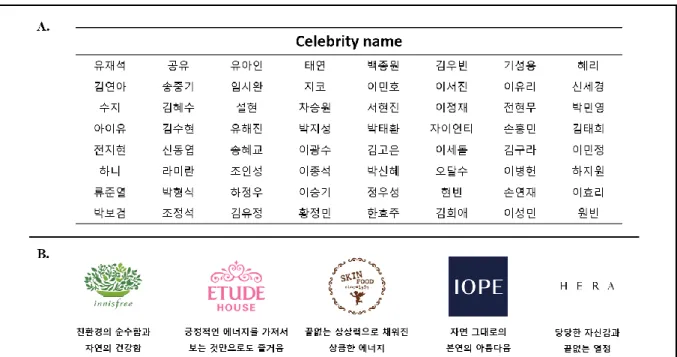
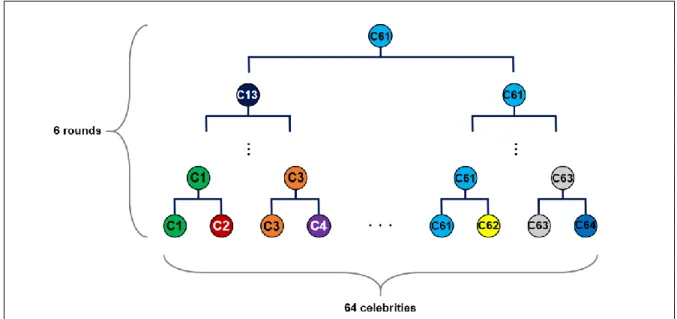
selected based on the BSTI (Brand Stock Top Index) model, which measures the brand value by combining the Brand Stock Index and Consumer Survey Index provided by Brandstock. The values that each brand pursues were derived from descriptions of brand values and goals disclosed on the representative website. After that, an online survey was conducted on 45 female subjects to rule out the impact of factors other than congruence between brand and celebrity. Subjects were asked to evaluate each of the 30 cosmetic brands and 78 celebrities on a five-point scale for liking (1: much less like to 5: much more like) and awareness (1: not well aware of to 5: very well aware of). Finally, by summing the score of liking and awareness, the top 64 celebrities (M = 8.19, SD = 0.89; Figure 2.1A) and the top 5 cosmetic brands (M = 8.49, SD = 0.47; Figure 2.1B) were selected for preliminary experiment stimuli.
Figure 2.1 | A preliminary experiment stimulus set. (A) Korean celebrities name selected by the sum of the score of liking and awareness. (B) Each logo and corresponding value of Korean cosmetic brands selected by sum of the score of liking and awareness.
27 2.2.3. Experimental procedure
Subjects were asked to sit comfortably in front of a computer screen and were provided with instruction about the experiment. The experiment was designed as one factor with two blocks and the blocks were named as appearance congruent black and value congruent block respectively. Each block included 5 sessions for 5 kinds of cosmetic brands. The session is a tournament basis and the detailed experimental procedure is shown in Figure 2.2. Because the experiment employed a task on a tournament basis with 64 celebrities, total rounds were 6 and total trials were 31. In the experiment, one of 5 cosmetic brands’ logo or value was shown randomly on the screen center, and two of 64 celebrity names were shown below it (Figure 2.3).As the round progressed, the celebrity selected by the subject moved to the next round and the unselected celebrity disappeared. All the sessions were repeated 2 times and the sequence of all the block and sessions were randomly assigned for each subject.
Figure 2.2 | An experimental procedure of preliminary experiment. The experiment employed a task on a tournament basis with 64 celebrities and the task was repeated 2times for 5 kinds of cosmetics separated with 2 blocks (appearance congruence block & value congruence block).
28 2.2.4. Stimuli acquisition
In order to define a combination of brand and celebrity according to the separate conditions, the score was calculated by summing up the number of choices made for each celebrity and cosmetics brand.
Although there was a total of 31 choices for each session, the selections during the first round with 32 set of celebrities were not included in the calculation because the variation was too high for each subject.
Therefore, the total number of choices per session was 15, calculated as a score and aggregated by subjects.
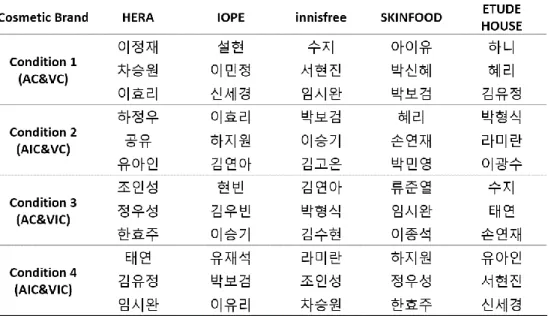
For the condition in which the celebrity and cosmetic brand are congruent for both appearance and value (condition 1), the top three celebrities for each cosmetic brand were chosen by summing up the rankings, where the rankings were converted into ascending order. On the other hand, in the case of the condition in which the celebrity and cosmetic brand are incongruent for both appearance and value (condition 4), three celebrities with the lowest-combined rankings were selected as the representative celebrities of each cosmetic brand (Appendix 1).
Figure 2.3 | An example of computer screen during the preliminary experiment. (A) An example of tournament basis task during the appearance congruent block. One of 5 cosmetic brands’ logo was randomly shown on the screen center.
Two of 64 celebrity names were randomly combined, and they were shown sequentially below the logo. (B) An example of tournament basis task during the value congruent block. The procedure is the same with the appearance congruent block.
29
In the case of conditions where the cosmetic brand is congruent with the value of celebrity but not with the appearance of celebrity (condition 2),the rankings were summed up, where the score from appearance congruent block was converted into a descending ranking and the score from value congruent block was converted into an ascending ranking. Likewise, the condition where the cosmetic brand is congruent with the appearance of celebrity but not with the value of celebrity (condition 3), the rankings were summed up in the same way that the condition 2 does. Given the rule defined above, a set of combinations to be used in the main experiment was finalized as can be seen in Table 2.2.As the main experiment employed a full factorial design with two factors, appearance congruence (congruent vs. incongruent) and value congruence (congruent vs. incongruent), 60 proper combinations of celebrities and brands were comprised through a preliminary experiment and divided into 4 conditions each having 15combinations of celebrities and brands. From now on, AC&VC (appearance congruent and value congruent) denotes condition 1, AIC&VC (appearance incongruent and value congruent) denotes condition 2, AC&VIC (appearance congruent and value incongruent) denotes condition 3, and AIC&VIC (appearance incongruent and value incongruent) denotes condition 4.
Table 2.2 | A set of combinations separated by conditions for the main experiment.
30 2.3. Main experiment
2.3.1. Subjects
Twenty-three female subjects aged between 19 and 26 years (21.3 ± 1.9) were recruited through the online participant recruitment site of UNIST and paid $10.6 for their participation. All subjects had normal vision and their vision was 0.8 or higher without the aid of glasses or hard lenses (Soft lenses were accepted). Also, they were all provided written consent according to the approval obtained from the Institutional Review Board of the Ulsan National Institute of Science and Technology (UNISTIRB- 16-29-G).
2.3.2. Stimuli
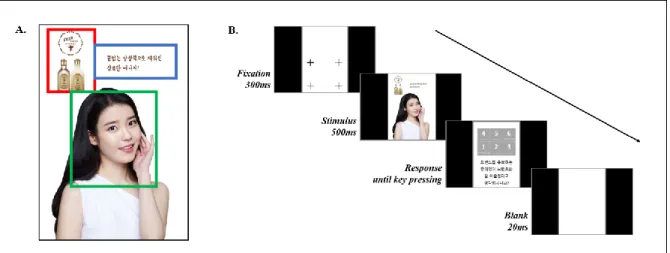
Totally, 60 stimuli in the form of an advertisement poster were composed of a white background with a face of celebrity, brand logo, product, and value. The size of the stimuli was 1920 × 1080 pixels and was centered on the computer screen. For analysis of eye-tracking data, the position of the components in each stimulus was maintained throughout all the stimuli (Figure 2.4A).
2.3.3. Experimental procedure
Subjects were comfortably seated in front of a computer screen at a distance of 140cm in a dark room and were given a written instruction about the experiment. The main experiment consisted of a training session followed by an evaluation session and post-questionnaire session. The experimental paradigm of the training session was the same as that of evaluation session, but to prevent learning effect, celebrities were replaced by mascots and they were combined with brands unfamiliar to Koreans on advertisement posters. The paradigm of both training and evaluation session can be seen in Figure 2.4B.
Each stimulus was shown once for 500ms following 300ms fixation mark randomly displayed at one of the specific 4 locations on the screen. During the stimulus presentation, subjects were asked to observe the advertisement poster freely and their eye movements were being recorded on an eye-
31
tracking instrument. The locations of the fixation mark were set aside from any AOI so that subjects’
gaze on the stimulus coming up next would not be affected by the fixation mark. In addition, to maintain subjects’ concentration during all the experiment period, the locations of the fixation mark randomly appeared in four different areas on the stimulus. After the presentation of the stimulus, subjects were required to evaluate whether the celebrity endorser is fit with the brand or not from 1 (not fit in at all) to 6 (very well fit) with the number key on the keyboard using the right hand.
For the purpose of conducting recall and recognition tests, a mental math test that serves as a distraction from the experiments done just before was followed. The mental math test included arithmetic calculations and was conducted in four stages with the increased level of difficulty gradually.
Subjects had to get as many correct answers as possible within 2 minutes in each stage, with the time limit of 15 seconds per question. Because the mental math test was described as a part of the whole experiments, subjects were required to participate actively.
Figure 2.4 | An example of stimulus and experimental paradigm. (A) The area of brand logo and product (red border;
AOI 1), brand value (yellow border; AOI 2), face of celebrity (green border; AOI 3) was maintained through all stimuli. (B) Although one out of 60 stimuli were randomly appeared on a screen, it was manipulated so that the same brand or celebrity were not came out back and forth.
32
Next, a recall and a recognition test (Kuvita et al, 2014) were done with a recording of subjects’
response under their consent. As the recall test proceeded without any aided items about brand and celebrity names, subjects had to recall the combination of brand and celebrity names appeared during the evaluation session by themselves within 3 minutes the time limit. In the case of the recognition test, there were lists of brand and celebrity names on the screen, including the names that appeared and did not appear during the experiment. The role of subjects was to find out the proper combination of brand and celebrity name from the list.
Finally, the post-questionnaire was conducted on all 60 stimuli about appropriateness, effectiveness, and liking on a six-point scale. Moreover, questions about appearance congruence and value congruence were inquired to evaluate the rating on a six-point scale explicitly, for the purpose of verifying stimulus classification appropriateness.
2.3.4. Recording and data processing
Before starting the experiment, the dominant eye to be used for eye-tracking data analysis was tested and the face of the subject was adapted to fit the eye-tracking instrument. Though the recording was done with an binocular mode, data from the dominant eye was only analyzed. The calibration and validation of the subject’s eye movements were completed before the evaluation session was conducted.
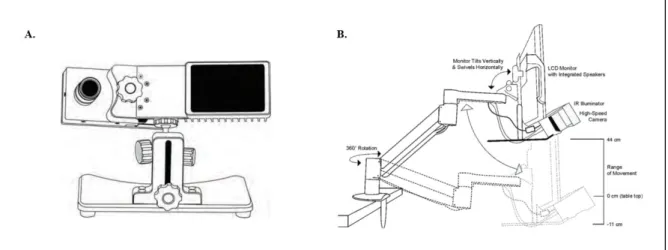
The eye movement data were recorded using a video-based eye tracking system with the head and chin supporter for stable data collection. For this research, ‘EyeLink 1000 Plus, SR Research’ produced by SR Research was used and this is a static remote eye-tracker (Figure 2.5), which puts both infrared illumination and video eye camera on the table and stimuli are presented on a remote monitor. By presenting stimuli through the monitor, eye-tracker gives a data with coordinates of a field of view. For stable coordinates data in a fixed coordinate system, the head and chin supporter were used, and the
33 head of subjects was fixed spatially.
Recording can be either monocular mode which records eye movements from one eye or binocular mode which takes data from both eyes. Though the instrument offers both modes, a monocular mode was used for study because of the difference between two eyes. It is commonly believed that the eyes follow the same path at the same time, so it is not required to measure both eyes. However, people almost have a dominant eye which is usually used when receiving visual information and has a time and spatial lag with the other eye. Therefore, it is recommended to use monocular mode for getting eye- tracking data. Also, EyeLink 1000 Plus provides users with 500Hz of the sampling frequency, which means that the instrument records the eye gaze pattern of subjects 500 times per second.
Recorded raw data was spatial coordinates of eye movements based on a two-dimensional axis on a screen and the events such as fixation, saccade, and blink were detected based on I-DT (Identification by dispersion threshold) algorithm (see 1.3.4. part for details). In this study, visual angle (V) was set to 1 degree and distance (D) between the monitor screen and the subject was 140cm, so the threshold (T) for fixation detection was approximately 92.4 pixels. Among detected events by I-DT algorithm, the fixation event was only used for analysis because the further analysis was processed using AOI measures. Therefore, data indicating saccadic event and blink was abandoned and the fixation events between AOIs were compared using various statistical tests.
34
Figure 2.5 | An image of EyeLink 1000 Plus instrument. (A) Front view of instrument is featured with eye camera.
(B) Side view of instrument is composed of eye camera and monitor for stimulus presentation. The height and direction of the camera and monitor can be easily changed.
35
3. RESULTS
36
THIS PAGE INTENTIONALLY LEFT BLANK
37 3.1. Verification of stimulus classification
Before data processing, it has been verified whether the classification of stimuli based on preliminary experiment appropriate or not. Scores evaluated during the post-questionnaire session on appearance congruence and value congruence were analyzed to verify stimulus classification appropriateness.
Figure 3.1 shows the distribution of scores with Box-violin-scatter plot. It seems like the variance of scores in terms of incongruent stimuli was bigger than in terms of congruent stimuli. As shown in Figure 3.2 below, subjects evaluated congruent stimulus set with the significantly higher score than incongruent set, which means that stimuli were properly classified according to congruence, regardless of the factor type which can be appearance or value (Two-way repeated measures ANOVA, F = 113.68, p < 0.001). Therefore, the classification of stimulus has been verified as valid, especially for congruence, and all of the analysis was performed based on the stimulus classified through a preliminary experiment.
38
Figure 3.1 | Box-violin-scatter plot of verification post-questionnaire.
Plot shows the difference in scores according to factor congruence.
Figure 3.2 | Verification of condition dividing. Two-way repeated measures ANOVA was conducted and the result shows that there was significant difference between congruence and incongruence (p < 0.001; left). As a result of multiple comparison, significant difference was found between congruence stimulus set and incongruent stimulus set for each factor type (p < 0.001; left). Interaction effect between factor type and congruence was not found (right).
39 3.2. Behavior results
3.2.1. Evaluations on the advertisement poster
Evaluation response collected during the evaluation session was analyzed. Firstly, to examine the differences between conditions the evaluation responses were distributed, and there existed some differences (Figure 3.3). Then, two-way repeated measures ANOVA was conducted and there were significant differences between value congruence factor (F = 207.68, p < 0.001) as well as between appearance congruence factor (F = 151.95, p < 0.001) (Figure3.4). Scores of value congruent stimulus were significantly larger than those of value incongruent stimulus, and scores of appearance congruent stimulus were significantly larger than those of appearance incongruent stimulus, also. Then, multiple comparisons were performed, and the result was significant for all kinds of comparison. Furthermore, the interaction effect between appearance congruence factor and value congruence factor was found (F
= 17.95, p < 0.001). When the value is incongruent, scores between appearance congruent and appearance incongruent has a larger difference compared with the case of value congruent.
Correspondingly, when the appearance is incongruent, scores between value congruent and value incongruent also has a larger difference compared with the case of appearance congruent.
40
Figure 3.3 | Box-violin-scatter plot of response score evaluated during evaluation session. Plot shows the difference in scores according to conditions.
Figure 3.4 | Comparison of response score evaluated during evaluation session. Two-way repeated measures ANOVA was conducted and the result shows that there were significant differences between within-factors (p <
0.001; left). As a result of multiple comparison, significant differences were found between all kinds of comparison (p < 0.001; left). Interaction effect between factor type and congruence was found (p < 0.001; right).
41 3.2.2. Recall and recognition results
Recall and recognition data was analyzed by converting an accuracy of recall or recognition as a form of rate. Response data was classified as a correct answer if brand and celebrity are well-combined, whereas if either brand or celebrity was wrong, response data was classified as a false answer. To assess the rate, the denominator for both correct and false answers was set as a total number of stimulus per condition, 15. For example, if someone recalls 8 correct answers and 5 false answers of stimuli in condition 1, the correct answer rate is 0.53 (8/15) and false answer rate is 0.33 (5/15). Finally, the accuracy was calculated by subtracting the false answer rate from the correct answer rate, so the accuracy would be 0.2 in the example. The number and rate of recall (Table 3.1) and recognition (Table 3.2) of the stimuli belonging to each condition were shown in the following table according to subjects, respectively.
42
Table 3.1 | Number and rate in recall task.
43
Table 3.2 | Number and rate in recognition task.