
Gepubliseer deur Korea Institute for National Unification (KINU) Uitgewer President, Korea Institute for National Unification.
Introduction
This research is mainly aimed at exploring a strategic direction in response to North Korea's advance in nuclear missiles by evaluating its implications. To this end, the study firstly analyzes the nuclear capability and nuclear strategy of the Kim Jong-un regime and then uses such analysis to evaluate the implications of nuclear progress over the next five years by categorizing them into the following dimensions : 1) international relations ;. This article presents the implications of the research and sets a direction for future research by proposing principles and strategies for South Korea in response to the DPRK's accelerated nuclear program.
Nuclear Capability and Nuclear Strategy of North Korea
North Korea’s Nuclear Materials and Nuclear Weapon Stocks
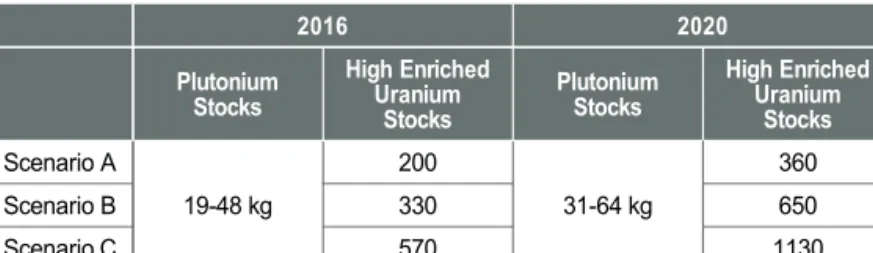
North Korea has three flow forming machines, which are essential for producing rotors and core components of centrifuges. Estimates of the regime's nuclear arsenal are calculated on the assumption that North Korea has weaponized all of its nuclear materials for warheads. Estimates of the current or future nuclear weapons stockpile in North Korea are based on the stockpile of HEU.
Still, as has been said, another possibility cannot be ruled out, that North Korea may have difficulty securing the HEU.
North Korea’s Nuclear Warhead Manufacturing Capability
2012 and 2014, requiring complex cleanup" and "this raises serious concerns about the safety of the reactor." According to the details of North Korea's fifth nuclear test, there could be a serious problem with North Korea's uranium enrichment. There is a possibility that North Korea is capable to build the first generation of fission weapons and has partially acquired the skills to build enhanced fission weapons This leads to the assumption that North Korea has conducted a fourth nuclear test using a mixture of tritium and deuterium.
North Korea's ability to produce an H-bomb will be determined by its nuclear strategy, but ultimately closely linked to its possession of nuclear material.
North Korea’s Nuclear Strategy
Implications of North Korea’s Advancement in
Implications on International Community
On the other hand, the advancement of Pyongyang's nuclear capabilities will weaken its alliance with China in the short to medium term, while the regime's nuclear armament will encourage competition and confrontation between neighboring countries. The nuclear armament of the Kim Jong-un regime is a serious threat to the international non-proliferation regime. It also seeks international recognition as a nuclear-weapon state and threatens major non-nuclear-weapon states.
All this could pose a unique and significant shock to the non-proliferation regime, even if the consequences for the global non-proliferation regime will be limited. The threats posed by North Korea's nuclear weapons do not extend beyond the borders of Northeast Asia, and the demonstration effect is weak. Moreover, the challenges posed by Pyongyang's nuclear ambition are fueling the international community's efforts to maintain and consolidate the nonproliferation regime.
Implications on Inter-Korean Relations
How dangerous technological progress affects the prospect of inter-Korean exchange and cooperation is another. Based on these studies, it can be concluded that the advancement of North Korea's nuclear capability and the subsequent growth of the military may encourage military provocations against the South, thereby increasing the possibility of an inter-Korean military crisis. First, a comparative analysis between North Korea's local provocations carried out before and after Pyongyang's third nuke.
Therefore, the authors recommend a cautious approach to asserting a positive correlation between North Korea's nuclear advancement and inter-Korean military confrontation based on previous studies. Second, after observing the detonation of North Korea's PMD-series mines in the DMZ in August 2015 and the subsequent negotiations between the two Koreas, it can be suggested that the advancement of North Korea's nuclear capabilities and increase in military power cannot give the Kim regime more pressure on the South or consolidate its negotiating power. Therefore, the DPRK's nuclear weapons may be a useful tool to increase deterrence, but not an effective means of coercion against South Korea.
A takeaway from the above analysis is that North Korea's advanced nuclear weapons do not necessarily lead to military provocations or coercion. Thus, there is little reason to believe that nuclear progress will cast a shadow over the future of inter-Korean relations, exchange and cooperation. Denuclearization is a worthy cause as North Korea's nuclear advancement is a key factor in instability and tension on the Korean Peninsula.
However, the authors wish to criticize the pessimistic view that the ROK is trapped in the security dilemma and therefore the future of South-North exchange and cooperation is bleak. In fact, under Kim Jong-un's leadership, many exchanges and cooperation programs have been reduced or postponed, although the regime's nuclear and missile capabilities have increased.
Implications on Korea
The response to Pyongyang's nuclear threats must be accompanied by a comprehensive analysis of South Korea's security landscape. Another argument that should not be overlooked is a call for enhanced intelligence sharing between Seoul, Washington and Tokyo, which could be an effective countermeasure against long-range missile attacks. When it comes to opposing North Korea's nuclear buildup, public opinion must be reflected to a certain extent in order to avoid service parochialism or bias toward regional interests in the ROK Armed Forces.
South Korea's sense of helplessness over Pyongyang's nuclear asymmetry is an issue to consider, given the economic gap between the two Koreas and the size of South Korea's economy. Budgetary competition between service branches in the military became a practice in a highly political and bureaucratic environment. Critics have already pointed to the lack of scientific perspective in the defense spending and allocation plan in the Medium-Term National Defense Plan, despite the government's request to do so.
Previous budget requests for the military, for example, have emphasized security threats, including North Korea's asymmetric threat and the possibility of a full-range provocation. But there is no vision found in the requests to respond to the most important security issues and trends of the time. In addition to the government-level meetings and cooperation, public diplomacy and other private channels for exchange should be better exploited as an opportunity to express Korea's concerns about North Korea's nuclear advancement.
Korea's experience suggests that service parochialism has had some negative effects on ensuring an effective response to North Korean threats, prompting the initiation of discussion on national defense reform. In order to avoid the same mistake, there needs to be a public debate about what institutional mechanisms would be useful to build a consensus on such a reform.
Implications on North Korea
South Korea’s Response
South Korea’s Basic Response Principles
It is agreed that deterrence by punishment is the most reasonable response to the North's nuclear forces. If Korea gains access to participate in US nuclear operations, there will be more confidence in the ROK-U.S. the alliance's ability to deter North Korean nuclear threats with punishment. As the DPRK's nuclear capability advances further, expectations and prospects for denuclearization are emerging, some of them optimistic.
First, an interim agreement between North Korea and the US on nuclear freeze and non-proliferation is unlikely to be reached in the near future, as this is something neither party would welcome. The tentative agreement, if prioritized in the ROK's North Korea.. policy, could cause unnecessary tension with the US, which is reluctant to sign such an agreement. Regarding North Korea's nuclear development, unrealistic expectations of each other only cause disappointment, worsening the lack of trust between parties.
Some observers suggest that North Korea may be taking advantage of such a situation and seeking the return of Cold War-style regional order. Moreover, if North Korea wrongly believes that a new Cold War has already been initiated, the country may become more provocative against the South, expecting solid support from China and Russia. Against this backdrop, Korea should focus on the international non-proliferation mechanism in addressing North Korea's nuclearization.
In other words, the problems that may arise from North Korea's status as a nuclear-weapon state can be prevented or kept under control. To this end, the Republic of Korea must be an active partner in the global effort to control the nuclear capabilities of the North Korean regime and avoid any comments that contradict the spirit of the effort.
Korea’s Strategic and Policy Response
First, there is a need to uphold the principle of peaceful resolution of North Korea's nuclear arsenal through dialogue and compromise. This would in turn increase sovereign risk, which will damage Korea's reputation and competitiveness in the global market. Another essential approach is a more detailed and step-by-step roadmap towards North Korea's denuclearization, which includes effective carrot and stick.
If North Korea's progress in precision-guided capabilities continues at this pace, the regime may add more independent return vehicles (MIRVs) to its arsenal in the future, one of the worst-case scenarios for the parties concerned. The effectiveness of the Korean kill chain is likely to increase in the future, as Seoul signed a $1.2 billion contract to deploy a series of Global Hawks, a high-altitude reconnaissance aircraft made in the United States, by 2019. The point is the integration of military technologies and state-of-the-art information technology, one of South Korea's key advantages over the North.
In this regard, the Korean chain of destruction initiative may need an implementation plan that also includes a long-term understanding of the surrounding factors. On the other hand, there is a possibility that the DPRK's progress in nuclear capability will facilitate the proliferation of North Korea's nuclear capability across the border. Another concern for Seoul is how to manage the economic risk that could result from North Korea's nuclear development in the short to medium term.
However, a unilateral campaign by South Korea for North Korea's denuclearization and reckless attempts to improve its relations with Pyongyang could be a risky choice. Unless the Kim regime shows visible steps towards denuclearization, Korea's independent sanctions lifting, such as the reopening of the Kaesong Industrial complex, will lose the momentum of the sanction. Talks should, of course, take a form that reflects South Korea's interests and guarantees the implementation of denuclearization measures.
However, denuclearization and a peace regime across the peninsula should not be considered the end of their regime for North Korea's current leaders.
