Basic Research Report 16-24
An Analysis of Consumer Propensity for Bundled Energy Services and the Prospects for Retail Electricity Competition in
South Korea
Yoosoo Lee
Research Staff
Head Researcher: Yoosoo Lee, Senior Research Fellow
Research Associates: Duhwan Won, Professor at Pusan University
ABSTRACT 1. Research Purpose
The sudden change in the energy sector domestically or globally is due to the strengthening of response to climate change caused by the increase in greenhouse gas emissions and the shift to a new energy system. The new climate system, which was adopted by the Paris Agreement at the end of last year, came into effect on November 4 this year, and preparations for the implementation of the new climate system have begun in earnest. On the other hand, the use of energy sources including fossil fuels, which is the main cause of greenhouse gas emissions, is changing in the process of conversion to a system corresponding to the response to climate change.
Changes in response to climate change and the corresponding energy system are largely driven by technological convergence through the development of energy technologies and the application of information and communication technology (ICT), etc, leading to market creation through the development of new business models. On the other hand, changes in the market structure of the electric power industry have enabled market operator to operate the market more efficiently by various businessmen’s developing various business models and pricing schemes that meet the consumer’s utility level under competitive environment. The development of technology and institutional environment to accommodate it are creating incentives for new business models, and businessmen are responding to consumer changes in a competitive manner.
In most countries experiencing the restructuring of the electric power industry, under the competitive market structure due to the liberalization of the retail market, various businessmen are strengthening their competitiveness by providing a combination of energy sources and various related services. On the contrary, the power retail market remains a monopoly structure and KEPCO is the only retailer. Thus, various businessmen are not able to develop new business models and provide related services. However, there is no incentive for KEPCO to develop various business models and provide energy bundled services, which makes it difficult to meet various consumer needs.
However, since Korea also planned to open the electricity retail market in the restructuring plan of public institutions announced on June 14 this year, it is expected that the energy bundled services will be provided by opening up the electricity retail market and various businessmen’s entering into the market. Therefore, it is necessary to analyze the propensity of consumer for new businessmen and energy bundled services, assuming the opening of the electricity retail market in advance. This is because it is necessary to give an answer to the question of how to design the retail market in advance by examining the problems that may arise when actually the electricity retail market is opened. Therefore, this study focuses on analyzing the consumers’ propensity for the energy bundled services in advance on the premise of the opening of the electricity retail market, and presenting the policy directions for the design and operation of the electricity retail market.
2. Summary
In order to consumers to offer a variety of energy source bundled services and pricing scheme, a competitive market structure based on the opening of the retail market is assumed. By the way, since the energy bundled services vary depending on the structure of the electricity retail market and the way of trading, it is necessary to understand this before analyzing consumer preferences. The competitive structure of the market depends on the way in which competition is introduced in the electric power retail market, which affects market power and market share of existing and new businessmen. And depending on the type of market transactions related to supply and demand, there are various ways of business and power purchase. The difference in market power and market share among such businessmen ultimately affect the provision of various energy services and their associated tariff decisions. On the demand side, new service- related business model associated with the demand response of the consumers is developed through the AMI installation, and consumers are changing to active consumers who are participating in changes in energy consumption pattern and production. the bundled services of energy sources are provided in various forms, such as combining energy sources or combining them with other goods and services, and in the form of value-added services, or combinations of other services.
Most of the major foreign countries are providing energy bundled services and various tariff menus by existing and new businessmen through the opening of the electricity retail market or liberalization of the market. As consumers are given right to choose the supplier, businessmen who are in the competition for survival are using the strategy of securing customers through rate discounts while providing energy service. It appears that a single energy company provides a combined service of various energy sources through mergers and acquisitions with other energy companies, or a single
energy company combines different energy sources. In addition, companies in areas other than energy provide services in a variety of ways, such as discounts on electricity rates through partnerships with utilities.
Korea has announced its policy to open up the electricity retail market in the future and allow the entry of various suppliers, but the specific schedule and plans have yet to be decided. However, since the policy direction for the electricity retail market was determined, it is necessary to review the design and operation of the market in advance.
Therefore, we analyzed the propensity of the consumers when the openness of the electricity retail market and the entry of the large number of suppliers into the market are assumed and various energy source and other bundled services are provided.
We identified consumer selection criteria for providing energy bundled services through survey for consumer and analysis of the results and examined the design and operation of the retail market based on the results. The analysis of consumer preference was made by determining the five attributes and the level of each attribute such as type of business, combined gas and heat service, combined internet and communication service, solar rental service, and electricity tariff.
As a result, consumers’ preference for KEPCO is still high even if other suppliers enter the market due to the opening of the electricity retail market. Consumers are positive about the competitive market structure, but the image of KEPCO as an electric power sale company is too high, indicating that it is not easy to choose other suppliers. Consumers are also more sensitive to the discount rate of bundled services than energy bundled services themselves, so they prefer to be supplied individually if all conditions are the same. Thus, in order for consumers to opt for a more efficient and satisfying choice for energy bundled services, suppliers should provide significant discounts or additional services. In the end, under the competitive market structure through the opening of the electric power retail market, it was confirmed that it is the most important factor for various suppliers to have the price competitiveness in order to provide the energy bundled services and be chosen by consumers.
3. Policy Implication
The conditions for suppliers to be competitive in the electricity retail market should be fair in the competitive conditions of the retail market. Discounts on energy bundled services can be lowered to some extent due to economics of scope, or productivity or efficiency enhancement, but they are limited. Basically, any discriminatory factors in market conditions that cannot be controlled by the suppliers should be eliminated. Therefore, the prerequisite for opening the electric power retail market should be dealt with in the light of creating a fair competition base for the market. If we choose to open up the retail market, maintaining the existing KEPCO, we need to focus on improving the unfair competition conditions by market power. This is because the image of a power supplier in the monopoly market has already been firm, making it difficult for new suppliers to secure customers.
In order to create a fair competition base along with the opening of the electric power retail market, it is necessary to newly establish rules for the trading conditions of the wholesale market and the use of transmission network. It is necessary to apply the same electricity purchase conditions in wholesale market of KEPCO to other suppliers and to require KEPCO, the network owner, to treat the third party fairly and equitably. If necessary, it can be considered to use asymmetric regulations that strengthen regulations on dominant supplier as a way to strengthen the competitiveness of new suppliers. In addition, the government needs to manage policies on existing energy sources in an integrated manner, while strengthening the market surveillance function for fair competition based on the creation of competitive conditions in the market. In the end, the policy improvement needs to be made so that laws and institutions are appropriate to competitive structure of the market.
Table of Contents
Chapter 1. Introduction ... 9
Chapter 2. Retail Electricity Markets and Types of Energy Service Bundles ... 11
1. Structure of Retail Electricity Markets and Changes in the Modes of Retail Electricity Transactions ... 11
A. Structure of Retail Electricity Markets... 11
B. Modes of Electricity Transactions in Retail Electricity Markets ... 12
C. Changes in the Role of Consumers and Means of Retail Electricity Transactions ... 12
2. Types of Bundled Energy Products and Services ... 13
A. Bundling of Energy Sources ... 14
B. Bundling of Energy Sources with Other Products and Services ... 14
C. Bundling of Energy Sources with Value-Added Services ... 14
D. Other Types of Bundled Services ... 14
Chapter 3. Analysis of Foreign Cases and Trends and Their Implications ... 16
1. United States ... 16
2. Japan ... 17
3. Europe ... 18
4. Implications of the Analysis of Foreign Cases ... 19
A. Similarities among Foreign Cases ... 19
B. Differences among Foreign Cases ... 19
C. Implications of Foreign Cases ... 20
Chapter 4. Analysis of Consumer Propensity for Bundled Energy Services ... 21
1. Previous Research ... 21
A. Research on Companies and Markets Offering Bundled Products and Services ... 21
B. Research on How Bundled Offers Influence Consumer Welfare ... 22
2. Consumer Survey on Bundled Energy Services ... 22
A. Survey Structure and Characteristics of Respondents ... 22
B. Current State of Consumers’ Residential Energy Use ... 24
C. Respondents’ Awareness of the Retail Electricity Market ... 26
D. Awareness of Solar System Leasing Programs ... 31
3. Analysis of Consumer Propensity for Bundled Energy Services ... 32
A. Conjoint Questions ... 32
B. Theoretical Analysis Model ... 34
C. Estimation of the Utility Function ... 36
D. Forecast for the Retail Electricity Market ... 40
E. Conclusion ... 41
Chapter 5. Potential for Retail Electricity Competition and Its Policy Implications ... 43
1. Consumer Propensity and the Structure of the Retail Electricity Market ... 43
2. Designing the Wholesale and Retail Electricity Markets and the Possibility of Retail Competition ... 43
3. Functions of Policies on the Retail Electricity Market ... 45
4. Policy Implications ... 46
Chapter 6. Conclusion ... 47
References ... 49
List of Tables
Table 4-1. Characteristics of Survey Respondents ... 23
Table 4-2. Attributes and Levels of Attributes in Conjoint Questions ... 33
Table 4-3. Sample Conjoint Questions ... 33
Table 4-4. Comparison of Ordinary Dummy Variables and Effect-coded Dummy Variables ... 37
Table 4-5. Definition of Variables in the Utility Function ... 37
Table 4-6. Basic Statistics of Variables ... 38
Table 4-7. Estimated Values of the Utility Function... 38
Table 4-8. Marginal Willingness to Pay per Attribute ... 40
Table 4-9. Relative Importance of Attributes Offered by Electricity Providers ... 40
Table 4-10. Consumers’ Choice Probability by Scenario (1) ... 41
Table 4-11. Consumers’ Choice Probability by Scenario (2) ... 41
List of Figures
Figure 2-1. Choosing the Method of Electricity Transaction in Accordance with the Changing Role of Electricity
Consumers ... 13
Figure 3-1. Retail Electricity Competition in the United States by State ... 16
Figure 4-1. Respondent’s Housing Types ... 24
Figure 4-2. Proportions of Energy Sources Used for Cooking in Residential Housing (%) ... 24
Figure 4-3. Types of Heating for Residential Housing ... 25
Figure 4-4. Average Monthly Electricity Bill ... 26
Figure 4-5. Level of Awareness of the Current State of Korea’s Retail Electricity Market ... 26
Figure 4-6. Satisfaction with KEPCO’s Services and Electricity Price ... 27
Figure 4-7. Opinion Regarding the Sale of Electric Power by Firms Other than KEPCO in the Event the Retail Electricity Market Is Opened ... 28
Figure 4-8. Opinions on the Various Effects of Opening the Retail Electricity Market ... 29
Figure 4-9. Changes in Prices of Various Services Due to the Bundling of Energy and Other Services in the Electricity Retail Market ... 30
Figure 4-10. Reasons for Keeping KEPCO after the Opening of the Retail Electricity Market ... 30
Chapter 1. Introduction
Due to the intensifying efforts to address climate change both domestically and internationally, the energy industry has recently been making a transition toward actively reducing greenhouse gases. Particularly following the adoption of the new climate regime with the signing of the Paris Agreement at the end of last year, most countries must now voluntarily meet the intended nationally determined contributions (INDCs) to reduce greenhouse gases and accelerate their transformation into low-carbon economies. With this, energy demand management policies have been increasing in importance, and it is becoming more and more necessary for consumers to take on more active roles in the energy industry. Until now, energy supply had been the key factor in balancing the overall supply and demand of energy, as increases in demand had been satisfied through the installation of additional facilities. Now, however, this energy supply- centered approach is proving increasingly inadequate to meet the goals of reducing greenhouse gas emissions and vitalizing the economy. In recent years, a new energy industry has emerged in Korea, which could accelerate the nation’s transformation into a low-carbon economy by utilizing new and renewable energy sources for small-scale, distributed generation and also by pioneering new territory for businesses through the development of new services and consumers’
more active role in energy consumption. This new energy industry is gaining increasing attention, as it has been recognized as a means of allowing the country to meet its greenhouse gas emission reduction goal through demand-side management and consumer-oriented services, such as demand response, energy conservation, and efficiency improvement, as well as a means of developing new industries that have great potential to become future growth engines.
However, such changes in energy supply and demand and the growth of this new energy industry are related to the structural changes in a country’s energy industry, such as the development of energy-related technologies and market liberalization. In particular, the opening of the energy retail market and entry of various businesses into the market provide opportunities for energy companies to offer consumers bundles of energy products and a diverse array of services. In foreign countries that have opened up their energy retail markets to competition, businesses have increased their investments in business models involving new services, allowing them to attract consumers with differentiated pricing strategies and services that bundle different types of energy sources. The South Korean energy market, however, is still monopolized, with the Korea Electric Power Corporation (KEPCO) being the sole provider of electricity in the retail electricity market. As a result, the current structure of South Korea’s energy market provides no room for the development of diverse business models and new services through price competition.
Yet, as announced through the Plan for the Restructuring of Public Institutions (June 14, 2016), the Korean government is planning to opening up its retail electricity market, which will likely lead to more in-depth discussions in the future.
The opening of the retail electricity market and the entry of new businesses into the market will give consumers the freedom to choose their electric power providers and bring competition to the market, giving rise to the need for a different set of regulations for the operation of the market. Therefore, prior to the opening of the market and the subsequent entry of a diverse array of electricity providers, it is important to analyze consumers’ propensity for electricity providers and the bundled energy services they would offer. The results of this analysis would allow us to identify the criteria consumers will use when selecting electricity providers and consumers’ level of satisfaction with such providers, while also helping us examine the methods for designing and operating a new retail electricity market. In establishing the structure of the retail electricity market, it is important to review and assess, in advance, the issues related to the energy service bundles to be offered by the wide range of providers that are likely to surface after the opening of the market.
This study therefore examines retail electricity markets that have already been opened to competition and focuses on analyzing consumers’ propensity for bundled energy services and reviewing the design and operation of an open electricity retail market. Since the opening of the market in South Korea would break the current monopolization and allow competition among an array of diverse businesses, the establishment of a level playing field will be a key factor in the operation of the market. The bundled energy services provided would also depend on consumers’ preferences, but as this issue is directly related to the basis of fair competition, it is important to center the discussion on this issue.
This study is organized as follows. After the Introduction, Chapter 2 explores retail electricity markets and examines the different types of bundled energy services, which become diversified in an open market. Considering this, it is important to review the different ways of opening a retail electricity market and the types of bundled energy services that can be provided, prior to the opening of the market. Chapter 3 focuses on the changes in business trends and types of bundled energy services that became available in foreign countries following the opening of their retail electricity markets, while exploring the implications of opening the market in South Korea. Chapter 4 provides an analysis of consumers’ propensity for bundled energy services and provides a starting point for discussions on the opening of the Korean market and the prospects for competition. To facilitate such discussions, the chapter presents a collection of data, acquired through consumer surveys, regarding the opening of retail energy markets and offers an analysis of the collected data. In Chapter 5, this study discusses market design and competition in relation to the opening of Korea’s retail electricity market, based on the results from Chapter 4, and draws implications for relevant policies in South Korea.
Lastly, the Conclusion offers a summary of this study and its implications.
Chapter 2. Retail Electricity Markets and Types of Energy Service Bundles 1. Structure of Retail Electricity Markets and Changes in the Modes of Retail Electricity Transactions
A retail electricity market is the final stage of a monopolistic and vertically integrated electric power industry.
Traditionally, this market has focused on consumer protection through price regulation. However, with the disappearance of economies of scale in electric power industries and the introduction of competition into retail electricity and power generation sectors, which resulted in the separation of retail electricity markets from the electricity transmission and distribution sector, competitive structures have been established in electricity markets around the world.
Before competition was introduced to the retail electricity sectors around the world, the mode of retail electricity transactions was simple: all consumers unilaterally received supplies of electricity from the electricity supplier. However, the introduction of competition into retail electricity markets spurred the emergence of a diverse array of businesses, and a shift toward the development of new business models with new products and services that bundle different energy sources began to emerge.
With the development of more advanced information and communication technologies, consumers are becoming proactive in mutual information exchange. Today, consumers are changing, shifting from simple consumers who use electricity passively and are protected through regulated electricity rates, to prosumers who can actively control electric energy consumption and manage electricity generation, storage, sales, and demand. Amid these changes, retail energy transactions are becoming more complex and diversified, and the operation of energy systems is becoming more efficient, with the deployment of smart grid technologies and the development of remote control and automated systems.
Before we examine the different types of bundled energy products and services that emerge during the process of an electric power systems transformation, let us first review the changes that occur in the structure of the retail electricity market and electricity transaction methods.
A. Structure of Retail Electricity Markets
This study focuses on discussions about the structure of retail electricity markets in order to find an answer to the question: amid what kind of market structure is electricity traded in the form of bundled products and services?
Competition can be introduced to a retail electricity market either in phases or all at once. In general, retail electricity markets have been opened in phases, focusing on the size of consumers’ electricity bills, which depends on the amounts of electricity used. This phase-by-phase market opening aims to gradually introduce a competitive market structure by providing time to alleviate the resulting shock and allow consumers to adapt to the changes in their electricity bills, which had been protected in the monopolistic retail market.
On the one hand, consumers are given the freedom to choose from among numerous suppliers in an open retail electricity market. On the other hand, however, electricity rates are no longer fixed, meaning consumers have to accept the risk of fluctuating charges. Since consumers are able to compare rates when selecting their suppliers, it becomes possible for them to elicit reductions in electricity charges by prompting competition among suppliers. Under a competitive market structure, consumers also have to accept the risk of increased electricity prices. If the market becomes an oligopoly, firms may have a chance to collude with each other and ruin the competitive structure, which could then lead to supply instability or higher prices.
Introducing competition to a retail electricity market involves: first implementing large-scale pricing, followed by medium-scale and then small-scale pricing, with grace periods in between, thereby gradually introducing competition and eliminating price regulations.1 In the early stages of this process, price cap regulations are implemented to protect competitive consumers and limit excessive increases in electricity rates. After a certain period, the price cap is removed, and price liberalization is allowed to take place. Under this structure, non-competitive consumers are charged regulated electricity rates by electricity companies that have been designated as providers of last resort.
Since the types of electricity providers differ depending on the structural reorganization of the electric power industry,
1 Large-scale pricing is largely equivalent to that of industrial pricing. Compared to household consumers, industrial consumers have a fixed load pattern and react sensitively to changes in electricity prices. Therefore, if given the freedom to choose, industrial consumers are more likely to switch suppliers in consideration of the increase in profitability that could result from the changes in their electricity bills.
it is important to examine the structures of electricity markets. The liberalization of a retail electricity market allows different structures to emerge, based on vertical or horizontal divisions or on the means through which new businesses enter the market. Differences in these new structures arise from different competitive compositions, which are contingent on the existence of a dominant business in the earlier structure.
Electricity market liberalization based on vertical or horizontal divisions allows a variety of businesses to exist in the market by vertically or horizontally separating and dividing the electricity sales sector of the existing monopolistic, vertically integrated electric power provider. Under this type of retail electricity market structure, it is possible for multiple businesses with similar market shares to emerge. In the long term, however, it is highly likely that these electricity retail companies will evolve by merging with electricity generation companies. Since this case presupposes the separation of electricity retailing from the electricity transmission and distribution network, problems related to the unfair use of the electricity transmission and distribution network would not be an issue.
On the other hand, if a retail market is opened to competition while the monopolistic provider is still in business, new electricity providers and the previously market-dominating electric power company will both engage in sales activities.
In this case, the dominant company, which owns the electricity transmission and distribution network, would likely treat the new providers differently. Therefore, the most important task in the formation of a competitive composition in this retail market is ensuring fair competition through the separation of the electricity transmission and distribution network from the dominant electric power company. In addition to realizing this separation, it is also important to allow new electricity providers to purchase wholesale electricity under the same conditions as the dominant electricity provider. In the end, the establishment of conditions for fair competition between new providers and the dominant provider is the key to the successful opening of a retail electricity market.
B. Modes of Electricity Transactions in Retail Electricity Markets
Electricity transactions in a competitive retail market are related to the means of electricity supply and demand between the various providers and consumers. In most competitive retail electricity markets, consumers have the freedom to choose from various electricity providers, purchase electricity directly from the wholesale market without going through a provider, or receive electricity by engaging in transactions directly with an electricity generator. In addition, consumers can also receive their electricity through retailers, aggregators, or brokers.
There are several different types of electricity retailers. First, there are simple retailers and companies that engage in both the retail and distribution businesses. There are also types of companies that engage in the retail business by merging with an electricity generation company, in consideration of the changes in profitability as well as to distribute the risks resulting from the variability of pricing and supply in the wholesale and retail electricity markets following market liberalization. Moreover, there is a wide variety of other types of businesses in retail electricity markets, including aggregators, who act as intermediaries between power generators and consumers, and service providers, who offer a broad range of services related to electricity transactions.
C. Changes in the Role of Consumers and Means of Retail Electricity Transactions
For a certain period of time following the opening of a retail electricity market, consumers tend to continue playing passive roles in receiving their electricity, despite the existence of a new market structure that allows for competition among numerous businesses. Theoretically, it would be reasonable to design a market that allows consumers to respond to the real-time electricity rate, which reflects the supply cost by time. In reality, however, consumers were largely unable to respond to the electricity rate in real time in a retail electricity market that was opened to competition, as an advanced metering infrastructure (AMI) had not been established then. However, with the gradual application of information and communications technologies and the establishment of AMI, new business models are emerging through mutual information exchanges between suppliers and consumers, leading to changes in the status of consumers in retail electricity markets.
As electricity transactions began undergoing diverse transformations, the role of consumers changed as well. In other words, the diversification of consumer choice leads to the development of more ways to purchase power.
First, it became possible for electricity consumers to receive a supply of electricity as well as other energy products through an electricity provider or another type of energy company. Due to bundling, it also became more convenient to
purchase TV, telecommunications, and Internet services along with electricity. Moreover, consumers were able to directly and indirectly participate in demand-side management, such as demand response, electricity conservation, and improvement of efficiency in electricity use, thereby controlling the use of electricity.
Figure 2-1. Choosing the Method of Electricity Transaction in Accordance with the Changing Role of Electricity Consumers
판매사 A Supplier A
송배전망 Electricity transmission and distribution network 소비
생산 판매 저장
Consumption Generation Sales Storage
소비자 프로슈머
Consumers Prosumers
This participation of consumers in not only the consumption of energy but also in its production, storage, and sale is expected lead to changes in the operation of the energy system. Consumers can now purchase electricity through the electricity transmission and distribution network in the retail electricity market, which consists of utility companies and a variety of electricity sales companies. They can also generate electricity themselves for their own consumption or sell dump loads.
Such electricity transactions provide a foundation for consumers to make strategic choices in becoming energy prosumers and earning profits. If consumers install solar panels, they can make profit from the differences between the amount of electricity consumed and the amount generated over time, as there are times when there are power surpluses and power shortages. Consumers can make use of this. And if power storage devices are added to the equation, it becomes possible for consumers to make even more strategic choices from among the wide range of ways to generate, purchase, and consume energy.
2. Types of Bundled Energy Products and Services
The sales of bundled products and services is the realization of economies of scope, which refers to the reduction of production costs and the prices of goods by businesses combining their production lines or service systems rather than manufacturing each product separately. Bundling can also reduce transaction costs for consumers, as they no longer have to purchase each product separately. On the other hand, however, the strategy of bundling products has been used by market-controlling businesses to maintain their dominance of and exclude other competitors from the market. This shows that businesses can bundle products and services to improve efficiency while also aiming to control competition in a
competitive market. In reality, the bundling of different energy sources and bundling of energy supply services with additional services have had both positive and negative aspects. With a focus on efficiency improvement,2 This section examines the bundling of different energy sources, the bundling of electricity and other products or services, and other types of bundles, with view to improving efficiency.
A. Bundling of Energy Sources
Upon the opening of a retail electricity market, new businesses enter the market and establish various strategies to attract customers, while existing businesses develop various products to compete with new businesses and attract customers. Aside from the existing power companies, energy-related businesses, such as gas, petroleum, and heating companies, come to prefer providing bundles of various energy sources rather than providing each energy source separately.
After the liberalization of a retail electricity market, companies begin to diversify their energy sources through mergers with and acquisitions of companies that work with different energy sources and establish new businesses.
B. Bundling of Energy Sources with Other Products and Services
In the telecommunications market, market liberalization leads to the vitalization of businesses that bundle their wireless communication, Internet, and TV broadcast services together, allowing them to offer these services to consumers, for the duration of the contract, for prices much lower than if each service were provided separately. With the opening of a retail electricity market, a wide range of businesses begin to enter the market. Energy companies providing electricity, gas, and heat, as well as businesses involved in telecommunications, housing management, hospitality, Internet shopping, and other industries, participate in the market by providing packages of their own services bundled with electricity supply services.
In terms of providing electricity services through the bundling of such services with different energy sources or other products, the conditions of an open retail electricity market are most advantageous for telecommunications and municipal gas businesses, as they already have fixed customer bases. As telecommunications businesses, in particular, already offer bundles of telecommunications and broadcasting products and services, they have an advantage in terms of securing customers by offering packages that bundle such existing services with different energy sources, such as electricity and gas. However, since non-energy-related companies are inexperienced in technical matters and supply stability maintenance, such companies might prefer providing energy services through partnerships or collaborations with energy companies rather than directly procuring and providing energy services to consumers.
C. Bundling of Energy Sources with Value-Added Services
In addition to providing services that bundle different energy sources or bundle energy sources with other types of products, energy-related businesses, including the existing utility companies, are simultaneously providing a variety of value-added services related to energy supply. Value-added services bundled with energy sources are fundamentally related to businesses that could make profits based on consumers’ load patterns as well as energy production and sales.
For instance, energy sources can be bundled with value-added services, such as energy demand management consultations, device sales, maintenance and repairs, and inspections. The installation of insulated windows or charging stations for electric vehicles could be offered as value-added services as well. Solar panel leasing and other similar businesses are also related to consumers’ consumption of self-generated electricity, sales of dump loads, and profit creation.
D. Other Types of Bundled Services
2 The main goal of Section 2 is to examine the types of bundled products featuring different types of energy sources alongside other products. The efficiency of the bundled products will not be discussed, as that extends beyond the scope of this study.
Besides the bundles of energy sources and other products and services mentioned above, there are other types of bundled services that businesses can provide. For instance, non-energy companies can form partnerships with energy companies to provide electricity along with a loyalty program through which consumers accumulate points by purchasing electricity, which can then be used to purchase other products. In addition, these businesses can also offer various extra benefits, such as fuel discounts, gift cards, and day passes for ski resorts and amusement parks.3 Moreover, through intermediary electricity purchasing services, service providers can provide a supply of electric power in the form desired by consumers. Lastly, companies can also market an electricity product package by assigning IP addresses to smart home appliances purchased by consumers and offering deductions on electricity bills for certain periods of time.
3 BEUC (2015), “Building a consumer-centric Energy Union,” BEUC position paper, p. 12, footnote 27.
Chapter 3. Analysis of Foreign Cases and Trends and Their Implications
It is difficult to provide electricity-centric bundled energy products in a retail electricity market that has not been liberalized. Bundled offers are currently used as strategies to strengthen companies’ competitiveness and attract customers in a competitive market, as they allow companies to gain an advantage in terms of cost and convenience by providing bundles of products and services rather than offering each product or service separately. However, if there is only one dominant company in the market, there is no need for such a variety of strategies to strengthen the company’s competitiveness. Moreover, with the presence of only one dominant state-owned company, all customers, both existing and new, have no choice but to purchase electricity from that company. As a result, the company has little reason to reduce costs or improve its services.
Most countries that have restructured their electric power industries have completely open retail electricity markets and barely any price regulation.4 With the intense competition in terms of product prices and quality in competitive markets, bundled offers are used as a strategy to keep existing customers, attract new customers, and maintain the satisfaction level of customers.
In this chapter, we will examine foreign countries that provide energy product and service bundles and draw implications for South Korea.
1. United States
The structure of the electricity market in the United States differs by state; thus, the opening of the retail electricity market to competition progressed in different ways. As illustrated in Figure 3-1, about half of the states have opened their retail electricity markets to competition. The 15 green states have opened their markets, while the eight red states have either postponed or eliminated retail competition. Among the red states, four—California, Nevada, Oregon, and Virginia—allow limited competition in the electricity retail market, permitting only large-scale industrial customers and several commercial customers to choose their electric power providers.5
Figure 3-1. Retail Electricity Competition in the United States by State
Sources: Belmont Electricity Supply Study Committee (2004, p. 19),
http://www.eia.gov/electricity/policies/restructuring/restructure/elect.html,
and the U.S. Energy Information Administration (2003, p. 3); Morey & Kirsch (February 11, 2016), p. 4.
The opening up of the retail electricity market to competition has displayed trends that are different from that of the monopolistic retail market, specifically: 1) increased number of options for consumers in terms of electricity bill plans and services, and 2) companies’ focus on strengthening their competitiveness through the differentiation of products and
4 In cases where retailers are no longer able to provide electricity to consumers, it is necessary to designate a provider of last resort. In most cases, the dominant electricity distribution and sales company in the locality are designated as such providers.
5 Morey & Kirsch (February 11, 2016), p. 3
services. Similar to electricity providers in Europe, electricity providers in the United States adopted differentiation strategies that led them to merge with gas companies to improve their competitiveness.
American electricity providers are also offering consumers more freedom of choice by introducing new electricity bill plans.6 The United States has adopted utility green pricing programs, which encourage customers to purchase energy generated from renewable sources at higher premiums, and is currently working toward implementing separate pricing programs for energy produced from renewables, such as a surcharge for the renewable portfolio standard (RPS). A couple of examples are Austin Energy’s Green Choice Program and Tucson Electric Power’s Renewable Energy Standard and Tariff surcharge.
However, with the opening of the retail electricity market, a variety of new energy providers has emerged. It is particularly noteworthy that demand response providers are expanding their business activities. One such company, EnerNOC, currently offers services in demand response, energy efficiency improvement, and energy purchase consultations, among others.
Another trend that emerged following the opening of the retail electricity market was the integration of power and telecommunications companies to provide communications services and power as well as bundled products combining electricity, phone, broadband Internet, and home security services. Moreover, some telecommunications and computer companies also began including energy management services in their bundled service packages.7 Although the structure of the United States’ retail market differs by state, a wide range of bundled services are available for customers in those states where retail competition has been maintained.
2. Japan
Having completed the opening of its retail electricity market in April 2016, Japan is home to a variety of energy providers offering new energy services. In April 1995, Japan began gradually opening up its retail electricity market in phases through amendments of the Electricity Business Act. Nonetheless, the monopolistic structure of the market has remained largely unchanged. After the Fukushima nuclear disaster, however, concerns regarding the stability of the electricity supply and pricing began to surface, leading to growing demand for a more competitive market structure and electricity price liberalization. Although the liberalization of the retail electricity market for domestic customers was delayed prior to the nuclear disaster, energy policies were redirected to break down the barriers for all customers and liberalize electricity prices.
In fact, Japan has laid the basis for a competitive market structure and the entrance of new energy businesses by opening its retail electricity market and liberalizing prices through the three-stage reform of its electric power system.
After the opening of the market, the number of newly registered energy providers increased, adding to the regionally monopolistic electricity providers, and these new energy providers are now promoting new services.
One of the new types of services that emerged in Japan after the opening of the retail electricity market is bundles of energy products and related services, involving electricity and other energy sources. The wide variety of providers offering bundles of energy products and services can be largely divided into four categories.
First, there are energy providers that offer bundles of energy products and services. With the opening of Japan’s retail electricity market, energy providers other than electric power companies, such as gas and oil companies, began offering products and services, bundling their own products with electric power. Currently, many single energy source providers, especially oil and gas providers, are transforming into comprehensive energy providers, as doing so allows them to gain a competitive edge in price competition and reduce risks by bundling their own energy sources with electricity instead of selling them separately.
6 In Texas, numerous electricity retailers provide electricity plans with services, such as energy conservation solutions, and there are over 100 different plans. (Joongang Ilbo, Sept. 20, 2016, “Texas has 100 electricity plans, Japan offers an Internet and electricity bundle.”)
7 After merging with AT&T, the largest telecommunications company, Duke Energy, the largest electric power holding company in the United States, began providing telecommunications and electricity services. Also, Central Indiana Power (CIP), a small cooperative located in Indianapolis, merged with Hancock, a local telecommunications company, and created NineStar Connect, which provides bundled electricity and telecommunications products (Katherine Tweed, “The Merger of Telecom and Utilities; Is it the Future?,” Greentech Media, April 15, 2011).
Second, there are businesses from industries unrelated to energy that bundle their own products and services with electricity services. One of the major industries involved in providing these types of bundled products and services is the telecommunications industry. Japan’s telecoms, which had focused on providing product and service bundles featuring Internet, TV, and communication services, are now concentrating on expanding their customer bases by also providing electricity services or partnering or collaborating with electricity providers. Companies in the housing, distribution, and ICT industries are also expanding their businesses by bundling their own products or services with electricity services.
For instance, SoftBank, a Japanese telecommunications company, is now engaged in several renewable energy projects, including solar power and fuel cell projects, and is also selling electricity generated by its renewable energy facilities to commercial businesses.
Third, there are new energy supply methods promoted by autonomous local governments, which have been developed to help those regions become energy self-sufficient. Here, new energy supply methods are ways of generating electricity through the operation of eco-friendly energy production facilities fueled by renewable energy sources.
Energy projects conducted by local governments in Japan are related to the promotion of the chisan-chisho (地産地消, meaning “locally produced and locally consumed”) movement, which fosters independent local energy businesses as part of the country’s decentralized energy infrastructure project. Through this project, local governments in Japan have introduced independent, public facility-centered energy systems in an effort to reduce local energy costs.8 These projects are concentrated in the power generation industry, involving mainly public electric power businesses and waste power generation businesses. Recently, local governments have been creating energy supply systems that allow them to become energy self-sufficient by actively utilizing local renewable energy sources, such as large-scale solar power stations.9
Lastly, there are energy cooperatives based in certain areas that produce electricity and distribute the profits to the participating residents. In these cooperatives, all energy-related activities are performed jointly, from energy management and purchasing to the production of energy from various sources, including renewables, in various decentralized facilities. This type of joint energy management became possible with the increase in the active participation of energy consumers and their greater acceptance and understanding of energy production and renewable energy sources.
However, excessive competition resulting from the reckless entry of new electric power providers into Japan’s retail electricity market produced adverse side effects. One case of a failed energy cooperative in Japan illustrates this point.
The Logitec Cooperative Association, a new electricity provider in Japan, offered electricity at lower rates than existing power companies. However, as it did not have its own energy production facilities, the association had great difficulty procuring affordable electricity and eventually went bankrupt due to poor returns.10
As illustrated above, a broad range of services has become available in Japan thanks to the emergence of a number of new electricity providers after the opening of the country’s retail electricity market. It is important to note that, as new electricity providers are developing new bundled services, existing dominant electricity providers are also competing to attract customers by proposing a variety of electric power plans and providing diverse services.
3. Europe
Through the EU Electricity Directive, Europe opened its retail electricity market in 2007, regardless of the operation of national electricity wholesale markets. As a result, all EU members currently have open retail electricity markets. While some European countries followed their national plans to voluntarily open up and liberalize their retail electricity markets prior to the directive, others participated involuntarily only upon the implementation of the directive.
With the full-fledged opening of the retail electricity market, large-scale energy businesses actively proceeded to engage in mergers and acquisitions. As a result, many electricity and gas providers transformed themselves into comprehensive energy providers, offering electricity generated from a variety of energy sources. The active efforts of electricity and gas companies to integrate with other electricity and gas companies within the EU has been regarded as a move to secure their shares of the market, which has expanded with the widening of an extensive power grid throughout the EU.
8 Korea Energy Economics Institute, World Energy Market Insight. Vol. 14-39, October 31, 2014, p. 21.
9 Ibid., p. 24.
10 KEPCO Economy & Management Research Institute, Vol. 14, May 16, 2016, p. 25.
In particular, investments in gas power generation increased after the liberalization of the electricity market, as the construction and investment return periods are shorter compared to other power sources. As a result, electricity providers merged with or acquired gas companies and began providing bundled services that included electricity and gas. Large- scale energy companies, in particular, provided various electricity billing plans and pursued strategies to differentiate themselves from their competitors. Electric power providers, such as Italy’s Enel and Germany’s RWE Power, concentrated on attracting customers by providing discounts on bundled products and customized plans. France’s EDF implemented a time-based rate scheme that features a strong price differential between off-peak and peak hours for residential customers, leading to changes in the consumption pattern as customers sought to avoid using electricity during peak hours.
The growth in demand for electric power has been slowing in Europe. In addition, with the increase in energy from renewable sources, wholesale electricity market prices have dropped, and profits related to traditional power generation methods have been decreasing. As a result, traditional energy providers are beginning to provide more diverse and comprehensive energy services in the retail market.11 Businesses are now utilizing distributed generation and smart meters, and they believe that bundles of services, diverse energy sources, and other products from different industries will become an important source of revenue in the future. France’s EDF and Germany’s E.ON SE and RWE Power have expanded their businesses to provide energy services related to distributed generation, while the Netherland’s Essent, Italy’s Enel, and Spain’s Endesa are diversifying their existing energy services. Moreover, other companies are spurring the development of new business models based on consumers’ energy usage information and the expansion of demand management-related services, such as energy conservation and efficiency enhancement.12 These trends are the result of a forecast in the energy industry that, with the change in the role of consumers, the development and expansion of various business models that can be applied to the demand side will provide new profit-making opportunities in the future.
4. Implications of the Analysis of Foreign Cases A. Similarities among Foreign Cases
The competition schemes in retail electricity markets provided opportunities for certain energy providers to engage in different types of businesses. Regardless of the type of electricity provider, whether energy supplier or another type of business, the most important factor was lowering energy prices to attract more customers. To this end, energy providers came up with a range of diverse electricity billing plans and strengthened their competitive edge by reducing customers’
electricity bills through the provision of bundled services.
In this process, companies developed business models that allow consumers to actively participate in the energy market and began paying more attention to consumer convenience and profitability instead of focusing simply on supplying electricity. This trend gave birth to bundles of energy sources, other diverse types of products, and various additional services, which companies began offering at reduced prices in order to secure more customers.
With the strengthened competitiveness of businesses following the opening of the retail electricity market, electric power providers began offering a diverse range of services. In addition, consumer habits began changing, as customers started playing an active role in energy production and management, leading businesses to diversify their strategies and sell electric power produced from diverse energy sources. The overall change in electric power supply systems and electric power providers is a result of the growing efforts to address climate change, which have led to an increase in the use of energy from renewable sources and distributed generation and changes in the role and status of consumers.
B. Differences among Foreign Cases
Bundles of diverse energy sources, non-energy products, and additional services typically began emerging after the liberalization of retail electricity markets, depending on the types of service providers. In the early phase, immediately following market liberalization, a diverse array of businesses flooded the markets. With time, however, the market structures changed, as businesses began to engage in mergers and acquisitions as a means of strengthening their competitiveness. As a result, retail electricity markets became oligopolies, centered around a number of large providers.
11 KEPCO Economy & Management Research Institute, (2015 Vol. 30, August 10, 2015), p. 1-3.
12 Ibid, p. 4-6.
In Europe, companies merged or acquired smaller companies to provide energy by combining their products and services. Prior to these mergers and acquisitions, many energy companies integrated with other energy services to provide bundles of diverse energy products and services. In this way, the companies attempted to strengthen their competitiveness and minimize risk by diversifying their energy mix. This could be the result of the EU’s comprehensive management of power supply policies, through its electricity directive, for one massive power grid stretching across Europe.
In Japan, the general trend was not mergers and acquisitions, but single businesses providing bundled products and services. Japanese energy companies tended to enter other industries in order to provide bundled offers and create a synergy effect. This difference between European countries and Japan arises from the competitive composition of their markets, in relation to the operation of the retail electricity market and the way in which competition was introduced.
C. Implications of Foreign Cases
Bundled energy products and services emerged after the liberalization of retail electricity markets. Prior to their liberalization, the retail electricity markets had been monopolies, with only one vertically integrated, market-dominating company providing electric power. However, with the introduction of competition into the markets, energy companies began combining energy sources and other services in a bid to attract more customers, resulting in the emergence of a greater variety of services. With more providers for consumers to choose from, companies were exposed to fierce competition to attract customers, leading them to develop customized electricity billing plans that better reflect customers’ consumption patterns and services that meet customers’ needs. The development of diverse energy services and bundles of diverse energy sources and other products were all business strategies employed by providers to ultimately increase the level of customer satisfaction.
On the other hand, the enhancement of power generation technologies and adoption of information and communications technologies have allowed certain regions to establish energy self-sufficient systems, prompting other companies to change their strategies in order to secure customers. In the past, electricity companies made profits by simply providing electricity. Today, however, they are transforming their operations to provide energy-related services along with services that used to be provided in other industries in an effort to better satisfy their customers’ needs.
Chapter 4. Analysis of Consumer Propensity for Bundled Energy Services
Bundled energy products and services began emerging in competitive markets after the opening of the retail electricity market. Currently in South Korea, KEPCO holds a monopoly in the retail electricity market, making it unlikely that a variety of diverse bundled services will be made available. In analyzing consumers’ Propensity for different types of bundled energy services, it is important to look at their interest in such bundled energy services, presupposing that the retail electricity market has been opened to competition. In other words, it is necessary to understand consumer response to the entry of companies providing an array of diverse service bundles, including services such as electricity, gas, TV, and telecommunications, before designing the structure of the retail electricity market. In this chapter, we therefore analyze data collected through surveys in an effort to better understand consumers’ preferences for bundled energy products and services as the groundwork for opening and designing Korea’s retail electricity market.
1. Previous Research
In economics, there are two major approaches to analyzing the development and provision of bundles of various goods and services in the market. One approach is to study the changes in the market structure or the profits earned by companies through the provision of such product or service bundles, while the other is to study the changes in the levels of satisfaction or welfare from the consumer’s perspective.
Although numerous case studies have been done on lawsuits under the Fair Trade Act, relatively few empirical studies have been conducted.13 In this study, we take the latter approach and focus on the consumer’s perspective to analyze the array of diverse bundled services in the energy sector. It is important to note that, in Korea and abroad, studies on bundled goods and services have generally concentrated on the broadcasting, Internet, and telecommunications industries, with little attention paid to the energy industry.
Among the studies that have been conducted on the energy industry, the majority has employed conjoint analysis, an analytical tool used to examine consumer preferences for particular services. First, Jongsu Lee et al. (2004) used switch dummies to calculate the switching costs in electrical power services, presuming the provision of bundled energy services. Kaenzig et al. (2013) studied consumer preferences in relation to electric power supply, while Kosenius et al.
(2013) analyzed consumer preferences in the area of new and renewable energy. Lastly, Huh et al. (2015) concentrated on verifying residential consumer preferences for improved electric power services. These studies all presented the attributes and level of attributes that influence consumers’ decision-making as variables and used surveys to analyze consumer preference.
In the non-energy sectors, conjoint analysis is used mainly in the telecommunications, Internet, and broadcasting industries. Park & Koo (2016) estimated the switching costs involved when customers trade in their smartphones, while Dauda & Lee (2015) assessed customer value in online banking services. Nakamura (2011) also estimated the switching costs involved in changing integrated phone systems, and Lee & Cho (2015) evaluated consumers’ willingness to pay for Internet, TV broadcasting, and IPTV services. These studies, too, categorized the attributes and level of attributes of consumers’ decision-making and drew conclusions based on analyses of data collected through surveys.
As this study aims to understand customers’ preferences for bundles of energy sources, centering on electricity, and other services in a country without a competitive retail electricity market, we first conducted a detailed examination of existing studies, focusing on the different approaches taken.
A. Research on Companies and Markets Offering Bundled Products and Services
In South Korea, empirical studies on companies and markets offering bundled products and services have been conducted by Chunggyu Choi (2004), Sangseung Lee (2001), and Jaeyoung Lee et al. (2008). First, Choi (2004) analyzed the effects of bundled services on prices, profits, and competition among businesses in the telecommunications industry and deduced the optimal means for the government to decide how bundled offers should be regulated. Choi also studied the economic effects of bundled offers provided to consumers by competitive telecommunications businesses presuming that the services are provided via the communications networks of other businesses.
13 Farrell and Klemperer (2007).
Lee (2001) examined the types of telecommunications service bundles and the government’s related regulatory policies and studied the advantages and disadvantages of service bundles from the perspectives of consumers and businesses. For communications businesses, such bundled offers gave rise to anti-competitive effects due to overlapping investments among businesses, as networks are necessary to provide communications services.
Lee et al. (2008) analyzed foreign cases of bundled services to identify and examine the factors involved in the revitalization of the sales of these bundled services, and proposed policy plans for Korea accordingly. Lee et al. also studied the various means of providing and using bundled services, the changes in the Korean market, and the factors involved in the vitalization of bundled offers.
B. Research on How Bundled Offers Influence Consumer Welfare
Active research has been carried out on the sales of bundled goods and services in the Internet, broadcasting, telecommunications, and IT industries. Ben-Akiva and Gershenfeld (1998) conducted the first study on the sales and consumer use of bundled services in the telecommunications market. This study analyzed the factors involved in consumers’ choices of bundled offers, including home phone services, and concluded that adequate bundling of phone services and effective pricing strategies could increase the consumption of bundled services.
Looking at the provision of bundled offers that focus on product pricing, Internet accessibility, and videophone and roaming services, Kim (2005) analyzed the consumer utility of bundled telecommunications products. Klein and Jakopin (2013) also studied the consumer utility of bundled telecommunications products. Jun Lim et al. (2009) conducted consumer surveys on the current circumstances of bundled broadcasting communications products, discovering that the top two reasons people used such bundles were: 1) low price, and 2) the convenience of integrated bills. In their research on telecommunications bundles in Korea, Youngbeom Kim and Seokgyu Lee (2011) found that the consumer value of telecommunications bundles was influenced by the complementary functions of the products in the bundles. In addition, Jinbo Sim (2010) examined the consumer acceptance of bundled broadcasting and telecommunications products using the technology acceptance model (TAM), and analyzed the effect of product characteristics on consumers’ willingness to accept the products.
As discussed above, numerous studies have been conducted to analyze consumer preferences for various types of bundled products and services in the broadcasting and telecommunications industries. However, there are very few studies on the influence that bundled services in the energy sector have on consumer welfare. This is because the broadcasting and communications market has been opened, allowing for the provision of a variety of bundled services and granting researchers access to information on consumer preferences for bundled products.
On the other hand, as the Korean energy sector is still led by monopolistic regulatory businesses, it is difficult to accurately analyze consumer propensity. Conducted to estimate the switching costs in the electric power service market, the aforementioned research by Jongsu Lee et al. (2004) is the only study in Korea that focuses on the changes in consumer utility in relation to bundled energy services. Lee’s study, however, is limited to service switching costs, and does not attempt to conduct any additional analysis on the changes in consumer utility. To address this dearth of research, this study goes one step further to discuss estimates of and analyze consumer utility in relation to bundles of energy and other services from the consumer’s perspective.
2. Consumer Survey on Bundled Energy Services
In order to analyze consumer’s propensity for energy service bundles, it is necessary to secure empirical data related to consumer behavior. However, as bundled energy services are not available under the current monopolistic structure of the energy market in Korea, we conducted a survey based on the presumptions that the retail electricity market was opened to competition and that various businesses were offering bundles of diverse services. First, we will examine the structure of the survey and analyze consumer behavior related to energy service bundles.
A. Survey Structure and Characteristics of Respondents
The survey conducted to collect the information necessary for analyzing consumer propensity consisted of questions
related to consumers’ decision-making regarding virtual bundles of energy services and products. Accordingly, the questionnaire for this study was created using words that were easy for respondents to understand and was conducted by a professional survey company.
In order to increase the representability of the survey, the questionnaire was sent to 1,755 people over the age of 19 nationwide, who were sampled proportionally by region, sex, and age group, and 810 of them participated. The sample error was ±3.5 percent with a 95-percent confidence level. The survey was conducted online over a one-week period at the end of June 2016. As answering the questions required prior knowledge of an open retail electricity market and electricity charges, most questions were designed to provide the information respondents would need to answer them.
The questionnaire was divided largely into five sections: questions on the respondent’s current residential energy use, questions on the electricity pricing system, questions on the respondent’s awareness of the retail electricity market, questions on the respondent’s awareness of solar system leasing programs (which are one of the bundled energy products), and conjoint questions.
The socio-economic characteristics of respondents were classified into four groups: sex, age group, region of residence, and household income. Among the total of 810 respondents, 49.8 percent were men and 50.2 percent were women. By age group, nearly 20 percent of respondents were in their 20s, 30s, 40s, 50s, and 60s. By region of residence, about half of the respondents (50.3 percent) lived in the greater Seoul area, while the rest were distributed across the nation. By household income, respondents with incomes between KRW 3 and 5 million were the largest group, at 36 percent, followed by those with incomes between KRW 2 and 3 million, at 22.6 percent.
Table 4-1. Characteristics of Survey Respondents Characteristics No. of Respondents (%)
Sex
Male 403 (49.8%)
Female 407 (50.2%)
Age
19-29 143 (17.7%)
30-39 149 (18.4%)
40-49 174 (21.5%)
50-59 154 (19.0%)
Over 60s 190 (23.5%)
Region of Residence
Seoul 165 (20.4%)
Incheon/Gyeonggi 242 (29.9%)
Daejeon/Chungcheong 85 (10.5%)
Gwangju/Jeolla 74 (9.1%)
Daegu/Gyeongbuk 85 (10.5%)
Busan/Ulsan/Gyeongnam 130 (16.0%)
Gangwon/Jeju 29 (3.6%)
Household Income
KRW 2 million or less 156 (19.3%)
KRW 2.01 to 3 million 183 (22.6%)
KRW 3.01 to 5 million 292 (36.0%)
KRW 5.01 to 7 million 117 (14.4%)
Over KRW 7 million 62 (7.7%)
B. Current State of Consumers’ Residential Energy Use
An understanding of respondents’ housing types is necessary to understand the major factors involved in residential energy consumption, which is important for the questionnaire on the diversification of bundled energy services. In the survey, respondents were asked to select from several options to identify their housing type. These were: detached single- unit housing, attached multi-unit housing, apartment complex, officetel, and others. The results showed that the majority of respondents (58.5 percent) resided in apartment complexes, followed by attached multi-unit housing (18.1 percent) and detached single-unit housing (17.3 percent).
Figure 4-1. Respondent’s Housing Types
거주 주택 형태 Type of Residence
단독주택 Detached single-unit housing 연립주택(다세대) Attached multi-unit housing
아파트 Apartment complex
오피스텔(원룸) Officetel (studio)
기타(기숙사, 다중생활시설 등) Others (dormitory, shared housing, etc.)
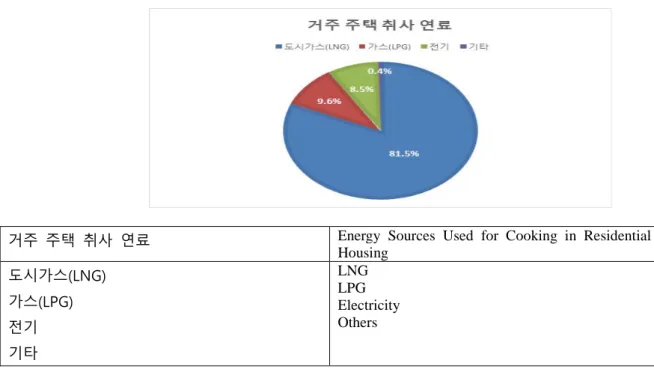
In terms of the type of energy used for cooking in residential housing, LNG was the most popular (81.5 percent), followed by LPG (9.6 percent) and electricity (8.5 percent). The large number of households using LNG seems to have been the result of the expansion of the city gas distribution network with the increased supply of apartment complexes.
Figure 4-2. Proportions of Energy Sources Used for Cooking in Residential Housing (%)