Chapter 1. Introduction
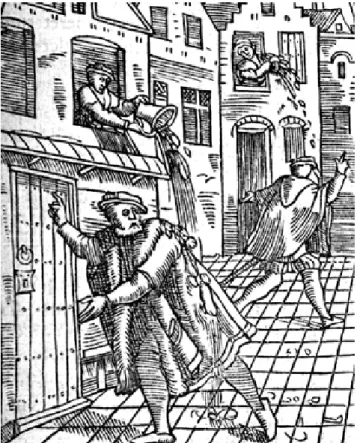
Flush toilet and excreta
In the USA, it is said that about 3% of all local energy demand is needed for wastewater treatment and conveyance [8]. The particular study reported that the use of pharmaceutical products for various purposes increased their concentration in the influent and flow of wastewater treatment plants [9].
Environmental engineering and Convergence of Science and Arts
Several such convergence studies have been carried out, but the methodology of the present study differs from this, with the originality of the present study being the convergence between the sciences and the arts. In considering two factors, namely reason from science and intuition from the arts, the current methodology can offer an alternative solution.
A suggested approach to environmental engineering
- Environment, Cognition, Environmental engineering
- Perception, Essence and Qualitative research
- Alternative environmental engineering with convergence of science and arts
According to this approach, by the word "interaction" the relationship between people and their environment is important for the meaning of the environment in the alternative concept of environmental engineering. The definition of the word "essence" comes from Aristotle, namely "what is, must have been". The first goal focuses on the establishment of a new research methodology, that is, on the convergence of the methodology of science and art.
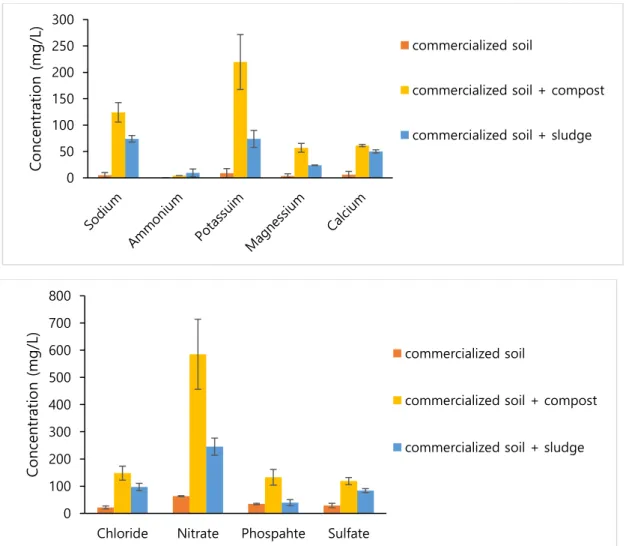
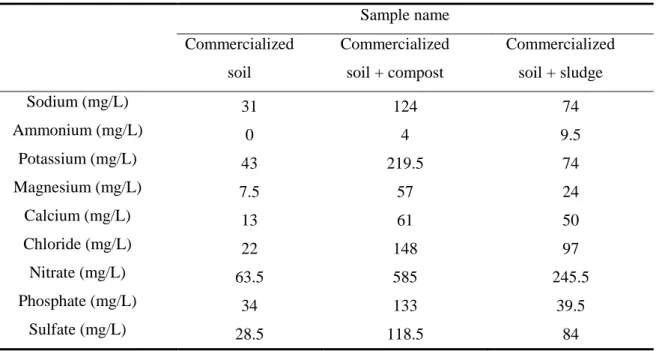
As shown in Figure 5.2 (a, b), the soil mixed with compost showed the highest concentration of ions of the detected species. Interviewee no. 2 said: “Correct and detailed information about mud is important, but it cannot influence the change of negative perceptions about mud. He understood the limitation of the toilet to flushing, ie. the current water shortage problems could not be solved while the flush toilet system was in use.
Rose, C., et al., The characterization of stool and urine: a review of the literature to inform advanced treatment technology.
Chapter 2. Background and related research
Brief history of Environmental engineering
Science and Arts
- Brief history of Science and Arts
- Study methodology of Science and Arts
- Convergence studies
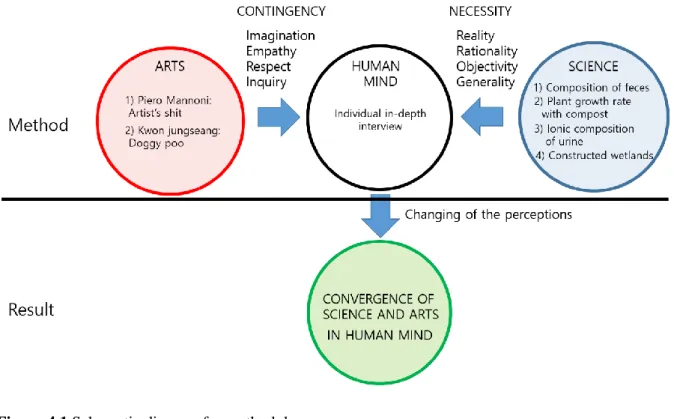
Instead, art employs contingency, which is the major difference in the methodology of art and science (contingency versus necessity). Based on these characteristics of science and art, a flow chart is proposed to explain the different methods in science and art (Figure 2.3).
Composition of feces
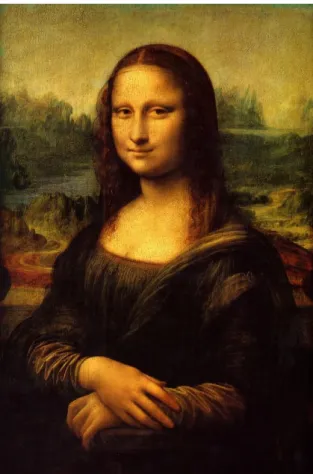
Ahn's method was to first show anamorphic works of art to the students and explain the principle. One survey respondent in the study said the method was interesting because "I can immediately apply what I learned in class."
Natural Organic matter study in Environmental engineering
- NOM fractionation and Preparative HPLC
- NOM molecular structure with Pyrolysis GC/MS system
When they listened to the explanation of the artworks, they were not interested in the artworks. Ferguson, K., The Music of Pythagoras: How an Ancient Brotherhood Cracked the Code of the Universe and Illuminated the Path from Antiquity to Oute.
![Figure 2.5 Proposed molecular structure of humic acid, adapted from Duan and Gregory [54]](https://thumb-ap.123doks.com/thumbv2/123dokinfo/10528928.0/30.892.275.622.367.602/figure-proposed-molecular-structure-humic-adapted-duan-gregory.webp)
Chapter 3. Objectives, hypotheses and research structure
Research problem statement
In order to reduce such wastage of water resources and to prevent water pollution, efficient systems for treating waste water and flushing toilets have been developed. Therefore, the negative perception that faeces should be removed from our society as soon as possible should be changed to a positive perception that faeces are valuable to our society.
Objectives and scope
Hypotheses
Research structure
In the current study, the opinions of the artists may be unusual and may vary depending on the artists selected. Because excrement was in the human body before it was excreted, it is part of the body.
Chapter 4. Methodology
Overview of the methodology
The principle of the measurement is to calculate the difference between the total amount of carbon (TC) and the amount of inorganic carbon (IC) in the sample. A comparison of the ion concentration results in the current study and the reported results [68] is shown in Table 5.5. These results indicate that in each case, a transformation of molecular features had occurred in the constructed wetland.
Compared to the effluent, some parts (I4, I5 and I6) of the organic matter in the effluent were interpreted as removal of the constructed wetland. As can be seen from the interviewees' response to the importance of feces, the interviewees had a lot of information about feces.
Scientific analytical research of feces with experiments
Limitations of the methodology
Biographical research of the artists who made their artworks with excreta
Since experiences from the past are always connected to the present life, the results of the research enable the development of the present topic. In the case of the middle sample, the three peaks showed high proportions of PS and amino sugar. A biographical survey relevant to artists who have used excrement in their artwork was conducted to attempt to change the negative perception of the waterless toilet through the present study.
Discussion about the works of art and the purpose of the artists - Questions about the meaning of existence and dirt.
Introduction
Study methodology
- Sample preparation
- Preparative HPLC
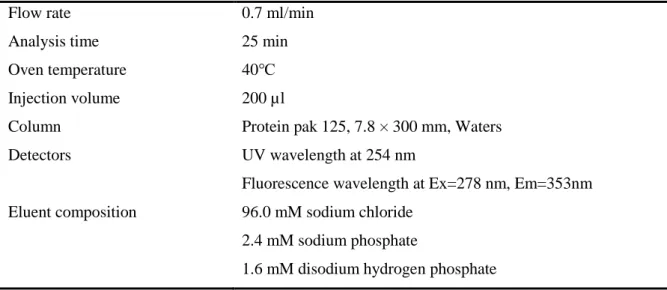
- High-performance size exclusion chromatography (HPSEC)
- Pyrolysis GC/MS system
- Dissolved organic carbon concentration analysis
- Ion chromatography
Results
- Compost characterization in terms of humification degree
- Plant growth with nutrient composition from the mixed soil with compost and
- Ion composition change of storage urine
- Wastewater treatment results of influent and effluent of the constructed
In the present study, the ionic compositions of fresh urine and stored urine (retention time of 62 days) were analyzed. This result can be attributed to the lack of activity of the urea-active bacteria. The different ion concentrations in the stored urine can probably be attributed to the different experimental conditions.
Total nitrogen concentration in stored urine decreased by approximately 10% compared to that of fresh urine (Figure 5.4). However, DOC concentration increased with water flow, which is associated with plants in the constructed wetland.

Summary
The study methodology and the theoretical background for the art could be useful in changing the negative perception of faeces by asking what the meaning of faeces was. From the results of the interview, I thought that the lack of scientific information about feces could be one of the factors that had formed the negative perceptions. They believed that science and technology could change the negative perceptions dramatically if the problems of bad odor and sanitation of the waterless toilet could be solved.

Chapter 6. Biographical research of the artists who create their artworks with excreta 57
Artists profiles and Characteristics of artworks
- Piero Manzoni (1933~1963)
- Kwon Chong-saeng (1937~2007)
In 1955 he started using alternative materials in his artwork, such as tar, scissors, pincers or buttons. The term ''achrome'' means the absence of color, or ''colorlessness''. He wanted to express an empty space without any colors or lines because he thought these signs could imply unexpected meaning to the viewers. He was influenced by the self-sacrifice of his mother and expressed his opinions about a worthwhile life in his literary work.
![Figure 6.2 Artworks of Piero Manzoni (a) Pins 1597, Oil, tar on canvas (98 x 130 cm) captured from Piero Manoni Archive [82] (b) Achrome 1958 captured from TATE [83] (c) Achrome 1961-1962, Bread rolls, kaolin on canvas (31 x 31 cm) capture](https://thumb-ap.123doks.com/thumbv2/123dokinfo/10528928.0/73.892.124.777.114.713/figure-artworks-manzoni-captured-archive-achrome-captured-achrome.webp)
Data analysis
However, two artists emphasized that feces were critical objects related to the essence of humanity.
Summary
His opinion is that the smell of the faeces is a sign that can indicate danger, so changing or removing the smell can reduce the negative perceptions about faeces in people. So the public toilets without a flushing system can be a very dangerous place'' 2) ''The correct and detailed information about excrement is important, but it cannot influence the change of the negative perceptions about excrement. The most interesting finding from the interview with the artistic information was the amount of knowledge of the interviewees about excrement.
At the beginning of the interview, the interviewees showed that they had a strong negative perception about feces, and expressed their opinions when the artistic information was provided. They thought that science and technology could help dramatically change negative perceptions if scientific technologies could solve the odor and sanitation problems of the waterless toilet.
Chapter 7. Individual in-depth interview for applying the methodology of the
Introduction
Study methodology
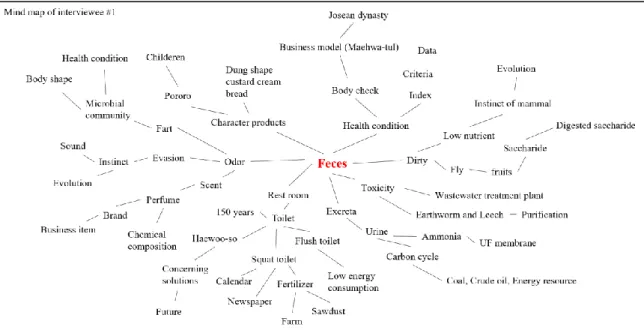
Because the interview will discuss about feces, it required that a person does not feel a strong repulsion towards feces. However, this research focuses on changing the perception of stool during the interview; therefore, the risks or adverse effects to the interviewee were minimal. Then each sentence in the interview was typed in here, and keywords were categorized and analyzed after the interview.
Contents of interview
- Mind map results
- Meaning of feces
- Scientific data about feces
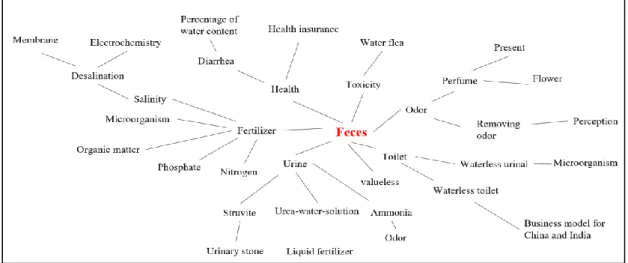
- Redrawing mind map
However, he insisted that the negative perceptions of excrement could be changed through technical improvements. Therefore, he believes that changing the negative perceptions of excrement will not be possible with only improved technology. The conclusion was that the interviewees did not have specific information about the scientific characteristics of feces.
Findings
- Influence of interview with artistic information
- Influence of interview with scientific information
- Changing or unchanging perceptions of feces
Respondents did not know scientific information about feces; moreover, there is little academic knowledge on the subject. This is not to say that the negative notions about excrement are wrong, as these notions have been confirmed by human history. We found two findings, namely 1) a reduction in the branches of the mental map, 2) a change in individual perceptions on the stool.
Summary
There were three perceptions, namely 1) the flush toilet is a technology of the past, 2) the waterless toilet is a promising system for the future, and 3) education is needed to provide information about defecation. By using the research method, the convergence of science and art methodologies could help provide the opportunity to consider the essence of scientific technology. The original aspect of the waterless toilet is the treatment of the feces, as the feces are moved by hand.
Chapter 8. Summary and Conclusions
Summary
Therefore, the convergence of science and art methodologies is applied in the present study, as both human and scientific factors are considered in the study of the problem. The convergence of science and the arts attempts to converge these components in the human mind with the qualitative research method. Finally, human perceptions were studied to determine the changing points when interviewees received scientific and artistic information about feces, since the human mind is the ultimate point of convergence in the convergence of science and art methodologies.
Conclusions
On the other hand, they get the images that come from using technology. Thus, FSM makes sense from the point of view of the economy and the mind of the human being.” Michael, I., et al., Urban wastewater treatment plants as hotspots for the release of antibiotics to the environment: A review.
Chapter 9. Contribution of Convergence Works to the Society
Feces Standard Money (FSM)
We can receive a certain amount of FSM in exchange for the powdered feces and use the FSM to achieve an equivalent value in a system. Every time we produce and use FSM, it will remind us of our being and existence from the bottom line between FSM and man. Its perspective on economics and man is to realize human happiness, as mentioned in the preface to this chapter.
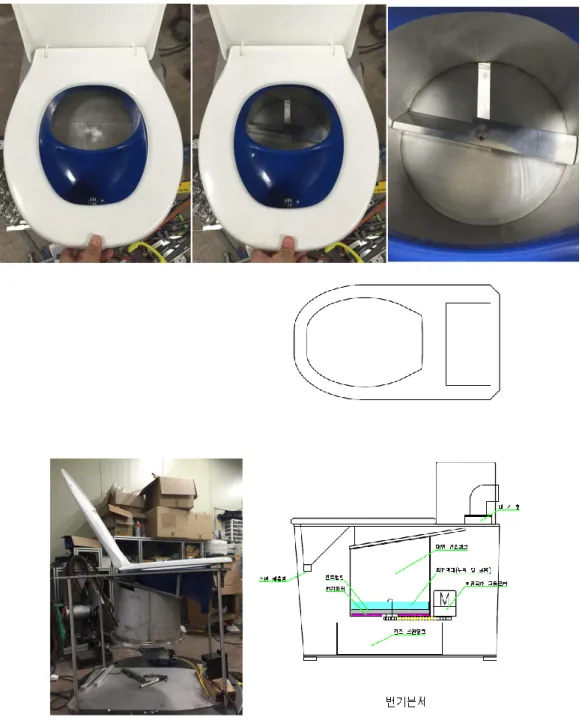
Waterless drying toilet
Arshanitsa, A., et al., Fractionation of engineering lignins as a tool for improving their antioxidant properties. Wershaw, R., et al., NMR characterization of humic acid fractions from various Philippine soils and sediments. Tavakkoli, E., et al., Additive effects of Na+ and Cl- ions on barley growth under salinity stress.


![Figure 2.6 Molecular structures of several pyrolysis products. Adapted from Greenwood et al [58]](https://thumb-ap.123doks.com/thumbv2/123dokinfo/10528928.0/31.892.123.775.204.693/figure-molecular-structures-pyrolysis-products-adapted-greenwood-et.webp)